






Abstract
This study examined consumers’ motivations for participating in market research online communities (MROCs) and an integrative role of community identification in explaining its motivational antecedents and consequences. Online survey data (n = 1,461) were collected from various company-sponsored MROCs, which were run by a leading online community service provider in the United States. The findings showed that several motivations underlying MROC participation had an influence on members’ sense of identification with MROCs. Furthermore, members’ identification with MROCs was found to contribute to enhancing their feeling heard by the sponsoring company, which in turn affected their intention to continually participate in communities and trust in the sponsoring company’s brand. Theoretical and managerial implications were discussed in relation to the value that listening to consumers has for market research.
Keywords
Introduction
In a culture that highly values “listening to” consumers, online research communities have been actively employed as an alternative to traditional online research techniques (Rappaport, 2010; Wiesenfeld, Busy, & Sikdar, 2010). As a platform for participative and conversational research, marketers appreciate the efficacy of company-sponsored market research online communities (MROCs), which are closed to invited members for brand interaction in response to topics prompted by the researchers or marketers (Comley, 2008; Heinze, Ferneley, & Child, 2013; Schillewaert, De Ruyck, & Verhaeghe, 2009). Embracing consumers’ voices in MROCs provides companies with ways to capture consumer insights, evaluate new products, as well as improve product quality. Participation of MROCs allows consumers to share opinions about the brand, become connected with other consumers, gain new product information, and exchange advice with others in their community (Baldus, Voorhees, & Calantone, 2015; Füller, Mühlbacher, Matzler, & Jawecki, 2009; Rappaport, 2010).
As relationships with consumers fostered within online communities become more valuable, marketers are actively investing their resources in setting up and maintaining MROCs (Troch & De Ruyck, 2012). A key issue for marketers is to determine how to promote consumers’ participation and conversation in MROCs (Moran & Gossieaux, 2010). Toward this end, it is critical for marketers to understand the motivations driving consumers to participate in MROCs and the effects of those motivations on consumers’ attitudes toward the MROCs and the brand (Baldus et al., 2015; Heinze et al., 2013). Thus, this study attempts to investigate the following research questions: (1) What motivates consumers to join MROCs sponsored by companies? (2) How are consumers’ motivations related to their identification with the MROC? (3) How does consumers’ identification with the MROC influence the feeling that their input is heard by companies? (4) How does consumers’ feelings of being heard by companies lead to positive outcomes such as intention to continuously participate in MROCs and brand trust? These research questions will be empirically tested with online survey data from a sample of various company-sponsored MROCs, which are organized and run by a professional community-based research firm in the United States.
As a theoretical framework, this study applies the functional approach of attitudes (Katz, 1960) and social identity theory (Tajfel, 1978) to understand why consumers participate in MROCs and evaluate the outcomes that follow. The functional approach asserts that individuals’ attitude can serve diverse psychological and social motivations, which play a pivotal role in understanding attitude formulation and change. This approach posits that even the same attitude can be explained by different motivational functions for different individuals (Lavine & Snyder, 1996; Mowen & Sujan, 2005; Snyder, Clary, & Stukas, 2000). Drawing insights from this perspective, this study identifies a variety of motivations served by consumers’ participation in MROCs and examines which motivations for becoming involved in MROCs are related to consumers’ perception of identification with MROCs and its consequences. In addition, using the lens of social identity theory (Tajfel, 1978), this study examines an integrative role of community identification in explaining the motivational antecedents and consequences of identification with the MROC (Dholakia & Bagozzi, 2004; Dholakia, Bagozzi, & Pearo, 2004). In line with the functional approach of attitudes, this study argues for members’ identification with the MROC to be an important predictor of their motivations to participate in the MROC and assesses how members’ identification affects their feelings of being heard by companies, which in turn influences subsequent responses such as their intention of continuous participation as well as their perception of brand trust.
This approach is beneficial because it provides a theoretical linkage between motivational functions of community participation, community identification, and consequent attitudes and behavioral intentions. By understanding the relationship between motivational functions and an array of positive outcomes such as community identification and feelings heard, researchers or companies can develop customized appeals to recruit new community members. This finding also suggests managerial takeaways about how to manage and retain community members (Baldus et al., 2015; Brüggen, Wetzels, de Ruyter, & Schillewaert, 2011; Heinze et al., 2013; Vocino, Polonsky, & Dolnicar, 2015).
Literature review
MROCs
MROCs are sponsored by companies or research firms to harness the power of listening to consumers (Rappaport, 2010). MROCs are primarily built around a group of target consumers who are customized according to the company’s business objectives. Members are asked to sign up in order to join the password-protected communities (Austin, 2009; Heinze et al., 2013). In these invitation-only, privately branded communities, MROC members share their opinions with other members, the community manager, and brand representatives, creating the social context within the group (Rappaport, 2010). Community members are encouraged to discuss topics relevant to the other members and the company over a period of time.
MROCs are often “closed” to invited members only because brand interaction occurs in response to topics prompted by the researcher (Comley, 2008; Heinze et al., 2013). Community members feel valued when they give and receive information as part of their participation in the community and, more importantly, when their feedback serves as a springboard for the company’s decision-making processes (Comley, 2008). Given the value of reciprocal conversations within MROCs, it is essential for marketers to figure out how to attract members to MROCs and enhance their patronage of one (Heinze et al., 2013). This challenge can be met by examining why consumers choose to join MROCs. A deeper understanding of different motivations for participating in MROCs would provide marketers with useful information for the development of strategies to build and maintain successful MROCs.
It should be noted that MROCs are similar to online panels in that they consist of a pool of registered people who have consented to participate in research on a regular basis (Brüggen et al., 2011; Göritz, 2004, 2008; Heinze et al., 2013). Both are voluntary opt-in commercial online communities initiated by companies seeking opinions on a certain topic and operated by a set of guidelines and policies (Daugherty, Lee, Gangadharbatla, Kim, & Outhavong, 2005; Vocino et al., 2015). With regard to member-to-member interactions, MROCs actively foster social dynamics between participants (and researchers) about topics, and, to some extent, a number of online panels also create community areas and offer forums to their participants to interact with each other (Comley, 2008; Schillewaert et al., 2009). Although there are some differences between MROCs and online panels (e.g., community size, community moderation, client involvement) (Comley, 2008), the aforementioned similarities imply overlaps between motivations to join MROCs and online panels. Thus, an array of motivational factors to take part in online panels is also examined as a guidepost for this study.
Functional motivations for MROC participation
This study takes the functional approach of attitudes to account for the reasons consumers participate in MROCs. The functional approach postulates that attitudes toward the object serve a variety of psychological and social motivations depending on the purpose and that people hold a similar attitude in the service of different motivations (Clary et al., 1998; Katz, 1960). Furthermore, motivations being served by the targeted attitude are expected to influence subsequent cognitive thoughts and behaviors (Eagly & Chaiken, 1993; Mowen & Sujan, 2005; Snyder et al., 2000). This approach is highly applicable in the MROC context. Consumers’ willingness to participate in MROCs is explained with various motivational functions served by their attitude toward community participation. These motivational functions subsequently impact consumers’ thoughts, feelings, and behaviors toward their participation in MROCs, which accentuates the practicality of the functional approach. This functional approach to motivations has been applied to online panelists in the online volunteering context (Daugherty et al., 2005; Vocino & Polonsky, 2011; Vocino et al., 2015). Although the labels of functional motivations vary, several functions are common to both MROCs and online panels.
Researchers have discussed a core set of functional motivations: knowledge, utilitarian, value-expressive, and ego-defensive (Clary et al., 1998; Katz, 1960; LeBoeuf & Simmons, 2010; Manuel, Youn, & Yoon, 2014). Within MROCs, a knowledge function explains members’ motivations to learn new information about brands. In the service of utilitarian function, individuals join MROCs to obtain personal interests or maximize rewards, such as making best buying decisions, fulfilling their desire to share opinions, or receiving financial incentives. Individuals can participate in MROCs to express their central values and self-concepts by posting their opinions on topics, which represents a value expressive function. In terms of the ego-defensive function, individuals join MROCs to feel secure and supported by sharing their opinions with like-minded members or receiving confirmation that they have made the right decision in a product choice (e.g., Baldus et al., 2015; Brodie, Ilic, Juric, & Hollebeek, 2013; Heinze et al., 2013; Rolland & Parmentier, 2013).
Additional motivational functions have been identified by researchers. Daugherty et al. (2005) added a social function of attitude to explain why individuals become members of online panels. Vocino and Polonsky (2011; Vocino et al., 2015) also argued that online panel participation provides members with opportunities to meet people and make new friends. In a similar vein, members join MROCs to interact with other members, company representatives, and the community facilitator. They desire to be a part of the community and stay connected with people of shared interests or passions (Baldus et al., 2015; Moran & Gossieaux, 2010). Another function that community participation serves would be to help the sponsoring company (Baldus et al., 2015; Heinze et al., 2013; Hennig-Thurau, Gwinner, Walsh, & Gremler, 2004). Similar to online panels, MROCs are, indeed, initiated by companies to solve business problems (Comley, 2008). Members see their participation as a way for the company to hear their thoughts and possibly assist the company in producing better products (Brodie et al., 2013; Brüggen et al., 2011; Chu, 2009). Altogether, a set of six motivational functions are employed to examine members’ motivations to join MROCs: knowledge, utilitarian, value-expressive, ego-defensive, social, and helping the company. This study explores how these motivations lead to consumers’ subsequent responses toward community participation.
Motivations and identification with the MROC
Consumers identify themselves with the communities they belong to. Such a sense of belonging to a community is called “community identification,” which refers to the strength of the relationship with the community (Algesheimer, Dholakia, & Hermann, 2005; McAlexander, Schouten, & Koenig, 2002; Muniz & O’Guinn, 2001). Community identification occurs through both cognitive and affective processes (Bhattacharya & Sen, 2003). The cognitive process involves differentiating community members from non-members based on perception of similarities with members and differences with non-members (Algesheimer et al., 2005). Consciousness of this kind of mindset reflects a categorizing aspect of community identification—“a me-versus-them attitude” (McAlexander et al., 2002, p. 42; Muniz & O’Guinn, 2001). From the affective process, consumer identification represents an emotional tie between the member and the community, which is called kinship (Algesheimer et al., 2005; McAlexander et al., 2002). This study expects that six functional motivations underlying MROC participation would have a positive influence on members’ identification with the community.
One theoretical perspective that supports our expectation is social identity theory (Tajfel, 1978; Tajfel & Turner, 1985), which values an individual’s identification with the group and an emotional bond attached to the membership (Bagozzi & Dholakia, 2006). Social identity theory posits that a sense of identification with the community is developed from its functionality to the extent that the community meets members’ needs, motives, and desires (Dholakia & Bagozzi, 2004; Mathwick, 2002). This functional view of the community indicates that members’ motivations for participating in the community are important antecedents to developing community identification (Dholakia & Bagozzi, 2004). Dholakia et al. (2004) empirically found that motivational antecedents (e.g., purposive and entertainment motives) led to stronger identification with the virtual community. Consistent with their finding, this study argues that functional motivations to join MROCs discussed above will be significant predictors of identification with the MROC.
Applying typologies of functional motivations and social identity theory to MROCs (Dholakia & Bagozzi, 2004), we anticipate that community identification increases as members participate in MROCs to express their own inner beliefs (value-expressive) or receive social support from other community members (ego-defensive). Members also feel more attached to the MROC when they gain useful information about brands in an uncertain situation (knowledge) or when they have personal incentives for participating in the MROC (utilitarian). Bonding with other members or feeling part of a community leads to greater attachment to the MROC (social). Additionally, the motivational function of assisting the company in making better products by supplying comments or feedback contributes to members’ identification with the MROC (helping the company). Thus, each of these motivations is expected to have a positive influence on identification with the MROC. This argument is in line with Baldus et al.’s (2015) study discovering that members’ motivations to engage in online brand communities, including MROCs, predicted their intentions to participate in brand communities. Based on our discussion, the following hypothesis is developed:
H1. Members’ motivations for participating in MROCs will have a positive impact on identification with the community.
Community identification and feeling heard by companies
One unique benefit that MROCs offer is to boost members’ beliefs that their opinions are heard by companies (Heinze et al., 2013). “Feeling heard by companies” indicates that community members know companies actively listen to them, respect them, and act upon their voices in the decision-making process (Füller et al., 2009; Heinze et al., 2013; Rappaport, 2010). In this study, community identification is expected to have a positive effect on members’ feeling heard by companies. Existing studies document evidence supporting this argument. Prior studies illustrated that stronger attachment to brand communities led to positive relationships with the company, which reinforced consumers’ perception that the organization values their opinions (Lee, Kim, & Kim, 2011; McAlexander et al., 2002). When members identify with the community and have stronger emotional connections with other members, they contribute more actively to the community by providing opinions to companies and interacting with other community members (Bagozzi & Dholakia, 2006; Dholakia & Bagozzi, 2004; Tsai, Huang, & Chiu, 2012). Through such community participation, members see comments or feedback from the moderator, researchers, and companies, thus experiencing feeling heard by companies or perceived empowerment in the co-creation process (Brodie et al., 2013; Comley, 2008; Füller et al., 2009). This reciprocal feedback loop is important for active members who have a stronger sense of identification with the community (Heinze et al., 2013).
Following social identity theory, studies also imply that members who strongly identify with the community develop a sense of responsibility for the whole community and to other members rather than pursuing self-interests, which in turn motivates them to actively post comments or share opinions (Algesheimer et al., 2005; Qu & Lee, 2011; Woisetschläger, Hartleb, & Blut, 2008). Given that identification represents members’ sense of belonging and positive feelings toward the community, members would not contribute knowledge sharing if their opinions are not recognized by companies (Chu & Chan, 2009; Qu & Lee, 2011). Empirically, members’ community identification was found to give a significant impact on the stages of product development from idea generation to launching (Chu & Chan, 2009). This finding indicates that members’ perception that companies listen to their opinion increases as their identification with the community is stronger. It seems logical that members’ sense of identification with the research community enhances an interactive conversation with companies and other members, which allows members to help companies solve business problems. Thus, a stronger sense of community identification is expected to lead to increasing members’ perception that their opinion matters to companies. This discussion develops the following hypothesis:
H2. The strength of members’ identification with the MROC will have a positive impact on members’ feeling heard by companies.
Feeling heard by companies and intention to continuously participate in MROCs
From a marketing research perspective, it is crucial to turn community members into more active and committed members since the company can benefit from establishing such a long-term relationship with its members (De Wulf, Odekerken-Schrӧder, & Iacobucci, 2001; Heinze et al., 2013). Intention to participate in MROCs in this study refers to members’ intention to continuously participate in community activities and stay committed to MROCs in the future (Algesheimer et al., 2005; Baldus et al., 2015; Shen & Chiou, 2009). This study argues that “feeling heard by companies” is an important predictor of explaining members’ intention to continue participating in MROCs.
Several studies stated that when members believe they influence a company’s product design and decision-making processes through virtual community activities, they are more likely to take active part in similar activities in the future (Comley, 2008; Brodie et al., 2013; Füller et al., 2009; Heinze et al., 2013). Likewise, this study contends that members who know that their opinions have been taken seriously and respected by companies tend to show a stronger intention of continuous participation in the MROC. In other words, members feel valued by knowing that companies reflect their voices in the decision-making process, and this feeling intensifies their commitment to the MROC. Thus, the following hypothesis is developed:
H3. Members’ feeling of being heard by companies will have a positive impact on their intention to continuously participate in the MROC.
Feeling heard by companies and brand trust
Trust between community members and the sponsoring brand has been regarded as the important outcome (or value) that the brand community enhances (Habibi, Laroche, & Richard, 2014; Heinze et al., 2013). Brand trust represents consumers’ willingness to rely on the brand’s ability to perform the function it promises to fulfill (Chaudhuri & Holbrook, 2001). Through an interactive and rich dialogue with the company in the community, members observe that the company cares about their opinions and understands their needs (McAlexander et al., 2002). Studies argued that members who know companies actively listen to them are more likely to have trust in the brands sponsored by those companies (Hajli, Lin, Featherman, & Wang, 2014; Lerman & Austin, 2006; Rappaport, 2010; Wiesenfeld et al., 2010).
As members notice their influence in a company’s decisions, they believe the brand is reliable and sincere because the company reflects their feedback or opinion in improving the quality of their products or in developing new products (Füller et al., 2009). Indeed, community members’ perception of companies’ efforts to care about their opinion and listen to their voice was found to positively influence brand trust (Habibi et al., 2014). Therefore, members’ feeling of being heard by companies will lead to a sense of ownership over the brand examined in the MROC. This discussion develops the following hypothesis:
H4. Members’ feeling heard by companies will have a positive impact on an increase in brand trust.
Methods
Data collection and samples
An online survey was conducted to gather data from members of company-sponsored MROCs. All MROCs used in this study were created and managed by a leading online community service provider in the United States. Participating communities were secure, password-protected and invitation-only environments. To embrace a varied perspective, 13 different consumer packaged-goods brands across industries were studied: five food and beverage, three personal care, two household products, and two toy and game companies. Before data collection was started, all necessary client permissions were obtained to use participating communities.
A total of 1,461 US community members were included for data analysis. Among members, 70.8% were female and the majority of the respondents (77.9%) ranged in age from 25 to 54 years. By ethnicity, 79.6% were Caucasian, 7.7% were Hispanic, 6.9% were African American, and 3.9% were Asian American. For detailed profiles of respondents, see Appendix 1.
Unlike online research panels or other forms of traditional market research, participating MROCs shared several features that make the sample frame for this study unique. For example, this study included 13 MROCs, each with a member composition designed to address the specific business needs of the sponsoring company. Thus, the pool of community members invited to take the survey does not constitute a nationally representative sample. However, it should be noted that community members participating in this study were recruited across 48 states in the United States, indicating the widest possible coverage across the nation. And by design, community members are not required to participate in any given research activity, rather they opt-in to those projects that interest them the most. Again, these highly motivated participants may not represent the wider research community, affecting the results (Brüggen et al., 2011; Vocino et al., 2015). Nonetheless, the research objective of this study is not to generalize findings to entire MROCs, but rather to discover the theoretical relationships among the proposed constructs. This approach allows us to better understand motivations for participating in MROCs and subsequent outcomes that follow.
Measures
The survey instrument consisted of items to measure the following constructs: (1) six functional motivations, (2) community identification, (3) feeling heard by companies, (4) intention to continuously participate in MROCs, (5) brand trust, and (6) demographics. The measures for functional motivations underlying MROC participation were derived from prior studies on the functional approach of attitudes (Brüggen et al., 2011; Clary et al., 1998; Daugherty et al., 2005; Snyder et al., 2000) as well as electronic word of mouth (Hennig-Thurau et al., 2004; Hennig-Thurau & Walsh, 2003–2004). The wording was tailored to consider relevance to research community participation.
Prior to examining research hypotheses, all items used to measure functional motivations were tested whether they produced the factor structure specified with the six motivations. For this, it is necessary to estimate whether items that were supposed to measure each motivation represented each corresponding motivation. To this end, a confirmatory factor analysis (CFA) was run on 15 items using LISREL 8.54 with the correlation matrix as input (Jöreskog & Sörbom, 1993). The Maximum Likelihood estimation method was employed. The results showed that all items converged well on the respective factors with estimates being between .60 and .85 except one item, “to get incentives and/or gifts.” This item did not go well together with the other items measuring the utilitarian function with a low estimate of .11 and was dropped from the final CFA. The CFA with the remaining 14 items showed a good fit of the data to the model (χ2 = 720.83, degrees of freedom [df] = 62, p < .001, Normed Fit Index [NFI] = .977, Non-Normed Fit Index [NNFI] = .969, Comparative Fit Index [CFI] = .979, Root Mean Square Residuals [RMSR] = .044, Root Mean Square Error of Approximation [RMSEA] = .085; Bentler, 1992; Browne & Cudeck, 1993). A total of 14 items were thus used for subsequent analysis and all six motivations showed acceptable Cronbach’s alphas ranging from .62 to .86 (see Table 1).
Functional motivations for online research community participation.
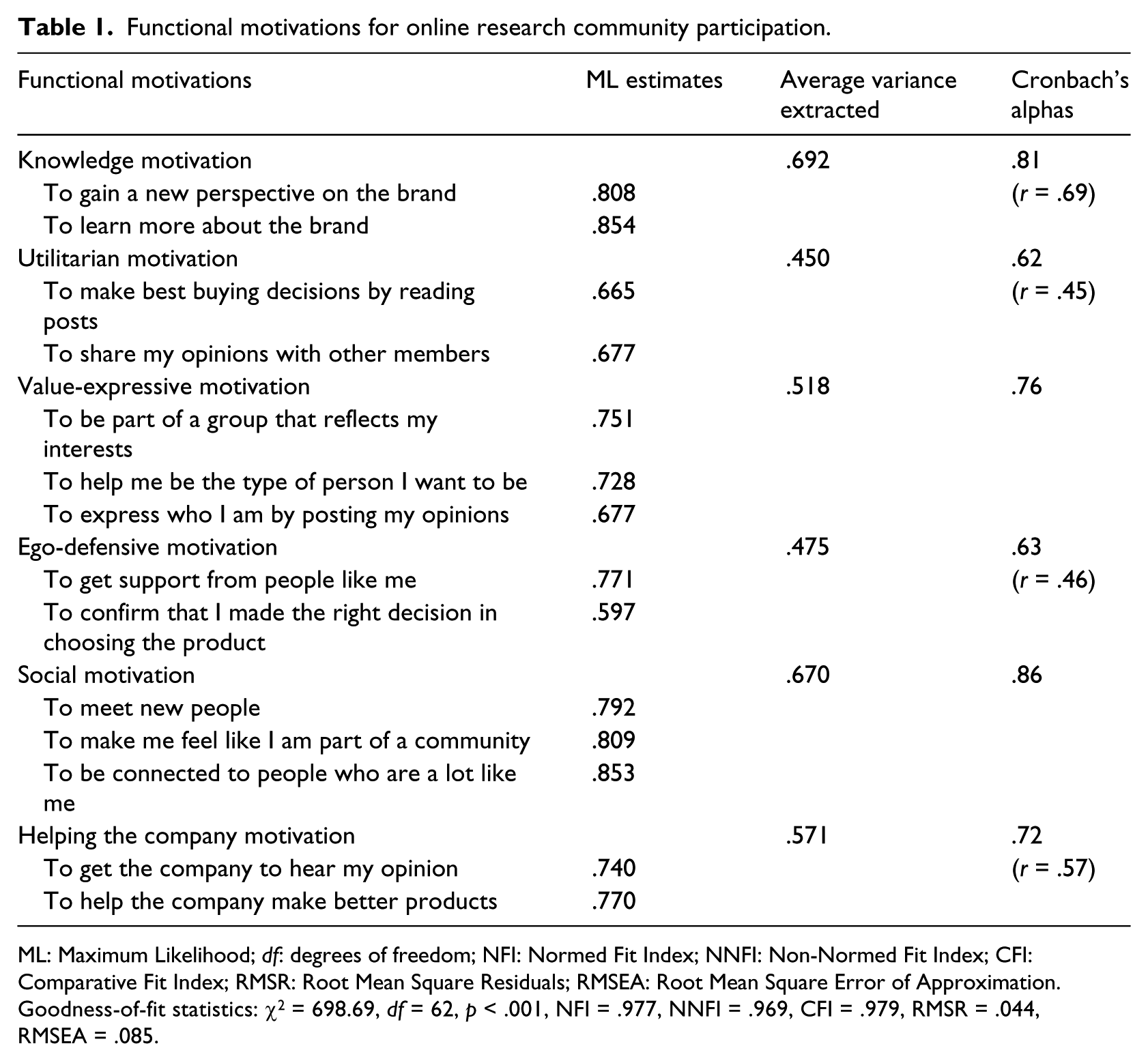
ML: Maximum Likelihood; df: degrees of freedom; NFI: Normed Fit Index; NNFI: Non-Normed Fit Index; CFI: Comparative Fit Index; RMSR: Root Mean Square Residuals; RMSEA: Root Mean Square Error of Approximation.
Goodness-of-fit statistics: χ2 = 698.69, df = 62, p < .001, NFI = .977, NNFI = .969, CFI = .979, RMSR = .044, RMSEA = .085.
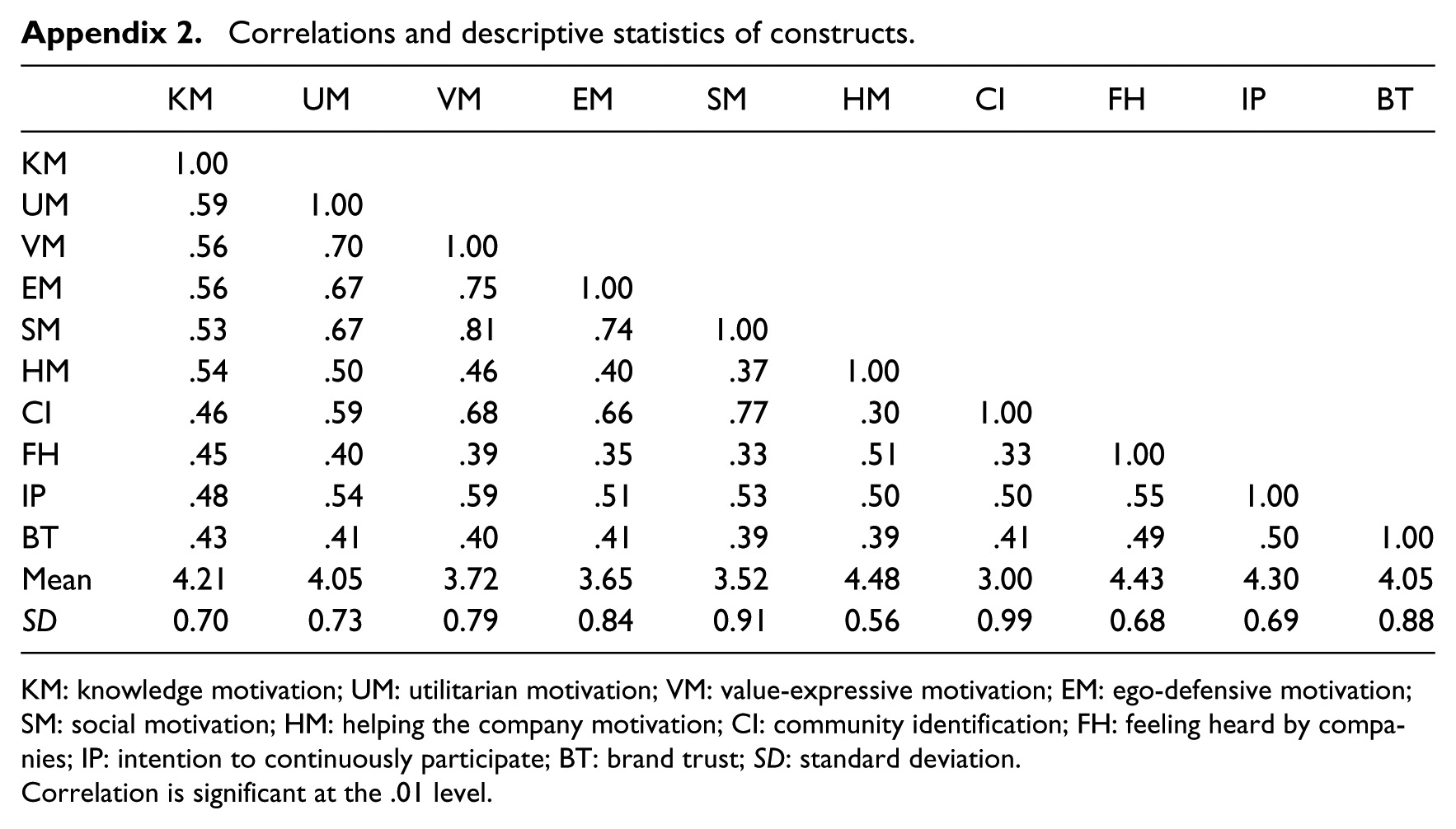
Identification with the community (α = .91, r = .84) as well as intention to continuously participate in MROCs (α = .61, r = .52) were measured with two items that were selected and modified from prior studies on brand community (Algesheimer et al., 2005). Two items for community identification are as follows: “I am very attached to other members in this community” and “The relationships I have with other members mean a lot to me.” Intention to participate in MROCs was rated with two items: “It would be hard for me to quit this community” and “I will continue to participate in this community.” “Feeling heard by companies” was assessed with a single item: “I feel like my opinion is being heard by the sponsoring company” (Lerman & Austin, 2006). Brand trust was also measured with a single item: “I trust the sponsoring brand more than before I joined this community.” All items were rated on a 5-point Likert scale ranging from 1 = strongly disagree to 5 = strongly agree. Multiple items were aggregated and divided by the number of items for further analyses. Correlations and descriptive statistics are presented in Appendix 2.
Data analysis
To test the causal relationships between the constructs, path analysis was performed via LISREL 8.54 (Jöreskog & Sörbom, 1993). The model was assessed with the Maximum Likelihood method of parameter estimation and employed the correlation matrix as the input. The overall fit indices for the model were not acceptable, indicating a poor fit of the model to the data (χ2 = 1001.65, df = 21, p < .001, NFI = .938, NNFI = .869, CFI = .939, RMSR = .200, RMSEA = .179) (see Table 2). RMSEA was not satisfactory because it was higher than the acceptable threshold of .08 (Browne & Cudeck, 1993). Thus, the modification indices were examined to improve the model fit (Anderson & Gerbing, 1988).
Path analysis results for hypothesized causal paths (original model).
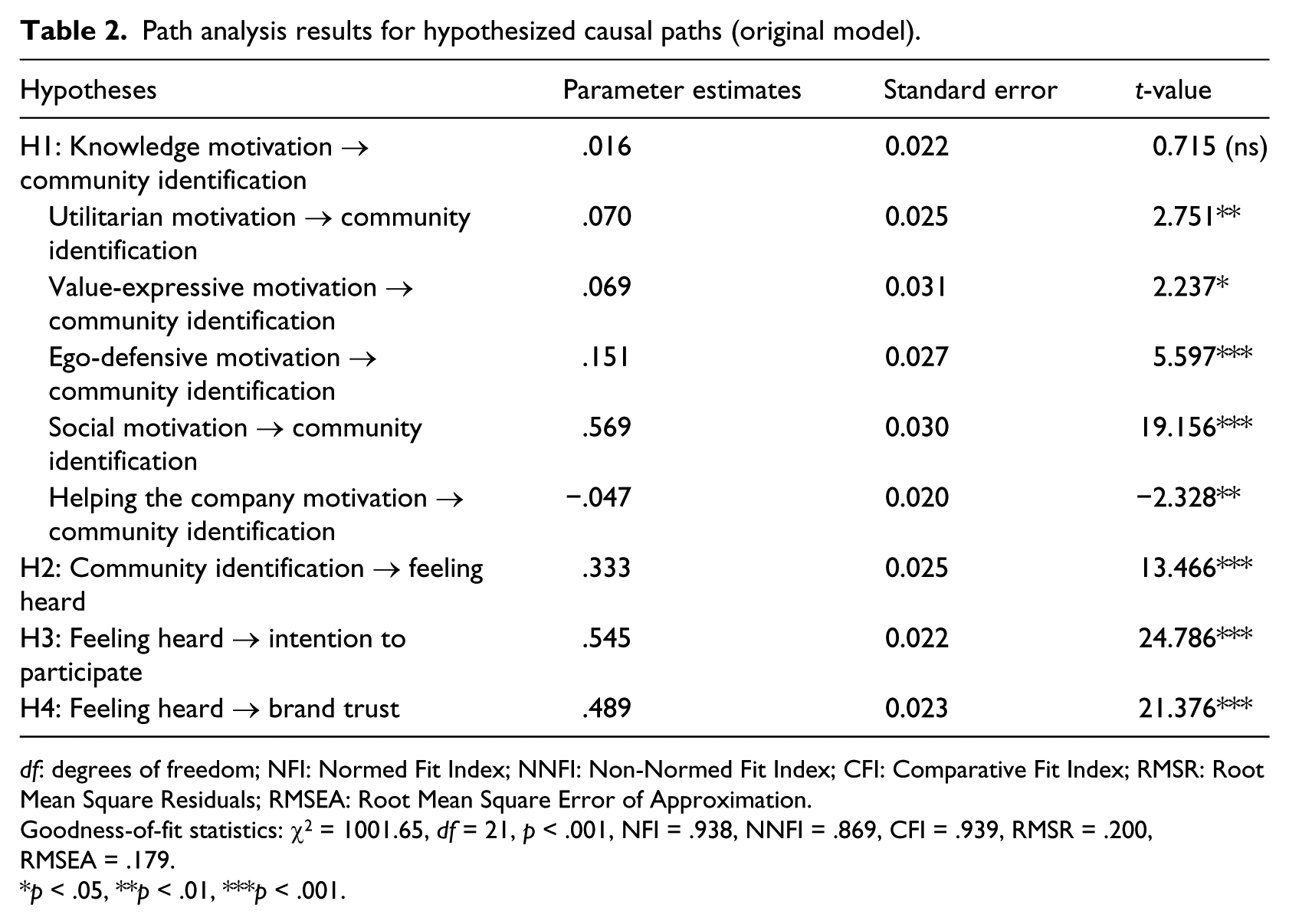
df: degrees of freedom; NFI: Normed Fit Index; NNFI: Non-Normed Fit Index; CFI: Comparative Fit Index; RMSR: Root Mean Square Residuals; RMSEA: Root Mean Square Error of Approximation.
Goodness-of-fit statistics: χ2 = 1001.65, df = 21, p < .001, NFI = .938, NNFI = .869, CFI = .939, RMSR = .200, RMSEA = .179.
p < .05, **p < .01, ***p < .001.
An observation of modification indices suggested that the model fit could be improved by adding (1) three paths from “motivations” to “feeling heard” and “intention to participate,” (2) two paths from “community identification” to “intention to participate” and “brand trust,” along with (3) one path from “brand trust” to “intention to participate.” After the model modification, the goodness-of-fit statistics demonstrated that the modified model provided a better fit (χ2 = 131.14, df = 15, p < .001, NFI = .993, NNFI = .980, CFI = .993, RMSR = .038, RMSEA = .073). Prior literature suggested that those six new paths are justifiable and post hoc explanations will be provided in the “Discussion” section later on. Table 3 reports the parameter estimates of paths in the modified model.
Path analysis results for hypothesized causal paths (modified model).
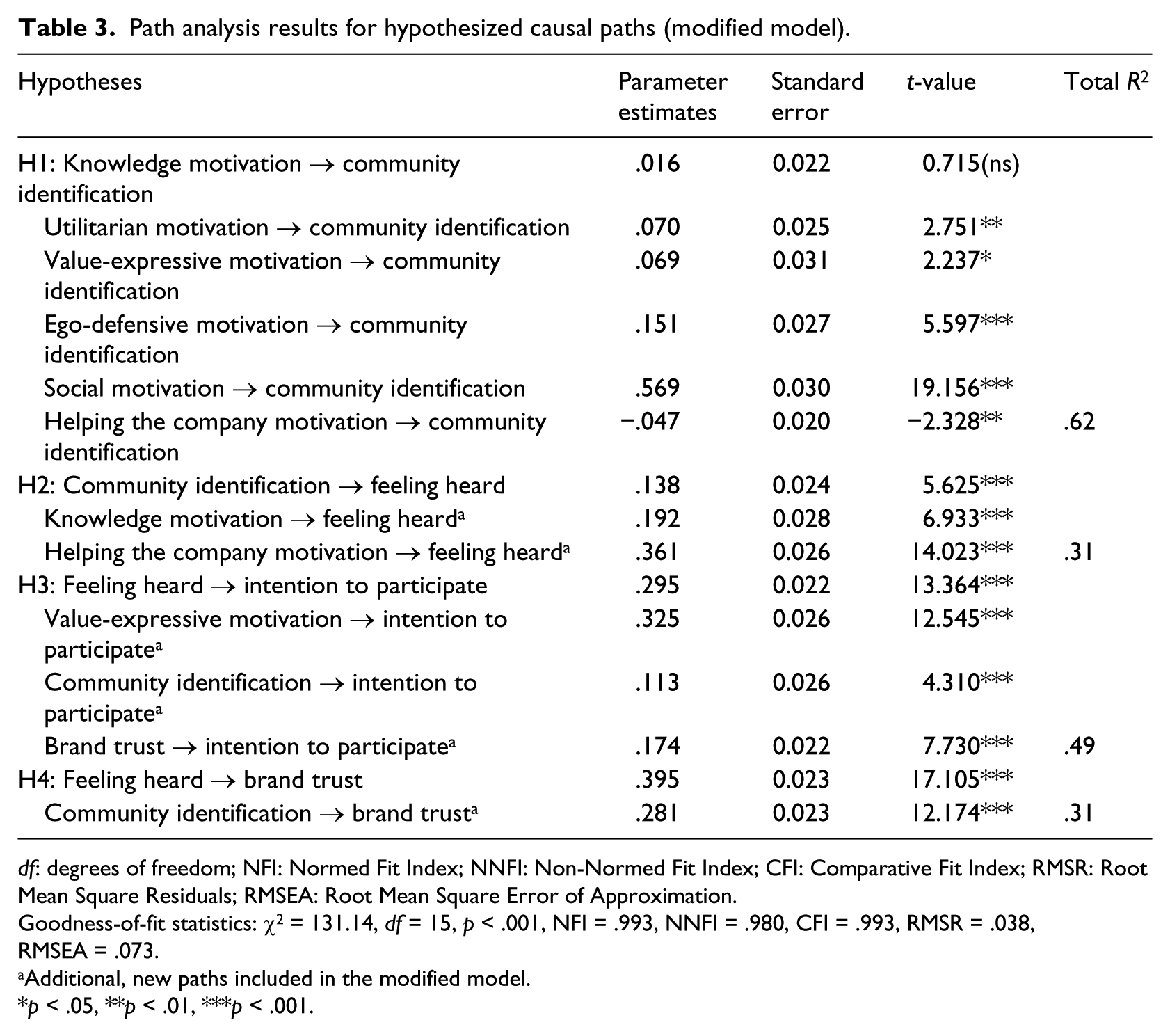
df: degrees of freedom; NFI: Normed Fit Index; NNFI: Non-Normed Fit Index; CFI: Comparative Fit Index; RMSR: Root Mean Square Residuals; RMSEA: Root Mean Square Error of Approximation.
Goodness-of-fit statistics: χ2 = 131.14, df = 15, p < .001, NFI = .993, NNFI = .980, CFI = .993, RMSR = .038, RMSEA = .073.
Additional, new paths included in the modified model.
p < .05, **p < .01, ***p < .001.
Results
H1 testing: motivations and community identification
H1 predicted that members’ motivations for participating in MROCs would have a positive effect on their identification with communities. The expected relationships were supported with social motivation being the most influential predictor: social (γ = .569, p < .001), ego-defensive (γ = .151, p < .001), utilitarian (γ = .070, p < .01), and value-expressive (γ = .069, p < .05) (see Table 3). Knowledge motivation was not found to influence community identification (γ = .016, ns). It is noteworthy that motivation of helping the company had a negative impact on identification with the community (γ = –.047, p < .01). Members may experience decreasing identification only when they participate in the MROC to assist companies in solving their problems or achieving business goals.
H2–H4 testing: consequences of community identification
H2 anticipated that members’ sense of identification with MROCs would have a positive influence on their feeling of being heard by companies. As expected, path analysis showed support for the relationship between these two constructs with β = .138, p < .001. H3 predicted that the more members feel that companies have heard their opinions, the more likely they are to continue to participate in the research community. The results demonstrated strong support for this relationship (β = .295, p < .001). H4 investigated the positive relationship between feeling heard by companies and brand trust. As shown in Table 3, as community members felt that their opinions have been heard by companies, they were more likely to trust the brands sponsored by those companies (β = .395, p < .001). Overall, all causal relationships hypothesized in our study were supported.
In the modified model, six additional paths were included as discussed above. Regarding motivations for participating in MROCs, brand- and company-related motivations such as knowledge (γ = .192, p < .001) and helping the company (γ = .361, p < .001) led to members’ greater perception that their opinions were being heard by the company. Value-expressive motivation led to members’ greater intention to continuously participate in future community activities (γ = .325, p < .001). Community identification was found to give an impact to intention of continuous participation (β = .113, p < .001) and brand trust (β = .281, p < .001). Finally, the path from brand trust to intention of continuous participation appeared to be significantly positive (β = .174, p < .001) (see Table 3).
In the modified model, six motivations accounted for 62% of the total variance in explaining members’ identification with MROCs. Likewise, 31% of the total variance was jointly explained for feeling heard, 49% of the total variance was explained for intention of continuous participation, and 31% of the total variance was explained for brand trust.
Discussion
This study, by drawing insights from the functional approach of attitudes and social identity theory, examined consumers’ motivations to join MROCs and an integrative role of community identification in explaining its motivational antecedents and its consequence. The theoretical framework underlying motivational functions of community participation, community identification, and its outcomes were applied to the MROC context, leading to an in-depth understanding of the initiation and continuation of members’ MROC participation. The findings of this study showed that the motivations for becoming involved in MROCs played a role in enhancing members’ sense of identification with communities. This identification was also found to help community members feel that their voices were heard by the sponsoring company, which in turn increased their likelihood to continuously participate in MROCs and their perception of trust in the sponsoring company’s brand. Overall, these results supported the hypothesized relationships.
Theoretical implications
Understanding members’ motivations for joining MROCs offers a useful insight for explaining subsequent thoughts and behavioral intention in MROCs. Six motivations underlying MROC participation were developed based on the literature review: knowledge, utilitarian, value-expressive, ego-defensive, social, and helping the company. The path analysis showed the predictive utility of motivations for explaining members’ community identification, with social and ego-defensive motivations serving as strong drivers. Given the social nature of community participation, these two motivations turned out to be important to members in attaining important psychological goals such as interacting with and getting social support from a like-minded group of people. To a lesser degree, utilitarian and value-expressive motivations were found to influence members’ sense of identification with their MROC. Instrumental or value-oriented motivations such as making best buying decisions or expressing personal identity led to greater attachment to the MROC. Interestingly, company-serving motivation dealing with companies’ problems or tasks did not contribute to increasing members’ sense of identification with the MROC.
Furthermore, the analysis showed that the strength of members’ identification with the community contributed to enhancing members’ feeling heard by the MROC sponsoring company, which affected their intention to continually participate in the MROC and trust in the sponsoring company’s brand. These findings provide several implications. First, if community members perceive similarities with fellow members or are emotionally attached to the community, they are more likely to feel their opinions have been heard by companies. A robust identification with the community represents a stronger sense of belonging to and a positive feeling toward the community, thus stimulating members to make active contributions to the community. Such activities can foster a sense of partnership with the sponsoring company, which allows members to feel they can make a difference, leading to positive changes for the company and its consumers (Brodie et al., 2013).
Our findings also indicate that “feeling heard by the company” is a key component in the conceptual model for studying the value of MROCs. Given the very nature of listening to consumers inherent in MROCs, it becomes necessary to consider the concept of feeling heard by the company as an outcome of employing MROCs as well as an antecedent of leading to positive business outcomes. Members’ feeling heard was found to be related to their ongoing participation in the MROC and their tendency to trust the brand, indicating the importance of boosting members’ feeling heard by the company.
Post hoc explanations for additional, new paths included in the modified model should be discussed, although they were not hypothesized. First, the three paths from motivations to feeling heard and intention to participate were added. Prior literature suggested that online brand community engagement, which was referred to as “motivations to interact with an online brand community,” explained members’ perceived empowerment or feelings of change (Brodie et al., 2013) and members’ intentions to participate in a brand community (Baldus et al., 2015). Particularly, “knowledge” motivation (e.g., learning about the brand) and “helping the company” motivation (e.g., contributing to the community) were discussed to have a positive effect on members’ feeling of being heard by the company or members’ perceived empowerment (Brodie et al., 2013). Interestingly, “value-expressive” motivation (e.g., self-expression) was found to have a positive impact on members’ willingness to participate in future activities (Baldus et al., 2015). It is highly likely that members will stay as a member if they appreciate social venues through which they can show who they are by acting as members of the community.
Second, members’ identification with MROCs was found to affect their intention of continuous participation and brand trust directly (and indirectly through feeling heard: H2–H4). These direct relationships are in line with the ones of prior studies on brand communities (Dholakia & Bagozzi, 2004; Dholakia et al., 2004; Lee et al., 2011; Shen & Chiou, 2009; Yeh & Choi, 2011). A strong sense of identification within the community generates some favorable member behaviors that benefit both the community and the brand, including community engagement and participation (Algesheimer et al., 2005; Stokburger-Sauer, 2010; Tsai et al., 2012). Finally, the path from brand trust to an intention of future participation was also added. It is reasonable that, if members have a greater level of trust in the brand, they are more likely to show a stronger intention to continuously participate in a community’s future activities (Füller et al., 2009). Taken together, the inclusion of those six new paths resulted in a better model fit with justifiable interpretations.
There are several ways practitioners can act on these findings to improve the MROC experience for their members and maximize return on investment for the company.
Managerial implications
The findings exhibited that market researchers need to address unique motivations underlying MROC participation when they design and manage MROCs. In particular, social and ego-defensive motivations were the most important determinants in explaining members’ community identification. Social motivation highlighted the benefit of psychological similarities such as shared group interests or an inclusive mindset in shaping community cohesion (Brown, Broderick, & Lee, 2007). This feeling of camaraderie echoes the importance of “connected research,” which values social interactions with community members and researchers (Schillewaert et al., 2009). As part of the member recruitment and maintenance strategy, researchers need to emphasize the opportunity to connect with others around a shared interest or common passion.
Members’ sense of identification with MROCs was also strengthened when they received social support from fellow members or gained a feeling of security about their product decisions (the ego-defensive motivation). This finding sheds light on the value of a reinforcement communication program, in which companies assure members that they have made the right choice in consumption activities. Endorsements from other members who have had favorable or unfavorable experiences with the product or service in question can also help bolster members’ relationship with the research community. The analysis indicated that value-expressive motivation came into play in enhancing members’ identification with MROCs. It is important for marketers to engage in everyday-life conversations with community members about their interests and self-expressions in addition to seeking answers to business problems under investigation.
This study also found that utilitarian motivation played a role in increasing members’ identification with the community. Instrumental rewards such as making best buying decisions or opinion-sharing, which emphasize giving and getting practical advice, appeared to lead to greater attachment to the community. Notably, it should be discussed that the extrinsic reward (e.g., monetary incentives or gifts) was not compatible with the reward that gives and gets practical advice (e.g., making best decisions or opinion-sharing) in a CFA. In relation to this finding, we expand our discussion on the two different approaches that examine extrinsic incentives as one of the motivations to join research communities or online panels. Some studies underscored the importance of extrinsic incentives (e.g., money, prize, or financial reward) in participating in communities or online panels, although extrinsic reward seekers revealed the low level of response rates and response quality perception (Baldus et al., 2015; Brüggen et al., 2011; Göritz, 2004). Other studies applied for the volunteer function inventory to gauge online panelists’ motivations and found six motivations—value, understanding, social, career, protective, and enhancement (Vocino & Polonsky, 2011; Vocino et al., 2015). This line of studies did not include the motivation of extrinsic incentives.
In tandem with the first line of studies, our study initially valued the importance of extrinsic incentives as one of the motivations for joining MROCs. Thus, we included one item to measure extrinsic incentives and two items to measure giving and getting practical advice. Unexpectedly, the item measuring extrinsic incentives did not converge well on the other two items that gauge giving and getting practical advice. This finding implies that extrinsic incentives and giving and getting practical advice, as sources of accounting for the utilitarian motivation, may be discernible in the mind of community members. Based on the result of the analysis, we dropped the item measuring extrinsic incentives and did not consider incentives-focused utilitarian rewards any more. This is in line with the findings of prior studies discussed above, which unveiled the weak influence of extrinsic incentives on its subsequent responses (Baldus et al., 2015). Companies should understand that monetary incentives alone may not be enough to trigger personal interests for joining MROCs, although it is important to recognize people’s efforts (and a monetary “thank you” is a perfectly appropriate way to do that).
The analysis uncovered a positive relationship between community identification and feeling heard by companies. This finding suggests a crucial role of researchers and companies in fostering members’ identification with their MROC. Several scholars have argued that the increasing communication and interaction between community members, researchers, and companies can be utilized to build and bolster members’ identification with the MROC (Bhattacharya & Sen, 2003; Dholakia & Bagozzi, 2004).
This study also demonstrated that the efficacy of MROCs depends on the extent to which members feel heard by companies. From the perspective of research firms, a great deal of time, effort, and money go into their attempts to maximize members’ patronage to the community. Research firms strive to mobilize members into becoming more active contributors while also inspiring them to be more loyal to the community. It is important for researchers to understand that membership maintenance can be enhanced through enhancing members’ feeling of being heard (Comley, 2008). From the marketers’ perspective, one benefit stemming from members’ feeling heard is an increase in the tendency to trust the brand promoted by the company. In addition, feeling heard is important because brand trust was subsequently found to heighten members’ intention of continuous participation as a loyal member in the modified model. Thus, members empowered by feeling heard are more likely to actively perform the role of brand recommenders or brand evangelists as well as a loyal member of the MORC.
A key issue, then, is to develop tangible ways to make members feel that companies are really listening to them and taking their input seriously. One way would be for practitioners to use a communication tool to explain how companies react (or do not) to members’ feedback or opinions. It is vital that marketers foster and develop the brand-community member relationship through active listening, which in the world of MROCs means publicly posting what the company did with members’ feedback. The old adage, “no news is good news,” does not work in the context of MROCs. Even if the feedback to members is, “We heard you, but can’t act on your great suggestions just yet,” that simple act is often enough to foster a reciprocal brand–consumer relationship (and is a far superior choice than silence) (Heinze et al., 2013).
Market researchers and community managers can also use the research process, itself, as a means for creating an iterative feedback loop between community members and the company. By fielding revised concepts, new product ideas, and messages that reflect community members’ feedback, researchers show by example how members’ contributions are being used. There is no better impetus for continuing to participate in MROCs (and no better proof that the sponsoring company is truly listening) than members seeing the results of their feedback making a difference in real life: in stores, on television, and in the homes of their friends and families.
Study limitations and future research
Several limitations of this study are worth noting. As mentioned, findings from this study may not hold well for other online communities because of the sample used. Community members voluntarily opt-in to MROCs that interest them, so they may be more motivated than the ordinary consumers to engage with a brand. This potential sampling bias limits the generalization of the results across other online communities (e.g., Facebook brand page) or even other MROCs. In addition, the higher proportion of women and Caucasians in the sample is a result of the fact that MROCs used in this study cover 13 consumer packaged-goods brands. These MROCs tend to be targeted to women with buying power who are largely Caucasian. Thus, the findings should be interpreted with care. Yet it should be recalled that the objective of this study is to explore the relationships among the theoretical constructs, instead of generalizing findings to other communities. Future research is needed to replicate the findings of this study within a context of different online communities.
For some constructs, one or two items were used to reduce community members’ fatigue, minimize response errors, and increase response rate. Given that multiple items account for more variance and increase an internal consistency reliability estimate (Clark & Watson, 1995), future work should use multiple items for each construct. Despite the use of a small number of items, it is encouraging to see that the path model explained a large amount of the variance of dependent measures, ranging from 31% to 62%.
It should be noted that constructs measuring several motivations for joining MROCs are problematic due to insufficient discriminant validity (Farrell, 2010). As shown in Table 1, the average variance extracted (AVE) estimates for utilitarian and ego-defensive motivations were less than .5, which is not considered as adequate (Bagozzi & Yi, 1988). Furthermore, the AVE versus shared variance test (i.e., square of the correlation) (Fornell & Larcker, 1981) suggested the items that are supposed to measure utilitarian, ego-defensive, and value expressive motivations may not be good measures of those motivations. Thus, caution should be made when interpreting the findings.
Last but not least, we need to take into account the issue of simultaneous causality before drawing causal inferences from path analysis due in part to the correlational nature of survey data (Bascle, 2008; Duncan, Magnuson, & Ludwig, 2004; Gennetian, Magnuson, & Morris, 2008). For example, there is the possibility that members’ sense of community identification may influence their feelings of being heard by the company, but members’ feeling heard by the company may also generate their sense of community identification. Although our conceptual model tests the former relationship, the reverse causation of the relationships should be taken into consideration with caution.
Conclusion
In conclusion, MROCs are a valuable venue for creating a continuous feedback loop between members and the sponsoring company because they often represent a long term, ongoing commitment for members and brands (Heinze et al., 2013). In support of this argument, the study’s findings take a step toward advancing our knowledge of the efficacy of research community participation, as well as offering valuable insights for understanding motivations and subsequent responses of participating in online research communities.
Footnotes
Appendix
Correlations and descriptive statistics of constructs.
| KM | UM | VM | EM | SM | HM | CI | FH | IP | BT | |
|---|---|---|---|---|---|---|---|---|---|---|
| KM | 1.00 | |||||||||
| UM | .59 | 1.00 | ||||||||
| VM | .56 | .70 | 1.00 | |||||||
| EM | .56 | .67 | .75 | 1.00 | ||||||
| SM | .53 | .67 | .81 | .74 | 1.00 | |||||
| HM | .54 | .50 | .46 | .40 | .37 | 1.00 | ||||
| CI | .46 | .59 | .68 | .66 | .77 | .30 | 1.00 | |||
| FH | .45 | .40 | .39 | .35 | .33 | .51 | .33 | 1.00 | ||
| IP | .48 | .54 | .59 | .51 | .53 | .50 | .50 | .55 | 1.00 | |
| BT | .43 | .41 | .40 | .41 | .39 | .39 | .41 | .49 | .50 | 1.00 |
| Mean | 4.21 | 4.05 | 3.72 | 3.65 | 3.52 | 4.48 | 3.00 | 4.43 | 4.30 | 4.05 |
| SD | 0.70 | 0.73 | 0.79 | 0.84 | 0.91 | 0.56 | 0.99 | 0.68 | 0.69 | 0.88 |
KM: knowledge motivation; UM: utilitarian motivation; VM: value-expressive motivation; EM: ego-defensive motivation; SM: social motivation; HM: helping the company motivation; CI: community identification; FH: feeling heard by companies; IP: intention to continuously participate; BT: brand trust; SD: standard deviation.
Correlation is significant at the .01 level.
Funding
The author(s) received no financial support for the research, authorship, and/or publication of this article.