






Abstract
Dementia is exhibited by both emotional and physical states such as agitation. Chemical restraints, often used for agitated behaviors, are not always effective and produce untoward effects. Baby doll therapy is a nonpharmacologic therapy that can affect agitated behavior in dementia patients, yet a protocol for the therapy did not exist. An implementation protocol for doll therapy for those with dementia was developed and implemented with 16 residents in a dementia care center. Outcomes were measurements of the impact of the dolls on six areas of the resident’s behavior and their reactions to the doll. Participants had an increase in level of happiness, activity/liveliness, interaction with staff and others, and ease of giving care. There was also a reduction in the level of anxiety. The increase in happiness was a statistically significant outcome. Baby doll therapy is an effective nonpharmacological approach for improving the well-being of patients with moderate to severe dementia.
Keywords
Background
Individuals with dementia may present with agitation and other unsafe behaviors. Historically, the use of devices and techniques that restricted and restrained the movement of dementia patients were common treatment approaches. Over time, the use of restraints has increasingly been viewed both as undesirable and abusive. As a result, chemical restraints to control agitated and other unsafe behavior are now being used for treatment. According to Blowcott (2009), use of chemical restraints, usually in the form of antipsychotic medications, to control behavior is not always successful and increases the possibility of adverse side effects, including death, and furthers digression of cognitive faculties. Currently, the U.S. federal and state agencies have set a goal of reducing use of antipsychotic drugs in nursing home residents (Health Care Council of Illinois, 2012).
The purpose of this project was to evaluate the implementation of the non-invasive evidence-based intervention of baby doll therapy on the occurrence of agitated behaviors of individuals with dementia.
Methods
Project protocol summary for baby doll therapy in dementia residents.
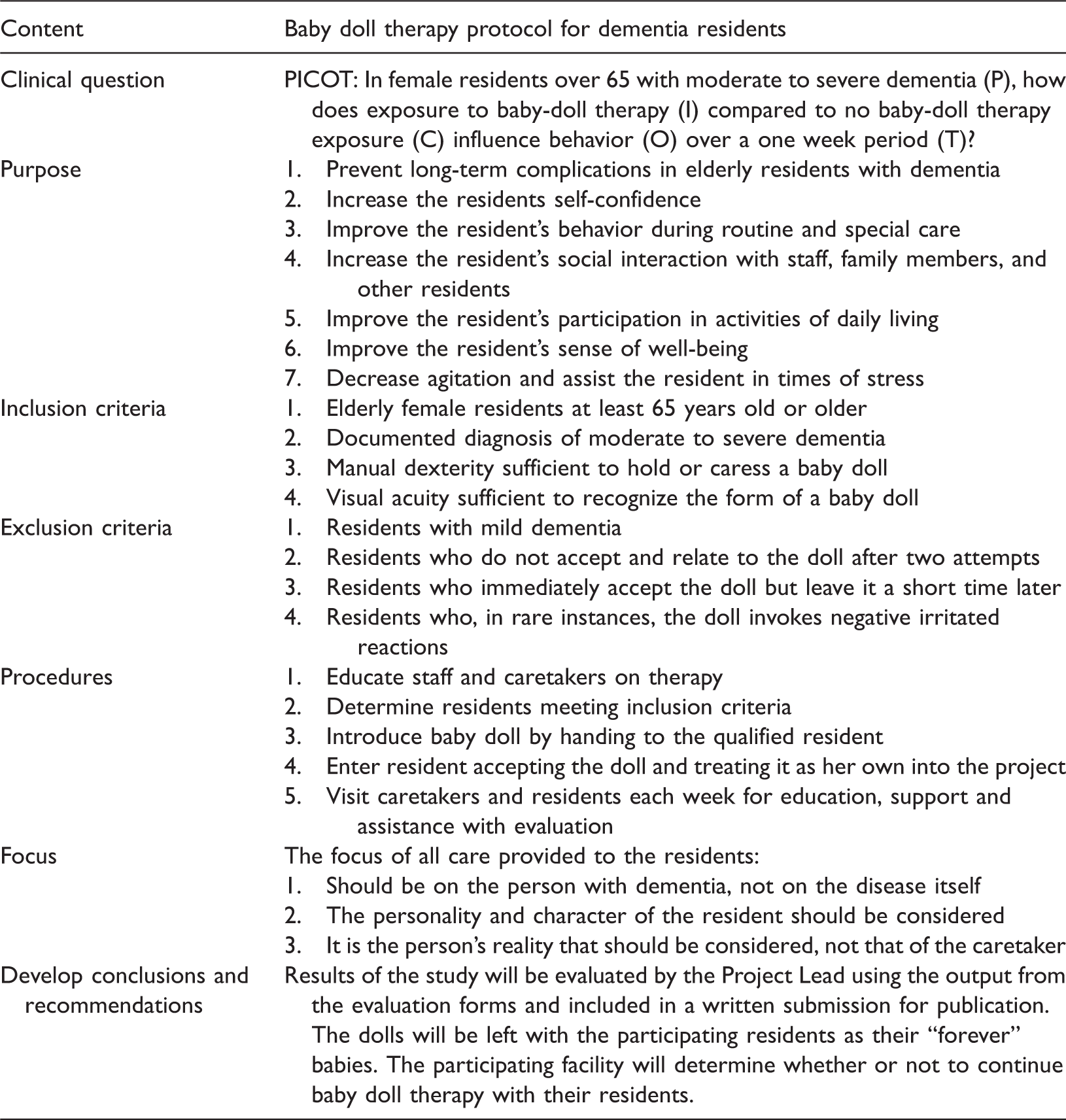
A change in behavior of the participants following the implementation of doll therapy was the primary outcome of the project. The evaluation tool used to measure participant behavior was an adaptation of the instrument (used with permission) developed by Mackenzie, James, Morse, Makaetova-Ladinska and Reichett (2006). The adapted instrument has two scoring sheets, one to record initial data and the second to record the change in behavior that was observed one week after introduction of the doll. The instruments contain six areas of behavior, activity/liveliness, interacting with staff, interacting with other residents, happiness/contentment, agitation, and amenable to personal care, as rated by the resident’s primary nursing staff, usually a nursing assistant. During the first rating, the nursing staff member was requested to give a one-sentence description of the resident’s usual behaviors before the use of the doll.
A second evaluation tool used by the Project Lead was the Engagement Observation Rating Tool for Doll Therapy, adapted from a rating tool used by Cohen-Mansfield, Marx, Dakbeel-Ali, Regier and Theina (2010). The instrument was designed to evaluate the participant’s interaction with the doll over a 10-min time period, at the initial introduction of the doll and at approximately one week after introduction of the doll. Observed was the total time of engagement with the doll, attention to the doll, and attitude and action toward the doll.
The setting for the project was a dementia care center for Alzheimer’s disease, a 60-bed skilled nursing facility. The center provides both permanent and temporary services for residents with Alzheimer’s dementia and dementia from other causes. The center accepts permanent residents at a stage on the Deterioration Scale for Dementia and Related Disorders that the family members feel their loved one needs 24-h care (Your Health Our Mission, 2014, p. 1).
Nursing staff were educated on doll therapy by provision of written material introducing the therapy and demonstrating the introduction and handling of the doll with the resident. Gaining buy-in from the staff by personalizing instructions and providing opportunity for questions and answers in face-to-face encounters was important. Attempts were made to follow-up with the same staff member whenever possible.
The participants for implementation of the “Baby Doll Therapy in Dementia Patients” were female residents in a long-term care facility. The inclusion criteria were: resident in a long-term care facility (LTCF), female gender, 65 years old or older, diagnosis of moderate to severe dementia, manual dexterity to hold or caress a doll, visual acuity to see a doll, and ability to accept an offered doll. The study participants were similar to the populations reported in the literature.
While the inclusion criteria stated that the baby doll therapy would be made available to residents who were 65 years old or older, residents were referred by the staff and the age was unknown by the Project Lead until after consent was obtained. One of the residents who was entered into the study was only 60 years of age. It was subsequently realized that age was not the important criterion for participation; rather cognitive ability was the important criterion. It was anticipated that 16 residents and the nursing staff caring for them would participate in the project.
Dolls used for the project were realistic looking and safe for the residents to handle. The dolls had soft bodies and were light weight. They were life-sized infant baby dolls with eyes that opened and closed according to the position of the doll. They were all blue-eyed, blond-haired, female Caucasian dolls. A picture of the dolls is shown in Figure 1.
Picture of the baby dolls used for the Project.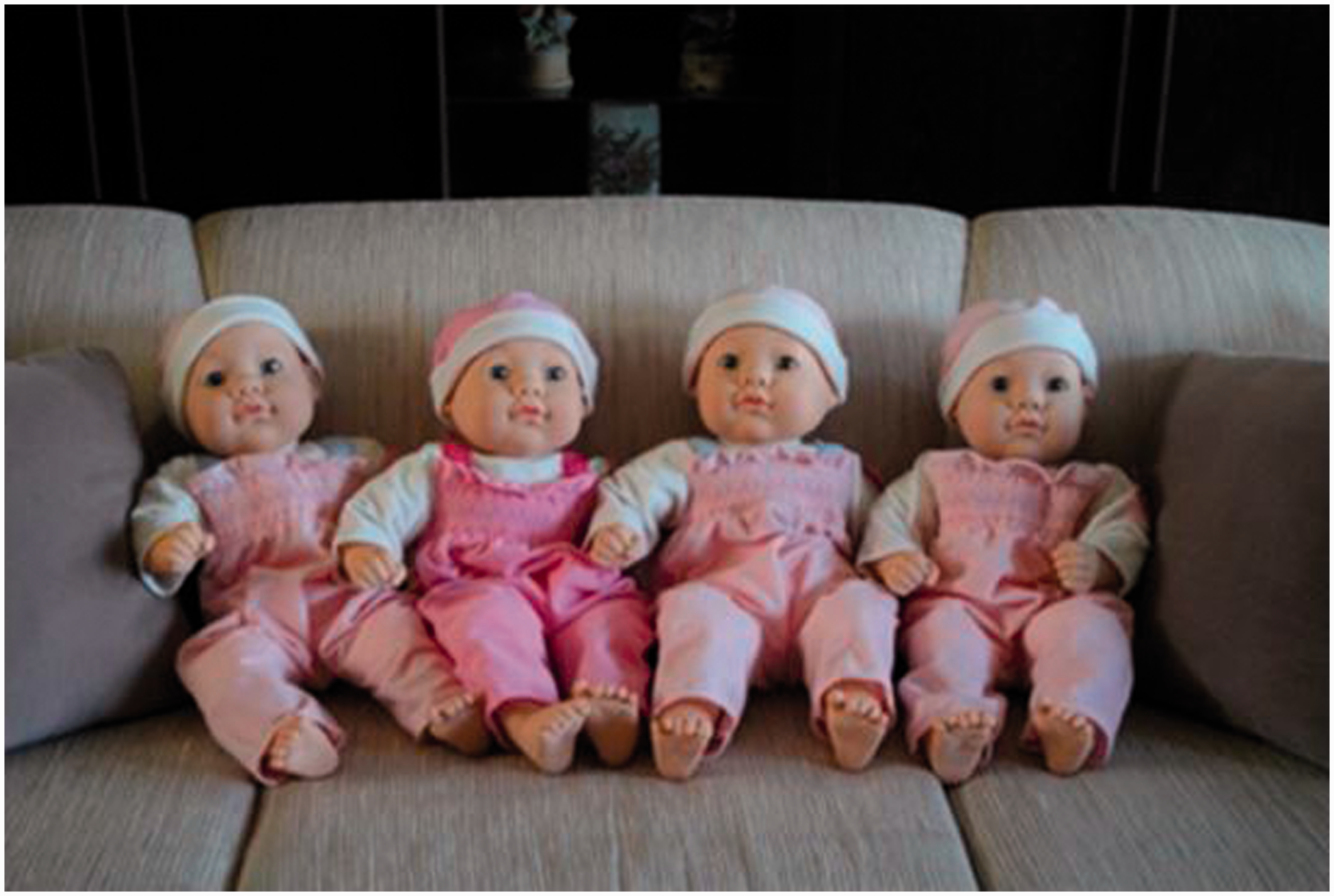
Participants were selected by asking the nursing staff at the dementia care center to recommend residents who they felt met the inclusion criteria and by the Project Lead observing resident’s behavior during the time spent in the Center. A total of 18 residents were introduced to the doll with 16 ultimately included in the project, representing 27% of the facility’s residents. The ages of the participants ranged from 60 to 94 years. The participants were all Caucasian females with the exception of one African American female resident.
There were numerous barriers related to the project. Staff time allocated to the project accounted for several of the identified barriers. The education program that was planned prior to implementation was not able to be delivered, as it would have required paid time for staff to attend. Staff members were introduced to the project while on duty, using an informal approach. The Nursing Director suggested there might be a problem with the nursing staff perceiving an increase in workload but that was not expressed by the staff. At times, it was difficult to get enough staff time to do the resident evaluations, and several times the Project Lead would help out with resident care waiting for an opportunity to get with the nursing staff to fill out the evaluation form. Staff turnover on the units within the facility each day posed an added barrier. While the staff were briefly informed about the project in the change-of-shift report on most of the wards, several new staff members appeared each day without knowledge of the project. Another significant barrier was that the facility had already provided baby dolls on each ward, and the residents were used to holding dolls during the day.
Outcomes
Scores for the six main categories of the resident’s behavior, on a scale of 1 to 5, before and one week after introduction of the doll.

aStatistically significant value.
Figure 2 shows the change in the participant’s level of happiness after one week of interaction with a baby doll, as evaluated by the nursing staff. The nursing staff perceived that seven of the clients demonstrated a “little more” happiness after interacting with the baby doll.
Change in level of happiness prior to and one week following doll therapy initiation (n = 16).
The change in level of agitation after one week of interaction with a baby doll, as evaluated by the nursing staff, is presented in Figure 3. One of the residents was perceived as demonstrating a “little more” agitation after interacting with the baby doll. Two of the residents who initially were perceived as demonstrating “a lot” of agitation were perceived as demonstrating a “little less” agitation after interacting with the baby doll and one client who originally was perceived as having “some” agitation was perceived as demonstrating a “little less” agitation. There was no statistically significant difference between the before and after behavior.
Change in level of agitation prior to and one week following doll therapy initiation (n = 16).
Figure 4 shows the change in level of ease of giving care after one week of interaction with a baby doll, as evaluated by the nursing staff. Three of the participants were perceived as demonstrating a “little more” ease of giving care after interacting with the baby doll. Even though there was a perceived difference in the ease of giving care behavior it was not statistically significant at the p = 0.05 level.
Change in level of ease of giving care prior to and one week following doll therapy initiation (n = 16).
Nursing staff were asked to provide short comments regarding their perspective of the participant’s response to baby doll therapy during the week following intervention of the doll. Half of the comments suggested a positive reaction by the residents toward the doll and three of the comments suggested that the participants did not interact well with the doll. When questioned about their evaluation of the baby doll therapy after one week, most of the nursing staff agreed that the therapy had helped to modify many aspects of the residents’ behavior and that, “… the dolls have been good for the residents.”
Following are the brief case summaries of four of the participants, representing varied responses to the doll therapy. The names of the residents have been changed to provide privacy.
When first given the doll, Judy’s behavior became hard to manage. She would not put the doll down for personal care or to eat. She became very belligerent and the nursing assistant took the doll away and gave it back to the Project Lead, refusing to reintroduce the doll. The following day Judy found someone else’s doll (the other resident had left the doll in a chair) and started caring for it and the nursing assistant eventually accepted Judy having the doll because she became easier to manage at that time. Judy became compliant with therapy. Judy’s husband was elated with the doll therapy and he offered to pay the Project Lead for the doll. He stated that Judy was much happier with the doll.
Phyllis is a single woman who has never had children but she seemed interested in another resident’s doll. The nursing assistant caring for Phyllis said she thought she would like a doll. She took the doll immediately when offered to her and said, “A pretty doll, she is pretty.” She said, “I can’t keep her, I don’t know what to do with her. Will you help me get her home? I don’t think I can do this.” Phyllis continued to hold the doll during the full observation period and she was entered into the program. During the next week, Phyllis was not seen with the doll and the staff members said she didn’t seem interested in it. During the second observation period, the doll was found in her room. When offered the doll she refused the doll and walked away.
Nancy’s family members stated that she would never accept a doll because she always made fun of the other residents who carried a doll or a stuffed animal. They requested the Project Lead try giving her a doll anyway. Nancy accepted the doll right away and carried it into the dayroom with the other residents. She would hide her doll so other residents could not hold it. She knew right where the doll was hidden when asked, “Where is your baby?”
One resident, who originally was not engaged with the doll, became engaged during the first week. Doris, a very hyperactive resident, continually moved, picked up things, and talked almost constantly. Doris originally accepted and kissed the doll, then set it in a chair after two to three minutes and walked away. She was not entered into the program. A few days later, Doris was frequently observed walking and holding another resident’s doll. At that time, Doris was entered into the program and given another resident’s doll, since that resident had rejected the doll during the week. During the second week, Doris carried the doll frequently. Near the end of the second week, Doris was sitting quietly in a chair holding the doll almost all day, a considerable change in her usual behavior.
Discussion
A review of the literature for alternative therapies to chemical restraints indicated that doll therapy has provided a purposeful activity that can help dementia residents feel useful. In most instances, those who participated in doll therapy were less agitated, slept better, related to others better, and had an overall positive affect improvement (Baumann, 1990; James, Mackenzie, & Mukaetova-Ladinska, 2006). Although not as dramatic as some of the changes found in the literature, the participants in this project did show an improvement in usual behavior, especially in the realm of happiness, with some decrease in anxiety. Furthermore, the husbands of at least three of the participants stated that their wives were happier and smiled more while holding their dolls.
At the time of acceptance of the setting for the project, it was unknown to the Project Lead that the facility had already instituted a type of baby doll therapy within several months of inception of the project. Several dolls had been purchased by the facility and were available in the common areas for the residents to hold and interact with during the day. This proved to be a major confounder to implementation of the project because many of the residents were used to holding and interacting with a baby doll. The staff used this previous experience with dolls to indicate whether or not the resident would be a good candidate for the baby doll therapy.
During the implementation of the project, there was a large turnover of personnel and although several attempts were made to assure that the staff members filling out the pre-survey were the same staff members to fill out the post-survey, this was not always possible. Additionally, one of the nursing assistants had a bad experience with the initial resident accepting the baby doll, and this appeared to prejudice her perception of the effect of the baby doll therapy on the residents in her charge. The nursing assistant was responsible for rating seven of the 15 participants.
Another limitation and possible confounder to the project was that the dolls were all female Caucasian dolls with blue eyes. Ultimately, this did not appear to be a problem in this particular study because only one of the residents entered into the project was not Caucasian. The client, an African American woman, accepted the doll and treated as if it were her own “baby”.
A study reported in Mount Sinai Inside (2010) stated that even dementia residents who never had children could still respond favorably toward the doll. However, the only participant in the Baby Doll project who had not had children became agitated when faced with caring for the doll. During the week after introduction of the doll, the Project Lead did not see the resident with her doll. The staff stated that she did not seem at all interested in the doll and they did not offer the doll nor talk about it with her. Her reaction with the Project Lead during the second evaluation indicated that the doll was causing her some stress.
Although three reports in the literature indicated that some geriatric professionals and family members might view use of baby dolls as being demeaning to elderly residents, Scott (2009) opines that Caregivers rightly have an aversion to treating older adults like children, even when the effects of dementia render them child-like. But here's a wonderful exception that Alzheimer's residents enjoy: Try giving a woman in the later stages of dementia a baby doll (p. 1).
Hosier (2011) presented an account given by the resident care coordinator of an LTCF of a resident with dementia who was exhibiting “unusual behaviors” despite pharmacologic intervention. The resident was given a donated baby doll and her behavior improved. Because the results with this resident were so successful, the staff began giving baby dolls to the other residents, including male residents, with positive results for most of the residents.
The therapy did not appear to present any ethical concerns to staff or family members in the facility where the current project was implemented. Every guardian/family member whose permission to introduce a baby doll to their loved one immediately gave permission upon explanation of what the project was all about. Not one guardian or family member mentioned the possibility of the doll being demeaning to their loved one.
Conclusions
The evidence in the literature suggests that baby doll therapy is an easy, non-threatening, and non-toxic method of controlling untoward behavior in dementia residents. The literature is replete with case histories of immediate change upon receipt of the doll by the residents/patients of the facilities where doll therapy was introduced. A more recent research study, performed on the psychiatric dementia ward at the Mount Sinai Hospital in New York City, demonstrated a reduction in the use of Haloperidol among dementia residents using baby doll therapy. “The most important finding was that the dolls prevented the more prevalent negative emotions and agitations like throwing things or combative behavior,” (Green, et al., 2011, p. 3). Family members were supportive of the therapy, as they indicated it provided comfort to their loved ones.
It is recommended that a project of this type should be attempted in a residential dementia setting where the residents have not been used to having and holding baby dolls during the day. Baby doll virgins may respond differently to the baby doll therapy than those who have held baby dolls frequently.
The Baby Doll Therapy project was completed over a two-week timeframe with 16 participants and demonstrated a positive change in resident’s behavior, as rated by the nursing staff. The baby dolls were left with the residents as their “forever babies” when the project was finished. Baby doll therapy, using the evidence-based protocol developed for this project, was simple to institute, effective, time-saving, and demonstrated immediate results in behavior improvement.
Footnotes
Acknowledgements
We would like to acknowledge the contributions of Dr Judy Ribak, Dr Gladeen Roberts, and Ms Jodi Jameson to the project. Without the support and efforts of the dementia center nursing director, the staff, the patients, and the family members, this project would not have been possible. Our regards and thanks to all of those who supported the work in any respect during the completion of the project.
Declaration of Conflicting Interests
The author(s) declared no potential conflicts of interest with respect to the research, authorship, and/or publication of this article.
Funding
The author(s) received no financial support for the research, authorship, and/or publication of this article.