






Abstract
Without power and political authority, planning theorists’ advice for planners to be politically astute is of little help. The politically astute planners could do little in the face of political pressure. In this context, the logical advice for planners would be to join politics and acquire the political authority that they need to materialize their plans. This article, through case studies from the United States, Brazil, and Nepal, shows that the planners who joined politics were able to accomplish some of the most difficult planning tasks in their towns and suggests that planners should take up elected position as and when possible.
Introduction
Political pressures often distort or dismiss good planning ideas put forth by planners (Flyvbjerg, 2002; Grange, 2012; Hoch, 1988; Krumholz, 2001; Mitchell, 2003). Planning theorists suggest that planners need to be politically skillful to combat these challenges. They say, without these skills, planners would be marginalized, forced to make unethical decisions, or would be disciplined (Flyvbjerg, 1998; Hoch, 1988; Hoch and Cibulskis, 1987; Krumholz, 2001). The political skills that the planning theorists are advocating for planners are not about winning elections to be political leaders but to be skillful in organizational politics within their given advisory role as staff-aides or civil servants. In other words, planners are advised to be sensitive to conflicts associated with elected officials, institutions, and other staff while carrying out their tasks (Read and Leland, 2010). Basing on these premises, planning theorists have coined a number of political roles for planners. They are planners as bureaucrats, advocates, communicators, and power-players.
However, experience shows that many planners as bureaucrats, advocates, communicators, and power-players were unable to resist powerful politicians adamantly pursuing vested interests (Brooks, 2002; Flyvbjerg, 1998; Hoch, 1988). Many planners who tried their best to convince politicians to not to go for less ethical or poor quality plans were either fired or disciplined (Hoch, 1994; Krumholz, 2001; Mitchell, 2003). Had the planners sought for political positions and won, they would overcome these threats and gain the political authority that is required to implement the plans that they want. However, no author has suggested planners take elected positions.
This article presents case study from the United States, Brazil, and Nepal and shows that the planners who took elected positions were able to complete some of the most difficult planning tasks in their towns. The case studies are not about one-hundred-percent perfect planner-politicians. They are about the planner-politicians who were able to address some of the most difficult planning problems, even if their actions were not perfect.
The article is organized as follows. First, it defines what planning, the plan, and “taking action” mean for planners. Second, it presents the institutional context under which planners operate. Third, it evaluates how effective are the staff-aide-planners’ political skills that most planning theorists advice for. Fourth, it presents work of one planner-politician each from the United States, Brazil, and Nepal. Fifth, it discusses about the effectiveness of the planner-politician’s role in creating better plans, and finally, it makes some conclusions.
What the planners mean by a “better plan”?
Before we dwell on planners’ performance, it is important to define what planners mean by the term planning, the plan, and taking action. Planning embraces a wide variety of useful meanings. It is a process of creating cities that are technically sound, environmentally sensitive, socially responsible, and democratically representative (McDonald, 1996). Planning is about producing ideas for a purpose by collaborating, coordinating, and adjusting intentions to new information and situations (Hoch, 2007). It is a process of securing consensus among stakeholders on planning decisions (Innes and Gruber, 2005). Planning is also a process of state control on city development (Webster and Lai, 2003). Furthermore, it is about working on behalf of the weaker sections of society as an advocate for their causes (Davidoff, 1965; Fainstein, 2014a; Forester, 1982).
The plan is a practical scheme that shows ways to deal with complexity (Donaghy and Hopkins, 2006). It creates alternatives to cope with uncertainty and ambiguity and indicates future intended outcomes (Hoch, 2009). Plans provide information to shape collective actions (Innes and Gruber, 2005; Kaza, 2008). They should be adaptable to changing circumstances and be able to coordinate with many other plans to resolve complexity (Donaghy and Hopkins, 2006). Plans are also schemes about correcting chaos, unplanned development and restoring order (Hopkins, 2001).
More importantly, the plan is an idea set to meet people’s expectations (Kaza, 2008). Unless plans are adopted and implemented, these expectations will not be realized. Plan implementation requires the power and authority to make decisions. Moreover, in the absence of power or political authority, plans prepared by planners (power of plan making) often get shelved (Burby, 2003; Neuman, 1998). There is a need for planners to engage with politics for creating as well as implementing plans, rather than just being a tool for politics (Grange, 2012). Realizing this, many planners have occupied seats in Congress and state legislatures, mayor and council posts, and city and county manager positions in the United States (Neuman, 1998). This article is part of assessing the performance of these planner-politicians in the three nations mentioned above.
The “better plan” this article is talking about is the planners’ ability to be the power (take elected position) to help create better ideas for cities and implement them. Those ideas could take various forms. To some, it could be leveraging power to create new plans and implement them or forging inter-jurisdictional consensus for environment protection. To others, it could be to take action to enforce planning regulations that have been stalled for years and correct the mistakes of the past: restore public amenities and vital transportation corridors that were occupied by illegal developers for years and ensure efficient city mobility.
How institutions shape planners’ actions?
The institutional rules and political governance play an important role in shaping planners’ actions and vice versa (Alexander, 2005; Giddens, 1984). Liberal form of governments motivate planners to protect communities against the forces of capitalism, and the conservatives direct planners to reduce government functions and rely on market mechanism (Healey, 1998). Urban regimes, pursuing economic and political interests, significantly influence planners’ actions at the local level in both forms of government (Stone, 1993).
In a plural democracy, dealing with conflict of interests (resulting from various forms of urban regimes) is a routine job of planners (Sager, 2012). The planners address those conflicts mainly through three forms of political governance (Backlund and Mantysalo, 2010). They are aggregative, deliberative, and agonistic models of democracy. The first model assumes that each individual is motivated to promote its own self-interest, and voting is the key instrument to sort out those conflicts of self-interests (Mouffe, 1999). However, in this case, the one who gains power through votes do not fairly represent all the voices in many cases (Mouffe, 1999; Purcell, 2006). The deliberative model of democracy believes in practical reasoning through argumentation and persuasion. In this model, a decision would be legitimate only if each person with a stake in the issue is involved in all the phases of planning and decision-making. The aim is to mobilize collective action to forge consensus (Amin, 2006; Burby, 2003; Feiock, 2009; Healey, 1998). However, Ploger (2004) argues that conflicts could not be addressed by consensus, compromise, majority vote, political decision, or by law because the process is likely to suppress emotional concerns of the people through hegemonic rhetoric and marginalize the voices of the weaker citizens (Dryzek, 2005; Norval, 2007).
Mouffe (1999) proposes agonistic pluralism as a way of addressing the weaknesses of aggregative and deliberative democracy. According to her, instead of suppressing dissent, the agonistic model allows disagreements to surface respectfully (Mouffe, 1999): Even if conflicts would remain unresolved, stakeholders would still come to a mutual agreement on the procedure to work further for possible resolutions (Barber, 1984; Hillier, 2002; Mouffe, 2000).
However, Mouffe’s (1999) call for dissent has the potential to spur social disintegration in divided societies (Dryzek, 2005) and her idea of “coexistence of conflict” sounds respectful but does not provide solutions to resolve those conflicts and go back to work (Bond, 2011; Forester, 1999). Backlund and Mantysalo’s (2010) study of five Finnish cities and Ploger’s (2004) study of a Danish regeneration project saw the continuation of rationalistic comprehensive planning through traditional institutional and political practices, with no traces of agonism.
How effective are the political skills that planning theorist have prescribed for staff-aide-planners?
As we all know, rational planning as a plan making exercise has been heavily criticized for its political ignorance: relying too much on technical analysis and paying too little attention on value differences in the planning process (Campbell and Marshall, 1999). To overcome these weaknesses, planning theorists have coined various political roles for planners. Those roles are planners as bureaucrats, advocates, communicators, and power-players. Some believed that planners as government bureaucrats would serve public interest through policies, rules, and administrative procedures (Campbell and Marshall, 1999; Read and Leland, 2010; Sanyal, 2005). They would deliver policies incrementally through small changes and adjustments on existing policy in the face of limited time and information (Lindblom, 1959). However, bureaucrat planners were criticized in that they only served certain class interests and were rent seekers for policy delivery (Sanyal, 1996; Storbjörk and Hjerpe, 2013). Others expected planners to act as a watchdog, whistle blower, within the bureaucracy, or as a “guerrilla in bureaucracy” to curb political dominance (Beauregard, 1990). However, this is not an easy task: “[t]he progressive spirit thrives far more readily in the halls of academe—where there is virtually no risk attached to its espousal—than it does in the nation’s city hall” (Brooks, 1990: 219).
Other theorists argued that planners should act as advocates of the people. Davidoff argued that planners should not only justify planning as comprehensive model of rationality, being right in the words of Hoch (2007), but also focus on social problems and social justice aspect of the citizen (doing good). They should work not only in government offices but also outside and openly advocate for the weak and minorities (Davidoff, 1965). In 1969, Paul Davidoff, principal proponent of advocacy planning, formed a Suburban Action Institute (SAI) in Westchester County, NY, to “open the suburbs for all, in particular for the non-affluent and non-white” (Danielson, 1976). In the early 1970s, SAI declared several projects in the suburbs. However, none of them got local zoning approval. To counter local opposition, SAI founders hoped to build “a local base of support” among “the Suburban church; builders and housing developers; some groups within the fair housing movement; and suburban employers of low and moderately skilled workers” (Danielson, 1976). However, SAI could not get the support as expected because these groups felt that confrontation was counterproductive in bringing change. Later, Davidoff realized that without political mandate pushing progressive agenda is an uphill battle, and ran for the US congress. Unfortunately, he failed to get enough support from Westchester County New York (Brooks, 2002).
Progressive planning emerged as the next version of advocacy planning in the early 1970s. The theorists argued that progressive planners while working in government office should promote equity planning: “influence opinion, mobilize underrepresented section of community and implement policies that redistribute resources to poor and working class” (Metzger, 1996: 113). Norman Krumholz was highly praised for successfully pushing a number of progressive policies in Cleveland, Ohio. However, some scholars believed that Krumholz succeeded mainly because he was fortunate to get a political soft-corner. Hill (1989) asserts that Krumholz received a franchise from Mayor Stokes to build his progressive agenda. Furthermore, Krumholz’s legacy ended abruptly after a business-oriented administration took office (Brooks, 2002). Metzger’s (1996) review on progressive planning in the United States is less optimistic on its success.
Next, planners were advised to be effective communicators, educators, and consensus builders while carrying out any planning tasks. This notion was based on communicative rationality theory (Habermas, 1984). The theory claims that under certain ideal conditions, we could come to a consensus regarding our moral, political, and social disagreements. Forester (1980), a leading scholar in communicative rationality theory, contends that “planning actions are not only technical, they are also communicative: they shape attention and expectations” (p. 283). He says a good planner is not the one who can analyze and make plans but the one who talks, argues, and listens; who can convince people to support ethical options; and be watchful that information may be distorted by the powerful at the expense of the poor (Forester, 1980, 2012).
Nonetheless, Sanyal (2002) was surprised to see that practicing planners troubled with moral dilemmas and looking for ethical compromises were not making use of the merits of communicative rationality. This is because not all planning problems are “consensual types.” Many are “controversial types” that could not be addressed by communicative skills alone (Altshuler, 1965). Even if all parties were willing to engage in rational argumentation, some conflicts could not be resolved by argumentation (Bernstein, 1992, 1972). Flyvbjerg and Richardson (2002), as well as Grange (2012), argue that powerful and clever people would manipulate, misinform, or dominate the discourse and thwart impartial process of discourse ethics (communicative rationality) so that the “consensus” produced might occur as a result of domination. For these reasons, Fainstein (2014b) doubts that consensus can deliver just outcomes. Forester (1987) too admits that mediated negotiation will not work when one party enjoys unilateral power, and in this case, the negotiation may be used to co-opt weaker parties.
Indeed, Hoch (1994) had found that “[l]ocal officials and developers often pressured planners to abandon the moral conventions of the planning tradition and apply the planning rationale as a justification for individual gain” (p. 324). In some cases, powerful actors were found enticing planners with bribes and forcing them to tell lies in planning decisions (Hoch, 1988). In 2003, a planning director in Cincinnati tried to persuade the mayor and city manager not to approve real estate developments that violated every aspect of the city plans and codes (Mitchell, 2003). The director of planning tried everything in her power to persuade the mayor and the city manager to change their minds. Despite those efforts, the city mayor and the manager abolished the entire planning department of the city and fired most of the planning professionals to eliminate obstacles to the real estate interests (Mitchell, 2003).
Reacting to the weaknesses of the advisory-political role of planners, Flyvbjerg and Richardson (2002) say, without understanding the dynamics of power, planning theories could do little to help planners facing political pressures. They further recommend planners to be power-player and not just communicator to deal with political pressures. Flyvbjerg and Richardson (2002) documented how the Chamber of Commerce and the city officials in Aalborg distorted rationality and used incorrect information in favor of car instead of pedestrian-oriented policy for the city.
Flyvbjerg (2002) describes how he fought in Aalborg against the city officials and the Chamber of Commerce by using media and the radio station, exposing facts, and changing the attitude of the people in power. However, he did this, as a university professor and not as a bureaucratic planner working in the city, with no job risk, as alluded above by Brooks (1990). Next, Flyvbjerg and Richardson (2002) say that power is needed to limit power, but they have not answered how civil-servant planners could use power to limit political pressure without putting their jobs at risk (Harrison, 2013).
Mouffe (1999), as discussed above, proposes agonism as an alternative to communicative rationality. She argues that one should allow dissent to surface in communicative argumentation to make the process more democratic. However, it is yet not clear when that dissent would end and planners would go back to work.
The critical review of planning theories in this section shows that the political skills that planning theorists have suggested for planners are often less helpful in dealing with political pressures that crop up in town halls. Planners “are members of a weak professional community working as employees in vulnerable occupational positions” (Hoch, 1996: 40). They lack authority to take action in favor of better planning (Grange, 2012; Krumholz, 2001). In this situation, one of the viable options for planners is to gain the authority by joining active politics (seek elected position). That is to come out of their “servant-political-role” and take up the “master-politician-role” so as to acquire the power that is necessary to make things happen. The section that follows presents stories of some planners who joined active politics and took elected positions.
Power of planner-politician: case studies from the United States, Brazil, and Nepal
This section presents case study of one planner-politician each from the United States, Brazil, and Nepal, respectively, to show how their elected position helped them to accomplish some of the most difficult and challenging planning tasks. The cases are developed from the planning literature, journal articles, reports, and local newspapers. The case studies follow with a brief introduction of institutional context of the three nations. The United States is a democratic capitalist country where local governments mainly take planning responsibility. Planning decisions are made through an aggregative or representative model of democracy depending upon the size of the city. Local governments approve plans by majority votes of the residents or the legislative body, after public hearings. Brazil has had a democratic, federal republic form of government since 1985 (Burton and Stevens, 2011). As in the United States, municipalities (with a mayor as the executive head and a unicameral legislative council) exercise planning responsibilities with aggregative and deliberative form of democratic practices (Burton and Stevens, 2011). Nepal has a parliamentarian democracy where both central government line agencies and local governments look after planning issues. The former looks after physical planning issues and the latter mainly looks after municipal service management. The planning decisions are made by majority votes of planning board members with limited representation of stakeholders. The case studies are presented as follows.
The United States
This section presents a story of a planner, David R. Godschalk, who worked as elected official in North Carolina. Godschalk, with a master’s degree in planning from the University of North Carolina (UNC) and experiences as planning director at Gainesville, Florida, took professor position at UNC in 1983. David’s engagement on local affairs grew when Mayor Joe Nassif asked him to chair a Growth Management Task Force in 1983 (Godschalk, 2006). In 1984, David was asked to fill in the position of a council member who died unexpectedly. He took up this position, and once the term was over, he ran again for the same position and got elected.
As a town council member, he was able to accomplish two major tasks in Chapel Hill. The first was the negotiation and implementation of an intergovernmental Joint Planning Agreement, and the second one was the subsequent negotiation and implementation of watershed protection regulations. In his second term in office, Orange County and two other towns (Carrboro and Chapel Hill located within the Orange County) were engulfed in development-related conflicts. Orange County as a whole wanted to protect property owners’ rights. Carrboro (also located in the Orange County) had an interest to promote growth around the Chapel Hill’s watershed area. Chapel Hill (adjacent to Carrboro) was concerned with the development and degradation of its watershed and water quality and wanted jurisdiction over its urbanizing fringe area to control the quality of development through annexation. The county refused extraterritorial jurisdiction to Chapel Hill (Godschalk, 2006). In 1986, a 177-unit cluster subdivision was proposed in Carrboro area around the creek drained directly into the watershed of the University Lake reservoir which sparked controversy between the county and the towns (Godschalk, 2006).
To address this conflict, a subcommittee comprising one elected board member each from the three jurisdictions was formed. David R. Godschalk represented Chapel Hill in the subcommittee (Godschalk, 2006). David applied all his planning insights and mediation skills that he had learned and taught during his academic career, for this task (Godschalk, 2006). First, he identified the interests of the three jurisdictions. Second, he helped identify joint planning area (the area of common concern to all) and demarcate each government’s jurisdictions in the map. Finally, he was able to have an agreement with all the three jurisdictions for forming a joint review and approval mechanisms for plans and projects proposed in the disputed areas. The agreement was endorsed by the three governing boards and eventually codified into state law by the North Carolina General Assembly as an important new piece of planning legislation (Godschalk, 2006). This agreement became a key model for intergovernmental cooperation in North Carolina.
Next, Godschalk worked as one of the elected officials in inter-jurisdictional workgroup of elected officials to seek agreement on the watershed protection regulation of the University Lake watershed (Godschalk, 1992). He helped achieve best possible outcomes, by suggesting processes that allowed constructive discussion and offering alternatives that were compatible to all the parties involved (Godschalk, 2006). Six months later, an agreement on watershed protection regulation was reached, local government approved the regulation, and finally the regulation was incorporated into the zoning ordinances.
Brazil
Jaime Lerner, an urban planner, was three times mayor of Curitiba and twice Governor of the State of Parana (Spatial Agency: Jaime Lerner, n.d.). In the mid-1960s, Curitiba was a rapidly growing city with lot of traffic congestions. The mayor at that time was trying to implement a car-oriented modern city by destroying the historic downtown (Capdevila, 2012). Jaime Lerner, as a faculty architect-planner from the Federal University of Parana, opposed the idea of demolishing the old historic downtown (Capdevila, 2012). As a result, Curitiba municipality canceled the plan and sought to create a new master plan. Lerner and his team proposed a new master plan that respected the historic town and guided development along high-density growth corridors served by Bus Rapid Transit (BRT). He finally won municipal support for the plan in 1966. Lerner not only won support, but 5 years later in 1971, he managed to be appointed as mayor of the city by the then military regime, worked until 1983, and again he was democratically elected in 1989 after the military regime was over (Phillips, 2008).
His first job as mayor was his symbolic move to encourage pedestrians and restrict car movement in the historic downtown (Macedo, 2013). He started this by Friday with over 100 construction workers and finished during the weekend before the opposing groups would go to the court for filing injunction against the move (Macedo, 2013). However, local residents when they saw the pedestrian path were impressed and realized that the move increased shopping activities and business sales. The pedestrian market worked very well and more adjoining residents demanded for the same.
Lerner’s master plan had proposed five primary corridors of development that radiated from the downtown, as a framework for the city’s growth (Gustafsson and Kelly, 2012). The corridors were served by transit-oriented development (BRT), and both sides of the corridors were zoned for denser commercial and residential area to promote denser form of development, reduce urban sprawl, and spare more space for park development, wetland protection, and tree plantation. Next, as an innovative waste collection strategy, Lerner launched a program that traded bags of groceries and transit passes for bags of trash. Eventually, he succeeded in implementing all of his visions mentioned above (Capdevila, 2012).
Nepal
Dr Baburam Bhattarai (Dr BRB hereafter), with a PhD in regional planning from Jawahar Lal Nehru University (JNU), India, took over office as 34th prime minister (PM) of Nepal in August 2011. Within one-and-a-half year term in office, he was able to accomplish one of the most difficult urban road improvement tasks in Kathmandu Metropolitan City (KMC), almost unthinkable for many policy-enforcement officers. The paragraphs that follow briefly introduce the problem of city road congestion followed by a detailed account of the PM’s action in KMC.
KMC is the most congested city (also capital) of Nepal experiencing frequent traffic gridlocks on city streets. The road congestion was as a result of city roads bottlenecked by proliferation of illegal developments (buildings and structures). The majority of those illegal developers were not informal settlers or squatters. They were formal adjoining private-property owners resourceful with wealth, power, and politics. They took advantage of the government’s inability to take care of the road right-of-way (ROW) established by building bylaws in 1976, and partially incorporated adjoining road land into their residential premises. These powerful developers were able to thwart several attempts to demolish the illegal buildings and restore ROW in the past.
In this chaotic context of illegal development and traffic congestion, Dr BRB took office as PM in 2011. He had to experience frequent traffic congestions on his way to his work and spend about 1 h to travel 4 km distance from his residence to his office. One day, the PM was impressed when he saw planning authorities attempting to remove illegal buildings from ROW for widening the congested roads. He called all the ministers and policy-enforcement officers to his office and informed them that the ROW restoration and road-widening task in KMC was vital to ease traffic congestion. It was to receive top priority. He appreciated the planning authority’s move to restore ROW, instructed the finance minister to set aside budget for road widening, and urged all the ministries to show full support for the task. Furthermore, he formed a Kathmandu Valley Road Expansion High-Level Monitoring Committee (KVREHLMC) and appointed his secretary (chief of staff) as the coordinator of the committee. The task of the coordinator was to monitor the work progress, have regular meetings with the enforcement agencies, provide necessary support, and report to the PM.
With this high-level political support, the task progressed with better coordination and a clear division of responsibility. According to the chief of traffic police, two former ministers from one political party came to a site in the Lazimpat area and put obstructions there along with other protesters (mainly illegal developers). They were arrested for 8 h and were released after the work was over. Next, nearly 1000 court cases were filed to obtain stay order against the demolition. Most of them were dismissed. Since restoring public land from illegal developers was a lawful act, the court did not obstruct the task. Finally, planning authorities were able to recover 200 km of the KMC’s ROW from illegal developers, remove 410 illegal building structures from the ROW, widen the roads, and ease traffic congestion.
Those developers who had built their building structures on the road premises prior to the enactment of the ROW standard in 1976 were compensated by the Kathmandu Valley Town Development Committee (KVTDC), a central government line agency responsible for planning and development control in Kathmandu valley. Those who built after 1976 were not given compensation considering their act as illegal. After the public notification 1 about removal of illegal structure from the ROW, 60% of the structures under the ROW were demolished by the illegal developers themselves and the remaining 40% by the planning authority, according to the secretary of the Ministry of Urban Development.
Discussion
David R. Godschalk, as a political insider (elected official), had more influence over decision-making than as a staff-aide-planner, in Chapel Hill, North Carolina. Godschalk’s political position (his position and legitimacy) provided him access to engage with his political peers and legitimate status to better inform the peers about planning issues. He was trusted and listened to more seriously by his fellow town council members (peers) because the type of relationship was “master-master” instead of “servant–master”. Second, since he was less vulnerable to job risks associated with political pressure, he was bold in presenting the truth among his fellow members (Godschalk, 2006). Finally, with better analytic knowledge and consensus building skills, he was able to educate busy non-planner-council-members about planning benefits and motivate them to choose the right option (Godschalk, 2014). This ultimately helped him to forge inter-jurisdictional consensus on the environmental protection plan. A political outsider (staff-aide-planner) could do the same, but they would not have the same leverage as a political insider as mentioned above (Table 1). David R. Godschalk’s deep interest in conflict resolution plus the sudden offer for him to fill a vacant council position at Chapel Hill Town Council opened the window of opportunity to chart his planner-politician course (Godschalk, 2006).
Power of planner-politician in creating better cities.
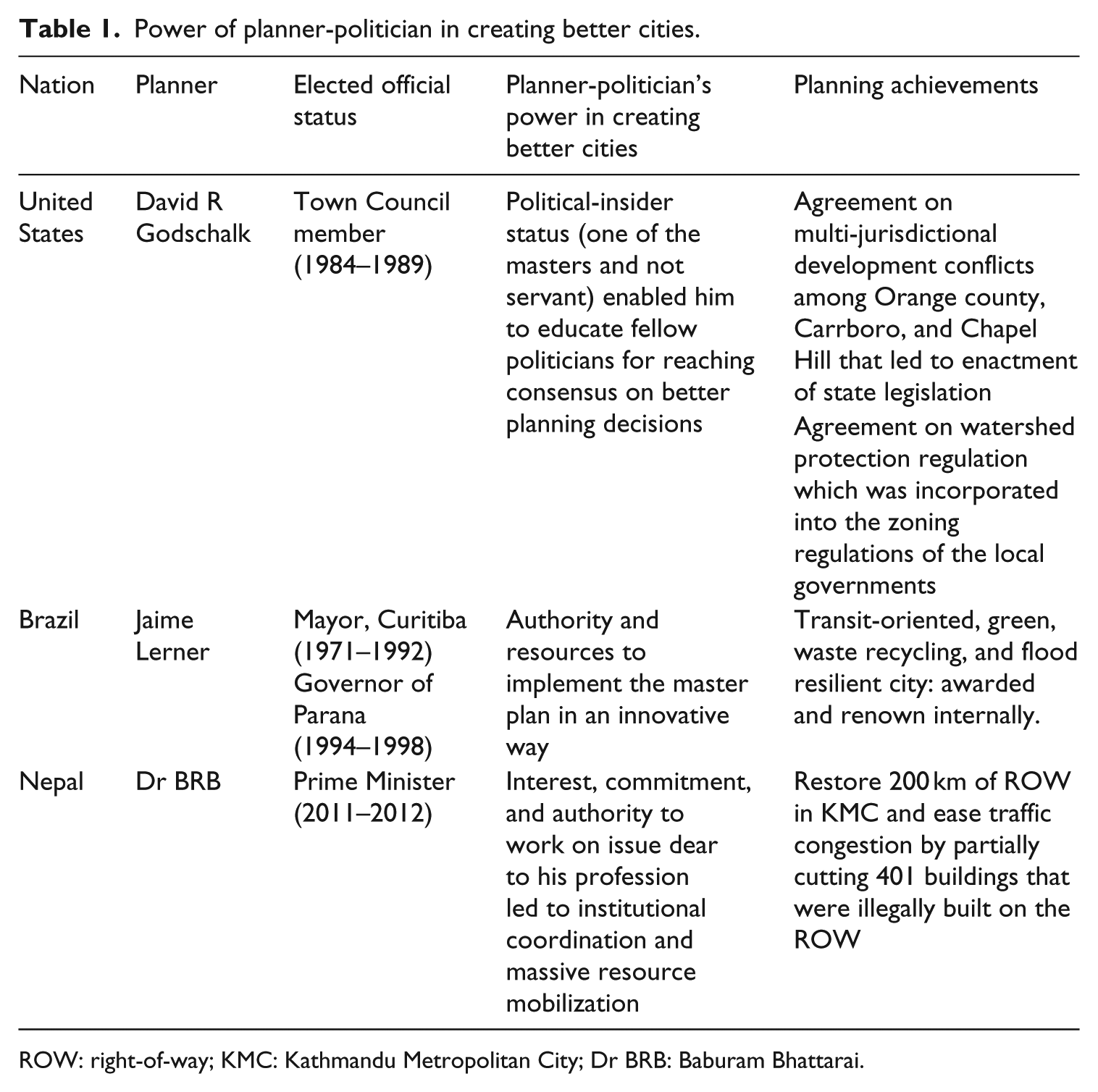
ROW: right-of-way; KMC: Kathmandu Metropolitan City; Dr BRB: Baburam Bhattarai.
Jaime Lerner in Curitiba gained both the planning and political power that was required to implement his city master plan and transformed Curitiba from car-oriented city to a green, pedestrian-friendly, and public-transit-oriented metropolis (Gustafsson and Kelly, 2012). Lerner’s electoral success (political power) as mayor opened the door (empowered him) to implement his plan that he created and which won the municipal competition. He had the privilege to mobilize all the resources that were needed to implement the BRT, a flood protection project, park development schemes, and a waste recycling program. Had he worked only as a consultant and winner of the municipal master plan, he would simply not have the power and resources to do what he has done today. Lerner was visible and right on the political mark through his planning advocacy for Curitiba. The military regime further pushed him in the driving seat of politics by appointing him as mayor in 1971, from where he never turned his back (Phillips, 2008).
In the case of Nepal, it is important to note that planning is not only about creating new ideas and implementing them but also enforcing the unenforced planning regulations and road standards to ease city congestion. Planning regulations (ROW standards) in KMC stayed unenforced for 39 years. Road lands were partially occupied by illegal developers, and this resulted in congestion causing public inconvenience. The role of the planner-politician in this case was to acknowledge the importance of the unenforced planning regulations and exercise political power to enforce road standards, restore ROW, and ease traffic congestion. Dr BRB, as the first planner-PM of Nepal, disposed an enormous amount of planning authority to restore the city ROW from the illegal developers. With the PM’s planning background, deeper interest in planning agendas, and political authority to mobilize resources, he was able to accomplish very complex road improvement tasks in KMC. Had BRB tried to address the task as staff-aide-planner or senior civil servant, it would be almost impossible for him to mobilize the resources that were needed for the ROW restoration task. Dr BRB was already active in politics when he was a student of planning in India in early 1980s. (I had met him once in India in one of his political events.) This eventually led him to join mainstream politics in mid-1990s and be a political leader.
The examples show that the planners who took elected positions were able to accomplish planning tasks that were considered very hard to achieve: complex, big in scope, and difficult to implement. These experiences indicate that this two-in-one role of planner-politician is found to be a unique leadership position where power and rationality do not fight, as shown by Flyvbjerg (1998), but rather they coordinate and unite for making better planning decisions. It avoids the chances of gridlock in decision-making as a result of division of opinions between two personalities: the one with “power of knowledge” (planner) and the other with “power of decision-making” (politician). The planner-politician role owns both the power and gains full autonomy to make things happen as fast as one would wish (Beckman, 1973).
However, these accomplishments and merits should not overshadow the dark sides of planner-politician role. One needs to shed light on those sides as well (Yiftachel, 1998), if they exist, to make the planner-politician role more just and democratic (although this is not the scope of this article). For example, one should ask how Godschalk in Chapel Hill achieved consensus. Was the consensus as a result of suppressing some of the needs of weaker sections of the society? Did the process involve all the stakeholders in decision-making and entertain some degree of agonism? In the case of Curitiba, did Lerner practice deliberative democracy or agonism in decision-making when he was appointed by the military regime (Moore, 2007)? Was his tactics of the pedestrianization of the downtown (dismantling of roads on Friday evening and completing the pedestrian path by Monday to bypass court stay-orders) fair, transparent, and democratic? Piel (1997) found that the elite class growth machine (Molotch, 1993) had played an instrumental role in the planning process in Curitiba. Grand plans were developed in collaboration with experts and powerful interest groups and with little inputs from low-income people. There was little say of low- and middle-income people in decision-making. The developers and city elites largely controlled the planning decisions (Piel, 1997). Some progress was made only in the late 1980s when a light rail project failed because of lack of consultation with the local people, users, and financers. However, this shows that more work is needed to ensure full democratic participatory process of planning in Curitiba. Similar questions could be asked to Dr BRB from Nepal: Did the road widening and illegal building demolition follow due process and address the genuine concerns of the perpetrators?
Conclusion
Experience from the United States, Brazil, and Nepal shows that planners who acquired political authority were able to accomplish difficult and important planning tasks. Godschalk’s political position in Chapel Hill, North Carolina, provided him an access to engage with his political peers, educate them in planning issues, and forge inter-jurisdictional consensus on environmental protection plan. Lerner’s electoral standing in Curitiba was the key power that enabled him to implement his visionary plan. In Nepal, Dr BRB’s planner-PM position enabled him to mobilize enormous resources and forge institutional coordination to enforce planning regulations that stayed unenforced for many years and ease road congestion.
This suggests that planners should not believe that they are by default staff-aides or civil servants, and for this reason, they should not even imagine the possibility of taking an elected position. Rather, those planners who see the possibility of winning elections should consider joining politics because doing so gives them more power to negotiate, educate, take action, support, and implement their planning dreams. Side by side, the planning theorists should admit that planner’s political skills without political authority are not helpful in many cases, and for this reason, they should stop relying only on the planner’s political skills and also advocate for an active political role of planners (in town halls, planning classrooms, and in their writings).
Feiock (2009) says, “[o]nly individuals are capable of action, yet individuals often act in the name of a group or organization” (p. 357). However, if the organization or institutional rules are inefficient and political governance continues antagonistic and less democratic decision-making practices—as has been shown by Backlund and Mantysalo (2010), as well as Ploger (2004)—so that politicians make people hostage of indecisions or faulty decisions, then the individual, the planner should act by other means. One effective way to do so, if feasible, is to take up elected positions to acquire the power necessary to create better plans and cities. Acting adds more value than simply complaining or waiting (as helpless civil servant) for the institution to improve.
In his time, had Paul Davidoff invested his entire advocacy-time in seeking a political position in the United States and won, he would likely to have succeeded in making many more changes as a political insider (like Godschalk, Lerner, and Dr BRB) than what he was able to do as outside advocate (Brooks, 2002). Similarly, had Flyvbjerg (2002) joined politics instead of playing a sideline advocacy role in Aalborg, he would have more control over political power to influence planning decisions at Aalborg town hall.
However, it is worth reiterating that no plan or planning action is a 100% perfect, will make everyone happy, and will address all issues. Nor did the ones presented in the case studies above. They could only be better ideas and actions taken in a given circumstances to achieve the best possible outcomes. They may be better, but are not free from all weaknesses because of the circumstantial and institutional constraints. Even so, the better plans implemented by the planner-politicians as presented above have provided a huge relief to a world utterly frustrated by inaction, negligence and chaos. The work of would be planner-politicians and the ones presented in this article should be viewed in this light.
Furthermore, planner-politicians cannot be a panacea for all problems. To be effective, they need to meet the following conditions. First, planner-politicians need to have a sincere desire to do something fair and good for cities and towns. Second, they should have the interest, resources, nature, and skills to contest and win elected positions. Third, planner-politicians should not be corrupt. They must not compromise the public interest for self-interest. Planner-politicians cannot decide plans unilaterally. They must decide through a deliberative and agonistic model of participatory democracy. They must dare to take action on the call of planning-urgency.
Last, but not the least, those planners unable or uninterested in taking elected position should continue as staff-aides, with the political skills as recommended by planning theorists. More and more cities and towns need staff-aide planners’ advice to run the day-to-day planning business of municipalities. Both the staff-aide-planners and planner-politicians have unique advantages for creating better cities. Planners should fight from both the fronts.
Footnotes
Acknowledgements
I am grateful to the contribution made by the reviewers on my article, and I also thank Dr Sophie Sturup, lecturer at Department of Urban Planning and Design, Xi’an Jiaotong-Liverpool University, for her hard work for providing some comments in this work.