







Abstract
In an inter-country adoption process, the private issue of becoming a parent takes place within a regulated institutional setting and process with professionals acting as gatekeepers along the way. This qualitative study based on 19 narrative interviews scrutinizes the strategic interaction used by prospective adoptive parents to navigate the controlling institutional setting of statutory pre-adoption services. This social interaction with the professionals is analysed as power negotiations and discussed by utilizing Goffman’s conceptual framework of expression management and stage play. The study shows that prospective adoptive parents, whose primary aims differ from those of the professionals, play on different teams than the professionals. Therefore, they utilize expression games through information, emotion, and team management in order to put their best foot forward in the pre-adoption services. But along the inter-country adoption play the audience shifts and the professionals often join the same team as the future adoptive parents. Further, the article discusses the consequences of this on the relationship between the professionals and prospective adoptive parent as a client within a global inter-country adoption scene.
Keywords
Introduction
In adoption, the private issue of becoming a parent takes place within a regulated institutional setting. When adopting from abroad this setting is further embedded in a strictly controlled adoption process. In the statutory services of suitability assessment, preparation for adoptive parenthood and matching with a child; the often middle-class (Eriksson et al., 2015; Hjern et al., 2004) prospective adoptive parents encounter different means of control as part of the process. This control is justified by the best interests of the child to be adopted. Though prospective adoptive parents often have powerful positions in life (Simmonds and Haworth, 2000: 261–263), they are often powerless in their inability to have children without help. By entering the pre-adoption services they become, through institutional practices, socialized into clients and objectified (Alcabes and Jones, 1985; Juhila, 2009: 52). In social work in general, clients are usually seen as being in need of empowering and participatory actions (Siisiäinen, 2014; Uggerhøj, 2014) and hence power relations are acknowledged (e.g. Dominelli, 2002; Healy, 2000). In adoption on the other hand, since prospective adoptive parents are seen as the most powerful party in the adoption process, in relation to the child and the biological parents (Simmonds and Haworth, 2000), the power inequality between them as clients and the professionals has hardly been of interest in research. Also, the professional discourse and texts guiding adoption work (Ministry of Social Affairs and Health, 2013) often neglects this power inequality and calls for co-operation and mutual decision making between the client and the professional in a controlled gatekeeping setting. As Ryburn (1997) points out, this kind of partnership in a relationship requires equal power positions. This article makes a contribution in filling this gap by considering the power dynamics between the clients and professionals in statutory pre-adoption services through analyzing the social interaction between them.
Both as an instance of the client position and the dynamics in the inter-country adoption process prospective adoptive parents often describe experiences of powerlessness intertwined with straining emotions as well as a sense of limited agency (Daniluk and Hurtig-Mitchell, 2003; Eriksson, 2016b; Högbacka, 2008; Sandelowski et al., 1991). According to Foucault (1982), the individual is not powerless in front of institutions, though inhabiting a vulnerable role as a client. Even if the power distribution between the professionals and the client is unequal, the client has the ability to act in a way that she/he chooses and that serves her/him best in the situation (Goffman, 1969). In interactions, power is negotiated between the parties, and in this study, it is scrutinized as the strategic interaction of the prospective adoptive parents as clients.
The power negotiations in the institutional context are further embedded in a societal and cultural context. In inter-country adoption, on a global level, the direction of movement of the children almost always goes from the less economically developed South and East to the West (Högbacka, 2008). But power dynamics of supply and demand of children in the global scene are not straightforward (e.g. Högbacka, 2008; Selman, 2012; Yngvesson, 2002). On a mesolevel the Western receiving countries are dependent on the sending countries since they themselves have a shortage of desired children available for adoption.
According to a relational understanding of power, it is present in social practices on all levels of society (Foucault, 1982). The most accessible level of power is that between people and local practices, which is manifested through everyday social micro-practices (Foucault, 1982). In adoption, the most tangible contact the client has with the institution and the welfare system is through their relationship with the social worker and other professionals. Since Foucault has been criticized for leaving little space for agency (Chambon, 1999: 70), the work of Goffman (1959, 1969, 1983) is utilized for this empirical study of social interaction. Goffman is not traditionally regarded a power theorist even if he makes human agency visible through observations (Jenkins, 2008; Rogers, 1977). Goffman (1967: 111) saw emotions as part of behaviour itself, but never developed a theory of emotions (Turner and Stets, 2005: 30). In this article, emotions are seen to be formed in an interplay between cognitive, motivational and physiological components, embedded in wider cultural settings (e.g. Boiger and Mesquita, 2012).
This article analyses how prospective adoptive parents as clients within social services engage in strategic interaction with professionals inter-country adoption processes. The empirical analysis is based on 19 narrative interviews with Finnish women and men who have been clients in statutory pre-adoption services, with the wish to adopt a child from abroad. The analysis utilizes Goffman’s (1959, 1969, 1983) dramaturgical metaphors and concepts of strategic interaction and expression games in scrutinizing the strategies that prospective adoptive parents use to navigate the pre-adoption services.
The context: Statutory pre-adoption services in inter-country adoptions
The process for prospective adoptive parents in Finland before a child is matched into the family consists roughly of two stages: the pre-adoption counselling (assessment and preparation) and a waiting period. An application for an adoption permit separates these two. The process throughout involves controlling elements. According to Eriksson (2016b), the inequality in power relations and the dependency of the clients is manifested and perceived by the prospective adoptive parent through micro-practices of controlling and gatekeeping functions of the professionals handling their case throughout the process.
The aim of the first phase, pre-adoption counselling, is to secure the rights and best interests of a future adoptive child by an assessment of the suitability of the prospective adoptive parents, and by offering them preparation for adoptive parenthood (Adoption Act 22/2012). In Finland, the processes of evaluation and preparation have not been separated but remain intertwined elements of support and control as the social worker acts both as a gatekeeper and a supporter (Adoption Act 22/2012). Professionals screen clients for suitability, to minimize risks in parenthood. Compared to other family assessments in social work, the suitability assessment is made before the child is placed into the family and therefore becomes an evaluation of parental potential, not performance. As with family assessments in general, it is mainly based on verbal interaction and discussions (Holland, 2000) between the prospective adoptive parents and social workers. The assessment of suitability takes place in a complex interaction between the clients and the professionals, and as such form a relationship-based setting (see e.g. Ruch, 2005) which expects honest, open and reflective interaction. Further, they offer preparation for adoptive parenthood, by fostering client self-reflection in accordance with the guidelines issued by the Finnish Ministry of Social Affairs and Health (2013) (Eriksson, 2016a) through the provision of information, and by offering tools for self-evaluation. The aim is to have families who based on an informed decision about adoption are emotionally ready and suitable to offer a home for a child in need of one.
Based on the social work assessment of suitability and readiness for adoption, a permit for adoption is applied for from the Supervisory Authority for Welfare and Health. In the following phase – the waiting period – the prospective adoptive parents are customers of a mediating adoption agency that assist them in adopting a child from abroad through accredited contacts. The agency acts as an intermediator between the prospective adoptive parents and the sending countries authorities and organizations. The final decision about the matching and placement of a child, as well as the finalization of an adoption in the final phase, is usually made by the authorities in the birth country of the child.
In the pre-adoption process which usually stretches over several years, the institutional roles of client and professional are set, and hence the rules, routines and expectations (Goffman, 1959) are presupposed to some extent. In every institution, there are official expectations about an actor’s duties in relation to it (Goffman, 1973), and when prescribed the role of a client, the front for that role is already established. Loseke (1999) argues that clienthood defines the user of service as being in need of help, and the professional as the person to provide help and support. This social order is powerful and we try to maintain it by all means (Mik-Meyer and Villadsen, 2013: 38). But always, when observing a social institution we will find a resistance to this, and something that Goffman (1961) calls a ‘secondary adjustment’ and a ‘hidden life’. Whenever people are forced into a certain world, they will also adapt conscious strategies. Based on micro-sociological studies of face-to-face interaction, Goffman (1959, 1983) argues that always when other people are present, man strives to find a conduct and means of impression management for achieving individual or social goals. Social interaction has calculative aspects which include ‘expression games’ (Goffman, 1969: 10) in which the information conveyed to the other party in an interaction is both controlled and managed. This strategic action further is a part of what Goffman (1959) conceptualizes as stage play.
Data and methods
As Goffman studied face-to-face interaction, the empirical data in this article consists of narrative interviews, that is retrospective oral accounts of former prospective adoptive parents. Though narratives about social interaction retold are reconstructed in the interaction between the narrator and the researcher for a specific purpose and audience (Holstein and Gubrium, 2004) we can to some extent access the social worlds that lie behind the reconstructed narrative (Miller and Glassner, 2004), and hence they do inform us about social interaction. Noteworthy is that people express past events in a process of ‘retrospective meaning making’ (Chase, 2005) and for example the outcome of the adoption process will influence the narrative told. This has been taken into account in the analysis. The strategies used in interaction were similar regardless of outcome of the process, but the evaluation of their efficiency later differed.
Characteristics of the 19 interviewees in total.
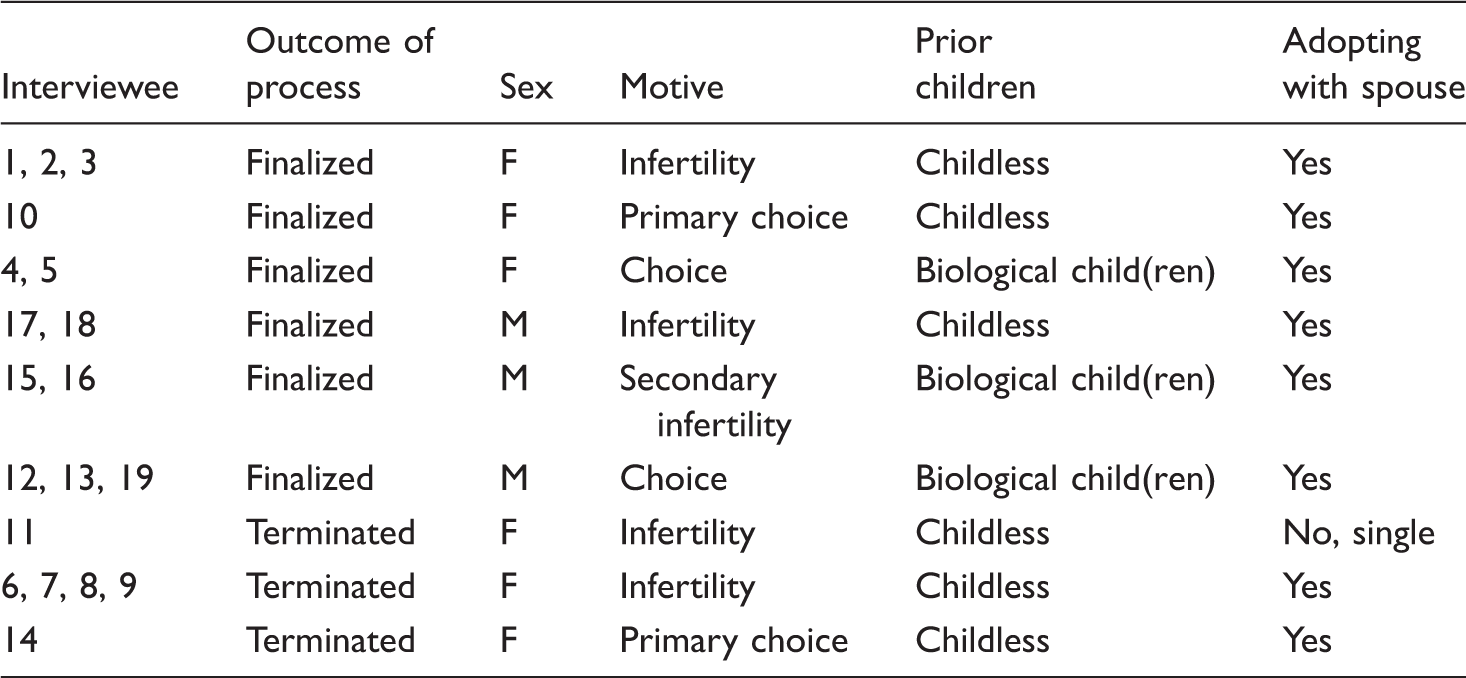
The 19 interviews were conducted in the way proposed by Rosenthal (2004), where the narrative interview consists of one period of narration, followed by a period of questions by the interviewer. The triggering invitation from me was ‘Would you please tell me about your adoption process?’ Thereafter, questions about issues raised in the narrative were asked and lastly some questions about their experiences of the different phases of the process, important events and important persons during the process, their service experiences and their encounters with professionals. Some interviews consisted of long complete narratives, whereas others turned out more as discussions about the adoption process. The interviews were recorded and transcribed. The interviewees were aware that I as a researcher had an interest in the professional practices involved within the process. They also knew my position as a social worker who had formerly worked with adoptions.
Firstly, the data was coded descriptively identifying all sequences of narrated actions or thoughts about actual, intended or considered actions in interaction with professionals. This was then followed by a coding into categories which utilized conceptual frameworks of Goffman (1959, 1969, 1983). The idea of using Goffmanesque theatrical metaphors and concepts of expression games in the analysis initially came from some of the narrator’s own word choices. One woman described the setting of assessment as something that is ‘not really real’, it felt like a ‘performance’. Another was talking about ‘planning the performance’, and a third did not feel comfortable in playing an ‘insincere role’.
The game and team play of the actors in the context was identified as playing the game of pre-adoption services, making a good impression through expression games and joining the same team.
Prospective adoptive parents playing the game
In everyday life, strategic acts unfold and every act as part of a play has an audience, regardless of the audience being present or not (Goffman, 1969). The main performers in the immediate institutional setting of pre-adoption services: the prospective adoptive parents and the professionals, both have their own performance, and also act as the audience for each other’s performances (Goffman, 1959). The number of audiences grows when the play is extended to the global scene of inter-country adoption.
In the play of pre-adoption services, the aim of the professionals is to undertake an assessment of parental risk and potential and to prepare suitable families to be matched with adoptable children. The main task of the professional in this stage is to advocate for the unknown child, while some prospective parents expect a service offered to them function as advocating for them. The client’s aim when entering the stage is to become a parent, often as smoothly as possible within a slow bureaucratic process. This play of two main teams is scrutinized in this study, through the analysis of the interaction between the clients and the professionals from the client’s point of view.
Showing one’s best side – Expression games
The performance in a situation where one is in the vulnerable position of being assessed and under observation includes showing ones best sides; being honest up until a certain point and ‘glossing over things’. As one man said, he ‘gives the professionals as much trust as they deserve’. Actors in Goffman’s (1959, 1983) texts ‘want to make a good impression on others’, and hence these actions become part of the play. The actors make an impression on the audience and also assert to themselves and others about who they pretend to be. Performances can also be idealized, whereby the actors give a better impression of themselves than reality would suggest (Goffman, 1983).
Information management
As the client pictures themselves as favourable as possible, the social worker tries to see behind this façade and verify the accuracy of the performance. One woman compared the situation to a job interview: … in that way one was selling oneself, all the time, it was kind of like a job interview …//… that if I had discussed the issues with a therapist or with my husband or alone handled the issues, it would have been different. But there, you really had to pretend and act a little bit, somehow like here and now we have to convince this person that we are good adoptive parents. … not really like lying, but yeah maybe …//… the main motive of the discussion was not that I wanted her (the social worker) to help or cure me, but to show this person that I am what I am and I can be a good adoptive mother
Further, there are audiences and players outside of this immediate context. The play is not merely about being approved, but also competing with other prospective adoptive parents as their numbers exceed the amount of children available for adoption. The decline in adoptions globally, as the supply of children does not meet the demands (Selman 2012), has led to insecurity and long waiting times for prospective adopters (Högbacka, 2008). As the social worker and the professionals in the mediating organizations are merely one part in the chain of the process, the feeling of having to prove one’s suitability continues all along the process until a child is placed in the family and the adoption finalized. As one father described the judge in the child’s birth country had the ultimate power to decide about their families’ future and a mother said ‘nothing is sure, until you have the child in your arms’.
Emotion management
Emotion management as one form of expression management can be ‘inhibiting or fabricating expressions’ (Goffman, 1969: 10). In the adoption process, some emotions are accepted and even expected, like the sorrow related to infertility which is expected, and can hence lead to its fabrication (see also Eriksson, 2016a). However, emotions like anger and disappointment are often hidden. In the initial assessment phase, also insecurity about adoption as being the right choice is sometimes hidden, in fear of it either prolonging or ending the process. Here, expression management takes the form of hiding negative emotions in the interaction and avoiding the expression of, for example dissatisfaction or insecurity.
In the waiting period (after the adoption permit is granted), ‘the game’ consists of passively waiting and the most common strategy is to be seen as passivity, even if emotional support from the professionals sometimes would be needed. In many narratives, the feeling of not wanting to bother the professionals during the waiting period (which may stretch over years) was common. Among the interviewees, it was felt that one did not want to be categorized as one of the ‘hysterical’ adoptive parents who were calling the agency all the time, and exposing one’s insecurities or anxieties was not perceived as being accepted or desired conduct.
The clients often felt they were expected to play along by not confronting the professional with complaints or by expressing negative emotions in the interaction. If clients were dissatisfied with the service, they did not complain until occasionally later when they had adopted the child. The clients in pre-adoption counselling are vulnerable because their dream of becoming parents to an adoptive child is at stake. They commonly expressed tendencies of not wanting to influence the process in a negative way: … one had this kind of fear that if one would not get along and disagree with the person handling our case, that it would influence our case, that it could influence our process. … reason said that it’s not like that, but the emotions said that it might be best not to become opposed to her anyway … well you are pretty helpless, and on their terms …//… just trying to get along with everybody not to destroy one’s chances to get that child. So in that way it’s not something one constantly thinks about, but if one feels dissatisfied, then one thinks twice about how to formulate the dissatisfaction.
According to Hochschild (1998: 9), and Kusenbach and Loseke (2013: 24) people are expected to suppress, change or shape their emotions to fit cultural expectations. In this context, the same applies to fulfilling institutional expectations. Expression management is utilized by the clients in fear of either ruining the adoption process or making it more complicated. Therefore, negative emotions are rather contained in interactions with professionals and expressed ‘backstage’ (Goffman, 1959), on other stages to alternative audiences, for example in peer-support groups or in social media.
Team management
Often the performance is given by a team of actors, usually a couple wanting to adopt and a team of professionals. Then, team management becomes important. One couple said that ‘the night before (the meeting with social worker) we decided what role we would play’, hence setting up their performance backstage at home. One strategy not coinciding with the ideal according to the institutional expectations is when the client takes an active stance in trying to control the situation or maximize the odds of the process to proceed according to his/her wish. This happens, for example by way of information control, expression games (Goffman, 1959), or by attempts to manipulate the social worker: … somehow we decided that there (in the meetings with the social worker) we would do and say and steer the situation in a way – sure we did what we were asked to, but somehow we had this feeling that we have to be pretty strict so that things would go as we ourselves wanted them to
Couples hoping to adopt feel a need to present a united front in their performance. This can need either rehearsal or contracts backstage to make it convincing. In a play, the actors on the team can also face possible disruption (Goffman, 1959). Examples of this were, for example, one woman who had forbidden her husband to make any further jokes in the presence of the social worker, since the social worker did not seem to have got the first one. Another woman was ready the entire time to kick her husband on the shin in case he said something ‘stupid’ that is, ‘took the wrong line’ during the meetings with the social worker.
Some teams also had to settle things back-stage before entering their interaction with the professionals. One man had to make sure his wife was still going to agree to apply for a new adoption permit when the first one expired and not express wishes to terminate the process. Another man was himself the one who was hiding his insecurity about adoption, in favour of his wife’s desire to adopt. Men expressed they had handled the negotiations backstage before entering the stage, while the women seemed to try to be more in control of the situated activity. There were also accounts of negotiations about whether to proceed with an insecure or long-spun process, and the showing of a united decisive front to the professionals.
Professionals and prospective adoptive parents joining the same team
Being cognitively on the same team and accepting the public control that the professional’s exercise was common, but often with some emotional resistance to the setting that inhibited true team play. When playing the game, the client accepted the agenda of being evaluated, of receiving training for adoptive parenthood, as well as the waiting for a suitable match with a child. They basically adapted (Siisiäinen, 2014) to the situation and were compliant (Fargion, 2014; Littell, 2001) in order to reach their goals. Two women said they accepted the setting: … we related to the pre-adoption preparation and assessment as a giving experience, and not just like it is something one has to pass as obligatory, but that it can seriously offer lots of useful things for the future … anyhow we got along well (with the social worker) and we had decided that we were not going to be difficult, but we tried to make the meetings proceed in good co-operation and that it was to our own advantage … and it was
Another woman and her spouse had consciously decided to be open and honest in the assessment: … but we also decided right from the beginning that we would be honest, and not try to hide something, that we are not going to hide anything nor try to be something we are not. We are going to be who we are, and then it is either good enough or not, because you can't do more than that.
Here the client perceived the aim of the professional to be the same, that is to help them acquire a child, and in this context, the aim defines which team the players are on. The rhetorical device of ‘being on the same side’ was used and then the interests of the family to adopt a child into the family was perceived to be shared with the professionals. Many prospective adoptive parents trusted the professionals and felt supported during their pre-adoption process. One example shows a woman who places full trust in the social worker to judge her suitability, and also compared it to a job-interview where the recruiter probably knows whether one is suitable for the job or not: … it is good anyway that in case one would not be suited as an adoptive parent, then it would be good that you are rated out in that stage and don’t get the child and then destroy it …
Though the aim of the whole adoption process is to ensure the right of the child, the dynamics of advocacy seems to partly change during the process. When having ensured suitability of the prospective adoptive parents the professionals in the receiving country partly become advocates of the adoptive parents to be and ‘join their team’. Home-study reports, as well as the clients’ applications are written in co-operation with the professionals to achieve a preferred outcome for the prospective adoptive parent. After completed assessment, the client and the social worker form a team in an advocacy performance, where the audience is the adoption council granting permits for adoption and the sending country matching children based on the applicant’s home-study reports. Written home-studies are suited to the requirements of the sending country, and Noordegraaf et al. (2009) have shown the formulation of biographical information into home-studies as presenting a positive picture of those being recommended for adoptive parenthood.
Discussion
The results show that clients respond to the power inequality and controlling practices of the professionals with strategic actions in order to enhance the outcome and flow of the adoption process. In Goffman’s (1959) terms, the clients and professionals play on different teams, with different aims, but in pre-adoption services they are expected to play on the same team with a common goal. Though the strategic action stem from different primary aims of the parties, as demonstrated, the aims in reality do become intertwined. The client’s secondary aim usually is to offer a home for a child and the secondary aim of professionals to help the prospective adoptive parents in becoming parents. Hence, the division or opposition in aims is somewhat artificial, but illustrative.
In the light of social work literature and studies showing that a good working relationship with the professional influences the outcome of assessment and service (e.g. Holland, 2000, 2011; Littell, 2001; Platt, 2012; Yatchmenoff, 2005), the strategies adopted by clients seem plausible. A good relationship requires trust, but also adapting and conforming that have been shown to be favourable strategies from a client’s point of view (Holland, 2000; Littell, 2001). According to Holland (2000), clients in child welfare assessments who are co-operative, motivated and articulate in their service relationships are in general ascribed the same attributes, thus having an impact on the result of the assessment.
The institutional setting might inhibit the achievement of a state of honest reflection in the interactions with the professional, which has also been noted by van Nijnatten (2010) in the context of child welfare. Earlier resistance and strategies by clients in child welfare have been identified by Smith (2008) and Dumbrill (2006), and in prospective adoptive parents by Noordegraaf et al. (2010). Dumbrill (2006) names three strategies as ‘playing the game, co-operate, or fight’, all of which are connected to the different perception of the power usage of the professional. Strategies used in the pre-adoption services resemble those found among other child welfare clients. As Goffman (1969) puts it, ‘our ability to act rationally and thus strategically maximize our own gains pointedly depends on our ability to assess and predict the thoughts and actions of the other persons involved’. The prospective adoptive parents possess this ability to a higher degree than many traditional client groups in social work.
The presence of what Dumbrill (2006) calls ‘fighting’ among child welfare clients, is very subtly perceived in pre-adoption services. When comparing adoption services with child welfare, it is important to acknowledge the difference of voluntariness in the clients’ participation in the services. Much of child welfare deals with non-voluntary clients, whereas pre-adoption services are voluntary and the clients are contrastingly eager to enrol. The adoption of a child is a voluntary choice, but the pre-adoption service is a mandatory component of the process. In child welfare, open resistance among clients is often present (e.g. Mirick, 2012), but in pre-adoption services, this resistance is neatly hidden. However, even subtly resisting clients can be seen to lack the needed motivation for adoptive parenthood. If dissatisfied, an exit from the services is possible but the price to be paid for this is often a termination of the adoption process, which frequently means giving up the hope of having a child. Hence, the client has to navigate the situation in the best possible way.
The expression games in pre-adoption services further resemble those of risk management used by clients in mental health, and identified by Reynolds et al. (2014) as ‘playing the game of containing frustration and demonstrating compliance’. The same risks of crucial assessment information being hidden, and a reluctance to express dissatisfaction lest it possibly becomes a barrier to good relations with the professionals that were pointed out by Reynolds et al. (2014), exist in pre-adoption services.
The strategies of information control and emotion inhibition might present a challenge to achieving optimal pre-adoption service outcomes as at a certain point it comes to hinder a trustful relationship with the professionals. This especially appears to be the case when the aim of the professionals is clearly perceived by the clients to be different or conflicting with their own. The lack of trust in the relationship inhibits both receptivity to information needed in rearing an adoptive child and reflection. Emotion management can further inhibit the reflection and also hinder needed support in fear of negative emotions influencing the process in an undesired way. The employment of these strategies itself can be stressful and have a negative effect on the future adoptive parents. Further for the assessment to succeed, the professionals need truthful information based on the verbal accounts of the clients. Withholding or giving false accounts always remains a weak spot and presents a risk in verbal assessments. During the waiting period, the withholding of information can take the shape of not informing the agency about, for example, major changes in one’s life, or even the loss of motivation for adoption.
Also in the light of the global forces which influence inter-country adoption, these client strategies are understandable. The micro-level performances of the professional and the prospective adoptive parents are but a small part of the global scene of inter-country adoption, involving market elements (e.g. Högbacka, 2008; Triselotis et al., 1997; Yngvesson, 2002). The powerful forces in this game are reflected in the interactions on micro-level between social workers and clients, as is the most tangible dependency of the adoption agencies on the sending countries authorities, policies and institutions.
Employing some degree of strategic behaviour can be seen as one of the few possibilities the client has to influence the progress and outcome of the process. In relation to the institutions and the bureaucratic process, prospective adoptive parents who for example want to shorten the waiting time or hope for a child with certain characteristics, choose and change their preferred birth country of the child according to the fluctuating situation.
According to earlier research (Corby et al., 2002; Platt, 2012), the key to success in child welfare services is to find some level ground or form of congruence in the views between the clients and the professionals. In the study by Dumbrill (2006), clients either perceived professionals to exert power over them, or as form of support. It seems that the client’s perception of the professional as either playing on the same team or on the opposite team is important, or as Dumbrill (2006) puts it, perceiving the power to be exercised either over or with the client. Child welfare will always need to balance this power tension between support and control, where the general perception of support seems to shift to control when the team that the professional plays on is seen to shift. Still, the negotiating of power relationships in a narrow institutionalized space will remain. This means that prospective adoptive parents need to perceive that the professionals are at least partially playing on the same team as themselves, and that they have a shared goal, indifferent of the fact that their primary aims and goals are in fact not fully shared. It is also important not to make these interactive performances on different levels adult-driven through the primary aim of the adult clients taking over and overshadowing the priority of the needs of the children in adoption. In the services the main aim should be to make the pre-adoption process as beneficial as possible for all of its parties, and consequently improve the future wellbeing of adoptive families. Acknowledging and making visible the power imbalance and its effects on interaction makes the interactive stage less prone to information control and expression games, and fosters a more favourable relationship between client and professional.
Footnotes
Declaration of conflicting interests
The author(s) declared no potential conflicts of interest with respect to the research, authorship, and/or publication of this article.
Funding
The author(s) disclosed receipt of the following financial support for the research, authorship, and/or publication of this article: The author has been supported by the Ella and Georg Ehrnrooth Foundation in writing this article.