







Abstract
Healthy nutrition is the driving force behind measures to address the obesity and diabetes epidemic. Therefore, the relevance of healthy nutrition to public health is steadily increasing. Although many consumers have positive attitudes towards healthy nutrition, their eating habits do not always match these attitudes. This paper suggests that individuals can overcome the discrepancy between attitude/intention and behaviour if they consider implicit associations with healthy or unhealthy nutrition. Our paper aims to develop a research strategy to analyse the impact of the interplay between explicit and implicit food associations on food consumption. The suggested process comprises the following steps: consumer segmentation, isolated analysis of different implicit drivers, holistic examination of interaction effects of different drivers and development of implications for policy makers and managers.
Keywords
Abbreviations and acronyms
IAT Implicit Association Test
Introduction
Diet-related diseases, such as type 2 diabetes mellitus and obesity, negatively affect quality of life, cause numerous deaths each year, and raise the health spending share of health insurance companies and national governments.1-4 These negative impacts can be avoided to a large extent by a change in consumers’ lifestyles. Several international studies show that type 2 diabetes, for example, is largely preventable with early lifestyle change. 5 Key indicators for preventive success are the increase in physical activity and the modification of eating behaviour. Any contribution to fostering healthier food choices is relevant for the prevention of chronic diet-related diseases. 6 In particular, consumers need to increase the relative consumption of healthy, compared to unhealthy, food. Prevention methods are most efficient when they target high-risk groups at a preclinical stage of disease. They should focus on modifiable risk factors such as overweight and harmful lifestyle,7,8 so that a change in consumers’ eating habits will have a major societal impact.
Extant prevention campaigns are helpful in raising problem awareness. Many consumers are now aware that healthy nutrition fosters their well-being. Despite the attitudinal change and the growing intention of many consumers to eat healthy food, efforts in changing actual nutritional behaviour have not yet led to satisfying results. It is our hypothesis that this discrepancy is due to the fact that nutrition behaviour is largely driven by implicit attitudes. Implicit attitudes are unconscious and automatic and cannot be verbalised. Although eating is an action of which the individual may be aware, control of eating habits is not necessarily explicit. In contrast, consumers frequently choose their food products in an unconscious manner. Empirical research demonstrates that consumers’ implicit and explicit attitudes towards healthy nutrition often diverge.9-14 The distinction between implicit and explicit processes of food purchase, preparation and consumption therefore plays a key role in gaining a deeper understanding of the gap between positive explicit attitudes towards healthy nutrition and the consumption of non-healthy food.
To date, little is known about implicit drivers of unhealthy nutrition and how they can be overcome by prevention campaigns. The present paper outlines an agenda for intensifying research in this field. We argue that researchers can gain a holistic view of the complex process of food choice by combining the theories and methods of different fields. To guide future research, we suggest the following multiple-step approach: consumer segmentation, isolated analysis of different implicit drivers, holistic examination of interaction effects of different drivers and development of implications for policy makers and managers.
The proposed research agenda
Implicit attitudes towards unhealthy food stem from various sources, such as intrinsic product attributes (e.g. taste), extrinsic product attributes (e.g. branding), consumer lifestyle (e.g. convenience) and/or cognitive processing (e.g. visual perception). Since all of these factors influence food choice simultaneously, an explorative, holistic and multi-step approach is necessary to identify the implicit drivers of unhealthy eating habits (figure 1).
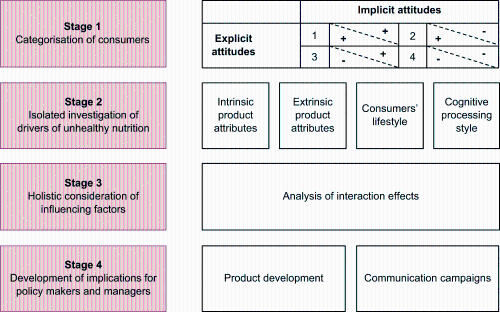
Overview of the research agenda
Stage 1: Categorising consumers based on different attitudes towards healthy nutrition
We suggest considering the interplay between implicit and explicit attitudes towards healthy nutrition as a moderator variable in any investigation concerning the antecedents of healthy food choice. Researchers should segment consumers on the bases of implicit and explicit associations towards healthy nutrition. As a simple starting point, we distinguish two groups of consumers regarding their implicit attitudes (negative versus positive), and two groups regarding their explicit attitudes (negative versus positive). Combining these dichotomous categories results in a scheme of four groups of consumer types (figure 1).
We believe that those who exhibit differences in implicit and explicit attitudes towards healthy eating are of special interest (i.e. groups 2 and 3). Behavioural shaping is required when explicit attitudes are far more positive than implicit ones (group 2). Although these consumers intend to eat a healthy diet, they reject healthy food for unknown implicit reasons. Interventions are to be tailored particularly for this group, because their health behaviour is hardly influenced by additional information given through educational campaigns. Traditional persuasion strategies, such as educational advertising, are not applicable to improve the eating behaviour of this group because such strategies change explicit attitudes only and do not affect implicitly driven food choices.
Explicit attitudes can be measured with self-report questionnaires, whereas implicit attitudes cannot be accessed and verbalised easily by the individual. To overcome this obstacle, we suggest using the IAT, 15 which measures implicit attitudes by a multiple-step procedure of computer-based reaction-time tasks. Subjects have to rapidly sort stimuli that appear on a computer screen into two target concepts (e.g. healthy or unhealthy food) or into evaluative attributes (e.g. good versus bad or delicate versus distasteful). The subject’s implicit associations are derived from differences in mean response times in the different task conditions (easier versus more difficult pairings of the target concepts and attributes). By combining the IAT with self-report questionnaires, individuals can be classified into one of the four consumer segments.
Stage 2: Separate investigations of drivers of unhealthy nutrition
For the analysis of different drivers for unhealthy nutrition we suggest distinguishing between product-based and personality-based implicit obstacles of healthy food consumption. Product-based factors comprise intrinsic and extrinsic product attributes. Personality-based drivers include lifestyle and cognitive processing styles.
Intrinsic product attributes
Intrinsic product attributes, such as smell, taste, appearance, texture, or mouth-feel affect food preferences and food choice. At least partially, preferences develop unconsciously and exert their influence on eating habits in an implicit way. Hedonic attitudes (e.g. pleasantness) towards food are strongly influenced by fat, sugar or salt intake, which correlate well with diet-related diseases. 16 Sensory methods allow analysis of the implicit impact of intrinsic food attributes on attitudes towards healthy nutrition and food choice. 17 Sensory experiments, for example, help measure the effect of a particular treatment (different amount of sugar in a cake) on the subject’s responses (how the subject likes the cake).
Extrinsic product attributes
Extrinsic product attributes, such as packaging, image, price, distribution or branding, also implicitly influence food choices. 18 In particular, the extrinsic labelling of intrinsic properties is a hot topic. 19 A ‘reduced fat’ label, for example, negatively affects the acceptance of chocolate bars. 20 The analysis of the influence of extrinsic product attributes is difficult, however. If consumers are asked to specify the product attributes which determine their choice, they often demand the ‘perfect product’ (all preferred attributes at the lowest price). In order to overcome this inflation of expectations, researchers should use decomposition techniques (e.g. conjoint analysis) to identify product attributes that are most relevant in consumers’ decisions. 21
Lifestyle
Apart from product-based drivers, personal implicit drivers also affect food choice. Frequently, consumers unconsciously purchase certain products that represent their personal lifestyle. Convenience orientation, which is a facet of lifestyle, strongly affects consumption behaviour. 22 We suggest using the Food-Related Lifestyle scale 23 because it is the most comprehensive measurement instrument in this area. It collects consumer information on attitudes and behaviour with regard to purchase, preparation and consumption of food products. Based on this instrument, six food-related lifestyle segments have been identified: hedonistic consumers, conservative consumers, extremely uninvolved consumers, enthusiastic consumers, moderate consumers and adventurous consumers.
Cognitive processing
Cognitive processing is essentially based on visual information, which requires visual attention. The study of eye movements provides a promising approach for revealing personality-based implicit factors. Eye-tracking is currently considered to be a reliable method to measure a person’s allocation of attention. 24 It enables the observer to directly gain information about subjects’ preferences in comparative displays. 25 For instance, overweight or obese individuals focus more intensively on high-calorie foods than healthy weight persons when confronted with different foods. 26 To better understand the implicit influences on food decisions, functional differences between eye movement parameters provide insightful information. Eye movement parameters allow differentiation of how individuals process attentive information. 27 Based on such relationships between cognitive-affective information processing and gaze behaviour, eye tracking experiments can help to identify implicit preferences for unhealthy food. We expect that information processing varies between the four consumer segments. The analysis of eye movements provides invaluable diagnostic information in the course of developing specifically tailored intervention programmes.
Stage 3: Holistic consideration of influencing factors
To gain a comprehensive understanding of the implicit drivers of unhealthy nutrition, a holistic view of the interaction between different drivers is required.28,29 Food choice depends on a set of multi-sensory implicit drivers (e.g. visual, gustatory, olfactory and haptic), which might interact with lifestyle as well as intrinsic and extrinsic food attributes. We suggest refining and combining the findings of Stage 2 to develop more complex models. First, researchers should examine interaction effects of intrinsic and extrinsic food attributes to overcome sensory disadvantages of healthy foods (e.g. less preferable taste, texture or colour). They should examine whether some extrinsic product attributes are quality signals, which are capable of substituting less favourable intrinsic attributes. These effects may interact with the way a person processes food information. For instance, there may be segment-specific differences in how much attention consumers pay to intrinsic (e.g. appearance) and extrinsic food attributes (e.g. nutrition facts). Finally, researchers can investigate how a person’s lifestyle moderates these effects. Health-conscious consumers, for example, may accept a loss in taste in favour of fat-reduction if the food is explicitly declared as being healthy. Convenience-oriented individuals, in contrast, accept a loss in taste only if it is compensated by an easier method of consumption (e.g. via packaging, distribution or availability).
Stage 4: Development of managerial implications
Product development
Based on findings from the previous stage, strategies to overcome disadvantageous intrinsic attributes by highlighting extrinsic health-related and health-unrelated product attributes will be developed. Health-related attributes refer to food ingredients (e.g. labelling of ingredients or nutrition facts), whereas attributes not related to health refer to elements of the marketing mix (e.g. packaging, price, positioning, branding). As the four consumer segments are expected to differ in their needs, products must be tailored to meet a specific profile of implicit and explicit attitudes towards healthy nutrition. In the case of health-conscious consumers, we expect that signalling the healthy nature of a product is sufficient to compensate for the negative intrinsic product attributes of healthy food. Negative explicit or implicit attitudes, however, can only be compensated by non-health-related attributes, such as lower price or positioning that fits the consumer’s lifestyle.
Communication campaigns
Our agenda also helps in gaining knowledge on how social marketing campaigns, which aim at fostering healthy nutrition, can be improved. Communication strategies need to be tailored to the specific consumer segments. Consumers with positive explicit and implicit attitudes towards healthy nutrition are to be persuaded by communicating health-related messages, whereas negative explicit or implicit attitudes must be overcome by non-health-related messages stressing other positive aspects (e.g. social and physical attractiveness). These campaigns may aim at repositioning healthy food products by addressing central underlying needs of high-risk groups (e.g. convenience, social identity, conspicuous consumption).
Discussion
Europe is faced with a fast growing prevalence of type 2 diabetes. This effect is driven by the increasing prevalence of obesity in Europe due to lifestyle and behavioural changes, by a continuously earlier onset of the disease in the younger population and by an increasing age of the European population. Interventions for the targeted or population-based primary and secondary prevention of diabetes may address this challenge. Studying consumer behaviour may become necessary for successfully implementing diabetes prevention programmes into daily practice. The suggested research agenda puts the focus on consumers’ implicit attitudes towards healthy and unhealthy food. Its overall academic prospect is to widen and deepen the understanding of implicit drivers of unhealthy nutrition. In this way, it contributes to the explanation of the attitude/intention–behaviour gap in food consumption. Theories can be developed on how attitudes towards unhealthy nutrition depend on the interaction of product-based and personal drivers. Furthermore, the agenda helps to establish a holistic framework to explain why different segments consume healthy or unhealthy food.
Based on these scientific outcomes, our agenda will provide producers, marketers, physicians and policy makers with new insights into why consumers refrain from buying healthy food. They will learn how to design effective communication campaigns. For product development, the findings will give hints about how to compensate the disadvantageous intrinsic attributes of healthy food (e.g. loss in taste) by improving extrinsic attributes (e.g. labelling, branding, packaging). In this way, our approach also contributes to the success of producers of healthy products (who must compete with producers of conventional food). The implications will help to design appropriate products that overcome fundamental obstacles for healthy nutrition. Note that our approach is focused on cognitive processes (both explicit and implicit). Food choice depends on additional factors, such as physiological processes of the human body, which might not be addressed by our approach. Future research should develop models of how to integrate these factors as well.
Fulfilling the agenda’s objectives will realistically increase the chances of implementing diabetes prevention programmes in European countries, which will lead to a more efficient reduction of type 2 diabetes, eventually bringing about social and economic benefits and positive impact on public healthcare costs.
Key messages
Despite growing health awareness and intention, diet-related diseases are increasing
Understanding implicit associations with nutrition is important to overcome attitude–behaviour discrepancy
Implicit associations comprise personality-based, as well as product-based, factors
Footnotes
Acknowledgements
A realisation of this research approach will be supported by the German Bundesministerium für Bildung und Forschung (grant number 0315670).