






Abstract
Broadband noise in turbofan inlets is represented in a frequency domain analysis by a statistical distribution of propagating duct modes. The required number of modes is estimated by Rice’s approximation method. A brief overview of essential results from the theory of acoustic propagation in ducts is given, providing a starting point for Rice’s estimation of the distribution of propagating modes in a uniform unlined duct required to represent a broadband noise source. The relationship between mode cut-off ratio and attenuation in lined ducts is examined to connect cut-off ratio to modal attenuation, and it is shown by example that for arbitrary impedance at a specified frequency, modes with similar cut-off ratios have similar attenuation. It is then shown by example that the attenuation of a low-order circumferential mode, specifically the axially symmetric circumferential mode, with a large range of propagating radial mode cut-off ratios, is insensitive to impedance variations near the optimum impedance. Two models for estimating achievable attenuation for broadband noise attenuation, based on equipartition of acoustic power among propagating modes, are considered. One uses only the axially symmetric circumferential mode, and the second uses all propagating circumferential modes and their associated propagating radial modes. A new parallel architecture version of an established propagation code, designed to include all propagating modes on a statistical basis, is described. Examples for prediction of acoustic power attenuation of broadband noise at low frequency and at moderate frequency are used to compare the performance of the axially symmetric circumferential mode and the all circumferential mode models. It is shown by example that a broadband noise model based on the axially symmetric circumferential mode predicts lower attenuation than a model with all propagating circumferential modes. Rice’s correlation of mode cut-off ratio with attenuation justifies this observation.
Introduction
The prediction of suppression of fan-generated noise from turbofan engines has generally been directed toward tones. For early, low bypass ratio engines, blade/stator interaction tones at approach and cut-back conditions were most important. In modern high bypass ratio engines, blade passage frequency (BPF) and multiple pure-tone noise at takeoff, cut-back and cruise conditions, as well as blade/stator interaction tones, are targeted. Performance prediction of acoustic linings has generally focused on tones, principally because the generation mechanism is well understood and the modeling of the physics of the problem lends itself to simplifications based on the Tyler and Sofrin 1 identification of the spinning mode structure associated with rotating and stationary blade counts. There has been considerable success in reduction of turbofan engine tonal noise, to the extent that it can often be attenuated to near or below the level of broadband noise. This exposes broadband noise as a contributor to the various metrics used to assess the environmental impact of aircraft noise. Consequently, it is appropriate that a prediction tool be available to assess the suppression of broadband noise that can be achieved by acoustic treatment specifically designed for it, or that can be achieved as a by-product of acoustic treatment designed for tones.
ANOPP (Aircraft Noise Prediction Program), 2 an aircraft noise environmental impact assessment tool, has imbedded in it an engine noise module that includes broadband noise based largely on empiricism. A user-provided engine noise module can also be used to provide data in the ANOPP format. One motivation for the present investigation has been the development of a user-based module more theoretically based than the imbedded ANOPP module.
For a specified flight operation, ANOPP predicts effective perceived noise level. This metric is based on one-third octave band spectral decomposition of engine and airframe noise. Propagation and radiation of inlet tonal contributions to the spectrum can currently be modeled efficiently by codes described in the literature3,4 or by commercial codes. The same cannot be said for broadband inlet noise. Generation of broadband noise, and hence its propagation and radiation, is not easily quantifiable because the Tyler and Sofrin procedure for identification of modal content is not available. An early study of broadband noise, 5 based on statistical considerations, suggested that at least at high frequencies, the acoustic field can be constructed on the basis of equipartition of acoustic power among all propagating modes. This leaves modal phasing to be treated as statistical and essentially requires representation of the source in terms of all propagating circumferential and radial modes, not just the ones associated with the Tyler and Sofrin model. The implication that models of broadband noise should include all propagating modes on a statistical basis makes codes designed for tonal noise impractical to use. The purpose of this investigation is to develop an improved method of modeling broadband noise that is useful at the design level.
The discussion begins with the assumption that it is necessary to examine inlet noise suppression over the 24 one-third octave bands with center frequencies from 50 to 10,000 Hz. Noise is generally a combination of broadband noise and tones. Tones are related to shaft frequency
The most practical design tools for modeling acoustic propagation and radiation from turbofan engines are based on frequency domain models that have a common basis in the linearized Euler equations (LEE). With the assumption of isentropic potential mean flow, LEE is reduced to an acoustic velocity potential formulation. With the further assumptions that the nacelle geometry is axially symmetric with circular or annular cross section, that the acoustic treatment is axially symmetric, and that the source is modeled in terms of circumferential modes, the field equations for the single-field variable velocity potential become spatially two dimensional for each circumferential source mode. If the duct is uniform, the mean flow field becomes uniform, and the governing field equation is the convected wave equation and can be written in terms of either acoustic potential or acoustic pressure. In the frequency domain, the formulation is completed with appropriate boundary conditions, including the specification of an impedance relationship for acoustically treated walls and the condition of vanishing acoustic particle velocity normal to untreated, rigid walls. 7 If the potential mean flow assumption is not invoked, then in general LEE must remain in terms of the primitive flow variables. For a specified mean flow profile that does not vary axially in a uniform duct, LEE can be reduced to the Pridmore-Brown formulation for sheared flow, resulting in a single-field equation in terms of acoustic pressure. 8 In this investigation, the sheared flow option is not used because the design tools are based on potential mean flow.
Models for acoustic propagation and radiation from turbofan inlets break down into frequency domain models and time domain models. Gabard 9 has noted that frequency domain models are burdened by the requirement to consider all propagating circumferential modes with their associated propagating radial modes, resulting in inefficiency and computational expense. Gabard proposes the use of time domain computation and has introduced a statistical source model for this purpose. Time domain models have the advantage that the solution is a time series and Fourier methods can be used to extract spectral information, eliminating the requirement of frequency by frequency computations. Frequency domain methods have the advantage that the mathematics naturally decomposes into modal component solutions that contain a wealth of information contributing to the optimization of acoustic treatment via Rice’s classical concept of modal cut-off ratio.10–17 It is the goal of this investigation to extend frequency domain methods to efficiently include broadband noise modeling.
Commonly used duct propagation analysis tools are based on time harmonic solutions for a specified circumferential mode. For unlined uniform ducts, each circumferential mode is associated with a distribution of radial modes. Each mode is classified as propagating (cut-on) or non-propagating (cut-off) based on whether in isolation it can carry acoustic power or not. The number of propagating radial modes associated with a specified circumferential mode decreases in number for increasing circumferential mode order, up to a circumferential mode order for which no radial modes propagate. A circumferential mode is said to propagate if at least one of its associated radial modes propagates. If no associated radial modes propagate (all modes are cut-off), the circumferential mode is cut-off. A broadband noise source in an unlined duct can be represented by all propagating modes at a specified frequency. The number of propagating modes at a specific frequency is predictable and finite, though it may be large. For a hard wall circular duct with uniform flow, Rice 10 has provided a method to obtain a good estimate of the total number of modes that can propagate at a specified frequency, as well as the number of propagating circumferential modes. This estimation method and a series of Rice’s investigations of the details of the effect of mode cut-off on duct propagation and radiation11–15 are used here to construct a useful model for broadband noise propagation and suppression.
The discussion begins with a brief overview of essential results from the theory of acoustic propagation in ducts. This provides the starting point for the method of Rice 10 for the estimation of the distribution of propagating modes in a uniform unlined duct required to represent a broadband noise source. The relationship between mode cut-off ratio and attenuation in lined ducts is then examined to connect cut-off ratio to modal attenuation, and it is shown by example that for arbitrary impedance at a specified frequency, modes with similar cut-off ratios have similar attenuation. It is then shown by example that the attenuation of a low-order circumferential mode, specifically the axially symmetric circumferential mode, with a large range of propagating radial mode cut-off ratios, is quite insensitive to impedance variations. Implications of these observations for attenuation of broadband noise attenuation are discussed. With this background, two models for estimating achievable attenuation for broadband noise attenuation are discussed. Both approaches use a new parallel-processor version of an established propagation code to include all propagating modes on a statistical basis.
Propagation models
Non-uniform ducts
Models of acoustic propagation and radiation from turbofan engines that are most useful for design are based on perturbations on a steady mean potential flow. The reduction of the LEE to a two-dimensional form for axially symmetric geometry and potential mean flow is emphasized because it forms the basis for frequently used prediction codes available in the literature3,4 and in commercial codes. The linearized conservation of mass and momentum equations, the equation of state for an isentropic medium and the acoustic velocity potential definition in terms of non-dimensional variables are
The coordinate system is cylindrical, with x-axis the axis of symmetry, r the radial coordinate and θ the circumferential coordinate. Spatial coordinates
Equations (1) to (4) are supplemented by boundary conditions on the duct walls. At acoustically hard walls the normal component of acoustic particle velocity vanishes
At walls with acoustic treatment, the Myers
18
impedance boundary condition is complicated by the velocity potential formulation and is presented here in three steps. The basic impedance relation is (impedance is a rigorous concept only for frequency domain models)
Equations (1) to (7) are solved in regions where the duct and mean flow field are non-uniform, using the finite element method (FEM) in the frequency domain for a specific circumferential mode. This generates acoustic solutions of the form
The non-dimensional frequency
FEM is implemented to generate solutions
Equations (1) to (8) are required in regions, where the duct and mean flow are non-uniform. The source is imposed in an appended uniform section of duct in which the flow field is essentially uniform and in which a solution in terms of a single circumferential mode and corresponding radial acoustic modes is generated, with incident and reflected modes. Incident modal amplitudes are imposed, and reflected modal amplitudes are calculated. In the case of an assumed reflection-free termination, a similar appended uniform section, perhaps with a radius differing from the source radius, is used in which the modal solution is imposed with no reflected modes and transmitted modal amplitudes calculated. For far-field radiation solutions, the computational domain is extended beyond the end of the duct with a reflection-free boundary imposed via mapped infinite elements.
The uniform duct solution yielding acoustic modes is an essential part of the general formulation of equations (1) to (8). It is also the basis for fundamental studies of the design of linings for optimum attenuation and is the starting point for the many contributions of Rice.10–15
Propagation in a uniform duct with uniform flow
When the duct and mean flow are uniform, equations (1) to (7) lead to the convected wave equation
The local Mach number Ml is based on the local speed of sound, and the local non-dimensional frequency
Equation (10) applies for circular, annular or rectangular cross section. In the following, details are given only for the circular geometry. The boundary condition at an acoustically hard wall at
The boundary condition for an impedance wall at
Progressive wave solutions of the form
Solutions in the circular duct case are
The non-dimensional transverse wave number κ is defined in terms of the non-dimensional axial wave number kx by
The inverse relationship is
For a specified circumferential mode, m, equation (15) or (16) yield an infinite sequence of transverse wave numbers (eigenvalues),
In an approach consistent with the FEM formulation for the non-uniform duct suggested by equations (1) to (8), the eigenvalue problem is solved via an FEM formulation.
20
This is done in a form common to unlined and lined ducts with uniform flow. The axial wave number
The axial wave number kx determines the type of solution in the unlined duct. Since the transverse wave number κ is real, equation (18) reveals that if
The ratio
A model for broadband noise must necessarily consider many, if not all, propagating modes in a statistical distribution. Rice 10 provides an estimation of the number of modes this could include.
Modal distribution in unlined ducts
There is no Tyler and Sofrin
1
model for broadband noise, and it is assumed that all propagating modes at a specific frequency must be considered. Rice
10
has provided a basis for estimation of the number of modes this might be for unlined ducts. His analysis introduces a parameter
This definition is retained here to facilitate comparison with Rice’s work. (Comparison with Pridmore-Brown
8
will show that the present non-dimensional frequency,
The eigenvalues of equation (15) are insensitive to the sign of m, corresponding to progressive wave solutions of equation (13) that include the axially symmetric mode for
Equation (22) can be solved by various means to determine the circumferential mode number for which there is only one propagating radial mode by setting Curves for approximate prediction of the number of propagating radial modes for a specified circumferential mode. The critical transverse wave number 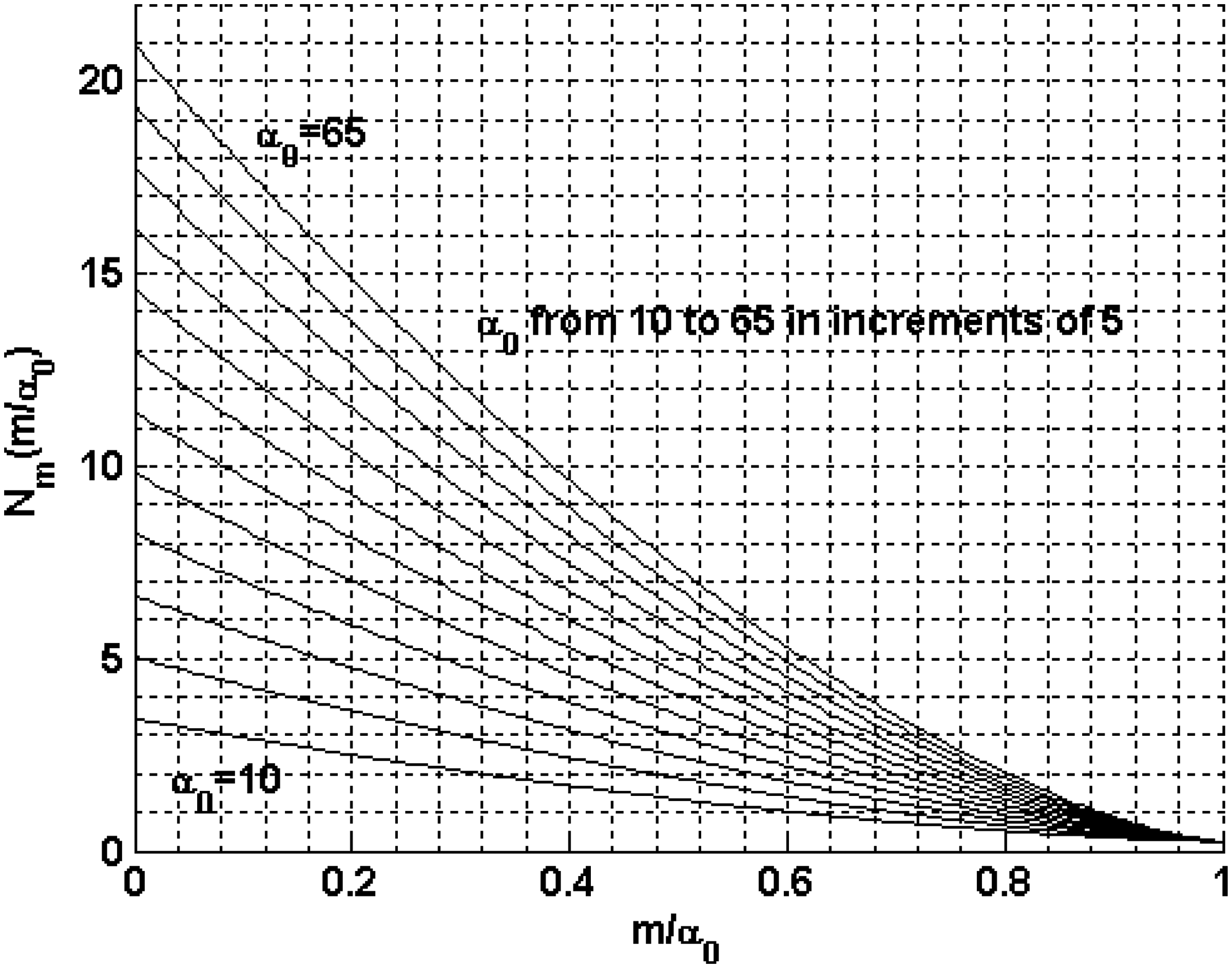
A useful point to be made is that for high frequency, and consequently high
Rice also provides a prediction for the total number of modes, composed of the propagating circumferential modes with their propagating radial modes. The prediction formula for one direction (including the axisymmetric mode
Equation (23) is shown in Figure 2. This figure shows the dramatic rise in the number of propagating modes as Curve for approximate prediction of the total number of propagating modes as a function of the critical transverse wave number 
Another useful approximation given by Rice is the number of propagating radial modes in the axially symmetric circumferential mode,
Equation (24) shows the transition from the notation of equation (22) and retains Rice’s notation in the final form. At
The approximate total number of modes predicted, including the axially symmetric mode and both clockwise and counter-clockwise spinning modes, is twice the result of equation (23), less the prediction of equation (24)
These results illustrate the rapidly expanding computational problem encountered in developing a model of broadband noise propagation. As frequency increases, the overall number of propagating modes increases dramatically, as does the number of propagating circumferential modes. In the
Modal distribution and attenuation in lined ducts
Rice 11 has studied broadband noise attenuation based on a semi-infinite, uniform circular cross-section lined duct. In the present study, the duct configuration is extended to consist of a finite lined section imbedded between an unlined source section and an unlined, reflection-free termination section. A distribution of many propagating modes is assumed in the source section, incident on the lined section, where there is scattering into transmitted modes into the lined section and reflected modes back to the source section. At the end of the lined section, there is scattering into reflected waves in the lined section and transmitted modes in the reflection-free termination section. This configuration was chosen for several reasons. It is physically realistic, representing a short section of unlined duct between the fan source and the lining. It is compatible with available FEM analysis methods. Most importantly, in the unlined source section all incident acoustic power is accounted for in the incident cut-on modes, and the number of these can be estimated by Rice’s method. 10
Rice’s estimation of the number of propagating modes is limited to unlined ducts, and therefore appropriate for the source and termination sections of the current duct model. The analysis method used in the present study models the source plane and termination plane with unlined duct modes, but uses a full FEM propagation solution in the interior, so that scattering at the lining leading and trailing edges is implicit in the solution. Modal solutions in the lined section are not explicitly generated. However, some features of a modal solution in the lined section are useful for envisioning how broadband noise is attenuated.
For lined ducts, the clear distinction between cut-on and cut-off modes, and the implication for transmission of acoustic power, becomes blurred. Since the transverse wave number, κ, is complex for a lined duct, the conventional definition, equation (20), no longer leads to a real cut-off ratio. Rice 13 has extended the definition of cut-off ratio to the case of lined ducts when the transverse wave number is complex. Essentially, the approach is to use the real part of the transverse wave number in the definition of cut-off ratio. Rice has presented a large body of work correlating cut-off ratio with optimum lining impedance and far-field radiation directivity based on this extended definition.12–17 Modal distribution estimates for unlined ducts serve only as a guide for lined ducts.
Cut-off ratios for propagating modes for an unlined circular duct, inlet

Columns are circumferential modes from
Cut-off ratios and attenuation for propagating modes for a lined circular duct, inlet

Columns are circumferential modes,
The number of propagating circumferential modes is reduced from 12 to 10, and the total number of propagating modes is reduced from 29 to 20. It is clear that attenuation is correlated with cut-off ratio across the circumferential and radial modes, with cut-off ratios near unity producing large attenuation. The insertion of acoustic treatment compresses the range of cut-off ratios from above. It is observed that attenuation increases rapidly as cut-off ratio reduces toward unity, and the highest circumferential modes have large attenuation.
The information shown in Table 2 is partially reproduced in Figure 3. Shown is the relationship between attenuation and cut-off ratio for the case of Table 2. Missing for the sake of clarity in the plot is the information relating the attenuation and cut-off ratio to specific circumferential/radial mode orders Correlation of attenuation with cut-off ratio derived from the data of Table 2.
Details of the scattering of unlined duct source modes into the lined section are not explicitly part of the propagation solution. The cut-off ratios and attenuations serve to indicate what type of propagation the lined duct will support. It is known that a specific circumferential mode will scatter into the same circumferential mode in the lined section. It is clear that the high-order circumferential modes will have high attenuation (particularly those with just one propagating radial mode). Among the lower circumferential modes, attenuation will depend on the distribution of radial modal amplitudes, and this can be analyzed statistically.19–21
Sensitivity to lining impedance
For broadband noise, it has been found by extensive example calculations that achievable attenuation is quite insensitive to impedance. Figure 4 provides a good example of this for a mode amplitude and phase distribution that produces the mean attenuation over a sample space of 1000 randomly chosen amplitudes and phases. This impedance map for a circular duct at non-dimensional frequency Impedance map showing attenuation in dB as a function of resistance and reactance for a circular duct, non-dimensional frequency 
For the broad range of cut-off ratios represented by this axially symmetric circumferential mode, attenuation is insensitive to impedance variations, roughly 0.1% change in attenuation for a 2.5% change in resistance or reactance near the optimum. An extended representation of broadband noise, including all propagating circumferential modes, introduces many more radial modes but does not extend the range of cut-off ratios with which attenuation is correlated. The examples of Tables 1 and 2 support this. For a given frequency, higher order circumferential modes have a reduced number of propagating radial modes, and attenuations for these circumferential modes become increasingly sensitive to impedance. These higher order circumferential modes can have attenuations typical for rotor locked tones, such as multiple pure tones, for which the circumferential mode number can approach the critical transverse wave number
Broadband noise
Rice
11
has suggested that broadband noise can be represented by the axially symmetric circumferential mode
The two models of broadband noise are examined using a duct propagation code based on the formulations described in equations (1) to (8). The source is defined in terms of mode amplitudes and phases and is propagated through the lined section via an FEM implementation. Scattering at the lining leading and trailing edges is imbedded in the solution. In its original implementation,21–23 the code architecture is sequential, considering one frequency and one circumferential mode at a time. In the implementation reported here, the code is parallel architecture with the number of processors determined by the number of cases of frequency and circumferential mode. To represent broadband noise, frequency is fixed, and solutions for duct propagation in all propagating circumferential modes, determined from Rice’s estimate, 10 are generated and superposed on an acoustic power basis. With this approach, the inclusion of all propagating circumferential modes (each with its associated propagating radial modes) means that all propagating modes are used to represent broadband noise. The number of propagating circumferential modes determines the number of processors used.
The observation of Dyer 5 that broadband noise can be represented by propagating modes with equal power and random phase is the basis for the statistical model used here. The source for a specified circumferential mode consists of all corresponding propagating radial modes with equal power and random phases. A phase distribution for the circumferential mode is determined by generating a sample space of 1000 randomly constructed source phase distributions and forming solutions for the acoustic field for each one. The ensemble of 1000 solutions is post-processed to find the solution with the mean attenuation over the 1000 cases. The phase distribution for this case is taken as the phase distribution defining the circumferential mode. This leaves the scaling of the acoustic power in the circumferential modes to be determined.
The propagation model is non-dimensional throughout, as noted in Propagation Models section. The statistical model is based on equipartition of non-dimensional acoustic power and random phase for propagating radial modes. Conveniently, the non-dimensional acoustic power in each radial mode is unity, so that the total non-dimensional power in each circumferential mode is equal to the number of propagating radial modes in the circumferential mode and the total non-dimensional acoustic power is equal to the total number of propagating radial modes across all propagating circumferential modes. Connecting propagation solutions to a source model requires source data. The ideal situation occurs if the source is specified by an acoustic power spectrum
The field equations for propagation are independent of the sign of the circumferential mode number. The statistics of the acoustic power distribution among the radial modes are therefore independent of the sign of the circumferential mode number, and it is only necessary to generate solutions for positive values of m. NT includes the axially symmetric circumferential mode contribution N0, estimated by Rice according to equation (24), and the contributions of all propagating positive and negative spinning modes
The scale factor
Acoustic power is distributed in the propagating circumferential modes based on the number of propagating radial modes in the circumferential mode
It is more likely that the source is defined by a sound intensity level (
The contribution of circumferential mode m to the
As noted, this relaxes the idea of equal partition of acoustic power among all propagating modes. It retains equal partition of power among radial modes for each circumferential mode but scales the circumferential modes to be consistent with the Sound Intensity Level defining the source. The assumption is that intensity at the measurement location distributes much like acoustic power. The failing is that intensity is a point metric at the measurement location, while power is a global metric at a duct cross section. Inconsistency with the concept of equal partition of acoustic power arises for circumferential modes that have low intensity at the measurement location. This can occur because the propagation solutions depend on the statistics of the source distribution. While not retaining a strict dependence of propagating modal power on the number of propagating radial modes across all propagating circumferential modes, results for acoustic power in each circumferential mode generally show that lower order circumferential modes with many propagating radials tend to dominate the computed source SIL spectrum.
The parallel architecture code also is suitable for an axially symmetric model for broadband noise in which only a single circumferential mode is used, as proposed by Rice.
11
If the example with
The parallel architecture code for broadband noise is an evolution of a code for propagation of multiple circumferential modes at different frequencies used to model multiple tones, including the effect of lining non-linearity. 24 Rice’s model for broadband noise 11 using only the axially symmetric mode suggests that broadband noise could be included in the multiple tone analysis by adding axially symmetric modes at the one-third octave band center frequencies. The investigation here was at least partially motivated by the intent to examine the effect on predicted attenuation of broadband noise by this simplification of Rice’s axially symmetric mode approach.
A realistic acoustic lining design, previously presented in connection with tonal noise suppression,
22
is used here to assess lining performance for broadband noise. The inlet duct has a uniform circular cross section. In Zlavog and Eversman,
22
the duct shape was an actual, slightly non-uniform, inlet contour. In the present example, the inlet contour is taken as uniform to maintain consistency with the discussion to this point. The source radius is 27.7 in. (0.703 m), and the fan has 22 blades with shaft speed
The source Sound Pressure Level spectrum for this example (assumed equivalent to an SIL spectrum) is in 50 Hz bands over the range Multiple tone spectrum with four dominant tones.
The lining is designed to target the 1100 Hz and 2200 Hz tones. It is two degree of freedom with perforated plate face sheet and laser drilled septum. Table 3 shows the lining parameters chosen to best achieve the suppression objective for the targeted tones. Figure 6 shows the impedance spectrum for the lining design over the frequency range 50 < f < 2500 Hz.
Impedance spectrum for takeoff condition for the nominal source spectrum with targeted tones at 2200 Hz and 1100 Hz: Non-Dimensional Reactance, – – – – ; Non-Dimensional Resistance, _________. Design parameters for lining designed for tones.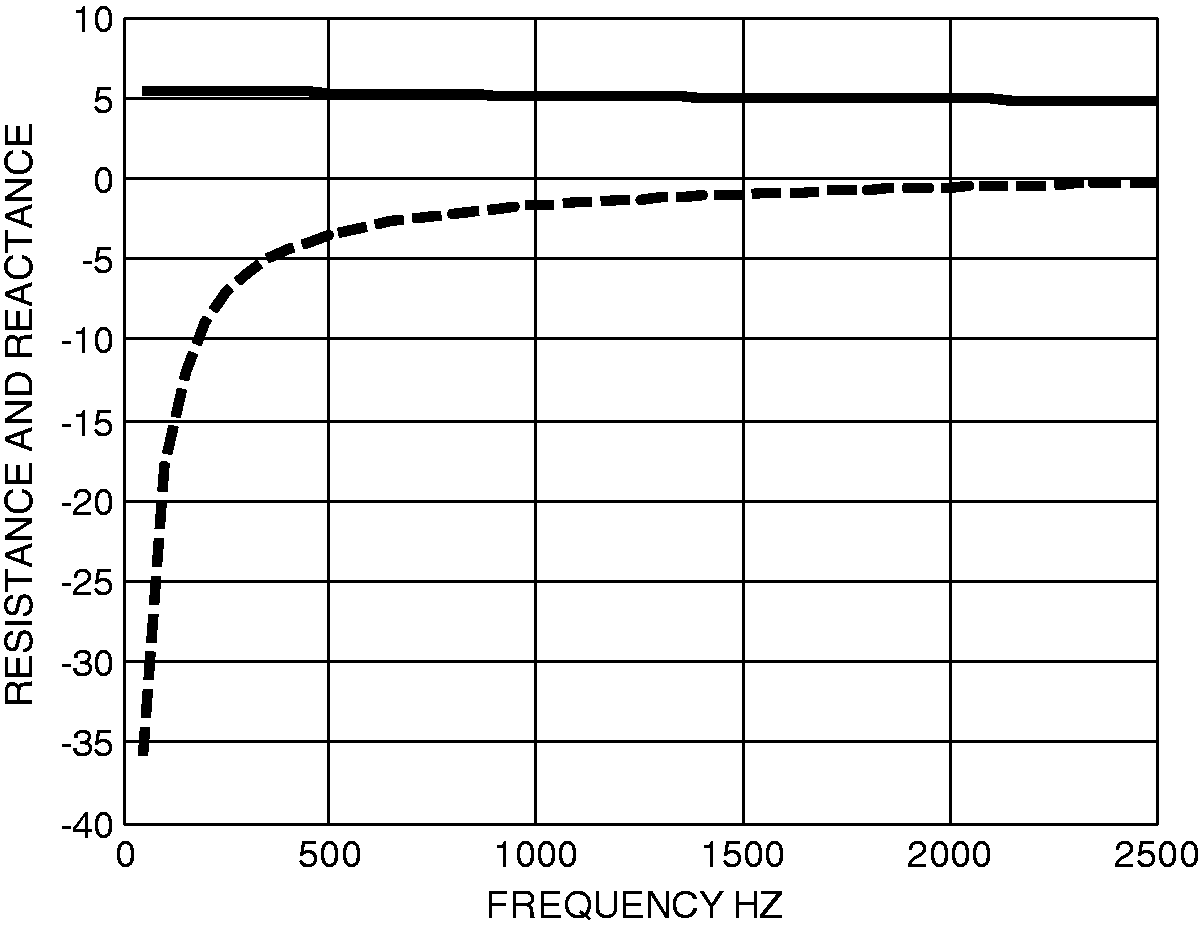

Propagation of broadband noise at 450 Hz and 1650 Hz is modeled. The frequency 450 Hz corresponds to non-dimensional frequency
For 1650 Hz, the Rice estimates are for the number of propagating circumferential modes
In the following examples, the actual propagating circumferential mode count was used, so that all propagating modes are present. Comparisons with computations using the Rice estimate for circumferential modes, which slightly underestimates the number, show very little difference in conclusions about achievable attenuation of acoustic power, particularly at higher frequency, where the extra unaccounted for modes are a small proportion of a large number of propagating modes.
Acoustic power summary for axially symmetric broadband noise, 450 Hz,

SWL In: source Sound Power Level; SWL Out: transmitted Sound Power Level.
Acoustic power summary for broadband noise with all propagating circumferential modes, 450 Hz,

SWL In: source Sound Power Level; SWL Out: transmitted Sound Power Level.
Acoustic power summary for axially symmetric broadband noise 1650 Hz,

SWL In: source Sound Power Level; SWL Out: transmitted Sound Power Level.
Acoustic power summary for broadband noise with all propagating circumferential modes, 1650 Hz,

SWL In: source Sound Power Level; SWL Out: transmitted Sound Power Level.
This prediction of attenuation using only the axially symmetric mode is similar to Rice’s modeling of broadband noise with the radial modes required to synthesize the plane axisymmetric mode 11 at the source plane of the semi-infinite lined duct. However, there are significant differences in the models. Rice’s source is deterministic, based on representing the plane wave at the entrance to the lining, while the source model here is statistical. Additionally, the current model has scattering associated with a finite length lining and hard wall source and termination sections.
Results for all 6 propagating circumferential modes with 16 propagating radial modes are summarized in Table 5. The table organization was discussed in connection with Table 4, but now shows the six propagating circumferential modes, each with their propagating radial modes (including
In the higher frequency case,
When all propagating circumferential modes are included in the
As in the lower frequency case, reference
Acoustic power attenuation is much lower in the
These observations are relevant only for the statistically based approach to distributing acoustic power among the circumferential modes from a presumed source definition with an
Discussion
Frequency domain methods provide an effective means to model propagation of broadband noise in turbofan inlet ducts. Perhaps, most importantly, frequency domain techniques preserve the usefulness of the work of Rice10–17 that has (1) provided for the estimation of the number and distribution of propagating modes, enabling the formalization of the suggestion of Dyer 5 that broadband noise consists of all propagating modes with equal power and random phase and (2) connected the concept of cut-off ratio to propagating modes in unlined ducts and to attenuation in lined ducts. In the present investigation, numerical schemes have been advanced to the extent that what might have been achieved laboriously by serial implementation of Rice’s computational approach, and graphical presentation is now efficiently done by FEM frequency domain modeling with codes written in parallel architecture. The approach employed here has been to extend an FEM code written in serial architecture, capable of modeling propagation at a single frequency and circumferential mode, to a parallel architecture that in the present application models all propagating circumferential modes for a specified frequency. This enables the implementation of the representation of broadband noise proposed by Dyer. 5
Broadband noise has been represented in the frequency domain by a statistical distribution of propagating duct modes. The required number of modes has been estimated by Rice’s approximation, 10 backed up by exact calculations in the FEM propagation code. Two models for estimating achievable attenuation for broadband noise attenuation have been examined. One uses only the axially symmetric circumferential mode, suggested by Rice’s study of broadband noise. 11 A second approach uses all propagating circumferential modes and their associated propagating radial modes. The parallel architecture code is designed to include all propagating modes on a statistical basis. Examples for prediction of acoustic power attenuation of broadband noise at low frequency and at moderate frequency have been used to compare the acoustic power attenuation prediction performance of the axially symmetric circumferential mode and the all propagating circumferential mode models. Computational demands increase with the number of circumferential modes required to include all propagating radial modes, but only to the extent of the number of processors used.
There are differences in the propagation model used by Rice, 11 and the one used here. In Rice’s axially symmetric model, radial mode content is deterministic, with mode amplitudes chosen to represent a plane wave at the entrance to the lining. In the present model, the lining is imbedded in a duct with hard wall source and termination sections that produce scattering of statistically distributed hard wall duct modes into the lined section, and scattering of lined duct modes into hard wall duct modes in the termination section. The model used here with the source represented by a statistical distribution of hard wall duct modes makes direct use of Rice’s modal density work. 10
Broadband propagation at two frequencies, one low and one moderate, has been investigated to assess how the axially symmetric model and the multiple circumferential mode model compare for prediction of acoustic power attenuation. It has been found that the axially symmetric approximation predicts lower attenuation, as compared to the all circumferential mode model in the both cases, and it is not a good predictor of attenuation when compared to the all propagating circumferential mode model. Both models capture the fact that attenuation is higher at the lower frequency. Rice’s correlation of mode cut-off ratio with propagation and radiation15–17 can be used to rationalize this observation.
All conclusions reached in this investigation have been obtained with distribution of circumferential mode power based on Sound Intensity Level measurements defining the source. A second approach with source data defined by SWL measurements leads to a more predictable distribution of acoustic power among the circumferential modes, but may not be as useful due to the unavailability of this type of data.
The axially symmetric model, originally suggested by Rice, 11 remains relevant. It accurately predicts the trend of achievable attenuation with frequency, though with lower attenuation than predicted by multiple circumferential modes.
An appreciation
It is a privilege to participate in this issue honoring the contributions of Ed Rice to the field of aeroacoustics, and a particular privilege to recognize the huge influence he still has on the way we approach the design of acoustic linings for the control of turbofan noise. His work identifying the importance of cut-off ratio of duct modal propagation in the prediction of acoustic lining performance, and his modeling of the impedance of perforates, were seminal. Ed’s remarkable physical insight allowed him to analyze complex phenomena in duct acoustics when computational power was far less than today. It is fitting that this volume has been compiled from authors whom he has influenced.
Footnotes
Declaration of Conflicting Interests
The author(s) declared no potential conflicts of interest with respect to the research, authorship and/or publication of this article.
Funding
The author(s) received no financial support for the research, authorship and/or publication of this article.