






Abstract
Shipborne pump systems play a crucial role in transportation, drainage, and auxiliary operations, directly supporting the safe operation of ships and the daily activities of crew members. Accurate prediction of the remaining useful life (RUL) of such systems is therefore essential for early fault awareness, maintenance planning, and mission assurance. Although RUL prediction has been widely investigated for components such as rolling bearings and aircraft engines, effective prediction approaches specifically developed for marine mechanical pump systems are still lacking. To fill this research gap, this study proposes a time–frequency Transformer–convolutional neural network (CNN) gated (TFTCG) model for pump RUL prediction. Vibration signals are characterized by complex temporal structures, exhibiting both short-term transient behaviors and long-term degradation trends. To capture these properties, CNNs are employed to extract local and detailed features, while a transformer-based architecture is introduced to model global dependencies and degradation patterns throughout the entire lifecycle. In addition, a gating mechanism is incorporated to adaptively fuse time-domain and frequency-domain representations, enabling effective integration of local anomalies and global degradation trends and further improving prediction performance. The proposed model jointly addresses fault diagnosis and RUL prediction, allowing it to simultaneously determine the current degradation stage of the pump and predict its future degradation trajectory from real-time input data. Comparative experiments conducted on the C-MAPSS dataset demonstrate the superior performance of the TFTCG model, which achieves a lower root mean square error of 9.76 and a Prognostics and Health Management (PHM) score of 124 compared with existing approaches. The effectiveness and generalization capability of the proposed method are further validated using a simulated marine mechanical pump dataset with an RMSE of 4.87 and a PHM score of 11.21.
Introduction
Marine vessels typically embark on extended voyages that last for several months, often in harsh and unpredictable environments. During these missions, failures in mechanical pump systems can lead to significant operational disruptions and jeopardize crew safety in extreme cases. Predicting the remaining useful life (RUL) of these pumps can enable timely maintenance and mitigate the risks associated with unexpected failures. In recent years, deep learning (DL) methods have shown promising results in RUL prediction, especially for systems that rely on vibration signals to assess performance degradation and predict failure.
Traditional RUL prediction models, based on DL techniques, often utilize datasets that cover the full operational lifecycle of mechanical systems. These methods have been particularly successful in fields like aerospace and manufacturing, where benchmark datasets are readily available. Representative network architectures include convolutional neural networks (CNNs), which excel at extracting spatial and local features, as well as temporal models such as long short-term memory (LSTM) networks and transformers, which are effective in modeling time-series dependencies.8–16 For example, Fan et al. proposed a trend-attention fully convolutional network framework that integrates a life metric signal selection strategy with a TaFCN-based prediction model, forming a complete RUL prediction pipeline. The fully convolutional structure avoids parameter redundancy commonly introduced by fully connected layers while enabling deep feature extraction. 1 Zhang et al. systematically investigated the impact of data compression and distortion on the RUL prediction performance of LSTM models, demonstrating that performance degradation remains controllable when the bit depth of compressed data exceeds 10 bits. Their findings provide valuable guidance for deploying intelligent maintenance models in resource-constrained environments. 2 To balance prediction accuracy and computational efficiency, Azyus et al. proposed a hybrid CNN–gated recurrent unit (GRU) architecture that combines the strong feature extraction capability of CNNs with the reduced parameter count and faster training characteristics of GRUs, offering an effective solution for efficient RUL prediction. 2 Traditional recurrent neural networks (RNNs) suffer from vanishing and exploding gradient problems and limited parallelization capability, while CNNs are constrained by the receptive field of convolutional kernels. To overcome these limitations, Mo et al. 3 introduced a Transformer-based encoder model specifically designed for RUL prediction, inspired by the success of Transformers in natural language processing, thereby providing a new paradigm for sequence modeling in prognostics.
However, while DL methods have been widely applied to predict RUL for systems such as aircraft engines and rolling bearings, research specifically addressing marine pump systems remains limited. Nevertheless, related research on other types of pump equipment offers useful insights. Lee et al. employed a bidirectional LSTM (BiLSTM) network for gear pump RUL prediction. By propagating information bidirectionally through hidden layers, BiLSTM captures both historical dependencies and future degradation trends, enabling more accurate modeling of complex temporal relationships during degradation processes. 4 For water pump vibration signals characterized by both localized impact features and long-term degradation trends, Pan et al. proposed a one-dimensional (1D)-CNN–LSTM model. In this framework, the 1D-CNN serves as a local feature extractor, while the LSTM performs temporal modeling, providing an effective cooperative solution for complex time-series analysis. 5 Guo et al. introduced a novel parallel CA-Transformer hybrid architecture for drilling pump RUL prediction. The model consists of two independent branches: a CNN–convolutional block attention module (CBAM) branch that extracts deep spatial features from time–frequency representations and suppresses redundant information through attention weighting, and a transformer branch that focuses on capturing long- and short-term temporal dependencies from time-domain signals. This parallel design effectively mitigates information interference and improves generalization performance. 6 Nasir et al. extracted time-domain statistical features, such as root mean square (RMS) and kurtosis, from multisensor vibration data of centrifugal pumps and systematically compared the performance of algorithms including K-nearest neighbors (KNN), support vector machine (SVM), and LSTM. Their results confirmed that LSTM significantly outperforms traditional methods in prediction accuracy due to its ability to capture temporal dependencies. 17 To address the practical challenge of data scarcity in engineering, Zhou et al. developed a finite element physical model for the rolling bearings of centrifugal pumps. They proposed a correction method combining a stacked autoencoder and an LSTM network to generate digital twin vibration data. Features were directly extracted from frequency-domain signals using LSTM, and the relevance vector machine was finally employed for RUL prediction, offering a novel technical pathway to tackle data shortage in real-world applications. 18
Despite the success of existing DL-based RUL prediction methods, several limitations remain. First, most existing studies rely on single-domain feature representations, which may fail to fully capture the complex characteristics of vibration signals. Second, conventional feature fusion strategies typically adopt static or direct concatenation methods, lacking the ability to adaptively adjust feature importance during different degradation stages. Third, few studies jointly consider fault stage identification and RUL prediction within a unified framework, limiting real-time applicability. To address these challenges, this paper proposes a novel time–frequency transformer–CNN gated (TFTCG) framework. The main contributions of this work are summarized as follows:
Innovative dynamic gating mechanism for adaptive feature fusion: We introduce a novel gating mechanism, inspired by but distinct from GRU, that dynamically weights and integrates time-domain and frequency-domain features. Unlike simple concatenation or addition, this mechanism learns to emphasize the most contributive domain (empirically shown to be the time-domain) for RUL prediction at different degradation stages, enabling an intelligent and adaptive dual-domain fusion strategy.
A multiscale feature extraction strategy tailored for pump RUL prediction: A synergistic framework is designed where CNN explicitly captures short-term local anomalies (e.g., transient impulses), the Transformer encoder models long-term global degradation trends, and their fusion, guided by the gating mechanism, facilitates the identification of medium-term degradation patterns (e.g., wear accumulation). This clear functional demarcation and collaboration address the multiscale nature of vibration signals in pump degradation.
Failure time prediction capability: The proposed model predicts the time-to-failure by identifying the current lifecycle stage using real-time signal features and jointly considering long-term degradation trends and short-term signal variations.
Experimental validation: A degradation simulation experiment is conducted on a marine centrifugal pump to construct a full-life-cycle dataset for model validation. In addition, comparative experiments on the publicly available C-MAPSS engine dataset further demonstrate the superior performance of the TFTCG model, achieving lower root mean square error (RMSE) and PHM scores than existing methods. Uncertainty quantification and extensive ablation studies further validate the model’s robustness and design rationale.
Proposed method
The proposed RUL prediction strategy for marine centrifugal pumps is illustrated in Figure 1. The experimental platform simulates the operational lifecycle of a centrifugal pump under four health states: normal condition, slight degradation, moderate degradation, and severe degradation. Vibration signals are collected throughout the entire process to construct a full life-cycle dataset.
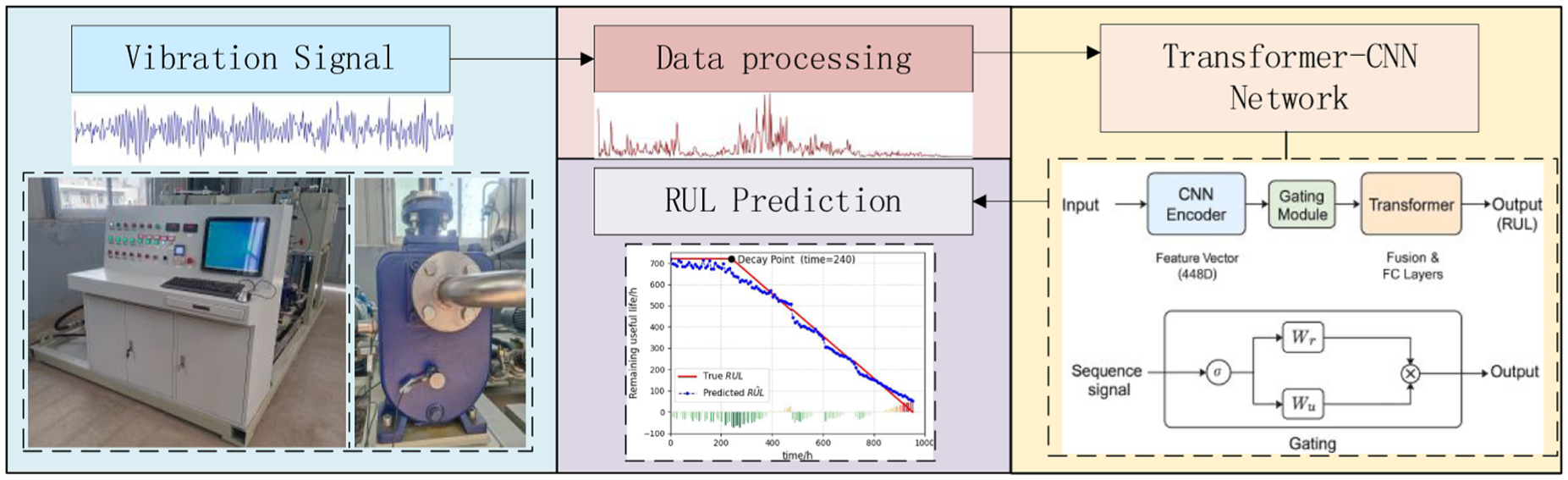
The proposed RUL prediction strategy.
After data preprocessing, both time-domain and frequency-domain signals are used as inputs to the proposed TFTCG model. The model is designed to address the characteristic degradation patterns of marine centrifugal pumps, where time-domain signals reflect overall vibration energy and trends, while frequency-domain features capture fault-specific components. The training and validation datasets consist of labeled samples with corresponding RUL annotations and are used for model construction and optimization. Once the model is trained, unlabeled data from the test set are treated as real-time input to simulate online operating conditions.
The TFTCG model extracts dual-domain features from vibration signals and identifies the current degradation stage of the pump based on real-time data. A gating mechanism is employed to adaptively adjust the contributions of time-domain and frequency-domain features. The model then outputs the RUL prediction curve, enabling both assessment of the current degradation stage and prediction of the occurrence time and severity of future faults.
Experiment
To meet the data requirements of RUL prediction algorithms for marine mechanical pumps under realistic operating conditions, a performance degradation experiment was conducted on a mechanical pump using a typical RUL prediction test platform under multisource coupled physical field conditions. The experiment aims to generate representative degradation data and to organize and classify the collected signals for subsequent validation of the proposed RUL prediction algorithm.
The physical prototype of the experimental platform and the configuration of its functional modules are shown in Figure 2.
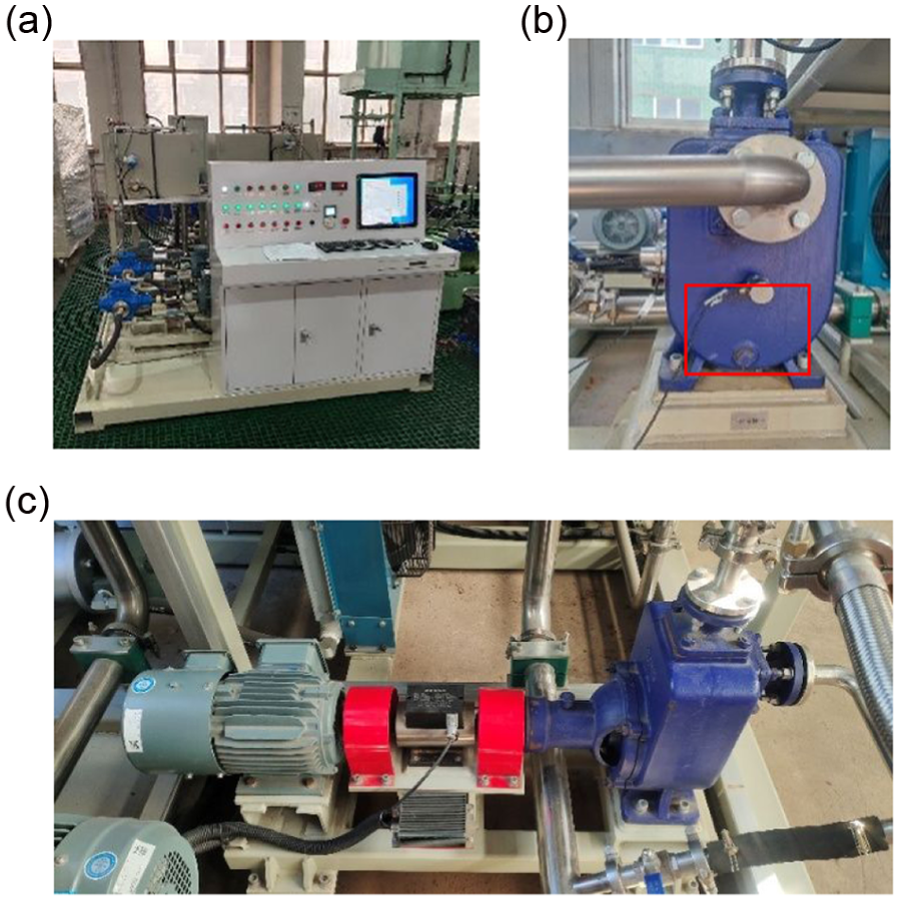
Full life cycle simulation test platform for mechanical pump performance degradation: (a) control system, (b) data acquisition sensor, and (c) drive and electronic control systems.
The experimental platform consists of three main modules: (a) a control system, (b) a data acquisition system, and (c) a drive and electrical control system. The platform is capable of simulating typical performance degradation modes of mechanical pumps with different specifications. It provides functions for system speed and load control, working medium temperature regulation, as well as acquisition and storage of vibration, pressure, flow rate, rotational speed, and torque signals.
Using this typical RUL prediction test platform, performance degradation experiments are conducted with a marine centrifugal pump as the target equipment for RUL prediction. The experiments are carried out under controlled indoor environmental conditions, with an ambient temperature of 25.8°C, measured by the lubricating oil temperature sensor, and a relative air humidity of 45%. The testing equipment and instruments employed in this study are listed in Table 1.
Testing equipment and instruments used in the experiments.
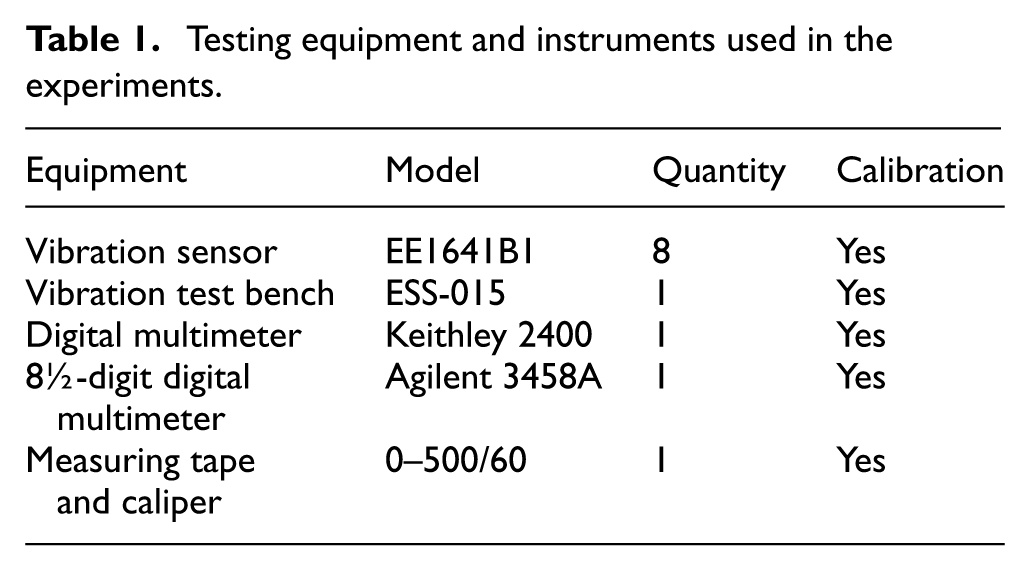
The equipment parameters of the experimental test rig are summarized in Table 1. The torque of the drive motor is determined by the operating frequency, with a torque range of 0–50 N·m. The motor torque is displayed on the control panel as a percentage of the maximum torque. At a motor frequency of 40 Hz, the output torque corresponds to 71.8% of the maximum value, that is, 35.9 N·m.
The specifications of the acceleration sensors are as follows: sampling frequency Fs = 20,000 Hz, sensitivity of 10 mV/g, measurement range of ±14g, and measurement accuracy of ±1 mg. The arrangement of the sensor measurement points is illustrated in Figure 3.
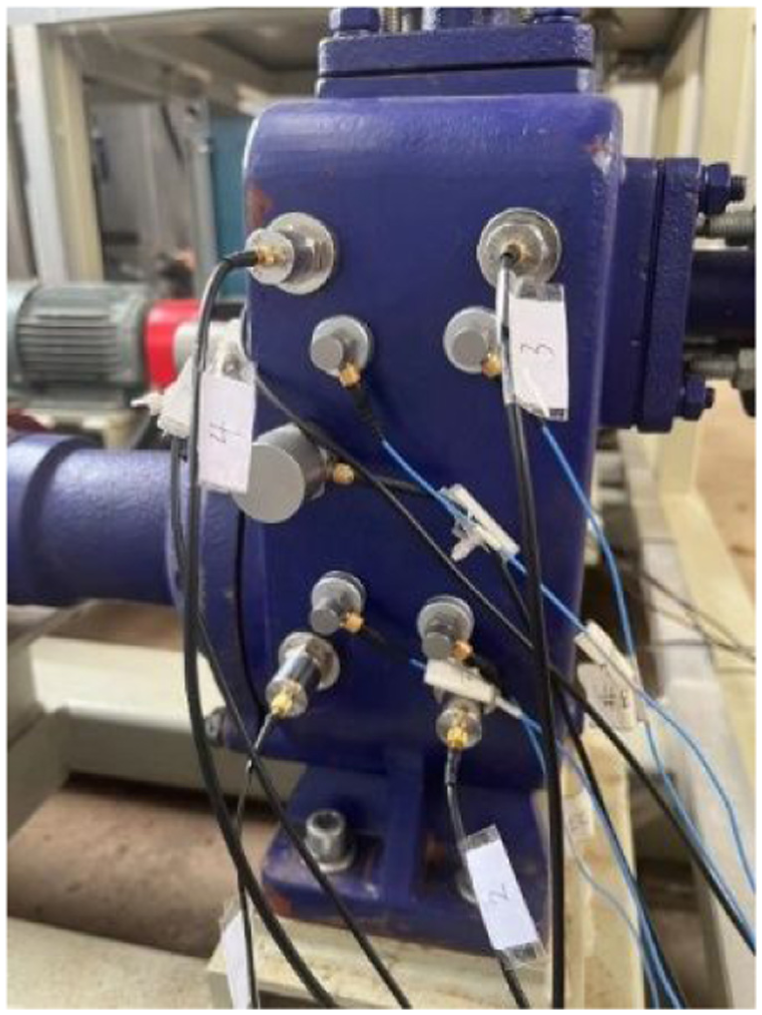
Example of sensor measurement point layout.
Data processing
The vibration signals collected by the acceleration sensors on the mechanical pump test platform are unlabeled 1D acceleration time-series data. The dataset is divided into training, validation, and test subsets with a ratio of 8:1:1, thereby forming a full life-cycle database for the mechanical pump.
The pump test rig dataset consists of eight measurement channels, and each channel contains data corresponding to four degradation levels. Table 2 presents the degradation states and their associated labels for a representative single channel. The degradation process is divided into four stages: normal, mild degradation, moderate degradation, and severe degradation. The “Label” column denotes the RUL duration, where more severe component degradation corresponds to a shorter RUL.
Degradation stages and corresponding RUL labels.
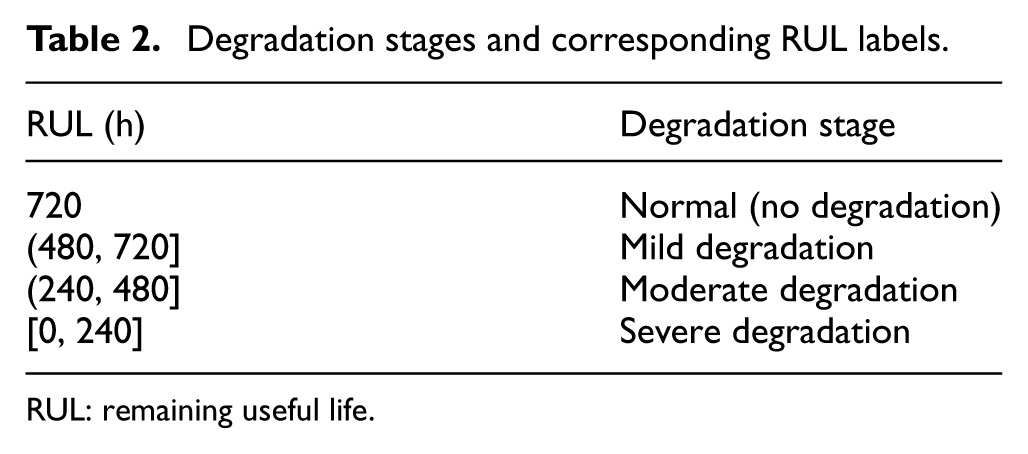
RUL: remaining useful life.
Unlike the C-MAPSS dataset, in which degradation progresses continuously in simulated data, the degradation states in the pump test rig dataset are stagewise. This is because the test rig data are not obtained from the natural degradation process of the pump during operation, but rather from artificially induced degradation states. Consequently, the resulting RUL curves exhibit a stepwise characteristic.
The data processing pipeline consists of data cleaning, band-pass filtering, wavelet-based denoising, feature engineering, normalization, RUL labeling, sliding-window sequence construction, and output data generation, as shown in Figure 4.
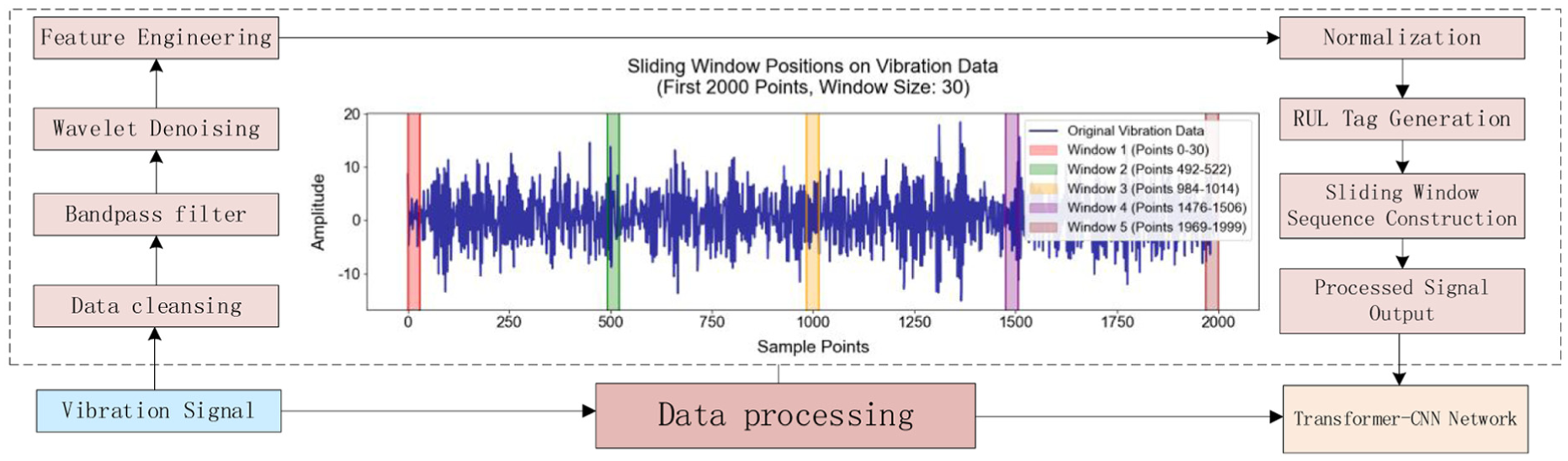
Data processing workflow.
The first step focuses on data cleaning of the time-domain signals. This includes filtering valid labels and nonempty signals, converting vibration signal strings into numerical values with format verification, performing quality checks to remove abnormal signals (e.g., all-zero signals and outliers), eliminating low-variance features, removing constant columns, and conducting data screening and column renaming. These operations improve data quality and validity, providing a reliable foundation for subsequent preprocessing and model training.
Next, band-pass filtering is applied to the frequency-domain data to remove low-frequency baseline drift and suppress high-frequency noise while preserving fault-related frequency components. The Nyquist frequency is set to half of the sampling frequency (20 kHz) and is used to normalize the cutoff frequencies. The actual cutoff frequencies are then converted into normalized values required by the digital filter, and a Butterworth filter is employed to implement the band-pass filtering process.
Vibration data from marine mechanical pumps typically contain background noise; therefore, denoising is further applied to the filtered time–frequency dual-domain signals. Noise components are removed by discarding specific wavelet coefficients and applying soft-thresholding to the remaining coefficients, resulting in denoised signals suitable for feature extraction. The comparisons of raw data and processed data are illustrated in Figure 5.
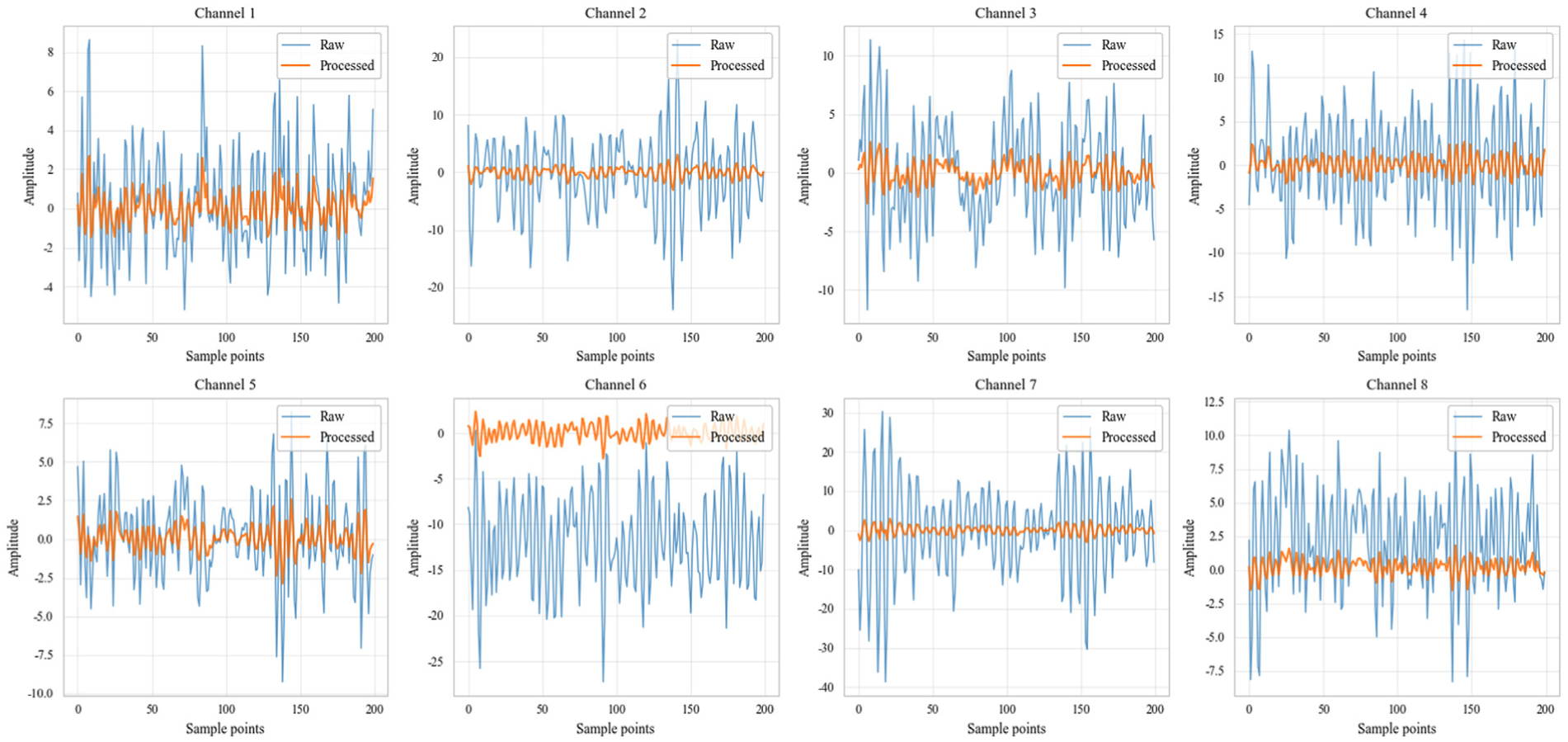
Data processing comparisons.
Since the experimental dataset includes multiple measurement channels from different spatial sensor locations, feature engineering is performed to evaluate the importance of signals from each channel. Sensor signals that are highly correlated with fault characteristics are selected, while less informative features are removed to reduce input dimensionality. After interval-based normalization, RUL labels are assigned to the vibration data according to the true RUL of the pump obtained during the experiments. Finally, sliding-window sequence construction is applied to generate training samples with local contextual information, thereby enhancing temporal dependency modeling.
Proposed network
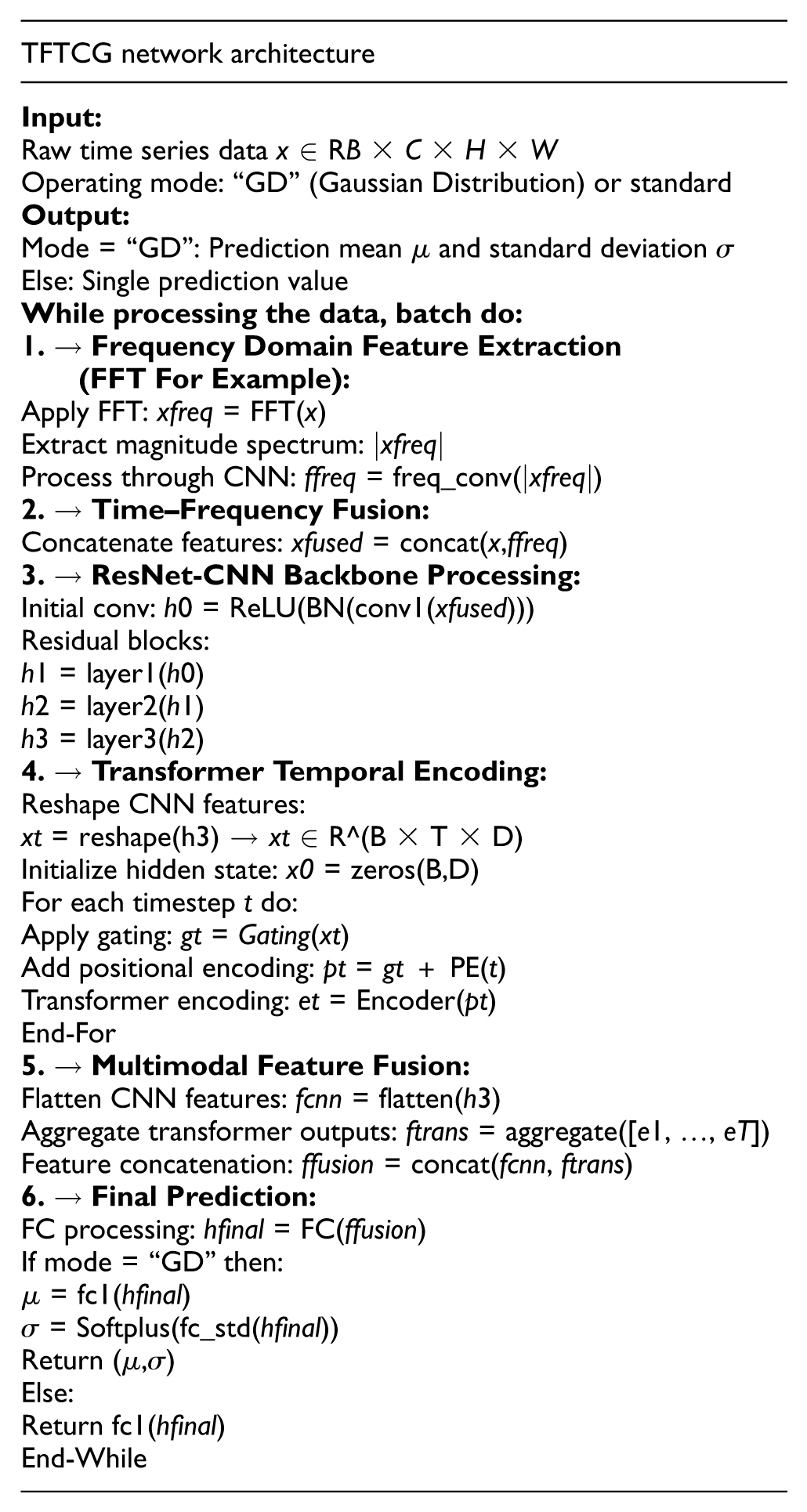
The proposed hybrid TFTCG DL model consists of three core components: a feature extraction module, a label classification module, and a RUL prediction module, as shown in Figure 6. The key innovation lies in the adaptive gating fusion module and the clearly defined multiscale collaboration between CNN and transformer, rather than a mere architectural combination.
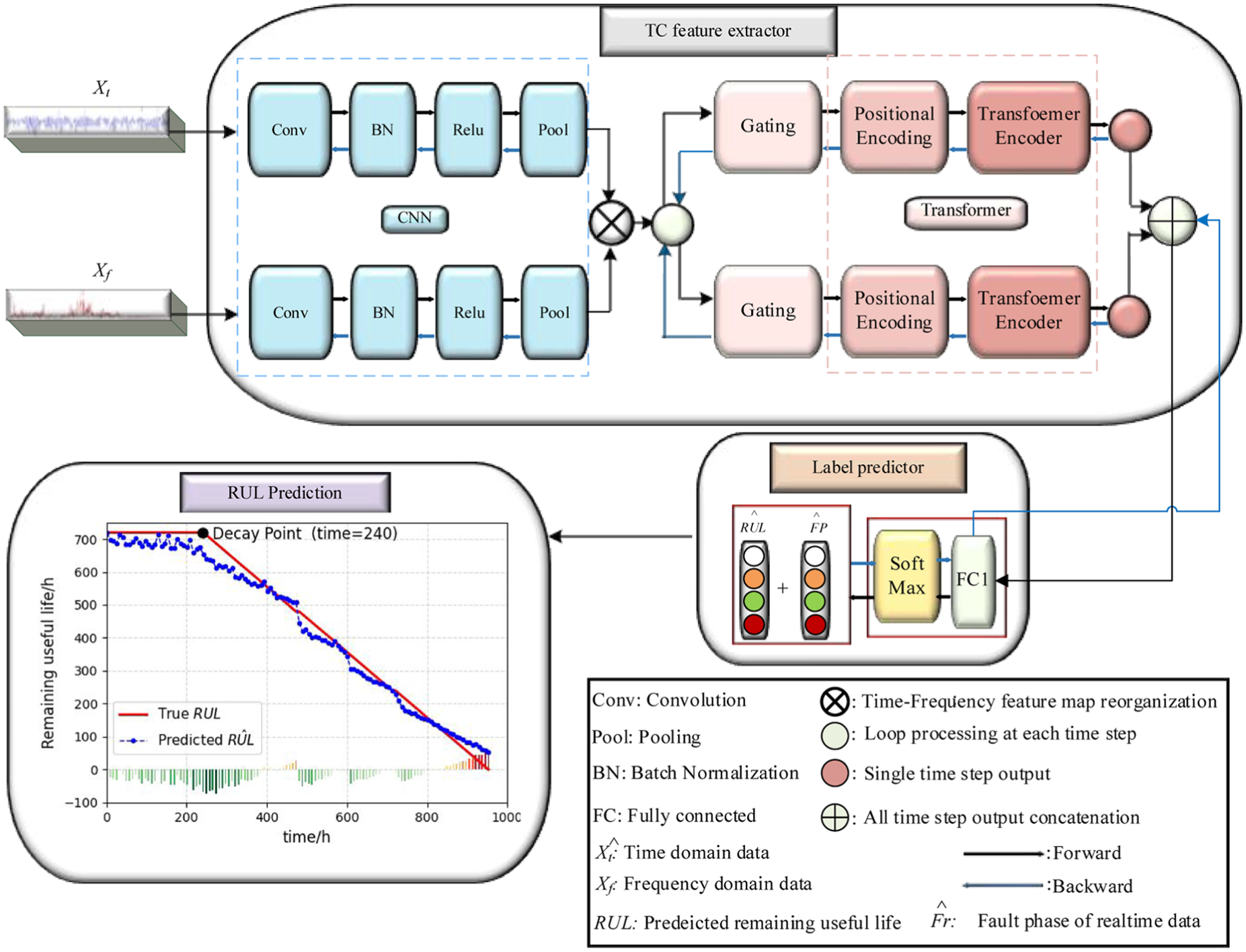
TFTCG network. TFTCG: time–frequency transformer–convolutional neural network gated.
Network overview: The model receives the equipment’s real-time signal,
Feature extraction is conducted via a dual-path time–frequency framework. In the frequency-domain path, various methods such as fast fourier transform (FFT), continuous wavelet transform (CWT), and short-time Fourier transform (STFT) are employed to extract frequency features. The time-domain path, on the other hand, directly utilizes the preprocessed raw time-domain signals as network input.
This dual-path architecture is essential for pump prognostics: the time-domain path captures general amplitude trends and non-stationary transients, while the frequency-domain path (using FFT, CWT, or STFT) is tailored to isolate and track the evolution of pump-specific components indicative of different health states.
The network first employs a ResNet-based CNN architecture to capture detailed features corresponding to different fault stages, and then integrates the extracted features to reconstruct the time–frequency representations along the channel dimension.

Here,
The reconstructed feature





In these equations,
The core of the temporal modeling is a customized transformer encoder that incorporates the adaptive gating mechanism as an internal, preattention processing step at each timestep. As detailed in the pseudo-code (Figure 6, step 4), this mechanism utilizes reset and update gates (Equation (2) and (3)) to dynamically control the flow of information between the fused feature at the current timestep (
It is worth noting that the proposed gating mechanism differs from traditional GRU structures. While GRU is designed for temporal memory control, the gating mechanism in this study focuses on adaptive feature fusion across time and frequency domains. Specifically, the reset gate controls the contribution of historical features, while the update gate regulates the integration of newly extracted frequency-domain information. This design enables dynamic adjustment of feature importance according to different degradation stages.
At each time step, temporal correlation features are extracted through the transformer. The encoder utilizes sinusoidal positional encoding:


Here, t denotes the position at the current time step, and i represents the feature dimension index. (t) is the positional encoding vector with a dimension of dmodel. The parameter 10,000 was determined through an ablation study, which tested values of 1000, 10,000, and 100,000.
The gated output

Multihead self-attention layer:

Each attention head in the multihead self-attention layer:

Scaled dot-product attention:

Feedforward network:

Temporal feature sequence encoding:




After extracting the temporal feature sequence at each time step, it is fed into the label classification module. This module serves two main functions: it generates the label
This architecture performs comprehensive extraction of both time-domain and frequency-domain features, utilizing a dual-scale modeling approach with local CNNs and global Transformers. It effectively combines the advantages of short-term details and long-term sequence features. The model employs adaptive gating for intelligent feature fusion and uses Gaussian distribution outputs to quantify uncertainty. This architecture is highly suitable for handling complex multimodal time-series data, especially in applications where both temporal dependencies and frequency characteristics need to be considered. The specific performance of this model architecture is detailed below.
Results
Contrast dataset
The self-constructed pump dataset captures vibration signals under conditions that simulate typical marine pump failure modes, including seal wear, impeller imbalance, and cavitation, thereby ensuring the model is validated on relevant characteristic signatures.
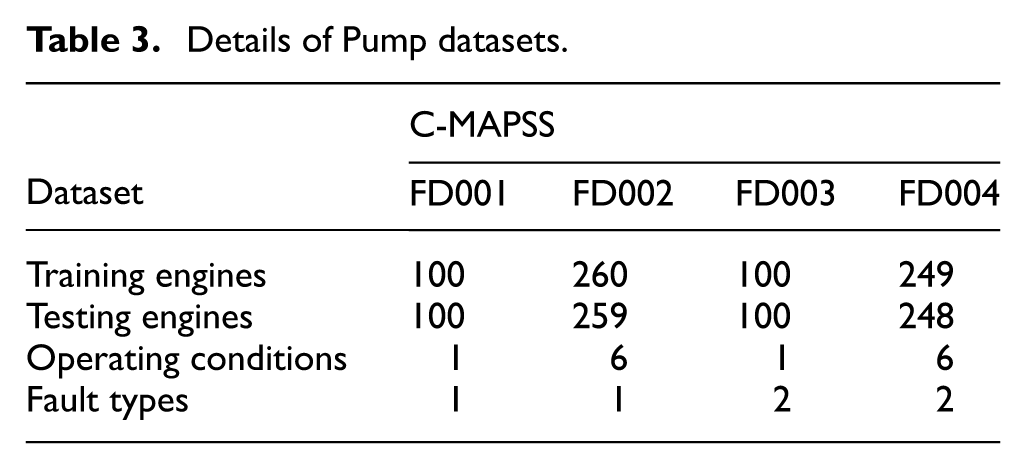
Apart from our Pump dataset, we use the C-MAPSS dataset 7 for a comparative analysis between our model and others. This dataset consists of four subsets, as described in Table 3, each containing 21 simulated variables and degradation life cycles of turbofan engines. First, we evaluate the performance superiority of our model by comparing it with existing models on this publicly available turbofan engine dataset. Subsequently, the model is applied to predict the RUL on the pump dataset.
Details of Pump datasets.
Performance metric
This article uses two main performance metrics, RMSE and a scoring function, to evaluate the model performance. 8
RMSE is a commonly used metric in prediction tasks. We use it to compare the proposed model with existing models. Its formula is as follows:

Here, n represents the number of test samples,
The scoring function is a performance metric specifically designed for RUL prediction. Its mathematical formula is as follows:
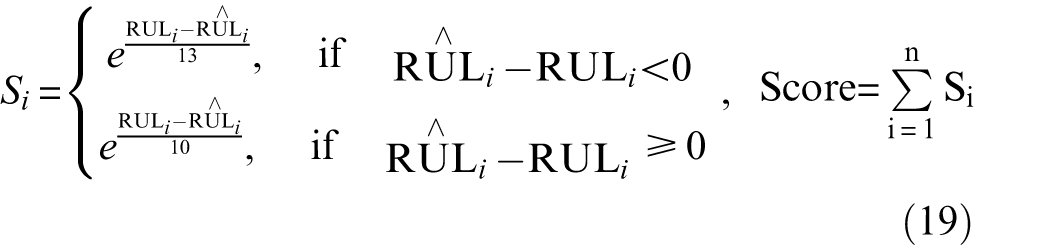
In practical applications, delayed predictions may lead to severe equipment damage. Therefore, when the predicted RUL value is greater than the true value, the scoring function applies a more severe penalty. This design encourages the model to predict failures earlier rather than making delayed predictions.
Parameters and ablation tests
The TFTCG model was implemented in PyTorch and trained on an NVIDIA GTX 1080 GPU. The model was trained using the AdamW optimizer with an initial learning rate of 1e-4, which was reduced by a factor of 0.5 if the validation loss plateaued for 10 epochs. Early stopping with a patience of 20 epochs was applied based on the performance metrics. The batch size was set to 256. For the standard prediction mode, we used mean squared error loss. For the Gaussian distribution (GD) mode, the negative log-likelihood (NLL) loss was used. The hyperparameters, including the number of transformer layers (2), attention heads (4), and the dimension of the gating module (128), were determined via a random search over a predefined space, with the objective of minimizing RMSE and scoring function on the validation set.
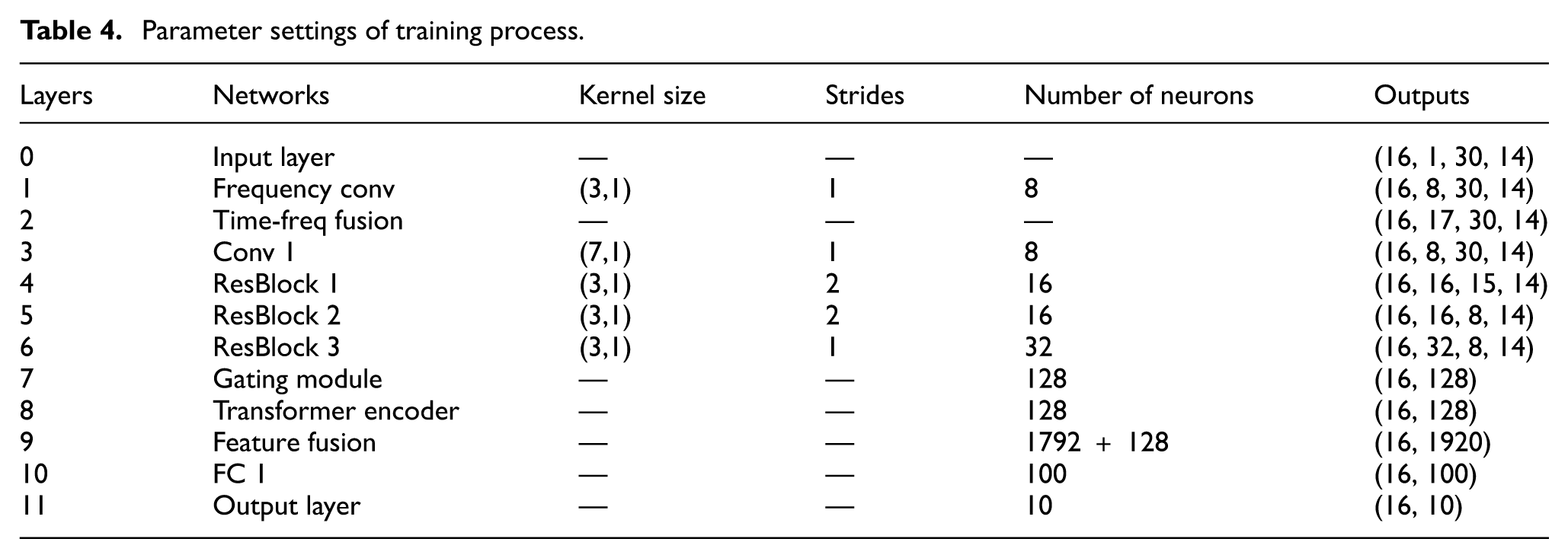
For the state-of-the-art (SOTA) parameters of our model, the setting of the training process is listed in Table 4.
Parameter settings of training process.
Ablation tests were conducted on various feature extraction methods, including the individual ResNet model, the single Transformer model, the single time-domain feature extractor (TD), and the single frequency-domain feature extractor (FD), as well as the TFTCG hybrid framework. The comparative results are presented in Table 5. Bold text relate to the best two performance of metrics in each subset. The results clearly demonstrate that time-domain features play a dominant role, and our proposed TFTCG model significantly outperforms the baseline models in terms of performance across all test scenarios.
Results of ablation experiment on various modules.
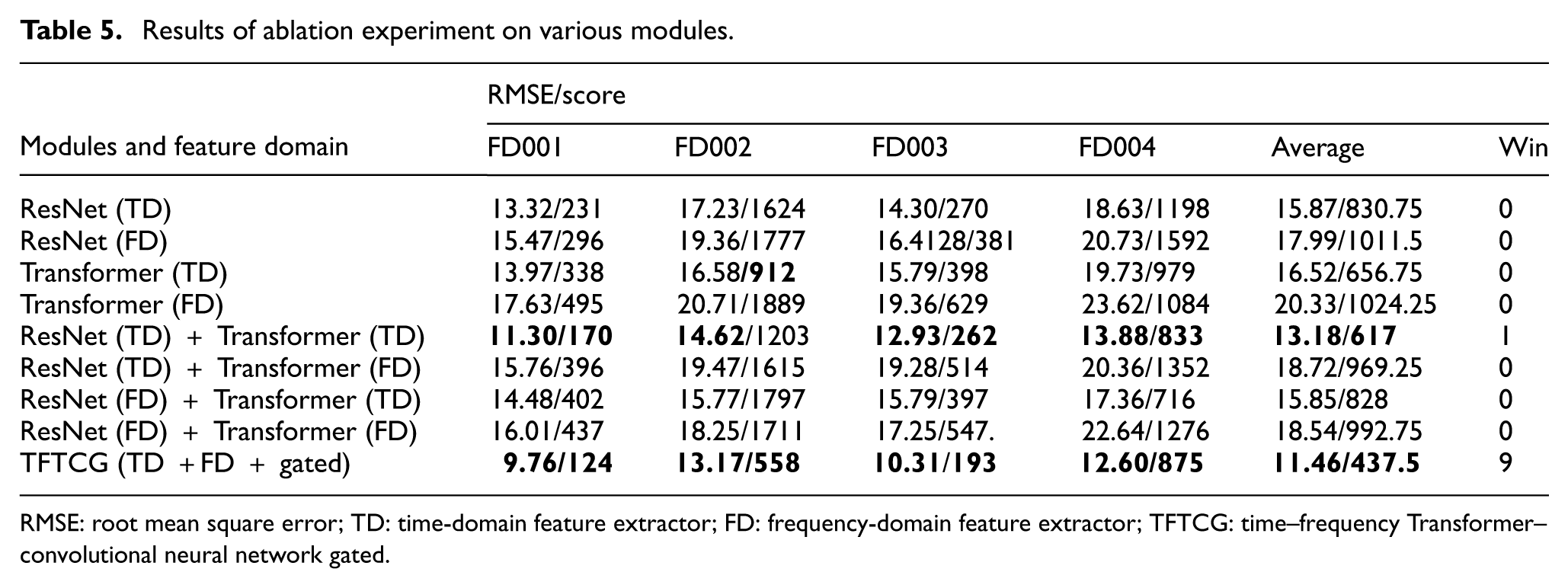
RMSE: root mean square error; TD: time-domain feature extractor; FD: frequency-domain feature extractor; TFTCG: time–frequency Transformer–convolutional neural network gated.
Furthermore, the performance of three frequency-domain computation methods—FFT, CWT, and SCFT—used in the TFTCG (time + frequency + gated) model is compared, as shown in Table 6. Bold text relate to the best performance of metrics in each subset. The results indicate that FFT outperforms CWT and SCFT, making FFT the SOTA method for frequency-domain feature extraction.
Results of ablation experiment on various modules.
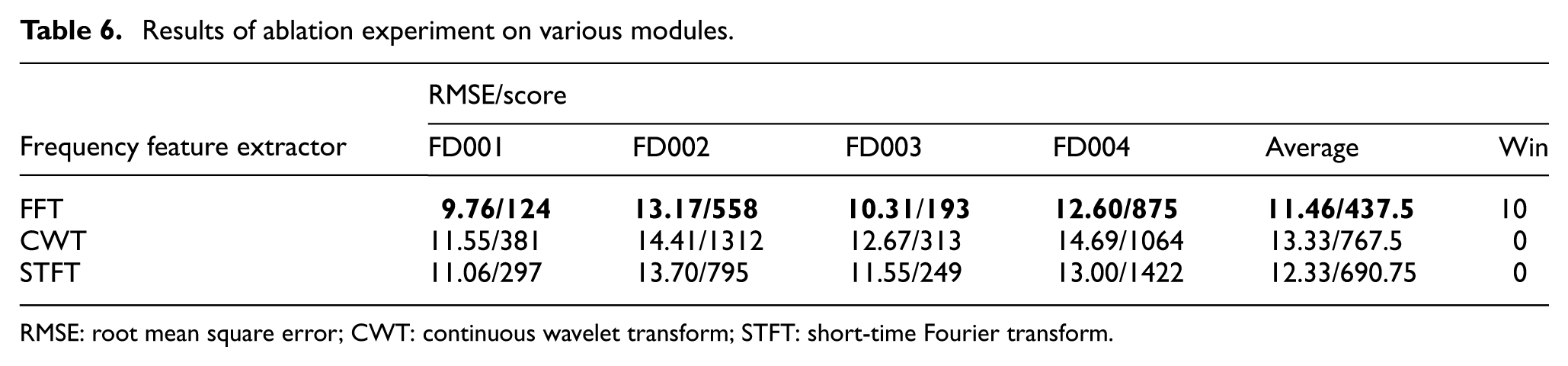
RMSE: root mean square error; CWT: continuous wavelet transform; STFT: short-time Fourier transform.
Comparison with SOTA models
Table 7 presents the performance comparison of the proposed TFTCG model and the SOTA models on the C-MAPSS dataset. Bold text relate to the best two performance of metrics in each subset. The table highlights the superior performance of our proposed model in predicting the RUL across different fault conditions. The results demonstrate that the TFTCG model significantly outperforms all the compared models across all four fault subsets (FD001, FD002, FD003, and FD004). Specifically, the TFTCG model achieves an average RMSE of 11.46, which is lower than the performance of other models, including BiLSTM, deep convolution neural network (DCNN), hybrid deep neural network (HDNN), bi-directional long short-term memory convolutional neural network (BLCNN), similarity-based interpolation recurrent neural network (SBRNN), trend attention fully convolutional network (TAFCN), bidirectional LSTM denoising autoencoder (BiLSTM-DAE), two-stage attention-based hierarchical transformer (STAR), bidirectional temporal convolution with multi-scale (MBiTCN), multiscale spatiotemporal evolution network (MSEvoNet) and deep residual network and attention mechanism (DRNaAM). Notably, the TFTCG model also achieves the best score in the “Win” column, outperforming other models in most performance metrics. This highlights the superior performance of our proposed model in predicting the RUL across different fault conditions.
Performance comparison of proposed TFTCG model and the latest SOTA methods on C-MAPSS dataset.
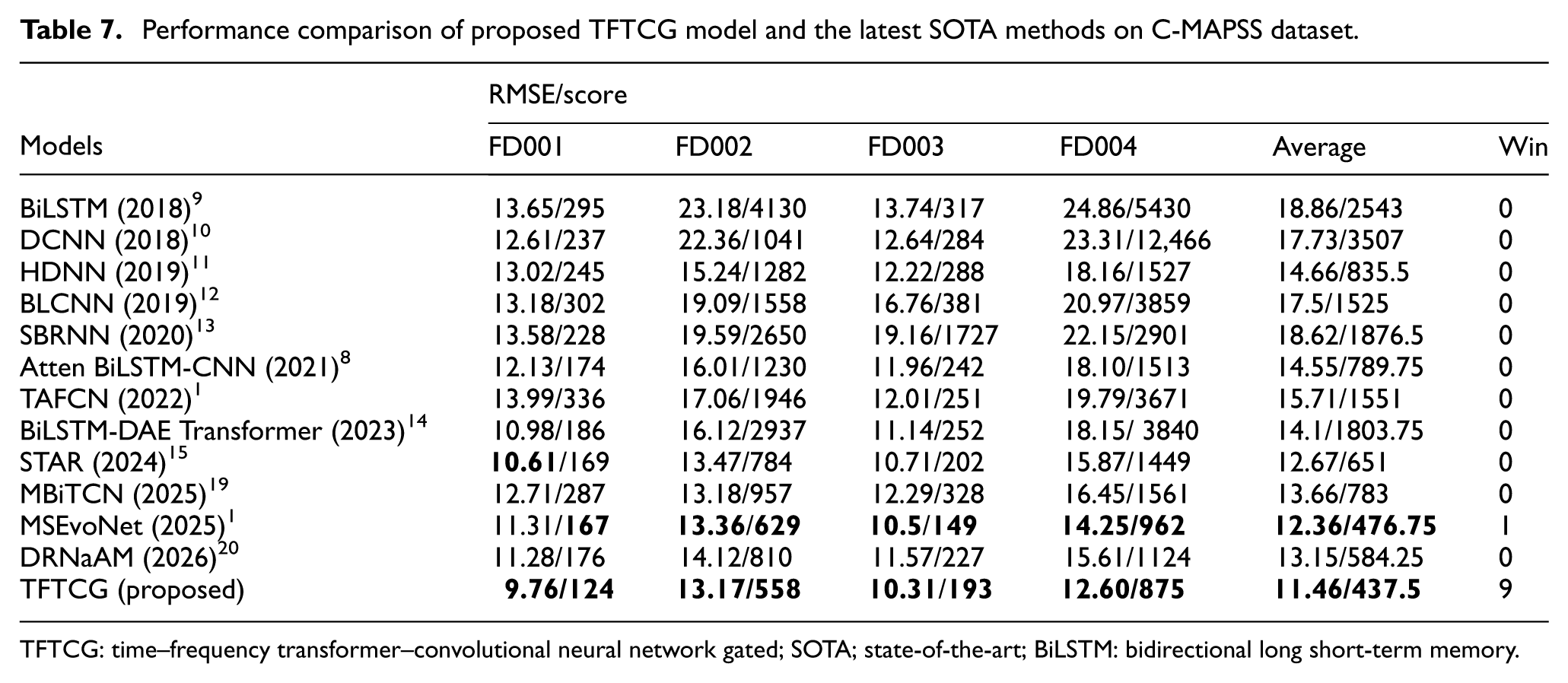
TFTCG: time–frequency transformer–convolutional neural network gated; SOTA; state-of-the-art; BiLSTM: bidirectional long short-term memory.
To statistically validate the performance improvement, we conducted a paired t-test comparing the RMSE values of TFTCG against the second-best performer (MSEvoNet) across the four C-MAPSS subsets (FD001-FD004). The test was performed on the RMSE results from five independent training runs with different random seeds for each model. The difference in RMSE was found to be statistically significant with a p-value of 0.032 (p < 0.05), confirming that the superior performance of TFTCG is not due to random chance.
Performance on pump bench
The RUL prediction performance of the proposed TFTCG model on the pump dataset is illustrated in Figure 7. The x-axis represents the pump’s operational time, starting from the moment real-time data is fed into the model. The time zero corresponds to the pump’s activation, and the time axis extends until the pump’s failure. The y-axis displays the RUL of the pump.
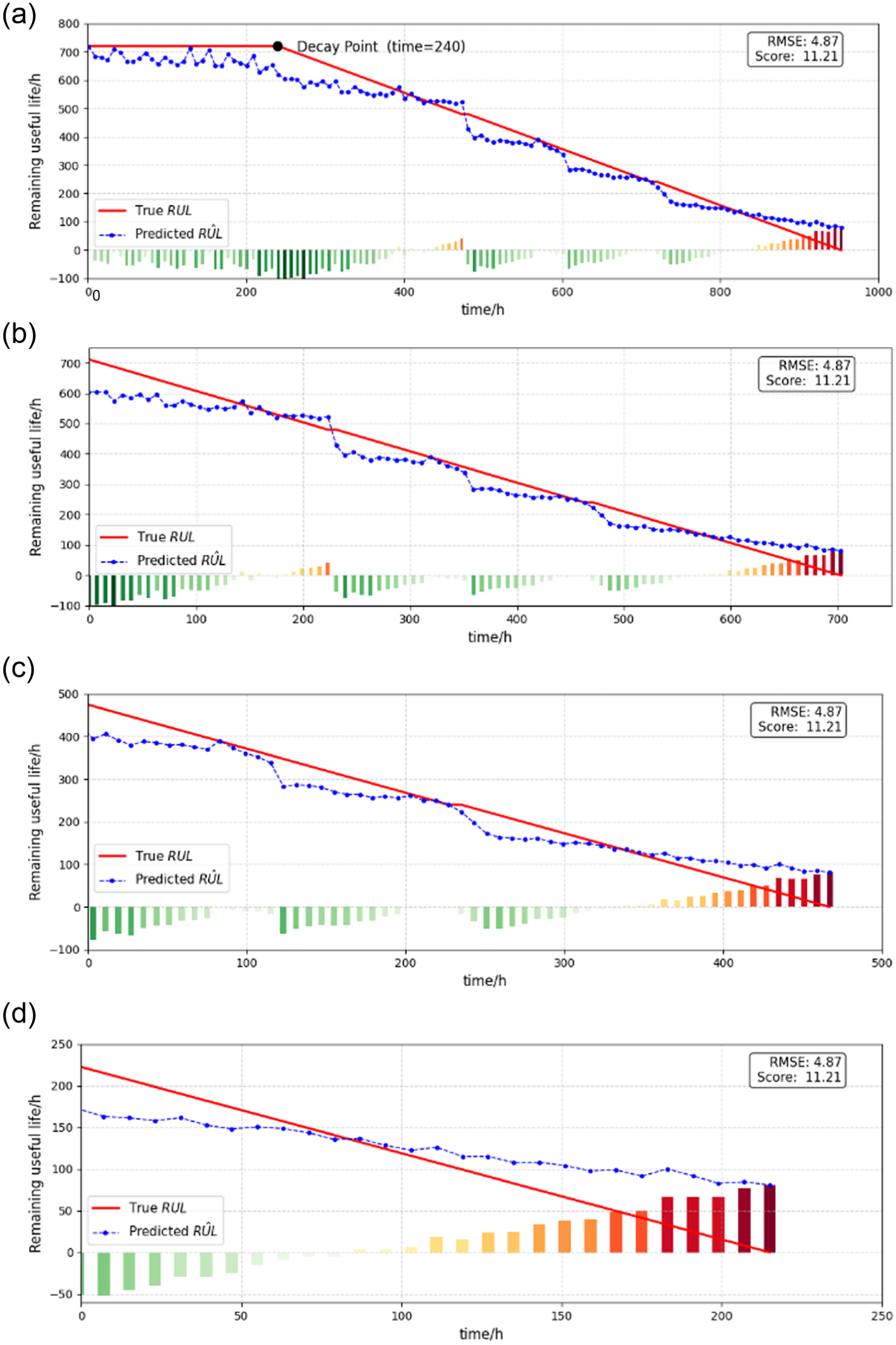
Performance of the proposed TFTCG model on the Pump dataset. TFTCG: time–frequency Transformer–convolutional neural network gated. (a) Normal state. (b) Mild state. (c) Moderate state. (d) Severe State.
In Figure 7(a), when the pump is operating in a normal state, the RUL curve gradually moves closer to the decay point as the pump continues to function. This shift indicates a decrease in the RUL as time progresses. In Figure 7(b), the pump begins to experience a mild fault. By leveraging real-time fault diagnosis data, the model predicts the pump’s future RUL, accounting for the increasing severity of the fault. As the fault worsens, the zero point of the RUL curve shifts to the right, reflecting the pump’s declining condition.
Figure 7(b) to (d) further illustrates this trend, where the fault severity increases due to prolonged operation or external influences, leading to performance degradation. This results in a noticeable shortening of the pump’s RUL. These fault prediction curves highlight the TFTCG model’s capability in predicting the RUL under various fault conditions in real time.
The confusion matrix of real-time health state prediction is depicted in Figure 8. The confusion matrix presents the performance of the model in predicting the severity levels of the pump under different real-time data. The rows represent the actual class labels, while the columns correspond to the predicted class labels.
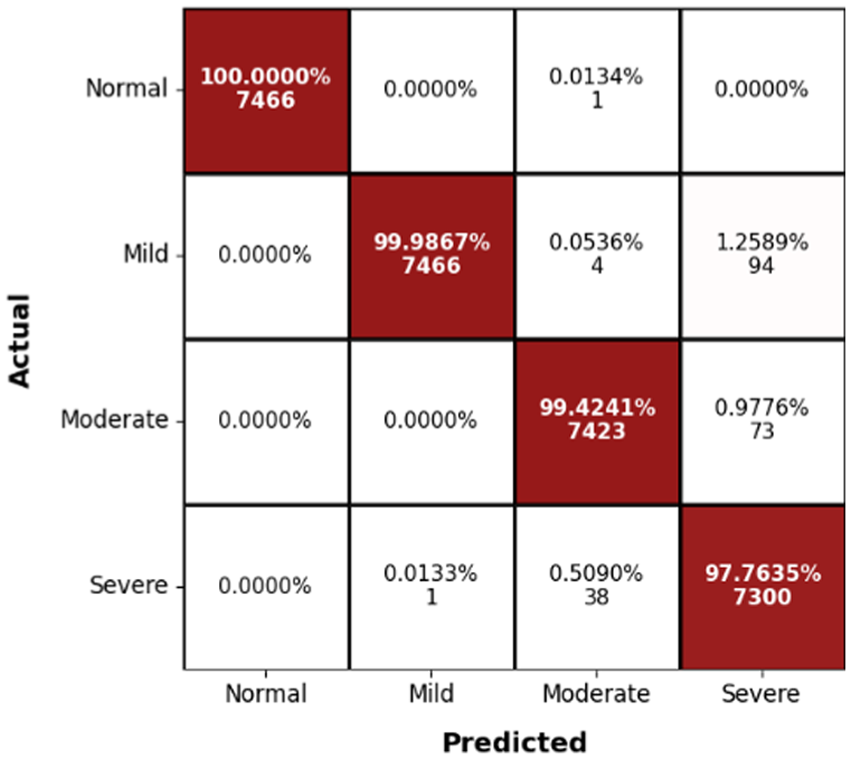
Confusion matrix of real-time health state prediction.
The model accurately predicted all instances of the normal class (100%) with 7466 samples correctly classified as normal. For the mild class, the model achieved a prediction accuracy of 99.9867%, correctly identifying 7466 out of 7467 mild cases. However, a very small number (0.0133%) were incorrectly classified as moderate. In the case of moderate instances, the model demonstrated an accuracy of 99.4241%, correctly classifying 7423 of the 7466 moderate instances. The remaining instances were mostly misclassified as severe (0.5090%). For severe cases, the model achieved an accuracy of 97.7635%, with 7300 of the 7467 severe cases correctly identified. A small proportion of instances (0.9776%) were misclassified as moderate.
Overall, the confusion matrix shows that the model performs excellently for the majority of the cases, particularly for normal and mild categories, with minimal misclassification in the other classes.
Overall, the confusion matrix shows that the model performs excellently for the majority of the cases, particularly for normal and mild categories, with minimal misclassification in the other classes.
The relationship matrices generated by Pearson’s correlation are visualized to enhance the method’s interpretability and clarity. The test is conducted on the pump dataset with a RUL of 720. The results are shown in Figure 9.
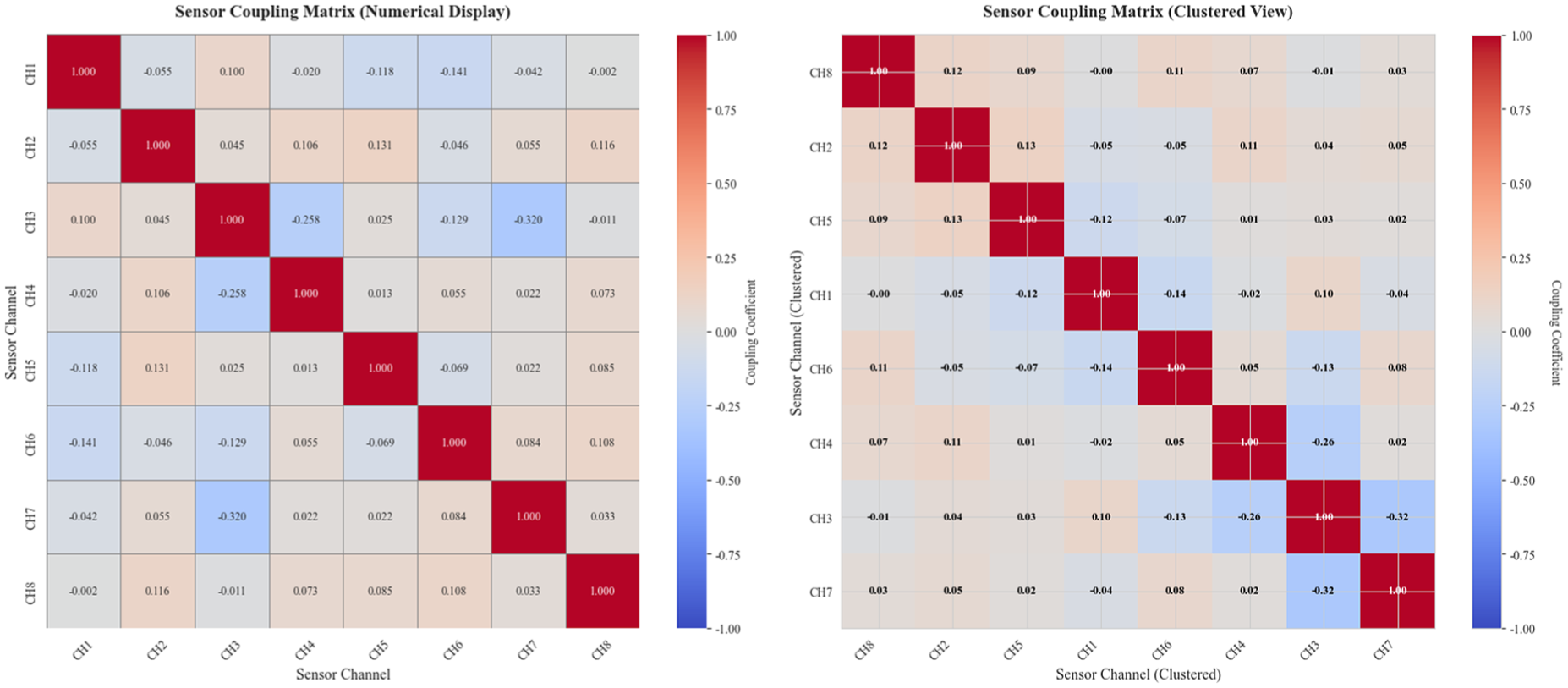
Visualization results of the Pearson’s coupling matrix.
While the TFTCG model does not contain an explicit spatial modeling module (e.g., graph convolution), this post hoc analysis reveals the dynamic intersensor relationships implicitly captured by the model during the degradation process. The left matrix shows numerical coefficients with the values representing the Pearson’s correlation coefficients between each pair of sensor channels, and the right panel presents a clustered view where sensor channels with similar coupling relationships are grouped together. The color scale on the right side represents the range of correlation coefficients, with values closer to 1 indicating a high positive correlation and values closer to −1 indicating a high negative correlation.
The generally low but structured correlation coefficients suggest that the model learns to establish a unified, time-evolving representation that reflects degradation-related dependencies among sensors, rather than static spatial connections.
Uncertainty quantification analysis
As described in “Proposed network” section and Figure 6, the TFTCG model can operate in GD mode, outputting both the mean (μ) and standard deviation (σ) of the predicted RUL to quantify predictive uncertainty. During training in this mode, we minimize the NLL loss:

where
We evaluated the uncertainty estimates on the FD003 test set. Figure 10(a) shows the predicted RUL curves with 95% confidence intervals (μ ± 1.96σ) for randomly selected sample engines. The intervals well encapsulate the true RUL trajectory, demonstrating calibrated uncertainty. More importantly, the width of the confidence interval varies dynamically over time. It is observed that the interval typically widens when the engine operates in a relatively stable state, and significantly narrows during periods of rapid deterioration. This dynamic behavior indicates that our model can quantify the varying levels of confidence in its predictions based on the input data characteristics, rather than providing a static uncertainty estimate. Such context-aware uncertainty is crucial for practical applications, as it alerts maintainers to periods of high prediction risk.
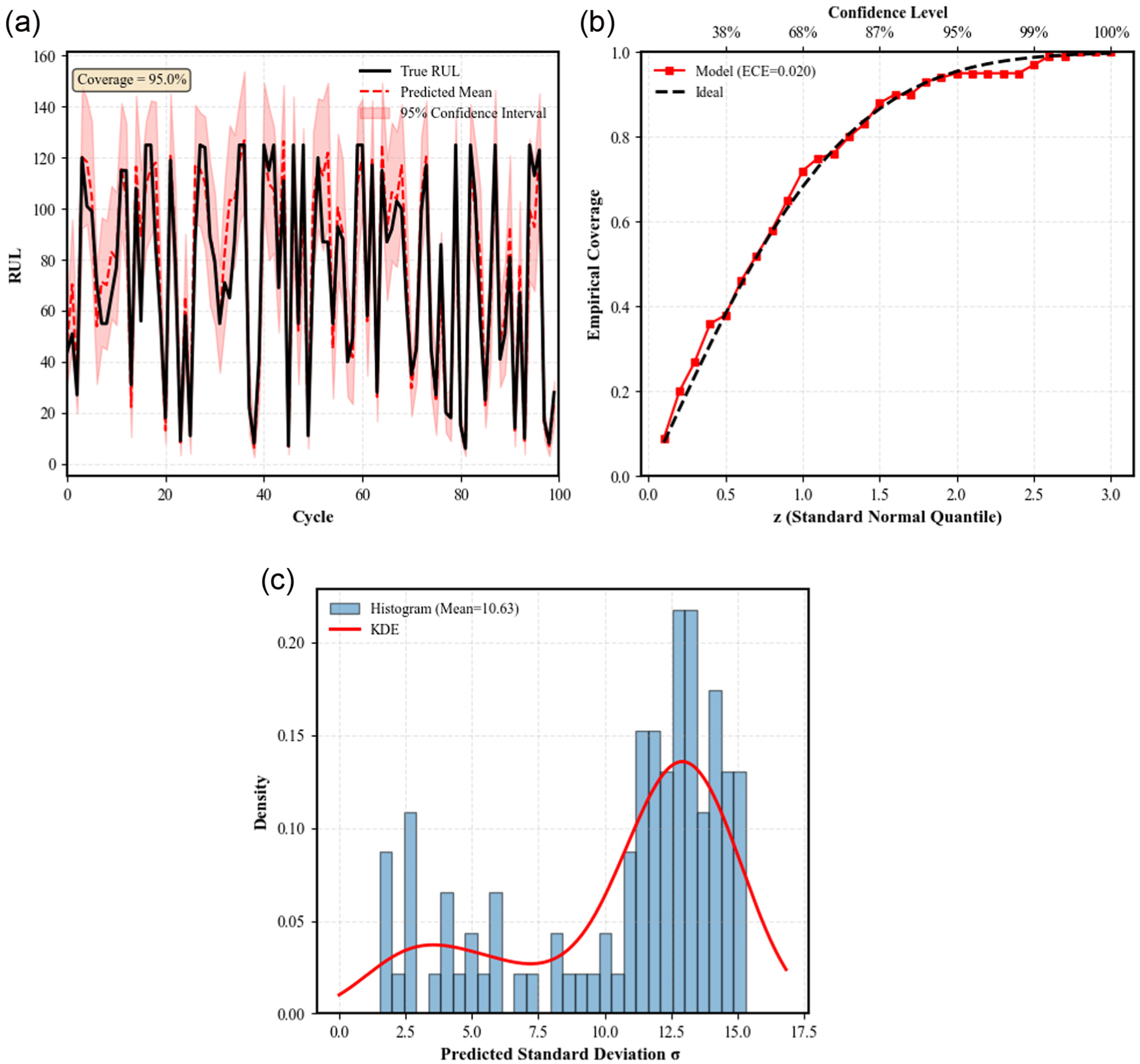
Uncertainty quantification and evaluation of the TFTCG model on the C-MAPSS FD003 test set: (a) RUL prediction with uncertainty, (b) calibration curve, and (c) uncertainty distribution. TFTCG: time–frequency transformer–convolutional neural network gated; RUL: remaining useful life.
The reliability of the uncertainty estimates is further assessed. Figure 10(b) presents the calibration curve, where the model’s calibration performance (red curve) is close to the ideal diagonal (black dashed line). The expected calibration error is 0.020, indicating good reliability. Figure 10(c) shows the distribution of the predicted standard deviations across the test set. The distribution is right-skewed, with a peak at lower uncertainty values (mean σ = 10.63). This shape indicates that the model is highly confident (low uncertainty) for the majority of predictions, while assigning appropriately higher uncertainty to a smaller subset of cases, which likely correspond to periods of rapid degradation or anomalous patterns. This aligns with the dynamic interval widths observed in Figure 10(a) and demonstrates that the model’s uncertainty quantification is not only calibrated but also semantically meaningful.
These results substantiate the model’s capability not only for accurate point prediction but also for providing reliable uncertainty quantification, which is crucial for risk-aware maintenance decision-making.
Discussion and limitations
The pump dataset used in this study was constructed through controlled staged degradation experiments, resulting in stepwise RUL trajectories. This approach offers high controllability and is effective for validating the model’s capability in degradation stage identification and RUL prediction under well-defined conditions, as evidenced by the high accuracy in the confusion matrix (Figure 8). However, it is important to acknowledge that real-world pump degradation is often continuous and more stochastic. The stepwise nature of our dataset may limit the direct generalization of the model to such perfectly continuous scenarios. Future work will focus on validating the TFTCG model on continuously degrading pump data collected from actual operational environments. Nevertheless, the model’s superior performance on the continuously degrading C-MAPSS dataset (“Comparison with SOTA models” section) strongly suggests its inherent potential to handle continuous degradation patterns.
Conclusion
This article introduces the TFTCG model for the accurate prediction of the RUL of marine centrifugal pumps. The proposed model leverages a dual-domain approach that integrates both time-domain and frequency-domain features, enabling it to capture intricate short-term anomalies and long-term degradation patterns. The incorporation of a gating mechanism further enhances the model’s ability to adaptively fuse these features, significantly improving prediction accuracy and robustness.
Experimental validation on both the publicly available C-MAPSS dataset and a custom marine pump dataset demonstrates the superior performance of the TFTCG model. The model achieves a significant reduction in RMSE and a higher PHM score compared to existing SOTA models, proving its effectiveness in predicting RUL under complex operational conditions. Ablation studies further highlight the importance of both time-domain and frequency-domain feature fusion, as well as the gating mechanism, in enhancing the model’s predictive capabilities.
The TFTCG model offers a promising solution for real-time fault detection and degradation monitoring in marine mechanical systems. Its ability to predict the RUL accurately, even in dynamic and harsh operating environments, provides a valuable tool for proactive maintenance and operational decision-making. This study advances the field of predictive maintenance for marine pumps, contributing to the broader application of DL techniques in industrial prognostics.
Future work will focus on enhancing the model’s generalizability to different types of mechanical equipment and exploring its real-time prediction capabilities in diverse operational environments. Additionally, we aim to incorporate more advanced feature extraction methods and improve the computational efficiency of the model, further extending its applicability to real-world industrial settings.
Footnotes

Author contributions
Funding
The authors disclosed receipt of the following financial support for the research, authorship, and/or publication of this article: The author would like to gratefully acknowledge the Provincial Key R&D Program of Heilongjiang (2023 ZXJ03C02), National Natural Science Foundation of China (no: 52075117), and Harbin Manufacturing Industry Science and Technology Innovation Talent Project (2023CXR CGD031) for their support.
Declaration of conflicting interests
The authors declared no potential conflicts of interest with respect to the research, authorship, and/or publication of this article.
Data availability statement
The C-MAPSS dataset used in this study is publicly available.7 The degradation dataset of the marine centrifugal pump is available from the corresponding author on reasonable request.