







Abstract
This article seeks to explain variations in presidential activism in semi-presidential countries in Sub-Saharan Africa. Africa is one of the continents where semi-presidentialism is most prevalent, but the dynamics of intra-executive relations are severely understudied. The four case studies discussed here—the Democratic Republic of Congo, Niger, Cabo Verde, and São Tomé e Príncipe—belong to the premier-presidential subtype. In this exploratory study, we aim to examine how institutional dimensions of premier-presidentialism interact with contextual factors to explain variations in presidential activism among Sub-Saharan African countries. In addition to fundamental contextual differences among the two pairs of countries, francophone and lusophone, there are specific institutional factors associated with the design and operation of premier-presidentialism that contribute to greater presidential activism in the two francophone cases. Taken together, these contextual and institutional factors skew effective executive power heavily toward the president in our francophone countries. We also find that the degree of political institutionalization matters for the impact of presidential activism on intra-executive conflict and government policymaking capacity. The article increases our understanding of the operation of semi-presidentialism in this understudied region, underscoring the importance of both contextual and constitutional factors for explaining variations in presidential activism in Africa.
Introduction
Africa is one of the continents with the greatest prevalence of semi-presidentialism. Yet, the dynamics of intra-executive relations and the channels for presidential activism are profoundly understudied in the African context. The literature on semi-presidentialism in transitional and younger democracies is largely confined to Eastern Europe (e.g. Brunclik and Kubat, 2019; Elgie and Moestrup, 2008, 2016; Gherghina and Miscoiu, 2013) while Africa is almost entirely ignored. With some case-study exceptions (Chaisty et al., 2018; Elgie and Moestrup, 2007), comparative analyses of African countries are critically underrepresented among semi-presidential studies (Åberg and Sedelius, 2020). This study of presidential activism among semi-presidential regimes in Sub-Saharan Africa addresses this gap.
Presidents in Sub-Saharan Africa’s semi-presidential countries tend to be very active (Shugart, 2005: 333). Within the dual executive, the president is generally at the forefront of the political scene, leading cabinet meetings, speaking to the public, and representing the country in international fora. Prime ministers tend to act as “stewards,” limited to coordinating government action (Momo and Gatsi, 2020: 6). However, in the premier-presidential variant of semi-presidentialism, where the popularly elected president lacks unilateral power to dismiss the prime minister, there is considerable variation in the level of presidential activism. In some countries, it is indeed the prime minister who is the dominant actor, regardless of whether the president is backed by a legislative majority or there is a situation of cohabitation. 1
In the context of Sub-Saharan Africa, such variation could intuitively be attributed to varying contextual factors such as colonial background, level of democracy, and geographical structure (cf. Sanches, 2020; Sanches et al., 2022). Yet, the literature on semi-presidentialism, based primarily on countries in Europe, emphasizes the institutional dynamics of the premier-presidential model itself as key to understanding varying levels of presidential activism. Such institutional dynamics include specific presidential powers, minority versus majority governments, and the president’s influence over his or her political party (Elgie, 2018; Köker, 2017).
Our argument is that institutions matter also in the African context. Therefore, in this exploratory study, we aim to examine how institutional dimensions of premier-presidentialism interact with contextual factors to explain variations in presidential activism among Sub-Saharan African countries. In addition, we seek to understand the impact of presidential activism on intra-executive conflict and policymaking capacity.
We explore the four existing 2 premier-presidential countries in Sub-Saharan Africa: two francophone, relatively large mainland states, the Democratic Republic of Congo (DRC) and Niger, classified as “Not Free” and “Partly Free,” respectively, by Freedom House (2023), and two lusophone small island-states, Cabo Verde and São Tomé e Príncipe (STP), which are both designated as “Free” countries.
As we shall see, in addition to fundamental contextual differences among the two pairs of countries, there are specific institutional factors associated with the design and operation of premier-presidentialism that contribute to a higher degree of presidential activism in the two francophone cases: situations of cohabitation are relatively rare; majority governments are the norm; and presidents often maintain the role as party leader and/or the ability to appoint the prime minister of their preference. In addition, while aggregate constitutional powers provide little insight, there are specific differences in terms of agenda-setting powers that stand out, between our lusophone and francophone cases. Taken together, these contextual and institutional factors skew effective executive power heavily toward the president in our francophone countries.
The article is organized as follows. Next, we discuss research design and place our four premier-presidential cases in the wider context of semi-presidentialism in Sub-Saharan Africa. Subsequently, and based on the literature on presidential activism, much of which is centered on Europe, we discuss aggregate and specific presidential powers; lay out the prevalence of majority, cohabitation, and minority governments; and catalog the presidents’ role within their respective parties. Then follows an in-depth analysis of presidential activism in our four country cases, comparing periods of congruent presidential and legislative majorities versus times of cohabitation. Finally, the article explores the consequences of presidential activism in terms of intra-executive conflict and policymaking capacity. The conclusion summarizes the main findings.
Research Design: Premier-Presidentialism and Contextual Distinctions
States and politics in Africa are commonly described as patrimonial, reflecting the idea that patrimonial forms of authority permeate institutional structures. Patrimonialism has been linked to the “big men” politics of strong presidents, particularly evident in the 1970s and 1980s (Sigman and Lindberg, 2017). And indeed, strong presidential incumbents in Sub-Saharan Africa have frequently utilized the institutions of democracy as means to their own ends (Ishiyama et al., 2018; Morse, 2019). Sub-Saharan Africa is thus challenging for institutional analysis and many scholars have placed greater weight on the impact of informal rules of the game rather than on formal institutions (Van Cranenburgh, 2008). While we should not underestimate the importance of informal processes, this overriding focus overlooks the significant degree of institutionalization and democratization that has occurred in Africa since the 1990s (Crawford and Lynch, 2012; Moestrup, 2011; Sigman and Lindberg, 2017). Recent findings suggest that constitutions play a significant role in regime maintenance and peaceful transitions even in some of the most authoritarian contexts in Africa. In this way, formal institutions shape the expectations as to who will be the de facto leader even in contexts where formalities and rules are regularly violated (Hale, 2015; Meng, 2021).
Currently, 18 of the 49 countries 3 in Sub-Saharan Africa have adopted a semi-presidential constitution. Only four are premier-presidential, while the remainder have president-parliamentary constitutions, an indication of the tendency to privilege presidential preeminence within Africa’s semi-presidential systems. 4 Among our four premier-presidential cases, two were classified as “Free” by Freedom House in 2023 (Cabo Verde and STP), one as “Partly Free” (Niger), and one as “Not Free” (the DRC). Hence, in addition to sharing a legacy of substantial influences from the semi-presidential models of their former colonial powers, France and Portugal (see below), our cases simultaneously represent distinct experiences of democracy: the francophone countries, DRC and Niger, exhibit lower levels of democratic development compared to the two lusophone countries, Cabo Verde and STP. Scholars have recently associated higher levels of democracy in, for example, Cabo Verde and STP with their “smallness”: their status as island-states and with a population below 1.5 million enhances democracy by closer connections between citizens and politicians, increased community cohesion, and a geographical buffer against potential instability in neighboring mainland states (Sanches et al., 2022).
In this focused comparison (George and Bennett, 2004), then, we have two distinct pairs of countries that represent significant contextual variation in terms of colonial background, level of democracy, population size, and mainland versus island status. Our endeavor is to emphasize how such scope conditions interact with key institutional features of the premier-presidential systems to explain the differences in variation and implication of presidential activism across the cases.
Data on the internal workings of and the mechanisms for intra-executive coordination are generally scant for most semi-presidential African countries. For our purposes, we rely on close readings of constitutional texts and secondary literature, including news media and opinion surveys.
Institutional Drivers of Presidential Activism
Presidential Powers
Raunio and Sedelius (2020: 35) define presidential activism as “the presidents’ use of their formal powers and their attempts to influence politics through informal channels.” Formal powers are those enshrined in the constitution, while informal channels refer to strategies such as “going public” or behind the scenes negotiations to shape government policies. So, is part of the explanation for greater presidential activism in the francophone premier-presidential countries that the francophone presidents tend to have stronger formal powers than their lusophone counterparts? The use of informal channels will be discussed below in our in-depth case comparisons.
Table 1 provides the presidential power scores by Doyle and Elgie (2016): the score is a linear, weighted construct of all existing presidential power measures for that country at a given time. A higher score between 0 and 1 indicates higher overall constitutional powers. Though not fully up to date, we note that aggregate constitutional presidential powers were lower for our country cases compared to France (0.465, 1963–2008) and Portugal (0.543, 1983–present) (Doyle and Elgie, 2016). Also, the scores for both Cabo Verde and STP are higher than for Niger under the 2000–2009 constitution. These aggregate presidential power scores thus do not obviously help explain the high degree of presidential activism in francophone semi-presidential countries in Africa and point to the need to consider specific powers.
Presidential Powers.
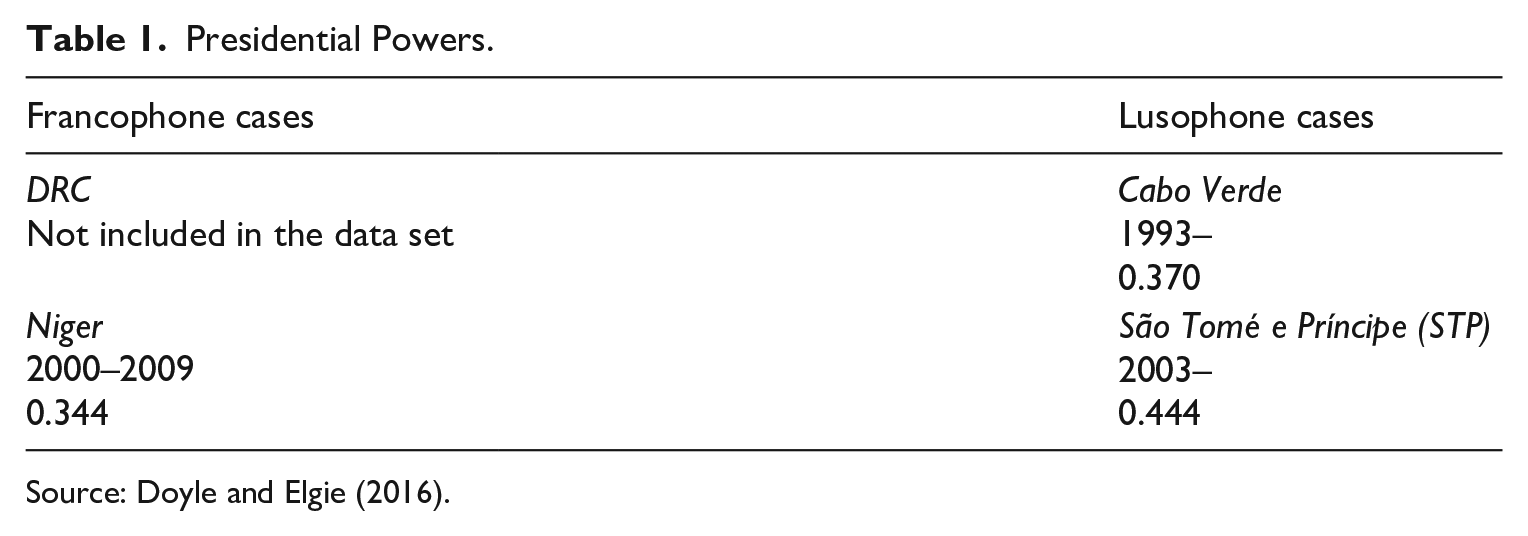
Source: Doyle and Elgie (2016).
To unpack the constitutional powers that may facilitate greater activism on the part of our francophone presidents, we consider variations in entry points for the president to influence the policymaking process. Following Lazardeux (2015: 23-24), we distinguish between the agenda-setting and policy formulation stage, and the decision-making stage when drafted bills become law. According to constitutional provisions, the government is generally vested with the authority to determine and execute policies in our four countries, although there are reserved policy domains in defense and foreign affairs for the president in the DRC and STP, and in Niger during periods of cohabitation. In the DRC, “Defense, security and foreign affairs are domains of collaboration between the President of the Republic and the Government” (art. 91). 5 In STP, the president is specifically given competence “In consultation with the Government to conduct the whole negotiation process for concluding international agreements” (art. 82). 6 In Niger, during periods of cohabitation, “the Ministers charged with National Defense and with Foreign Affairs are appointed by mutual agreement of the President of the Republic and the Prime Minister” (art. 81). 7
When it comes to the conduct of cabinet meetings, there are important differences between the francophone and lusophone countries. In Cabo Verde 8 and STP, the prime minister leads cabinet meetings; the president is only invited at the request of the prime minister. In contrast, in the DRC and Niger, the president convenes and presides over the council of ministers. In Niger, the constitution specifies, however, that “The agenda of the Council is established by mutual agreement between the President . . . and the Prime Minister” (art. 57). This clarification was not present in the 1992 constitution, and the run of show of cabinet meetings became an important source of conflict during the cohabitation between President Mahamane Ousmane and Prime Minister Hama Amadou, as discussed below.
Overall, presidents in our francophone countries are thus better placed to influence policy formulation through formal channels than their lusophone counterparts, thanks to their participation in and presiding over cabinet meetings. Emphasizing the significance of their colonial-institutional legacy, the DRC and Niger follow the French example, 9 while Cabo Verde and STP are more closely aligned with the Portuguese constitution, where the president only chairs the council of ministers if asked by the prime minister. 10 At the decision-making stage, veto powers are similar across our four countries: a simple majority of legislators can override a presidential veto and ensure that a draft bill becomes law.
Government Majorities and the Presidents’ Role Within the Party System
Focused predominantly on Europe, several studies have established that in addition to the president’s constitutional powers, government majority conditions and cohabitation influence both the menu and types of presidential activism (Köker, 2017; Raunio and Sedelius, 2020) as well as the likely outcome in terms of intra-executive conflict (Elgie, 2018; Sedelius and Mashtaler, 2013) and policymaking capacity (Lazardeux, 2015). Presidents backed by a legislative majority should, all else equal, have greater ability to shape government policies than in situations of cohabitation or divided executive or minority governments. Table 2 shows that our two francophone countries have tended to have majority governments, while cohabitation has been more prevalent in our lusophone cases; minority governments have been rare and short lived across our cases. Niger is the only francophone country in Sub-Saharan Africa to have experienced cohabitation shortly after its transition to multiparty democracy in the 1990s. The DRC went through a period of divided executive during the first two years of President Félix Tshisekedi’s mandate, when former President Joseph Kabila’s coalition, the Common Front for Congo (FCC), maintained the legislative majority, relegating Tshisekedi’s party, the Union for Democracy and Social Progress (UDPS), to the role of junior partner in the cabinet.
Types of Government 1991–2023.
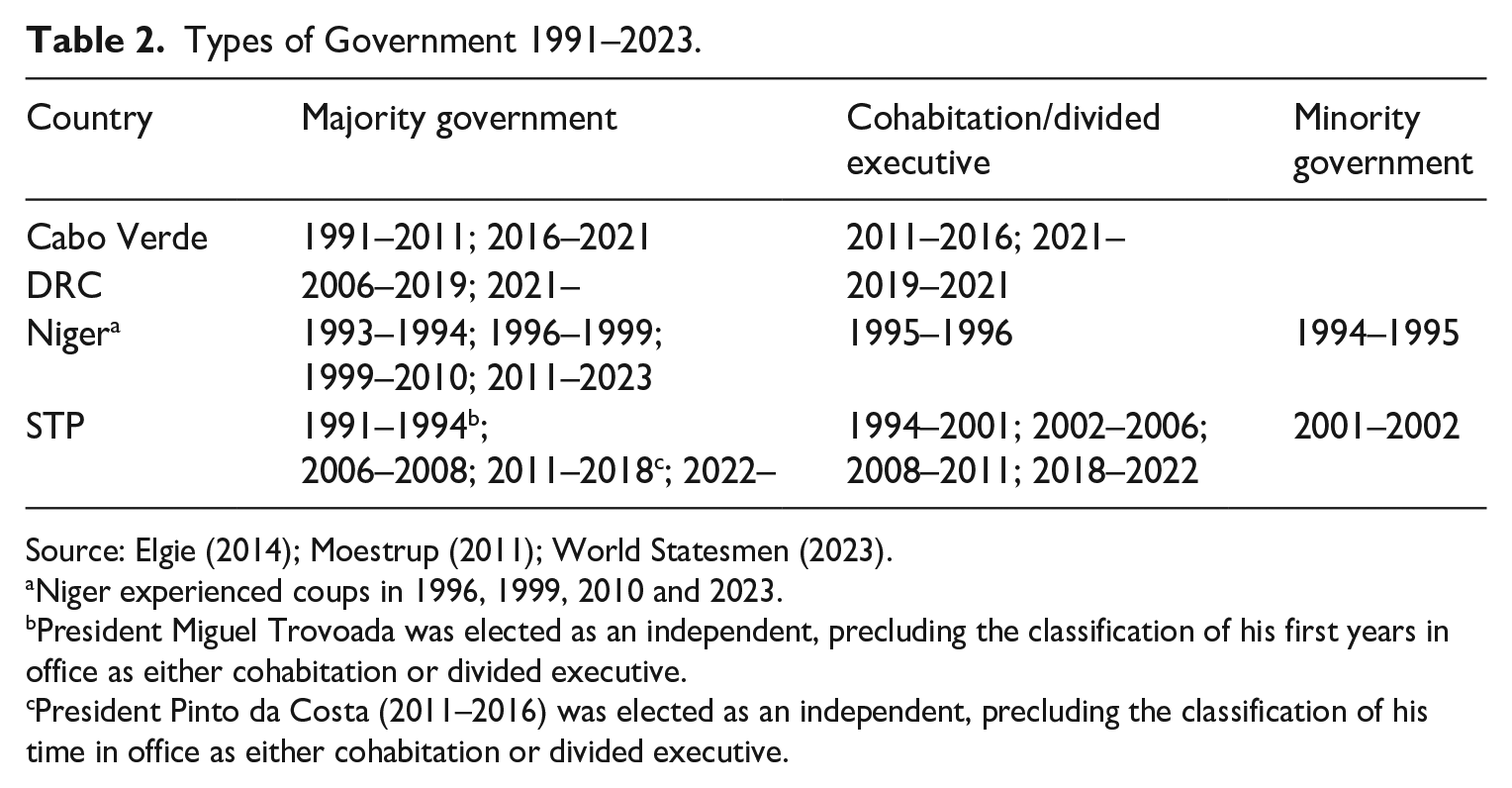
Source: Elgie (2014); Moestrup (2011); World Statesmen (2023).
Niger experienced coups in 1996, 1999, 2010 and 2023.
President Miguel Trovoada was elected as an independent, precluding the classification of his first years in office as either cohabitation or divided executive.
President Pinto da Costa (2011–2016) was elected as an independent, precluding the classification of his time in office as either cohabitation or divided executive.
Presidential activism is moreover conditioned by the degree of internal organization and coherence within the president’s party. Centralized parties are more effective vehicles of presidential influence over the legislative process than factionalized parties where the president is faced with competing elite networks (Passarelli, 2020). To assess party factionalism in highly personalized, patronage-based political systems is challenging, however: a ruling party can be strong and centralized until it suddenly fractures into competing factions. Notably when the president and party leader is headed for the exit, other elites will position themselves in the succession struggle. Here, we will focus on the president’s role as party leader as shorthand for his or her ability to influence legislative processes through the party and to sideline a prime minister from the same party. We find that in the DRC and Niger, the president remained the party leader at the time of the appointment of the prime minister, 11 while in Cabo Verde and STP the president did not hold the presidency of his party. In the latter two countries, the prime ministers are the leaders of their respective parties, further strengthening their hand vis-à-vis heads of state who are no longer at the helm of their parties. Again, the lusophone countries follow the example of Portugal, where the presidents similarly relinquish party leadership positions once elected, while the francophone countries are more closely aligned with the French practice of presidents remaining the de facto leaders of their parties. 12
To conclude, the prevalence of presidents maintaining their role as party leaders and the greater frequency of majority governments in contrast to situations of cohabitation or minority governments, combine to provide a permissive environment for presidential activism in our two francophone countries. While aggregate presidential power scores do not help explain the “presidential supremacy” among our francophone dual executives (Momo and Gatsi, 2020), differences in formal agenda-setting powers between francophone and lusophone presidents appear significant. This will be explored more in the following.
Explaining Variation in Presidential Activism: Case Narratives
Thus far, our general observations suggest that in addition to significant contextual differences between the lusophone and francophone countries, institutional factors previously identified in other semi-presidential contexts help to explain variation in presidential activism. These include specific presidential prerogatives, cohabitation or divided government, and the president’s influence over his or her party. In the following, we provide case narratives on each of the four countries to verify the relevance of these factors. The cases also allow us to tease out presidents’ use of informal powers, such as “going public” and maneuvering behind the scenes.
Cabo Verde is, like STP, a small lusophone island state which has, however, experienced much greater political stability. In stark contrast to STP discussed below, since the democratic transition in 1991 the country has only had four prime ministers, of whom one served 15 years uninterrupted. The country is basically a two-party system (Sanches, 2020: 191–192). Jorge Carlos Fonseca’s presidency (2011–2021) is interesting because it covers both a period of cohabitation (most of his first term) and a time of unified government (the end of the first and the entirety of his second term). Relations between presidents and prime ministers in Cabo Verde have tended to be amicable (Sanches and Costa, 2020). The concern that the relations may be too friendly, making the president unable to exercise oversight, became a campaign issue in 2011, with Fonseca running on the ticket of the Christian Democratic Movement for Democracy (MpD) arguing that cohabitation would be good for the country and that voters should not “place all their eggs in one basket” (Amado, 2016). 13 Though intra-executive relations remained generally cordial during the 2011–2016 cohabitation with Prime Minister José Maria Neves of the social democratic African Party of Independence of Cape Verde (PAICV), Fonseca was an active president. He used his veto six times, with the speed picking up toward the end of his first term, as he was preparing to stand for reelection. His April 2015 veto of a bill which would significantly have increased salaries of elected officials—including his own—was unique in that the president blocked legislation his own party supported. The bill was, however, deeply unpopular among the public and demonstrators had called on Fonseca to veto it. Though parliament could have overridden his veto, the government chose not to. Foreign policy proved to be the area of most tensions, notably the question of who represents Cabo Verde at international summits—the president or the prime minister? Ultimately, the prime minister bowed out of the fight that was playing out very publicly in the media, and Fonseca represented the country at the 2014 Africa–Europe Summit (Moestrup, 2017: 12–17). However, with the return to congruent majorities in 2016, the prime minister was back to playing a preeminent role in foreign fora, for example, representing Cabo Verde at the 2018 Beijing Summit of the Forum on China–Africa Cooperation. Fonseca did not become a wallflower, nevertheless, especially during the COVID-19 pandemic, a time during which the president came to play a much larger role in the political process. The president and the prime minister increased the frequency of their interactions beyond the weekly scheduled meetings, and Fonseca met repeatedly with the speaker of parliament, with political and civil society leaders, and issued numerous public messages with reference to the pandemic, contributing substantially to moderating tensions during the health crisis (Sanches and Costa, 2020). Among our four countries, Cabo Verde hence represents a case of government stability and relatively smooth interactions between the president and prime minister. Comparable to democratic contexts in Europe, presidential activism, salient in foreign policy and during the pandemic, has played out in a context characterized by a significant level of party institutionalization and regular transitions of leadership (Sanches and Seibert, 2020).
On the contrary, São Tomé e Príncipe (STP) has experienced significant political instability since transitioning to multiparty elections in 1991, including two short lived coups where constitutional order was restored through negotiations within a week (Seibert, 2016: 999). Hence, presidential activism has occurred in a context of personalistic politics, competing clientelistic networks and a political landscape characterized by party instability and frequently changing coalitions (Seibert, 2016). The country has had a plethora of fragile and shifting coalition governments among four major parties and 19 prime ministers. 14 STP also has had the highest incidence of cohabitation cases in Sub-Saharan Africa. The tenure of President Evaristo Carvalho (2016–2021) of the Independent Democratic Action (ADI) is—like that of Fonseca in Cabo Verde—an interesting case of presidential activism during unified government versus cohabitation. At the time of Carvalho’s election in 2016, the ADI, a centrist political party, controlled both the presidency and the prime minister position. However, in 2018 the opposition coalition led by the left-leaning Movement for the Liberation of São Tomé and Príncipe–Social Democratic Party (MLSTP/PSD) won the legislative majority. Before the change of prime minister, Carvalho played a supporting role to the implementation of the ADI government’s policies, including the creation of a new Constitutional Court, and by dismissing the acting president of the old Constitutional Court. Carvalho did, however, drag his feet in promulgating an amendment to the National Defense law transferring the right to appoint the Chief of General Staff of the Armed Forces from the president to the prime minister (Seibert, 2018). During the cohabitation with Prime Minister Jorge Bom Jesus, Carvalho was more independently active. In January 2019, the Jesus government dismissed the governor of the central bank and replaced him with a senior MLSTP/PSD party official, over the president’s objections, who accused the government of infringing on his constitutional authority (Freedom House, 2020). When the government in September that same year tried to remove the attorney-general appointed by the previous ADI government, President Carvalho again opposed the move as violating presidential prerogatives. To strengthen his position, the president this time convened the Council of State, a 13-member advisory body that includes the president of the national assembly, the prime minister, the attorney-general, former presidents, other heads of institutions, and five citizens. The president subsequently pressured the prime minister to reshuffle his cabinet; the prime minister promised to draw lessons from the political crisis and to engage in a “constructive institutional relationship with the presidency” (Seibert, 2021: 274–275). In 2020, Carvalho used his veto to oppose a government budget to combat the COVID-19 pandemic which he considered to not have followed proper procedures (Camunda News, 2020), and in 2021, he vetoed a controversial revision of the electoral code (Seibert, 2021: 275).
Niger first transitioned to multiparty democracy in 1993, and this former French colony has since experienced significant political instability, more severe than STP. The country has gone through four coups (1996, 1999, 2010, and 2023 15 ) and five constitutions, two of which have been presidential (1996–1999, and 2009–2010). A challenging 12-month cohabitation period characterized by gridlock and political stalemate discredited the nascent democratic semi-presidential institutions and paved the way for the first of these coups, in January 1996. President Ousmane of the social democratic Democratic and Social Convention (CDS) had at first sought to impose his choice of prime minister after losing the parliamentary majority in January 1995; however, the government was toppled in a vote of no confidence, and Ousmane was forced to appoint Hama Amadou of the center right National Movement for the Development of Society (MNSD). During the cohabitation period that followed, president and prime minister clashed repeatedly over appointments within the local and central administration, agenda-setting for cabinet meetings, and even the use of the presidential airplane. Ousmane requested that parties from the left-leaning Alliance of the Forces of Change (AFC) coalition backing him be included in the cabinet, which the prime minister refused. The issue at heart was whether governing power should effectively shift to the prime minister in a situation of cohabitation, or whether power should be “co-managed” between president and prime minister (Moestrup, 2007: 113–114). Two additional coups later, Niger saw its first peaceful transfer of power from one elected president to the next, in April 2021, 16 to be followed by yet another military coup in July 2023. 17 Nigerien constitution makers have taken the country’s past troubles to heart and sought to spell out how power is to be shared between president and prime minister in the event of cohabitation, first in the 1999 constitution and then even further in the 2010 fundamental text. Since then, Niger has de facto oscillated between a president-parliamentary and a premier-presidential system, depending on whether there is congruence between presidential and legislative majorities. A subsection of the constitution (arts. 81–82) mandates that in the event of cohabitation, the president appoints the prime minister from a list of three candidates proposed by the legislative majority; the president may only dismiss the prime minister upon the government’s resignation; and the president and prime minister must agree on appointments to the defense and foreign affairs cabinet positions. Art. 82 goes further to state that the president appoints to civil employments within the state administration on the government’s proposal; when not in cohabitation, the president can make such appointments independently by decree (art. 70). The 2010 constitution makes explicit that when the president is backed by a legislative majority, he or she is the dominant partner within the dual executive and sets the government’s policy agenda. This was very apparent during Mahamadou Issofou’s presidency (2011–2021). There was considerable stability in government and only one prime minister for the entire 10-year period, Brigi Rafini, who belonged to the same party as the president, the Nigerien Party for Democracy and Socialism (PNDS). The prime minister was, however, left with limited space to maneuver and chiefly restricted to implementing the president’s political vision (Imeran Maiga, 2017: 57–58; Zaki, 2017: 113). The ability of the new constitutional provisions to facilitate a period of cohabitation is yet to be tested.
The Democratic Republic of Congo (DRC), a former Belgian colony, has had a troubled transition to more open politics. Following the return to multiparty elections in 2006, subsequent polls have lacked transparency and credibility. However, former President Kabila’s designated successor trailed so far behind in the December 2018 presidential election that ultimately an opposition candidate, Félix Tshisekedi, was declared the winner—though by many accounts another opposition leader, Martin Fayulu of the Engagement for Citizenship and Development (ECIDE) party, had actually come first (Godfrey, 2019). While losing the presidential seat, Kabila and his allies of the FCC, the former left-leaning presidential alliance, kept a legislative majority and the constitutional right to appoint the prime minister; as a result, in 2019 the DRC entered an uneasy period with a divided executive. The president’s party, the similarly left-leaning UDPS, was the junior partner in government and Tshisekedi chafed under the limited power of his office. Under pressure to deliver on promises of electoral and governance reforms, Tshisekedi declared in his new year speech that 2020 would be “the year of action” (International Crisis Group (ICG) 2021). In October 2020, Tshisekedi appointed three new judges to the Constitutional Court, breaking Kabila’s control over the court. At the same time, the president initiated political consultations to form a new parliamentary majority and succeeded over the following months in enticing a significant number of former Kabila supporters into his camp. By December 2020, Tshisekedi ended the coalition with Kabila and threatened to dissolve parliament, should he not succeed in securing sufficient backing for the formation of a new government. The Constitutional Court allowed MPs to leave their political groupings in parliament and join new alliances, without the risk of losing their seats (Sematumba, 2021). In short succession, the pro-Kabila speaker of parliament was ousted, Prime Minister Ilunga was toppled in a vote of no confidence, and the president of the Senate resigned. In February 2021, Tshisekedi named Jean-Michel Sama Lukonde as the DRC’s new prime minister. Lukonde is from a small political party without seats in parliament and lacks an independent power base. In contrast to his predecessor, he has acted as an “auxiliary” to the president, while high profile government policies, including infrastructure projects and fiscal policy issues, were handled at the presidential level (Tshiamala, 2021).
Our case narratives illustrate differences in opportunities for formal presidential activism (Raunio and Sedelius, 2022; Tavits, 2009) between our lusophone and francophone cases. Through their presiding over cabinet meetings and the agenda-setting powers, presidents in Niger and DRC become the dominant executive actor during periods of political congruence between president and legislative majority. That is not the case in Cabo Verde and STP where the prime minister remains in charge of day-to-day agenda-setting for the government. Paradoxically, in our lusophone countries periods of cohabitation provide comparatively greater opportunity for presidential activism using vetoes at the decision-making stage (vetoes that in most cases, however, are easily overridden by a legislative majority). We see, nevertheless, that in both our lusophone and francophone cases, tensions have abounded over where the president’s formal powers end and those of the prime minister begin.
We also find great variation in terms of coordination between president and prime minister. In our lusophone countries, cabinet meetings do not serve as a formal coordination mechanism as presidents are not regularly invited. Instead, coordination is systematized through weekly meetings between president and prime minister in Cabo Verde, with the meeting frequency increasing as the situation requires. Similar smooth collaboration between the two executives in STP has been amiss. For example, during the 2018–2021 cohabitation, President Carvalho publicly bemoaned what he perceived as “institutional disloyalty and a lack of coordination” on the part of the Jesus government (Voice of America, 2019). Carvalho used the Council of State established through the 2006 constitutional reforms as a venue for expressing dissatisfaction and seeking to influence government decisions. In the DRC, President Tshisekedi created a Presidential Strategic Watch Council (PSWC) to monitor government implementation of his commitments (Tshiamala, 2021). The PSWC is headed by a powerful presidential advisor who reports directly to Tshisekedi himself, and can demand activity reports directly from cabinet ministers.
In terms of informal channels for presidential activism, going public has been a favored strategy by presidents in STP, in a context of highly personalized quarrels between leading politicians who have dominated Sao Tomean politics since the 1970s (Seibert, 2016). Presidents and prime ministers have repeatedly clashed through declarations to the press. President Fonseca of Cabo Verde also went public at times during his cohabitation with Prime Minister José Maria Neves, communicating his positions via speeches or in the media to influence public opinion. In Niger, debates over the respective powers of president and prime minister also played out in the media during the turbulent 1995–1996 cohabitation period, and the Constitutional Court was repeatedly asked to interpret the constitutional text (Moestrup, 2007). And in the DRC, Tshisekedi was very vocal about his frustration at his reform agenda being stymied, before he succeeded in securing the backing of a legislative majority.
Finally, the DRC illustrates the importance of patronage politics and behind the scenes maneuvering by the president to clear the way for presidential influence in a context of weakly institutionalized political parties. With inducements ranging from offers of cash to political office, President Tshisekedi succeeded in eroding support for former President Kabila and creating a new legislative majority (Africa Confidential, 2020). This enabled him to oust the legislative leadership, topple the pro-Kabila prime minister, and appoint a new coalition government backing his policy agenda. In contrast, in Cabo Verde, a country with much more institutionalized politics and democratic practices, the COVID-19 crisis provided an opening for greater presidential activism during a period with congruent presidential and legislative majorities—not to replace but to shore up the government’s policies.
Impact of Presidential Activism
Turning finally to the consequences of presidential activism, we consider here the impact on the level of intra-executive conflict and policy making capacity by distinguishing again between periods of cohabitation versus periods of congruent presidential and legislative majorities.
Niger is a particularly interesting case regarding intra-executive conflict. As indicated above, intra-executive tensions due to a lack of clarity in the distribution of constitutional responsibilities between the two executives during cohabitation contributed to undermining the country’s fragile democratic institutions in 1996 (Moestrup, 2007: 114). The constitution was subsequently amended to explicitly address presidential powers during cohabitation. During the presidency of Tandja Mamadou (1999–2010), relations between the president and Prime Minister Hama Amadou, both belonging to the MNSD party, were initially collaborative. However, as Tandja was nearing the end of his second term, Hama was toppled in a vote of no confidence over his alleged involvement in a corruption scandal. He was subsequently jailed in an apparent effort to stymie his bid for the presidency in 2009, while Tandja maneuvered to remove presidential term limits. When the National Assembly and the Constitutional Court opposed his call for a referendum to extend his rule, Tandja dissolved both institutions and proceeded to rule by decree (Idrissa and Decalo, 2012: 14–15). Tandja’s constitutional manipulations quickly backfired, however, and in February 2010 he was ousted in a coup (Moestrup, 2014). It is only with former President Issoufou peacefully relinquishing power at the end of his second term in 2021 that Niger for the first time experienced a constitutional change of power between elected presidents. This period of consolidation of democratic gains was abruptly interrupted by yet another military coup in July 2023.
In the DRC, we have seen a similar distinct difference in the degree of intra-executive conflict between the previous divided executive period under Tshisekedi and Prime Minister Ilunga, and the time since Tshisekedi was able to appoint his own prime minister. The conflict was resolved more peacefully than in Niger, by Tshisekedi successfully breaking apart the previous legislative majority and forming a new governing majority. Since then, the two executives have collaborated well, and Prime Minister Lukonde has supported Tshisekedi in the implementation of his policies. An impetus behind President Tshisekedi’s maneuvers to secure a new legislative majority was his frustration at lacking the space to implement the economic and political reforms he had campaigned on. However, after Tshisekedi came to play the dominant role in policy making, his flagship programs of free education and more electrification struggled because of the economic realities of the country; insecurity persisted in the east; and perceptions of corruption increased (Africa Confidential, 2022). In the very challenging Congolese context, Tshisekedi’s activism did not have the desired impact.
In our lusophone countries, Cabo Verde has experienced much smoother collaboration between the two executives than STP, both during cohabitation and congruent majorities. In STP, presidential activism and intra-executive conflict were particularly prevalent prior to the constitutional changes that transitioned the country from a president-parliamentary to a premier-presidential system in 2006. Before that change, presidents would frequently dismiss prime ministers with whom they disagreed, resulting in significant government instability. In contrast, Cabo Verde has experienced government stability and cordial relations between president and prime minister, in a context with much greater institutionalization of political parties and routine leadership successions (Sanches and Seibert, 2020: 226).
In Cabo Verde, the frequency of presidential vetoes increased during cohabitation, compared to previous periods of congruent majorities (Moestrup, 2017: 12–14). Cohabitation happened during a very challenging time, following the 2008 financial crisis that hit the small and open economy hard. However, according to the World Bank Governance Indicator that measures perceived government effectiveness over time, 18 governance actually improved between 2010 and 2015, from a −0.02 to a 0.15 score on a scale from −2.5 to 2.5. Presidential activism only hindered the government’s policymaking capacity late in the cohabitation period, when a combination of Fonseca’s high popularity rate and insufficient time before the elections left three of his vetoes standing. The approaching legislative and presidential elections provided both an opportunity and an incentive for Fonseca to showcase his activism. An already very popular president further improved his standing through his activism during the last 12 months of his first mandate and was easily reelected.
In STP, presidential activism has contributed to government instability. The high turnover of ministers has led to frequent policy changes, and with changes in government also comes “excessive replacement of senior office holders, since parties reward their followers with government jobs” (Sanches and Seibert, 2020: 228). In the end, the government’s effective policymaking capacity has been negatively impacted by the reduced administrative capacity, though since the transition to premier-presidentialism greatest responsibility for government instability now lies with the legislature.
From the above, we see that the relation between contextual and institutional factors plays a significant role in understanding how presidential activism affects intra-executive conflict and government capacity. In a context of weak institutions, presidential efforts at contesting the boundaries of constitutional power vis-à-vis the government can result in government instability and even undermine democracy. Where countervailing powers moreover are weak, presidential activism can focus on shaping the political and electoral playing field to maintain power in the hands of the president. In contrast, where democratic institutions are stronger, presidential activism can be channeled to not overly impede and perhaps even strengthen government capacity, as witnessed during the COVID-19 pandemic in Cabo Verde.
Conclusion
This study has provided insights to explain variation in presidential activism between francophone and lusophone premier-presidential systems in Sub-Saharan Africa. Both contextual and institutional factors combine to strengthen the hands of francophone presidents compared to their lusophone counterparts. In line with theoretical expectations and empirical observations elsewhere, we find that the prevalence of congruent majorities and the tendency for the president to maintain the role as leader of the majority party provide a favorable opportunity structure for presidential activism.
In our francophone cases (DRC and Niger), the president convenes and presides over the council of ministers and tends to be the policy-setting and determinant actor within the dual executive when presidential and legislative majorities align, as is the case in France. In contrast, in our lusophone countries (Cabo Verde and STP), the prime minister is the government lead during periods of both congruent majorities as well as cohabitation and chairs cabinet meetings while the president is only invited at the request of the prime minister, as is the case in Portugal. Also, in the lusophone countries, the president steps down from party leadership, while the prime minister is the leader of the largest party in parliament. In our two francophone countries, in contrast, during congruent majorities presidents have been the dominant political figure, tending to appoint a prime minister with a more limited independent political base. Again, the family resemblances with political practice in Portugal and France, respectively, is striking.
In addition, francophone presidents have more opportunities for influencing policymaking through formal agenda-setting powers, particularly when presidential and legislative majorities align; lusophone presidents, paradoxically, have greatest space for activism during periods of cohabitation, through their veto powers. Presidents in both francophone and lusophone premier-presidential systems use informal powers such as “going public” liberally, often tied to disagreements over the boundaries for presidential power.
Looking finally at the impact of presidential activism, our findings emphasize the significance of contextual factors, in particular the level of democracy and institutionalization. The case of Niger shows that intra-executive conflict tends to be deeper and potentially more destructive in countries with more patronage-based politics and where political parties are weaker. As also revealed by studies on, for example, post-Soviet semi-presidential systems with low levels of institutionalization (Elgie and Moestrup, 2016), such conflict can result in government instability and even regime disruption. Where parties are weak, informal maneuverings by the president can contribute to reshuffling majorities to increase the space for more formal presidential activism, in the process further weakening party cohesion, as in the DRC. In contrast, where institutions are stronger, and the praxis of prime minister dominance is well established, presidential activism can be channeled to not overly impede and perhaps even strengthen government policymaking capacity, as witnessed during the COVID-19 pandemic in Cabo Verde. Where the prime minister is the dominant actor, carefully timed presidential initiatives can moreover boost presidential popularity and increase chances of reelection.
Our analysis of presidential activism in Sub-Saharan Africa contributes to a greater understanding of the operation of semi-presidentialism in this often-understudied region. It underscores the importance of both contextual and institutional factors for explaining presidential activism in Africa. Yet, we have just scratched the surface of presidential behavior within the dual executive, and only among four out of 18 semi-presidential countries in Sub-Saharan Africa. Further studies are required to go beyond these cases as well as to assess more carefully the president’s (informal) ties with his or her party, and with other institutions and stakeholders, including the bureaucracy and civil society.
Footnotes
Author’s note
Thomas Sedelius also affiliated to School of Social Sciences, Södertörn University, Sweden.
Declaration of conflicting interests
The author(s) declared no potential conflicts of interest with respect to the research, authorship, and/or publication of this article.
Funding
The author(s) received no financial support for the research, authorship, and/or publication of this article.
