







Abstract
First-generation college students (FGCS) are significantly less likely to complete degrees compared to continuing-generation students. Among the multifaceted causes for this disparity, many FGCS possess limited social and cultural capital in academia, resulting in lower rates of help-seeking and resource utilization. In this study, we conducted an in-depth qualitative investigation to better understand FGCS's help-seeking attitudes, decisions, and behaviors. Twenty-five first-year FGCS at a 4-year, regional, public university participated in individual interviews. A faculty–student team analyzed interview data using reflective thematic analysis. Our findings demonstrate that FGCS were highly strategic about help-seeking, weighing potential costs and benefits. Though they valued self-sufficiency, FGCS sought support when they identified tangible problems and solutions, when potential providers were accessible and had clearly designated roles, and when helpers conveyed personal interest, empathy, and nonjudgment. These results support several recommendations for policy and practice, including critical consciousness, peer mentoring, and difference-education interventions.
Keywords
In the United States, four-year college degrees have become prerequisites for many, if not most, careers promising livable salaries, benefits, and opportunities for advancement (Carnevale et al., 2011). Longitudinally, college degrees are associated with better health, greater civic engagement, and higher earnings, making them potential vehicles of social mobility, particularly for students whose parents did not attend college (i.e., first-generation college students; FGCS; Ma et al., 2016). Although FGCS have enrolled at increasing rates in recent decades, they are much less likely to graduate college compared to continuing-generation students, even after controlling for income (Startz, 2022). If they do graduate, FGCS incur more debt, have lower median incomes, and are less likely to obtain jobs that require college degrees (Fry, 2021).
Causes for these inequities are complex and multivaried (Engle & Tinto, 2008; Startz, 2022), though one widely cited phenomenon is that FGCS enter college with less social capital (i.e., resources accessed through interpersonal relationships) and cultural capital (i.e., familiarity and proficiency with dominant cultural norms) in academic settings (Collier & Morgan, 2008; Hagler, 2018; Yee, 2016). This disparity is exacerbated over time, as FGCS are less likely than continuing-generation students to access campus services, seek and obtain academic support, and form personal relationships with university faculty and staff (Raposa et al., 2021; Yee, 2016). Although these deficits are widely documented, relatively little is known about how FGCS decide if, when, and from whom to ask for help when faced with the immense challenges to their success. To address this gap, this paper reports on an in-depth, qualitative investigation of FGCS's help-seeking attitudes, decision-making, and behaviors during their first year—when risk for drop-out is highest (Engle & Tinto, 2008).
Theoretical and Empirical Background
Literature on college student help-seeking is siloed, in that academic and mental health help-seeking are often studied separately. However, these help-seeking processes are interrelated, with overlap among underlying problems (e.g., anxiety impacting academic performance), pathways (e.g., referrals between academic and mental health providers), and deterrent and promotional factors (Ayón et al., 2024; Sapiro et al., 2023). Thus, we will consider research and theory across these domains while making relevant distinctions.
Extensive research documents the importance of understanding and promoting help-seeking during college. A recent meta-analysis of 108 studies showed that academic help-seeking is robustly associated with better grades (Fong et al., 2023). This association between help-seeking and performance remains after controlling for relevant confounds, like previous grades (Hunt & Eisenberg, 2010), and tends to be stronger among disadvantaged students (Williams & Takaku, 2011). Reflecting the importance of mental health help-seeking, many common psychological problems arise and/or worsen during emerging adulthood, and college counseling centers often facilitate students’ first-ever contact with professional services (Eisenberg et al., 2012). Yet, most college students who meet criteria of psychiatric diagnoses do not receive treatment (Hunt & Eisenberg, 2010), and unmet mental health needs are among the top reasons students cite for dropping out (Gallup & Lumina, 2023).
Several complementary theories are useful in understanding college student help-seeking. The theory of planned behavior holds that behavioral intentions predict behavioral performance, and that intentions are determined by perceived subjective norms (e.g., social stigma versus acceptability of help-seeking) and behavioral control (e.g., the degree to which one believes they can actually obtain help needed to solve problems; Hess & Tracey, 2013). An extension of this theory is the health behavior model, which holds that health-related behavior (in this case, help-seeking) is influenced by one's threat assessment (i.e., perceived likelihood and severity of a problem) as well as perceived costs versus benefits of the behavior (Czyz et al., 2013). Shifting to the academic domain, self-regulated learning theory holds that academic help-seeking unfolds across several decisional stages, such as determining (a) if there is a problem, (b) if help is wanted/needed, (c) whether to seek help, (d) the type of help needed, and (e) who is able and willing provide needed assistance (Karabenick & Berger, 2013). Cutting across these theories are metacognitive processes through which students appraise problems, their own abilities, access to external resources, and relative costs and benefits of seeking help.
Help-Seeking Deterrents
There are several points at which this process can break down for FGCS and other marginalized student populations. First, students may not perceive that problems exist, or they may underestimate problems’ severity and chronicity. Several studies have documented a widely held belief that stress is fundamental to the college experience, and that many students, even those with clinically significant depression and/or anxiety, do not believe their problems are serious enough to warrant formal services (Czyz et al., 2013; Pace et al., 2018). Academically, many FGCS and other underrepresented students do not seek help until they perceive a tangible need, often late in the semester after receiving several low grades (Hvizdak et al., 2019; Richards, 2020). When they do perceive problems, many students prefer to resolve them on their own (Chang et al., 2020; Sapiro et al., 2023; Vinyard et al., 2017). Importantly, self-reliance has likely been an adaptive response because many FGCS were educated in underresourced settings, where help was not reliably available, and have been hegemonized into the Eurocentric norm of “pull-yourself-up-by-your-bootstraps” independence (Chang et al., 2020; Hagler, 2018).
Even if they do recognize and accept that they cannot solve problems on their own, students then face significant stigma—both internalized and perceived from others. FGCS, who already may feel alienated and marginalized in academia, often believe asking for help marks them as “struggling” and confirms that they do not belong (i.e., stereotype threat; Winograd & Rust, 2014). In qualitative studies, students often expressed shame, embarrassment, and fear of judgment, particularly toward seeking help from professors and other authority figures (Clegg et al., 2006; Patel et al., 2015; Payne et al., 2023). This fear may be exacerbated by underrepresentation of faculty from minoritized, working-class backgrounds, as well as experiences of implicit and explicit discrimination (Ancis et al., 2000; Milkman et al., 2012). For these reasons, marginalized, underrepresented college students are more likely to seek informal help from family and peers (Clegg et al., 2006; Gulliver et al., 2010). Other deterrents to help-seeking are more practical in nature. College students often note that they simply do not have time to seek out and engage with additional resources (Czyz et al., 2013; Dunley & Papadopoulos, 2019), particularly low-income students working and living off-campus (Kuh et al., 2006). Facing these steep psychological and practical barriers, students may decide not to seek help if they anticipate that likely benefits will not outweigh costs. For example, students are less likely to seek help when they anticipate someone will be unwilling and/or ineffective—often informed by past negative experiences (Sapiro et al., 2023).
Factors Promoting Help-Seeking
While barriers and deterrents are well-documented, relatively less is known about factors that promote help-seeking. Payne and colleagues (2023) attributed this gap in knowledge to predominantly deficit-based approaches to studying FGCS and other underrepresented populations, calling for more attention to students’ strengths and resilience. Perhaps unsurprisingly, students tend to seek help from people they believe will understand and relate to their problems (Chang et al., 2020; Payne et al., 2023). Although empathy often arises naturally among peers, students are more willing to seek help from faculty and staff after establishing personal relationships (Clegg et al., 2006; Pellegrino, 2012; Richards, 2020). Students perceive professors to be more approachable when they engage in nonacademic conversation, enthusiastically welcome and make time for questions, and get to know students individually (Micari & Calkins, 2021; Payne et al., 2023). Further, students are more likely to seek help from unfamiliar sources when they are actively coached and encouraged by people they know (Richards, 2020; Stanton-Salazar, 2011), and their use of non-counseling campus resources increases the likelihood of subsequently seeking mental health counseling (Ayón et al., 2024), suggesting that less threatening forms of help-seeking can serve as entry points.
In terms of student-level factors, a widely replicated finding involves students’ orientation toward academics. Students who are mastery-oriented (i.e., intrinsically motivated to learn and improve) are more likely to seek help, especially from formal sources, compared to students who are performance-oriented (i.e., extrinsically motivated to finish assignments and receive good grades; Alexitch, 2002; Fong et al., 2023; Martín-Arbós et al., 2021). Qualitative research shows that, though many students value self-reliance, they can recognize their limits and will ask for help, especially when they perceive help-seeking to benefit their learning and more efficiently resolve a problem (Payne et al., 2023; Sapiro et al., 2023; Vinyard et al., 2017).
Research Gaps and Goals of the Current Study
Collectively, existing research suggests that FGCS's help-seeking decisions are highly deliberate and multifaceted. However, the existing body of literature has several limitations. First, authors tend to examine academic and psychological help-seeking separately, even though these processes are likely interrelated. Second, with some exceptions (e.g., Payne et al., 2023), most studies have focused on deficits and barriers, with relatively less known about student, provider, and institutional factors promoting help-seeking. Third, most research on FGCS and other underrepresented populations has occurred at two ends of a spectrum—at selective, predominately White institutions, and open-enrollment community colleges—with less known about other types of institutions serving large proportions of these students (Startz, 2022). In the current study, we analyzed in-depth interviews among FGCS attending a regional, public, 4-year university, pursuant of the following research question: “How do FGCS decide if, when, and from whom to seek help?” We were interested in promotional factors, deterrents, and their interactions, as well as help-seeking across academic, practical, and personal issues (and their overlap). Inductive qualitative methods were best-suited for this goal due to the significant gaps in knowledge and the exploratory, process-oriented nature of our research question.
Methods
Participants and Procedure
Participants were 25 first-year, FGCS at a mid-size, regional, public, 4-year, moderately selective urban university in the northeastern United States with a large proportion of commuting students (See Table 1 for sample demographics). We defined first-generation status as not having a parent or primary caregiver with a 4-year college degree. These 25 students were a subsample from a larger mixed-methods study (Hagler et al., 2021). Participants were initially recruited between June and October 2018, during which they completed a baseline electronic survey. Recruitment strategies included distributing flyers via university emails, orientation packets, postings across campus, and in-person at a summer bridge program for students with provisional acceptance. Participants completed a follow-up electronic survey at the end of Spring semester (2019), after which they were invited via email to participate in in-person interviews on a rolling basis until 25 interviews were completed (based on available budget). Interview participants received a $25 Amazon gift card.
Sample demographics (N = 25).
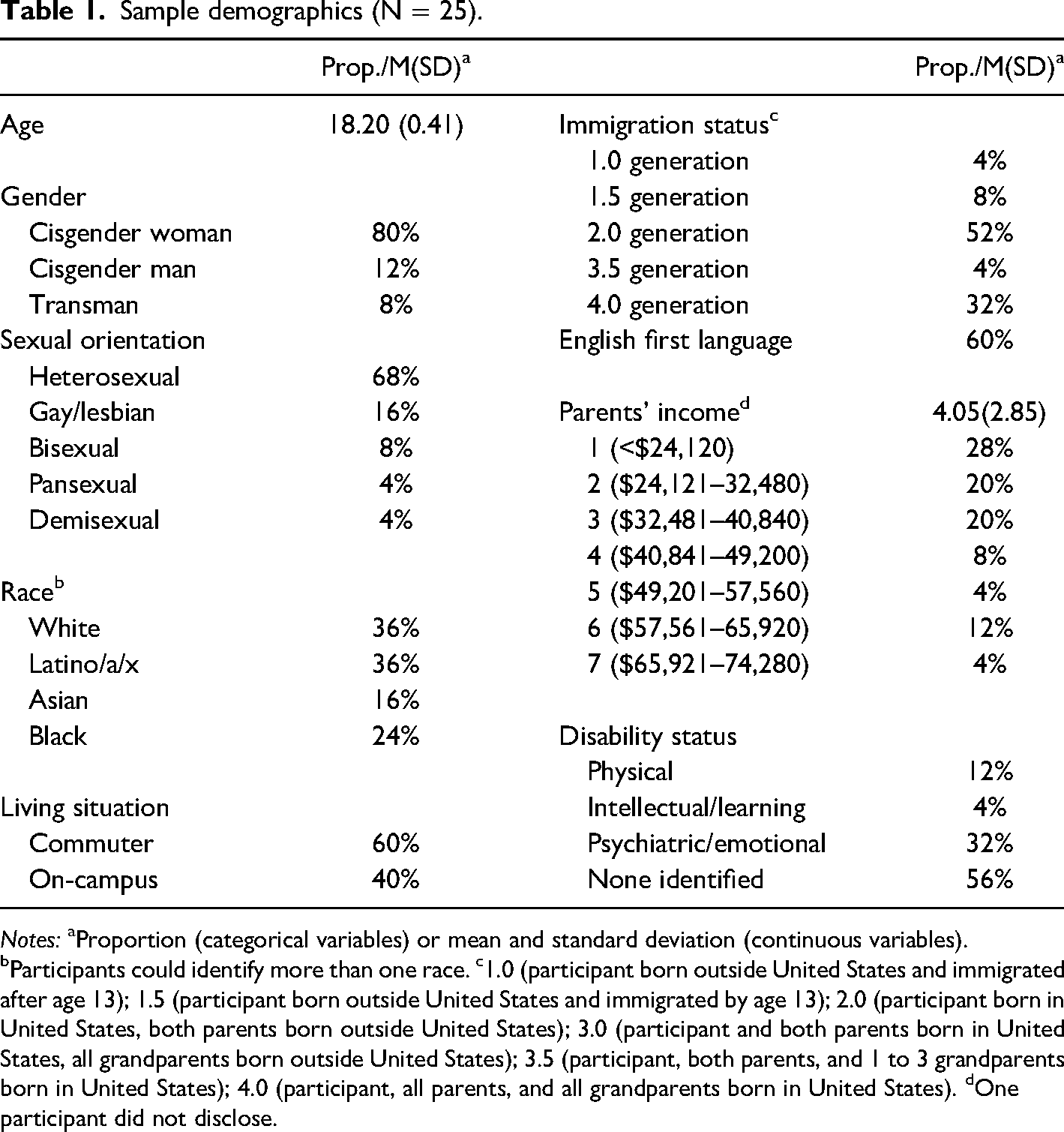
Notes: aProportion (categorical variables) or mean and standard deviation (continuous variables). bParticipants could identify more than one race. c1.0 (participant born outside United States and immigrated after age 13); 1.5 (participant born outside United States and immigrated by age 13); 2.0 (participant born in United States, both parents born outside United States); 3.0 (participant and both parents born in United States, all grandparents born outside United States); 3.5 (participant, both parents, and 1 to 3 grandparents born in United States); 4.0 (participant, all parents, and all grandparents born in United States). dOne participant did not disclose.
The first author conducted all interviews in a private lab space on campus during the last month of participants’ first year of college. At the time, the interviewer was a doctoral student and had no preexisting relationships with participants. Interviews were approximately 40 min long, on average, and followed a semi-structured protocol, asking students about their experiences navigating the college application process and first year, challenges and coping strategies, sources of support, and attitudes and decision-making around help-seeking. Interviews were audio recorded and transcribed verbatim.
Authors’ Positionality
Analysis occurred during the fall semester of 2022, after the first author moved to a different institution. He is a White, cisgender, gay man from a middle-class background and an assistant professor of psychology at a regional, public, minority-serving 4-year university. Both his parents have bachelor's degrees, and he was the first in his family to attend graduate school. He strives to approach this work with humility and critical consciousness, reflecting upon his gender, race, and class privilege in educational spaces. To engage student perspectives, the faculty first-author collaborated with three undergraduate students on analyses. The second author is a Black, cisgender woman from a working-class background. Her mother has a bachelor's degree, and no one on her father's side attended college. The third author is a Black, cisgender man from a working-class background. He is the first in his family to attend college. The fourth author is a Black, cisgender woman from a working-class background. One of her parents has a bachelor's degree. At the time, all three student co-authors were juniors or seniors and served as peer mentors to first-year students through a university program.
Analysis
We analyzed the interviews using reflective thematic analysis. The first author is experienced in this approach and trained the student researchers using the methodological developers’ guidebook (Braun & Clark, 2022). Throughout analyses, we engaged in reflective memoing and discussion focused on our identities, positionalities, and subjective attitudes toward help-seeking in academic settings. The faculty first-author strove to facilitate a collaborative, shared, and nonevaluative space by emphasizing confidentiality, self-disclosing his own reflective process, and explicitly naming and inviting discussion around the power differential inherent between students and faculty. Notably, he never had any of the student researchers in class and was unlikely to in the future based on his course offerings.
The faculty author received an internal grant to compensate student researchers. Due to the grant's time constraints, analyses occurred over one academic semester, and students’ level of involvement was scaled to be substantial yet manageable with other responsibilities. Thematic analysis is a systematic but flexible approach, allowing for modifications to fit with goals and compositions of research teams (Braun & Clark, 2022). During the first phase, “Familiarization,” all authors read all interview transcripts, during which we memoed and shared subjective reflections and preliminary analytic insights. During the second phase, “Coding,” the faculty first-author worked systematically through the data, identified and labeled segments of meaning relevant to the research question, and compiled coded interview segments for each label. The student co-authors reviewed these coding documents in detail. It is acceptable and recommended practice for one team member to complete coding (Braun & Clark, 2022), which allowed student researchers to maintain manageable time commitments. During the third phase, “Generating Initial Themes,” each author used reflective journals to individually brainstorm thematic ideas. Though the first author conducted the raw coding, each author independently made connections and distinctions among codes through reflective memos and visual mapping. Across multiple meetings, we shared and discussed these ideas, collaborating in-depth to co-create an initial thematic structure.
During the fourth phase, “Developing and Reviewing Themes,” we returned to the interviews to evaluate the thematic structure, identifying interview excerpts that exemplified each theme and subtheme as well as additional meaning clusters not captured by the initial thematic structure. To scale students’ involvement, the faculty first-author reviewed all interviews, while students each reviewed different subsets. During the fifth phase, “Refining and Naming Themes,” we discussed and came to consensus on the final thematic structure based on this review. During this process, we revised names of themes and subthemes to best convey intended meanings, and we combined some overlapping subthemes. For example, initially separate subthemes around expressions of validation and shared experiences were merged into Subtheme 5b, “Finding Someone who Gets It.” Further, through collaborative discussion, we added a new theme: “Preference for Self-Sufficiency.” We had initially placed this concept under the theme “There's No Such Thing as Free Help” because loss of self-sufficiency, at times, contributed to shame and anxiety toward help-seeking. However, the student co-authors pointed out that several FGCS expressed finding inherent value in self-reliance, and some participants described striving for self-sufficiency even without finding help-seeking to be particularly threatening or anxiety-provoking. Each of the co-authors reflected that this resonated with their own experiences. Upon reviewing the data, we identified several quotations illustrating this point, and agreed that “Preference for Self-Reliance” constituted a stand-alone theme (see Results for more detailed explanations of these themes).
Results
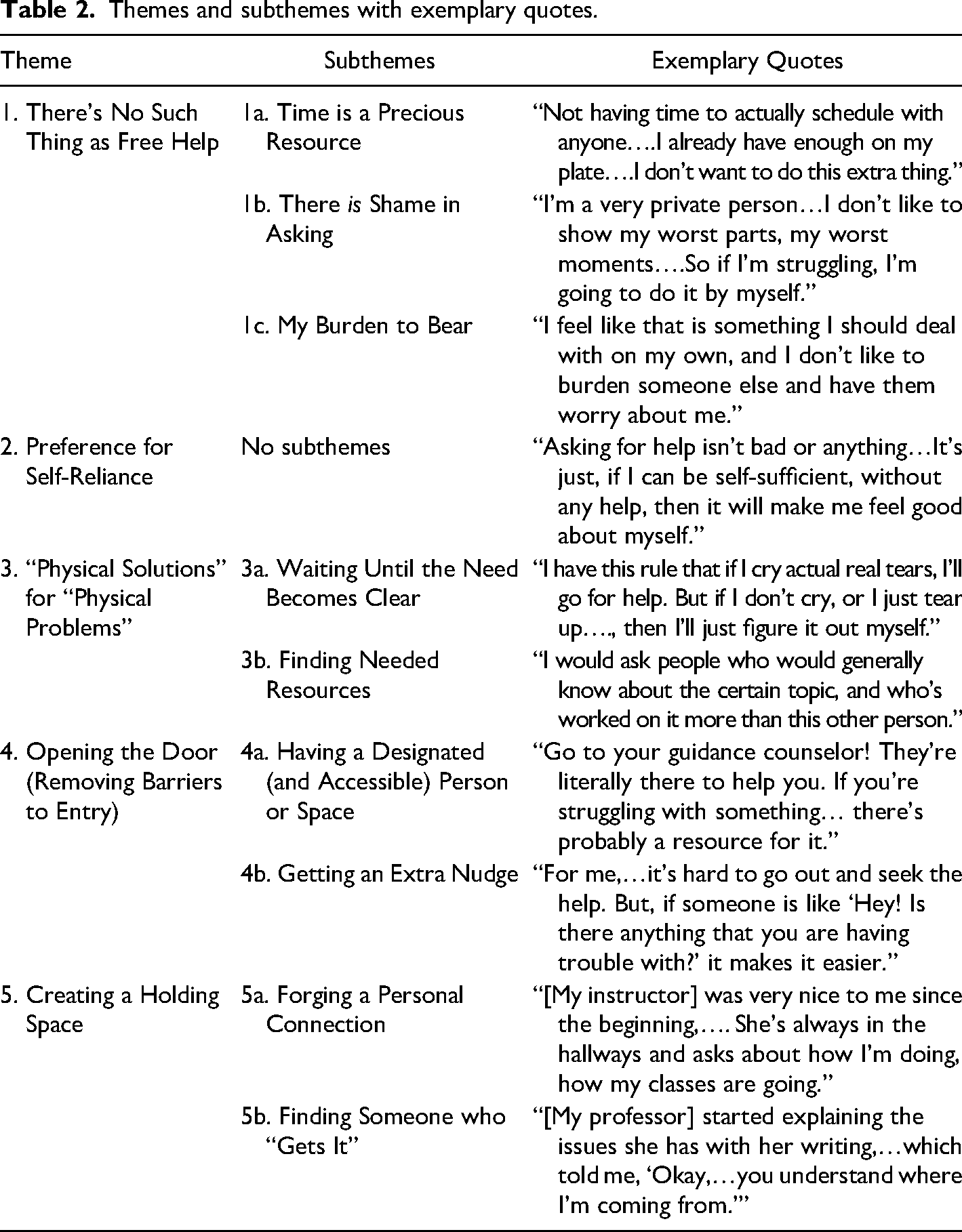
Through our analysis, we constructed five distinct themes, four of which had subthemes (see Table 2). We expound upon themes and present exemplary quotes in the ensuing sections. We assigned unique pseudonyms to each participant.
Themes and subthemes with exemplary quotes.
Theme 1: There's No Such Thing as Free Help
We evoked the adage, “There's no such thing as free lunch” to convey participants’ perception that help-seeking comes at a price. Although university personnel may perceive services to be freely available, students cited hidden costs of time, shame, and burdening others.
Subtheme 1a: Time is a Precious Resource
Time was a precious resource among this sample of FGCS. Many juggled long commutes to campus, part- or full-time jobs, and/or familial obligations on top of their rigorous coursework. Students described needing to make strict, regimented decisions about their priorities, and some perceived that they did not have the “luxury” of asking for help. Asked about barriers to using campus resources, Miranda responded, “Not having time to actually schedule with anyone….I already have enough on my plate….I don’t want to do this extra thing.” Stretched thin by a demanding STEM major and hour-long commute, she viewed help-seeking as an “extra thing” that seemed more burdensome than beneficial. Despite being assigned a mentor through a nonprofit organization, Hannah, who lived and worked off campus, reported that “I haven’t talked to [my mentor] in a while.…And I don’t really have time if I wanted to. I don’t even watch Netflix or TV!” Melissa, who also held an off-campus job, noted that her professors’ limited office hours were difficult to attend: “Their office hours are always during times when I have class…or on days when I’m not here—it's like, we can’t meet up.”
Subtheme 1b: There is Shame in Asking
Beyond practical barriers, asking for help had a significant psychological cost for many students. Despite societal efforts to destigmatize help-seeking with messaging like “there's no shame in asking,” many students expressed feeling shame, embarrassment, and fear of judgment when they needed help. Elisa, a student in a rigorous pre-health program, said asking for help made her feel vulnerable and exposed: “I’m a very private person…I don’t like to show my worst parts, my worst moments….So if I’m struggling, I’m going to do it by myself.” Anthony acknowledged the normalcy of needing help yet still identified shame as a major barrier: “I feel like I’ve failed at the thing that I’m doing and I feel really dumb….It's not like I’m the only person that's ever struggled….But it just feels like the whole world is crashing,…and it just feels really, really bad to ask.” Jonathan, who was retaking two classes, struggled with social comparisons and internalized expectations that he should be “independent:” “I just feel like everyone around me has their life together…and here I am, taking courses that I just should have finished first semester….I’m just the type of person who's afraid of asking questions. College is the time to be independent and you have to take responsibility.” Anna, an Asian-American woman, described how the model minority myth (Chou & Fagan, 2015) exacerbates shame around academic help-seeking: “I feel like if I ask for help, they see less of me because of my race. Like, ‘Oh, you’re smart! You’re supposed to know everything,’ but in reality, I don’t. That kind of cut me…and it prevents me from getting help.”
Subtheme 1c: My Burden to Bear
Beyond the personal costs of help-seeking, students also expressed concern about burdening others. Regina, a Black woman majoring in a challenging STEM field, expressed reluctance to ask questions in class, “I might have a question and not want to ask it if there are really smart people around me. It's wasting time…. cause then I stop the whole class from learning…because I didn’t understand something.” Miranda described feeling chronically stressed but not wanting to impose this on others: “I feel like that is something I should deal with on my own, and I don’t like to burden someone else and have them worry about me.” Gabriel expressed willingness to seek help for academic issues but noted that he kept a personal issue (i.e., his parents’ marital problems) to himself, even though it impacted his academics: “No one else needs to shoulder that…In those situation…like personal…you’re just being a huge burden.”
Theme 2: Preference for Self-Reliance
Although many students identified these costs as primary barriers to help-seeking, some also expressed that they simply preferred doing things on their own. For example, Jessica expressed pride in accomplishing tasks independently: “I really like being self-sufficient… Asking for help isn’t bad or anything…It's just, if I can be self-sufficient, without any help, then it will make me feel good about myself.” Sierra expressed a similar preference for self-sufficiency while noting she is willing to “reach out” if necessary: “I think there's a good thing about trying to figure something out on your own. Obviously, if it doesn’t work, reach out…I’m not totally closed to reaching out.” Regina perceived that working through difficult academic tasks improves her learning: “I’ll struggle with it for hours….cause I like to figure it out myself….I think struggling with it will helps me remember better.” Lauren, a low-income, formerly homeless student, denied anxiety or active avoidance of help-seeking, noting that she had grown accustomed to independent problem-solving: “For the most part, I’m pretty okay doing things on my own… because I’ve had to do so many things on my own, I’m just used to it. It's just…my natural reaction.”
Theme 3: “Physical Solutions” for “Physical Problems”
Whether students perceived costs of help-seeking or just preferred self-reliance, they were selective and pragmatic in their decision-making around if, when, and from whom they sought help. We derived the name of this theme from an exemplary quote by Colin, who said he only asks when “there's an actual goal to accomplish…like, a physical solution for a physical problem. A physical end goal.” Colin, and many of his peers, did not seek help just for the sake of it. Rather, they reached out when their need became clear and when they could identify someone with necessary knowledge, power, and/or resources to reach a solution.
Subtheme 3a: Waiting Until the Need Becomes Clear
Asking for help, especially beyond peers, was not most students’ preferred or default approach. For example, Rachel, an academically gifted student who finished the year with all A's, stated that she never attended office hours because she found academics to be manageable: “I just never really like thought to go….Unless I was having a specific problem like I had to give them a doctor note or something.” When students did seek help, they often waited until they became desperate or perceived significant, clear costs to not asking. In a humorous but earnest tone, Colin articulated a specific threshold: “I have this rule that if I cry actual real tears, I’ll go for help. But if I don’t cry, or I just tear up over whatever stressful situation, then I’ll just figure it out myself.” For many students, this threshold occurred when they perceived tangible threats to their grades and/or finances. Jonathan, who articulated internalized stigma toward help-seeking, nonetheless said, “I try to figure it out but if it looks like ‘Oh my God, what am I doing?’ I’m going to pop some red flags….Grades are money so if it's a problem, I need to fix it.” Layla described avoiding help-seeking most of her life but identified a major change in college, especially after seeing her tuition bill: “The financial investment definitely hit me…that you’re paying for this and now you have debt to your name….There isn’t a choice anymore. I have sabotaged myself…by not seeking out support.” Callie also pinpointed a turning point when she withdrew from a class, which she attributed to not asking for help: “Now I will get the help I need because…I learned that if I don’t, I’m only going to suffer.”
Subtheme 3b: Finding Needed Resources
After identifying a clear need for assistance, students strategically selected people who were most likely to provide the needed resource—by virtue of experience, skill, and/or positionality. Isabel put it simply: “I would ask people who would generally know about the certain topic, and who's worked on it more than this other person.” Consistent with this perception, Samantha, a pre-health major struggling with science prerequisites, frequently elicited support from her RA (Residential Assistant): “He's a bio major…I took general bio last semester, so I would go to him every single week, and be like ‘Can you help me with this?’” Kimberly did not live in dorms but nonetheless sought advice from RAs because she perceived them to be experienced and knowledgeable. “I have reached out to friends. They are RAs, and most of them are also seniors….They have great advice cause they have experience towards managing everything.” Similarly, Celia sought individual support from a faculty advisor in her summer bridge program based on perceived expertise: “She did a lot of presentations on topics that I needed help with…like resume, housing, so I kind of was like, ‘Oh I guess I’ll just go off of that and I know she knew what she was talking about.’”
In contrast, students did not seek help from people who they did not think could help them. Despite being assigned a college mentor, Elisa said she does not go to her for academic and career support, noting, “I see [her] more like a friend than a mentor….She's not in my major…She doesn’t have the same type of goals as me so it's hard for her to relate or give me advice.” Many students, like Gabriel, described receiving significant emotional support from families of origin while noting that they could not rely on them for some college-related problem-solving: “My parents both did not go to college, so I was at square one or even at square zero you could say. I had no idea what to do at all!” Although students often felt comfortable interacting with peers, some recognized the limits of peers’ knowledge and experience. For example, Colin said, “I feel people my age can’t help me entirely with my problems….These adults I’ve been talking about, they’ve been through a lot of stuff. But these kids just have no experience to draw on…. It would just be them guessing as good as I can.”
Theme 4: Opening the Door (Removing Barriers to Entry)
Due to the time and psychological costs that came with help-seeking, students benefitted from anything that made it more accessible and less threatening. In particular, they were more likely to seek help when they saw an “open door”—and when someone nudged them through it.
Subtheme 4a: Having a Designated (and Accessible) Person or Space
Students expressed being more likely to seek help when they could identify a person or space designated to help them. This removed logistical hurdles of finding the right person, time, and place, and it also alleviated some of the psychological barriers. Students felt less guilty, embarrassed, or ashamed about asking when they recognized that helping was part of someone's job. Some students were fortunate to have a mentor assigned to them through nonprofit organizations supporting underrepresented college students, which most found helpful. Daniela expressed gratitude toward her mentor: “She's really helped me a lot throughout my process. I feel like if I didn’t have her, I wouldn’t have anyone to go to….and she's always available….If I have any questions…I just text her and she answers in 10 minutes!” Asked about advice she would give to other first-gen students preparing for college, Celia emphatically said: “Go to your guidance counselor! They’re literally there to help you. If you’re struggling with something or not knowing what to do, there's probably a resource for it.” Although Lauren generally preferred doing things on her own, she found it easy to ask her RA for help obtaining summer housing because: “She's right down the hall, so that makes it easy. And [housing] is the kind of thing that she is supposed to help with.”
As Lauren conveyed, it was important that the designated person or space was also accessible. Daniela contrasted her responsive mentor with her academic advisor: “I did meet up with my advisor two times…because I had a hold [preventing class registration]. But then I emailed him about a situation with my math requirement and still haven’t received an email back.” Another frequently cited negative example was the university counseling center. Students knew this was the “designated” place for mental health support but felt deterred by its notorious waitlist. Rachel said, “There's definitely a really big back up…it takes months to get in…If I were to think about it then, it's like ‘Meh, it would take a month anyways!’”
Subtheme 4b: Getting an Extra Nudge
After becoming aware of available resources, some students benefited from extra encouragement to utilize them. In other words, even when doors were open, students sometimes needed to be nudged through. Lauren was assigned a sophomore peer mentor through a student leadership program and expressed appreciation for her regular check-ins: “She would check in, like ‘Do you have any problems? Or anything you have questions about?’….For me,…it's hard to go out and seek the help. But, if someone is like ‘Hey! Is there anything that you are having trouble with?’ it makes it easier.” Although all professors held office hours, Sebastian identified specific ones who went out of their way to remind students of their availability: “Some professors will outgoingly say, ‘If you need help, come to me. I’m always in my office hours. And if you can’t make office hours, email me, I’ll schedule a time.’…Like, ‘If you need help, I’ll help you!’” Although it was beneficial for “nudges” to come from helpers themselves, students also described encouragement from others, especially people they trusted and knew well. For example, Layla, who had an assigned mentor, said, “[My mentor] told me to always make use of your professors….Talk to them. They are part of your resources.” In most cases, the “nudge” not only raised awareness of resource availability but also lessened psychological barriers to help-seeking—convincing them that, “yes, really,” some people want to help.
Subtheme 5: Creating a Holding Space
Beyond being “designated” in helping roles, it also mattered how people responded to students’ requests. This final theme involved helpers’ actions that made students feel safe, cared for, and understood, which impacted the likelihood that students would ask for help in the future (specifically from that person, and more generally).
Subtheme 5a: Forging a Personal Connection
When identifying people from whom they recurrently sought help, students described actions by helpers that made them feel personally connected and cared for. This occurred when helpers demonstrated genuine interest in students’ well-being, were attuned to needs, and, at times, went beyond rote performance of “job requirements.” Still, most students described simple, empathic actions rather than grand gestures. For example, Sara identified a previous course instructor from whom she continues to seek advice: “She was very nice to me since the beginning, up until now, even though I don’t have any classes with her. She's always in the hallways and asks about how I’m doing, how my classes are going.”
Sometimes, helpers demonstrated personal interest by anticipating students’ needs, which enabled students to accept help they may not have otherwise asked for, particularly around more personal matters. Jessica described a professor going out of his way to connect her with financial resources: “I wrote an essay about the American Dream, talking about my personal situation, and he reached out to me, like ‘I can show you where to go for financial aid….and grants for low-income students.’” Colin, who had developed an informal mentoring relationship with a campus police officer, described this person's key role getting him into counseling: I made this joke about dying. I was completely joking, 100 percent, but he took it seriously and then he said something along the lines of ‘[Colin], if I came to work and you weren’t here…, I would feel so bad. Because I really care about you.’ And that really got to me because, I was like ‘Okay, if you’re really genuinely worried about me, then I will go [to counseling], but you have to go with me cause I don’t want to go alone.’ And he did—he did go with me.
In contrast, many students readily identified people or offices they did not find helpful, even if they were the ones “designated” to help, which deterred them from making future requests. Sara perceived that some financial aid advisors took impersonal approach: “They tell you what you already know, what you have to pay….They don’t really have anything extra to give you…any extra or personal advice.…I don’t know. They—they don’t really care much.” At times, students recognized that faculty and staff serving many students lacked the capacity to take highly personalized approaches. While not faulting them, students nonetheless felt deterred from asking for help. For example, Samantha stated she had never asked a professor for help, explaining that, “My classes are bigger, not groups of 20 or 30.…I feel like it's harder to make a personal connection with professors when there are so many students they have to teach.”
Subtheme 5b: Finding Someone Who “Gets It”
Due to internalized shame around help-seeking, many students sought out people they perceived to be understanding and less likely to judge them. In other words, they wanted someone who just “gets it” without much explanation and justification. Often, this nonjudgmental space was naturally facilitated by shared experiences and nonhierarchical positionality, particularly among peers. Kimberly, like many students, expressed that it feels easier to seek help from fellow students rather than parents, professors, and advisors: “My friends understand all the things I’m going through, cause they’re with me. Same level classes, same pressures….Working together is great because you can ask them lots of things and they will never get fed up with you. They won’t be like ‘Oh, that's such a stupid question.’”
However, some students also identified helpers in positions of authority who facilitated nonjudgmental spaces, though this required more intentionality. Regina, a STEM major, described how her advisor provided validation after she received a low grade: “I was crying in her office because I was stressed out about calculus….and she was like, ‘It's okay. Your grade doesn’t define you.’…Intelligence is part of my identity and that letter didn’t make me feel good at all. But she was like ‘You’ll be okay….You’ll do better and move on.’” Here Regina's advisor took her concerns seriously while helping her separate the grade from her self-worth. Other faculty communicated a supportive, nonjudgmental attitude by making self-disclosures that helped students relate to them. For example, Layla described a helpful interaction with her English professor: “I felt really frustrated with a paper….and she started explaining the issues she has with her writing, and how she has to map it out.…which told me, ‘Okay,…you understand where I’m coming from.’”
Discussion and Implications
In this paper, we reported on our in-depth analysis of FGCS’ help-seeking attitudes, decisions, and behavior. To our knowledge, this is among the first qualitative study to examine these phenomena among FGCS at a regional, 4-year, public institution, similar to those serving large proportions of these students (Startz, 2022). Our inductive, qualitative approach also allowed us to avoid silos and false dichotomies that have limited previous studies. Our data and results capture factors that deter and promote help-seeking, and how they interact, as well as interrelated processes of seeking support for academic, mental health, and other personal issues. Overall, our findings challenge a deficit-oriented, stereotyped perception that FGCS completely avoid asking for help. Rather, we found that FGCS are highly strategic and deliberate about help-seeking. Faced with immense challenges and finite resources, they carefully evaluated potential costs and benefits. At times, they opted for self-reliance, which has likely been an adaptive response in previous underresourced settings (Hagler, 2018; Payne et al., 2023). However, when they identified clear needs and benefits, many FGCS in our sample did strategically seek help from people they perceived to be most accessible, willing, and capable of resolving the problem at hand. This decision-making process is consistent with theoretical frameworks that identify the intricate metacognitive processes involved in forming complex behavioral intentions (Czyz et al., 2013; Hess & Tracey, 2013; Karabenick & Berger, 2013).
Our results have important implications for practices, programs, and policies aiming to empower FGCS to obtain the resources they need. Consistent with previous research, our participants identified both practical (i.e., time, accessibility) and psychological (i.e., shame) deterrents to help-seeking (Chang et al., 2020; Payne et al., 2023). It is important to note that even the psychological deterrents described by our participants can be traced to systemic inequities causing marginalized students to internalize shame, stereotypes, and alienation in academia (Chang et al., 2020; Collier & Morgan, 2008; Hagler, 2018). Previous investigations of university faculty, staff, and administrator perspectives suggest that they may underestimate structural barriers, overly attributing underrepresented students’ lack of help-seeking to dispositional and individual decision-making (i.e., simply not wanting help; Sapiro et al., 2023). These misperceptions may deter more active efforts to elicit, encourage, and destigmatize students’ help-seeking. Continuing education, trainings, and awareness campaigns—particularly those centering FGCS's lived experiences—may help to instill more critically conscious perceptions and motives among university personnel (Stachowiak, 2015).
Beyond consciousness-raising, additional structural changes may facilitate FGCS's resource access and utilization. Many of our FGCS participants emphasized the value of having designated people and offices, with clarity around their respective roles and functions. This not only reduced practical barriers (i.e., knowing where to go and whom to ask) but also psychological ones. Students felt less embarrassed, ashamed, and guilty about asking for help when they realized it was someone's actual job. This seems like an obvious insight but is challenging in execution. At times, students believed designated helpers (e.g., professors) were uninterested or unwilling to help, due to perceived lack of empathy and personal connection (Clegg et al., 2006; Payne et al., 2023; Pellegrino, 2012). In other cases, they perceived designated helpers (e.g., assigned mentors), though personable and engaged, to lack specialized expertise or knowledge to advise them on specific issues (Vinyard et al., 2017).
Collectively, these findings provide rationale for well-designed triage and referral systems in universities (Joslin, 2018; Werntz et al., 2023). Within these systems, it is important that each student has a designated “point person” whom they know and trust, and whose explicit job responsibility is to help. Of course, this person need not directly resolve all issues students encounter, but they should have a strong working knowledge of university resources so that they can make thoughtful referrals and warm handoffs. Although academic advising has been thought to fill this role, in practice, many students report minimal satisfaction and low utilization due to advisors’ limited capacity, fragmented knowledge, and focus on course registration (Allard & Parashar, 2012; Joslin, 2018). Rather, peer mentors may be better-suited for this “point person” role, particularly for first-year students (Werntz et al., 2023). As in previous studies, our FGCS participants experienced more natural, empathic connections with fellow students due to shared experience and nonevaluative positionality (Clegg et al., 2006). In particular, “near-peers” (i.e., upper-class students) offered “the best of both worlds”—approachability and greater knowledge and experience navigating college. Some students identified dormitory RAs serving this function, but most of our sample (like many FGCS) were commuters, highlighting the need for alternative programs. Though more extensive and robust evaluations of peer mentoring programs are limited, preliminary evidence shows that they can improve mentees’ grades, well-being, and degree persistence, not to mention academic and psychosocial benefits experienced by the peer mentors (Ahmed et al., 2021; Collier, 2017; Sharpe et al., 2018).
Of course, many students will, at some point, require specialized assistance from authority figures and others whom they do not know well (e.g., professors, deans, financial aid advisors), and our results highlight several ways these providers can make interactions with FGCS more comfortable, constructive, and personalized. As in previous studies, our participants highlighted simple but kind actions by faculty and staff that made them feel seen and cared for (Clegg et al., 2006; Micari & Calkins, 2021; Payne et al., 2023). Such gestures included learning students’ names, greeting them in hallways, engaging in nonacademic conversation, actively inviting and allowing time for questions, and making judicious self-disclosures that helped students relate to them. Beyond increasing students’ comfort and rapport, providers who took personal interest in students were more attuned to their needs, which was particularly important when dealing with sensitive topics. As in previous research, our FGCS participants expressed discomfort seeking help for “personal problems” (e.g., mental health, family issues) compared to more “cut-and-dry” practical matters (Sapiro et al., 2023). However, many were willing to accept help when someone detected personal issues, tactfully expressed concern, and offered assistance, like when the campus police officer helped Colin initiate mental health counseling.
Although Colin accessed and benefited from counseling, several students specifically noted that they had not sought this service, despite interest and perceived need, due to a months-long waitlist. This problem is nearly universal among university counseling centers, stemming from resource and personnel shortages to meet high demands (Eisenberg et al., 2012; Hardy et al., 2011). It is essential that universities strive to increase counseling staff and availability to adequately serve students, though there are several promising innovations to optimize limited resources, including rapid triage methods (Hardy et al., 2011) and high-yielding, brief interventions (Seigers & Carey, 2010).
Accessibility was also a widely discussed concern about professors’ office hours, which were often a few hours per week that did not align with FGCS's busy class and work schedules. Faculty can take several steps to increase accessibility, such as expanding office hours (including varying times and days of the week), providing virtual options, and offering availability by appointment (Li & Pitts, 2009). Consistent with previous research, our findings suggest that faculty can further increase utilization by enthusiastically reminding students of their desire to help and making personalized outreach efforts (Micari & Calkins, 2021; Payne et al., 2023)
In addition to these wide-ranging recommendations for university personnel and service-providers, several effective interventions directly engage FGCS and other underrepresented groups, empowering them with information and skills to seek out and obtain needed resources. For example, difference-education interventions, which highlight and convey value in the lived experiences of diverse college students, can effectively promote campus resource utilization and academic performance among FGCS—even with a single session (Stephens et al., 2014). Similarly, Connected Scholars, a 4-session, classroom-based social capital intervention aiming to destigmatize help-seeking and teach students networking skills, led to increased help-seeking and stronger academic performances among first-year FGCS (Parnes et al., 2020). Shared across these programs is respect for students’ agency and goals of destigmatizing help-seeking without encroaching on autonomy. Findings from our study further suggest that FGCS may benefit from information about the tangible impact of help-seeking (e.g., on their learning and academic performance) and messaging that reframes help-seeking as a normative, necessary process of becoming independent adults, aligning with the widely held value of self-reliance (Clegg et al., 2006; Payne et al., 2023; Sapiro et al., 2023).
Limitations and Future Research Directions
Despite this study's important contributions, some limitations should be acknowledged. First, our thematic analysis was impacted by our subjectivity and lived experiences. Researcher subjectivity is inherent to—and even a strength—of qualitative research, and we addressed this by composing an analytic team with diverse perspectives and engaging in reflective practices (e.g., journaling, open discussion). Still, it will be important for these research questions to be investigated by other teams and with varied approaches—including mixed and quantitative methods. One fruitful direction would be to design experiments to further validate specific themes and subthemes. For example, researchers could design vignette-based studies in which they experimentally manipulate scenarios (e.g., clearly designating helpers’ roles and responsibilities; Subtheme 4a), behaviors (e.g., potential helpers’ disclosure of personal experiences; see Subtheme 5b), or framing language (e.g., presenting resource-seeking as an aspect of self-sufficiency; Theme 2), and measure the impact on students’ helps-seeking attitudes and intentions. Researchers may also design and experimentally evaluate interventions based on themes and subthemes. For example, future studies may investigate the effectiveness of “nudging” students to seek help. This could involve multiple experimental conditions, in which nudging comes from peers, faculty, staff, and/or automated text messages in order to evaluate differing impacts on students’ help-seeking attitudes, intentions, and behavior.
Although our sample was diverse and relatively large for qualitative research, it was derived from one institution among a specific cohort of students, which may not be generalizable to others. Additional research conducted in different regions, at different types of institutions, and in future cohorts will be necessary to identify convergent (replicated) and divergent findings. Relatedly, these interviews were conducted during the academic year prior to the COVID-19 pandemic, and thus did not capture short- and long-term impacts of this collective trauma. Data on students’ help-seeking attitudes and behaviors collected throughout the pandemic, if available, would be invaluable. Even in the absence of studies specifically designed for this purpose, archival data on campus service utilization and student retention may illuminate some changes as the pandemic unfolded. Further, current and former students may be interviewed and asked to retrospectively reflect upon how the pandemic impacted their help-seeking attitudes and behaviors.
A strength of this study is its active collaboration between faculty and undergraduate students who had recent, lived experiences with help-seeking. We followed the methodological guidelines of reflexive thematic analysis, which is a flexible approach that can be adapted to specific projects and research teams (Braun & Clark, 2022). To facilitate the student co-authors’ sustainable involvement within the grant period, the faculty first-author conducted the time-intensive coding process. As described above, the student co-authors carefully reviewed coding documents while independently memoing and mapping thematic ideas, after which we collaborated to co-construct and refine the thematic structure. Still, it should be acknowledged that the faculty author, despite active efforts to share power, may have had relatively more influence due to his positionality and role as sole coder. In the future and under difference circumstances, research teams should consider alternative approaches, such as using multiple coders including students.
Finally, this study utilized a semi-structured interview protocol, which elicited cohesive, topical narratives relevant to the research question with reasonable participant burden. However, the protocol may have missed important factors and considerations, such as in-depth explorations of identities beyond FGCS status and participants’ developmental histories. Although these topics spontaneously came up in some interviews, it was impossible to comprehensively probe all aspects of FGCS's experiences. Future researchers should design in-depth interview protocols to examine the intersectionality of first-generation college student status with racial, gender, immigration, and ability/disability statuses, among others.
Conclusions
This study provided an in-depth, qualitative examination of FGCS’s help-seeking attitudes, decisions, and behaviors. Facing a range of academic, practical, and personal challenges, our FGCS participants were deliberate and resourceful, carefully appraising problems, weighing potential benefits, and strategically seeking support from sources they perceived to be most willing and able to help. Although it is important to acknowledge these students’ resilience given limited resources, we made several actionable recommendations for university practice and policy, aiming to empower FGCS to obtain needed resources and achieve equitable success in higher education.
Footnotes
Acknowledgements
Data collection for this project was supported by the first author's Graduate Research Fellowship from the National Science Foundation. Data analysis was supported by a REAL (Ready to Experience Applied Learning) Grant from Francis Marion University.
Declaration of Conflicting Interests
The author(s) declared no potential conflicts of interest with respect to the research, authorship, and/or publication of this article.
Funding
The author(s) disclosed receipt of the following financial support for the research, authorship, and/or publication of this article: Data collection was supported by a Graduate Research Fellowship from the National Science Foundation (grant number 1356104). Data analysis was supported by an internal grant from Francis Marion University.
