







Abstract
Employee engagement continues to capture the interest of practitioners and scholars, yet estimates are that between 50%and 70% of workers are not engaged. Disengagement has implications for profitability, productivity, safety, mental health, turnover, and employee theft.
The article builds on Kahn’s concept of disengagement and presents a consolidated view of the research regarding the process of disengagement. A call to action is presented, as a plea to organizations to address cognitive, emotional and behavioral/physical needs of the majority of workers who are less than fully engaged.
Human resource development (HRD) researcher and practitioners who work in organizations where engagement is low, turnover is high, or morale is plummeting.
The mass of men lead lives of quiet desperation. What is called resignation is confirmed
desperation.
A 72-year-old employee who had been with a major jewelry and upscale home goods chain for more than 20 years was led out in handcuffs after nearly half a million dollars in jewelry was found in shoeboxes under her bed, in her closet, and buried in her backyard. When questioned, she told security that every time her manager was mean to her, or slighted her, she would pocket “a little something,” and then put it in the shoeboxes. This store had fired several managers and associates over the years due to the persistent inventory shortages, but no one had ever dreamed that the real culprit was one elderly and seemingly loyal employee.
Finally, after keeping her job search quiet for more than six months, a top-performing employee gave notice after accepting a new position, even though it was for less money. Her manager and the human resources (HR) staff were shocked and in the exit interview asked why she was leaving. She told them they needed to just look around to see that morale was awful, people were frustrated and confused, and she was tired of the backstabbing and favoritism.
A committee on adjunct faculty issues heard a presentation that likened the part-time faculty to rental cars: “You really don’t take as good care of them, do you?” Several of the adjuncts in the room related how hard they worked and how little they received in resources, prestige, remuneration or appreciation. In addition, although they were happy to be teaching, the downsides often seemed far too daunting and unfair.
Throughout this Special Issue, there are positive statistics and purposes presented to explain the importance of engagement to organizations. It seems that employee engagement matters. Engaged employees have consistently been shown to be more productive, profitable, safer, healthier, and less likely to turnover (Fleming & Asplund, 2007; Wagner & Harter, 2006), yet only 30% of the global workforce is estimated to be engaged (Harter, Schmidt, & Hayes, 2002; Saks, 2006).
So what of the other 70%?
If engaged employees are more productive, profitable, safer, healthier, and stay with their organizations longer, then it follows that disengaged employees might be less productive, have a negative effect on profitability, have more accidents, suffer from more maladies, and quit more often. When asked, company executives say that employee engagement is important, yet the Conference Board (2010) found that only 45% of U.S. employees say they are satisfied with their jobs, the lowest number since they began the surveys in 1987. Worse yet, 22% of employees expect to turn over in the next year, and a disproportionate number of those looking to move are younger workers (Conference Board, 2010). Satisfaction is a much lower threshold than engagement, employees can be satisfied with a job because it pays the bills and is close to home but that does not guarantee that they are physically, mentally, and emotionally invested in the organization’s success, the hallmarks of employee engagement.
The costs of disengagement have not been calculated, though some statistics might begin to reflect on important economic reasons to address this silent majority. Disengaged employees cost organizations in revenues and profitability, not just by failing to go above and beyond in their productivity but also in the high costs of employee turnover and theft as evidenced in the opening scenarios. Company revenues in organizations with high levels of engagement can be as much as 40% higher than those with low levels, and revenue per employee is significantly higher in companies with employees who have high levels of pride in their company (Herman, Olivo, & Gioia, 2003). Turnover, including the costs of separation, vacancy, replacement, and training can range from 30% to 200% of the lost employee’s salary (Herman et al., 2003). Worse, with bad economic times, companies suffer further from substandard work from employees who would like to leave but cannot find another position. Occupational fraud and abuse cost organizations 5% of revenues, or US$2.9 trillion in 2010, with the average fraud costing an organization US$160,000 (Ratley, 2010). Deviant employee behaviors which include property deviance (theft of merchandise or supplies, unauthorized discounts, falsifying records, etc.) and production deviance (time theft, absenteeism, taking long breaks, leaving early, work withdrawal behaviors) have been linked to hundreds of billions of dollars in losses and may account for as much as 30% of small business failures (Kulas, McInnerney, DeMuth, & Jadwinski, 2007, p. 390). Engaging more employees can significantly aid a company’s bottom line, or so it seems.
The true costs of work and of poor psychosocial quality of work are just beginning to be investigated. One study (Butterworth et al., 2011) concludes that low quality work can be more harmful to an employee’s mental health than being unemployed, yet greater than half of all workers go to work every day feeling less than engaged. These are people who toil (or cope) in quiet desperation. And yet we know little of them, or of their experience, from the literature. Of the 210 citations and abstracts in the ABI Inform database that include the words “employee engagement,” only three contain the word “disengagement.”
The Construct of Disengagement
The disengagement construct is poorly defined and the literature is spread across a range of disciplines and hidden within other concepts and frameworks. Kahn’s (1990) seminal work discussed both engagement and disengagement as influences on employees, defining disengagement by the behaviors that cause workers to leave out their personal self in their work role. Disengagement is characterized by the disconnection of individuals from their work roles to protect themselves physically, mentally and/or emotionally from real or perceived threats. This disconnection can be operationalized in terms of having to separate work life from home or outside activities or beliefs, a failure to find meaning in the work itself, a lack of belief in the purpose of the organization, or a sense that the individual is powerless to overcome stagnation and frustration in the work environment (Sheep, 2006).
The need to protect oneself in the work environment has been linked closely to literature around burnout (Maslach, Schaufeli, & Leiter, 2001; Schaufeli & Bakker, 2004; Schaufeli, Leiter, & Maslach, 2009), turnover and warm-chair attrition (Herman et al., 2003), ethical and spiritual issues (Sheep, 2006), poor mental health (Butterworth et al., 2011) and employee theft (Kulas, McInnerney, DeMuth, & Jadwinski, 2007). Kahn (1990) characterized disengagement as an internal process, with disengaged employees tending to withdraw emotionally, lack energy for the work, and become uninvolved and uncaring about the people and tasks they encounter at work.
Engagement is not a static state; it fluctuates over time (Evans & Redfern, 2010). It may be more appropriate to discuss a continuum of engagement, from fully engaged through occasionally and/or temporarily disengaged to actively disengaged and to ask if full engagement at all times is possible, or even fair to ask?
Emotional Work and Negative Emotions
Maitlis and Ozcelik (2004) suggest that people’s work experiences are highly emotional, yet we know little about the negative emotions in organizations. The contention that the study of negative emotions outnumbers those on positive ones (Schaufeli & Bakker, 2004) has not been the case with the engagement literature. Few articles have been written about the disengagement construct, so researchers have to look broadly at the literature. A search for the literature on the broader subject of “job dissatisfaction” provided 245 scholarly citations and abstracts in ABI Inform and PsychInfo combined, and generated additional searchable topics such as: burnout; job limiting pain; political skill; personal control; hostile attribution style; interrole conflict and failure. There is suggestion in the engagement literature that workplace bullying, organizational ethics problems, distrust, and fear may be additional organizational antecedents, whereas outside activities, education, respect, self-confidence, and self-consciousness may be individual antecedents to disengagement.
One reason there is little literature on disengagement may be that the antithesis of engagement has been postulated to be instead, burnout (Schaufeli & Bakker, 2004; Schaufeli et al., 2009). Burnout is generally accepted to be a metaphor to describe a person who is mentally weary (Schaufeli & Bakker, 2004). Burnout has been linked to emotional exhaustion, depersonalization, a lack of personal accomplishment, a failure of organizational supports and both escapist and control coping strategies (Leiter, 1991).
The conceptualization of burnout and its representation as the opposite of engagement has been challenged (Demerouti, Mostert, & Bakker, 2010). Rather than being opposites, burnout has been conceptualized as an erosion of the positive state of engagement (Schaufeli et al., 2009). This has led to the current view from positive psychology that it is not simply a matter of employees who are not facing burnout, who are free of stress and healthy, engagement requires employees who are willing to do more than expected, to be proactive and motivated and committed to the organization (Schaufeli et al., 2009). In similar fashion, disengagement is not simply the absence of engagement, but a cognitive decision, emotionally charged, which manifests in behaviors that put physical, mental, and emotional distance between the worker and their work, their peers, and their organization.
The discussion and measurement scales for burnout revolve around the three dimensions that are considered to constitute engagement: vigor, dedication and absorption (Maslach & Leiter, 1997; Schaufeli & Bakker, 2004). The measurement continuums for the dimensions of burnout, from engagement to burnout, are: vigor (energy) and exhaustion, dedication (involvement) and cynicism, and absorption (efficacy) and ineffectiveness. The fully disengaged employee is therefore characterized as weary, unproductive and skeptical. It is hard to believe that 70% of the U.S. workforce fits that description, but these are commonly discussed dimensions and measurements.
Kahn (1990) considered three concepts to be influential in constituting engagement: meaningfulness, safety, and availability. His conceptualization of disengagement was of the individual distancing him or herself from their work role and interactions with others, in an effort to withdraw, defend and protect the self (Kahn, 1990, p. 701). A fully disengaged worker would be one who did not find the work or the organization to be important or energizing, who felt threatened, or who lacked the resources and willingness to make an effort. Kahn (1990) acknowledged that disengagement was a process, and his research describes individual stories that led to the conceptualization of disengagement as a gradual distancing of the individual from their work role. Turnover, the ultimate distancing, has been shown to be driven by two strong emotions: feeling inadequate, and feeling that it is easier to leave than to try to fix the situation (Herman et al., 2003), supporting Kahn’s conceptualization.
The Process of Disengagement
Disengagement is likely to occur in stages, as has been posited in the development of engagement (Macey & Schneider, 2008). New employees tend to show higher levels of employee engagement, which may naturally taper over time (Trahant, 2009). This section hypothesizes how the process may occur, and at the cognitive, emotional and physical/behavioral states that have been linked to burnout and disengagement.
At first onset, an employee becomes cognitively disengaged: “I am confused; I’m not sure what is going on. This doesn’t seem fair or right. But I don’t like it and I do not know what I can do about it.” The employee begins to focus on what isn’t working and attempts to correct the problem. Mental effort goes into trying to clarify expectations, request resources, or attempt to find a way to express their concerns. The employee begins to adopt “performance protection strategies” (Schaufeli & Bakker, 2004, p. 297) and expend mental energy trying to find ways to lower their increasing discomfort. The employee begins to weigh two options: to either address the reasons for their disillusionment through communication or to exit the organization (Cusack, 2009).
If the stress continues and the confusion is not alleviated, the emotional aspects of the situation begin to take their toll. The person begins to feel fatigue, anger, irritability, and frustration which begin to drain the energy and motivation for performance (Schaufeli & Bakker, 2004). The individuals may then begin to adopt behaviors that are self protective, in response to perceived threats to their physical or emotional safety, either from stress, unrewarding interpersonal relationships in the workplace, or a continual failure to have their basic needs met (Schaufeli et al., 2009). This stage may be reflected as passive coping, or even passive aggression, as the person attempts to assuage feelings of helplessness and aggravation. The individual may manifest negative emotions by adopting a rote, “just tell me what to do” attitude that is reactive and short term focused (Cusack, 2009). Disengagement has been linked to a conservation of resources approach when there is overlap between work and family demands (Halbesleben, Harvey, & Bolino, 2009; Judge & Watanabe, 1993).
The outcome may be a decision that, “I don’t care.” This is a cognitive decision reflected in the choice to no longer engage mentally or emotionally in the work or workplace. Although this choice often precedes the decision to quit, in a difficult economic climate it may result in a person retaining their position but no longer making an effort to engage with the job or the people (Herman et al., 2003). Deviant behaviors, especially production deviance and time theft may increase (Kulas et al., 2007). This stage may take the form of cynicism, or giving up hope that things will change for the better.
Organizational change cynicism reflects the employee’s loss of faith in the organization’s direction and leadership, allowing feelings of unfairness and a loss of trust to seep in, and the individual begins to question his or her commitment and future options (Watt & Piotrowski, 2008). When negative emotions are left unaddressed, employees must find an outlet for their feelings of frustration, helplessness, anger, resentment or a wish to get even. Cynicism has been shown to be highest among groups who feel that their status in the organization is low or that they are held in low esteem by their organization or the public. These individuals are unlikely to have high levels of organizational identification and are less likely to make the effort to engage (O’Brien et al., 2004).
Ultimately, the person moves from a passive coping mode (Schaufeli & Bakker, 2004, p. 297) to the devastating domain of behavioral disengagement and adopts strategies to protect himself or herself from harm. A cynical employee may give up any attempt to control the situation and become rigid and resistant (Cusack, 2009). Otherwise, the employee may choose to act via an external script or set of rules, eliminating any effort to internalize or innovate (Kahn, 1990). This can result in passive aggressive behaviors like withholding information, absenteeism, and incivility. Incivility has been empirically linked with a loss of both safety engagement and availability engagement (Reio & Sanders-Reio, 2011), making it less likely that the individual worker will experience the support or access that would perhaps reinvigorate their ability to engage and may possibly encourage others to disengage.
Kahn (1990) suggested that it is not uncommon for people to withdraw and defend themselves, suggesting that “people act out momentary attachments and detachments in role performances” (Kahn, 1990, p. 694). Behavioral disengagement may lead to burnout, or to turnover, work stoppages, absenteeism, theft or other passive aggressive acts. Kulas et al. (2007) found a correlation between employee dissatisfaction and theft behaviors, with an organizational climate for theft having an intensifying influence. The theft of both property and time, through absenteeism and work slowdowns, is destructive to both the individual and the organization. The end stage of disengagement is turnover, the final resignation. Employees who cannot find a way to feel competent and committed and who finally realize that things aren’t going to change no matter how they try, finally quit (Herman et al., 2003).
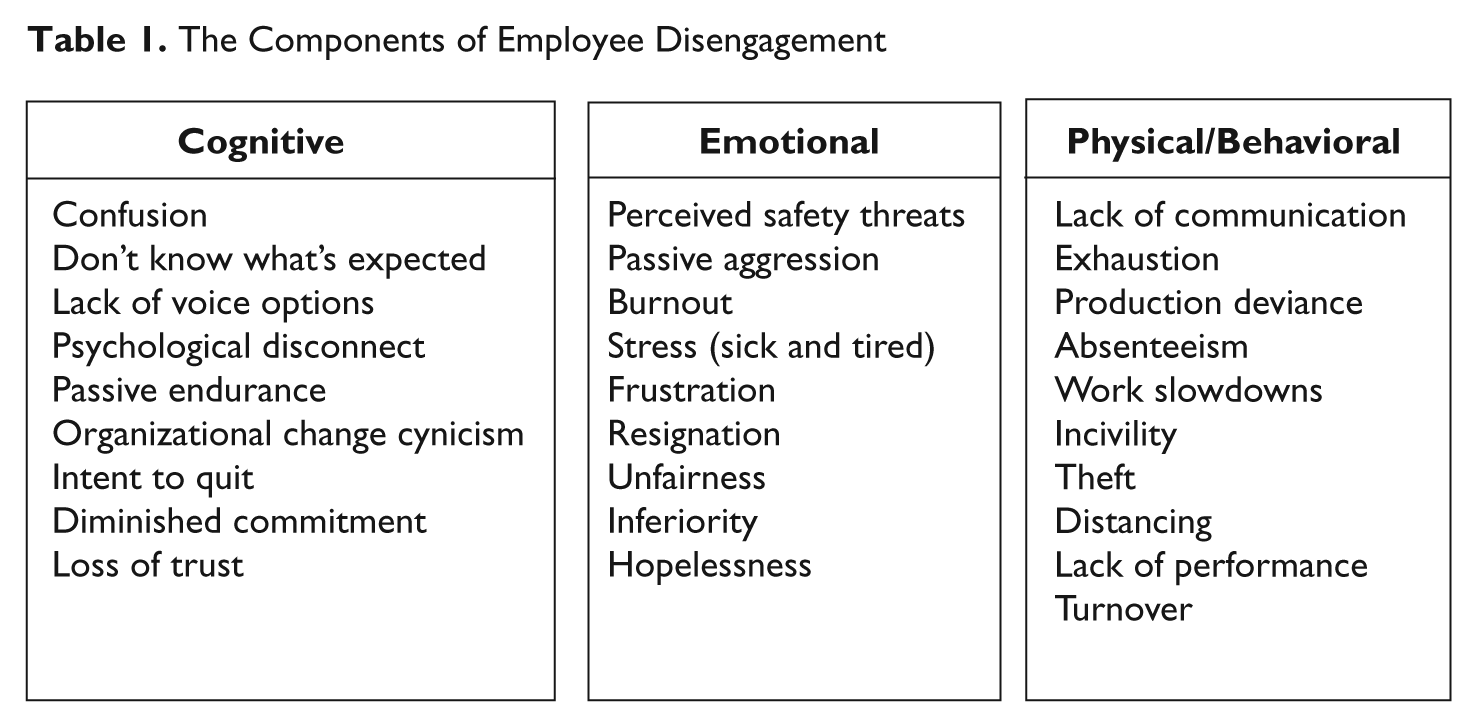
The process by which an employee moves from engaged to somewhat disengaged to fully disengaged has not been fully explored, though it has been experienced by many workers. Table 1 presents some components of employee disengagement, as a useful starting point for researchers and practitioners. Table 1 attempts to organize the components that have been linked to employee disengagement in the research. This charting is a first step to helping researchers focus more fully on one or more aspects of disengagement. What is lacking in the literature is a sense of the interconnectedness of the many components. It may be that there is not a linear decent from engaged to disengaged, but instead the employee is experiencing a spiral that engages different elements as the individual attempts to find safety, availability and meaning in his or her relationship with the organization. Some workplaces are more toxic than others, some workers are more resilient, some organizations have people or systems in place to intervene, and others specialize in making a bad situation worse.
The Components of Employee Disengagement
A Call to Action for HRD
Disengagement has huge costs for individuals and organizations. Employee engagement is essential to the health, well-being, and success of organizations and individuals as the work environment becomes leaner, more information-driven, and crushingly competitive.
Human Resource Development (HRD) researchers and practitioners have a great opportunity and challenge in the years ahead. Garavan (2007) indicates that strategic HRD should contribute to a firm’s competitive advantage by enhancing the unique skills and capabilities of its workforce in a way that is difficult for competitors to imitate. Macey and Schneider (2008) suggest that engaged employees may be that advantage. A fully engaged workforce must be an organizational priority.
HRD practitioners can be leaders in creating more engaging work places. Practitioners might be encouraged to start with the easy questions:
Does this organization care about people? What is your evidence?
Is there someone in the organization who is responsible for developing the human resources of the firm, and do they have any resources or power?
Is there a mechanism for employees to voice their feelings, frustrations, concerns or complaints in a way they believe can produce positive change (Cusack, 2009)?
What evidence is there of a commitment to employee engagement in the stories, traditions, mission and values of the organization?
How much common ground is there between employees and management?
Strategic HRD “must focus on evaluating the linkages among organizational strategies, HRD systems, and policies and practices, incorporate the perspectives of multiple stakeholders, and focus on contributions at multiple levels of analysis” (Garavan, 2007, p. 12). Engagement is not a one-size-fits-all construct. Context is essential (Lincoln, 2009). Each organization has to arrive at a common understanding of what exactly employee engagement is in their organization. From there it is possible to address strategically the supportive strategies, systems, policies and practices, as well as the expectations, weaknesses and frustrations that are hampering the willingness of employees to fully engage (Cusack, 2009; Hirschman, 1970).
HRD researchers and practitioners need to be collecting their own data. For example, Google just began discussing their 4-year effort to improve management by collecting and analyzing more than 10,000 observations about their managers on more than 100 different variables, including performance appraisals, observations and interviews (Bryant, 2011). Armed with the results of sifting that data, they arrived at what works for Google. Now training and development can teach, coach, and reward the behaviors that have been proven to work for Google’s management and staff.
What kinds of data should HRD practitioners or researchers collect? Human experience data is essential. Survey aggregate data will not tell you how George in accounting is coping with downsizing, a sick child, a mean-spirited boss or an overwhelmingly stressful workload. Start by observing and sifting existing data. Go to the marketing department and ask them what causes them the biggest headaches. Find out where turnover is the highest and lowest. Ask accounting or operations who they count on when there’s a crunch. Go to the most productive and least productive teams or departments and observe, ask questions, look for behavioral and physical evidence of engagement and disengagement. Don’t just measure; investigate (Denzin & Lincoln, 2005). The goal is to operationalize the behaviors that create engagement, to disseminate what works throughout the organization, to begin to recognize and celebrate successful engagement wherever it appears. Grapple with the tough questions like: How can you gauge the cost of the time and energy employees expend plotting ways to get even with difficult managers or perceived unfair practices? Why is the perception there?
HRD practitioners might begin by chipping away at this statistic: that 85% of employees doubt their leaders’ knowledge about how to develop employee engagement where they work (Czarnowsky, 2008). According to Shuck and Reio (2011) in the introduction to this issue, “Entire companies and international consulting groups advertise dedication to the diagnosis, evaluation, and development of solutions to low employee engagement although few share a common definition, measurement approach, or application.” Perhaps it’s time to look at the contradictions. Since the publication of the Q12 in May, 1999, (Buckingham & Coffman, 1999), hundreds of consultants and companies have used the Q12 as the basis for employee satisfaction surveys and unit-level management interventions. There are now organizations with more than 10 years of data which can be analyzed and sifted through new paradigms. If the answers to questions such as “Do you know what is expected of you every day?” (Buckingham & Coffman, 1999, p. 28) have not changed in 10 or more years, then we have learned more about disengagement than engagement, have we not? Employees need to believe that their leaders can develop engagement, and HRD practitioners are in possession of the data to demonstrate whether or not that development has occurred.
HRD practitioners must be at the forefront of encouraging communication within organizations and must recognize the signs of disengagement. The development of disengagement is a process and so is the thwarting of its development. As leaders of change in organizations, HRD leadership must be aware of the building blocks of organizational change cynicism and warning signs of employee burnout. In a landscape of rapid and constant change, the importance of getting and keeping fully engaged workers cannot be underestimated (Schaufeli et al., 2009). Viewing disengagement as a robust concept and as a process of eroding the employee’s full engagement with their job, coworkers, unit, and their organization can lead to enhanced intervention strategies that are as unique as the individuals engaging them. HRD practitioners must become advocates, giving individuals the opportunity to raise their voices to illuminate aspects of organizational life, policies, and politics that erode employee well-being.
The research agenda for disengagement is clear: Find out if organizations really want their employees to be engaged. Then find out what separates those individuals who do engage from those who do not, using the tools presented in this issue. Study each group separately. Look for the behavioral manifestations of disengagement (lack of communication, exhaustion, production deviance, absenteeism, work slowdowns, incivility, theft, distancing, lack of performance and turnover), then probe deeply into their relationship to the cognitive and behavioral manifestations. Begin with the symptoms of disengagement, determine their causes and systematically work to eliminate them. The next phase of the research agenda requires a mixture of research methods to ferret out the process of disengagement, understand how disengagement effects individuals and organizations, and focus on building the belief that organizations can foster and leaders can deliver on the promise of organizational engagement.
This article began with a quote stating that many people “lead lives of quiet desperation,” and employee disengagement is certainly a contributing potential factor to that state. For ultimately, quiet desperation and a life lived simply coping with the winds of change are the great cost of disengagement. Imagine what happens when a spirit of engagement, trust, meaningfulness, and wholeness becomes an integral part of the future of organizations (Sheep, 2006). HRD scholars, theorists, practitioners, and consultants will all have a contribution to make to the development of engagement; however, they choose to engage with the concept. Clearly, we have some work to do.
Footnotes
The author(s) declared no potential conflicts of interest with respect to the research, authorship, and/or publication of this article.
The author(s) received no financial support for the research, authorship, and/or publication of this article.