






Abstract
Despite the high prevalence of stalking and the risk of harm it poses to victims, arrest rates, prosecutions, and convictions for stalking continue to be low in the United States. The overall goal of this article is to introduce a multidimensional framework of stalking that adds to the current literature by (1) providing a conceptual framework consistent with legal elements of many stalking statutes to facilitate assessment, communication, documentation, and safety planning for stalking several victims; (2) introducing a more systematic way of assessing course of conduct and the context of fear in stalking situations in order to increase the understanding of cumulative fear for stalking victims; (3) emphasizing the aspects of stalking harm that go beyond violence and that show how harm from stalking accumulates over time including life sabotage; and (4) discussing 12 risk factors derived from the overall multidimensional framework that can be used to describe the big picture of stalking and to facilitate safety planning for victims. Implications for future research are discussed.
Caitlin, 46, had been widowed for about three years when she met Drew, 44, at a yard sale. Their first few dates were romantic and fun and made Caitlin forget for just a moment how much she missed her husband. After about three months, however, Caitlin decided Drew was too moody and obsessive about her time and attention. The day after she told him she did not want to see him anymore, he started following her, repeatedly calling her, and showing up at her house. Two days after their breakup, he showed up at her house and knocked on the door for hours. She hid from him. She was shaking and afraid. She asked her roommate to tell him to leave. This made Drew very angry. That night Drew began calling every few minutes all night long. By the next day, she had about 200 calls and many messages. That’s when Caitlin realized she needed to make some major changes. She changed her cell phone number and her schedule, such as leaving work earlier or later than normal to try to avoid seeing Drew. Within a few days, Drew found her new phone number and continued to repeatedly call and text her. Night after night he showed up at her house and would refuse to leave. He often followed her and approached her in public places. He would also leave messages for her detailing everywhere she had been that day just to let her know he was watching. He sent her and her mother cards and e-mails although none of them contained direct threats. A few weeks later, Caitlin received a call from an unknown man asking for sex. He said he got her number from the men’s bathroom at her work. When Caitlin saw what was written in the bathroom she recognized Drew’s handwriting. Several weeks later, Caitlin found that her car had been vandalized. Caitlin felt frustrated, lost, angry, and afraid. She called the police the next day to find out what could be done. The police told her that because many of the incidents happened in the city where she worked rather than where she lived she needed to call that police department. Caitlin felt defeated and did not call the police again. She texted a friend in frustration, “My purpose in life. It used to be more clear, I used to be motivated for living every day. Now it’s a struggle, a tiresome effort. I’m just tired and discouraged and feel incapable, inadequate.” A few days later and 6 weeks after breaking up with Drew, as Caitlin was loading grocery bags into the trunk of her car in a crowded parking lot, Drew shot her. He then drove to a park and shot himself. Drew had stalked six other women prior to meeting Caitlin. He had even been convicted of stalking and spent time in jail over a decade earlier.
1
One striking thing about this case is that stalkers are dangerous in multiple ways. In just a 6-week period, Drew made Caitlin feel incapable and inadequate and took away her sense of purpose in life. She also experienced other consequences such as public humiliation, car damage, interference with her job and work schedule, and watched powerlessly as her mother was harassed. Another striking thing about this case is Drew’s history and the pattern of his stalking behavior. This case raises the question of whether Drew could have been stopped. If so, what could have stopped him? Why didn’t the police officer take Caitlin’s concern more seriously? What kind of safety planning may have helped Caitlin? And, given Drew’s long history of stalking, why did he end it all with this victim? Why this time? After over two decades of stalking laws being enacted in every state, cases like Caitlin’s continue to happen too frequently. Despite the high prevalence of stalking and the risk of harm it poses to victims, arrest rates, prosecutions, and convictions for stalking in the United States continue to be relatively low (Brewster, 2001; Jordan, Logan, Walker, & Nigoff, 2003; Logan, Walker, Faragher, & Hoyt, 2009; Klein, Salomon, Huntington, Dubois, & Lang, 2009; Miller, 2001b). The overall goal of this article is to introduce a multidimensional framework of stalking that adds to the current literature by (1) providing a conceptual framework consistent with several legal elements of many stalking statutes to facilitate assessment, communication, documentation, and safety planning for stalking victims; (2) introducing a more systematic way of assessing course of conduct and the context of fear in stalking situations in order to increase the understanding of cumulative fear for stalking victims; (3) emphasizing the aspects of stalking harm that go beyond violence and that show how harm from stalking accumulates over time including life sabotage; and (4) discussing 12 risk factors derived from the overall multidimensional framework that can be used to help describe the big picture of stalking and to facilitate safety planning for stalking victims.
This multidimensional framework, derived from the literature, underscores the varied and dynamic nature of stalking. Research shows that when stalking victims reach out for help, the stalker’s actions are often denied, minimized, and diminished by friends and family members as well as victim advocates, counselors, police officers, and others who are so critical in helping victims understand what is happening to them and how they might protect themselves (Brennan, 2008; Glass, 2006; Logan, Walker, Stewart, & Allen, 2006; Lynch & Logan, in press; Meinberg, 2003; Nicol, 2006). This conceptual review follows several elements of many legal definition along with specific subcomponents in order to provide some different ways of thinking about each of the legal components. By aligning the research literature with the legal construction of stalking, we hope that assessment of stalking and its harms can improve. Likewise, this conceptual review should embolden community responses to stalking with victims obtaining better protections.
When the cumulative fear and harm from stalking are not fully considered: (1) law enforcement and helping professionals may misinterpret target reactions and thus fail to fully understand the situation; 2 (2) targets may not see the situation and may not recognize their own dangerous circumstance; and/or (3) targets may have difficulty in communicating the stalking situation in an organized way making it hard for others to fully understand why they are so afraid. Further, this multidimensional framework provides a way of facilitating a more complex and multidimensional understanding of stalking to better answer the questions posed at the beginning of this article “Why this target; Why this time?”
The overall goal of this literature review is to provide the research grounding for the multidimensional framework introduced in this article to facilitate the understanding, assessment, communication, and documentation of stalking and for safety planning with stalking victims. This conceptual review builds upon several previous literature reviews and adds new citations on stalking. The literature cited in this article represents 237 papers, books, and reports ranging from 1973 to 2015.
Background
Stalking definitions vary in the literature (Finch, 2001; Logan, 2010; Spitzberg & Cupach, 2014); however, they often include a variation of two main components: (1) course of conduct (two or more acts) (2) that induces fear or concern for safety (Logan, 2010; National Center for Victims of Crime, 2007). The first element, course of conduct, often includes repeatedly calling, texting, leaving gifts, showing up, and asking friends or family for information about the target. These behaviors can be viewed in several different ways. For example, these kinds of behaviors are often part of a “normal” courtship or breakup pursuit (Spitzberg & Cupach, 2014). This kind of courtship pursuit is romanticized in movies and novels (Nicol, 2006). To be pursued is not necessarily a disturbing experience or one that should cause concern (Nicol, 2006; Spitzberg & Cupach, 2014). Even so, there are times when relationship pursuit is unwanted and becomes intrusive to the target and this is sometimes called obsessive relational pursuit (ORI; Spitzberg & Cupach, 2014). ORI can be invasive, annoying, and frustrating to targets. However, when the target of pursuit becomes distressed, fearful, and starts to change his or her life because of the pursuit, it has crossed into stalking (Emerson, Ferris, & Gardner, 1998; Logan, Cole, Shannon, & Walker, 2006; Logan, Walker, Jordan, & Leukefeld, 2006; Spitzberg & Cupach, 2014).
The second element is related to the impact of stalking on the victim. In particular, the impact is often defined as fear or concern for safety which is present in many legal definitions of stalking (Finch, 2001; National Center for Victims of Crime, 2007). The fear victims have from stalking is pervasive and cumulative over time. Unlike a single stressful event that takes place against the backdrop of other normal psychological and social functioning, stalking interferes with many aspects of life. Even basic and ordinary routines become sources of terror for the target of stalking (Nicol, 2006). One stalking victim summarized the experience with, “Going to bed, for a walk, to a movie—such ordinary things. Unless you’re being stalked. Then everything feels risky” (Brennan, 2008, p. 4). On top of that, for victims of stalking, coincidences no longer exist, “What I’m left with is always the same: he has bled the assumption of innocent coincidence right out of my life. His final gift to me is a life of not knowing, not ever knowing for sure” (Brennan, 2008, p. 270).
Research shows that victim fear is not unreasonable, given stalking is associated with an increased risk of homicide, physical assault, sexual assault, explicit threats, and property damage (Logan & Walker, 2010; Logan, Walker, & Hoyt, 2012; Logan, Walker, et al., 2006). The Federal Bureau of Investigation considers stalking a high risk indicator for assassinations (Borum, Fein, Vossekuil, & Bergland, 1999; Fein, Vossekuil, & Holden, 1995) and other research suggests the majority of women murdered by ex-partners were stalked (Campbell et al., 2003; McFarlane, Campbell, & Watson, 2002). Stalking is also associated with physical assault and threats with a weapon (Borum et al., 1999; Campbell et al., 2003; MacManus et al., 2013; Mohandie, Meloy, McGowan, & Williams, 2006).
However, the harm from stalking goes beyond the risk of physical assault and includes (1) continuing and escalated harassment and stalking, (2) social and financial harm (i.e., life sabotage), and (3) harm to someone close to the target (e.g., children, parents, and new partner; Baum, Catalano, Rand, & Rose, 2009; Finch, 2001; Logan, 2010; Logan, Walker, Hoyt, & Faragher, 2009; Logan, Walker, et al., 2006; McEwan, Pathé, & Ogloff, 2011). Just like in Caitlin’s case, private and public space, social relationships, employment, finances, day-to-day routines, and future plans are all potentially invaded by the stalker (Logan, Cole, et al., 2006; Sheridan, Davies, & Boon, 2001). And, the more invasive the stalking is in terms of social and economic consequences, the greater the victim psychological distress and fear (Logan, Walker, et al., 2009; Sheridan & Lyndon, 2012). Stalking also poses a risk to public safety, as other persons can be collateral victims. For example, in the case presented at the beginning of this article, no other witnesses were directly harmed in the shooting of the victim and the suicide of the stalker, but the shootings took place in public parking lots and were no doubt witnessed by other people including children.
For someone targeted with stalking, there are no easy answers about how to make it stop (Brennan, 2008; Glass, 2006; Meinberg, 2003; Nicol, 2006). Stalking, regardless of the victim–offender relationship, is often minimized, denied, or dismissed. In general, like in Caitlin’s case, criminal justice and victim service representatives do not always view a stalking situation as a serious crime or as a dangerous situation (Botuck et al., 2009; Brewster, 2001; Jordan et al., 2003; Logan & Cole, 2007; Logan, Cole, et al., 2006; Logan, Nigoff, Jordan, & Walker, 2002; Logan, Walker, et al., 2009; Miller, 2001a, 2001b; National Center for Victims of Crime, 2007; Tjaden & Thoennes, 1998; Weller, Hope, & Sheridan, 2013). Spitzberg (2002b) concluded that although stalking is as, if not more, traumatizing than other forms of trauma, the lack of obvious physical harm contributes to minimizing stalking. Finch (2001) also argues that because the typical orientation of the justice system is focused more on physical harm rather than psychological harm, the terror that stalking causes is minimized and, thus, stalking charges are a less frequent occurrence than the number of stalking cases that likely qualify, and this conclusion is consistent with research (Baum et al., 2009; Klein et al., 2009; Logan, Nigoff, et al., 2002; Tjaden & Thoennes, 1998).
In addition, stalking is often reported or discussed by focusing on specific incidents or tactics, many of which are not illegal. And tactics, in isolation, may seem to appear harmless. Further, the fear and harm from stalking are cumulative over time rather than from an incident. Each incident potentially elicits an effect making the history and trajectory of incidents greater than the sum of its parts (Logan & Walker, 2009). Cumulative stressful or traumatic experiences can have a more severe and enduring impact on individuals than single stressful or traumatic incidents (Aneshensel, 1992; Classen et al., 2002; Green et al., 2000; Logan, Walker, et al., 2006; Pearlin, 1999a, 1999b; Wheaton, 1997, 1999). The cumulative and chronic effect of stalking interferes with other areas of life (Emerson et al., 1998; Logan, Cole, et al., 2006; Pearlin, 1999a, 1999b; Spitzberg & Cupach, 2014; Wheaton, 1997; 1999). Thus, it is important to assess the wider picture of stalking. Understanding the big picture of the stalking situation requires the assessment of several key dimensions including the course of conduct, the context of the threat, and the full scope and nature of consequences of being stalked.
Multidimensional Framework
The multidimensional framework is based on three key components: (1) intentional course of conduct; (2) that causes reasonable fear, concern for safety, or other emotional distress; and (3) is unwanted. The first two components are consistent with the definition of stalking presented at the beginning of this article and are integral in many legal definitions of stalking (Miller, 2001a, 2001b; National Center for Victims of Crime, 2007; National Institute of Justice, 1993; Purcell, Pathé, & Mullen, 2004a; Tjaden, 2009). The last component, unwanted, is used in lay definitions of stalking (Beatty, 2003) and in some stalking statutes (Miller, 2001b; National Institute of Justice, 1993; Office for Victims of Crime, 2002). Figure 1 provides the overview of the framework that is described in detail below.
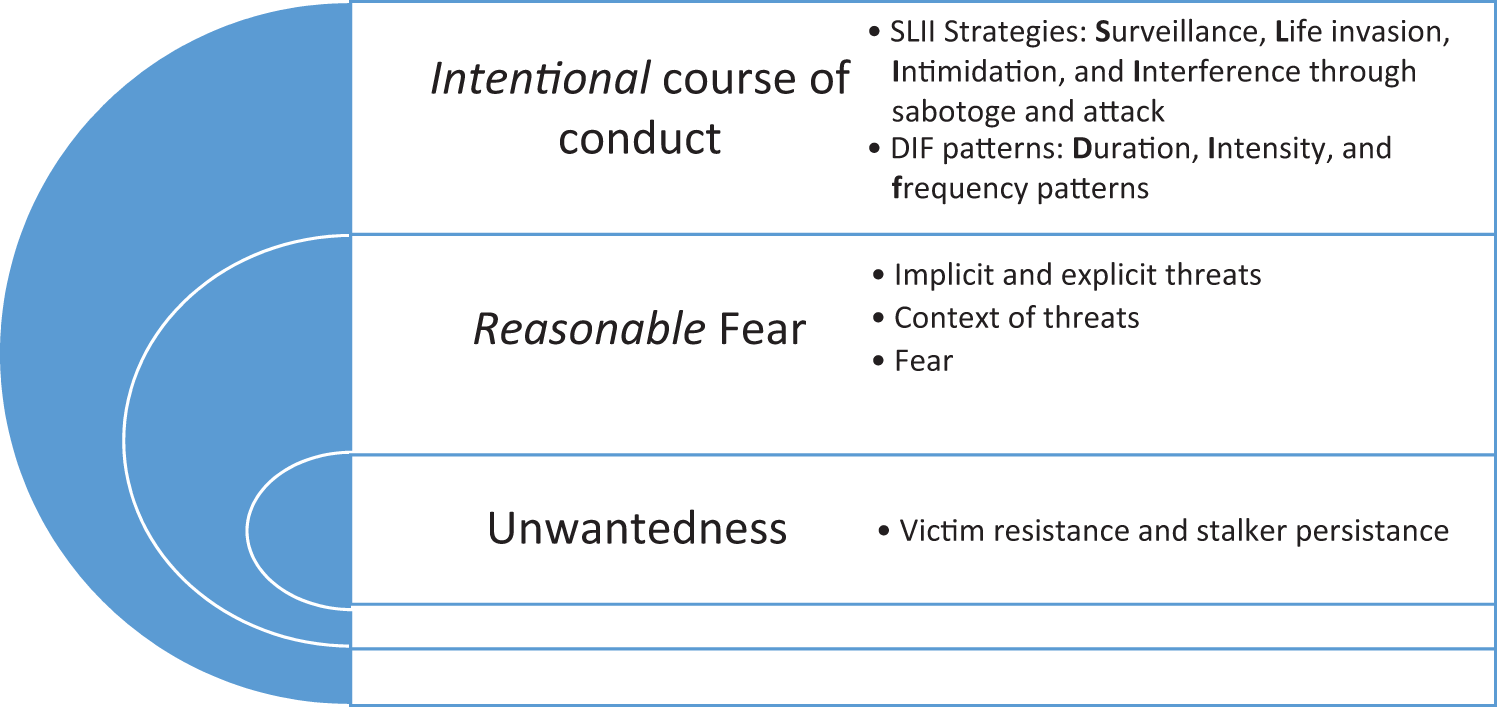
Framework for assessing stalking.
Intentional Course of Conduct
This first component of the multidimensional framework includes two main elements that, together, provide an overview of the stalking course of conduct. The first is a classification of tactics that are referred to in this article as: Surveillance, Life invasion, Intimidation, and Interference (abbreviated as SLII tactics) and the second captures the pattern of SLII strategies that consists of (a) Duration, (b) Intensity, and (c) Frequency (abbreviated as DIF patterns). Documented patterns of stalking or harassing behavior provide more clear information about the intentionality of the acts (Fein et al., 1995; Meloy, Hoffman, Guldimann, & James, 2012).
SLII strategies
Stalking has primarily been measured by asking a series of questions about expected and typical tactics. However, stalkers are creative and use a wide diversity of tactics. Thus, it is impossible to come up with an exhaustive list of all possible tactics (Finch, 2001; Logan, Cole, et al., 2006; Spitzberg & Cupach, 2014). Also, a long list of tactics can be overwhelming. In response, several research groups use general categories to facilitate communication about stalking behavior (Kropp, Hart, & Lyon, 2002; Spitzberg & Cupach, 2014).
For the multidimensional framework presented here, tactics were organized into four categories based on tactic function (see Table 1): (a) Surveillance, (b) Life invasion, (c) Intimidation, and (d) Interference through sabotage or attack (abbreviated as SLII, pronounced “sly” tactics; Logan, 2010, 2013).
SLII Strategies.

Surveillance
Surveillance, when all the tactics are taken together, is often the most common strategy reported by victims and includes following, spying on, watching, showing up unexpectedly in places where victims are, and waiting in places where victims are likely to appear (Blaauw, Winkel, Arensman, Sheridan, & Freeve, 2002; Canter & Ioannou, 2004; Kropp et al., 2002; Logan, 2010; McFarlane et al., 1999; Mechanic, Weaver, & Resick, 2000; National Center for Victims of Crime, 2007; Sheridan et al., 2001; Spitzberg, 2002b). Electronic monitoring or tracking is also included in this dimension (Southworth, Dawson, Fraser, & Tucker, 2005; Southworth, Finn, Dawson, Fraser, & Tucker, 2007).
When surveillance or tracking a target is present as part of the course of conduct, it is more likely to be perceived by victims and the general public as stalking than harassment or innocent pursuit (Amar, 2007; Baum et al., 2009; Beatty, 2003; Logan, Cole, et al., 2006; Ngo, 2011; Sheridan & Davies, 2001; Spitzberg, 2002a; Spitzberg & Cupach, 2008). Several studies have found that surveillance, in particular, is associated with severe violence (McFarlane et al., 2002; Sheridan & Roberts, 2011) and increased victim fear (Logan, Cole, et al., 2006). McFarlane, Campbell, and Watson (2002) found that women who reported their partner had followed or spied on them were more than twice as likely to experience an attempted or actual homicide by that partner. Thus, surveillance is one of the sentinel components of stalking associated with victim fear and with severe and potentially lethal violence.
Also, surveillance may be extended by using proxy stalkers—the involvement of other people in attempting to keep track of targeted victims (Logan, Cole, et al., 2006; Melton, 2007a, 2007b; Mullen, Pathé, & Purcell, 2000). Proxy stalking is a relatively common tactic especially for ex-partner stalkers (Logan, Cole, et al., 2006; Melton, 2007a, 2007b; Sheridan et al., 2001). Proxy stalking, in a broad sense, may be as insidious as the stalker questioning or tricking the target’s friends and family members to gain information or access to the target, to actually having a friend or family member follow the victim (Logan, Cole, et al., 2006; Spitzberg & Cupach, 2014). Proxy stalking has been associated with severe violence (Sheridan & Roberts, 2011).
Life invasion
Life invasion is a particularly common form of stalking and harassment, and it includes phone calls, e-mails, texts, and other unwanted contact (e.g., gifts; Kropp et al., 2002; Logan, Cole, et al., 2006; Spitzberg, 2002b; Sheridan et al., 2001). It is referred to as invasion because it means entry directly or through electronic means into the private sphere of victim lives—even though it can occur in public settings. This category includes property invasion, spreading rumors, and public humiliation. Invasion often expands from a target’s home, phone, or computer into other spaces like work, grocery stores, and recreational activities (Cupach & Spitzberg, 2000; Emerson et al., 1998; Logan, Cole, et al., 2006; Nicastro, Cousins, & Spitzburg, 2000).
Invasion into a target’s public space can put the public at greater risk of witnessing or actually experiencing threats and violence. Invasion can also include harassing friends and family members. For example, victims have talked about their stalker knocking on their friend’s house at all hours of the day and night looking for them (Logan, Cole, et al., 2006; Sheridan et al., 2001). The level of stalking invasion has been associated with increased victim distress (Cupach & Spitzberg, 2000; Emmerson, Ferris, & Gardner, 1998; Nicastro et al., 2000).
Intimidation
This form of stalking/harassment includes direct and indirect threats of harm, property damage, forced confrontations (other than attack), threats or actual harm to self, and threats to target about harming friends and family members (Kropp et al., 2002; Logan, Cole, et al., 2006; Sheridan et al., 2001; Spitzberg, 2002b).
Threats and property damage have been associated with stalker violence (Groenen & Vervaeke, 2009; McFarlane et al., 2002; Sheridan & Roberts, 2011). Explicit threats are predictive of subsequent violence (Bjerregaard, 2000; Brewster, 2002; Echeburua, Fernandez-Montalvo, de Corral, & Lopez-Goni, 2009; Harmon, Rosner, & Owens, 1998; Kropp, Hart, & Lyon, 2008; McEwan, MacKenzie, Mullen, & James, 2012; McEwan, Mullen, & Purcell, 2007; Roberts, 2005b; Rosenfeld, 2004; Rosenfeld & Harmon, 2002; Sheridan & Roberts, 2011; Thomas, Purcell, Pathé, & Mullen, 2008). Another study found that although the vast majority of women with abusive partners experience explicit threats of harm, the frequency of explicit threats of harm was associated with concurrent abuse, control, severe physical violence, forced sex, and stalking (Logan, 2015).
One study found that women with protective orders against violent ex-partners who were stalked after the protective order was obtained experienced an average of over US$600 in property damage during the 6-month post protective order period. The damage is significant when compared to a total of about US$100 in damages for women who experienced ongoing violations but no stalking during the 6-month postprotective order period (Logan & Walker, 2010).
Interference through sabotage or attack
This category includes tactics that have direct consequences to victims including financial or work sabotage, kidnapping or deliberately keeping the target from leaving or going somewhere, attacking friends and family members, and physical (including road rage) or sexual attack of the target (Logan, Cole, et al., 2006; Logan, Shannon, Cole, & Swanberg, 2007b; McEwan et al., 2007). This dimension also includes tactics that are used to ruin a target’s reputation such as threatening or actually posting embarrassing pictures and spreading harmful rumors on social networking and other websites. In these cases, the interference can cause direct harm to victim employment, personal relationships, child custody, and potential future opportunities. Potential future opportunities include access to resources, jobs, housing, social, and political or community involvement, which can all be diminished by stalker behaviors (Logan, Cole, et al., 2006).
Interference through physical and sexual attack within the context of stalking varies by study with rates ranging between 30% and 50% (James & Farnham, 2003; McEwan, Mullen, MacKenzie, & Ogloff, 2009b; Mohandie et al., 2006; Nicastro et al., 2000; Rosenfeld & Harmon, 2002; Sheridan & Roberts, 2011). Rates of physical and sexual attack also vary by stalker type with ex-partners more likely to assault their targets than acquaintances and strangers (McEwan, Mullen, MacKenzie, & Ogloff, 2009a; Mohandie et al., 2006; Rosenfeld & Harmon, 2002; Sheridan & Roberts, 2011). Ex-partner stalkers were also more likely to threaten or use weapons (one in three cases) than nonintimate stalkers (one in five cases; Mohandie et al., 2006). Another study found that partner stalking victims, compared to women with abusive partners but who were not stalked, reported significantly more interference while they were driving (e.g., trying to run her off the road and trying to cause her to have an accident) which is dangerous for the public at large (Logan, Cole, et al., 2006).
Interference also incorporates sabotage of the victim’s life. An example of the harmful impact on a stalking victim’s life comes from Lasdun’s (2013) story of being stalked by a former female student. Although he didn’t focus much on the fear of physical violence from his stalker, he felt his career, job opportunities, and reputation were severely impacted by the online campaign she took on to “ruin him” (p. 62). He also suffered psychologically from the stalking and harassment as described below:
Her obsession with me achieved perfect symmetry; I became just as obsessed with her. I couldn’t write, read, or play with the kids, listen to the news, do almost anything without drifting off … into morbid speculations about what new mischief she might be getting up to. The sheer quantity of her emails was such that I never had time to recover my equilibrium between them. Even the ones that consisted of abuse left a bruised, unclean feeling and there was never time to purge this, so that an accumulation of unprocessed disgust, pain, and bewilderment seemed to be piling up inside me … I couldn’t think about anything but her, and pretty soon I couldn’t talk about anything but her. (pp. 128–129)
Consistent with Mohandie’s findings, Logan and Walker (2010) reported that partner violence victims with protective orders who experienced both violations and stalking had significantly greater fear of social and financial harm and lost significantly more time from work than victims who experienced protective order violations but no stalking. That same study found women being stalked after a protective order lost an average 78 hr from work to deal with stalking during the 6-month follow-up period while a group of women who had protective orders against a violent ex-partner and experienced ongoing violations but no stalking reported losing a total of 18 hr of work during the 6-month follow-up period. Ex-partner stalkers often target victims at their workplace (Logan, Shannon, et al., 2007b; Nicastro et al., 2000) and many of those stalked by (ex) partners report that their coworkers or supervisors had been directly and indirectly threatened in the prior year (Logan, Shannon, et al., 2007b; Logan & Walker, 2010).
DIF patterns
Stalking and harassment are dynamic behaviors that change over time. They can either escalate or de-escalate, stop, then start again, and change approach in tactics, scope, and nature (Cattaneo, Cho, & Botuck, 2011; Kropp et al., 2002; Miller, 2001b). There are three components that help describe the dynamic nature and context of the SLII strategies: duration, intensity, and frequency.
Duration
Duration of the stalking and harassment is important in describing the bigger picture of course of conduct (Kropp et al., 2002; Logan, Cole, et al., 2006). Duration, here, is defined as when the stalking started and how long it has lasted. However, if stalking is ongoing, the true duration would not be known. Additionally, given the nature of stalking, what appears to be desistance for some may actually be a break in the stalking (Nobles, Fox, Piquero, & Piquero, 2009; Spitzberg & Cupach, 2014).
In general, stalking duration can last for a few days, a few weeks or even years (Brewster, 1999; Kropp et al., 2002; Mohandie et al., 2006; Purcell et al., 2002; Spitzberg & Cupach, 2014). One study found that unwanted intrusions beyond a threshold of 2 weeks were associated with a more intrusive, threatening, and psychosocially damaging course of harassment (Purcel, Pathé, & Mullen, 2004b). Another study found that most stalkers focused on targets longer than 2 weeks, but that stranger stalkers who did not attempt to contact targets were likely to desist in less than 2 weeks (McEwan, Mullen, & MacKenzie, 2009). Duration also played a role in perceptions of whether harassment type behaviors were labeled as stalking (Dennison & Thomson, 2002). Duration of stalking is associated with greater psychological distress in victims (Blaauw et al., 2002; Johnson & Kercher, 2009; Kamphuis, Emmelkamp, & Bartak, 2003; Purcell, Pathé, & Mullen, 2004b) and increased social damage such as social isolation, time off work, and relocation (Purcell et al., 2004b).
Intensity
Intensity is defined, here, as the number of different tactics and locations the stalker employs. Specifically, stalking victims are often harassed while at home, but it is rare for stalking to occur only in one location (Melton, 2007b; Logan, Cole, et al., 2006; Sheridan et al., 2001). Work is another place stalkers often harass and contact their target (Nicastro et al., 2000; Logan, Shannon, et al., 2007b). Further, Johnson and Kercher (2009) found that a greater variety of stalking behaviors was associated with more negative outcomes for victims. Specifically, the number of stalking tactics victims experience has been associated with increased psychological distress (Blaauw et al., 2002; Kamphuis et al., 2003; Nicastro et al., 2000) and violence (James & Farnham, 2003; Logan, Cole, et al., 2006). One study found that intensity of stalking tactics was more highly associated with serious forms of intrusive behavior than duration (Thompson & Dennison, 2008). Several studies found the greater the number of different stalking-like tactics experienced by victims, the more likely the behavior was labeled as stalking by victims (Amar, 2007; Phillips, Quirk, Rosenfeld, & O’Connor, 2004). Furthermore, several studies suggest that (ex) partner stalkers employ a greater number of different stalking tactics compared to nonpartner stalkers (Hakkanen, Hagelstam, & Santtila, 2003; Mohandie et al., 2006; Sheridan & Davies, 2001).
Frequency
Frequency includes how often stalkers make their presence known and the frequency of contact or making their presence known to the victim as well as frequency of approach, confrontation, and interference in the victim’s life. Higher frequency of stalking-like behavior has been associated with an increased risk of threats and violence as well as with stalker self-reports of intention to frighten, intimidate, or harm their targets (Thompson & Dennison, 2008). Frequency of approach to victims has been associated with greater likelihood of severe violence (Sheridan & Roberts, 2011). Stalkers who know their victims well more frequently directly approach their victims—probably due to their comfort level as well as their knowledge of victim lifestyles and whereabouts (James & Farnham, 2003; Palarea, Zona, Lane, & Langhinrichsen-Rohling, 1999). For example, ex-intimate partner stalkers were more likely to approach their target, be violent, threatening, and follow through on those threats and to damage property than nonintimate stalkers (Mohandie et al., 2006; Palarea et al., 1999). Proxy stalkers may also contribute to the frequency of stalking (Logan, Cole, et al., 2006; Logan & Walker, 2009; Sheridan & Roberts, 2011) and has been associated with severe violence (Sheridan & Roberts, 2011).
Summary of course of conduct
Course of conduct component of the multidimensional framework includes SLII strategies and DIF patterns of those strategies. One difficulty with stalking statutes in some states is the requirement of stalker intent making prosecuting cases of stalking more difficult (National Center for Victims of Crime, 2007). However, clearly documenting the SLII strategies their DIF patterns along with corroborating evidence of the course of conduct shows patterns of behavior, and patterns show intent (Borum et al., 1999).
Further, when examining DIF patterns, it is particularly important to consider whether there is an escalation of stalking, harassing, or threatening behavior. Escalation can be defined as a qualitative and/or quantitative increase in stalking, harassing, or threatening behaviors and may include frequency of harsher language, graphic or threatening enclosures, closer modes of delivery, more modes of delivery, ancillary incidents, and increased personalization indicators (Borum et al., 1999; Burgess et al., 1997; McEwan et al., 2012; Meloy et al., 2012; Rugala & Fitzgerald, 2003). Escalation has been associated with violence (Burgess et al., 1997; Kropp, 2008; Kropp et al., 2002; Rugala & Fitzgerald, 2003; Sato Mumm & Cupach, 2010; Sheridan et al., 2001). Higher intensity and/or greater frequency of stalking have also been associated with greater psychological distress (Blaauw et al., 2002; Botuck et al., 2009; Kamphuis et al., 2003; Mechanic, Uhlmansiek, Weaver, & Resick, 2000; Mechanic, Weaver, et al., 2000).
Reasonable Fear
The second main component of the framework is victim fear. Many statutes use the reasonable person standard which, very generally, asks the question “would the stalker’s conduct cause a reasonable person in similar circumstances to be afraid?” (National Center for Victims of Crime, 2007, p. 35). Understanding the reasonableness of fear includes assessing (1) the specific implicit or explicit threats, (2) the context of those threats, and (3) victim fear or concern for safety. These three subcomponents facilitate the understanding of why fear is cumulative over time and helps provide the context of the threats and fear.
Implicit and explicit threats
Rugala (2001) indicates that dealing with threats and threatening behavior is the single most important key to preventing violence. In very general terms, there are two main kinds of threats—implicit and explicit. Being followed, tracked, and watched is a pattern of fear inducing behavior and can create fear of future harm and significant emotional distress (Kamphuis et al., 2003; Kropp et al., 2002; Logan, Cole, et al., 2006; Mullen et al., 2006). In other words, stalkers can “pose” a threat without saying a word (Fein et al., 1995). Baum, Catalano, Rand, and Rose (2009) found that 56.8% of stalking victims did not experience explicit threats but were fearful or concerned for safety suggesting that understanding the threat implicit in stalking behavior is critical to understanding cumulative fear and harm.
In addition to the stalking behavior itself creating fear, implicit threats can be made through gestures like leaving objects in victim homes intentionally misplaced, misused, or broken. Threat can also be implied through words or phrases or even a certain look (Logan, Cole, et al., 2006; Logan & Walker, 2009). These gestures or ambiguous words/phrases may be linked to prior acts of harm or explicit threats especially in (ex) partner stalking cases (Logan & Walker, 2009). In some cases, the threat against victims may be obvious even when there is not an explicit threat such as sending a doll with no head to a person who is being harassed (Miller, 2001b). In other cases, more background information is needed such as when stalkers write “love forever” and in the same e-mail they refer to the number of guns they own (Miller, 2001b).
The relationship history provides some of the context necessary to see seemingly innocent gestures or words as threatening. For example, a former partner following his ex-girlfriend around, shaking his fist at her may be a strong reminder of physical violence she endured during the relationship; thus, she may interpret the fist shaking as a very real, visceral threat of future assault (Logan & Walker, 2009). Others may look at this man’s behavior and interpret it as “odd” or “crazy” but not as threatening. And, at the very least, they would probably not give the threats as much credibility as the man’s ex-partner would. One stalking victim described it as “Seeing and talking to my ex-husband brings back memories ….He has a way of looking at me, he knows how to look at me when he sees me to make me just shudder. And I’m afraid” (Logan, Cole, et al., 2006, p. 25). The threat implicit in stalking course of conduct is one of the unique components of stalking crime and also complicates risk assessment (Kropp et al., 2002; Miller, 2001a, 2001b). The pattern of fear-inducing stalking behavior often includes acts that, taken in isolation, are legal or that are minor crimes making the situation appear far less harmful than it is (Kropp et al., 2002; Miller, 2001a, 2001b).
An explicit threat can be defined, according to the Oxford English Dictionary, as “… a declaration of hostile determination or of loss, pain, punishment, or damage to be inflicted in retribution for or conditionally upon some course … ” (Simpson & Weiner, 1989). As noted above, explicit threats are part of the stalking course of conduct in between 30% and 60% of all stalking cases (Baum et al., 2009; Blaauw et al., 2002; Mullen et al., 2006; Pathé & Mullen, 1997; Purcell et al., 2002). Threats may bolster the power of the threatener due to the fear instilled in the target (Barnes, Gordon, & Hudson, 2001; Jenkins, 2009). Baum et al. (2009) found that 43% of male and female stalking victims were explicitly threatened most often with physical harm or death and a number of other things like harm to self, threats to harm others, or threats to harm pets.
Explicit threats of harm are more common in situations where stalkers and targets are acquainted with each other (Jenkins, 2009; O’Hair, Bernard, & Roper, 2011; Warren, Mullen, & Ogloff, 2011). One large study of stalkers who had been brought to the attention of law enforcement found that although overall 60% of targets were threatened by the stalkers, and the vast majority of the threats were made directly to their targets, 83% of ex-partners made threats, 63% of acquaintance stalkers made threats, 53% of stranger stalkers of private persons made threats, and 18% of public figure stalkers made threats (Mohandie et al., 2006). Frequency of explicit threats from abusive partners is associated with frequency and severity of concurrent abuse, violence, stalking, and distress (Logan, 2015).
In general, explicit threats in the context of stalking are associated with an increased risk of violence (Bjerregaard, 2000; Brewster, 2000, 2002; Echeburua et al., 2009; Groenen & Vervaeke, 2009; Harmon et al., 1998; Kropp, 2008; McEwan et al., 2007, 2012; Roberts, 2005b; Rosenfeld, 2004; Rosenfeld & Harmon, 2002; Sheridan & Roberts, 2011; Thomas et al., 2008) especially in combination with other risk factors such as substance use, mental health problems, and prior violence history (Barnes et al., 2001; Hillbrand, 2001; Warren et al., 2011). However, as shown above, research suggests threats may be more common and predictive of violence when (ex)partners are involved than acquaintance or stranger stalking (Logan, 2015; McEwan et al., 2009b; Meloy, 2001; Mohandie et al., 2006; Mullen et al., 2006; Sheridan & Davies, 2001; Warren et al., 2011).
Explicit threats are also associated with greater fear. One study found that victims being stalked who were explicitly threated had higher fear levels than those being stalked without explicit threats (Bjerregarrd, 2000). Further, explicit threats are related to higher psychological distress, regardless of actual violence, among stalking victims (Brewster, 2000; Pathé & Mullen, 1997; Purcell et al., 2004b). McEwan, Mullen, and Purcell (2007, p. 7) concluded, Though perhaps counter to expectations, it appears that the sense of looming vulnerability that accompanies threats may be more productive of psychological distress in stalking victims than the reality of actual physical assault, which importantly [actual physical assault], may precipitate a more sympathetic response, particularly from law enforcement.
Context of threats
In general, threats are interpreted within the psychological, cultural, and social frame in which the threat is made (O’Hair et al., 2011). Even a phrase like “I will hurt you” can be taken as a threat, a promise, or a joke depending on the context in which it is made and how it is interpreted (Rugala, 2001; Miller, 2001b). Further, context provides insight into the unique vulnerability of targets, and understanding the target’s unique vulnerability has implications for actions or reactions targets may consider in response to the threat (Becker, 1973, 1974; Jackson, 2009; Weinstein, 1988). As an example from health research, an individual can know about an illness and even know people with that illness, but the more they believe they are susceptible or vulnerable to that illness, the greater the perceived threat and the more likely a person will engage in precautionary behaviors (Becker, 1973, 1974; Weinstein, 1988). It is also likely that the more vulnerable the individual is perceived by others to that illness or threat, the more likely the individual will receive more assertive action by outside agencies. Four dimensions of context are discussed here: (a) characteristics and history, (b) mind-set, (c) environment, and (d) dynamic. It is the interaction of these four components that may help answer the questions posed at the beginning of this article “Why this target; Why this time?” (Borum et al., 1999; Fein & Vossekuil, 1998; Fein et al., 1995; McEwan et al., 2011; O’Hair et al., 2011; Rugala, 2001; Scalora et al., 2002).
Characteristics and history
Examination of offender characteristics is a concept very common in violence assessment and research (Andrews & Bonta, 2010). This article focuses on four specific characteristics that have been identified in the research on stalking: (1) history of violence and abuse, (2) history of criminal justice involvement, (3) substance use and mental health problems, and (4) technological expertise.
In general, a history of violence is associated with future violence (Andrews & Bonta, 2010; Bowen, 2011; Echeburua et al., 2009; Eke, Hilton, Meloy, Mohandie, & Williams, 2011; Hanson, Helmus, & Bourgon, 2007; Hilton & Harris, 2005; Kroner, Mills, & Reddon, 2005; Messing & Thaller, 2013; Yang, Wong, & Coid, 2010). Specifically, several studies have found an association with past violence and stalker violence (Groenen & Vervaeke, 2009; McEwan et al., 2009b; Morrison, 2001; Palarea et al., 1999; Sheridan & Roberts, 2011).
Further, those being stalked by an ex-partner frequently report prior physical, emotional, and/or sexual abuse by that partner (Krebs, Breiding, Browne, & Warner, 2011; Logan, Leukefeld, & Walker, 2000; Logan, Shannon, & Cole, 2007a; Miller, 2006; Spitzberg & Cupach, 2008; Tjaden & Thoennes, 1998). Sexual coercion and assault have been also associated with a greater likelihood of stalking (Krebs et al., 2011; Logan & Cole, 2011; Logan, Walker, & Cole, 2015; Nobles et al., 2009; Roberts, 2005a, 2005b) and future stalker violence (Echeburua et al., 2009; Sheridan & Roberts, 2011). And when there is a history of partner abuse there is an increased likelihood of explicit threats and violence during the course of the stalking as well as a longer duration and escalation of stalking (Campbell et al., 2003; Echeburua et al., 2009; Eke et al., 2011; Ferreira & Matos, 2013; Groenen & Vervaeke, 2009; Hilton & Harris, 2005; McEwan, Mullen, & MacKenzie, 2010; McEwan et al., 2007, 2009b; Mohandie, et al., 2006; Morrison, 2001; Palarea et al., 1999; Rosenfeld, 2004; Sheridan & Roberts, 2011; Thomas et al., 2008). Furthermore, the duration, intensity, and frequency of stalking are greater among those with prior relationship abuse by the stalker (Brewster, 2003; Ferreira & Matos, 2013; Mechanic, Weaver, et al., 2000; Mohandie et al., 2006; Palarea et al., 1999; Sheridan & Davies, 2001; Tjaden & Thoennes, 1998).
Also, prior stalking is predictive of future stalking even in the case of a court order prohibiting abuse and contact (Melton, 2007a; Logan & Walker, 2010). Burgess et al. (1997) found, from partner violence offenders charged with felony domestic violence offenses, that those who stalked their current (ex) partner were more likely to have a prior history of stalking than those who were not currently stalking their (ex) partner. Thus, if a stalker has stalked in the past, they are likely to stalk in the future (Burgess et al., 2007; Eke et al., 2011; Logan, Cole, et al., 2006; Logan & Walker, 2010).
History of criminal justice system involvement also is a factor to consider. In fact, many stalkers do have prior criminal histories (Douglas & Dutton, 2001; Jordan et al., 2003; Logan, 2010; Mohandie et al., 2006; Roberts, 2002). Some studies have found that criminal history has an inconsistent relationship with stalker violence although in general, a past criminal and violence history are associated with reoffending (Andrews & Bonta, 2010; Brewster, 2000; Harmon et al., 1998; Kropp, 2008; McEwan et al., 2007; Meloy, 2001; Mullen, Pathé, Purcell, & Stuart, 1999; Rosenfeld & Harmon, 2002). Several studies found that about half of those arrested or convicted of stalking reoffended with a new stalking or stalking-related charge or complaint (Malsch, de Keijser, & Debets, 2011; Olson & Stalans, 2001; Rosenfeld, 2003).
Research suggests substance use may be associated with increased likelihood of stalking as well as stalker violence (Cattaneo et al., 2011; Brewster, 2000; Burgess et al., 1997; Eke et al., 2011; Groenen & Vervaeke, 2009; Meloy, 2002; Melton, 2007a; Rosenfeld, 2003, 2004; Sheridan & Roberts, 2011; Willson et al., 2000). Substance use may also be an aggravator or have a disinhibiting impact when combined with other risk factors (Brewster, 2001; Groenen & Vervaeke, 2009; Meloy, 2002; Roberts, 2005b).
Furthermore, strong negative emotions among stalking perpetrators have been associated with stalking aggression and violence (Echeburua et al., 2009; Kropp, 2008; Morrison, 2001). Several studies found that stalkers may have a high rate of suicidality (Mohandie et al., 2006; McEwan et al., 2010). However, research has not found a strong association between stalking and any specific mental disorders (Douglas & Dutton, 2001; McFarlane et al., 2002; Rosenfeld, 2004). When examining more severe mental illness, studies find that psychotic stalkers are more common in stranger, celebrity, and acquaintance stalkers than partner stalkers, and that, in general, psychotic stalkers are less likely to be physically violent than nonpsychotic stalkers (Kienlen, Birmingham, Solberg, O’Regan, & Meloy, 1997; McEwan et al., 2007; Meloy, 2002). For example, Kienlen, Birmingham, Solberg, O’Regan, and Meloy (1997) found that nonpsychotic stalkers were angry, hostile, blaming, obsessive, dependent, and jealous and employed minimization and denial more often than psychotic stalkers. That study also found that nonpsychotic stalkers were more threatening and violent than psychotic stalkers. Although psychosis appears to be related to a reduced likelihood of violence, several studies found it was associated with stalking persistence (McEwan & Strand, 2013; McEwan et al., 2010). Several other studies have found that serious mental health problems especially in combination with prior violence history or substance abuse may increase the risk of subsequent violence (Borum et al., 1999; Harmon et al., 1998).
Also, when targets are being stalked, it is important to consider how likely and able offenders are to use of sophisticated technology (Borum et al., 1999; Fein et al., 1995; Reyns, Henson, & Fisher, 2011; Rugala & Fitzgerald, 2003). This component is necessary to establish the likelihood that offenders are capable, for example, of hacking into a cell phone, or using the computer to steal someone’s identity, or could be capable of making a bomb if that is what they are threatening. Having access to and knowledge of technology increases stalker ability to track, harass, and sabotage victims (Belknap, Chu, & DePrince, 2012; Holt & Bossler, 2009; Reyns et al., 2011; Sheridan & Grant, 2007; Southworth et al., 2007; Spitzberg & Hoobler, 2002).
Mind-set
Stalker mind-set includes (a) motivation, (b) justification, (c) ability, and (d) last resort thinking. Mind-set can sometimes be gleaned from through their communications to the target and to third parties as well as through their behaviors (Borum et al., 1999; Calhoun & Weston, 2009; De Becker, 1997; Fein et al., 1995; Meloy & O’Toole, 2011; Meloy et al., 2012). Motivation is associated with the “triggering” event or critical incident that influenced the stalker to see harassment, stalking, and violence as an option or solution (Borum et al., 1999; Calhoun & Weston, 2009; De Becker, 1997; Fein et al., 1995). These situations may include separation and divorce, being fired from a job or refused a promotion, a refusal for a date, or other experiences characterized by rejection, humiliation, and degradation. One study found that partner abuse victims predicted high risk of future violence when the offender was angry about the relationship termination and/or an arrest (Conner-Smith, Henning, Moore, & Holdford, 2011). Loss of status such as public humiliation, failure, or rejection (e.g., separation) can overwhelm an individual’s coping skills causing them to act out (Borum et al., 1999). For example, separation from an abusive partner, especially those with high levels of jealousy and control, is associated with escalated stalking and violence (Campbell et al., 2003; Davis, Ace, & Audra, 2000; Langhinrichsen-Rohling, Palarea, Cohen, & Rohling, 2000; Logan & Walker, 2004; Logan, Walker, Jordan, & Campbell, 2004; Logan, Walker, Shannon, & Cole, 2008; Mechanic, Weaver, et al., 2000; Melton, 2007a; Mullen et al., 1999, 2006; Roberts, 2002, 2005a, 2005b; Tjaden & Thoennes, 1998).
Justification includes revenge and blame. Feelings of rejection may promote revenge motives and rage among stalkers (Echeburua et al., 2009; Meloy, 2002; Morrison, 2001; Rugala & Fitzgerald, 2003). In particular, among ex-partners who felt rejected, there was an association of anger and jealousy with stalking (Davis et al., 2000; Dye & Davis, 2003). Stalkers with a revenge motive, regardless of relationship, have an increased likelihood of being violent (Meloy, 1998; Rosenfeld & Harmon, 2002) and an increased likelihood of persistent stalking (McEwan et al., 2007). Resentment and rejection are both associated with stalking, threats, property damage, and assaults (Malsch et al., 2011; Mullen et al., 1999). “The intent is to dominate, devalue, and in some cases, destroy” (Meloy, 1998, p. 20).
Another factor that is often mentioned in risk assessment is the likelihood that offenders have the capacity or ability to carry out a threat (Rugala, 2001; Rugala & Fitzgerald, 2003). Because stalking incorporates a deliberate and intentional course of conduct, there is a discernable process of planning (Fein & Vossekuil, 1999; Fein et al., 1995) or warning behaviors (Meloy et al., 2012) that can be examined for clues to the feasibility and capability for carrying out the threat. For example, the more graphic, detailed, and public the threats are, the greater the likelihood of violence (Borum et al., 1999; Burgess et al., 1997; McEwan et al., 2012; Meloy et al., 2012; Rugala & Fitzgerald, 2003). This is sometimes called violent or homicidal ideation (Calhoun & Weston, 2009; McEwan et al., 2011).
Clues can also include prior threats that have been carried out, possession or obsession with weapons, and technological expertise, or access to harmful materials (Borum et al., 1999; Fein et al., 1995; Rugala, 2001; Rugala & Fitzgerald, 2003). For example, possessing guns and an interest in weapons are risk factors for violence and lethal violence (Anglemyer, Horvath, & Ruterhford, 2014; Borum et al., 1999; Campbell et al., 2003; Kellerman et al., 1993; Sorenson & Wiebe, 2004). Mohandie et al. (2006) found, from their study of stalkers, that one in five stalkers threatened their targets with a weapon but one in three of the (ex) intimate partner stalkers threatened their target with a weapon including knives, guns, and other objects (61%). Possession of a gun is a risk factor for both suicide and homicide (Anglemyer et al., 2014; Bailey et al., 1997; Wiebe, 2003). Access to guns increases the likelihood of threats and actual use of the gun in violent relationships (Sorenson & Wiebe, 2004). Possession of a gun has been found to be a risk factor for intimate partner homicides (Campbell, Glass, Sharps, Laughon, & Bloom, 2007; Kellermann et al., 1993) with about 55% of women murdered by an intimate partner being killed with a gun (Gerney & Parsons, 2014). Further, women with partner abuse experiences believe that the presence and threats with guns represent increased risk of lethality (Lynch & Logan, in press).
Further, when stalkers are unconcerned about consequences, the risk for violence is increased (Borum et al., 1999; Fein et al., 1995). In other words, if offenders are stating that they do not care about severe consequences such as going to jail or dying, the risk level of the situation is elevated (Conner-Smith et al., 2011). Suicidality is a risk factor and is also noted as an issue for stalkers (McEwan et al., 2010; Mohandie et al., 2006). One study found that stalkers committed suicide at significantly higher rates (6 times more likely) than the general population, psychiatric patients, and a group of other offenders (McEwan et al., 2010). Characteristics such as suicidal ideation and “last resort” thinking are red flags for an increased likelihood of violence (Borum et al., 1999; Fein et al., 1995; McEwan et al., 2010; Rugala & Fitzgerald, 2003).
Dynamic
Another component of understanding violent crime is the victim–offender interaction or dynamic (Balemba & Beauregard, 2012; Block, 1981; Echeburua et al., 2009; Guerette & Santana, 2010; Sacco & Kennedy, 2002) and stalking (De Smet, Loeys, & Buysse, 2013; Geistman, Smith, Lambert, & Cluse-Tolar, 2013; Malsch et al., 2011; Reyns, 2010). Several studies suggest that victims’ behavioral responses can potentially influence the progression, escalation, or de-escalation of the stalking (Carr, Goranson, & Drummond, 2014; De Smet et al., 2013; Geistman et al., 2013; Sato Mumm & Cupach, 2010). For example, research that has examined stalking victim responses suggests that actions that make targets less accessible can contribute to eroding the stalkers’ interest (Cupach & Spitzberg, 2004; Dutton & Winstead, 2011). On the other hand, some speculate that responding to stalkers may be rewarding to them (Cupach, Spitzberg, & Carson, 2000; Malsch et al., 2011). Some targets respond to stalkers to increase their safety, to manage their situations, or to minimize follow through on a threats because they feel bad for stalkers or for other reasons (Logan, Cole, et al., 2006; Malsch et al., 2011; Mullen et al., 2006; Spitzberg & Cupach, 2014). Even negative interactions with victims may be reinforcing to stalkers and may increase the risk of stalking persistence and potentially violence. For example, one study found that victims responding to the stalker was associated with severe violence (Sheridan & Roberts, 2011) and another found that victims responding to their stalkers increased the likelihood of stalkers violating restraining orders (Hakkanen et al., 2003). Also, when there are situations between a stalker and a target that require close proximity or interaction like when there are shared working situations or close living arrangements it increases opportunities for stalkers to harass and intimidate targets (McEwan et al., 2007; Mullen et al., 2006). Potential upcoming events (e.g., anniversary dates, weddings, and custody hearings) that can escalate the intensity and frequency of the stalking or harassment behavior are also important considerations (Borum et al., 1999; Fein et al., 1995; Meloy, 1998; Sato Mumm & Cupach, 2010).
Part of assessing the stalking dynamic depends on the target–stalker relationship. In particular, ex-partner stalkers will likely have a very different dynamic than acquaintance and stranger stalkers with their target. Ex-partner stalkers are more threatening, violent, invasive, and more likely to reoffend after a court intervention than acquaintance or stranger stalkers (Mohandie et al., 2006; Palarea et al., 1999; Purcell et al., 2002; Sheridan & Davies, 2001; Schwartz-Watts & Morgan, 1998; Rosenfeld, 2003). Victims who had a prior relationships with stalkers had a greater number of psychological, physical, and social costs than stalking victims with no prior relationship (Sheridan & Lyndon, 2012).
However, not all partner violence offenders stalk (Douglas & Dutton, 2001; Harrell, Smith, & Newmark, 1993; Tjaden & Thoennes, 1998). Between 50% and 60% of women with protective orders report having ever been stalked by their violent partner (Douglas & Dutton, 2001; Logan & Cole, 2007; Logan & Walker, 2010). Women stalked by a violent partner or ex-partner typically experienced more psychological abuse and controlling behavior, more serious threats, more severe physical assault, and more of them experience injury as well as sexual assault during the relationship compared those being stalked by an ex-partner who was not abusive during the relationship and compared to those not stalked after separation by a violent ex-partner (Brewster, 2003; Cole, Logan, & Shannon, 2005; Coleman, 1997; Logan, Shannon, & Cole, 2007a; Krebs et al., 2011; Mechanic, Uhlmansiek, et al., 2000; Mechanic, Weaver, et al., 2000; Melton, 2007a, 2007b; Norris, Huss, & Palarea, 2011).
Another consideration is that one typically touted “solution” to ending the violence is for a woman to leave or separate from the violent partner. In fact, many women in abusive relationships do eventually leave violent relationships (Amato & Rogers, 1997; Bradbury & Lawrence, 1999; Testa & Leonard, 2001). Leaving a violent partner does not always stop the control, domination, and violence. In fact, separation has been identified as a very high risk period for assault and lethal violence (Campbell, 1995; Campbell et al., 2003; McFarlane et al., 1999), and studies suggest that stalking intensity and/or frequency increases during periods of separation (Logan, Cole, et al., 2006; Logan & Walker, 2004; Logan, Walker, et al., 2004; McFarlane et al., 1999; Mechanic, Weaver, et al., 2000; Melton, 2007a, 2007b). As part of the dynamic, victims stalked by violent partners report more separation attempts than partner violence victims who were not stalked (Logan, 2013; Logan, Shannon, et al., 2007a; Mechanic, Uhlmansiek, et al., 2000). On the other hand, several studies indicate that partner stalking victims were less likely to reconcile with the stalker after a protective order was obtained than victims with protective orders who were not stalked (Logan, Shannon, et al., 2007a; Logan et al., 2008).
Environment
Specific settings can facilitate or hinder violence or stalking. On one side of the equation is the environment for the stalker. For example, if the stalker has had limited or no consequences for the behavior especially when violating court orders or breaking the law, this may embolden the stalker or, at a minimum, not discourage the stalker (Andrews & Bonta, 2003; Carlson, Harris, & Holden, 1999; Kindness et al., 2009; Logan & Walker, 2010). And, if stalkers have support for their behavior, for example, from proxy stalkers, or even sympathetic family members, it may reinforce the stalking and violence (Logan, Cole, et al., 2006; Logan & Walker, 2009; Sheridan & Roberts, 2011). On the other hand, if stalkers are isolated from social supports that would help discourage the behavior, the behavior may be more likely to continue (Andrews & Bonta, 2010; Borum et al., 1999; Fein et al., 1995).
The other side of the equation is victim vulnerability. In other words, how accessible is the victim to the stalker (Fein & Vossekuil, 1998; Mullen et al., 2006)? Victim vulnerability includes victim isolation and unsafe housing conditions, limited access to resources, limited ability or willingness to put safety measures in place, and whether and how vulnerable third parties are to the stalker (Bancroft, 2002; Bybee & Sullivan, 2002, 2005; Echeburua et al., 2009; Fein & Vossekuil, 1998; Holt & Bossler, 2009; Mullen et al., 2006; Mustaine & Tewsksbury, 1999; Reyns et al., 2011). Another vulnerability factor is anything that compels ongoing contact with the stalker such as child exchanges (Mullen et al., 2006). Increased access to victims may be part of the reason ex-partner stalkers are more likely to threaten and assault their victims (Groenen & Vervaeke, 2009; Hilton & Harris, 2005; McEwan et al., 2007; McEwan et al., 2009b; Rosenfeld, 2004; Rosenfeld & Harmon, 2002; Sheridan & Roberts, 2011). This includes children or shared property (McEwan et al., 2007; Mechanic, Uhlmansiek, et al., 2000). Further, if stalkers are coworkers, classmates, bosses, neighbors, or co-parents, risks may be increased (Logan, Shannon, et al., 2007b; Mustaine & Tewksbury, 1999; Nicastro et al., 2000).
Fear
As described above, fear of stalking-like behavior increases with duration, intensity, and frequency of conduct, when the stalker is monitoring or following the target and when there are explicit threats (Dennison, 2007; Logan, 2010). Escalation in the frequency or intensity is also related to increased fear (Logan, Cole, et al., 2006). Tangible harms, such as property damage, interference with close others’ lives, and interference with employment or children are also associated with increased fear (Logan, Cole, et al., 2006).
In general, victim fear is a fairly accurate and robust predictor of actual violence (Bell, Cattaneo, Goodman, & Dutton, 2008; Cattaneo, Bell, Goodman, & Dutton, 2007; Heckert & Gondolf, 2004; Sheridan & Roberts, 2011). Some research suggests that victim perceptions of risk are a strong predictor of reassault equal to or even better than some risk assessment tools (Bell et al., 2008; Gondolf & Heckert, 2003; Heckert & Gondolf, 2004). When victims are being stalked, they estimate their risk of future violence higher (Bell et al., 2008; Bowen, 2011; Cattaneo et al., 2007). And studies show that higher fear is associated with a greater likelihood of stalker violence (Cattaneo et al., 2007; Logan & Walker, 2010).
When partner stalking occurs within the context of a current or former relationship that was violent, victim fear and distress are significantly increased (Brewster, 2002; Logan, Walker, et al., 2004; Mechanic, Uhlmansiek, et al., 2000; Mechanic, Weaver, et al., 2000). For example, Nicastro, Cousins, and Spitzburg (2000) found that partner stalking victims with histories of partner violence experienced over 3 times as many anxiety symptoms as stalking victims with no history of partner violence with the stalker. Brewster (2002) reported, from a sample of 187 women stalked by an ex-intimate partner, that women who experienced violence during the relationship had higher distress levels than women who had not experienced violence during the relationship. Second, there may be a dose–response relationship between severity of the history of violence and fear evoked from the stalking behavior. For example, Logan, Cole, Shannon, and Walker (2006) found the severity of abuse during the relationship was associated with a greater level of fear from stalking. Specifically, the more psychological abuse tactics a woman experienced in the relationship, the greater her fear and concern about future harm from the stalker. Likewise, women in more severely physically and sexually abusive relationships also reported more fear and worried more about future harm by their stalkers than women whose partners used fewer physically and/or sexually abusive tactics (Logan, Cole, et al., 2006).
The fact that victims must define the experience as emotionally distressing or fear inducing in many stalking statutes is controversial because victims sometimes have trouble admitting fear or do not recognize or appreciate the danger of being stalked. Professionals in victim service agencies and the criminal justice system believe that victims often do not recognize stalking (Logan, Walker, Stewart et al., 2006). Victims may minimize the situation themselves for a number of reasons (Logan, Cole, et al., 2006). However, it is important to remember that victims do not have to verbalize fear for an outsider to know whether a victim is afraid. In other words, fear can be established or corroborated by looking at target behavior. Stalking targets do a variety of things to cope over time and many of these things cost money (e.g., safety devices, changing jobs, and moving), time (e.g., take time off work or school and obtain a protective order), and/or are significant life changes (e.g., change day-to-day activities, stay with friends or family, change routes, avoid socializing, get pepper spray or other kind of weapon, change e-mail address, get off of social networking sites, and make other online changes), and most targets make multiple changes or accommodations (Baum et al., 2009; Logan, Cole, et al., 2006; Spitzberg & Cupach, 2008). Persons who are not concerned or worried about their safety are likely not going to invest the time, money, and effort to change their life in these ways. One study found that stalking victims were more likely than harassment victims to take protective actions like changing their routines, call the police, obtain a protective order, and talk to friends and family (Baum et al., 2009).
Summary of reasonable fear
The difficulty in many stalking statutes with fear is the reasonable fear or reasonable person standard. The legal threshold for stalking included fear in order to reduce the possibility of false allegations (National Center for Victims of Crime, 2007). However, the model stalking code recommends using the reasonable person standard for two main reasons (National Center for Victims of Crime, 2007). First, requiring actual fear puts a focus and burden on the target rather than on the pattern of fear inducing behavior the stalker is engaging in which would cause any reasonable person to be afraid. Second, the reasonable person component accommodates the context of the situation because it implies that a reasonable person within the target’s circumstances would be afraid. Using the framework outlined in this article and documenting the SLII strategies and DIF patterns along with the threats, context of the threats, and the impact on the victim will identify risk factors pointing to the need for safety planning. Victim fear need not be stated overtly, and it can be inferred from the reported stalking actions and protective steps taken by victims (Baum et al., 2009). The context of victim fear is particularly important to understanding and assessing the reasonableness of the fear (Conner-Smith et al., 2011).
Unwantedness
Another component of the framework for conceptualizing stalking is the unwantedness of the behavior. What is referred to here is far beyond irritation or dislike of the behavior, and it is an unambiguous will for it to stop. Among the indicators of unwantedness is examination of steps taken by victims to resist stalkers (target resistance) and the reactions of stalkers to persist in spite of that resistance (stalker persistence). As noted above, there are significant psychological, social, and life consequences of stalking (Amar, 2006; Blaauw et al., 2002; Brewster, 1999; Davis et al., 2002; Kuehner et al., 2007; Logan, Cole, et al., 2006; Mechanic, Weaver, et al., 2000; Pathé & Mullen, 1997; Purcell et al., 2002; Sheridan, Blaauw, et al., 2003; Sheridan & Lyndon, 2012; Spitzberg, 2002a; Westrup et al., 1999). And victims use many different strategies to cope with the stalking which may include confronting, appeasing, denying that it is happening or distracting themselves, withdrawing, talking to friends and family, and making various safety adjustments (Baum et al., 2009; Logan, Cole, et al., 2006; Spitzberg & Cupach, 2008).
Some of the strategies used by victims are more subtle in terms of conveying unwantedness, and others are more direct. Advice from various researchers and threat assessment experts suggests direct, succinct, and unambiguous notification that the behavior is unwanted is an important step to safety in stalking situations (Carr et al., 2014; de Becker, 1997; Meloy, 1998; Mullen et al., 2006; Pathé, 2002; Sinwelsky & Vinton, 2001; Spitzberg & Cupach, 2008; 2014). Further, when an offender is notified that the behavior is unwanted but persists anyway this is an important red flag and in that the deliberate and intentional component of the course of conduct is even clearer (Fein & Vossekuil, 1999; Fein et al., 1995; Miller, 2001a).
Consistent with this notion, stalkers may work to diminish the appearance of the intent of their actions. For example, Malsch, de Keijser, and Debets (2011) found that many of their sample of stalkers minimized or had excuses for why they engaged in stalking-like behavior. For example, stalkers indicated their interaction with the target was an accident, they blamed the victim or said that the victim contacted them, and they denied the harm or injury of their behavior. It is not clear whether these offenders actually believed these reasons or whether they were using excuses, but one study did find evidence that many of the victims who directly confronted their pursuers with clear acknowledgment that they did not want further contact or took protective actions to diminish contact did deter subsequent unwanted approaches (Sato Mumm & Cupach, 2010).
Direct action can include notifying stalkers verbally or in writing that victims want the behavior to stop, obtaining a protective order, calling the police, or through some other kind of official intervention. Studies suggest that when the economic costs of stalking are higher such as time lost from work, when stalkers use more intimidation tactics, and the higher the fear from the stalking the more likely targets are to report the crime to the police (Botuck et al., 2009; Felson, Messner, Hoskin, & Deane, 2002; Reyns & Englebrecht, 2010). However, studies of stalker recidivism suggest that there is a subgroup of stalkers who are not stopped even by a court intervention (Eke et al., 2011; Malsch et al., 2011; Mohandie et al., 2006; Rosenfeld, 2003).
Victim-requested civil protective orders have shown that they do make a difference in many cases of stalking with one half to two thirds of women who were being stalked by an ex-intimate partner reporting that 6–12 months after a protective order was in place the stalking had stopped (Logan, 2010, 2013). This is consistent with other research showing protective orders can be useful tools in intervening with stalking (Hakkanen et al., 2003). One study of stalkers who were referred to a forensic clinic found that 66% of the sample with protective orders ignored those orders but close to one third did not ignore the order (Harmon et al., 1998). Some studies have also found that even among the stalkers who had violated protective orders, the frequency of abuse and contact was reduced after protective orders were issued (Hakkanen et al., 2003; Logan, 2013; Logan & Walker, 2010).
However, when victims have protective orders banning offenders from contact or other unwanted behavior but the offenders persist in violation of that order, the risk for future harm is increased significantly (Logan & Walker, 2009, 2010). Violent ex-partners who stalk after a protective order were also more violent than abusive ex-partners who did not stalk (Logan, Shannon, et al., 2007b). Similarly, research indicates that a history of violating court orders or noncompliance with the orders including probation and parole violation is predictive of recidivism and violence (Andrews & Bonta, 2003; Echeburua et al., 2009; Kindness et al., 2009).
Thus, protective orders or other court orders may be an important tool for some stalking targets. However, they do not work for every case (Logan, Shannon, Walker, & Faragher, 2006; Russell, 2012). On the other hand, it is also important to note that targets of stalking may reach out to police or for protective orders but that does not mean they will be helped (Brewster, 2001; Jordan et al., 2003; Logan & Cole, 2007; Logan, Nigoff, et al., 2002; Logan, Walker, Stewart, et al., 2006; Miller, 2001b; National Center for Victims of Crime, 2007; Tjaden & Thoennes, 1998). They may not be eligible for a protective order in their jurisdiction (Buzawa & Buzawa, 1996; DeJong & Burgess-Proctor, 2006; Eigenberg, McGuffee, Berry, & Hall, 2003; Gist et al., 2001), and often the police and courts do not charge stalking (Klein et al., 2009). Further, although research shows that ex-partner stalkers are the most threatening, violent, and interfering, some research shows that ex-partner stalking cases are perceived as less threatening or serious than acquaintance or stranger stalking cases (Phillips et al., 2004; Sheridan, Gillett, Davies, Blaauw, & Patel, 2003; Weller et al., 2013).
Summary of unwanted
This component of the framework examines what actions the target has taken to make clear that the stalking is unwanted and how the stalker has responded in response. Targets can take many steps to cope with stalking; however, in some cases, stalking may persist regardless of target action unless other more stringent steps are taken. There is some research indicating that making a direct notification to the stalker that the target wants the stalking to stop is important for notifying the stalker as well as for documentation of the unwanted and intentional conduct.
Stalking Situational Risk Factor Profile
Based on the multidimensional framework and research described above, 12 main risk factors are identified. These 12 risk factors provide a profile that help to show intensity and deliberate actions by the stalker and also help explain target reactions to threat by describing the cumulative fear, vulnerability (ability to control or to defend oneself), and severity of consequences such as attack and life sabotage (Jackson, 2009). The characterization from these 12 risks factors must always be interpreted within individual contexts.
Course of Conduct
There are three main risk factors derived from the course of conduct component of the multidimensional framework.
SLII and DIF. The longer the duration and the greater the intensity and frequency (DIF) of unwanted SLII strategies (Surveillance, Life invasion, Intimidation, and Interference with life though sabotage or attack), the greater the risk of harm, persistence, escalation, and life sabotage (Kropp et al., 2002; Thompson & Dennison, 2008).
Escalation. Escalation is often a signal that something about the situation has changed, and escalation is associated with increased risk of harm to the victim others close to the victim (Burgess et al., 1997; Kropp, 2008; Kropp et al., 2002; Meloy et al., 2012; Rugala & Fitzgerald, 2003; Sato Mumm & Cupach, 2010). Further, upcoming events that might incite escalation such as a pending separation or divorce action must also be considered as potential risk factors (Borum et al., 1999).
Proxy stalking. Proxy stalking or involving others in the threatening, harassing, stalking, or assault may increase the risk of danger for victims (Logan, 2010; Logan, Cole, et al., 2006; Logan & Walker, 2009; Sheridan & Roberts, 2011). Engaging other people to target victims is a risk factor because it shows that offenders are determined to make sure this behavior continues in whatever way possible.
Reasonable Fear
The reasonable fear component of the multidimensional framework includes eight of the risk factors. Threats and fear are combined into one risk factor while seven risk factors are derived from the context of the threats subcomponent. Context of the threat is key to the “reasonable” component of this dimension.
Threat and fear. Threats, graphic threats (i.e., violence ideation), threats from ex-partners, threats to harm others close to the victim, and victim belief in offender capability of following through on threats should be carefully examined (Meloy et al., 2012; Meloy & O’Toole, 2011). When an explicit threat has been made, the likelihood of violence increases (Bjerregaard, 2000; Brewster, 2002; Harmon et al., 1998; Kropp, 2008; Roberts, 2005b; Rosenfeld, 2004; Rosenfeld & Harmon, 2002; Sheridan & Roberts, 2011). When threats are detailed, it may suggest even greater risk of harm because it may indicate specific plans have been made (McEwan et al., 2012). And victim fear of future harm is predictive of future violence (Bell et al., 2008; Cattaneo et al., 2007; Heckert & Gondolf, 2004; Sheridan & Roberts, 2011).
History of violence and abuse of others. History of abuse and violence toward others must be considered due to its relationship with threats and violence (Bowen, 2011; Eke et al., 2011; Hanson et al., 2007; Hilton & Harris, 2005; Kroner et al., 2005; Messing & Thaller, 2013; Yang et al., 2010). Past behavior is a good predictor of future behavior (Rugala & Fitzgerald, 2003). If offenders have done these things to other people, he or she is capable of doing them to victims and others close to victims.
Criminality, substance use, and mental health problems. Having a criminal history and substance use problems can be indicators of impulse control problems and disregard for the law that are all risk factors for violence and persistence of stalking, harassment, and threats (Eke et al., 2011; Kropp, 2008; Malsch et al., 2011; McEwan et al., 2007; Meloy, 2002; Rosenfeld, 2004). Mental health problems and negative emotions use can contribute to stalkers’ mind-set of blame and revenge (Kropp, 2008; Morrison, 2001). Not every mental disorder needs to be thought of as posing danger, but again, as with many of these risk factors, in combination with other factors, mental health problems generally increase the risk (Borum et al., 1999).
History of partner control, jealousy, and violence. As with other criminal patterns, the history of abuse and violence toward victims is a risk factor for stalking, violence within the context of stalking, stalking persistence, escalation, and life sabotage (Campbell et al., 2003; Eke et al., 2011; Ferreira & Matos, 2013; McEwan et al., 2007; Mohandie et al., 2006; Rosenfeld, 2004; Sheridan & Roberts, 2011; Sheridan et al., 2001). When this boundary has been broken in the past, it is easier to break it again in the future (James & Farnham, 2003; Palarea et al., 1999). If offenders have been controlling and jealous, they may feel they own victims and when they realize they cannot control victims, the risk of violence and harassment, persistence and escalation, and life sabotage is increased (Davis et al., 2000; Dye & Davis, 2003; Campbell et al., 2003; Langhinrichsen-Rohling et al., 2000; Mullen et al., 1999; Roberts, 2002, 2005a, 2005b).
Technical expertise. Technology can be used to track and monitor someone or to gain access to personal accounts, but it can be difficult to detect for the person being monitored (Belknap et al., 2012; Chaulk & Jones, 2011; Holt & Bossler, 2009; Reyns et al., 2011; Sheridan & Grant, 2007; Southworth et al., 2007; Spitzberg & Hoobler, 2002). This risk factor may increase the risk of violence, persistence and escalation, and life sabotage.
Mind-set. Offender mind-set of feelings of revenge and blame and lack of concern about severe consequences such as going to jail or dying are indicators of higher risk for violence (Borum et al., 1999; Malsch et al., 2011; Meloy, 1998; Meloy et al., 2012; Mullen et al., 1999; Rosenfeld & Harmon, 2002). In other words, this risk factor suggests offenders who blame victims, want revenge, and/or who do not care about severe consequences even if it means their own death are particularly dangerous. Risk may vary depending on motives, type of victim–offender relationship, and the type of risk under consideration (e.g., persistence, escalation, psychosocial harm, and violence; McEwan et al., 2012). Often motives along with violence ideation can be gleaned from leakage or warning behaviors (Meloy & O’Toole, 2011; Meloy et al., 2012). In other words, both content of threats to victims and content in online postings, statements made to third parties, doodling, videotapes, poems, essays, letters, songs, and tattoos (Meloy & O’Toole, 2011). Information about motive and violence ideation are clues to feelings, thoughts, fantasies, attitudes, and intentions (Meloy & O’Toole, 2011).
Weapons. Possession of weapons, while not diagnostic by itself, can be a serious risk factor when coupled with other risk factors (Borum et al., 1999; Campbell et al., 2003; MacManus et al., 2013). Research shows that access to guns increases the likelihood of suicide and homicide (Anglemyer et al., 2014; Kellerman et al., 1993) particularly in partner violence situations (Kellerman et al., 1993; Sorenson & Wiebe, 2004).
Victim vulnerability factors. Environmental vulnerabilities can be very wide ranging. They include working or living near victims, having a position of authority over victims, sharing children or having child custody/support issues, victim isolation, living in unsafe housing, limited access to resources, and limited or no consequences for offender behavior. These factors increase the likelihood of interaction, confrontation, and violence due to increased access (Fein & Vossekuil, 1998). These factors also make safety actions much more difficult (Bancroft, 2002; Bybee & Sullivan, 2002, 2005; Fein & Vossekuil, 1998). The risk of persistence, escalation, and life sabotage may be greater due to these risk factors.
Unwantedness
The unwantedness component of the framework has one main risk factor.
Victim resistance and stalker persistence. Understanding what victims have done to resist the stalker and how the stalker has responded (persisted) is important. Risk may especially be increased when a stalker has violated a court order banning them from stalking, harassing, or contacting a target (Andrews & Bonta, 2003; Kindness et al., 2009; Logan & Walker, 2010). When someone violates an order it may suggest they are willing to take a risk on whether or not there will be consequences, and many times enforcement of the orders are lacking (Logan & Walker, 2009). Violation of court orders may also be indicative of the lack of concern for consequences.
Summary of the Situational Risk Factor Profile
The risk factors described above are informed by the multidimensional framework and provide a comprehensive characterization of stalking as well as unique target vulnerabilities. Assessing these 12 main risk factors in stalking cases can provide a foundational base of knowledge to facilitate understanding, communication, and safety planning.
Conclusion
This article began with Caitlin’s story and with the two main questions “Why this woman? Why this time?” Stalking is dangerous, psychologically devastating, and the impact on a victim’s life is significantly negative. Some view stalking simply as one of several key risk factors for violence rather than viewing stalking, itself, as harmful and as comprising a wide range of behaviors and effects. This article introduces a multidimensional stalking framework grounded in several main elements of the legal statutes including (1) intentional course of conduct; (2) that causes reasonable fear, concern for safety, or other emotional distress; and (3) is unwanted. The first two components are consistent with the definition of stalking presented at the beginning of this article and are integral to many legal definitions of stalking and the last component, unwantedness, is used in lay definitions of stalking and in some stalking statutes.
The idea of “course of conduct” can be difficult to communicate about in the absence of a single sentinel action that clearly meets criteria for a crime. The multidimensional framework presented suggests the stalking course of conduct and the context of the threat it creates are central rather than the specific incidents alone. The framework components work together to provide a more comprehensive view of the stalking situation rather than focusing on one aspect. In particular, the multidimensional framework grounds a systematic assessment of course of conduct (i.e., SLII strategies and DIF patterns) as well as specific aspects of the context of the threat. Stalking is a particularly challenging situation to address and safety planning, like the stalking behavior itself, must be dynamic and ongoing. Assessment of stalking needs to extend beyond specific categorical acts to include the course of conduct over time, specific harms from stalking, and the intentionality of the behaviors. The multidimensional framework can be used for assessing stalking and for tailoring specific safety approaches within the context of the threat and specific victim vulnerabilities. Consistent with this framework, a stalking assessment is currently being piloted (Logan, Walker, & Messer, 2014).
To better understand the variety of risks from stalking consistent with the multidimensional framework, 12 factors were identified that helps to provide a situational risk profile. The situational risk profile has a dual purpose including to help show credibility of the threat and to help identify victim vulnerability. In essence, the 12 risk factors provide sharper definition of stalking. What is implicit in every act of stalking is an intention to compel targets to do what stalkers want, whether that is to return to a relationship, to meet the sexual needs of offenders, to experience fear in the face of stalkers’ coercive control, or for the stalker to sabotage the targets life—to destroy or ruin. The 12 risk factors help to flesh out the nature of that intention. These 12 risk factors have research evidence to support them; however, future research is needed to identify and clarify other potential risk factors to add to the situational profile. This article also suggests that there is still much we do not know about stalking. What exactly predicts violence, lethality, and life sabotage is unknown. The studies we have today provide a good foundation, but the factors associated with negative and positive outcomes (e.g., desistance) are not definitive.
Parallel to the course of conduct that pertains to stalking actions, the cumulative effect of fear and harms from stalking over time constitutes a major aspect for understanding the consequences of stalking. When cumulative fear and harm are not considered: (1) law enforcement and helping professionals may misinterpret target reactions and thus fail to understand the situation, (2) targets may not recognize their own dangerous circumstance and not see the situation as stalking, and/or (3) targets may have difficulty in communicating the stalking situation in an organized way making it hard for others to fully understand why targets are so afraid. Research shows that often when targets ask for help stalking is often denied, minimized, and diminished by friends and family members of victims as well as victim advocates, counselors, police officers, and other “first responders” who are so critical in helping victims understand what is happening to them and how to protect themselves (Brennan, 2008; Cho, Hong, & Logan, 2012; Glass, 2006; Logan, Walker, Stewart, et al., 2006; Meinberg, 2003; Nicol, 2006). Thus, the impact of stalking is best understood as cumulative fear and harm. If incidents are lifted out of context and treated singly, they often look petty and the victim appears to be overreacting.
Yet another conclusion, based on the literature, is the consequence of stalking that we term “life sabotage” must be given more consideration in understanding the full scope of stalking risk. While much of the risk assessment and threat assessment literature is focused on lethality risk or risk of violence, we find that major intrusion into a life for stalking targets is of very great importance for assessment and safety planning. Life sabotage is a combination of intrusion and interference that invades private living. Some victims even characterize being stalked as like being in a “prison without bars” (Antonovsky, 1987; Logan, Cole, et al., 2006; Ryan & Deci, 2000; Sapolsky, 1994). Stalking is an insidious process, and it is about one person taking intentional and deliberate steps to intimidate and interfere in another person’s life. Being targeted with this kind of harassment takes a significant toll on targets (Amar, 2006; Blaauw et al., 2002; Brewster, 1999; Davis et al., 2002; Kuehner et al., 2007; Logan, Cole, et al., 2006; Mechanic, Weaver, et al., 2000; Pathé & Mullen, 1997; Purcell et al., 2002; Sheridan & Lyndon, 2012; Sheridan, Blaauw, et al., 2003; Spitzberg, 2002a; Westrup et al., 1999). Stalkers can sabotage parts of targets’ lives in ways that can have negative impact on longer term career opportunities, parenting, current employment status, and even housing. One victim of acquaintance stalking recounted in the London Review of Books (DeWitt, 2014, p. 39) described the consequences as “the money melted away, debt mounted, work was disrupted-and there was always some new game to be played that provoked someone profoundly unstable.” The following paragraph summarizes the response after the stalker broke into her house one night with a gun saying he was going to shoot her: I did not understand: the months of disruption counted for nothing. The only crime which merited a penalty was that of breaking in on a single occasion; the penalty offered no long-term control of the behavior from which relief had been sought. Evidence counted for nothing. State of mind was not relevant to trespass: there was no physical evidence for that. State of mind was relevant to stalking; evidence in the form of diaries, receipts, correspondence, testimony of neighbors was available in abundance—but had not been asked for.
With these changes in the focus of future research, the social policy implications could be very important. If data were obtained showing the actual harms and losses (rather than their clinical proxies) resulting from stalking, it may be possible to rethink societal interventions. Public policy might be encouraged to develop interventions to reduce or stop the stalking rather than trying to ameliorate its effects on victims, which could lead to greater opportunities for victims to enjoy the liberties typically extended to free citizens (Logan & Walker, 2009).
In summary, this research review on stalking, guided by a multidimensional framework, suggests that (1) stalking behaviors are varied and complex making target responses difficult, (2) victim fear and harm resulting from stalking accumulate over time, and (3) stalking harms need to be expanded beyond violence to include sabotage of victim lives. We have added the term sabotage, a concept largely unaddressed in a systematic way in the literature on stalking, because it represents a common and extremely harmful aspect of stalking consequences. We believe that the framework is a step toward a more comprehensive assessment of the stalking situation and opens the door to better communication about stalking and the cumulative fear and wide harm it creates for victims. The framework may also help facilitate safety plans for those being targeted with stalking.
Footnotes
Declaration of Conflicting Interests
The authors declared no potential conflicts of interest with respect to the research, authorship, and/or publication of this article.
Funding
The authors received no financial support for the research, authorship, and/or publication of this article.