






Abstract
Childhood maltreatment is widely recognized as a significant risk factor for the development of insecure attachment. However, empirical evidence on the strength and direction of this relationship remains mixed. To address this gap, we conducted two three-level meta-analyses to (a) estimate the overall associations between childhood maltreatment and adult attachment and (b) examine key moderators of these associations. A comprehensive literature search was conducted across five databases. Two three-level meta-analyses were employed to account for the dependence among effect sizes within studies. The analyses comprised 1,304 effect sizes derived from 228 independent samples across 211 studies, with 82,376 participants. Results revealed significant and positive correlations between childhood maltreatment and both attachment anxiety (r = 0.23) and avoidance (r = 0.20), with stronger associations observed for emotional maltreatment and when multidimensional measurement tools were employed. These findings suggest that adverse caregiving experiences have an enduring impact on attachment across the lifespan. This highlights the importance of implementing policies to reduce the incidence of childhood maltreatment and developing intervention programs to help affected adults rebuild secure attachment bonds.
Forming and establishing healthy close relationships is a central developmental task for adults. High-quality close relationships exert enduring and profound effects on adults’ social and emotional development (Feeney, 2016). Attachment theory proposes that early interactions with caregivers exert a lasting influence on close relationships throughout the lifespan (Bowlby, 1969/1982). Childhood maltreatment, as a maladaptive form of child–caregiver interaction, is widely recognized as a global public health concern due to its high prevalence (World Health Organization, 2024). Adults with a history of childhood maltreatment often experience difficulties in close relationships, primarily due to the disruptive effects of early maltreatment on the formation of secure attachment bonds in adulthood (Mikulincer & Shaver, 2015). However, empirical evidence on whether childhood maltreatment affects adult attachment remains inconsistent, and there is a lack of systematic quantitative synthesis in this field. To address this gap, we conducted two meta-analyses to statistically synthesize existing findings on the associations between childhood maltreatment and specific adult attachment dimensions. This provides a more comprehensive understanding of the relationship, offering theoretically and practically significant insights.
Adult Attachment
Attachment is an emotional bond between individuals and attachment figures (e.g., parents or romantic partners), serving to seek protection, comfort, and support, thereby facilitating social adaptation (Bowlby, 1969/1982). It is primarily formed during early life through interactions between infants and caregivers. Hazan and Shaver (1994) extended this theory to adult relationships, proposing that individuals continue to form attachment bonds with close others in adulthood. As research advanced, a consensus emerged within the field advocating for a dimensional (rather than categorical) approach to conceptualizing adult attachment (Crowell et al., 2016). Within this dimensional framework, social and personality psychologists primarily measure adult attachment along two roughly orthogonal dimensions: attachment anxiety and attachment avoidance (Brennan et al., 1998).
Attachment anxiety is associated with unpredictable responsiveness from close others and reflects a strong desire for intimacy coupled with a fear of rejection. Conversely, attachment avoidance is linked to a history of persistent rejection and manifests as a general distrust of others, a preference for emotional distance, and excessive self-reliance. Lower scores on both dimensions reflect a more secure attachment, which is typically associated with a history of consistent, sensitive, and responsive care. Critically, elevated scores on either the anxiety or avoidance dimension are robustly associated with poorer psychological adaptation (Zhang et al., 2022).
Childhood Maltreatment and Adult Attachment
Theoretical Frameworks Explaining Childhood Maltreatment and Adult Attachment
Childhood maltreatment refers to any act of abuse or neglect, whether intentional or unintentional, perpetrated by caregivers against individuals under the age of 18 (World Health Organization, 2024). It primarily encompasses five distinct forms (Bernstein et al., 1994): emotional abuse, emotional neglect, physical abuse, physical neglect, and sexual abuse. The definitions and examples for each form are detailed in Supplemental Appendix A.
Multiple theoretical perspectives have been proposed to elucidate the mechanisms underlying the association between childhood maltreatment and adult attachment. Attachment theory proposes that the relational experiences between individuals and their caregivers are internalized as internal working models, which guide individuals’ perceptions, emotional responses, and behavioral tendencies in subsequent interpersonal relationships (Bowlby, 1969/1982; Feeney, 2016). Farina and Schimmenti (2025) further conclude that childhood maltreatment, as the primary form of attachment trauma, impairs the regulation of biological, emotional, and mental integration systems, fosters pathogenic beliefs about self and others, leads to deficient mentalization abilities, and promotes compensatory coping strategies in response to relational distress, thereby impeding the formation of secure attachment bonds in adulthood.
Social learning theory also posits that behaviors are acquired through direct or vicarious observation and experiential learning (Bandura, 1977). In this context, individuals who experience maltreatment by caregivers during childhood may internalize these abusive or neglectful relational patterns, increasing the likelihood that they will replicate similarly maladaptive behaviors in their adult relationships (Grady et al., 2017). Moreover, the internalization of abusive behaviors may lead individuals to normalize and accept aggression within interpersonal relationships, thereby heightening their susceptibility to victimization by intimate partners (Li et al., 2019). Thus, childhood maltreatment increases the likelihood that individuals will engage in and experience aggression within close relationships. This dual vulnerability ultimately hinders the formation of secure adult attachment bonds.
The third, the Couple Adaptation to Traumatic Stress (CATS) model offers a theoretical framework for understanding how traumatic experiences influence dynamics within dyadic relationships (Nelson & Smith, 2005). According to this model, trauma not only affects the cognitive, emotional, and behavioral functioning of the individual who experienced it but also exerts parallel effects on their close partners, ultimately undermining overall relationship quality. Empirical evidence indicates lower relationship well-being among partners of maltreatment survivors compared with partners of those without such histories (Vaillancourt-Morel et al., 2024; Zamir, 2022). In essence, maltreated individuals are often in relationships with partners who face relational challenges, further complicating the development of secure adult attachment. Collectively, the aforementioned theories clarify the underlying mechanisms by which childhood maltreatment disrupts the development of adult attachment, across cognitive, emotional, and behavioral domains.
Empirical Relationships Between Childhood Maltreatment and Adult Attachment
A substantial body of empirical research has investigated the link between childhood maltreatment and adult attachment, utilizing diverse samples across both Eastern and Western cultures and encompassing various stages of adulthood. Overall, the majority of these studies finds a significant association between childhood maltreatment and adult attachment. For instance, cross-sectional studies have consistently found that childhood maltreatment is positively correlated with attachment anxiety and avoidance (Bassi et al., 2024; Demır-kaya et al., 2023). Longitudinal research further reinforces these findings, indicating that childhood maltreatment can positively predict later levels of these adult attachment dimensions (Jiang et al., 2022; Papalia & Widom, 2024).
However, some studies have yielded contradictory results. Several studies did not find significant associations between childhood maltreatment and either attachment anxiety or avoidance (Karatzias et al., 2022; Şar et al., 2021), while others even report negative correlations. For example, Keskin and Yiğitoğlu (2019) found that, among substance abusers, emotional neglect was negatively correlated with both attachment anxiety and avoidance. Meanwhile, a cross-sectional study conducted among older adults observed a negative correlation between physical abuse and attachment avoidance (Van Assche et al., 2020). These inconsistencies suggest that the strength and direction of the relationship between childhood maltreatment and adult attachment remain inconclusive and warrant further systematic investigation.
Existing Literature Reviews in This Field
Motivated by a sustained interest in understanding the theoretical link between childhood maltreatment and adult attachment, numerous studies have reviewed this association. However, most of these reviews have relied on qualitative methodologies (Grady et al., 2017; Sloman & Taylor, 2016). Among the limited number of studies that have adopted quantitative approaches, the focus has often been on related but distinct topics. For example, meta-analyses showed that parents with insecure attachment were more likely to maltreat their children (Lo et al., 2019), and these maltreated children were more likely to develop insecure attachment (Baer & Martinez, 2006). Furthermore, while previous meta-analyses have identified a close link between early parent–child experiences and adult interpersonal relationships (Cao et al., 2022; Kim et al., 2021), they have not specifically examined the association between childhood maltreatment and adult attachment. Therefore, previous reviews have been unable to quantify the magnitude of the relationship between childhood maltreatment and adult attachment.
The Current Study
While previous studies have employed qualitative methods to elucidate the association between childhood maltreatment and adult attachment, the strength and direction of this relationship have yet to be quantitatively synthesized. To address this gap, the current study employs two three-level meta-analyses to quantitatively integrate existing empirical evidence. Given that childhood maltreatment impedes the formation of secure attachment bonds in adulthood, the current study hypothesizes that childhood maltreatment will be positively associated with attachment anxiety and attachment avoidance. Building on prior theoretical and empirical work, the study also investigates potential moderators that may explain variability in these relationships, including sample characteristics (e.g., age, sex, cultural background, and relationship status), childhood maltreatment characteristics (e.g., forms of maltreatment and measurement instruments), and adult attachment characteristics (e.g., instruments used to assess attachment). The rationale for selecting these moderators is detailed in Supplemental Appendix B.
Method
Transparency and Openness
This meta-analysis was conducted following the Preferred Reporting Items for Systematic Reviews and Meta-Analyses guidelines. The study was preregistered in the International Prospective Register for Systematic Reviews (registration number [CRD42024552361]). The complete datasets supporting this meta-analysis are archived in the Open Science Framework repository (https://doi.org/10.17605/OSF.IO/JAQYU).
Inclusion and Exclusion Criteria
Studies were included in this meta-analysis if they met the following inclusion criteria: (a) Given the weak correlation between interview-based and self-report measures of adult attachment (Roisman et al., 2007), coupled with the limited number of studies utilizing interview-based measures, eligible studies were required to assess adult attachment dimensionally using self-report measures; (b) Studies needed to report at least one zero-order correlation coefficient between any form of childhood maltreatment and either attachment anxiety or avoidance, or to provide sufficient statistical information to compute such an effect size. Studies for which correlation coefficients could not be obtained, even after reaching out to the corresponding authors, were excluded from the analysis; (c) The average age of the participants at the time of adult attachment assessment was age 18 or older; (d) In cases where multiple studies used the same dataset, only the earliest published study was included to avoid duplication.
Literature Search
We employed a rigorous literature search strategy to comprehensively identify relevant literature. Searches were conducted in November 2024 across five electronic databases: Web of Science, APA PsycINFO, ScienceDirect, Google Scholar, and China National Knowledge Infrastructure. The search strings (see Supplemental Appendix C) were applied to article titles and abstracts to identify studies addressing both childhood maltreatment and adult attachment. Additionally, we manually searched key journals within the field, such as Trauma, Violence, & Abuse, Child Abuse & Neglect, Journal of Interpersonal Violence, and Attachment & Human Development. Reference lists of relevant articles were also reviewed to identify further eligible studies. The first author initially screened the titles and abstracts of all identified articles to determine eligibility. To mitigate potential bias, a second coder reviewed all ambiguous or borderline records, and disagreements were resolved through discussion. Eligible articles were required to meet Criterion c and be classified as empirical articles. Any study meeting these criteria was subsequently reviewed in full text. A detailed overview of the study selection process is provided in Supplemental Appendix D.
Coding of Variables
Each independent study was coded according to the following characteristics: (a) study characteristics, (b) sample characteristics, (c) adult attachment characteristics, and (d) childhood maltreatment characteristics. When a primary literature contained multiple studies involving distinct samples, each was coded separately. Categorical moderators were dummy-coded (with at least three effect sizes per subcategory), and continuous moderators were mean-centered (with a minimum of ten effect sizes per variable). Although a range of potential moderators was coded, some were not included in subsequent analyses due to an insufficient number of effect sizes or limited variability—for example, sampling strategies and methods of assessing childhood maltreatment.
Study Characteristics
The following study characteristics were coded: author, publication year, effect size, sample size, publication status (i.e., published vs. unpublished), and study design (i.e., cross-sectional vs. longitudinal). Methodological rigor was evaluated using a rating system commonly employed in previous meta-analyses (Cao et al., 2022), encompassing four dimensions: sample quality (0.50 points for samples with over 500 participants and 0.50 points for random or stratified sampling), design quality (1.00 point for longitudinal designs), measurement quality (0.50 points for the use of multiple methods to assess adult attachment or childhood maltreatment), and analysis quality (1.00 point for structural equation modeling, 0.50 points for correlation or regression analysis).
Sample Characteristics
The sample characteristics were coded based on the following aspects: male ratio, mean age, sampling strategy (i.e., random/stratified vs. other methods), relationship status (i.e., percent of married and dating participants). Additionally, the cultural background of the sample was coded using the Country Comparison Tool (Hofstede Insights, 2024). Countries with an individualism index above 50 (e.g., United States, United Kingdom, and Canada) were classified as individualistic cultures, while those with an index below 50 (e.g., China, Turkey, and Thailand) were classified as collectivist cultures.
Adult Attachment Characteristics
Although this meta-analysis included only studies that measured adult attachment using self-report methods, a variety of instruments were employed across studies. The primary tools coded included the Relationship Questionnaire (RQ; Bartholomew & Horowitz, 1991), the Relationship Styles Questionnaire (RSQ; Griffin & Bartholomew, 1994), the Experiences in Close Relationships inventory (ECR; Brennan et al., 1998), and the Adult Attachment Scale (AAS; Collins & Read, 1990).
Childhood Maltreatment Characteristics
The characteristics of childhood maltreatment were coded in the following aspects: childhood maltreatment form (i.e., emotional abuse, emotional neglect, physical abuse, physical neglect, sexual abuse, or maltreatment composite), and measurement instrument (e.g., the Childhood Trauma Questionnaire [CTQ]; Bernstein et al., 1994).
Interrater Reliability
All identified literature was reviewed by the first author, who coded the studies that satisfied the inclusion criteria. To assess coding reliability, a second trained coder independently recoded these eligible studies. Interrater reliability was found to be excellent. For categorical variables, Cohen’s kappa ranged from .98 to 1.00, and for continuous variables, intraclass correlation coefficients ranged from .96 to 1.00. All discrepancies were resolved through discussion.
Data Analysis
Within the dominant two-dimensional framework, adult attachment anxiety and avoidance have been established as relatively orthogonal constructs (Brennan et al., 1998). Thus, a separate analytic approach for each dimension (i.e., anxiety and avoidance) is warranted, a practice consistent with established meta-analytic methodologies in the field (Zhang et al., 2022). In contrast, due to the high intercorrelation among various forms of childhood maltreatment, the primary analyses aggregated these forms, treating forms of childhood maltreatment as a moderator to explore potential differences. Accordingly, this study aims to conduct two meta-analyses to examine the associations between overall childhood maltreatment and each attachment dimension, thereby investigating potential moderators of these associations.
Correlation coefficients were selected as the effect size metric, given their widespread use. Other available statistical data (e.g., means per group, t-values) were transformed into correlation coefficients by means of the effect size calculators available at https://lbecker.uccs.edu. To address the potential skewness in correlation distributions, correlation coefficients were transformed into Fisher’s z scores using Comprehensive Meta-Analysis (version 3). The Fisher’s z scores and their corresponding variances were then pooled to estimate overall effect sizes. For interpretability, the pooled Fisher’s z values were subsequently converted back into correlation coefficients.
Given that a single study often reports multiple correlation coefficients between various forms of childhood maltreatment and adult attachment, effect sizes are nested within studies. To account for this dependency, a three-level meta-analytic model was employed, which partitions variance into three components: sampling variance of effect sizes (Level 1), variance of effect sizes within studies (Level 2), and variance of effect sizes between studies (Level 3). This modeling approach effectively addresses both the dependence among effect sizes and heterogeneity across and within studies (Assink & Wibbelink, 2016). Thus, this study employed three-level meta-analytic models to obtain more accurate parameter estimates and to rigorously test hypotheses. All eligible effect sizes were included in the model, thereby maximizing statistical power. Specifically, the overall correlation between childhood maltreatment and each attachment dimension was estimated using an unconditional model. To assess heterogeneity among the effect sizes, Cochran’s Q and the I2 statistics were calculated. The Q statistic assesses the presence of overall heterogeneity, while the I2 statistic quantifies the proportion of total variability attributable to between- and within-study differences. Likelihood ratio tests (LRTs) were conducted to determine the statistical significance of variance components at each level. When significant heterogeneity was detected, moderator analyses were conducted to identify potential sources of the heterogeneity. All statistical analyses were performed in R (version 4.3.3) using the “rma.mv” function from the metafor package (Assink & Wibbelink, 2016).
This study adopted a comprehensive strategy to assess publication bias. First, in accordance with the three-level meta-analytic approach, an extended funnel plot was generated to visually inspect the distribution of effect sizes (Fernández-Castilla et al., 2020). To quantitatively assess funnel plot asymmetry, a three-level extension of Egger’s test was applied (Rodgers & Pustejovsky, 2021), which is more appropriate for three-level meta-analytic models than the traditional Egger’s test. Additionally, the potential moderating effects of three methodological variables (i.e., publication status, sample size, and methodological rigor) on the pooled effect sizes were examined to further investigate bias. Sensitivity analyses were also performed to assess the robustness of the findings by excluding outliers and influential cases. Outliers were defined as effect sizes with residuals exceeding three standard deviations from the mean, while influential cases were identified based on Cook’s distance values greater than three times the average (for detailed procedures, see Gucciardi et al., 2022).
Results
Description of Included Studies
A total of 228 independent samples from 211 studies met the inclusion criteria, encompassing data from 82,376 participants. As individual samples often reported multiple effect sizes, this meta-analysis ultimately incorporated 1,304 effect sizes. Among the included studies, 96% utilized cross-sectional designs, while only 4% employed longitudinal designs. The publication years of the included samples ranged from 1999 to 2024. Of these, 19% were unpublished. In terms of geographic distribution, 34% of the samples were collected in the United States, 11% in Canada, 11% in China, 7% in Turkey, 7% in the United Kingdom, 5% in Germany, 5% in the Netherlands, 3% in Iran, 3% in Spain, and the remaining 14% were drawn from 13 other countries (e.g., Italy, Portugal, Australia, and India). Of the 223 independent samples that reported sex composition, the average percentage of male participants was 36%. Additionally, 202 independent samples provided data on participant age, with a mean age of 28.02 years (ranging from 18 to 74.9 years). Notably, 73% of the independent samples had a methodological rigor score of 1.00 or below. Full details of the included studies are available in the Open Science Framework repository (https://doi.org/10.17605/OSF.IO/JAQYU).
The Relationship of Childhood Maltreatment to Attachment Anxiety
Overall Effect Analysis
The first set of meta-analyses examined the relationship between childhood maltreatment and attachment anxiety, drawing on 666 effect sizes from 227 independent samples, which comprised 82,244 participants. The overall pooled effect was significant, positive, and medium in magnitude (Fisher’s z = 0.23, 95% Confidence interval [CI] [0.21, 0.25], p < .001; r = 0.23), accompanied by considerable heterogeneity (Q (665) = 4,295.52, p < .001). Most of the non‑sampling variance was between studies (I22= 52.76%) rather than within studies (I32= 32.09%), and both were significant (between: LRT = 162.52, p < .001; within: LRT = 467.56, p < .001). Additionally, the prediction interval analysis suggested a 95% probability that the effect size in future comparable studies would range from −0.02 to 0.48. This suggests that childhood maltreatment is not uniformly associated with attachment anxiety across all contexts.
Moderator Analyses
Childhood maltreatment form (F (5, 625) = 39.25, p < .001), maltreatment instrument (F (1, 664) = 11.51, p < .001), and attachment instrument (F (3, 561) = 3.18, p = .024) significantly moderated the association between childhood maltreatment and attachment anxiety (see Table 1). Specifically, among the various forms of maltreatment, emotional abuse and emotional neglect exhibited the strongest correlation with attachment anxiety, whereas sexual abuse demonstrated the weakest correlation. Studies employing the CTQ reported higher effect sizes compared to those using alternative maltreatment measures. In addition, studies that utilized the RQ to assess attachment anxiety yielded the smallest effect sizes, relative to those using the ECR or AAS. However, cultural background, relationship status, sex, and age did not significantly moderate the relationship between childhood maltreatment and attachment anxiety.
The Moderator Effects of the Relationship Between Child Maltreatment and Attachment Anxiety.
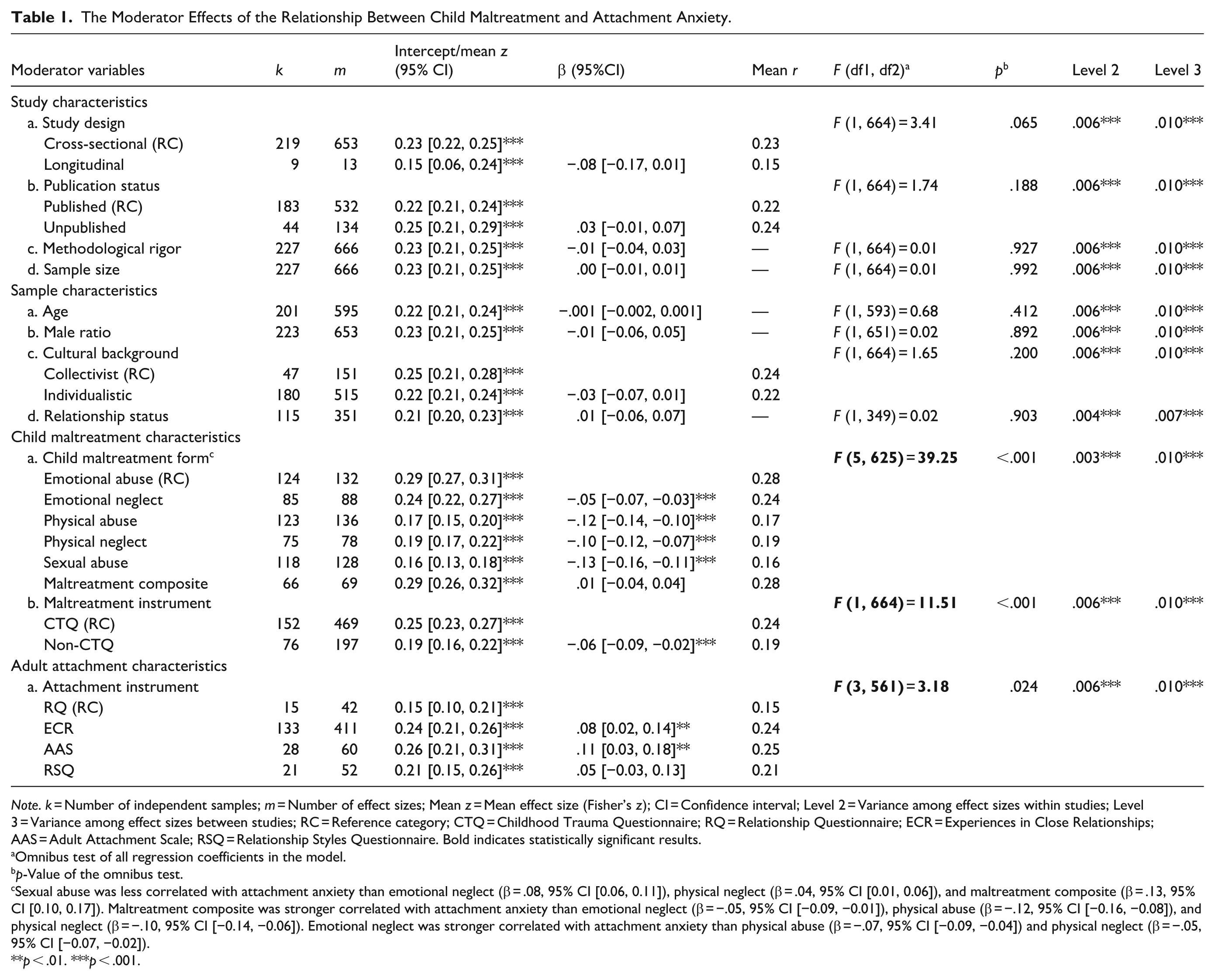
Note. k = Number of independent samples; m = Number of effect sizes; Mean z = Mean effect size (Fisher’s z); CI = Confidence interval; Level 2 = Variance among effect sizes within studies; Level 3 = Variance among effect sizes between studies; RC = Reference category; CTQ = Childhood Trauma Questionnaire; RQ = Relationship Questionnaire; ECR = Experiences in Close Relationships; AAS = Adult Attachment Scale; RSQ = Relationship Styles Questionnaire. Bold indicates statistically significant results.
Omnibus test of all regression coefficients in the model.
p-Value of the omnibus test.
Sexual abuse was less correlated with attachment anxiety than emotional neglect (β = .08, 95% CI [0.06, 0.11]), physical neglect (β = .04, 95% CI [0.01, 0.06]), and maltreatment composite (β = .13, 95% CI [0.10, 0.17]). Maltreatment composite was stronger correlated with attachment anxiety than emotional neglect (β = −.05, 95% CI [−0.09, −0.01]), physical abuse (β = −.12, 95% CI [−0.16, −0.08]), and physical neglect (β = −.10, 95% CI [−0.14, −0.06]). Emotional neglect was stronger correlated with attachment anxiety than physical abuse (β = −.07, 95% CI [−0.09, −0.04]) and physical neglect (β = −.05, 95% CI [−0.07, −0.02]).
p < .01. ***p < .001.
Publication Bias Assessment
The funnel plot showed a symmetrical distribution of effect sizes (see Supplemental Appendix E). This was further supported by the three-level extension of Egger’s test, which showed no significant asymmetry (F (1,664) = 0.20, p = .655). Additionally, methodological features such as publication status, sample size, and methodological rigor did not significantly influence the overall pooled effect (see Table 1). Sensitivity analysis identified five studies with residuals exceeding three standard deviations. Excluding these studies resulted in a slight reduction of 0.01 in the overall pooled effect (Fisher’s z = 0.22, 95% CI [0.21, 0.24], p < .001). Meanwhile, fifty-one influential cases were identified with Cook’s distance greater than three times the mean. Removing these cases led to a comparable reduction of 0.01 in the pooled effect size (Fisher’s z = 0.22, 95% CI [0.20, 0.23], p < .001). Collectively, these results suggest that the influence of outliers and publication bias on the overall effect is negligible.
The Relationship of Childhood Maltreatment to Attachment Avoidance
Overall Effect Analysis
In the second set of meta-analyses, the relationship between childhood maltreatment and attachment avoidance was investigated using 638 effect sizes drawn from 214 independent samples, comprising a total of 75,787 participants. The overall pooled effect was statistically significant, positive, and medium in magnitude (Fisher’s z = 0.20, 95% CI [0.19, 0.22], p < .001; r = 0.20) and showed substantial heterogeneity (Q (637) = 3,859.15, p < .001). The non‑sampling variance was more prevalent between studies (I22 = 59.20%) than within studies (I32 = 25.07%), and both were significant (between: LRT = 199.14, p < .001; within: LRT = 294.63, p < .001). The prediction interval analysis indicated that, with 95% confidence, future studies would likely report effect sizes ranging from −0.04 to 0.45, suggesting that the association between childhood maltreatment and attachment avoidance may not always consistently emerge across all contexts.
Moderator Analyses
The association between childhood maltreatment and attachment avoidance was moderated by childhood maltreatment form (F (5, 599) = 36.46, p < .001), maltreatment instrument (F (1, 636) = 5.46, p = .020), and attachment instrument (F (3, 535) = 4.66, p = .003; see Table 2). Notably, emotional abuse and emotional neglect showed the strongest correlations with attachment avoidance, while sexual abuse had the weakest correlation. Studies utilizing the CTQ to assess childhood maltreatment reported higher effect sizes than those using alternative instruments. Additionally, studies using the RQ to measure attachment avoidance exhibited the smallest effect sizes, in comparison to those employing the ECR, RSQ, or AAS. However, cultural background, relationship status, sex, and age did not significantly moderate the relationship between childhood maltreatment and attachment avoidance.
The Moderator Effects of the Relationship Between Child Maltreatment and Attachment Avoidance.
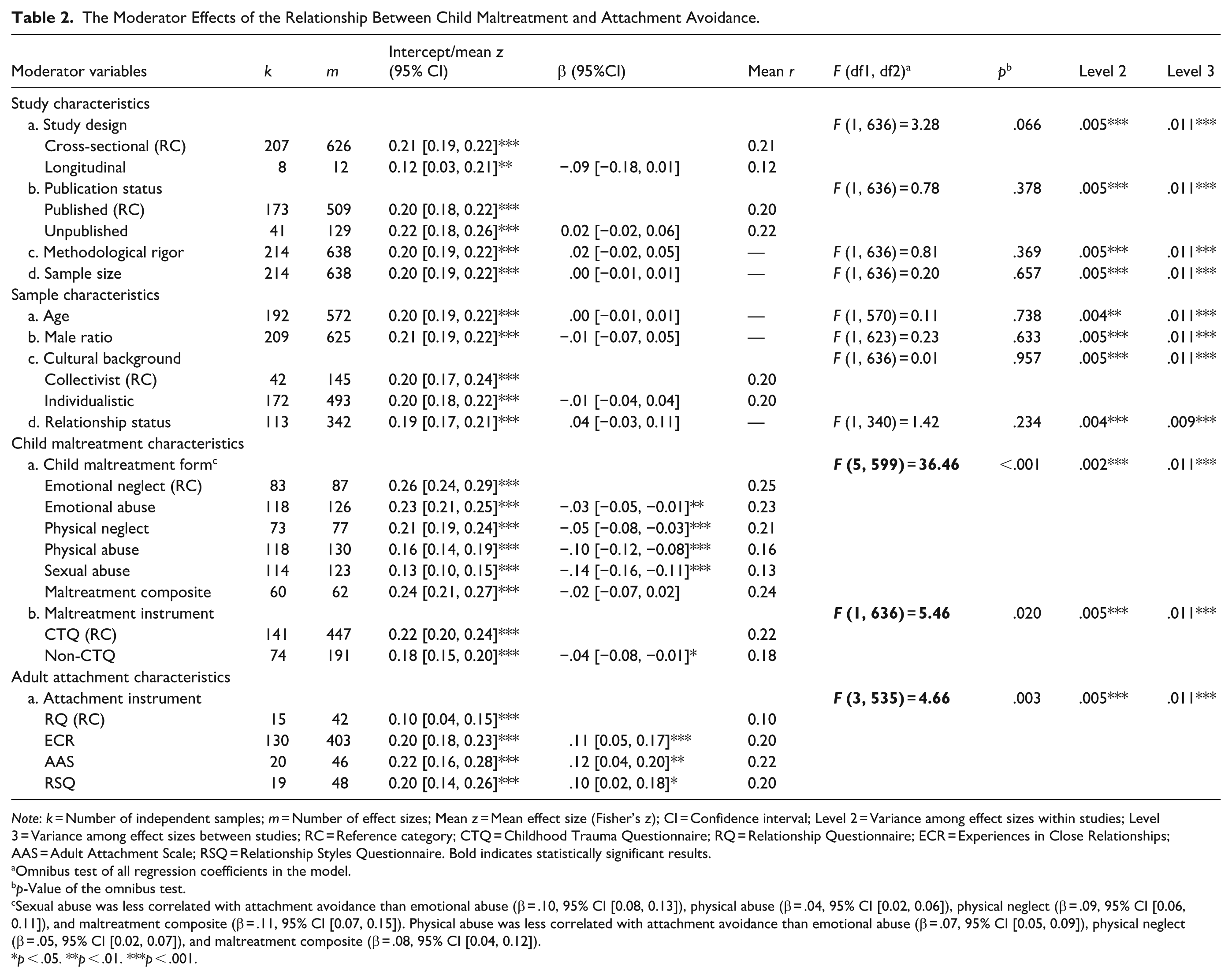
Note: k = Number of independent samples; m = Number of effect sizes; Mean z = Mean effect size (Fisher’s z); CI = Confidence interval; Level 2 = Variance among effect sizes within studies; Level 3 = Variance among effect sizes between studies; RC = Reference category; CTQ = Childhood Trauma Questionnaire; RQ = Relationship Questionnaire; ECR = Experiences in Close Relationships; AAS = Adult Attachment Scale; RSQ = Relationship Styles Questionnaire. Bold indicates statistically significant results.
Omnibus test of all regression coefficients in the model.
p-Value of the omnibus test.
Sexual abuse was less correlated with attachment avoidance than emotional abuse (β = .10, 95% CI [0.08, 0.13]), physical abuse (β = .04, 95% CI [0.02, 0.06]), physical neglect (β = .09, 95% CI [0.06, 0.11]), and maltreatment composite (β = .11, 95% CI [0.07, 0.15]). Physical abuse was less correlated with attachment avoidance than emotional abuse (β = .07, 95% CI [0.05, 0.09]), physical neglect (β = .05, 95% CI [0.02, 0.07]), and maltreatment composite (β = .08, 95% CI [0.04, 0.12]).
p < .05. **p < .01. ***p < .001.
Publication Bias Assessment
Visual inspection supported the symmetry of effect sizes (see Supplemental Appendix E), and the three-level extension of Egger’s test revealed no significant asymmetry in the distribution (F (1,636) = 0.18, p = .634). Moreover, methodological features such as publication status, sample size, and methodological rigor were found to exert no significant influence on the overall pooled effect (see Table 2). Sensitivity analysis identified six studies with residuals exceeding three standard deviations. Exclusion of these studies led to a minor decrease of 0.01 in the pooled effect (Fisher’s z = 0.20, 95% CI [0.19, 0.22], p < .001). Similarly, the removal of 43 influential cases with Cook’s distances exceeding 3 times the mean resulted in a minor reduction of 0.01 in the overall effect (Fisher’s z = 0.20, 95% CI [0.18, 0.21], p < .001). These results indicate that neither outliers nor publication bias had a significant impact on the overall pooled effect.
Discussion
Multiple theoretical frameworks have identified childhood maltreatment as a significant predictor of attachment in adulthood. However, the strength and direction of the association between childhood maltreatment and adult attachment remains unclear. To address this gap, we conducted a quantitative synthesis of existing empirical research, aiming to evaluate the overall magnitude of the association between childhood maltreatment and adult attachment, as well as to identify key moderating variables. The results demonstrated childhood maltreatment was significantly positively associated with attachment anxiety and attachment avoidance. Furthermore, these associations varied as a function of the forms of maltreatment and measurement instruments. Overall, these findings contribute to a more nuanced understanding of the link between childhood maltreatment and adult attachment, and offer valuable insights for developing targeted intervention strategies to support the development of healthier adult interpersonal relationships.
Overall Associations between Childhood Maltreatment and Adult Attachment
The current meta-analysis revealed that childhood maltreatment was significantly associated with both attachment anxiety and avoidance. Notably, these associations remained robust even after the exclusion of outliers, highlighting the stability of childhood maltreatment as a meaningful predictor of adult attachment.
As posited by attachment theory (Bowlby, 1969/1982) and social learning theory (Bandura, 1977), individuals who have experienced childhood maltreatment are more likely to perceive themselves as unlovable and others as untrustworthy, and are more likely to display aggressive behaviors in close relationships. These patterns increase the likelihood of developing insecure, rather than secure, attachment bonds in adulthood. Furthermore, according to the CATS model (Nelson & Smith, 2005), the adverse consequences of childhood maltreatment extend beyond the individual, affecting their romantic partners and relational dynamics. This interdependence may further exacerbate attachment anxiety and avoidance in adult close relationships.
The current study supports and extends prior meta-analytic evidence linking childhood maltreatment to attachment insecurity in early development (Baer & Martinez, 2006), highlighting that adverse early experiences have enduring consequences for attachment across the lifespan. Conversely, previous meta-analyses have shown that parents with insecure attachment are more likely to maltreat their own children (Lo et al., 2019). Taken together, the current findings and prior meta-analytic evidence provide further insight into the intergenerational transmission of attachment insecurity and childhood trauma. Specifically, early maltreatment by caregivers fosters the development of negative internal working models, which in turn increase the likelihood of insecure attachment in adulthood. These insecurely attached adults who have experienced maltreatment are, in turn, more likely to maltreat their own children, making it difficult for the next generation to form secure attachment bonds. However, this perspective requires further empirical validation in future research.
Although attachment theory posits that adverse early experiences with caregivers play a pivotal role in shaping attachment, we found that the relationships between childhood maltreatment and different adult attachment dimensions, while statistically significant, were of medium magnitude. This indicates that although the impact of childhood maltreatment on adult attachment is enduring, it also demonstrates considerable plasticity. This underscores the potential for targeted interventions to enhance attachment security.
As individuals mature, they form and maintain a range of interpersonal relationships. In adulthood, romantic partners often replace caregivers as primary attachment figures (Feeney, 2016). During periods of stress or vulnerability, support provided by romantic partners can fulfill attachment needs in ways that potentially mitigate the long-term effects of childhood maltreatment. The attachment security enhancement model further emphasizes that when partners respond sensitively and appropriately to individuals’ attachment needs, they can effectively foster greater attachment security (Arriaga et al., 2018). In other words, if romantic partners offer consistent, attuned, and supportive responses, the adverse impact of childhood maltreatment on adult attachment may be diminished.
Moderating Role of Childhood Maltreatment Form
The current study found that the form of childhood maltreatment moderated the link between childhood maltreatment and adult attachment. Specifically, among the various forms of maltreatment, emotional maltreatment showed the strongest association with adult attachment, while sexual maltreatment exhibited the weakest associations. Consistent with attachment theory (Bowlby, 1969/1982), the development of secure attachment relies on the provision of sensitive and responsive caregiving. Emotional neglect and abuse are particularly damaging, as they erode trust in others and diminish an individual’s confidence in forming secure attachment relationships later in life. These findings underscore the importance of emotional support in interpersonal relationships. Compared to material assistance, warm and consistent emotional responsiveness may play a more vital role in fostering secure attachment.
Notably, while emotional maltreatment exhibited the strongest association with adult attachment, its subtypes followed divergent pathways. Emotional abuse was most strongly associated with attachment anxiety, whereas emotional neglect showed the strongest link to attachment avoidance. This finding is supported by prior research, which has consistently documented that emotional abuse uniquely predicts attachment anxiety, while emotional neglect uniquely predicts attachment avoidance (Höltge et al., 2023). These differences may stem from the distinct ways in which various forms of emotional maltreatment shape internal working models (Höltge et al., 2023). Emotional abuse, an active form of maltreatment, primarily erodes an individual’s self-representation. This process fosters negative self-views regarding one’s worth and lovability, which constitute a core feature of attachment anxiety. In contrast, emotional neglect, a more passive form, chiefly undermines the representation of others. It promotes a generalized expectation of unreliability in relationships, a characteristic that is central to attachment avoidance.
Moreover, among all forms of childhood maltreatment, sexual abuse exhibited the weakest association with adult attachment. It is important to underscore, however, that this finding does not imply that sexual abuse is unimportant in the development of adult attachment. On the contrary, sexual abuse has been shown to have severe and long-lasting psychological consequences (Strathearn et al., 2020). The relatively weaker correlation between sexual abuse and adult attachment may be attributable, at least in part, to its lower reported frequency in the sample, potentially reducing its statistical impact within population-based meta-analytic samples.
Moderating Role of Measurement Instruments
The measurement instruments used to assess adult attachment served as a significant moderator of the associations between childhood maltreatment and both attachment anxiety and avoidance. Specifically, the associations between childhood maltreatment and these two attachment dimensions were weaker in studies utilizing the RQ compared to other instruments. This finding may reflect inherent limitations of the RQ, which relies on a single-item format in which respondents are asked to rate their alignment with specific attachment prototypes (Crowell et al., 2016). Such a simplistic approach may lack the nuance and sensitivity necessary to capture the complex manifestations of attachment anxiety and avoidance.
Furthermore, the relationships between childhood maltreatment and both attachment dimensions were stronger in studies that employed CTQ compared to those that used other measures. This result aligns with prior findings by Cao et al. (2022), who reported that the association between childhood maltreatment and adulthood relationship well-being was more pronounced in studies using the CTQ. One plausible explanation is that the CTQ, as one of the most widely utilized and psychometrically validated instruments, offers a comprehensive assessment of five distinct forms of maltreatment. Its multidimensional structure enables the more accurate and detailed capture of individuals’ maltreatment experiences, thereby enhancing the ability to detect associations with adult attachment. Additionally, a detailed discussion of other non-significant moderators (i.e., cultural background, relationship status, sex, and age) is provided in Supplemental Appendix F.
Limitations and Future Directions
There are several limitations that warrant consideration and underscore the need for further research. First, Farina and Schimmenti (2025) have mapped out the cognitive, emotional, and behavioral mechanisms by which childhood maltreatment influences adult attachment, including emotional dysregulation, maladaptive coping, and impairments in mentalization. Nevertheless, the present study did not test these potential mediators due to the scarcity of empirical research. Second, the current study focused primarily on the form of childhood maltreatment, overlooking other critical characteristics such as its age of onset and frequency, which may significantly influence the development of adult attachment (Bosmans et al., 2020). Third, due to the limited reporting of specific attachment figures in prior studies, the current meta-analysis was unable to compare the relationships between childhood maltreatment and adult attachment across different attachment figures. Finally, most studies included in this meta-analysis relied on retrospective measures of childhood maltreatment, a method prone to both common method variance and recall bias. These limitations may inflate the observed associations, thus complicating efforts to determine whether the relationship between childhood maltreatment and adult attachment is causal or spurious.
Implications for Research and Practice
Our findings carry significant implications for both research and practice. It identified a stable link between childhood maltreatment and adult attachment, reinforcing the central tenet of attachment theory that negative early interpersonal interactions can exert lasting influences on the development of attachment relationships across the lifespan. Consequently, cultivating a healthy and supportive caregiving environment and preventing maltreatment, especially emotional maltreatment, are essential for the adaptive development of interpersonal relationships.
For adults who have experienced childhood maltreatment, difficulty forming secure attachment bonds may impede the effectiveness of interventions targeting mental disorders in this population. Establishing secure attachment bonds in new intimate relationships is regarded as an effective strategy to mitigate the impact of early negative experiences (Arriaga et al., 2018), presenting a viable approach to improving attachment security among individuals with a history of maltreatment and offering a theoretical foundation for designing future intervention programs.
Furthermore, recognizing childhood maltreatment in adults poses clinical challenges due to its complex nature and the need for retrospective recall. Farina and Schimmenti (2025) have called for efforts to address the pathogenic processes of childhood maltreatment. The present study found that adults with attachment anxiety and attachment avoidance differ in their reported primary forms of childhood maltreatment, suggesting that clinicians may identify attachment characteristics to determine the core pathogenic components requiring repair. For example, interventions for those with high attachment anxiety should prioritize fostering a healthier self-concept, whereas for those with high attachment avoidance, interventions should focus on establishing a safe therapeutic relationship.
Lastly, the current study illustrated that well-validated, widely utilized, and comprehensive measurement tools are more effective at capturing the relationships between variables, providing valuable guidance for selecting suitable instruments in future research.
Conclusion
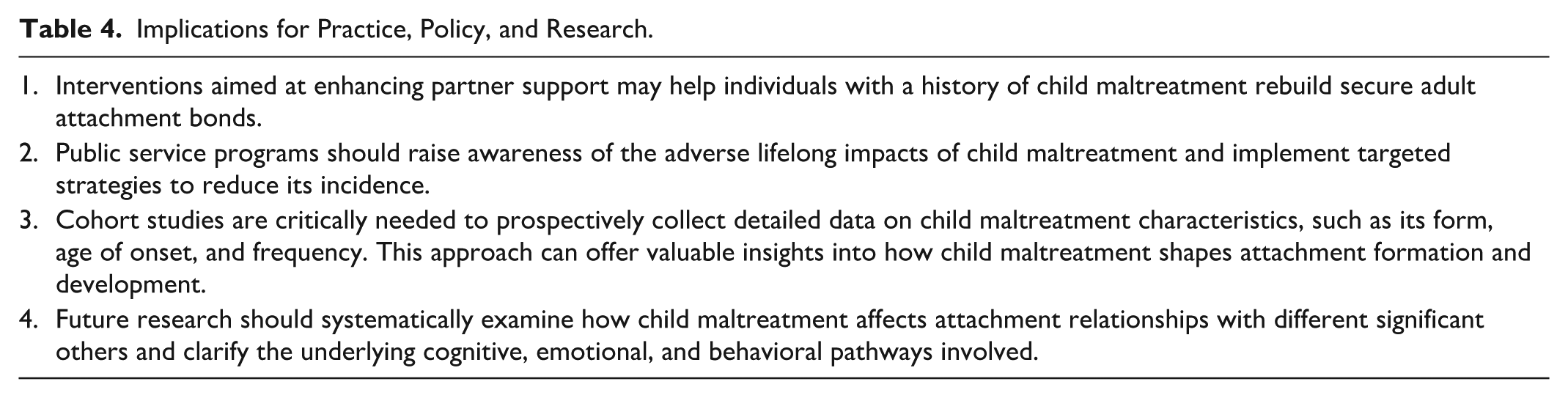
This study quantitatively synthesized the association between childhood maltreatment and both adult attachment anxiety and avoidance, demonstrating that specific forms of maltreatment exert distinct effects on adult attachment. We identify key research gaps and propose future directions, including the urgent need for cohort studies, the incorporation of richer maltreatment characteristics, and the examination of underlying mechanisms (see also Tables 3 and 4). Furthermore, it is crucial to raise public awareness regarding the adverse impact of childhood maltreatment on attachment development across the lifespan. Intervention strategies designed to enhance partner support can help adults with a history of childhood maltreatment rebuild secure attachment bonds.
Critical Findings.

Implications for Practice, Policy, and Research.
Supplemental Material
sj-docx-1-tva-10.1177_15248380261455767 – Supplemental material for Childhood Maltreatment and Adult Attachment: A Three-Level Meta-Analytic Review
Supplemental material, sj-docx-1-tva-10.1177_15248380261455767 for Childhood Maltreatment and Adult Attachment: A Three-Level Meta-Analytic Review by Song Li, Yuanxiao Ma, Xiaojun Cao, Junjun Liu, Yueyang Qi and Xu Chen in Trauma, Violence, & Abuse
Footnotes
Funding
The authors disclosed receipt of the following financial support for the research, authorship, and/or publication of this article: This work was supported by the National Social Science Fund of China (Number 23BSH134).
Declaration of Conflicting Interests
The authors declared no potential conflicts of interest with respect to the research, authorship, and/or publication of this article.
Data Availability Statement
The study was preregistered on the International Prospective Register for Systematic Reviews (registration number CRD42024552361) to enhance transparency and prevent unintended duplication of effort. The complete datasets supporting this meta-analysis are archived in the Open Science Framework repository ( ).
).
Supplemental Material
Supplemental material for this article is available online.
Author Biographies
References
Supplementary Material
Please find the following supplemental material available below.
For Open Access articles published under a Creative Commons License, all supplemental material carries the same license as the article it is associated with.
For non-Open Access articles published, all supplemental material carries a non-exclusive license, and permission requests for re-use of supplemental material or any part of supplemental material shall be sent directly to the copyright owner as specified in the copyright notice associated with the article.
