







Abstract
Community engagement methods like photovoice have allowed researchers to gather and incorporate the experiences and perspectives of community members in their work but have at times faced challenges regarding systematization, accessibility, and scalability. This practice note describes the Our Voice initiative, one example of a community-based participatory research framework that aims to build on photovoice theories and best practices and address these challenges by incorporating the use of a mobile app as well as elements of participatory action-based citizen science to support community-driven data collection, analysis, and advocacy. We explore the application of the Our Voice method and evaluation of multilevel participant and community outcomes across three different Bay Area, California, communities. In doing so, we hope to provide a potential example for practitioners of other community-based participatory research and photovoice-based models to draw from when working with diverse communities to integrate local perspectives and insights in the generation and implementation of sustainable community health improvements.
Keywords
While photovoice can be effective in facilitating critical dialogue around community members’ lived experiences within their local environments, its translation to larger scale social, environmental, and policy-level change often remains challenging (Evans-Agnew et al., 2014; Petteway, 2019; Prins, 2010). Community-based participatory research (CBPR) methods that integrate the principles of photovoice and citizen science present a promising avenue for increasing community engagement and self-determination while improving local environments (Evans-Agnew & Eberhardt, 2019). The use of mobile technologies to facilitate such processes can further improve systemization, accessibility, and scalability. The Our Voice Citizen Science Research Initiative is one example of such an approach.
Description of Project
Our Voice is a CBPR method that merges photovoice with citizen science to facilitate advocacy around community-level social, economic, and political determinants of health. Citizen science involves members of the public working with professional scientists to advance research, with the spectrum of activities ranging from crowdsourcing data for researcher use to community definition of research questions and local ownership of data (European Citizen Science Association, 2015; Evans-Agnew & Eberhardt, 2019; King et al., 2019). Using this latter model in conjunction with photovoice techniques, Our Voice further systematizes larger scale data collection, storage, and analysis using an evidence-supported mobile app called the Discovery Tool. This easy-to-use app augments photographic data with geotagging, mapping, audio-textual narratives, and simple positive/negative ratings contextualizing the significance of the environmental features photographed. With the support of trained facilitators, participants then engage in discussions to thematically organize these findings, prioritize needs and assets, and generate data-driven action plans for community engagement around identified issues (Figure 1).
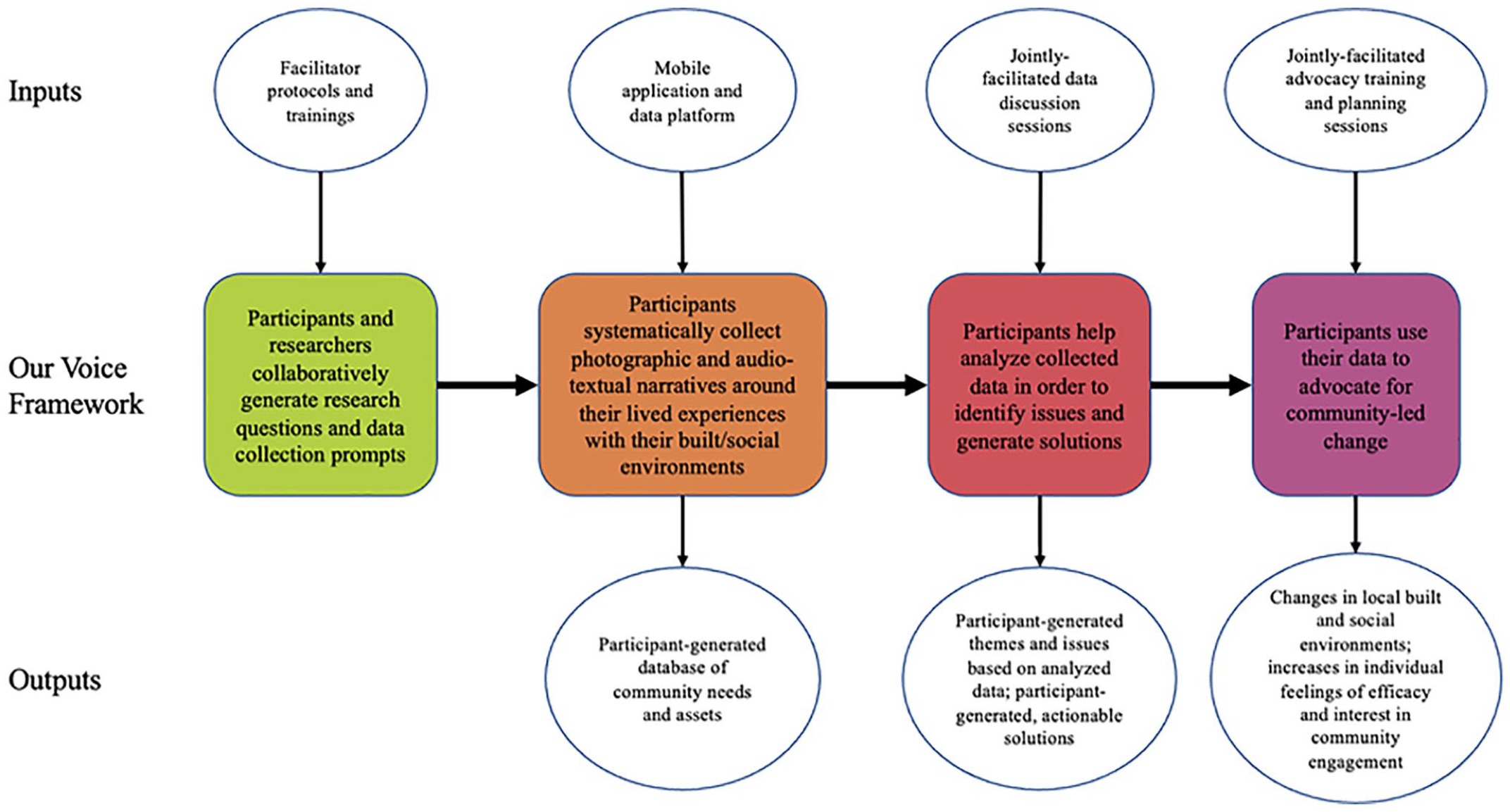
Our Voice Citizen Science “By the People” Method
Like photovoice, Our Voice is grounded in the democratization of research (Coburn, 2003; Wang & Burris, 1997); community members not only collect and analyze data but also codesign research questions and decide how findings should be interpreted and used. While photovoice typically focuses on the generation of critical consciousness and knowledge among participants about their communities, though, Our Voice places greater emphasis on systematic data collection and review to bring about environmental change. This structure makes Our Voice particularly effective for supporting the generation of actionable solutions to community-identified issues within shorter time frames.
Digital technologies may also increase opportunities for inclusion of the broad range of experiences community members may have within the same built environment (Petteway, 2019). Integrating audio-textual narratives with photographic data allows participants to clearly record images’ significance, ensuring individuals' experiences are accurately represented even when they are not physically present. This may improve accessibility within communities where residents have limited time or capacity to participate in longer or more intensive projects (Petteway, 2019).
This adaptability has been critical to the application of Our Voice in over 20 countries, with participants representing diverse age groups and racial/ethnic and socioeconomic backgrounds. Recent accessibility enhancements that have allowed for entirely remote project facilitation have further strengthened the groundwork for postpandemic use within communities that are more isolated or inaccessible to researchers (King et al., 2019; King et al., 2020; King et al., 2021).
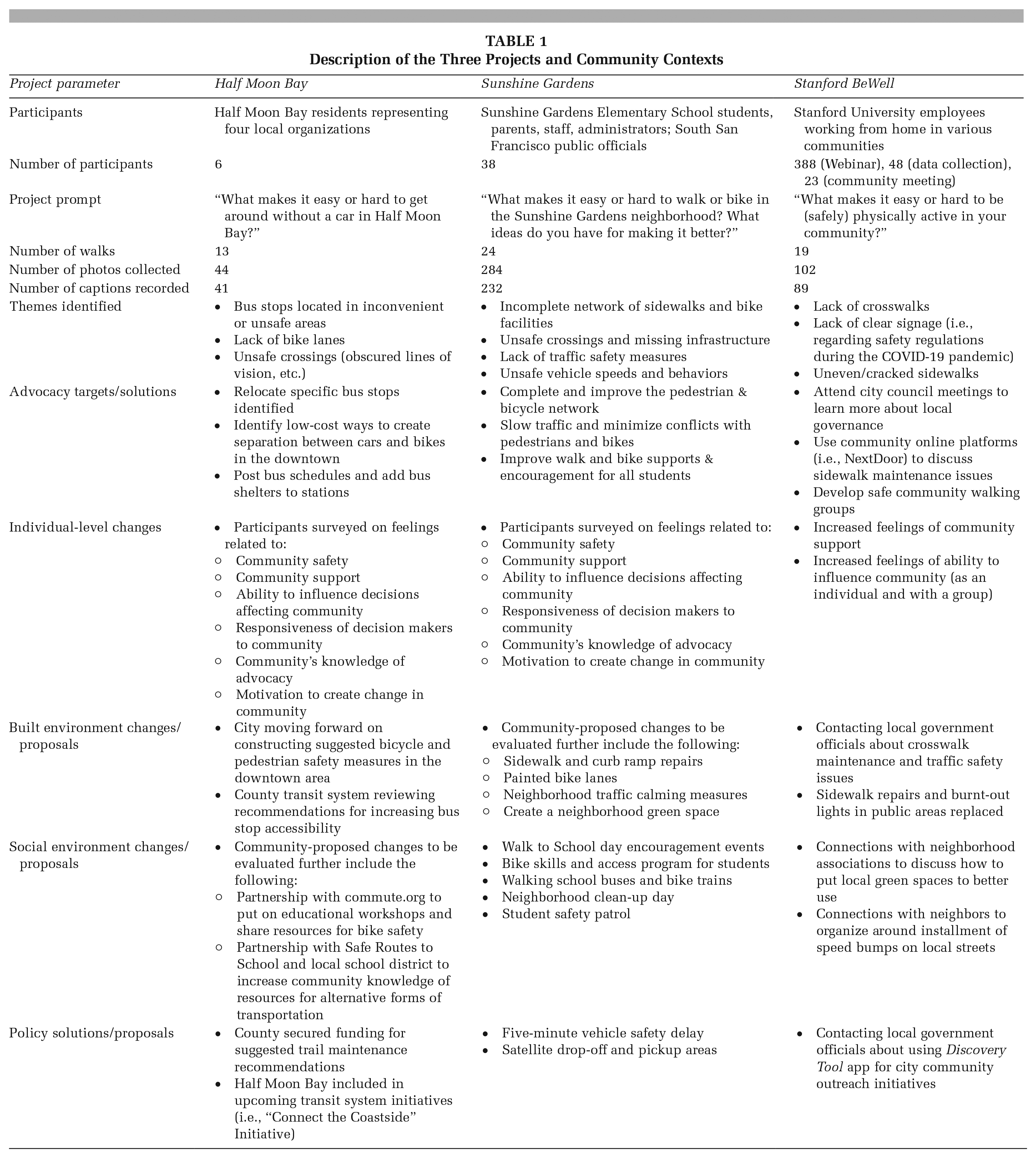
Here, we examine the Our Voice method across three COVID-era, remotely facilitated projects within California’s San Francisco Bay Area. Multilevel project outcomes are summarized in Table 1.
Description of the Three Projects and Community Contexts
City of Half Moon Bay Municipal Government (Half Moon Bay, CA)—Transit Equity
In the summer of 2020, the City of Half Moon Bay collaborated with Our Voice on a pilot project to engage residents in advancing equitable transportation access.
Six White and Latinx Half Moon Bay residents representing diverse ages and backgrounds used the Discovery Tool to photograph and document environmental features that made it easy or hard to get around without a car, then met in facilitated online sessions to distill their findings into five consensus-driven themes and 17 recommendations. With the support of a city staff liaison, they presented their findings and advocated for the implementation of their proposed solutions to the City Council’s Mobility Subcommittee.
Access to geotagged and descriptively captioned data facilitated participants’ successful advocacy. For example, participants photographed specific bus stops in inaccessible locations and identified options for relocation in their narratives and data discussions (Figure 2a). This specificity enabled them to clearly define areas of concern and recommend meaningful solutions that were well-received and scheduled for implementation by city and county officials.

Participant-Collected Discovery Tool Data
Sunshine Gardens Elementary School (South San Francisco, CA)—Safe Routes to School
With the support of the San Mateo County, CA Office of Education, Our Voice collaborated with Mark Fenton, a national public health, planning, and transportation consultant and walk audit expert, to assess factors affecting Sunshine Gardens Elementary School students’ ability to walk or bike to school in summer and fall of 2020. Under the proactive leadership of the school’s principal, César Gaytán, a representative group of parents, students, staff, and municipal officials participated in community audits and data analysis. To better support Spanish-speaking participants, facilitators provided both Spanish and English-language versions of the Discovery Tool, as well as simultaneous Spanish translation during meetings.
Use of Our Voice facilitation protocols, which encourage asset-based and solution-oriented brainstorming, supported consensus-building discussions to create appropriate, actionable steps to address challenges identified from Discovery Tool data (Figure 2b). Ultimately, participants proposed 24 multilevel recommendations to school and municipal officials, comprising a comprehensive approach to enhancing students’ ability to walk or bike to school. Many of these strategies are under consideration for the coming year as in-person classes resume.
Stanford University BeWell Program (Stanford, CA)—Employee Wellness
In summer of 2020, the Stanford University BeWell Program collaborated with Our Voice to invite employees to use the Discovery Tool to assess built environment features affecting safe access to physical activity in their own neighborhoods, attend an hour-long workshop to review their findings, and identify opportunities for engagement in improving community health.
Though the project was initially complicated by the geographical dispersion of the participants, postdata collection discussions illuminated common themes across neighborhoods. The availability of detailed, clearly described data allowed participants to meaningfully categorize photos, even those taken by other participants, and share information across communities. During one session, for instance, photos of debris blocking sidewalks taken by one participant (Figure 2c) led to others sharing how they had solved similar problems in their own neighborhoods by contacting their local governments. This social support encouraged the original photographer to identify resources to do the same.
Project Outcomes
Both community facilitators and the Stanford-based Our Voice team participate in collaborative and systematic evaluation of project outcomes at four levels of impact (individual, social environment, built environment, and policy).
Individual
Our Voice participants typically complete brief pre-/postsurveys measuring changes in attitudes or behaviors (e.g., information gathering on relevant issues, contacting policy makers) following project participation. When appropriate and feasible, these surveys are designed in collaboration with community facilitators. Previous studies indicate Our Voice participation is associated with increases in self-efficacy, community cohesion, and interest in community engagement (King et al., 2019; King et al., 2020; King et al., 2021). Furthermore, postproject evaluation data indicate that many participants report interest in catalyzing community engagement among their social networks, potentially creating ripple effects beyond those reported by the initial group of citizen scientists (Table 1).
Social Environment/Built Environment/Policy
Following project completion, the Our Voice team provides technical support and continued training as necessary to assist local partners in tracking subsequent development of resources, organizations, and/or efforts to communicate with decision makers that may have been inspired by citizen science activities. Past Our Voice participant advocacy has resulted in impactful local changes, including street signage improvements, formation of community advisory boards, and increased availability of resources like community gardens (King et al., 2019; King et al., 2020; King et al., 2021). These outcomes and other details about project methodology and implementation can be systematically tracked through the Our Voice project management dashboard, which is accessible to past and current partners and may be a resource for future projects or scale-ups.
Implications for Practice
Our Voice can complement photovoice storytelling through a CBPR-based citizen science framework with systematic multimethod data collection, analysis, and community-led deployment of solutions to promote change. Rooted in community self-determination and local knowledge, such projects may not only lead to more relevant solutions, but may also generate ripple effects that lead to community improvements long after projects have concluded (Coburn, 2003; King et al., 2019; King et al., 2020; King et al., 2021). Photovoice projects targeting multilevel, community-generated solutions to built or social environment challenges may adapt learnings from Our Voice and similar approaches to support the accessibility, effectiveness, and scalability of such efforts.
One potential limitation was that participants entered projects at different stages due to time and other constraints, meaning not all participants had the opportunity to participate in discussions and share in the insights that arose. While involving smaller numbers of residents is often resource-efficient, practical, and successful in producing observable changes in local environments (King et al., 2021), future Our Voice projects aim to continue to expand opportunities for flexible community participation through innovations like incorporating public-facing interactive maps, like Google Street View. These efforts aim to make Our Voice a more accessible, scalable, and ultimately sustainable resource for diverse communities around the world to identify local needs and assets, generate actionable solutions, and advocate for sustainable, meaningful change.
Footnotes
Authors’ Note:
We gratefully acknowledge César Gaytán for his enthusiastic support and community outreach efforts as the principal of Sunshine Gardens Elementary School, and the citizen scientists, community members, researchers, and organizations who have participated in Our Voice projects around the world, and whose guidance, support, and collaboration are essential to the continued growth of the field of community-based participatory research. All Our Voice projects described in the article have been approved by the Stanford University Institutional Review Board (IRB) for the protection of human subjects (IRB protocol #45330).
