







Abstract
Using evidence-based approaches grounded in science, public health professionals promote the well-being of individuals, families, and communities. Unfortunately, over the past year, the public health field and its science-based programs have been seriously threatened and undermined in the United States. The New York State Public Health Association (NYSPHA) recognized the toll federal actions were taking on the public health workforce and initiated the Express Yourself for Public Health discussion series as a safe space for the greater public health community to share fears and concerns and to better understand workforce needs. We hosted three rounds of this series in March, September, and December 2025. Each session was conducted via Zoom and lasted 1 hr, including a 5-min introduction, a 45-min facilitated discussion in breakout rooms, and a 10-min report out. In total, 160 individuals participated across 16 sessions. Participants spoke at length about the undermining of science, funding cuts, and misinformation/disinformation and the effect this has had on the authority of public health, employment security, and the future workforce. They shared ways they have navigated these challenges and offered suggestions for recruiting and retaining students in public health programs. Guided by our findings, we have initiated several career development opportunities including engaging members in new and existing topical, advocacy, and action-oriented workgroups; providing instruction in communications, advocacy, and leadership; revamping our mentorship program; and educating potential students on stacked certificate and dual degree programs. Similar organizations and associations should consider emulating our series to support their workforce during this time of uncertainty.
Keywords
Introduction
Using evidence-based approaches grounded in science, public health professionals promote the well-being of communities, reduce suffering and harm, and help individuals across the lifespan to thrive (American Public Health Association [APHA], 2026). Unfortunately, over the past year, the entire public health field and its science-based programs and guidelines have been seriously threatened and undermined in the United States. Examples include shrinking the national public health infrastructure by eliminating federal public health agencies and shrinking the workforce, reducing vaccines recommended for children and enabling eradicated diseases to reemerge, and misinterpreting and misusing research results (Trust for America’s Health, 2025). These actions have a lasting impact on the current and future public health workforce and the health and well-being of individuals, families, and communities.
The New York State Public Health Association (NYSPHA), the New York State affiliate of the APHA, represents public health professionals across the state. Early on, NYSPHA recognized the toll federal actions were taking on the public health workforce and initiated the Express Yourself for Public Health discussion series as a safe space for the greater public health community to share fears and concerns. This series helped NYSPHA understand workforce needs and initiate career development activities tailored to the current job market. This article describes the discussion series, its findings, and implications for practice.
Method
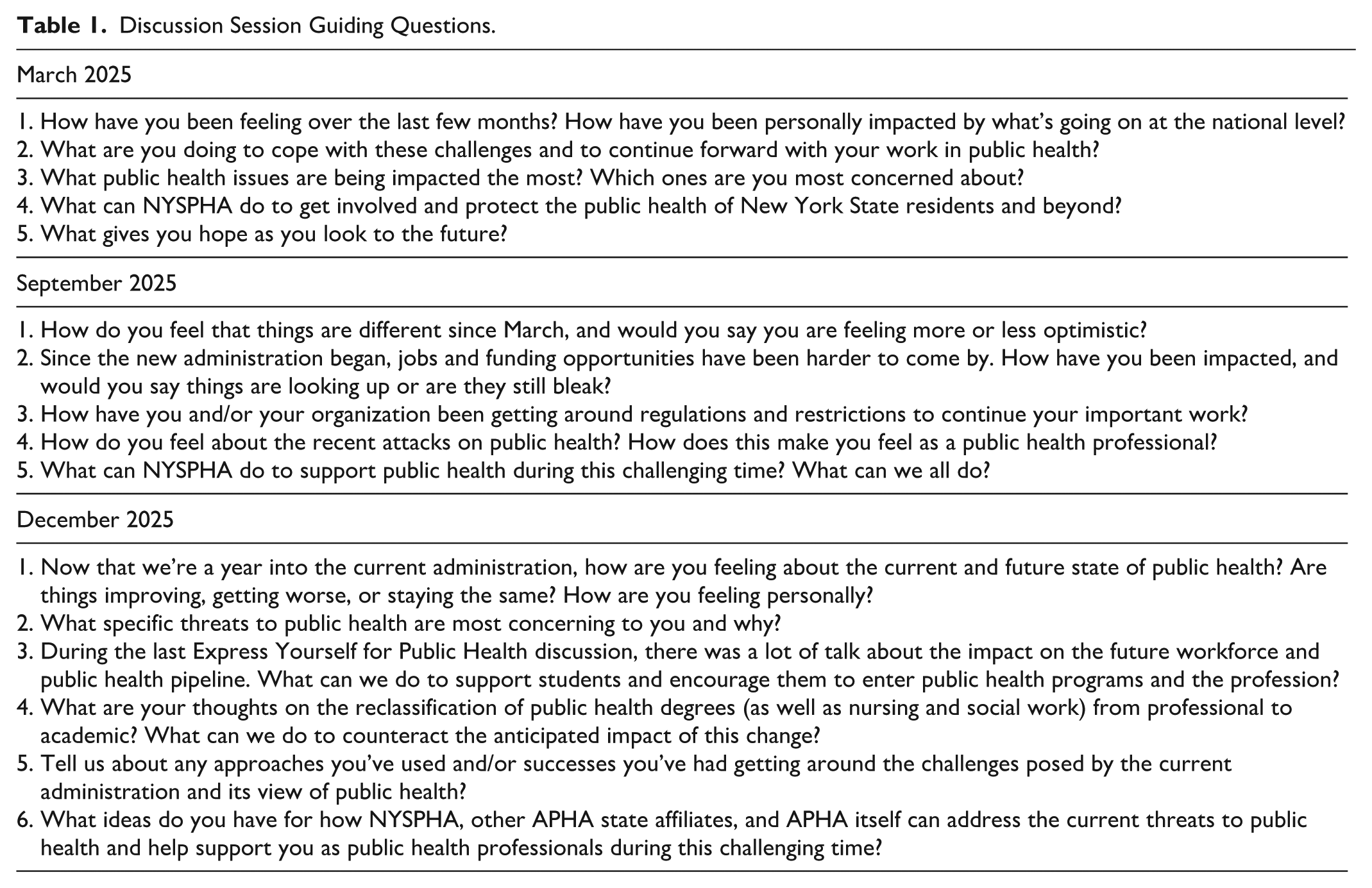
We hosted three rounds of Express Yourself for Public Health discussion sessions via Zoom in March, September, and December of 2025. Each round had a unique set of guiding questions (Table 1), developed with feedback from the NYSPHA Public Health in Action Committee, to help facilitate discussion.
Discussion Session Guiding Questions.
Participants and Procedure
We recruited public health students, professionals, and retirees via our newsletter, our social media channels, and the APHA member discussion board. Each session lasted 1 hr, including a 5-min introduction, a 45-min facilitated discussion in breakout rooms (6–10 participants plus a facilitator and notetaker), and a 10-min report out. In total, 160 individuals participated across 16 discussion sessions. Although demographic data were not collected to protect anonymity and promote participation at a time when public health professionals feared their jobs were at risk, students, professionals across sectors and career stages, and retirees participated from across the country, ranging in location from Maine to Alaska. At the beginning of each session, the facilitator explained to participants that information shared during the discussions may be presented via presentation or publication to raise awareness of and better address the needs of the public health workforce while ensuring participant anonymity. This work was non-human subjects research and did not require institutional review board (IRB) review.
Data Analysis
We used template-based rapid qualitative analysis (Hamilton & Finley, 2019) to obtain timely results. Our notetakers used a template to capture key points for each question along with exemplar quotes, discussing content with their session facilitator before finalizing template content. Two individuals from the project team routinely debriefed to minimize the influence of potential biases; they reviewed each template, sorted content into categories, discussed initial findings, and came to an agreement during these debriefs before finalizing the categories and results.
Results
Our results are organized by the following themes: (1) Undermining Science and Funding Cuts, (2) Misinformation and Disinformation, (3) The Future of the Public Health Workforce, and (4) Navigating Challenges. What NYSPHA can do to support the public health workforce will be described in the Implications for Practice section.
Undermining Science and Funding Cuts
Participants expressed concern over the dismantling of the public health infrastructure and how evidence-based information is being ignored. As one participant shared, “science is not being respected. The behavior is intentional which makes it worse.” Participants expressed worry over many public health issues including climate change, vaccination, rural health, changes in Medicaid, lack of access to health care, and behavioral health and stated that shifting program priorities and loss of services would have a significant impact on the communities they serve. As one participant shared, “A billion dollars for the USDA and farmers was cut. That affects schools and food pantries. We’re not making things healthier.”
Participants talked at length about funding cuts, with one lamenting, “It’s difficult to comprehend the years of funding that are disappearing. I’m still reeling from that.” They went on to explain how funding cuts are leading to lost jobs and income and how this will affect job seekers and those new to the field. One participant described their fears related to potential job loss: “There’s a lot of existential dread. Losing my job would force me to move from my home and farm and uproot my kids.”
In addition, participants shared how routine funding cuts and reinstatement, what they referred to as “boomerang funding,” was causing them confusion and stress. One participant stated, “A 5-year contract can be taken away at any moment, it means essentially nothing. I had a CDC grant that ended overnight. Uncertainties are so challenging on our mental health.”
Many participants admitted they felt less optimistic as time went on, sharing that the “gutting of the public health infrastructure” was leaving them discouraged. One participant shared:
I usually enjoy the course I’m teaching about public health, but not this semester, because it’s hard to teach about things that are being dismantled. I still feel awfully pessimistic and worried.
Misinformation and Disinformation
Participants described how the overwhelming amount of misinformation and disinformation makes it difficult for the public to discern fact from fiction, diminishes the authority of public health, and has led to a rollback of public health achievements that can have long-term consequences (e.g., vaccination). One participant stated:
How can public health be seen as an honest broker, when the impression is that everyone is lying? When folks hear so many different messages, it’s hard to know what is real or the truth. There is a lot of mistrust and disinformation.
Participants described how this lack of trust makes it difficult to be effective on the job, with one stating:
There’s an outright lack of trust in public health that’s been building. It’s become acceptable to demonize public health as a field and us as workers. Distrust and disdain make it hard to do our jobs.
Participants also described the personal impacts of distrust, with one sharing:
Being fearful, I don’t really share with people what I do for work. At a personal level, we care for people and the community, but having people disrespect us is very disheartening, it’s very hard.
Participants underscored the importance of de-politicizing public health and changing the narrative so that public health is again viewed as a protector of families and communities.
The Future of the Public Health Workforce
Students and professionals alike shared their concern about the public health workforce and the future of the field. They explained how distrust of public health, funding cuts, and the reclassification of public health degrees from professional to academic will deter students from entering the field. One participant shared:
Training students has been difficult. They have less faith in accurate information from government sources, and they don’t trust the information. I worry about how that influences their perception of public health in general.
Participants expressed the importance of supporting and maintaining the workforce, with one stating, “Public health problems aren’t going away because an administration is dismantling its infrastructure. The problems will still be there, so the need for the workforce still exists.” They shared several ideas for retaining students in public health programs, including sharing successes from the field, conveying how they can have the power to affect change, and leveraging stacked certificates and dual degree programs so they have a variety of transferrable skills when they enter the job market. One participant shared:
Dual degrees are the way to go. If someone becomes a physician assistant or social worker, they’re also a public health professional. It makes a difference how they solve problems and look at solutions, with a public health hat, even if they’re not working in a specific public health field.
Navigating Challenges
Participants shared several ways they are navigating challenges, including adapting services and reporting structures, countering misinformation with fact-based information, and engaging in advocacy. One participant described their efforts:
We have a grant from the Department of Health. We’re hiring a team of photographers and documentarians to show resilience through storytelling. Daycare, local schools, a chef. We can write letters to legislators, use social media, newsletters, pitch to traditional media.
Participants also explained how working in a state with supportive leadership and policies makes it easier to do their jobs and how a close-knit public health community helps them navigate challenges. One participant described the importance of togetherness:
Layers and layers have been thrown on us in terms of challenges to public health. The government was closed, staff benefits were stopped, there was no ACA extension. It just seemed there was so much going on that it could have been overwhelming had we not been together.
In fact, some participants felt more motivated to get involved, with one sharing:
This has driven my personal drive even more. It reminds me how important public health is and how to create and sustain change for communities; while there is so much uncertainty, it has upped my personal “why” we must do this work.
Implications for Practice
It is imperative for career development to be a top priority, as public health is only as strong as its workforce. NYSPHA and other professional associations whose members have been affected by federal actions are strategically positioned to offer career development opportunities that maximize employment potential and create strength in numbers. Providing opportunities for ongoing thought partnership and emotional support is also critical for maintaining the workforce; we are continuing the Express Yourself for Public Health series quarterly to provide our members the boost they need to fight on professionally and personally and find new direction when funding and employment are uncertain. We encourage other organizations and associations to emulate these efforts.
One way we used our results to guide career development was to create more opportunities for active involvement, effectively leveraging our members’ increased motivation to make a difference. For example, we convened new topical workgroups on chronic disease and maternal and child health to go along with our Mental Health, Climate Change, Advocacy, and Action workgroups. While we encouraged members to join these workgroups to help us in our fight to protect public health, we designed the experience as a way for them to build communications, advocacy, and leadership skills they may not have learned in graduate school or on the job. In fact, we have had several students lead special projects for our workgroups as part of an internship. Our webinar series, fall workshop, and annual conference are additional avenues we are using to provide instruction in these areas. Ultimately, communications, advocacy, and leadership skills are critical for our members as they pivot to new roles or sectors in today’s uncertain job market and evolving career landscape.
Although Express Yourself for Public Health participants were worried about the viability of future careers in public health, they shared several ways to build transferable skills among students and retain them in public health programs. As a result of these recommendations, we are revamping our mentorship program and are organizing a panel series to convey that public health careers are worthwhile, meaningful, and touch people’s lives. In addition, as part of our webinar series, we plan to educate students about dual degree programs and stacked certificates that give public health professionals greater latitude and flexibility as federal, state, and local priorities change. As Express Yourself for Public Health participants reminded us, the public health workforce, and those entering it, need to be apprised of these programs and how they can affordably access them.
While public health is experiencing a period of confusion and uncertainty, the need for public health professionals has never been greater or more urgent. We are using the information gained during our Express Yourself for Public Health series to help us retain, re-energize, and expand our workforce. We recommend that other organizations and professional associations like ours create safe spaces to support their members and employees, build morale and community, and seek input on career and professional development needs. Although it may create work upfront, these efforts will maximize workforce effectiveness and increase positive outcomes for communities in the long run.
Footnotes
Acknowledgements
The authors would like to acknowledge the NYSPHA board, staff, and committee members who served as facilitators and notetakers during Express Yourself for Public Health breakout sessions. The authors would like to extend a big thank you to the public health professionals and students who participated in our discussion series for their candid discussion, invaluable input, and the important work they do each and every day to support the health and well-being of their communities. Last, the authors would like to acknolwedge that the views expressed in this article are theirs and do not necessarily reflect the views of the institutions they represent.

Funding
The authors received no financial support for the research, authorship, and/or publication of this article.
Declaration of Conflicting Interests
The authors declared no potential conflicts of interest with respect to the research, authorship, and/or publication of this article.