






Abstract
Keywords
Introduction
Intraprocedural acute distal embolism of particulate debris or thrombi detached from an atheromatous plaque is a complication that may occur during percutaneous recanalization of the femoropopliteal and below-the-knee arterial segments. The incidence of distal embolization, as determined by angiographic or clinical manifestations, has been estimated to range from 1% to 5% for peripheral interventions,1 –3 with worse outcomes in diabetic patients with critical limb ischemia and chronic renal failure. 4 Distal emboli may occlude the distal runoff vessels, causing worsening ischemia and limb loss even if a successful recanalization of the main lesion is obtained. Although many techniques are available to extract or lyse emboli, currently a gold standard treatment does not yet exist.
Percutaneous catheter thromboaspiration and catheter-directed thrombolysis, with or without additional catheter thromboaspiration, are techniques used to address this complication when it occurs in the femoropopliteal segment,5,6 but they have some general and specific drawbacks. Catheter-directed thrombolysis is a time-consuming procedure, sometimes contraindicated owing to the patient’s bleeding risk and ineffective against hard and highly organized embolic debris. Often, neither may be effective in the below-the-ankle vessels due to reduced trackability of these devices in distal foot arteries. Rheological thrombolysis is another technique that could be effectively used to face this embolic complication, but it may itself cause further distal thrombosis3,4 and often is not adequate as a standalone therapy. 7
In this note, an antegrade mechanical thrombectomy device designed for clot removal in the setting of acute ischemic stroke is demonstrated in the treatment of distal embolization during limb salvage procedures.
Technique
Based on our experience in neurointerventional procedures, 8 the Penumbra 3MAX or 4MAX (Penumbra Inc, Alameda, CA, USA) was adapted for aspiration of thrombus in the distal foot arteries as a standalone device. These over-the-wire catheters (0.014- or 0.035-inch guidewire platform) have long working lengths ranging from 139 cm for the 4MAX to 153 cm for the 3MAX, which allow them to be advanced below the ankle even with a retrograde contralateral approach. The coil reinforcement of the distal atraumatic tip permits navigation in tortuous vessels with high pushability and trackability. Moreover, the lumen has a large proximal diameter that tapers to a smaller distal diameter, which greatly improves aspiration power (4MAX: 6-F proximal to 4.3-F; 3MAX: 4.7-F proximal to 3.8-F). Once the occluded arterial segment is reached, the catheters are then connected to the dedicated Penumbra pump for continuous vacuum aspiration for the duration of the procedure.
The use of the device is illustrated in 3 patients (1 woman and 2 men; ages 88, 70, and 73 years, respectively) undergoing limb salvage procedures who experienced distal embolization that would have seriously jeopardized the foot circulation (Figures 1–3). All patients were diabetic and had non-healing foot ulcers (Table 1) of varying severity according to the Texas wound classification system. Notably, all patients had single-vessel runoff.

An 88-year-old diabetic woman with multiple significant superficial femoral artery (SFA) steno-obstructions associated with a proximal occlusion of the calcific posterior and anterior tibial arteries. The pedal artery and plantar arch are supplied through peroneal collaterals (A–C). After dilation of the SFA lesions with a 4-mm×10-cm balloon (D–F), a focal occlusion (G, arrow) of the calcaneal artery associated with an occlusion (H, arrow) of the lateral plantar artery occurred due to distal embolization. Long thrombotic debris (I) was removed with mechanical thromboaspiration using the Penumbra 3MAX device (J, arrows). Completion angiography showed recanalization of the main lesions (K).
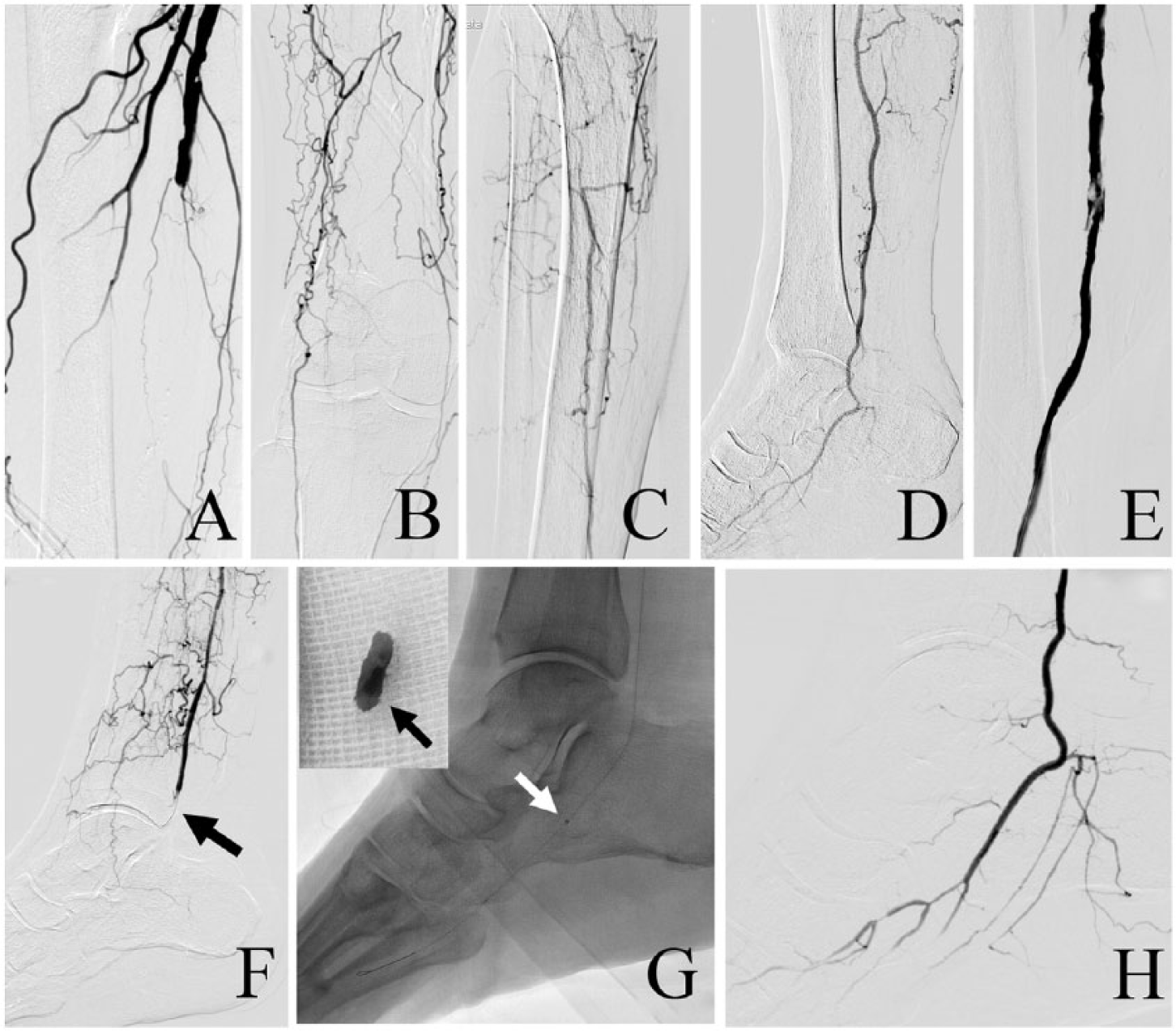
A 70-year-old man with obstruction of the proximal third of the superficial femoral artery (SFA) extending to the tibioperoneal trunk, with feeble collaterals from the genicular arteries reconstituting the posterior tibial artery at its middle third (A–D). After SFA subintimal recanalization and stenting, residual dissection (E) caused below-the-knee and foot embolization (F, arrow). Thrombus (inset in G, arrow) was successfully aspirated with the Penumbra 4MAX device placed in the lateral plantar artery (G, arrow) with a good angiographic final result (H).

A 73-year-old diabetic man with a preocclusive stenosis of the popliteal artery at P1 associated with a significant stenosis in the proximal anterior tibial artery (A, B) was treated with a high-pressure 5-mm balloon (C). Angiographic imaging showed an occlusion (D, arrow) of the dorsalis pedis due to distal embolization. Mechanical thromboaspiration was performed with the Penumbra 3MAX device (E, F, arrows) via the tortuous distal pedal artery with good angiographic results (G).
Clinical and Procedure Data.

Abbreviations: ATA, anterior tibial artery; CLI, critical limb ischemia; DM, diabetes mellitus; DYS, dyslipidemia; FP, femoropopliteal; HTN, hypertension; PA, plantar artery; PTA, posterior tibial artery; RF, renal failure; SFA, superficial femoral artery; TE, thromboembolization; TPT, tibioperoneal trunk; TWC, Texas wound class.
At the site of a previous minor amputation.
The patients were begun on dual antiplatelet therapy (acetylsalicylic acid 100 mg/d and clopidogrel 75 mg/d) 3 days prior to the procedure. Access was via an antegrade 6-F femoral sheath that was flushed with heparinized saline solution during the entire procedure to prevent clotting. Heparin was administered during the procedure to maintain the activated clotting time >250 seconds. In each of case, distal embolization occurred during the procedure owing to the challenging nature of the disease.
Antegrade mechanical thromboaspiration was performed using the Penumbra system 3MAX or 4MAX catheters, which were advanced through the tortuous anatomy to the occluded vessel. The dedicated continuous aspiration pump was engaged, which resulted in rapid removal of the long thrombotic debris. The lumens of the occluded arteries were restored with direct flow through the main lesion in each case. The ulcers all healed in 3 to 6 months, and the patients were symptom-free at 12-month follow-up.
Discussion
Distal embolization is a severe complication during limb salvage procedures that may jeopardize foot revascularization, leading to amputation despite a successful recanalization of inflow lesions. The use of antiplatelet therapy associated with antithrombotic therapy during the procedure 9 and continuous heparinized saline flushing of the introducer sheath are sufficient to obtain a rate of peripheral embolization <3%. 10 Considering this low rate of embolization, the routine use of filter protection devices to prevent embolic complications during superficial femoral artery (SFA) treatment is too expensive, complex, and not always practical. However, SFA angioplasty of a plaque during limb salvage procedures could cause distal embolization, which worsens the final outcome despite successful recanalization of the target vessel. Unequivocal strategies to manage these types of complications are still lacking.
Although traditional open surgical procedures are considered effective in restoring arterial flow to the extremities in acute femoropopliteal occlusion, significant perioperative morbidity and mortality are reported.11,12 Moreover the use of a Fogarty balloon below the knee could be ineffective due to the difficulty directing the catheter into any crural and foot arteries. Two randomized trials, STILE (Surgery vs Thrombolysis for Ischemia of the Lower Extremity) 11 and TOPAS (Thrombolysis or Peripheral Arterial Surgery), 12 established the role of percutaneous catheter-directed thrombolysis in patients with acute limb ischemia due to spontaneous femoropopliteal thrombosis and/or cardiac embolization. However, this approach could not be applied to foot embolization occurring as a consequence of iatrogenic plaque embolization during angioplasty due to several technical limitations that should be considered.
First, even if thrombolysis restores flow, the process is sluggish, so tissue ischemia may rapidly progress to infarction before the artery has recanalized. 13 Second, embolic fragments could be hard and highly organized because they likely originate from chronic thrombotic occlusions and would be refractory to thrombolysis. Even with microcatheter-directed thrombolysis, further thrombosis may be provoked. Last, given the distal location of the thromboemboli, the delivery of active thrombolytic agent through the side holes of the infusion catheter would not be directed deeply into the thrombus, but unavoidably upstream, so the treatment might be less effective. Infusion of thrombolytic agents is a long and tedious process, usually involving an overnight stay in the intensive care unit and periodic monitoring, thus significantly adding to the cost of the procedure.
Immediate extraction of the debris is considered the ideal solution. Manual catheter suction thrombectomy is a good option described in several experiences,14,15 but the main disadvantage of this approach is the risk of vessel dissection and failure to advance in small foot arteries. Another device that could be used to treat below-the-knee thromboembolic complications during endovascular procedures is the AngioJet Rheolytic Thrombectomy System (Possis Medical, Minneapolis, MN, USA). Spiliopoulos et al 7 treated 14 patients with this device for intraoperative thromboembolism and obtained an admirable technical and clinical success of 92.8%. In 8 of the 14 procedures, the AngioJet was employed in the distal third of the tibial vessels and in the below-the-ankle arterial bed. However, additional local thrombolysis was used in 9 procedures, protection filters in 6, and clot trapping with stenting in 6 cases, with the limitation that infrapopliteal stent deployment could afterward compromise long-term vessel patency. Besides the increased rate of stenting and adjunctive therapies involved with this device, other pitfalls of the AngioJet System are represented by the potential risks of further embolism, acute renal failure, and hemoglobinuria due to the prospective excessive hemolysis caused during utilization of the device. This is a less than ideal solution to treat distal thromboemboli in an already challenging limb salvage scenario, but it has been the only option available to the community for several years.
The Penumbra system catheters provide a highly trackable and atraumatic solution to clot extraction in the peripheral vasculature. The setup is easy, and it does not require the use of adjunctive devices or thrombolytic agents. The cost of a 3MAX or 4MAX catheter is around $1000, to which must be added ~$230 for the aspiration tubing. The Penumbra Aspiration Pump is available on free loan. The overall cost of using this device is lower than that of the AngioJet system, which runs ~$2800.
In all 3 cases described herein, results were achieved fairly quickly. As limb salvage becomes more aggressive, the rates of distal embolization can be expected to increase. The Penumbra system may become an essential part of the interventionist’s toolbox to deal with such challenging complications when they arise.
Conclusion
While further evaluation in a larger cohort of patients is needed, our initial experience using the Penumbra system in the peripheral vasculature is promising and demonstrates a fast and effective approach to treat intraprocedural distal embolization and avoid its potential dramatic clinical consequences.
Footnotes
Acknowledgements
The authors would like to thank Dr Sophia S. Kuo for her valuable assistance in manuscript preparation.
Declaration of Conflicting Interests
The author(s) declared the following potential conflicts of interest with respect to the research, authorship, and/or publication of this article: Roberto Gandini had a consulting agreement with Penumbra, which included writing articles directly related to Penumbra and Penumbra products, and has also received modest speaker fees. Enrico Pampana received modest speaker fees from Penumbra.
Funding
The author(s) received no financial support for the research, authorship, and/or publication of this article.