






Abstract
Keywords
Introduction
An endovascular first approach for femoropopliteal (FP) disease has become the primary strategy for both lifestyle-limiting claudication and critical limb ischemia (CLI).1,2 In the United States, more than 200,000 stents are implanted yearly in the femoropopliteal segment. 3 Despite improved patency with newer-generation nitinol stents and drug-eluting stents, more than 100 000 interventions for FP in-stent restenosis (ISR) are performed each year. 3 The incidence of FP-ISR is related to numerous factors, including lesion length, lesion location, stent fracture, and patient comorbidities. 4 Available treatment strategies for FP-ISR include conventional balloon angioplasty (BA), cutting balloons, laser atherectomy, self-expanding covered stents, drug-eluting stents, and drug-coated balloons (DCBs).5–13
Given that avoiding an extra stent layer is appealing, recent research attempts have been concentrated on treatment strategies that can avoid repeat stent implantation. Moreover, while Tosaka I lesions (FP-ISR <5 cm) can be effectively treated with relatively simple strategies, lesions of increasing complexity, including Tosaka II (FP-ISR >5 cm) and Tosaka III (in-stent occlusion), result in poor outcomes with conventional approaches. 14 The combination of laser atherectomy and BA is superior to BA alone based on the results of randomized and real-world studies.15,16 As a result, laser atherectomy is the only atherectomy device approved by the US Food and Drug Administration (FDA) for the treatment of FP-ISR.
DCBs are associated with femoropopliteal patency rates comparable to primary stenting for the treatment of de novo disease.17–19 The recent Randomized Femoral Artery In-Stent Restenosis (FAIR) trial demonstrated that DCBs are superior to BA for the treatment of FP-ISR. 20 However, the average lesion length in that study was relatively short (82.2±68.4 mm), and only 28.6% of the lesions were chronic total occlusions (CTOs), making the benefit of DCBs unclear for the treatment of longer FP-ISR lesions. 21 One small study reported that the combination of DCBs and laser atherectomy for treatment of FP-ISR patients was superior to DCBs alone, 22 confirming the benefit of laser atherectomy for FP-ISR and suggesting that the combination of laser atherectomy with DCBs may further improve the outcomes for complex FP-ISR. However, it is unknown whether the combination of laser and DCB is superior to laser and BA for the treatment of complex (Tosaka II and Tosaka III) FP-ISR lesions.
Methods
Study Design and Patient Population
This was a retrospective study of 112 consecutive patients (mean age 70.3±10.6 years; 86 men) with Tosaka II (n=29) and Tosaka III (n=83) FP-ISR retrieved from the vascular databases of 2 academic centers. The institutional review boards of both centers approved the study protocol. Experienced abstractors extracted baseline, procedure, and outcome data using the electronic medical records and angiographic images in both centers. Patients were grouped according to treatment with either laser atherectomy + DCB (n=62) or laser atherectomy + BA (n=50). The 2 groups were similar in baseline characteristics (Table 1), but the laser + DCB group had a lower preprocedure ankle-brachial index (0.5 vs 0.69, p=0.006), while patients treated with laser + BA had experienced more strokes (9.7% vs 14%, p<0.001). CLI was the indication for a third (37/111) of the procedures in the overall cohort, without any significant differences between the 2 groups. Fifty-three lesions (48.2%) involved both the superficial femoral and popliteal arteries.
Demographic and Angiographic Characteristics. a
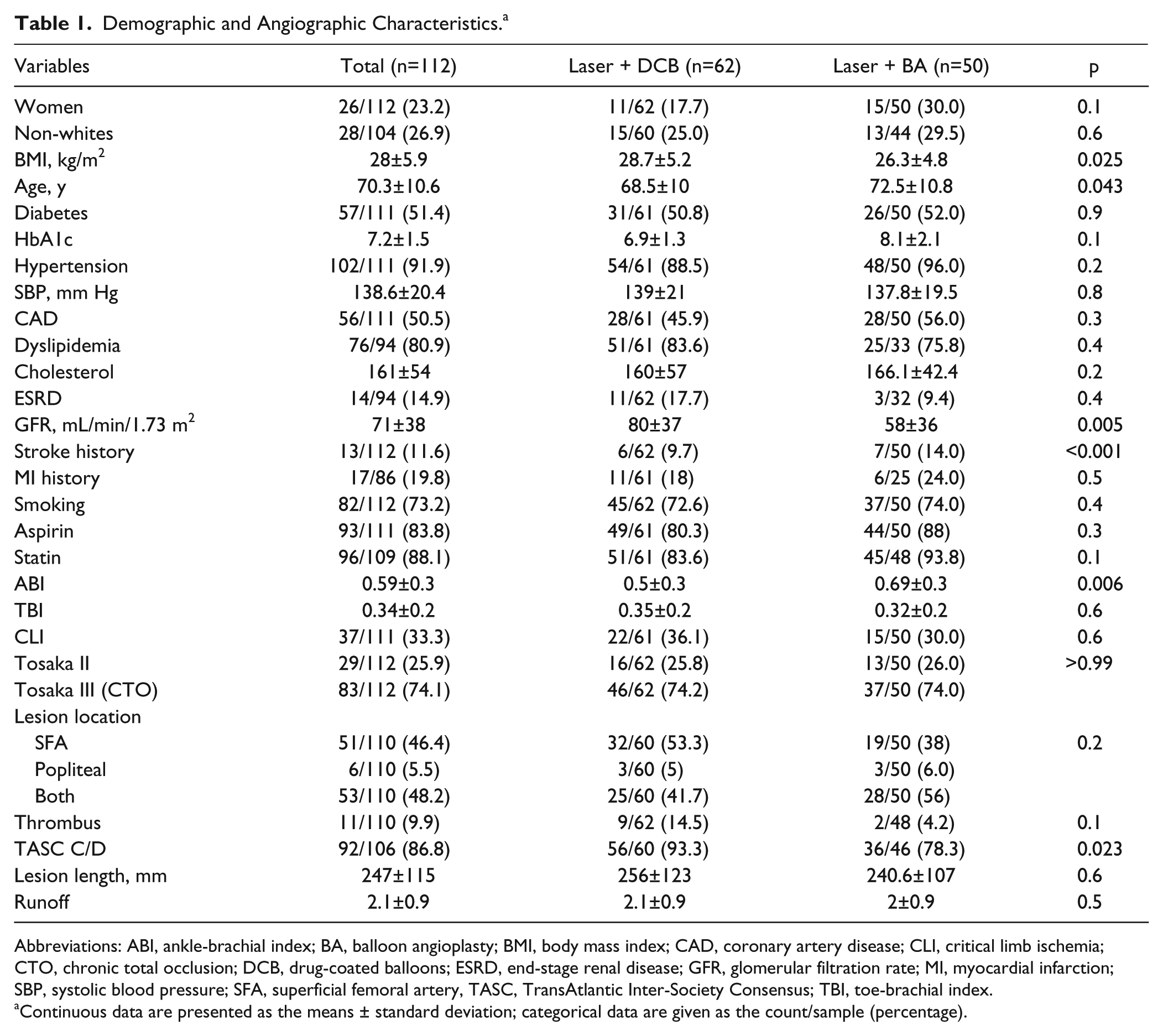
Abbreviations: ABI, ankle-brachial index; BA, balloon angioplasty; BMI, body mass index; CAD, coronary artery disease; CLI, critical limb ischemia; CTO, chronic total occlusion; DCB, drug-coated balloons; ESRD, end-stage renal disease; GFR, glomerular filtration rate; MI, myocardial infarction; SBP, systolic blood pressure; SFA, superficial femoral artery, TASC, TransAtlantic Inter-Society Consensus; TBI, toe-brachial index.
Continuous data are presented as the means ± standard deviation; categorical data are given as the count/sample (percentage).
Endovascular Treatment
FP-ISR lesions were crossed with a 0.035-inch guidewire. Predilation was performed before the intervention using balloons 1 mm smaller than the reference diameter. Scoring balloons and distal embolic protection devices were employed at the discretion of the operator. The most commonly used laser device overall was the Turbo Elite (Spectranetics Inc, Colorado Springs, CO, USA). Among lesions treated with laser atherectomy + DCB, the most commonly used device was the Turbo-Power excimer laser (Spectranetics Inc), followed by the Turbo Elite device and the Turbo Tandem device (Spectranetics Inc). After laser atherectomy, balloon angioplasty was performed with an uncoated or coated balloon [IN.PACT Admiral paclitaxel-eluting balloon (Medtronic Cardiovascular, Santa Rosa, CA, USA) or Lutonix (Bard Peripheral Vascular, Tempe, AZ, USA)]. Bailout stenting was used for treatment of flow-limiting dissections or suboptimal angiographic results with residual stenosis.
Definitions and Outcome Measures
Patients and lesions were analyzed on an intention-to-treat basis. Procedure success was defined as successful lesion crossing and treatment with final residual stenosis <30%. Major adverse limb events (MALEs) were defined as the combination of urgent target lesion thrombolysis, lower extremity bypass, or major amputation. Routine duplex ultrasound follow-up was used to monitor restenosis or reocclusion during follow-up. The primary outcome of this study was 1-year target lesion revascularization (TLR; including endovascular or surgical techniques), while secondary outcomes included 1-year estimates of reocclusion, limb salvage, and MALE.
Statistical Analysis
Continuous variables were described with the mean ± standard deviation and compared with the Wilcoxon rank sum test, while categorical variables were described with absolute and relative frequencies and compared using a chi-square or Fisher exact test. Kaplan-Meier survival curves were generated to estimate 1-year freedom from TLR and reocclusion for laser atherectomy + DCB vs laser atherectomy + BA. The association between baseline clinical, angiographic, and procedure characteristics and 1-year TLR were studied with a univariate Cox proportional hazard model; the results are presented as the hazard ratio (HR) and 95% confidence interval (CI). The statistically and clinically significant variables (p<0.05) were included in a multivariable model. For all tests, p<0.05 was considered significant. All analyses were performed using STATA software (version 14.1; STATA Corporation, College Station, TX, USA).
Results
Procedure Characteristics
The mean maximum fluency was 53±8 mJ/mm2 in the laser + DCB group vs 48±7 mJ/mm2 in the laser + BA group. The mean maximum repetition rate was 58±18 Hz vs 30±10 Hz, respectively. In the test group, the majority of the patients were treated with the IN.PACT Admiral DCB (n=52) vs 10 with the Lutonix DCB. An embolic protection device was more often used in the laser + DCB group (62.9% vs 26%, p<0.001), while bailout stenting was less often required in the laser + DCB group (31.7% vs 58%, p=0.006). Overall lesion success was 98% in both groups (p=0.502). In total, 10 complications (9 embolizations and 1 perforation) were reported, without statistically significant differences between groups (Table 2).
Procedure Characteristics and Outcomes. a

Abbreviations: BA, balloon angioplasty; DCB, drug-coated balloon.
Continuous data are presented as the means ± standard deviation; categorical data are given as the count/sample (percentage).
Outcomes in Follow-up
The combination of laser atherectomy + DCB was superior to laser atherectomy + BA for reduction of 1-year TLR, with estimates of 72.5% (95% CI 55% to 85%) vs 50.5% (95% CI 35% to 65%, p=0.043; Figure 1A). Combination therapy with laser atherectomy + DCB was also associated with greater freedom from reocclusion [86.7% (95% CI 70% to 95%) vs 56.9% (95% CI 41% to 70%), p=0.003; Figure 1B)]. Overall limb salvage rates were similar [free-dom from major amputation 94.8% (95% CI 81% to 99%) for laser + DCB vs 97.4% (95% CI 83% to 99%) for laser + BA, p=0.5; Table 3]. In a sensitivity analysis limited to patients with Tosaka III FP-ISR (in-stent occlusion), laser + DCB was superior to laser + BA in terms of freedom from 1-year reocclusion [87.1% (95% CI 56% to 94%) vs 57.1% (95% CI 39% to 72%), p=0.028; Figure 1C].

One-year freedom from (A) target lesion revascularization, (B) target lesion occlusion, and (C) target lesion reocclusion among lesions treated for in-stent occlusion (Tosaka III). BA, balloon angioplasty; CI, confidence interval; DCB, drug-coated balloon; HR, hazard ratio; KM, Kaplan-Meier; LA, laser.
Twelve-Month Kaplan-Meier Estimates of Outcomes.

Abbreviations: BA, balloon angioplasty; DCB, drug-coated balloons; MACCE, major adverse cardiac or cerebrovascular events; MALE, major adverse limb events; TLR, target lesion revascularization.
Other variables that had a significant association with 1-year TLR in the univariate Cox regression analysis included CLI (HR 3.2, 95% CI 1.56 to 6.6, p=0.002) and lesions that involved both the superficial femoral and popliteal arteries (HR 2.3, 95% CI 1.12 to 4.72, p=0.023). After adjusting for covariates, CLI remained an independent risk factor for 1-year TLR (HR 3.47, 95% CI 1.00 to 11.7, p=0.045), while the combination of laser + DCB was not associated with a significantly reduced rate of TLR (HR 0.35, 95% CI 0.11 to 1.04, p=0.059). Lesions involving both the superficial femoral and popliteal arteries (HR 2.38, 95% CI 1.05 to 5.38, p=0.038) and CLI (HR 2.22, 95% CI 1.00 to 4.92, p=0.050) were also univariate predictors of in-stent reocclusion. After multivariable adjustment, the only variable that remained associated with a reduction in 1-year reocclusion was treatment with laser atherectomy + DCB (HR 0.08, 95% CI 0.17 to 0.38, p=0.002; Table 4).
Multivariable Predictors of Target Lesion Revascularization and Reocclusion. a
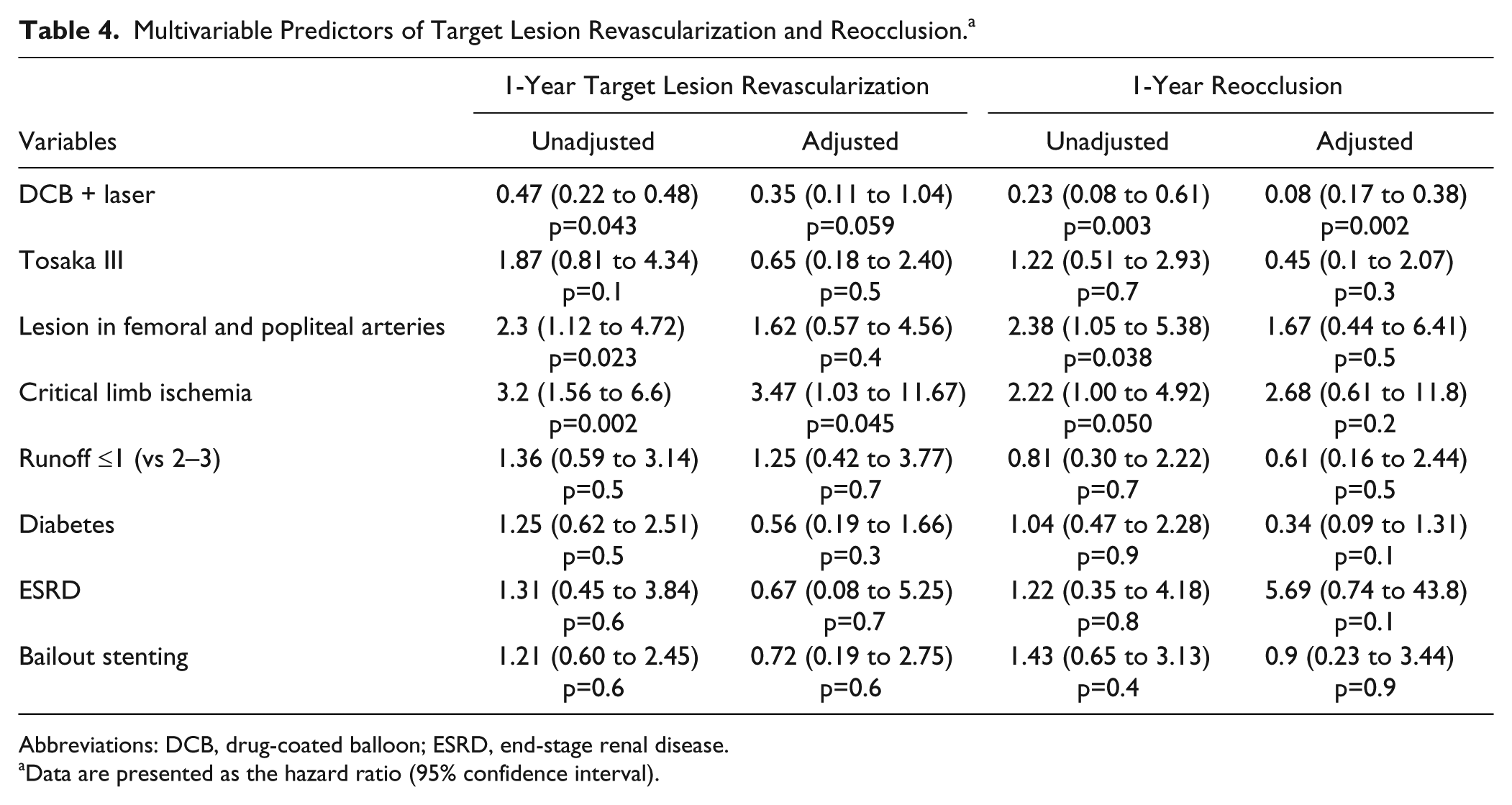
Abbreviations: DCB, drug-coated balloon; ESRD, end-stage renal disease.
Data are presented as the hazard ratio (95% confidence interval).
Discussion
Complex FP-ISR disease (eg, long lesion length or in-stent occlusion) is associated with high rates of 2-year recurrent restenosis for both Tosaka II (84.8%) and Tosaka III (53.3%) FP-ISR when treated with BA alone. 14 Thus, adjunctive therapies are needed to improve not only procedure success but also long-term outcomes of these patients. The EXCITE-ISR trial showed that laser atherectomy is safe and when combined with BA was associated with a lower rate of 6-month TLR vs BA alone (26.5% vs 48.2%). 15 This superiority was confirmed by real-world studies showing that the clinical benefit of laser atherectomy is most apparent when treating FP-ISR of long lesion lengths (Tosaka II) and FP in-stent occlusions (Tosaka III). 16 Since DCBs have been proven superior to BA for the treatment of both de novo and ISR lesions in the femoropopliteal segment, as well as in the coronary arteries, 24 it is logical that the combination of DCBs with laser atherectomy could further improve the outcomes of FP-ISR.17–19,23
A previous study by Gandini et al 22 compared laser atherectomy + DCB vs DCB alone, observing that the combined therapy was associated with significantly higher 12-month freedom from TLR (83.3% for laser + DCB vs 50% for DCB only). The 12-month freedom from TLR in our laser + DCB group was lower at 72.5%. However, our population differed in 2 major areas from the Gandini cohort. First, the percentage of CLI patients in our laser + DCB group was 36% while the Gandini study included only CLI patients, which explains the much higher 12-month limb loss rate in their study (8% in their laser + DCB group vs our 5.2% in ours). Second, Gandini and colleagues included only FP in-stent occlusions (Tosaka III), while a quarter of our cohort had Tosaka II lesions. Third, the lesion length in our DCB group averaged 25.6±12.3 cm vs 20.0±10.1 mm in the Gandini laser + DCB group.
The recently published results of the PACUBA1 trial (PAClitaxel balloon vs standard BAlloon in In-stent restenosis of the superficial femoral artery) showed superior 1-year freedom from TLR (49% vs 33%, p=0.03) for DCBs among 74 patients with FP-ISR. 25 Notably, this rate is inferior to our 72% estimate for the laser + DCB group but similar to the 50% rate for the laser + BA group. On the other hand, the 72% 1-year freedom from TLR rate in our laser + DCB group was lower than the 86% rate for the DCB only group in the DEBATE-ISR study. 26 However, our cohort consists of real-world patients with the longest reported mean lesion length of any study. The DEBATE-ISR study also included Tosaka I lesions, and the average lesion length was ~14 cm, 26 significantly shorter than in our study
Another trial evaluating the effectiveness of DCBs in FP-ISR was the In.PACT Global Study, which reported a 92.7% rate for freedom from clinically-driven TLR and no amputations after 12 months. 27 While these rates are significantly better than in our study, it is critical to consider that our cohort included longer lesions (25 vs 17 cm) and a much higher percentage of complex Tosaka III lesions (74% vs 24%), as well as a significant percentage of CLI patients (33%).
Notably, recent studies have also examined the role of covered stents for management of FP-ISR. The RELINE study reported a 12-month freedom from TLR similar to ours (79.9% vs 72.5%, respectively) for lesions that were on average shorter by 8 cm compared to our study; only 23% of the lesions were Tosaka III. 28
Our study also demonstrated that the 12-month rate of reocclusion was extremely low among patients treated with laser + DCB. This finding suggests that even when patients developed recurrent restenosis, the lesion was unlikely to progress to in-stent occlusion. Patterns of restenosis after DCB angioplasty are an active area of investigation, but initial studies have suggested that recurrent restenosis after DCB angioplasty is more likely focal, as compared to diffuse restenosis. Not all prior studies of DCB angioplasty for FP-ISR have reported recurrent occlusion rates. The DEBATE-ISR study reported a 12-month freedom from reocclusion of 82.9% in the DCB group and 46.2% for the BA group. 26 On the other hand, only 1 of 39 patients initially treated had a reocclusion after 12 months in the single-arm DCB study by Virga et al. 29 These encouraging initial results suggest that paclitaxel delivery to sites of FP-ISR may limit the severity of restenosis when it does occur.
By comparing the outcomes of laser atherectomy + DCB vs laser atherectomy + BA, our goal was to investigate the additive benefit of DCBs to laser atherectomy, which has been established as a standard of care in the treatment of FP-ISR. When used for the treatment of FP-ISR, DCBs deliver paclitaxel to the site of neointimal formation, thereby limiting the downsides of multiple stent layers and the potential increased risk for stent thrombosis with multiple stents.17–19 Moreover, DCBs can decrease the need for bailout stenting.20,26 Consistent with this, bailout stenting rates in our DCB + laser group were significantly lower than the BA + laser group (31.7% vs 58%, respectively). However, this number is still higher compared to bailout stenting rates (all of them <12%) in randomized trials for treatment of FP-ISR.15,20,25,29 This difference is most likely explained by our real-world population, with the majority of cases being very long lesions with a high percentage of occlusions.
Atherectomy options for FP-ISR are currently limited to laser atherectomy.7,16 Orbital atherectomy is contraindicated for such lesions, while excisional atherectomy has been studied in small observational cohorts only.9,12,30 A number of options exist for the use of laser atherectomy, including the Turbo Elite catheter, which provides low-profile ablation; the Turbo Tandem catheter, which provides directional cutting with the laser; and the Turbo-Power device, recently approved by the FDA for the treatment of FP-ISR. The Turbo-Power device enables up to 6 rotations in each direction and creates a larger cross-sectional area compared to the Turbo-Elite catheter. The effect of rotational laser atherectomy can be beneficial for neointimal ablation before using DCBs or other adjunctive devices; for this reason, the Turbo-Power device appears to offer treatment advantages over Turbo-Elite and Turbo-Tandem.
The mechanisms underlying the benefit from combined treatment with laser atherectomy + DCBs are likely multifactorial. Laser atherectomy provides debulking of the neointimal tissue inside of the occluded stent, thereby helping to prevent recoil of neointimal tissue after subsequent balloon angioplasty. Many of these restenotic lesions are also heterogeneous and contain significant thrombus, which laser atherectomy can effectively vaporize.16,22,31 Laser atherectomy also modifies the plaque, creating endothelial micropores whereby paclitaxel may more easily penetrate the neointimal tissue.32,33 Finally, the kinetic energy and laser-induced pressure waves generated with each pulse can modify plaque that may otherwise limit stent expansion during subsequent balloon angioplasty. For these reasons, laser atherectomy and DCB angioplasty have synergistic mechanisms of action that result in the large, clinically meaningful benefit observed in our cohort.4,7,31,34
Limitations
Our results should be interpreted in the context of the limitations of observational research, which include possible operator and case selection bias. However, it has been our practice to treat all FP-ISR lesions with laser atherectomy. The lower bailout stenting rates in the DCB group can be potentially explained by the fact that the operators were not blinded to the type of angioplasty used.
We did not use propensity score matching analysis since our overall sample was small. 35 However, the two groups did not have significant differences in the baseline characteristics, though the laser + DCB group had numerically higher percentages of several critical variables and comorbidities.
Conclusion
Laser atherectomy + DCB angioplasty are associated with high procedure success and low complication rates when treating complex FP-ISR, while decreasing the need for bailout stenting. The combination of laser atherectomy + DCBs improved 1-year TLR and reocclusion rates for the overall cohort and led to a lower reocclusion rate among patients with Tosaka III FP-ISR. Future large prospective cohort studies should be performed to confirm and further expand these findings.
Footnotes
Declaration of Conflicting Interests
The author(s) declared the following potential conflicts of interest with respect to the research, authorship, and/or publication of this article: Stephen W. Waldo receives research support to the Denver Research Institute from Abiomed, Cardiovascular Systems Inc, and Merck Pharmaceuticals. John R. Laird is a consultant/advisory board member for Abbott Vascular, Bard Peripheral Vascular, Boston Scientific, Medtronic, and W.L. Gore & Associates and receives research support from W.L. Gore & Associates, Medtronic, and Bard Peripheral Vascular. Ehrin J. Armstrong is a consultant to Abbott Vascular, Boston Scientific, Cardiovascular Systems Inc, Medtronic, and Spectranetics.
Funding
The author(s) received no financial support for the research, authorship, and/or publication of this article.