







Abstract
This study applies the wellbeing valuation approach to sport participation and volunteering using data from the German Socio-Economic Panel. Linear regression results show that sport and volunteering hours increase satisfaction with life, health, work, income, and leisure, but with diminishing returns in most models. In a seemingly unrelated regression, some of these effects turn insignificant. The instrumental variable estimates show causal impacts of sporting hours on all wellbeing measures, while volunteering only impacts health satisfaction. The monetary values vary depending on the type of wellbeing measure and estimator, indicating that future studies should consider the employed measures and estimators.
Keywords
Introduction
In recent years, the focus of sport policy and research has shifted from the mere assessment of tangible, economic impacts of sport to a broader assessment of impacts including intangible and non-economic impacts (Orlowski & Wicker, 2019). Social return on investment (SROI) analyses have emerged which consider social and health effects of sport participation and volunteering in addition to economic and consumption-related effects (Davies et al., 2019).
Because of their intangible nature, identifying appropriate monetary values for the benefits obtained from participating in activities like sport and volunteering that reflect the overall value of these activities to individuals is challenging. For example, individuals do not only generate direct use values from engaging in an activity, but also indirect use values such as health and social effects (Orlowski & Wicker, 2019). Hence, using any prices of sport participation (e.g., membership or entrance fees, clothing) or the opportunity costs of volunteering in terms of foregone income in individuals’ normal occupation (Orlowski & Wicker, 2015; Salamon et al., 2011) would not fully capture the value of these activities to individuals. Also, the latter approach assesses the input of individuals rather than the outcomes in terms of obtained benefits.
To address these issues, the wellbeing valuation approach, or compensating variation approach, has emerged in recent years (for an overview see Orlowski & Wicker, 2019). Its general idea is to estimate the contribution of different factors of interest to individuals’ subjective wellbeing (SWB) and assign monetary values by estimating compensation payments. In the case of a wellbeing-enhancing factor, the compensation payment reflects how much income individuals would be willing to forego that they can still enjoy the factor of interest while retaining their current level of wellbeing.
The purpose of this study is to investigate the effects of sport participation and volunteering on individuals’ SWB and assign monetary values using the wellbeing valuation approach. Specifically, this work considers that SROI models require values per hour rather than monetary values for the frequency of sport participation and volunteering. This study also considers different dimensions of SWB rather than only one general SWB measure. The following three research questions are advanced: (1) what is the relationship of sporting and volunteering hours with different SWB measures? (2) What monetary value of one sporting hour and volunteering hour can be assigned using the wellbeing valuation approach? And (3) how do these monetary values differ depending on the type of SWB measure employed and the type of estimator? The contribution of this work lies in the estimation of hourly values and the comparison of these values for different SWB measures and different estimators. It is among the first to employ the wellbeing valuation approach to volunteering.
Theoretical Framework and Literature Review
Subjective Wellbeing
Subjective wellbeing (SWB) is referred to as individuals’ affective and cognitive evaluations of their lives. It encompasses four separable components such as a global life satisfaction, satisfaction with important domains in life, high levels of positive affect, and low levels of negative affect (Diener, 2000). The focus of this study is on global life satisfaction and satisfaction with different life domains, including health, work, income, and leisure time. Previous studies focused on global measures of life satisfaction (e.g., Huang & Humphreys, 2012; Wicker & Downward, 2020) or happiness (e.g., Downward & Dawson, 2016; Ruseski et al., 2014). Within sport-related research, only a few studies considered satisfaction with other domains in life such as satisfaction with health or leisure time, but only for particular subgroups of the population such as elite athletes (e.g., Wicker et al., 2020) and fitness participants (Wicker et al., 2015) or for residents in the context of sport events (Littlejohn et al., 2016; Schlegel et al., 2017).
Wellbeing-Enhancing Activities
From a theoretical perspective, individuals engage in activities that enhance their wellbeing, while trying to reduce their participation in wellbeing-reducing activities (Abou-Zeid & Ben-Akiva, 2012; Wicker, 2020). Sport participation and volunteering are considered active leisure activities and qualify as the former (Downward & Dawson, 2016). Individuals participate in sport and volunteering for a number of reasons. The underlying theoretical mechanisms through which these activities yield SWB were summarized by Wicker (2020) for sport participation and by Wicker and Downward (2020) for volunteering. Common mechanisms for both activities include enjoyment (Frey, 1997), health (Lera-Lopez et al., 2017), social interactions (Downward et al., 2018), relational goods (Becchetti et al., 2008), distraction from problems and stress, and increased self-esteem and self-efficacy (Lehnert et al., 2012). Drawing on the literature on pro-social behavior, additional mechanisms such as altruism (Becchetti et al., 2008) and generosity (Lane, 2017) can be identified for volunteering.
From an empirical perspective, existing research has documented a positive and causal effect of sport participation on SWB (e.g., Frey & Gullo, 2021; Huang & Humphreys, 2012; Ruseski et al., 2014). While this finding applies to dummy variables, further evidence is available for the frequency, duration, and intensity of sport participation. Previous research found that more frequent participation in sport (more times per week or month) and a higher duration (more minutes per week/month) yielded higher wellbeing levels (Downward & Dawson, 2016; Lee & Park, 2010; Orlowski & Wicker, 2018). With respect to sport participation intensity, existing studies support the notion that higher-intensity activities such as vigorous- as opposed to moderate-intensity activities has no significant effects on wellbeing or even negative effects (Wicker, 2020; Wicker & Frick, 2017).
For volunteering, existing research has documented a positive and causal effect on SWB for general volunteering measures (e.g., Becchetti et al., 2008), while a distinction between different voluntary roles yielded inconsistent effects: Specifically, only operational roles such as organizing a sport event or providing transport, and maintaining sport facilities had a positive and causal impact on SWB. The causal effects of administrative roles such as board or committee positions and sport-related roles such as coaching and officiating were found to have a jointly, significantly negative causal effect on SWB (Wicker & Downward, 2020).
Monetary Valuation of Volunteering and Sport Participation
Driven by the need to assign monetary values to intangibles in several areas of sport economics, but also environmental economics, a number of valuation approaches have emerged (for an overview see Orlowski & Wicker, 2019). These methods can be classified into revealed preference and stated preference approaches, while hybrid approaches representing a combination of the former. Stated preference approaches include the contingent valuation method, the contingent behavior method, and choice modeling. Revealed preference approaches encompass hedonic pricing, the travel cost method, the replacement cost approach (RCA), the opportunity cost approach (OCA), and the compensating variation approach, also referred to as wellbeing valuation approach (Orlowski & Wicker, 2019). The focus of this study is on the latter revealed preference approach. Its advantages are outlined next by explaining the typically employed valuation approaches.
Estimating monetary values for volunteering has a long tradition in sports (Orlowski & Wicker, 2019) and non-profit economics (Salamon et al., 2011). The replacement and OCA have emerged as prominent approaches in this regard. The RCA considers the labor market equivalent wage rate of the activity as the corresponding monetary value of one volunteering hour. The OCA uses the foregone income in the volunteer's normal occupation as the corresponding monetary value. Both approaches are input-based as they focus on the activity (RCA) the volunteer performs and the time (OCA) needed for the volunteering activity.
In previous research, monetary values of volunteering in sport were typically obtained using the OCA (Orlowski & Wicker, 2015; Solberg, 2003) or RCA (Davies, 2004; Vos et al., 2012). For example, one hour of sport club-related volunteering in Germany was valued at €14 when employing the OCA and RCA (Orlowski & Wicker, 2015). Solberg (2004) studied sport event volunteers in Norway and assigned monetary values of NOK199 (€24; RCA) and NOK184 (€22; OCA) for one hour of volunteering. Davies (2004) only estimated aggregate monetary values for the voluntary sport sector in Sheffield and did not report hourly values. Vos et al. (2012) estimated human resource costs per unit (i.e. per club member) rather than per volunteering hour, meaning that these values cannot be used for comparative purposes. Collectively, the employed approaches (RCA, OCA) neglect the outcomes of volunteering for the individual which are also relevant to the policy debate (Downward & Dawson, 2016). The wellbeing valuation method addresses this shortcoming as it focuses on one possible outcome which is SWB. The wellbeing valuation method has been used to assign monetary values to volunteering in the UK (Davies et al., 2019); however, hourly values were not reported.
A few applications of the wellbeing valuation approach exist for sport participation. All of them addressed causality issues by employing instrumental variable estimators. Specifically, using data from the UK and a happiness measure as dependent variable, an extra minute of sport per year was valued at £215 (Downward & Rasciute, 2011) and £110 (Downward & Dawson, 2016). A German study estimated monetary values for different frequencies of participation (i.e. at least once per week, per month, or per year) compared to not participating at all (Orlowski & Wicker, 2018). Monetary values were estimated separately for males and females as well as for different categories of the dependent life satisfaction variable (from 0 to 10). The findings reveal that higher sport participation frequencies are associated with higher monetary values, with males having higher monetary values than females because of their higher incomes. Hourly values facilitating comparisons with the present study were not provided. The same limitation applies to a project report in the UK valuing sport and culture (Fujiwara et al., 2014).
This review shows that the body of research has already provided valuable insights into monetary valuation of sport participation and volunteering. Also, many studies have provided evidence of causal impacts on SWB. However, some shortcomings can be noted. First, most studies only used one global measure of SWB (i.e. happiness or life satisfaction), neglecting the different domains driving overall life satisfaction such as satisfaction with health, leisure time, and work. Second, only a few studies provided hourly values which are, however, needed for SROI analyses. This is because these values are typically combined with data on voluntary engagement and sport participation from other sources, reporting the number of volunteers and volunteering hours (e.g., Breuer & Feiler, 2017). Third, existing valuation research has shown that the obtained monetary values are sensitive to the employed methods (Orlowski & Wicker, 2015). While this previous study compared different valuation methods, the body of knowledge still lacks a comparison of the monetary values produced by different statistical estimators. The present study attempts to address these research gaps.
Method
Sampling and Data
Data were obtained from the German Socio-Economic Panel (GSOEP), which is a large-scale, yearly survey of the German resident population conducted by the German Institute for Economic Research. The GSOEP has been used in previous sport participation and volunteering research (e.g., Becchetti et al., 2008; Orlowski & Wicker, 2018). Households are selected based on specific criteria and most interviews are conducted as face-to-face interviews. The minimum age of respondents is 16 years. Household heads are asked to provide information about household members under 16 years. The present study uses data from the 2017 wave of the GSOEP because this is the first and only wave where hourly measures for both sport participation and volunteering are available. Previous GSOEP waves only included ordinal frequency measures for both variables. The sample consists of n = 30,861 respondents.
Measures and Variables
Table 1 provides an overview of the variables used in the present study. SWB was measured with a global life satisfaction measure and four variables capturing satisfaction with specific life domains including health, work, household income, and leisure time on an 11-point scale (from 0 = completely dissatisfied to 10 = completely satisfied). Respondents were asked how satisfied they would be currently with their life and specific life domains. The global measure has already been employed in previous valuation research (Orlowski & Wicker, 2018), while the global measure and some of the life domain measures were used in existing SWB research (e.g., Wicker, 2020; Wicker et al., 2015, 2020). Other SWB studies also employed a life satisfaction measure, though on a smaller scale (Wicker & Frick, 2017). The present 11-point scale is similar to the 10-point scale used in the Taking Part Survey in the UK to assess happiness (Downward & Dawson, 2016; Downward & Rasciute, 2011).
Overview of Variables and Summary Statistics.
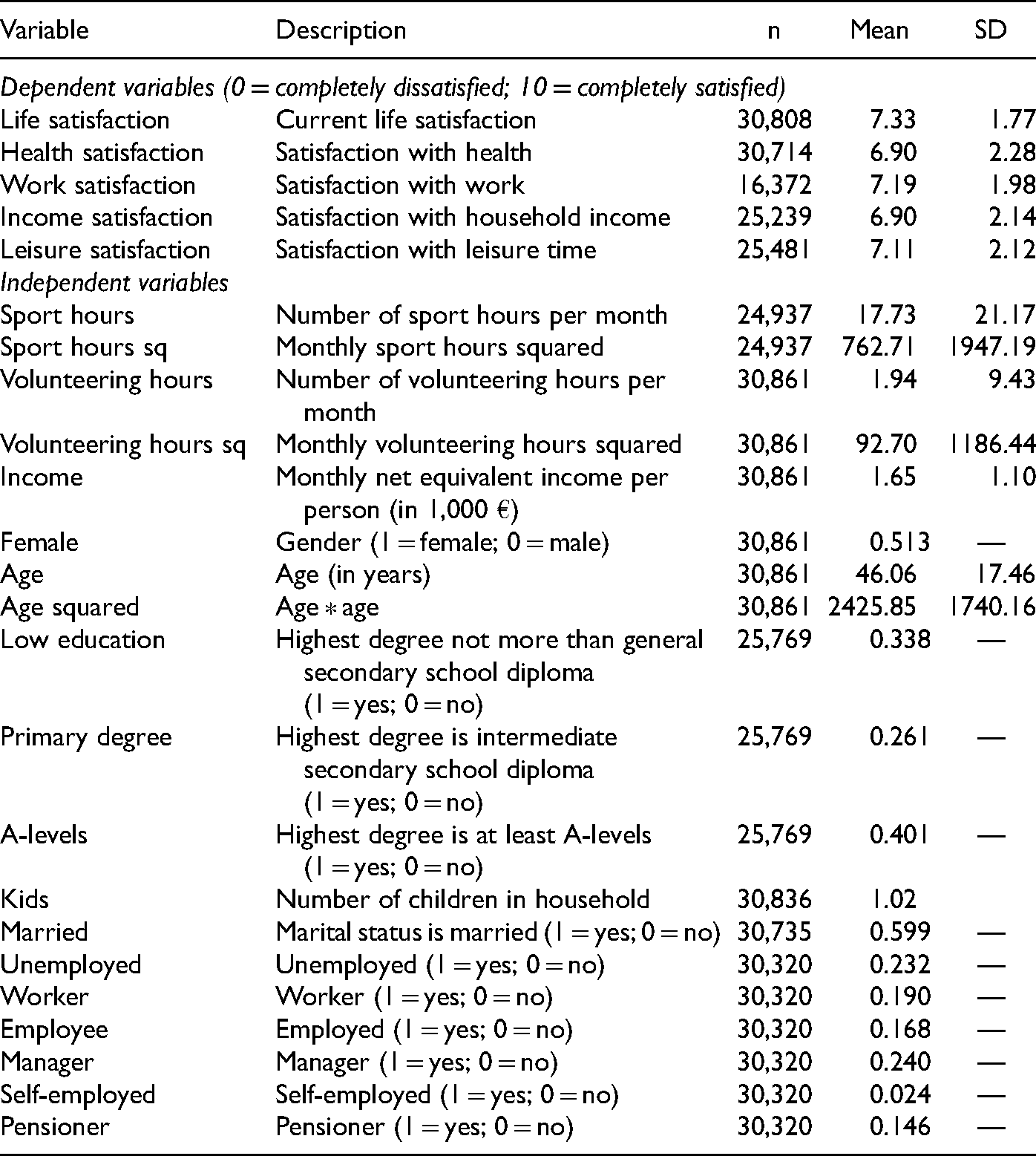
The independent variables of interest were the number of sporting hours and volunteering hours per month. The number of sporting hours was calculated from a list of activities asking respondents how many hours they engage in different daily activities on an average work day as well as a typical Saturday and Sunday. These hours were added up to reflect the number of weekly hours and multiplied by 4.348 that they reflect monthly hours. The number of monthly volunteering hours was calculated from a set of questions asking if respondents have a second or third job activity (in addition to their regular paid occupation) and if this activity is a side job or a voluntary activity. Respondents were asked to state how many days per month they spend on average on this activity and how many hours per activity day. Multiplication of the days per month with the hours per day results in the number of monthly volunteering hours.
The volunteering measure is a generic, not a sport-specific one, as voluntary coaching in sport (which is also available) is a too rare event in the data. The study also included the squared terms of sporting and volunteering hours to control for possible non-linear effects of both sport participation (Wicker & Thormann, 2021) and volunteering (van Willigen, 2000; Windsor et al., 2008). The income measure reflects the monthly net equivalent income per person according to the OECD-modified equivalence scale (Hagenaars et al., 1994). This scale considers that more individuals in a household lead to more economic needs, but not in a proportional way. It was obtained from a question assessing the joint monthly net income of all household members including salaries, pensions, child benefits, unemployment benefits etc. This value is divided by the number of the household members according to their age. The above scale assigns a weight of 1.0 to the household head, 0.5 to each subsequent person aged 14 years and older, and 0.3 to children under 14 years. In line with previous research (e.g. Downward & Dawson, 2016; Huang & Humphreys, 2012; Ruseski et al., 2014), the study included a number of control variables that could also affect SWB, such as gender, age, educational level, children, marital status, and employment status (Table 1).
Empirical Analysis
The empirical analysis consisted of four steps, with three steps consisting of different regression models and the last step of estimating monetary values. First, ten linear regression models (OLS) were calculated with the five different SWB measures as dependent variables. The first set including five models (Models 1a-5a) analyzed the effect of sporting and volunteering hours on those SWB measures. The second set extended these models by adding squared terms for sporting and volunteering hours to control for non-linear effects (Models 1b-5b).
In a second step, seemingly unrelated regression (SUR) models were calculated to check the robustness of the linear regression models. Since all five dependent variables are SWB measures, it can be assumed that the error terms of the five equations correlate with each other. Such a potential correlation can be checked with the Breusch-Pagan test which tests for the independence of error terms (Breusch & Pagan, 1980). This test was statistically significant for the models excluding (χ2 = 17820.91; p < 0.001) and including squared terms of sporting and volunteering hours (χ2 = 17714.00; p < 0.001), indicating that the five SWB variables are not independent of each other. SUR allows the equations to be related through the correlation in the error terms (Srivastava & Giles, 2020). Collectively, these test results indicate that SUR models should be preferred over separate linear regression analyses because the SUR estimates are more efficient in such a case (Zellner, 1962). Altogether, two SUR models were estimated, one excluding squared terms (Model 6a) and one including them (Model 6b).
The third step considers potential reverse causality of sport participation, volunteering, and the five SWB measures (Guan & Tena, 2021). The previous estimations give only information about relationships, but not causal effects. Previous studies indicated that causality might also go in the other direction, meaning that happier people are more likely to participate in sport and volunteer (Ruseski et al., 2014; Wicker & Downward, 2020). To test for potential endogeneity, two Sargan-Hansen tests were employed, with the corresponding Hayashi C statistics 1 indicating that endogeneity might be a problem for both sporting and volunteering hours.
To address the endogeneity issue, instrumental variable (IV) models were estimated. The generalized method of moments (GMM) estimator requires IVs that are correlated with sporting and volunteering hours, but not with the SWB measures (Baum et al., 2003). The instruments are three variables representing the number of sport clubs in the state per 1,000 residents in 2017 (German Olympic Sports Confederation [DOSB], 2018); the number of fitness centers in the state per 100,000 residents in 2017 (German Fitness Industry Association [DSSV], 2017), and the percentage of volunteers per federal state as reported in the 2014 volunteering survey of the German Federal Ministry of Family Affairs (2017). Instruments capturing the supply of sport facilities have already been employed in previous research (e.g. Huang & Humphreys, 2012; Ruseski et al., 2014; Wicker & Downward, 2020). Several diagnostic tests confirm the relevance and validity of the instruments. All F-tests of the first-stage regressions are higher than 10, showing the relevance of the instruments (Stock et al., 2002). Moreover, the Hansen J test is insignificant, accepting the null hypothesis that no correlation between the instrumental variables and the error terms exists, which satisfies the orthogonality conditions required for their employment (Baum et al., 2003). Hence, another set of IV models was estimated (Models 7–11) excluding squared terms.
In all regression models of steps 1–3, the remaining variables from Table 1 were included as control variables. Except of the squared terms, correlation coefficients were below 0.8 and variation inflation factors (VIFs) were below 10, suggesting that multicollinearity does not present an issue in the analysis.
In a final step, monetary values, or shadow prices (Powdthavee, 2008), for sporting and volunteering hours were calculated based on the results of the above models. The monetary values are obtained through the marginal rate of substitution of sporting and volunteering hours, meaning the coefficients for sporting and volunteering hours are divided through the income coefficient. For this step, it is important that the coefficients are statistically significant. Otherwise, no monetary values can be calculated (Powdthavee, 2008).
Results
Table 1 reports the summary statistics. Average life satisfaction is 7.33 on a scale from 0 to 10. The mean values of the life domains are lower, with respondents scoring 7.19 on satisfaction with work, 7.11 on satisfaction with leisure time, and 6.90 on satisfaction with both health and household income. On average, respondents participate 17.7 h per month in sport and spend 1.9 h on volunteering. Average monthly net equivalent income per person is €1,651. The descriptive statistics of the remaining variables can be retrieved from Table 1.
Table 2 displays the OLS models excluding squared terms, while Table 3 provides the models including squared terms. Models 1a-5a in Table 2 show that sporting and volunteering hours have a significant positive association with the global SWB measure and the four life domain variables with one exception – the effect of sporting hours on satisfaction with work is not significant. Income also has a significant positive effect on all SWB measures. The OLS models including squared terms (Table 3) also show positive associations between sporting and volunteering hours with all five SWB measures, again with the exception of sporting hours in the work satisfaction model. Notably, the squared terms of sporting and volunteering hours are negative in all models (again except for the work satisfaction model), indicating that the relationship between sporting and volunteering hours with SWB is inverse u-shaped in nature. The income effect is again positive and statistically significant, meaning that the wellbeing valuation approach can be employed.
OLS Regression Results (Excluding Squared Terms).
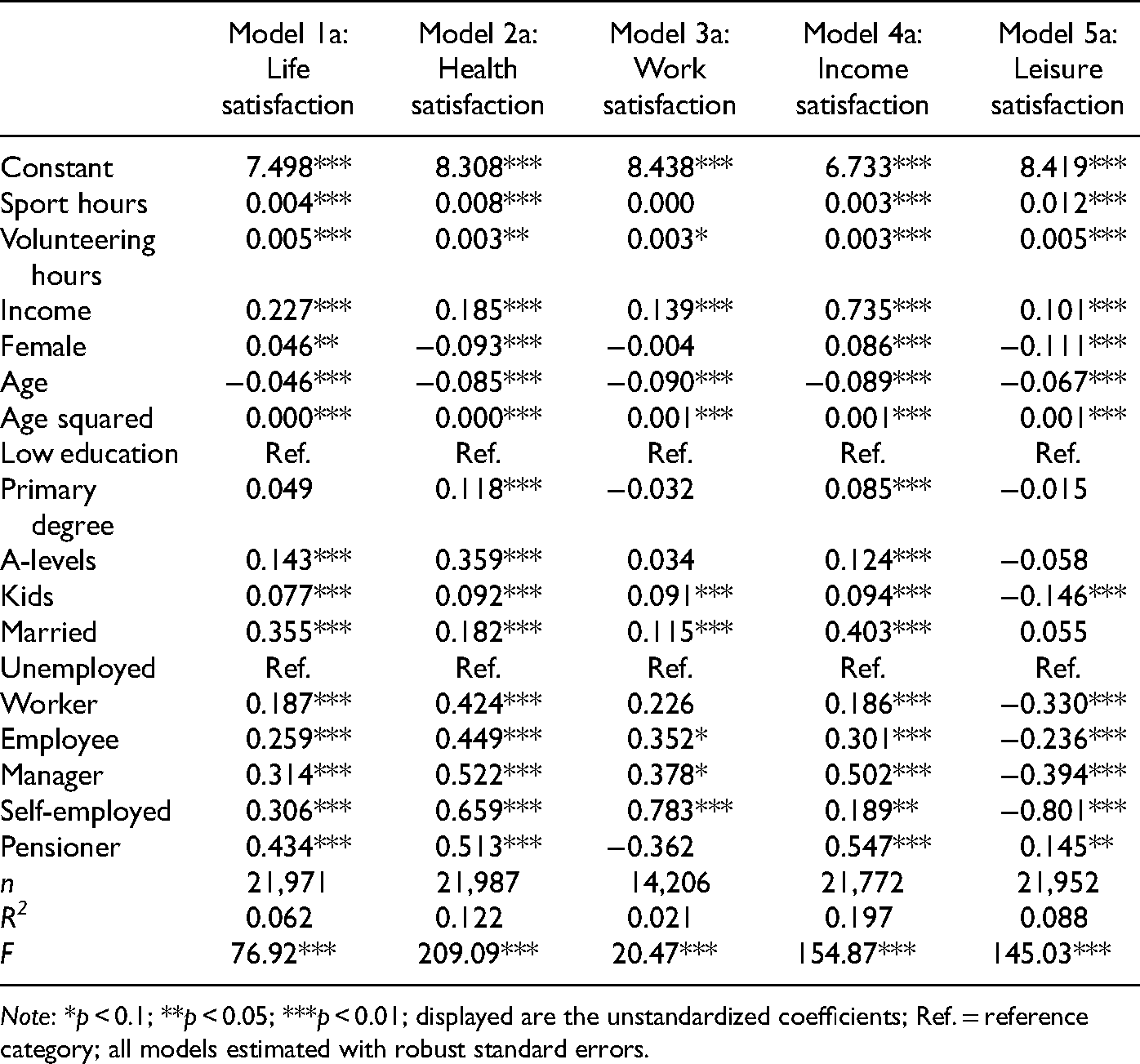
Note: *p < 0.1; **p < 0.05; ***p < 0.01; displayed are the unstandardized coefficients; Ref. = reference category; all models estimated with robust standard errors.
OLS Regression Results (Including Squared Terms).
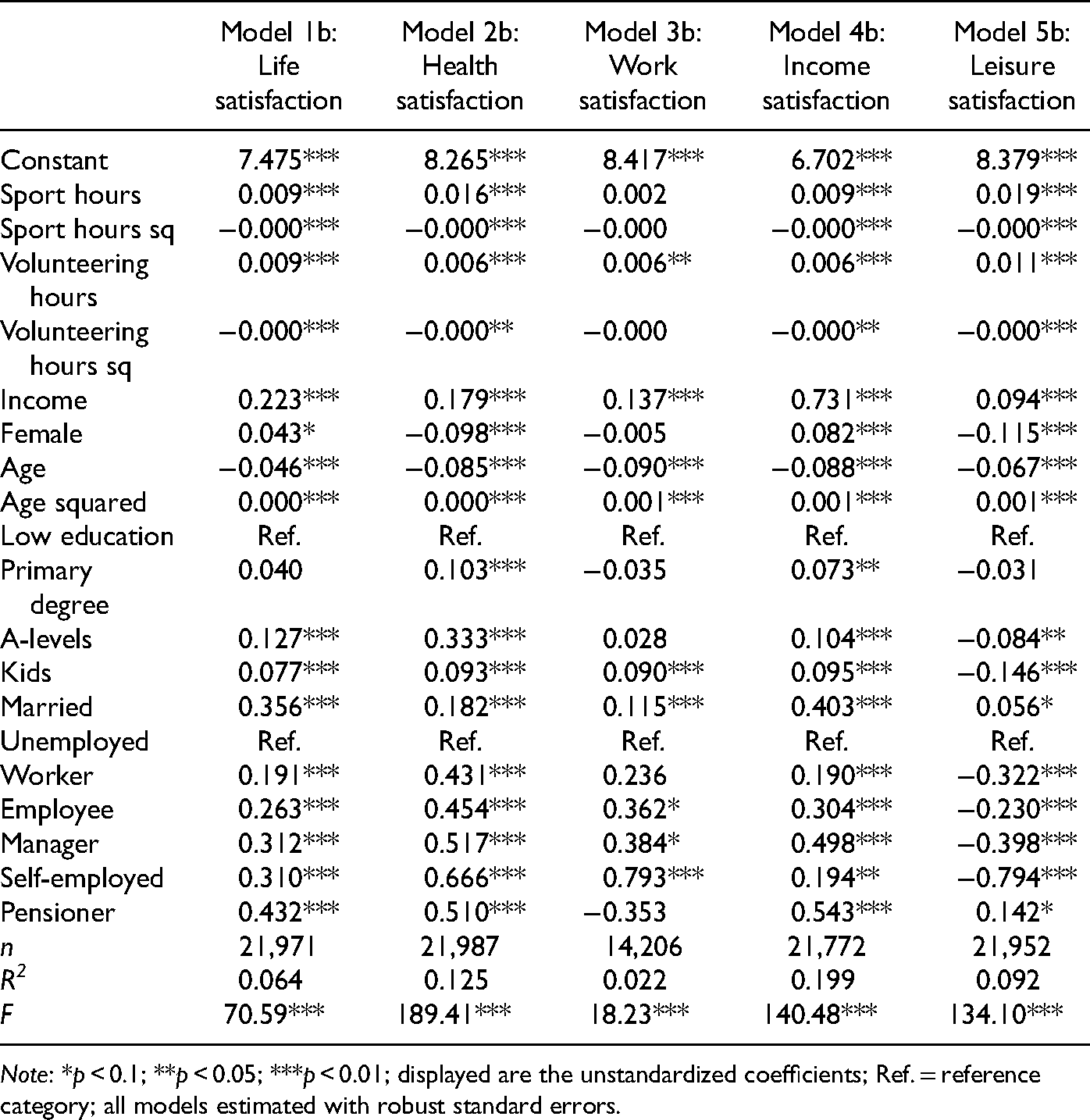
Note: *p < 0.1; **p < 0.05; ***p < 0.01; displayed are the unstandardized coefficients; Ref. = reference category; all models estimated with robust standard errors.
Table 4 summarizes the results of the SUR models, with Model 6a (6b) excluding (including) squared terms of sporting and volunteering hours. Model 6a supports the OLS findings from Table 2 in the sense that sporting hours is positively associated with all SWB measures except work satisfaction. Volunteering hours is positively associated with the global SWB measures and with satisfaction with work and leisure time. In Model 6b, the squared of sporting hours is negative, meaning that the relationship between sporting hours and four SWB measures (life, health, income, leisure time) is inverse u-shaped in nature. Again, the effect of sport hours on work satisfaction is not significant. For volunteering, an inverse u-shaped effect is evident for life and leisure time satisfaction, while the effect on work satisfaction remains positive as the squared term is not significant. The relationship between volunteering hours and satisfaction with both health and income is not significant.
Seemingly Unrelated Regression Results (n = 14,110).
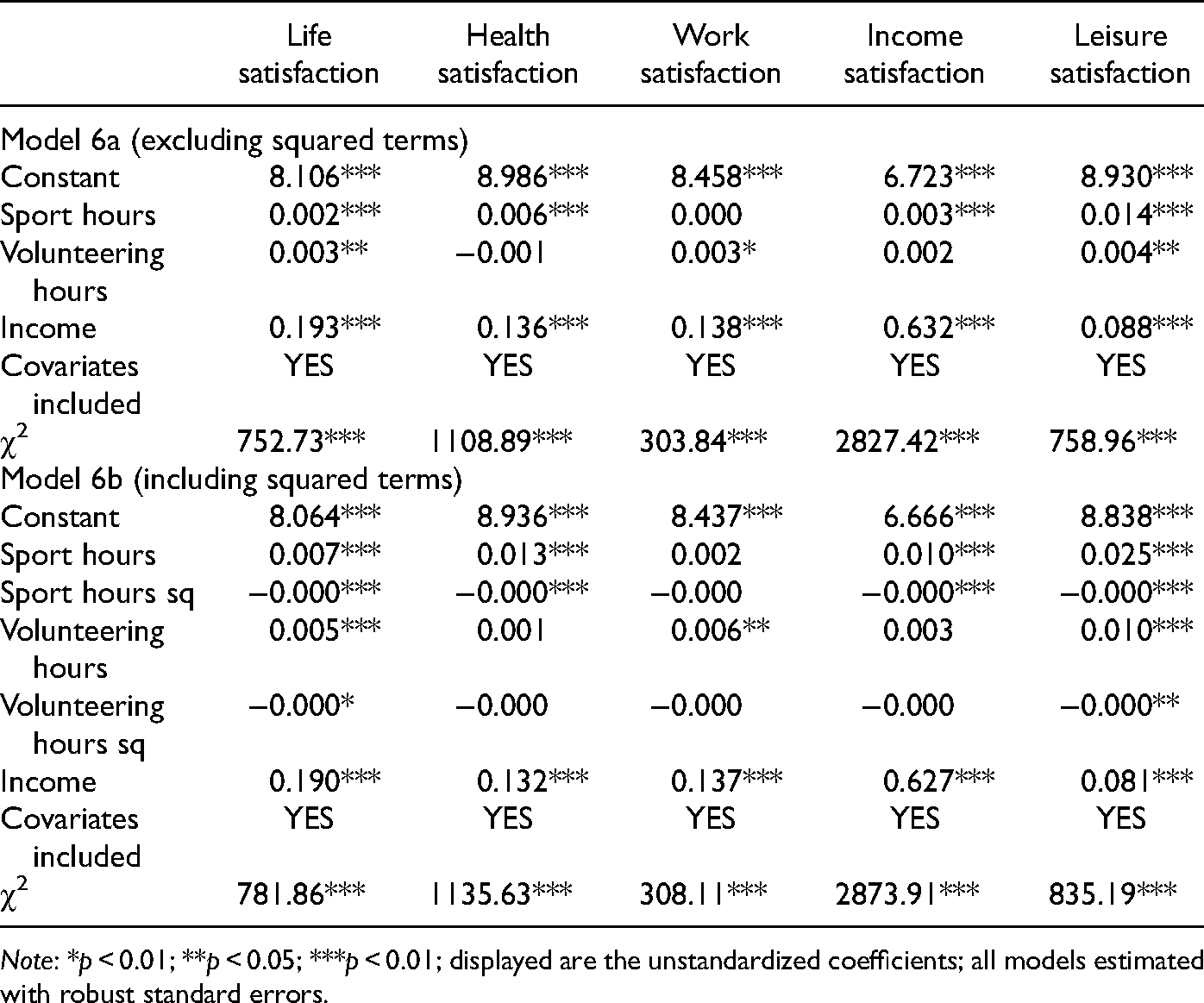
Note: *p < 0.01; **p < 0.05; ***p < 0.01; displayed are the unstandardized coefficients; all models estimated with robust standard errors.
Table 5 displays the results of the IV estimates using GMM. The number of sporting hours has a significant and positive causal impact on all five SWB measures, while the number of volunteering hours is only positive and significant in the model for health satisfaction. Income is only significant in two out of five models, i.e. in the life satisfaction and income satisfaction model, implying that monetary values can only be calculated from these models.
Instrumental Variables Results (GMM).
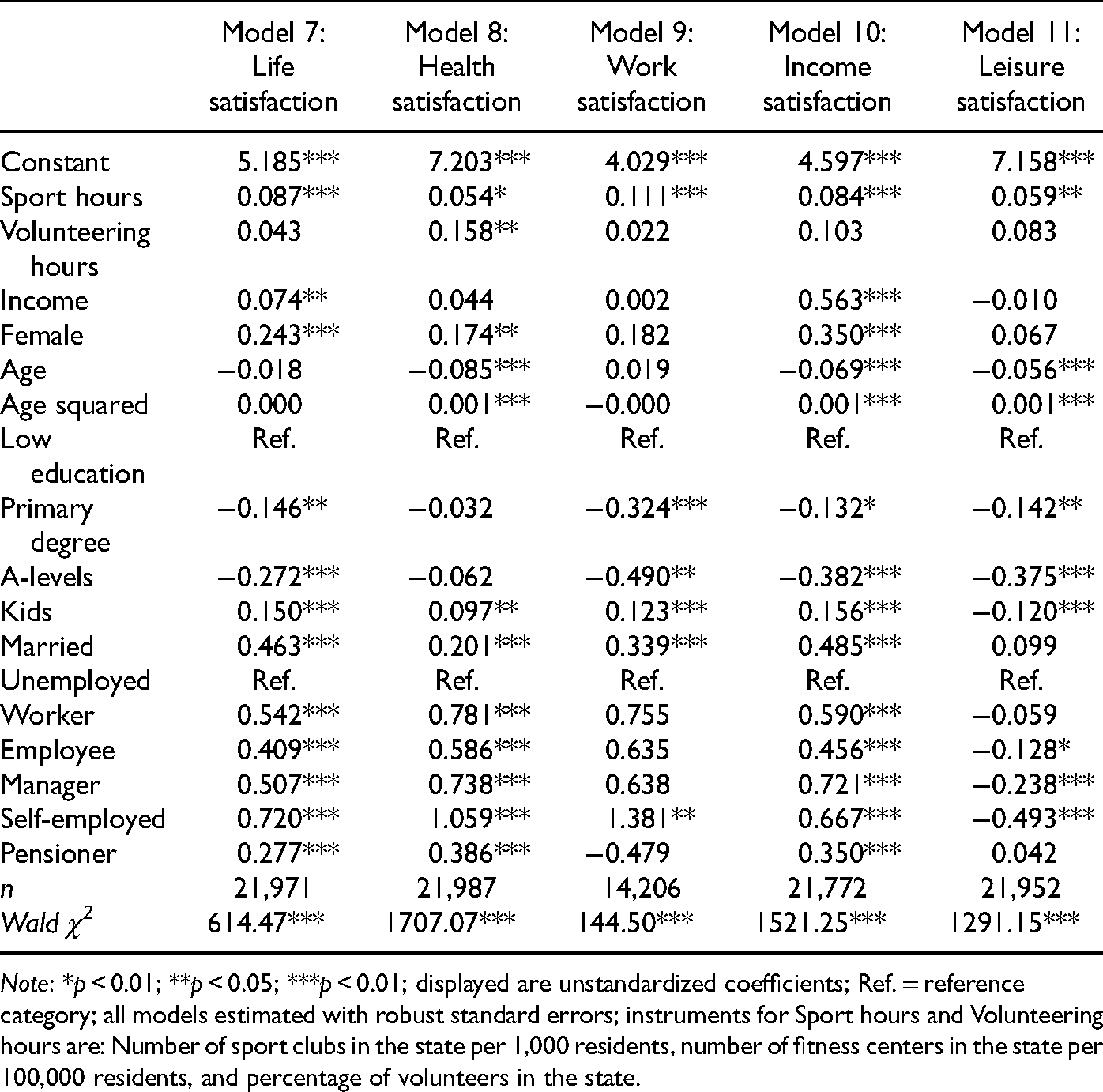
Note: *p < 0.01; **p < 0.05; ***p < 0.01; displayed are unstandardized coefficients; Ref. = reference category; all models estimated with robust standard errors; instruments for Sport hours and Volunteering hours are: Number of sport clubs in the state per 1,000 residents, number of fitness centers in the state per 100,000 residents, and percentage of volunteers in the state.
Table 6 gives an overview of the monetary values for one sporting and volunteering hour per month that were obtained from different SWB measures and different types of estimators. For example, one hour of sport per month is valued at €18.73 in the OLS life satisfaction model, €11.05 in the SUR model, and €1167 in the GMM model. The monetary values were higher for health satisfaction and lower for income satisfaction. The leisure satisfaction model yielded the highest monetary values for one hour of sport. Because of insignificant effects, none of the work satisfaction models produced any monetary values.
Overview of Monetary Values for one Sporting and Volunteering Hour per Month (in €) Obtained from the Wellbeing Valuation Approach.
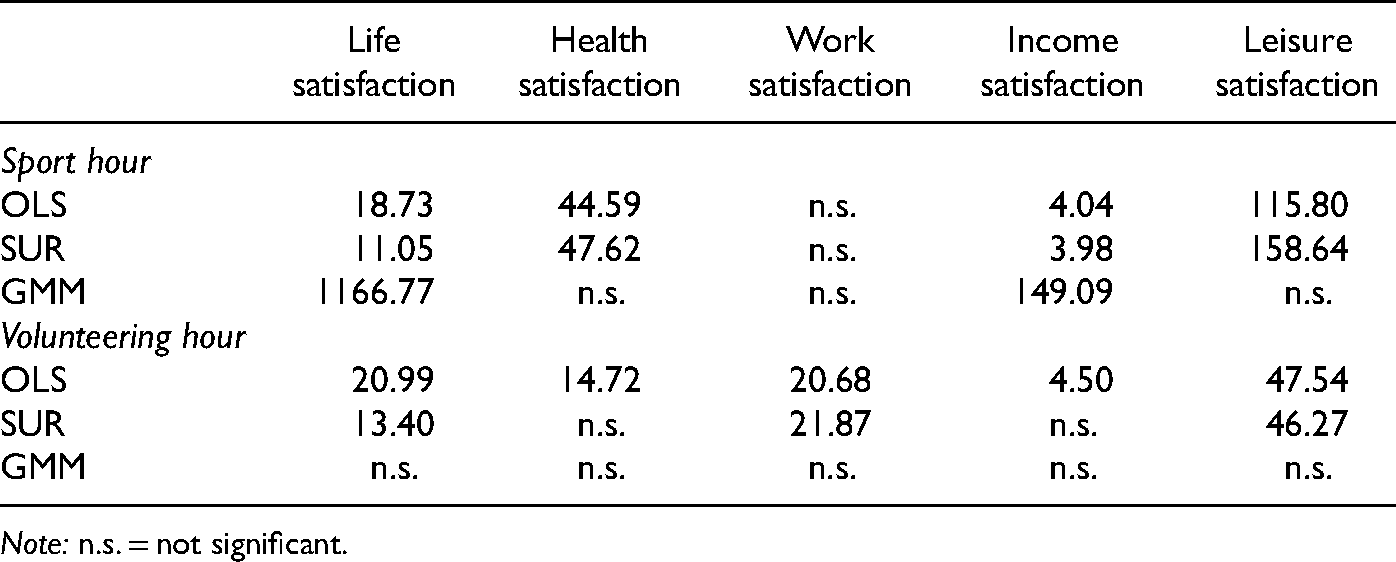
Note: n.s. = not significant.
Turning to volunteering, one hour is valued at €20.99 in the OLS model for life satisfaction and €13.40 in the SUR model. The work satisfaction OLS model has produced a similar value, while the corresponding SUR value is higher. Like for sport, the monetary values of the income satisfaction model are lower, while the leisure satisfaction model yielded the highest monetary values. No monetary values of volunteering could be estimated from the GMM models because of insignificant effects of either volunteering or income.
Discussion
This study set out to examine the association between sporting and volunteering hours with different SWB measures. Monetary values of one sporting hour and volunteering hour were assigned using the wellbeing valuation approach, recognizing that these monetary values differ depending on the type of SWB measure employed and the type of estimator. Data from the GSOEP were used which is largely representative of the German resident population. A set of regression models including OLS, SUR, and GMM models were estimated which served as the basis for the final monetary valuation.
Before the models results and monetary values are discussed in detail, attention is given to the control variables. Specifically, the effects of the control variables on the global SWB measure are in line with existing studies showing that age has a u-shaped effect on SWB and that children, marriage, higher educational levels, and (better) employment contribute positively to SWB (e.g., Downward & Dawson, 2016; Huang & Humphreys, 2012). These effects are also evident in the domain-specific models examining satisfaction with health, work, and income. Only the models for satisfaction with leisure time shows different directions of effects for some of the control variables. However, collectively, the effects of the control variables are similar to previous research and across employed estimators, indicating that the effects of the variables of interest are credible.
Starting with the effects of sport participation on SWB, the positive associations of sporting hours on the global SWB measure in the OLS, SUR, and GMM models are in line with existing research (Downward & Dawson, 2016). These positive effects in the linear and IV models are also evident for specific life domains including satisfaction with health, income, and leisure time. Hence, sport does not only improve overall SWB, but also satisfaction with these life domains. The positive effects on health and leisure time satisfaction echo existing research (Wicker et al., 2015; Wicker et al., 2020). However, these previous studies focused on subgroups of the population such as fitness participants (Wicker et al., 2015) and residents under 30 years (Wicker et al., 2020).
For work satisfaction, the OLS and SUR findings might suggest that work-related satisfaction is driven by other factors and not leisure-time sport participation. However, the effect of sporting hours is positive and statistically significant in the GMM model and hence causal in nature. Consequently, sport participation also increases SWB in this life domain. Typically, statistical significances become less likely as we move from linear to IV models; however, the combination of nonsignificant associations in the linear models and significant effects in the IV model is not uncommon (e.g., Wicker, 2020).
This study is one of few studies also including squared terms of sporting hours in the empirical models. Except for the work satisfaction models, these squared terms are significantly negative, indicating diminishing SWB returns when the number of sporting hours increases. These diminishing returns have been hardly studied in previous research as typically higher sport frequency (Orlowski & Wicker, 2018) and sport duration (Downward & Dawson, 2016) yielded higher levels of SWB. However, Wicker (2020) already indicated that the SWB effects depend on the purpose of sport participation, with competitive sport participation purposes not adding to SWB. The inverse u-shaped effect of sporting hours on the global SWB measure echoes Wicker and Thormann (2021) also documenting diminishing returns of sporting hours on the SWB of active sport club members in Germany. The present study extends this body of knowledge by showing that this relationship is also evident for the resident population and for SWB in specific life domains including health, income, and leisure time.
The monthly monetary value of €18.73 is within the range of monetary values obtained in two studies in the UK. Specifically, the monthly values were £9 (Downward & Rasciute, 2011) and £18 (Downward & Dawson, 2016) in these previous studies, which were equivalent to €13 and €22 at the time of the respective surveys. Monetary values of sporting hours for specific life domains have not yet been estimated in previous studies. The present OLS and SUR findings indicate that sport participation contributes much more to SWB in the domains of health and leisure time than to overall life satisfaction and income satisfaction. The monetary values obtained from the GMM models are much higher and can be considered extraordinarily high. The source of these substantial increases is not clear. Altogether, the monetary values from GMM models might be less suitable for inclusion into SROI analyses.
Turning to the effects of volunteering hours, the positive association with the global SWB measure is in line with previous research (Becchetti et al., 2008; Downward & Dawson, 2016). The SUR models considering the correlation between the five SWB measures, however, suggest that the previous effects on health and income satisfaction were overlapped by the other SWB measures as they turn insignificant. Hence, when considered together, volunteering is only significantly and positively associated with life, work, and leisure time satisfaction. In the GMM models, only the effect of volunteering hours on health satisfaction is causal in nature, meaning that volunteering adds to satisfaction with health. For the other life domains, the findings suggest that the causality might go in the other direction, implying that people who are more satisfied with their life as a whole as well as with the domains of health, work, and leisure time are more likely to volunteer many hours.
The OLS findings also show that the relationship between volunteering and SWB is not linear in nature as an inverse u-shaped effect was detected for all SWB measures except work satisfaction. The inverse u-shaped effect of volunteering hours on the global SWB measure is in line with previous research (van Willigen, 2000; Windsor et al., 2008). The effects on the life domain measures add to the body of knowledge as these have not yet been examined. Likewise, the SUR model identified some overlapping effects, meaning that the inverse u-shaped relationship only remains for life and leisure time satisfaction.
The monetary values for one hour of volunteering that were obtained in the models for the global SWB measure (i.e. €21 in OLS and €13 in SUR) are within the range of values from previous studies. However, in the context of volunteering, these values were obtained using other valuation approaches such as the OCA and RCA which have their methodological limitations (Orlowski & Wicker, 2015; Salamon et al., 2011). The wellbeing valuation approach has the advantage that it employs an output perspective and examines the outcomes of the volunteering activity rather than the inputs. Also, it relies on revealed preference rather than stated preference data. Hence, this approach can be considered a suitable method for monetary valuation studies and complements the portfolio of valuation approaches.
The findings have implications for researchers and policy makers interested in SROI analyses relying on such monetary values for sport participation and volunteering. As shown in this study, the wellbeing valuation approach represents a feasible method for producing monetary values for sporting and volunteering hours that can be entered into SROI models. However, it must be considered obtained estimates are sensitive to both the underlying SWB measure and the type of estimator. Looking at the different SWB measures, monetary values are highest for satisfaction with leisure time and lowest for income satisfaction (except the GMM value). When employing OLS and SUR estimators, the range of monetary values can be considered credible. Although the GMM models consider the causal impact of sport and volunteering on SWB, they yield monetary values that are substantially higher than those of the other two approaches and any values in previous research. Also, many variables are not significant, meaning that no monetary values can be estimated from these models. The GMM estimator scores high on adequacy because of the addressed causality, but scores low on practicality and credibility. Therefore, scholars should carefully reflect upon the use of this estimator within SROI studies.
Conclusion
This study examined the effects of sporting and volunteering hours on several SWB measures and estimated monetary values using the wellbeing valuation approach. It provided evidence that sport participation and volunteering do not only contribute to individuals’ overall life satisfaction, but also to specific domains in life including satisfaction with health, work, income, and leisure time. However, a nuanced look is necessary as the contribution of sport and volunteering to some life domains is overlapped by other life domains. Moreover, diminishing SWB returns can be observed when the number of sport and volunteering hours increases. The monetary values obtained with the wellbeing valuation approach varied depending on the SWB measure and the estimator. Collectively, this valuation approach can be considered a promising method for future valuation studies.
This work has some limitations that can guide future research. It is limited to the available data and variables, meaning that the data are only cross-sectional in nature and the sport participation variable only considered the duration, but not the intensity of sport participation. Given that sport purposes characterized by higher intensities were found to yield negative or no SWB effects (Wicker, 2020), future research should explore these effects in more detail for different life domains. Moreover, future research could study how different types of sport contribute to individuals’ global SWB and satisfaction with specific life domains.
Footnotes
Data Availability Statement
The data for this article are publicly available and also from the authors upon request.
Declaration of Conflicting Interests
The author(s) declared no potential conflicts of interest with respect to the research, authorship, and/or publication of this article.
Funding
The author(s) received no financial support for the research, authorship, and/or publication of this article.
