







Abstract
While many metrics may be used to assess the quality of U.S. prelicensure nursing programs, one commonly accepted metric is the student pass rate on the National Council Licensure Exam (NCLEX). NCLEX pass rates are increasingly being used in research projects, and it is critical to have consistent and complete data for such projects. These data are also important to the public for informed decision-making. In the age of open science and data sharing, there is no reason that these data should not be readily available and consistently reported to the public. The aim of this study was to determine how many, and which, state boards of nursing (BONs) publicly report NCLEX pass rates by nursing program. A descriptive, cross-sectional study design was used to examine each state BON website for NCELX pass rate data by program. Initial results indicated that 47 states and the District of Columbia reported NCLEX pass rate data by nursing program through their BON website. At the outset of this study, Alaska, Michigan, and Vermont did not report NCELX pass rate data by program. Michigan posted four years (2021–2024) of NCLEX pass rates by nursing program in February 2025. Amounts and types of data reported were reported inconsistently across states. NCLEX pass rate data by program should be transparently and consistently reported, in a standardized format by all states to facilitate nursing research, equitably inform the public, and increase trust.
Currently, there are more than 4.8 million registered nurses in the United States (National Council of State Boards of Nursing [NCSBN], 2024a) and nurses are the largest segment of the U.S. health care workforce (American Association of Colleges of Nursing [AACN], 2024). Passing the National Council Licensure Examination (NCLEX) is the final step a nursing student must take to practice as a registered nurse after graduating from an approved, prelicensure, nursing program (NCSBN, 2023a). Consequently, the percentage of students passing the NCLEX, typically, on the first attempt, is widely accepted as an indicator of quality for a prelicensure nursing program (Spector et al., 2020).
During the COVID-19 pandemic, pass rates dropped across the country. Nationally, the pass rate for U.S.-educated, first-time test takers fell from 88.2% in 2019 to 79.9% in 2022 (NCSBN, 2020; 2022). Educators attributed this drop to the major changes in educational practices such as increased online teaching, fewer on-site clinicals (Feeney, 2023) and increased stress and anxiety among students (Kells & Jennings Mathis, 2023) and faculty (Jun et al., 2020). Indeed, research from Spector and Silvestre (2024) recently confirmed these major problems and other disruptions to nursing education because of the pandemic. However, in April 2023, there was a change in the NCLEX testing style, known as Next Generation NCLEX, which placed more emphasis on the clinical judgement of test-takers; it also introduced polytomous scoring methods, allowing for partial credit (NCSBN, 2024b). After this change, pass rates bounced back; in 2023 the pass rate for U.S.-educated, first-time test takers was 88.6% (NCSBN, 2023b).
On the internet, third-party websites often report the NCLEX pass rates for each nursing program in a state, but noticeably in the spring of 2023 these data were not available in the state of Michigan. One website included the following statement: “The Michigan Board of Nursing does not provide NCLEX pass rate information for individual programs” (Nursing Schools 411, 2024, para 8). In the neighboring state of Ohio, however, the data were readily available on the state BON website.
Since 2015, the NCLEX has also been used to license registered nurses in all provinces of Canada (except Quebec; Singh-Carlson & May, 2020), and like the United States, each province has its own nursing regulatory body (or bodies; Canadian Nurses Association, 2025). NCLEX pass rate data by nursing program in Ontario were found on the College of Nurses of Ontario (2024) website. Although, not all provinces seemed to follow this model. For example, the British Columbia College of Nurses & Midwives (BCCNM) posted aggregate numbers on the total number of exam writers, passes, failures, and the yearly provincial pass rate, but no data by nursing program were found. Further, the following statement was noted, “BCCNM is currently reviewing how we report exam result data. Until the review is complete, no additional results will be posted. Education programs will be informed of their aggregate exam results directly” (BCCNM, 2025). Likewise, in their annual report, the College of Registered Nurses of Saskatchewan (CRNS) released the aggregate number of first time NCLEX exam writers in the province and the pass rates for the last three years (e.g., Total Writers 2021 = 561; Pass Rate 85%; Total Writers 2022 = 490; Pass Rate 74%; Total Writers 2023 = 583; Pass Rate 85%) without giving data by nursing program (CRNS, 2024a, p. 25). This may be due to the relatively small number of programs in the province (CRNS, 2024b). It was beyond the scope of this study to examine all 13 Canadian provinces for these data. Nevertheless, Ontario provided a good model of data transparency across nursing programs, and in this age of big data and open research, such quality measurement data should be readily available. Thus, it was decided to examine all state board of nursing websites to answer the following research question: Across the 50 states and the District of Columbia, how many, and which, state boards of nursing (BONs) provide NCLEX pass rate data by program?
Background
Using NCLEX pass rates as a measure of nursing program quality is controversial (Taylor et al., 2014). Granted, there are other metrics to measure program quality such as the number of doctoral prepared faculty members and student support services (Spector et al., 2020). Nevertheless, the first-time NCLEX pass rate is a widely accepted metric of quality used by all nursing program accrediting bodies including the Accreditation Commission for Education in Nursing (2024), the Commission on Collegiate Nursing Education (2018), and the National League for Nursing Commission for Nursing Education Accreditation (2021).
Complete program pass rate data are needed to conduct robust research on nursing education. Notably, the pass rate standard (i.e., the threshold below which a program is considered deficient) varies from state to state (NCSBN, 2024c). For example, in South Carolina a nursing program is considered deficient if the annual NCLEX pass rate is more than 5% percent below the national pass rate, while in many other states, such as Massachusetts, the threshold is an annual NCLEX pass rate of 80% for first-time test-takers (NCSBN, 2024c). In an analysis of the variation of NCLEX pass rate standards across the United States, Foreman (2017) identified 45 states (and the District of Columbia) that published NCLEX pass rates for each nursing program. However, only 34 states reported the number of test-takers (N) and these data were necessary for calculating confidence intervals. Using data from these 34 states, Foreman computed 95% confidence intervals for nursing program pass rates from 2010 to 2014 and found that approximately 17% of determinations regarding meeting, and 28% of determinations regarding failing to meet the established state pass rate standard may have been flawed. Foreman's dataset, however, was limited to 79% of test-takers because not all data were publicly disclosed (Foreman, 2017). He called not only for a national pass rate standard, but also for complete disclosure of pass rate data. As such, the purpose of this study was to identify how many, and which, BONs publicly report NCLEX pass rates for each prelicensure registered nursing program in the state.
Method
This study employed a descriptive, cross-sectional design. The NCSBN website was utilized to quickly identify and access each state (and the District of Columbia) BON website. Then, each website was examined for inclusion of NCELX pass rate data by program. Websites were initially searched during April–May 2023, and the searches were repeated in May–July 2024 and February 2025. The NCLEX information was most often found under a tab labeled “education” or by searching “NCLEX pass rates” in the search box on the website. Information about the data available from each state was collected in an Excel spreadsheet.
Results
In initial results, 47 states and the District of Columbia transparently reported NCLEX-RN pass rates by nursing program. No NCLEX pass rate data by program were found for the states of Alaska, Michigan, and Vermont. However, when updating the table of results, it was noted that Michigan uploaded four years of NCLEX pass rate data by program in February 2025. Currency (i.e., year available), amount (i.e., number of years), and type (e.g., first-time, repeat, or all test-takers; number of test-takers, passes, and failures; academic, calendar, or fiscal year) of data reported varied across all states. For example, in 24 states plus the District of Columbia the most recently reported data were from 2023; and in the other 24 states the most recent data were from 2024. The timeframe of data reporting was typically by calendar year including terms such as annual or yearly; four states reported data by fiscal year and two states had atypical timeframes including school year and October 1, 2022–September 30, 2023. Of those states reporting program pass rate data, 42 states and the District of Columbia provided the number of test-takers, while six states did not. The data are presented in Table 1.
Publicly Available NCLEX Pass Rate Data by Nursing Program.
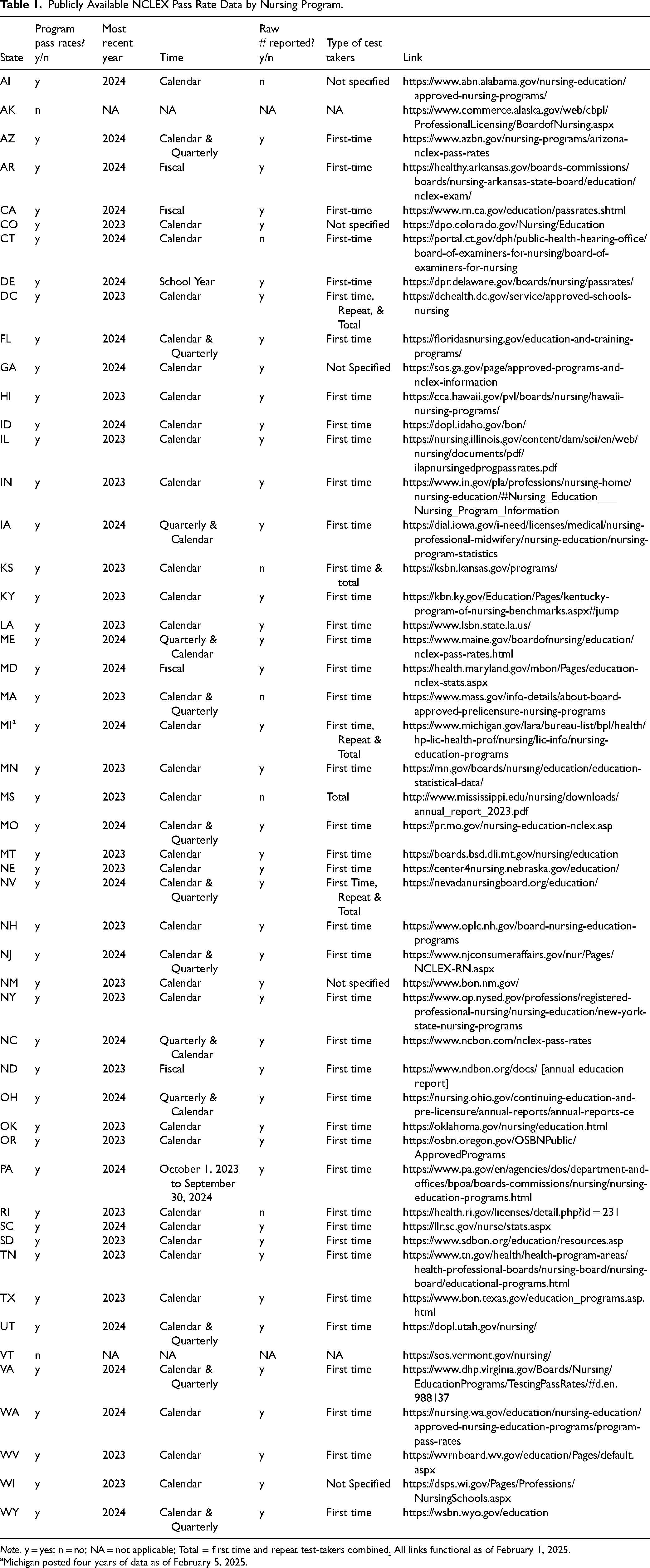
Note. y = yes; n = no; NA = not applicable; Total = first time and repeat test-takers combined
aMichigan posted four years of data as of February 5, 2025.
Discussion
Alaska, Michigan, and Vermont were originally the only three states where NCLEX-RN pass rate data by program were not found on, or through, the state board of nursing website. Alaska and Vermont are small states with only four prelicensure registered nursing programs in each state (State of Alaska, n.d.a; Vermont Secretary of State, 2022). The Alaska BON is facing staff shortages (State of Alaska, n.d.b) and Vermont's nursing programs have been in transition with three institutions merging into one as of July 2023 (Vermont State University, n.d.). Michigan, on the other hand, is a substantially larger state, with 74 prelicensure registered nurse programs in the state across approximately 60 institutions (State of Michigan, 2024), but until February 2025 the state BON did not post NCLEX pass rate data by program. This lack of transparency was distressing, but apparently not unusual; a 2015 investigation by the Center for Public Integrity and Global Integrity ranked the state of Michigan last in the country on government transparency (Kusnetz, 2015).
Incomplete NCLEX data may diminish the strength of nursing education research studies. The first necessary element for reliable research is disclosure of complete and consistent data. This should include establishing clear, uniform standards for reporting NCLEX data from every nursing program across the country including the number and type of test-takers (e.g., first time, repeat, or all test-takers), the percent passing, and a consistent format for the time period in which scores are reported (e.g., calendar, academic, or fiscal year). These data are necessary for researchers and members of the public to make robust comparisons and informed decisions.
Program pass rate data are reported to schools of nursing by NCSBN in a standard format, but are being released to the public by state BONs in very heterogeneous formats. A fiscal year rate in one program is not directly comparable to a calendar year rate in another program. Lack of transparency prevents stakeholders and the general public from accessing and using NCLEX pass rate data by program to make informed decisions. Similarly, a lack of standardized data reporting makes research and comparisons across nursing programs more difficult. Data harmonization and standardization are major issues in clinical research, data science, and informatics (Cheng et al., 2024). For example, a pediatrician from Children's Hospital of Philadelphia illustrated the difficulties with respect to standards by citing a one-day record from Children's Hospital in Philadelphia in which clinicians entering data into electronic medical records (EMRs) used 278 ways to describe fever for 465 patients, 123 different ways to express ear pain in 213 patients, and 99 different ways to describe red ears (Rubinstein et al., 2010, p.397).
Competition
Educating nursing students sufficiently so they can pass the licensing exam is obviously critical, as the NCLEX is considered the measurement of minimum knowledge for safe entry into practice (Spector et al., 2020). Withholding program pass rate data puts prospective students, their families, and other members of the public at a disadvantage because they cannot consider these data for informed decision-making. Moreover, citizens whose tax dollars contribute to funding the public university and community college nursing programs deserve access to this common benchmark about the quality of the education being provided.
In addition, programs that withhold this information may disadvantage students and those programs that do transparently disclose NCLEX data. Students may believe unsubstantiated advertising claims on school websites about preparing them to pass the NCLEX, and naïvely choose programs with undisclosed and potentially low pass rates, instead of making data-based decisions. Therefore, leaders of transparent nursing programs should pressure the remaining states to post this information in the spirit of equity and fairness.
Multistate Licensure
Forty states (and two U.S. territories) have enacted the Nurse Licensure Compact (NLC) which allows a registered nurse to have “one multistate license with the ability to practice in the home state and other compact states” (NCSBN, 2024d). Especially given the advent of multistate licensure, state BONs should collaborate to create uniform standards on a host of nursing regulatory requirements including pass rate standards and the uniform disclosure of nursing program pass rates to the public. Thus, it is time to standardize NCLEX data reporting and dissemination across the country, especially if nurses are to be licensed across state lines. Notably, Alaska and Michigan are not yet part of the NLC (NCSBN, 2024d) while Vermont became part of the NLC on February 1, 2022 (Vermont Secretary of State, 2024).
Trust
In a 2025 Gallup poll, the public rated nurses the most trusted professionals for the 23rd consecutive year (Saad, 2025). However, post-pandemic, in comparison to previous years, this trust declined overall (Saad, 2025). In addition to the pandemic and simultaneous political strife causing tension in society, the educational scandal known as Operation Nightingale, in which nursing programs in Florida were found to be fraudulently selling fake credentials to nursing students (U.S. Department of Health and Human Services, Office of Inspector General, 2023) may also have impacted the public's trust of nurses and the nursing profession. Thus, now more than ever, veracity and transparency in nursing education data are essential to help staunch this decline and promote the public's trust in the profession.
Limitations
Only one investigator reviewed the website content for this study. However, websites were checked multiple times for accuracy. Website data are ephemeral and frequently change; it is possible that data availability may have changed since the study was conducted. In fact, such a change was noted when the state of Michigan added four years’ worth of NCLEX pass rate data by program to the BON website in February 2025. Only NCLEX-RN data by program across the 50 United States and District of Columbia were systematically searched and collected. Practical nurse exam (NCLEX-PN) pass rates by nursing program were not included. Other countries using the NCLEX were not completely examined.
Conclusion
This study highlighted a lack of transparency and inconsistency in public reporting of NCLEX pass rate data by program, especially in the states of Alaska, Michigan (until February of 2025), and Vermont. It is recommended that all state BONs work toward more transparent disclosure and uniform reporting of NCLEX pass rate data by program, especially given the advent of multiple state licensure and issues impacting trust in the profession. The act of disclosure under pressure is not the same as embracing transparency as a core value.
Footnotes
Declaration of Conflicting Interests
The author declared no potential conflicts of interest with respect to the research, authorship, and/or publication of this article.
Funding
The author received no financial support for the research, authorship, and/or publication of this article.
