







Abstract
Competence-based education is an emerging trend in nursing education. Finland has initiated a pilot program for a national exam designed to evaluate the knowledge of graduating nursing students. However, research concerning students’ perspectives on exam quality and implementation remains scarce. The aim of this study was to explore graduating nursing students’ experiences and identify key areas for improvement in the organizational implementation of competence-based national nursing examination in Finland. This study employed Elo and Kyngäs’ qualitative content analysis, which examined a set of 109 mentions to open-ended questions from 106 graduating nursing students. The results revealed that students wanted better content validation, exam clarity, preparation resources, and flexibility in exams. The students also required explicit instructions and a structured framework for drug calculations. A competence-based national examination ensures compliance with standards, and it is essential to validate test questions and equip educators. Students need early preparation, and practice tests and materials should be improved for readiness.
Keywords
Introduction
According to the World Health Organization (WHO, 2016), the assessment and measurement of nursing students’ competencies are crucial for ensuring high-quality nursing care in complex and specialized health services. The objective of this initiative is to guarantee that graduating nurses possess the requisite knowledge and skills to provide safe and effective patient care (El Idrissi et al., 2021). It is recommended that competence assessment be initiated during nursing education (Ličen & Plazar, 2015).
Competence is defined as the demonstration of expertise in professional settings, thereby enabling the establishment of benchmarks and the development of strategies for the assessment of individuals and teams (Wu et al., 2015). Competence encompasses a multifaceted array of elements, including skills, knowledge, attitudes, levels of sufficiency, and performance (Liu & Aungsuroch, 2018; Nabizadeh-Gharghozar et al., 2021). A global trend in nursing education is competence-based education (CBE) (Cole, 2023; Lewis et al., 2022), which involves providing personalized learning and support, setting measurable objectives, and using various assessments to apply knowledge and skills in work settings (Holmes et al., 2021; Saud & Chen, 2018; Ten Cate, 2017). The implementation of CBE necessitates the execution of consistent and impartial competence assessments (Gravina, 2017; Holmes et al., 2021; Hossler & James, 2021). In the field of nursing, clinical competence is defined as a comprehensive mix of knowledge, skills, values, attitudes, and performance, which, when optimized, enables optimal professional performance (Gunawan et al., 2020; Yanhua & Watson, 2011). Johnson and Smith (2016) categorized clinical competence into two distinct aspects: technical competence and nontechnical competence. The technical aspect encompasses patient assessment and medication administration, whereas the nontechnical aspect includes planning, guidance, and teaching skills.
Research indicates that competence assessment methods for nursing students can be categorized into three main groups: self-assessment methods, structured assessment methods, and participatory assessment methods (Alizadeh et al., 2024). Self-assessment methods emphasize the student's own reflection and independent evaluation of their competencies (Retnaningsih, 2022). Structured assessment methods, such as exams and clinical practice evaluations, provide a systematic and objective way to measure students’ competencies (Wu et al., 2015). Participatory assessment methods, such as peer assessment and simulations, promote active student participation and collaboration in the assessment process (Johnson & Smith, 2016).
Previous studies have investigated newly graduated nurses’ own perceptions of their core competencies (Song & McCreary, 2020) and their core competency weaknesses and strengths (Theisen & Sandau, 2013). Liu and Aungsuroch, (2018) investigated the measurement of nurses’ core competencies in a global society. Competence assessment methods have emerged in studies, including evaluating the impact of nursing education on core competencies (Ke et al., 2017), the role of e-learning in enhancing core competencies compared with traditional learning (Lahti et al., 2014), and the use of simulation training to assess core competencies (Lavoie et al., 2018; Pires et al., 2017).
Assessment methods have significantly evolved in recent years, and their reliability and validity are essential for successful evaluation (Charette et al., 2020; Immonen et al., 2019). Immonen et al. (2019) highlighted the importance of integrating multiple assessment methods to capture the full spectrum of nursing competencies. Charette et al. (2020) emphasized the role of mixed methods in providing a more holistic view of new graduate nurses’ clinical competence. Alizadeh et al. (2024) explored the experiences of nursing students with the Objective Structured Clinical Examination, underscoring the need for reliable and valid evaluation tools.
Many studies have been conducted to identify methods and indicators for measuring the clinical competence of nurses and nursing students (Charette et al., 2020; Immonen et al., 2019; Meretoja & Leino-Kilpi, 2001). Gunawan et al. (2020) identified factors related to clinical competence in their study, and trends in clinical competence were assessed by Yanhua and Watson (2011). Technological advancements have also introduced new innovative opportunities for competence assessment. For example, simulations and digital assessment tools enable the practice and evaluation of realistic and complex clinical scenarios in a safe environment. These methods can enhance students’ clinical skills and better prepare them for real-life situations (Cant & Cooper, 2017; Nestel et al., 2018). The National Council of State Boards of Nursing, Inc. (NCSBN®) has created a new examination, known as Next Generation NCLEX, to assess new graduates’ readiness for clinical practice. Complex hypothetical, real-world clinical cases are used for graduates’ demonstration of clinical judgment (National Council of State Boards of Nursing, Inc., 2014).
A multitude of references delineate the competencies required for nursing students. These competencies are often similar in nature and may be grouped into one collective competence or enumerated independently. In this study, the researchers presented the generic competence domains identified by Wit et al. (2023) for key nursing competencies among students in Europe (Kajander-Unkuri, 2015), as well as national competencies in Finland (Silén-Lipponen & Korhonen, 2020). These domains were presented to illustrate existing studies concerning the assessment of nursing students in international, regional, and national contexts (see Figure 1). The standardization and unification of competence assessment are also important factors in nursing education. Standardized assessment criteria and methods ensure that all students are evaluated according to the same requirements, promoting the quality and comparability of education (Alkhelaiwi et al., 2024). In Europe, nursing education operates within the framework of the European Union (EU) Directive 55/2013, established under the Bologna agreement (European Parliament, 2013). This directive aims to standardize the skills and competencies expected from nurses responsible for general care.
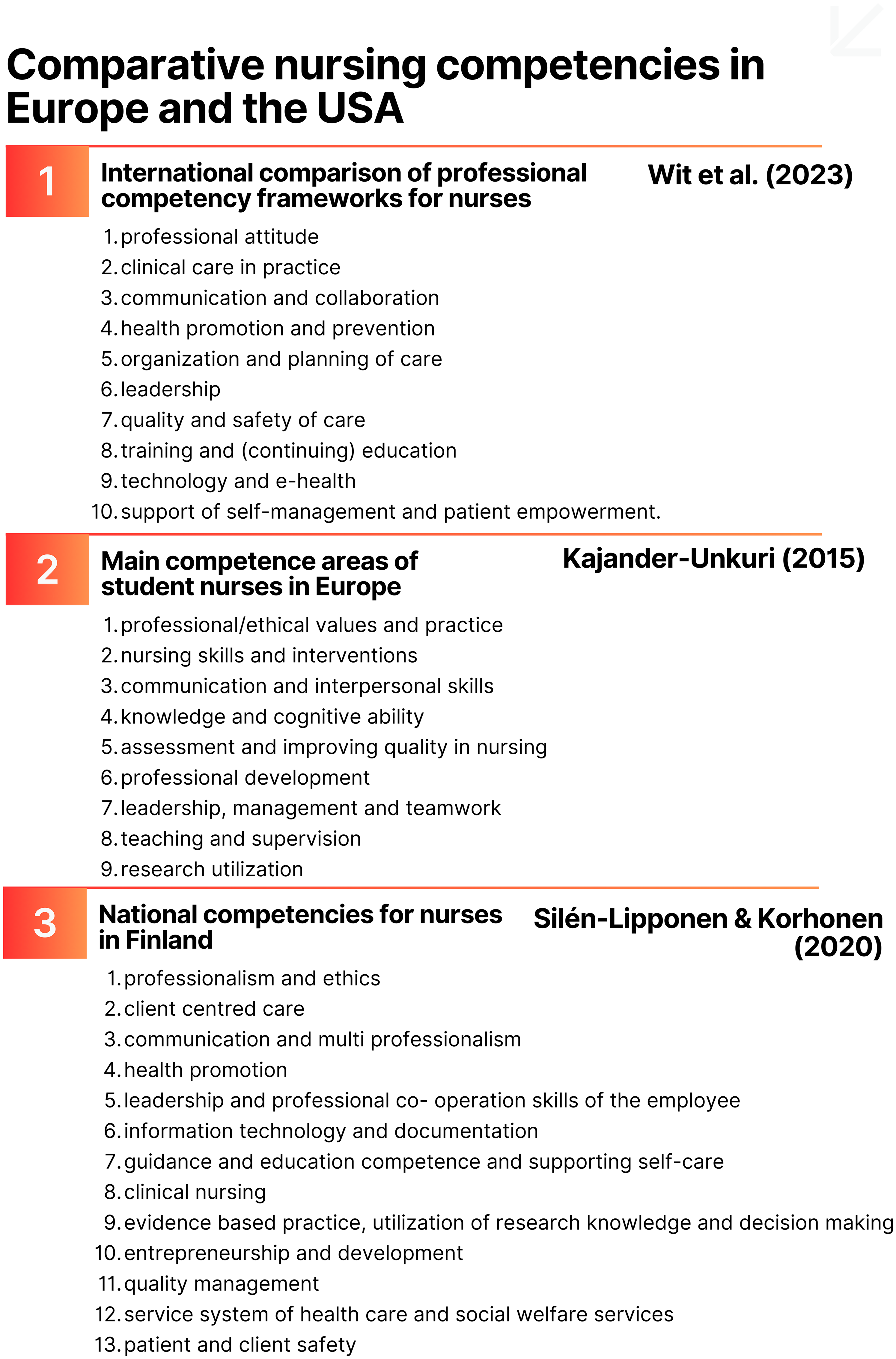
Comparative nursing competencies in Europe and the USA.
The challenges confronted by graduating nursing students in their endeavors to take national nursing examinations and the corresponding strategies devised to address these challenges ensure successful outcomes in the licensure examination. These challenges encompass a paucity of preparatory materials, inadequate faculty support, and difficulties with drug calculations (Dreher et al., 2019; Gill et al., 2019; Moran et al., 2022; Stolic, 2014; Wennberg-Capellades et al., 2022). A study by Huwendiek et al. (2020) indicated that a national licensure exam can significantly influence students’ learning behaviors before assessment. This examination is regarded as suitable for its objective nature and as a step toward a competency-focused evaluation (Huwendiek et al., 2020).
In the Finnish context, national examination for nurses (NEN) is not mandated by the national government, and each University of Applied Sciences (UAS) possesses the autonomy to decide on its implementation. A degree certificate is deemed sufficient as proof of fulfillment of requirements to be presented to the National Supervisory Authority for Welfare and Health (Valvira), indicating that the newly graduated nurse has attained the national competencies by the licensing authority as stipulated by the Health Care Professionals Act No. 559/1994 (Ministry of Social Affairs and Health, 1994) and that the higher education institution has adhered to the Universities of Applied Sciences Act 932/2014 (Ministry of Education and Culture, 2014).
To the best of the researchers’ knowledge, there have been no international studies conducted in Finland addressing organizational implementation or evaluating graduating nursing students’ experiences related to the content of the NEN.
Background of Finnish Nursing Education and the NEN in Finland
In Finland, nursing education adheres to the European Qualifications Framework Level 6, necessitating the accumulation of 210 European Credit Transfer and Accumulation System (ECTS) (Finnish National Agency for Education and the Ministry for Education and Culture, 2018). Of these, 180 ECTS are allocated for the attainment of general care proficiency (Silén-Lipponen & Korhonen, 2020). One ECTS is equal to 25–30 h (European Parliament, 2013). These credits are distributed across 13 components, which are designed to cultivate competencies over the duration of the program (Silén-Lipponen & Korhonen, 2020; see Figure 2). A national examination, developed by 20 universities with funding from the Finnish Ministry of Education and Culture, assesses preparedness. The exam is available in Finnish, Swedish, or English (Silén-Lipponen & Korhonen, 2020) and consists of two parts: a 100-item theoretical portion with a 65% passing rate and a five-item drug calculation portion with a 100% passing rate (see Figure 2). Administered by a nurse educator over a period of three hours, both components are initiated simultaneously. Eligible students who have accumulated a minimum of 180 ECTS credits may undertake the examination on multiple occasions until they achieve a passing grade. The examination uses a random question set from a bank maintained by experts from each participating UAS. If graduating students do not achieve a passing grade, they are permitted to consult with an examination coordinator and discuss for a retake.
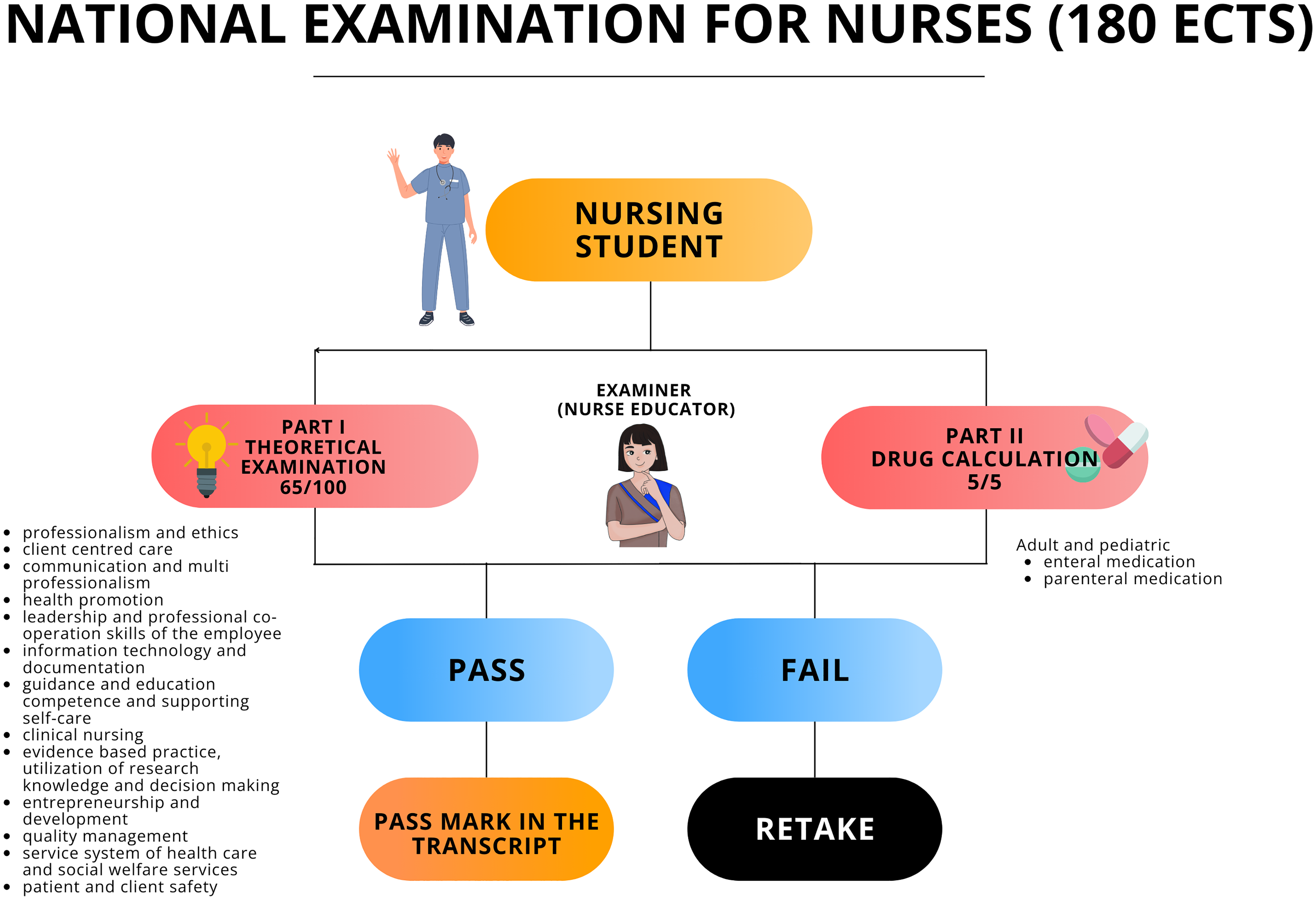
National nurses examination structure in Finland.
Methods
Aim
The aim of this study was to explore graduating nursing students’ experiences and identify key areas for improvement in the organizational implementation of the competence-based national nursing examination in Finland.
Design
This study adopted a qualitative content analysis (QCA) approach characterized by inductive reasoning following the framework established by Elo and Kyngäs (2008). Content analysis as a methodology can be applied to both qualitative and quantitative data. The frequency of mentions (f) can be analyzed quantitatively (Elo et al., 2022). The QCA was the most suitable methodology for this study because it described substantial amounts of open feedback from the nursing students, in this case, their perspective of the national nursing examination at an organizational level (Elo et al., 2022; Elo & Kyngäs, 2008). This study was guided by the guidelines of the Consolidated Criteria for Reporting Qualitative Research (see attached supplementary file), a comprehensive checklist that encompasses vital components of research design for reporting purposes (Tong et al., 2007).
Sample and Setting
A cohort of 224 nursing students from January to December 2023 participated in a NEN administered at one of the universities of applied sciences in Finland. Following the examination, the students were invited to provide their perceptions regarding the difficulty level of the examination, their assessments of the examination's content, and their recommendations for areas that could be improved. Among the 224 participants who completed the examination, 106 (47%) answered open-ended questions subjected to content analysis, with the caution that only those reports that were both clearly interpretable and sufficiently contextualized were included in the analysis.
Data Collection
Researcher AA (a nurse educator educated with health science education), who serves as the coordinator of the national proficiency test and as an organizational representative at Oulu University of Applied Sciences, was responsible for collecting the data. The data were collected from January to December 2023 from students who gave permission for the data to be used for research. Prior to the collection of data, the researchers (FC, PM, AR, SE, KK, RS) had not established any relationships with the students, except for their roles as educators in a select number of courses in which some students were enrolled. These data were retrieved from the learning management system and from an online survey that was conducted with the voluntary participation of the students. At the university, all students who have attained 180 ECTS (1 ECTS is equivalent to 25–30 h based on the EU Directive 55/2013) (European Union, 2013) are required to take the examination before graduation.
Data Analysis
The qualitative data were analyzed by researchers SE, AR, and RS (doctorate educated and part of the academic university team) using inductive content analysis (Elo & Kyngäs, 2008). All the researchers analyzed the data together. The analysis began by reading the students’ responses to the exam and the related challenges multiple times by three researchers to achieve a comprehensive understanding. After this, responses to the research aim were sought from the data. Original statements corresponding to the research aim, consisting of words, phrases, and sentences, were marked in the data with different colors. Themes were identified in the data, to which similar responses were transferred. The marked expressions were transferred to an Excel spreadsheet, where they were condensed and coded according to the respondents. The answers were also frequency-analyzed (f) to obtain an overview of which themes appeared most frequently in the responses. According to Polit and Beck (2015), quantification results can be expressed in terms of frequencies (f) and percentages (%), which, in addition to a verbal description, can describe the generality of the things contained in the categories (Vaismoradi et al., 2013). Quantification can serve a variety of purposes, including providing a quantitative illustration alongside a verbal description (Elo et al., 2022).
Rigor and Trustworthiness
In this study, reliability was evaluated using Lincoln and Guba’s (1985) criteria: credibility, dependability, confirmability and transferability. In terms of credibility, researchers have utilized their extensive expertise in qualitative research. Reflexivity was utilized through deliberate discussions with other researchers to address personal biases. The triangulation of researchers and their collaborative analysis also reinforced the study's credibility.
From the perspective of dependability, the steps of QCA (Elo et al., 2014) have been followed accurately and systematically. The transferability of the findings to other higher education institutions is possible as similar NEN is conducted in other Finnish UASs, which can also be benchmarked in other countries until they are developed and refined. Confirmability was addressed with the noninvolvement of researchers in the creation of the exam, ensuring objectivity.
Ethical Considerations
Eleven UASs signed an agreement for the period of January 1, 2022, to December 31, 2023, to collect research data from students during the pilot phase of the exam. At the end of the examination, the students voluntarily completed an electronic survey questionnaire. Despite the existence of a national research agreement, a research permit was obtained from the organization for the research in question. A research permit was formally requested from the Oulu University of Applied Sciences (April 26, 2024) to establish ethical standards before commencing the analysis of survey questionnaires. All participants willingly and voluntarily participated in the survey questionnaire following their examination. This study adhered to the guidelines for responsible research conduct outlined by the Finnish National Board on Research Integrity (TENK) and was in accordance with the principles of the World Medical Association Declaration of Helsinki (2013).
Results
Among the respondents, 13 students described the NEN as demanding, 134 expressed that it was moderately challenging, 76 deemed it satisfactory, and only one student perceived it as easy. The examination was allocated a total duration of 2.5 h for completion. The computed mean duration of completion for the entire cohort was determined to be 89.7 min, whereas the median duration was 80.5 min.
In general, the students expressed satisfaction with the NEN. However, in the context of this study, the researchers identified areas that could be improved to enhance the organization and structure of the NEN. These findings are expected to promote scientific discussion among the nursing education community at both the national and international levels. The objective of enumerating the mentions in percentages and numerical values is to provide readers with transparent information regarding the proportion of students among the 106 exam takers who have been mentioned in the feedback provided. This approach allows the readers to be generalized with caution.
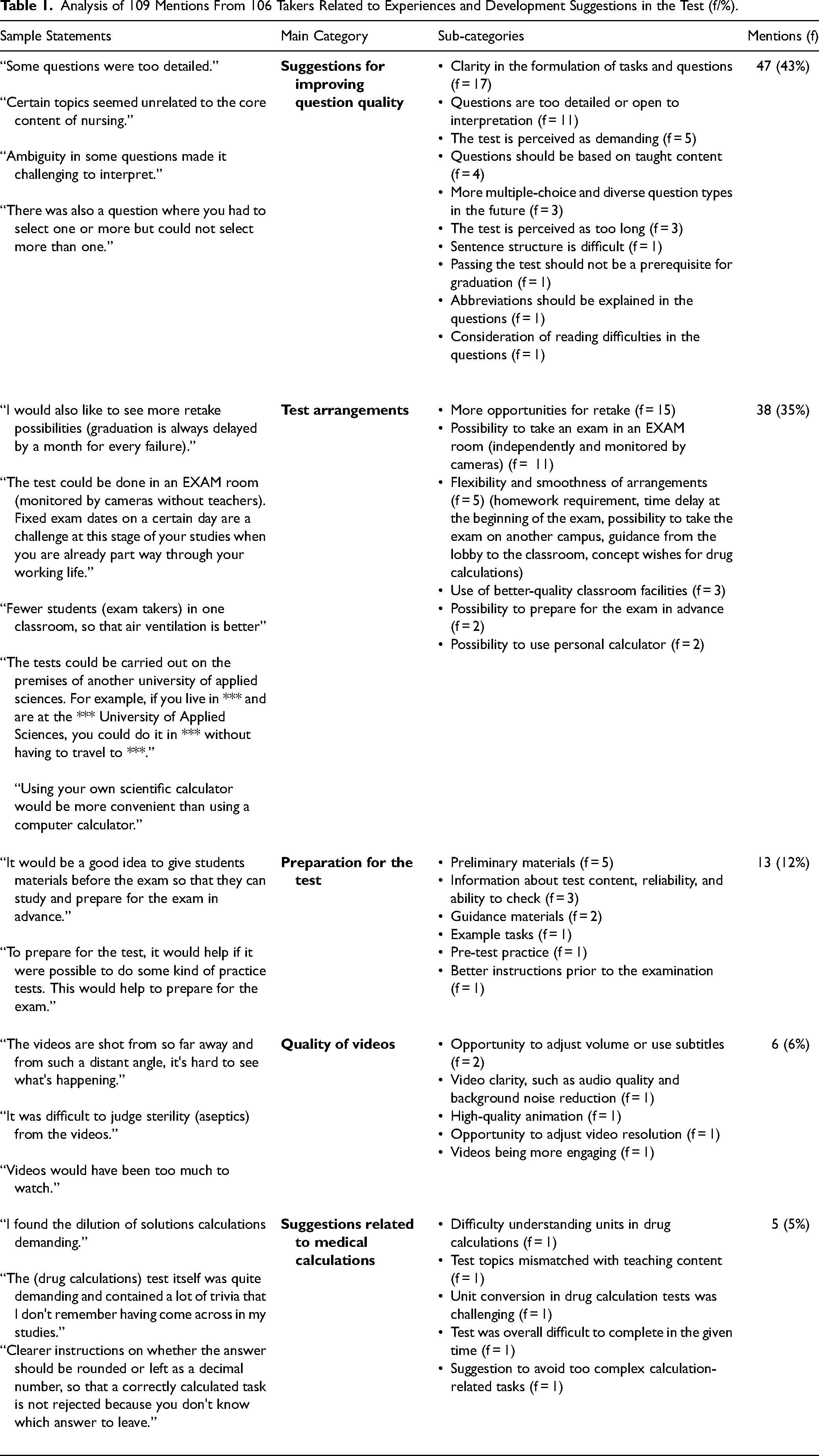
A total of 109 mentions from 106 graduating students were identified and grouped into six different themes: (1) suggestions for improving question quality, (2) test arrangements, (3) preparation for tests, (4) quality of videos, and (5) suggestions related to medical calculations (see Table 1 for sample statements and the specific number of mentions).
Analysis of 109 Mentions From 106 Takers Related to Experiences and Development Suggestions in the Test (f/%).
Suggestions for Improving Question Quality
The most frequently cited feedback among examinees pertained to suggestions for enhancing the quality of questions (f = 47, 43%), with specific emphasis on enhancing the clarity of task formulation (f = 17) and questions that were too detailed, leaving room for multiple interpretations (f = 11). Additionally, while the students perceived the examination to be a gauge of critical thinking ability, it was also perceived as demanding (f = 5), too long (f = 3), and difficult (f = 3). The graduating students have proposed that the questions should be based on material that has been taught in school (f = 4). Additionally, they have suggested that there should be more multiple-choice questions (f = 3). Abbreviations should be made clear and explained if they are used in the question (f = 1). Individuals with reading difficulties must also be considered (f = 1), and the exam should not be a prerequisite for graduation (f = 1).
Test Arrangements
The second most prevalent demand was for a wider range of test accommodations (f = 38, 35%), with a significant number of mentions (f = 15) calling for increased retake opportunities and the implementation of monitored exam rooms (f = 11). The implementation of extended fixed dates has presented challenges for students who concurrently hold part-time employment in healthcare facilities. In Finland, student nurses are permitted to work alongside their clinical instructors on the condition that they have achieved a specific number of credits (ECTS), as determined by their employers. These credits serve as benchmarks of their competencies and readiness to perform their duties under supervision. The examination is typically administered in a group setting, with multiple students taking the test in a single classroom. This format can lead to certain challenges, including the inability to maintain anonymity and the potential for undetected monitoring by peers.
Preparation for the Test
Preparations prior to the test emerged as the third most prevalent response from examinees (f = 13; 12%). Students indicated that it would be advantageous to provide preliminary materials (f = 5), comprising guidance materials (f = 2), that include justifications for answers prior to the examination, thereby enabling students to engage in advance in studying and preparing for the test. Graduating students also expressed a desire for access to the primary content, which could be facilitated through practice tests or mock tests (f = 3). These mock tests allow students to gauge the reliability of the content and review their performance. Additionally, the provision of sample tasks (f = 1) and practice tests (f = 1) to prepare graduating students prior to the examination was also suggested.
Quality of Videos
While most graduating students did not observe any issues with the quality of the videos, some examinees (f = 6, 6%) noted some concerns regarding the quality of the videos. Some respondents noted that the option to adjust the volume or utilize subtitles was lacking (f = 2). The clarity of the video, encompassing the audio quality and the reduction in background noise, was also subject to critical scrutiny (f = 1). Additionally, some graduating students expressed a desire for an opportunity to adjust the video resolution, although this suggestion was not supported by a consensus (f = 1). Furthermore, it was proposed that the video animation should be of high quality to facilitate effective interpretation (f = 1).
Suggestions Related to Medical Calculations
A parallel response was observed in the medical calculations. While most of the students demonstrated proficiency, one exam taker expressed difficulty comprehending units in drug calculations (f = 1). Additionally, one exam taker noted that the test topics did not align with the teaching content (f = 1). The unit conversion in drug calculation tests posed a significant challenge (f = 1). The test was generally arduous to complete within the allotted timeframe. It is therefore recommended by one exam taker that complex calculation-related tasks be avoided (f = 1).
Discussion
In its initial years of organizational implementation, several challenges have been identified, as demonstrated by the findings from contextual analysis of 106 graduating students who participated in the examination. These findings highlight strengths and indicate areas for improvement in organizational aspects, content validation, and further development to enhance the readability and comprehensibility of the examination.
The national nursing examination for nurses represents a collaborative initiative project involving nursing educators and academicians from UASs in Finland, designed to assess the theoretical knowledge of students across several competencies required from the EU Directive 55/2013 (Silén-Lipponen & Korhonen, 2020). As this examination was an outcome of a national project rather than a legislatively mandated requirement, the UASs maintain exclusive authority over its implementation. The direction for the implementation of the NEN is corroborated by previous studies showing that comprehensive assessments to gauge the proficiency of graduated nursing students are important for providing safe and high-quality patient care (Hou et al., 2019; Ignatavicius, 2021; Lai et al., 2023; Pike et al., 2019).
The most predominant feedback focused on two areas: question design (43%) and test arrangements (35%), indicating issues related to the clarity of how the questions were structured and the practicality of their implementation. Exam takers thought that the context of some of the questions was not related to nursing, that some questions were ambiguous and challenging to interpret, and that some were too detailed. As demonstrated in earlier studies, faculty members, irrespective of their years in the teaching profession, may lack the requisite preparation to formulate test questions that are both reliable and valid (Dreher et al., 2019). This lack of proficiency can be attributed to insufficient access to adequate support and educational resources (Dreher et al., 2019; Moran et al., 2022). Consequently, it is imperative that faculty members receive specialized training in question creation for the national nursing examination. Given the recent introduction of the national examination as a component of the Finnish nursing education system, the necessity of equipping educators with the skills to develop questions is paramount. This is crucial for maintaining the integrity of the NEN, which is implemented and administered by each UAS to its graduating nursing students.
In this study, the students expressed a desire for greater flexibility in exam scheduling. The use of online examinations has gained popularity in Finland. In Finland, a consortium of 28 UASs uses a modern approach to administer courses with EXAM rooms. These types of rooms utilize electronic-based software in a classroom setting, employing a booking system that allows students to select a suitable time for their examination. The classrooms are under constant supervision via camera surveillance and recorded for safety and monitoring purposes (EXAM, 2025). However, the integration of IT infrastructure and classroom supervision, particularly in the context of teachers’ presence, has presented challenges for students already engaged in professional activities. The students’ recommendation is corroborated by quantitative data indicating that in 2023, of the 286,000 exams taken in Finland, 24,800 were taken in EXAM rooms at universities other than the student's own university (Lepkowska, 2024). Understanding student engagement, satisfaction, and academic self-efficacy is crucial to ensure the success of learning programs in nursing (Luo et al., 2021). The consortium of the NEN from different UASs should consider the possibility of implementing this approach instead of using another online learning management system. This would save the time and energy of the examiners and allow flexibility to students who can take the exam anywhere across the country for convenience.
The preparation of students for any examination is a significant factor in their success. Preliminary materials, such as exercise books, can be made available to students for their use. In accordance with the test-taking skills element of the McDowell framework within the context of the NCLEX-RN, it is recommended that candidates complete a minimum of 2,000–2,500 practice questions to ensure success on the NCLEX-RN©. This suggests that candidates should allocate approximately 2–3 h per hour of study to the practice of these questions (McDowell, 2008). Prior studies have demonstrated that proper test preparation, coupled with the utilization of exercise materials, is associated with enhanced exam performance (Gaudet et al., 2022). Furthermore, research has demonstrated that exposure to question styles similar to those encountered during study periods, in conjunction with supplementary support from faculty members, can contribute to examination success (Almasloukh et al., 2023; Davis & Morrow, 2021; Sanderson et al., 2022). Several strategies should also be implemented to ensure the attainment of favorable outcomes in nursing examinations (Quinn et al., 2018).
Consequently, it is recommended that academic institutions formulate their strategies with data from the organization as a foundation (Glasgow et al., 2019). In the USA, a variety of materials are available online with global accessibility. Conversely, Canada has also produced materials with a local context (Lalonde et al., 2022). This accessibility can be largely attributed to the long-standing existence of the computerized implementation of NCLEX since 1994 (NCSBN, 2014), in contrast to the recently implemented examination in Finland. Given Finland's adoption of CBE and its administration of 13 distinct sets of competencies, it can be posited that the provision of information materials, such as online resources, to students for practice purposes is a viable option. In the contemporary era, the utilization of artificial intelligence as a practical instrument to formulate test questions, such as those posed by ChatGPT, can serve as a valuable educational assistive tool in the preparation for examinations (Wu et al., 2024).
In this study, the students experienced challenges with the content of the drug calculations such that the questions were challenging and complex. Research has indicated that nursing students encounter significant challenges when attempting to perform drug calculations (Gill et al., 2019; Stolic, 2014; Wennberg-Capellades et al., 2022). Most students mistakenly understand the question, perform unit conversion and calculate dilutions (Wennberg-Capellades et al., 2022). Interventions such as organizing workshops and exercises through online platforms can help students pass drug calculations (Gill et al., 2019; Stolic, 2014). In line with these findings, students receive consistent support from the organizational level in the event of three unsuccessful attempts to pass the drug calculations. Drug calculation workshop sessions are organized at the university level in person or online, where students can freely pose questions to the pharmacotherapy nurse educator directly. The sessions include both enteral and parenteral drug calculations.
Strengths and Limitations of the Study
To the best of the authors’ knowledge, this is the first international study to scientifically analyze the perspectives of graduating nursing students on the organizational implementation of the NEN in Finland. This will establish a foundation for the implementation of the NEN under legislation and monitored by national licensing authorities. The findings of this study could inform the authorities’ decision regarding the use of this examination for licensing IENs abroad prior to their migration to Finland. This approach is congruent with the systems in place in the USA and Canada, which have been demonstrated to facilitate the nurse labor migration flow for IENs.
This study exclusively presented the feedback of graduating nursing students who took the NEN at (blinded for review purposes), which limits the generalizability of the data. Furthermore, most of the students’ general feedback addressed areas for improvement rather than positive outcomes of the examination, reflecting the students’ readiness for graduation based on their examination results. The study did not make a specific comparison of the thirteen competencies required nationally because questions are randomly set by the system, which might necessarily reflect the difficulty of each question for each student.
Conclusion
The implementation of the NEN has posed several technical and validity challenges. Nevertheless, the execution of the pilot program has been largely successful, largely due to the concerted efforts of national coordination among UASs in Finland, where coordinators can consult with each other. While the digital platform for the NEN can be a useful tool for assessing competencies, it is essential to validate test questions and equip educators. Students need early preparation, and practice tests and materials should be improved for readiness. Additionally, further research is necessary to assess the impact of competence-based assessments utilizing written examinations in the future.
Policy Recommendations
In terms of content, it is recommended that educators undergo continuous training to develop questions and ensure their validity when the program is implemented in its final form. To ensure a certain degree of flexibility for exam takers, with the objective of achieving an appropriate balance between academic studies and personal obligations, the consortium of the entire network of universities of applied sciences should give full consideration to the possibility of transitioning to the utilization of testing rooms that are accessible in a variety of locations throughout the country, in addition to the premises of the institution itself.
Supplemental Material
sj-pdf-1-ppn-10.1177_15271544251396550 - Supplemental material for Challenges and Perceptions of Graduating Nursing Students to Develop the Competence-Based National Nursing Examination in Finland: A Qualitative Study
Supplemental material, sj-pdf-1-ppn-10.1177_15271544251396550 for Challenges and Perceptions of Graduating Nursing Students to Develop the Competence-Based National Nursing Examination in Finland: A Qualitative Study by Floro Cubelo, Arja Rantala, Satu Elo, Kirsi Koivunen, Reetta Saarnio and Pia Mäenpää in Policy, Politics, & Nursing Practice
Footnotes
Declaration of Conflicting Interests
The author(s) declared no potential conflicts of interest with respect to the research, authorship, and/or publication of this article.
Funding
The author(s) received no financial support for the research, authorship, and/or publication of this article.

Supplemental Material
Supplemental material for this article is available online.
Author Biographies
References
Supplementary Material
Please find the following supplemental material available below.
For Open Access articles published under a Creative Commons License, all supplemental material carries the same license as the article it is associated with.
For non-Open Access articles published, all supplemental material carries a non-exclusive license, and permission requests for re-use of supplemental material or any part of supplemental material shall be sent directly to the copyright owner as specified in the copyright notice associated with the article.
