






Abstract
Sociologists have long debated whether the concentration of immigrants in some neighborhoods exacerbates or mitigates disadvantage. This study extends this inquiry to investigate residential stability in poor immigrant neighborhoods. Quantitative analyses show that poor immigrant neighborhoods nationwide have an eviction rate 26 percent lower than similarly poor non-immigrant neighborhoods. Ninety in-depth interviews with landlords and tenants in two neighborhoods, Boston’s Chinatown and Houston’s Gulfton, demonstrate how co-ethnic owners and property managers engage in informal practices that provide flexibility to households at risk of displacement. However, in Chinatown’s enclave housing market, efforts by co-ethnic landlords and community organizations further suppress rents; in Gulfton’s secondary immigrant housing market, low rents (and low evictions) come at the cost of dilapidated housing. This article connects immigration and housing studies by underscoring how the protective qualities of some poor immigrant neighborhoods extend to housing dynamics, shielding their residents from evictions in a precarious housing market.
Introduction
Housing unaffordability in America has led to increasing material hardship (Shamsuddin and Campbell 2022), health problems (Graetz et al. 2024), and eviction (Desmond 2016). Affecting over a million households nationwide annually (Gromis et al. 2022), evictions are linked to the perpetuation of poverty and mortality (Collinson et al. 2024; Graetz et al. 2024). While studies have documented eviction rates to be prevalent in neighborhoods with higher shares of Black and Hispanic residents (Desmond 2012; Lens et al. 2020), few studies have investigated housing dynamics in immigrant neighborhoods (see also Tesfai and Ruther 2022).
Immigrants today in the United States are just as likely to live in a majority-immigrant neighborhood as they were in 1920 (Abramitzky and Boustan 2022). Scholars have long observed the distinct social features and functions arising from such dense concentration of immigrants (Park 1915; Wilson and Portes 1980; Wirth 1927). And despite the heterogeneity in immigrant neighborhood contexts, a response to growing diversity in immigration streams and destinations (Flippen and Farrell-Bryan 2021; Li 2009; Logan, Alba, and Zhang 2002), many immigrant neighborhoods still have high poverty rates. While sociologists have debated whether and when these neighborhoods, despite their concentration of disadvantage, help or hinder immigrant integration (Alba et al. 2014; Jargowsky 2009), research has found immigrant neighborhoods to have lower crime rates and better mental health outcomes (Eschbach et al. 2004; Graif and Sampson 2009; MacDonald, Hipp, and Gill 2013; Ousey and Kubrin 2018). However, as rental housing has become increasingly unaffordable (Joint Center for Housing Studies 2024), researchers have yet to extend this question to housing outcomes. To investigate, this study asks two research questions:
We combine quantitative and qualitative analyses to understand residential stability in immigrant neighborhoods throughout the United States. Drawing on over a million eviction records in 54 metropolitan areas (MSAs), we find that many immigrant neighborhoods with high poverty rates have unexpectedly low eviction rates. Controlling for neighborhood characteristics, poor immigrant neighborhoods have an eviction rate 26% lower than similar poor non-immigrant neighborhoods. Across cities, a high immigrant concentration significantly weakens the well-documented relationship between neighborhood poverty and eviction (Desmond 2016).
As immigration streams and destinations transform and diversify, immigrant neighborhoods might not confer protections similarly. We draw on the segmented assimilation model to compare how neighborhood contexts, including neighborhood racial composition and availability of co-ethnic housing resources, relate to lower-than-expected eviction rates in poor immigrant neighborhoods. Quantitative analysis shows immigrant concentration moderates the relationship between racial composition and evictions. Controlling for poverty, high immigrant concentration closes the White-Hispanic neighborhood eviction rate gap. However, eviction rates in Black neighborhoods, regardless of immigration concentration, remain the highest across all groups.
To analyze local housing dynamics, we draw on 90 in-depth interviews with tenants and landlords in high-poverty, low-evicting immigrant neighborhoods with diverse housing environments: Boston’s Chinatown and Houston’s Gulfton. Both neighborhoods have low eviction rates, but for different reasons. While co-ethnic owners and property managers in both neighborhoods provide flexibility and leniency to households who fall behind on rent, in Chinatown’s enclave housing market, intentional efforts by co-ethnic landlords and community organizations suppress or subsidize rents; however, in Gulfton’s secondary immigrant housing market, low rents (and low evictions) come at the cost of substandard housing quality. 1
Our findings contribute to the housing and immigration literatures in several ways. First, this study is among the first to systematically examine evictions across immigrant communities nationwide, extending the debate on the protective qualities of immigrant neighborhoods to housing outcomes. Second, by distinguishing between enclave housing markets and secondary immigrant housing markets, we show how such protective qualities vary across local housing dynamics to shape residential outcomes. Third, we attend to support immigrants receive from co-ethnic landlords and property managers, parties overlooked in the literature on social support that focuses primarily on kin networks (Menjívar 2000; Rosen et al. 2023). Finally, we show nativity to be a key dimension neglected in housing and displacement studies.
The Dual Nature of Immigrant Neighborhoods
Sociologists have long studied the distinct social and economic conditions in immigrant enclaves (Logan et al. 2002; Lyons, Vélez, and Santoro 2013; Park 1915). However, perspectives differ on whether these neighborhoods help or hinder immigrant communities (Alba et al. 2014; Portes and Zhou 1993; Ruef and Grigoryeva 2018). With respect to residential instability, research leads to mixed expectations. On one hand, immigrants are more likely to reside in disadvantaged neighborhoods (Jargowsky 2009), which typically have higher eviction rates (Collinson et al. 2024; Desmond 2016). Most eviction cases are brought for non-payment of rent (Nelson et al. 2021). As rents outpace income gains, households become increasingly cost burdened (Airgood-Obrycki, Hermann, and Wedeen 2023). Lower wages (Abramitzky and Boustan 2022), higher rent burdens (Krivo 1995; McConnell 2013), and underrepresentation in housing programs (Reina and Aiken 2021) may heighten immigrants’ eviction risk.
Immigrant concentration may also be the result of segregation and discrimination in the housing market (Charles 2003; Iceland and Scopilliti 2008). Newer arrivals who lack English proficiency, credit histories, or knowledge of city dynamics have restricted housing options, creating a captive tenant base (Carrillo et al. 2016; Dávila 2004; Zhou 2010). Just as employers in the enclave economies have exploited their workers’ marginalized status (J. Lin 1998; Sanders and Nee 1987), landlords in immigrant neighborhoods may target vulnerable tenants (Oliveri 2009; Zhou 2010). Aware of the high demand from the immigrant population, landlords may be more willing to rely on eviction to discipline renters (Rosen et al. 2023).
On the other hand, immigrant neighborhoods may promote residential stability. Sociologists have documented high concentrations of ethnic and social capital in immigrant enclaves ( M. Lin and Zhou 2005; Whyte 1943; Wirth 1927), where ethnic ties facilitate information-sharing about labor and housing opportunities (Wilson and Portes 1980; Zhou 2010). Controlling for socioeconomic factors, studies find immigrant neighborhoods to have lower crime rates and better mental health outcomes (Eschbach et al. 2004; Graif and Sampson 2009; MacDonald et al. 2013). Importantly, successful efforts to resist gentrification may extend to other forms of displacement (Hwang 2016; Winnick 1990). Together, these considerations raise the following research question:
Segmented Residential Contexts: Neighborhood Race and Co-ethnic Housing Resources
Since the early generation of immigration studies (Park 1915; Thomas and Znaniecki 1919), immigrant populations and their destinations have diversified. Accounting for these changes, the segmented assimilation theory posits that features, including racial prejudice from the host society and resources available through co-ethnic communities, shape divergent modes of immigrant incorporation (Portes and Zhou 1993). Similarly, for evictions, diverse processes might underlie eviction outcomes in immigrant neighborhoods. We draw from housing studies to investigate two neighborhood factors closely related to evictions: neighborhood racial composition and availability of co-ethnic housing resources.
Racial inequality continues to strongly shape residential patterns (Hall and Greenman 2013; Rosenbaum and Friedman 2007), including eviction (Graetz et al. 2023). Black and Hispanic renters face the highest eviction rates at all income levels (Graetz et al. 2023; Hepburn, Louis, and Desmond 2020). While scholars have explored how immigrant status complicates racial stratification in areas like residential segregation (Iceland and Scopilliti 2008), knowledge on how immigrant concentration intersects with racial stratification in eviction rates remains limited. Research has documented strong community ties and social support within some Asian and Chinese immigrants (J. Lin 1998; Zhou 2009). However, some low-income immigrants from Latin America have fragmented ties (Menjívar 2000) and constrained support (Schmidt 2024) owing to their embeddedness in resource-constrained networks.
The segmented assimilation model highlights the importance of co-ethnic resources in immigrant neighborhoods (Portes and Zhou 1993). In particular, those with access to co-ethnic networks can channel resources to overcome barriers and adapt into the host society (Portes and Rumbaut 2024). One well-documented example of such resources, coined by Wilson and Portes (1980), is the enclave labor market, which is characterized by a spatial concentration of co-ethnic owners and workers (Light 2010; Wilson and Portes 1980; Zhou 2010). The enclave labor market provides an alternative to immigrant workers excluded from the primary labor market, one associated with upward mobility and well-paying jobs—and otherwise channeled into the secondary labor market, one with limited job security and advancement opportunities (Bailey and Waldinger 1991; Waldinger and Lichter 2003; Wilson and Portes 1980). While past debates focused primarily on whether co-ethnic employers are motivated by solidarity or exploitation (Sanders and Nee 1987; Wilson and Portes 1980), the enclave labor market nonetheless provides benefits, such as flexible work hours, informal arrangements, and shared language and cultural norms, that enclave workers may prefer over arrangements in secondary labor markets (Bailey and Waldinger 1991; Zhou 2010).
However, these concepts of market segmentation have not been applied to the housing market, a key economic arena shaping the immigrant experience. Drawing on this literature to distinguish between market segments by different ownership characteristics, we extend its application to explain housing experiences and landlord-tenant dynamics in immigrant neighborhoods. Just as co-ethnic employers offer benefits to enclave workers, enclave housing markets with co-ethnic owners might provide tenants protection from displacement pressures. Neighborhoods with higher proportions of co-ethnic owners experience lower rates of racial turnover and neighborhood flux (Dahir and Hwang 2025). Ethnographic studies have also noted differences between co-ethnic and non-co-ethnic landlords (Dávila 2004; Zhou 2010). However, those outside of both the enclave and mainstream primary housing markets may face worse housing outcomes in a secondary housing market consisting of low-cost, low-quality homes (Portes and Zhou 1993). Despite landlords’ influential role in directing housing and neighborhood dynamics (Desmond 2016; Gomory 2022; Rosen 2014), researchers have not examined this key class of actors in immigrant neighborhoods.
Data and Methods
This study takes a mixed-method approach. We first use court records to quantitatively assess patterns across immigrant neighborhoods. Observing eviction rates to be lower than expected in high-poverty immigrant neighborhoods, we conduct 90 interviews in Boston’s Chinatown and Houston’s Gulfton to investigate their local housing dynamics and ownership structures.
Quantitative Sample
Of the nation’s largest 200 MSAs, we retain an MSA in our sample if it (1) had over 10,000 foreign-born residents and (2) was located in a region where 75% of tracts had at least one year of validated eviction records between 2012 and 2016. 2 The 54 MSAs in the final eviction analytic sample cover more than 67 million residents, including 9.7 million foreign-born residents. 3 The analytic sample contains a diverse set of important immigrant cities such as Miami, Houston, and Seattle, but is not representative of all cities. 4
Eviction Data
We measure evictions using formal eviction judgments: judicial findings that ordered defendants (tenants) to quit the premises. Tract-level estimates of evictions come from court records collected by Princeton University’s Eviction Lab (Gromis et al. 2022). These individual-level records were cleaned, stripped of duplicates and commercial cases, geocoded, and validated against publicly available statistics (Desmond et al. 2018). In total, our sample contains 13,289 census tracts, averaging 296,083 eviction judgments a year between 2012 and 2016. To calculate tract-level eviction rates in our initial descriptive analyses, we divide the total eviction judgments by the total number of renter households, taken from the 2012–2016 American Community Survey (ACS) estimates.
Immigrant Neighborhood Definition
We operationalize neighborhoods as census tracts and immigrant neighborhoods as those with at least 25% of residents foreign-born to capture neighborhoods with a substantial presence of immigrants. 5 Table 1 summarizes neighborhood-level characteristics in a broader sample of tracts, as well as average city-level differences between immigrant and non-immigrant neighborhoods. Immigrant neighborhoods are more highly populated, have a higher population of renters, are more urbanized, and have much higher poverty rates. They have significantly lower shares of White residents and significantly higher shares of Hispanic and Asian residents. Their residents are also more likely to be employed in the service sector, more likely to have children, and less likely to have a college degree. They have slightly higher labor force participation rates but also higher unemployment rates. Immigrant neighborhoods have lower median rents, higher rent burdens and overcrowding, and older and large multifamily buildings.
Characteristics between Immigrant Neighborhoods and All Other Neighborhoods.
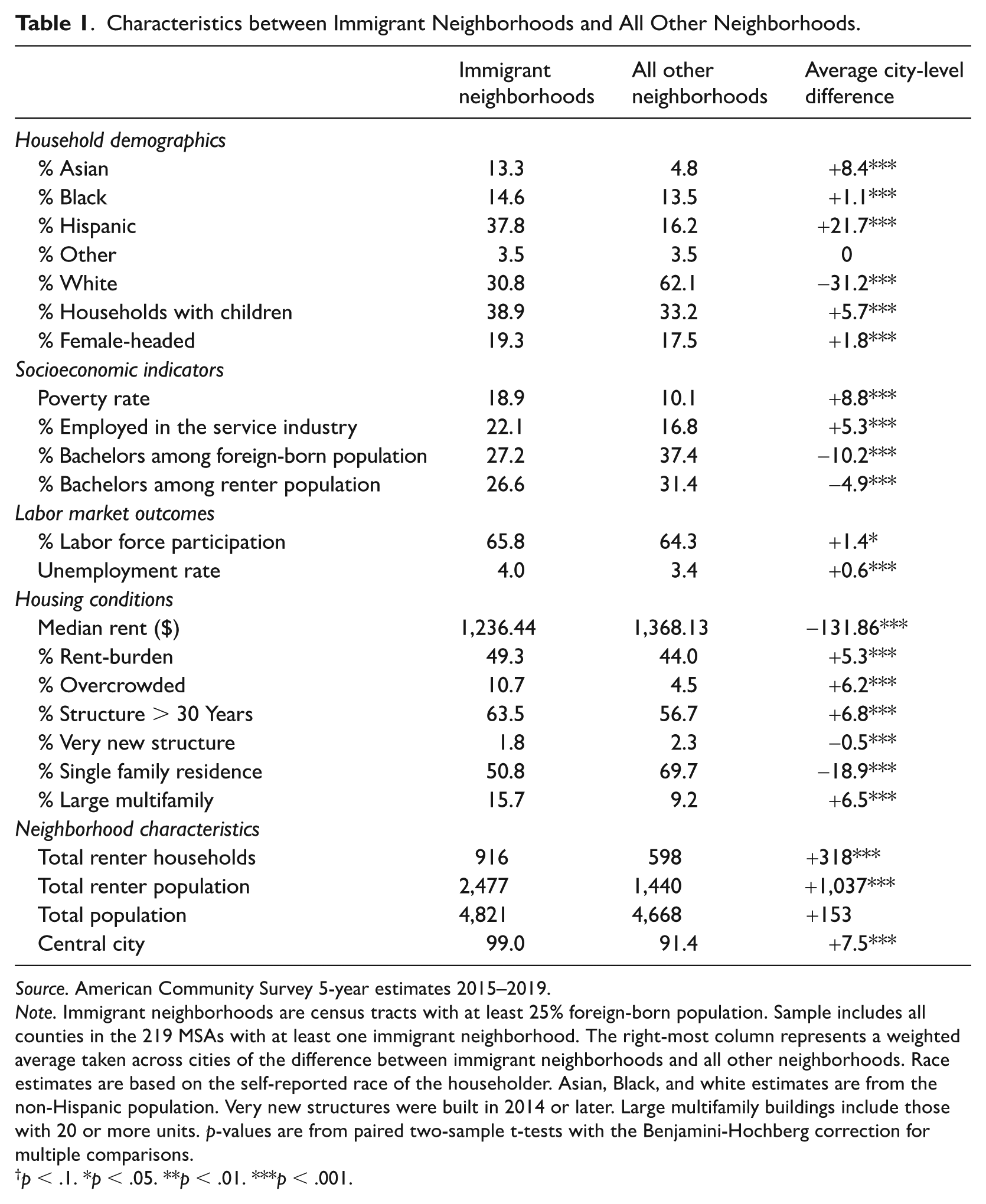
Source. American Community Survey 5-year estimates 2015–2019.
Note. Immigrant neighborhoods are census tracts with at least 25% foreign-born population. Sample includes all counties in the 219 MSAs with at least one immigrant neighborhood. The right-most column represents a weighted average taken across cities of the difference between immigrant neighborhoods and all other neighborhoods. Race estimates are based on the self-reported race of the householder. Asian, Black, and white estimates are from the non-Hispanic population. Very new structures were built in 2014 or later. Large multifamily buildings include those with 20 or more units. p-values are from paired two-sample t-tests with the Benjamini-Hochberg correction for multiple comparisons.
p < .1. *p < .05. **p < .01. ***p < .001.
Neighborhood Characteristics
For most tract characteristics, we draw from the 2012–2016 ACS 5-Year estimates. We estimate neighborhood poverty rates by taking the share of households whose income falls under the federal poverty line. In all analyses, we standardize neighborhood poverty rates to the MSA. We repeat our main analyses using neighborhood median household earnings (logged) as an alternative measure of a household’s ability to pay rent.
We consider any neighborhood with a racial majority of non-Hispanic White residents, non-Hispanic Black residents, or Hispanic residents as White, Black, or Hispanic neighborhoods, respectively. In the initial descriptive analyses, we classify neighborhoods with more than 25% of residents Asian as Asian neighborhoods and all others as Other or No majority. In subsequent regression models, we group Asian neighborhoods with Other or No majority neighborhoods due to sample size constraints.
We further control for tract-level characteristics commonly associated with eviction. As most evictions are initiated due to rent non-payment (Nelson et al. 2021), we include the natural logarithm of tract median household rent to capture rent pressures. Since women and households with children face higher risks of eviction (Graetz et al. 2023), we include tract-level share of female-headed renter households and renter households with children. Immigrants often double-up to maintain low rent (Carrillo et al. 2016; Painter and Yu 2010). We therefore include a measure of neighborhood rates of overcrowding, defined as the percentage of renting households with more than one person per room per unit (Blake, Kellerson, and Simic 2007).
Occupational status and educational attainment are common indicators of immigrants’ economic standing and assimilation (Portes and Rumbaut 2024). Accordingly, we include the percentage of immigrants with a bachelor’s degree or higher and the percentage of residents employed in the service sector. Neighborhoods with higher levels of immigration have been associated with gentrification, making tenants more vulnerable to rent pressures and landlord harassment (Stabrowski 2014; Zhou 2010). We include a tract-level measure of gentrification employing data from the 2000 Census and the 2012–2016 ACS (See Online Appendix A1 for details).
Quantitative Analytic Approach
To understand differences in eviction rates between immigrant and non-immigrant neighborhoods, we fit a regression model predicting tract-level evictions with an exposure term for the number of renter households. Given the count nature of eviction cases, we use a negative binomial regression, which also adjusts for overdispersion. Our key explanatory variables are the indicator for immigrant neighborhoods, neighborhood-level poverty rate, and the interaction between the two. The interaction allows the slope coefficient of poverty rate to shift if the neighborhood is an immigrant neighborhood and to test for a moderating effect. The model is:

The dependent variable (Yij) is the average count of evictions in tract i in metropolitan area j from 2012 to 2016. In some models, we include a set of tract-level covariates (the vector Xij). In a second set of models, we shift our main independent variables of focus to the neighborhood racial majority, an indicator for immigrant neighborhood status, as well as the interaction between the two. In these models, we include neighborhood poverty rate as a tract-level control variable. We include MSA fixed effects (
Qualitative Case Studies Selection
Statistical analyses with available administrative data are limited in their ability to capture complex housing dynamics or to distinguish the primary mechanisms of stability from correlates. To better understand these underlying processes, we conducted 90 in-depth interviews with tenants and landlords in two sites. We first identified immigrant neighborhoods with high poverty rates (above the MSA’s highest quartile) and low eviction rates (below the MSA’s lowest quartile). From those neighborhoods, we selected two sites with similarly low eviction rates but maximum heterogeneity in other important dimensions such as racial composition, regulatory environment, housing cost, and immigration history: Chinatown in Boston, MA and Gulfton in Houston, TX.
The histories and policies of migration and housing vary widely across metropolitan and local contexts, which can shape whether and how immigrants access social and ethnic capital in their neighborhoods. Accordingly, we selected two metropolitan areas with distinct migration histories and housing characteristics. Boston has been a major immigrant gateway since the early twentieth century, while Houston’s immigrant population did not grow rapidly until the 1950s (Singer 2015). Boston is a northeastern, formerly industrial, high-cost city with an aging housing stock and tenant-friendly housing laws. Located in a pro-business state, Houston is a Sunbelt city with few zoning regulations, landlord-friendly housing laws (Gomory 2024; Hatch 2017), and a newer, lower-cost, and more multifamily housing stock (Glaeser 2012). From these cities, we further selected sites with high concentrations of Asian and Hispanic immigrants, the two largest foreign-born racial groups, to account for the racialized experiences of immigrant integration (Portes and Rumbaut 2024). Crucial to this study’s focus on housing, the local context and history of each community and neighborhood further shaped different ownership structures and access to co-ethnic resources and social support (Rendón, Martínez, and Kulkarni 2023).
Chinatown, Boston
Chinatown was established in the late nineteenth century, shaped by a history of exclusion, displacement, and urban renewal. The community has a long history of organizing, to provide services for the increasing Chinese immigrant population but also as a response to hostile attitudes, exclusionary policies, and threats of displacement levered by urban renewal policies (Chinatown Atlas 2025).
Chinatown consists of a mix of older, historic row houses with two to three units each and newer multifamily buildings. Many of the latter are subsidized, including the Metropolitan, a 23-story tower providing 115 affordable housing units. Single-room occupancy (SRO) buildings, which previously served as a cheap alternative for Chinatown’s laborers, have been replaced with newer developments. Ethnic-specific businesses, including supermarkets, restaurants, bakeries, and spas, serve residents and visitors alike. Its central location and nearby luxury buildings have made its properties attractive to developers and investors, prompting fears of gentrification. Chinatown continues to house many Chinese immigrants, with 62% of its residents identifying as Asian. Earlier immigrants to the neighborhood came primarily from Hong Kong and Taishan (a city in Guandong); more recent arrivals commonly have roots in Fujian province.
Chinatown’s residents are disproportionately poorer, less educated, and more likely to work in the service industry compared to neighboring tracts and the city overall. With 23.8% of households falling under the poverty line, Chinatown neighborhoods are among the poorest in the Boston metropolitan area. 6 However, its average eviction rate is just 0.6%, compared to the metro wide average of 1.5%.
Gulfton, Houston
Unlike Chinatown, Gulfton did not emerge as an immigrant destination until the late twentieth century. Located in southwestern Houston, the neighborhood was built “as a purely short-term, relatively spontaneous speculative process” (Taaffe and Fisher 1997:36), whose target shifted from middle-class White families to the growing immigrant population in the 1980s (Rogers 2005). As such, the residents of Gulfton do not have the same historical ties with the neighborhood as Chinatown residents do, nor the level of community organizing or property ownership. Gulfton also hosts a much larger range of immigrants by origin and legal statuses (Rogers 2005). While it houses mostly Hispanic immigrants from Mexico and Central America, many of whom are believed to be undocumented, it has also attracted residents from more than eighty countries, including Somalia and Afghanistan (Brinley and Hilbig 2019). This heterogeneity, combined with “the spatial designs of the large, multistory apartments” (Rodriguez 1993:119) further contribute to the lack of a unified ethnic identity in Gulfton. Gulfton’s large apartment complexes form one of the densest zip codes in the city (Rogers 2005). These sprawling compounds comprise up to a thousand units per property, spread across two- or three-story buildings. These buildings face inwards toward unkempt courtyards, defunct swimming pools, and rusted playground sets, each forming “an enclave unto itself” (Rogers 2005:38). Residents are within walking distance to strip malls with mainstream and ethnic-specific businesses, including laundromats, check cashers, grocery chains, and specialty food stores. Gulfton has a poverty rate of 38.4%, among the highest in the metropolitan area, and its census tracts average at the 97th percentile for neighborhood poverty rates in 2012–2016. 7 Despite this, Gulfton’s tract average eviction rate is just 1.6% compared to the metro wide average of 3.8%. Online Appendix Table A6 presents demographic characteristics for each neighborhood in 2016 and 2021.
In-Depth Interviews
Our research team conducted 90 in-depth interviews. In Boston, we interviewed 25 tenants, 15 landlords or property managers, and eight experts in 2021. In Houston, we spoke with 24 tenants, 13 property managers or landlords, and five experts in 2022. We recruited tenants with the assistance of community organizations and at local events. To avoid interviewing only participants well-connected to community organizations, we asked interviewees to refer us to other members of their networks. Given our study’s focus on understanding stability, we did not deliberately seek out tenants who were evicted; rather, we concentrated on asking current tenants about their full residential history. We asked tenants about the housing search process, their relationships with their landlords, and experiences with evictions and housing insecurity, including informal evictions (e.g., buy outs, lock changes) that might not show up in formal eviction records. We first identified and contacted landlords who appeared in eviction records. We recruited landlords and property managers through introductions by community organizations, which was especially effective in Chinatown, as many property owners participated in local associations. Additional interviews with landlords and property managers were obtained by snowball sampling. We interviewed landlords and property managers about their rent collection and eviction policies, relationships with tenants, and experiences with the court system. Finally, we interviewed leaders from key community organizations to provide additional policy context in each site. We include the tenant and landlord interview protocols in Appendix A2.
Interviews were conducted in English, Cantonese, Mandarin, and Spanish. The first author conducted all the interviews in Cantonese, Mandarin, and English. The third author conducted all the interviews in Spanish. Each interview lasted between 30 and 120 minutes. With their consent, we use participants’ real names to promote transparency and the potential of future validity checks (Jerolmack and Murphy 2019); otherwise, we use pseudonyms. All interviews were recorded, then transcribed. We analyzed the interview data using an iterative analytic strategy (Deterding and Waters 2021). We coded for pre-existing themes based on prior research and included in the interview guide, as well as themes and constructs that emerged during the coding process.
Results
Eviction and Poverty in Immigrant Neighborhoods
To establish the relationship between neighborhood immigrant concentration and poverty, we first plot the distribution of tract-level poverty rates by neighborhood immigrant concentration in Figure 1. Broadly, neighborhoods with at least 25% immigrant residents have much higher poverty rates than neighborhoods with proportionally fewer foreign-born residents (median of 15.9% vs 7.6%). Neighborhoods with at least 40% immigrant residents have the highest poverty rates.
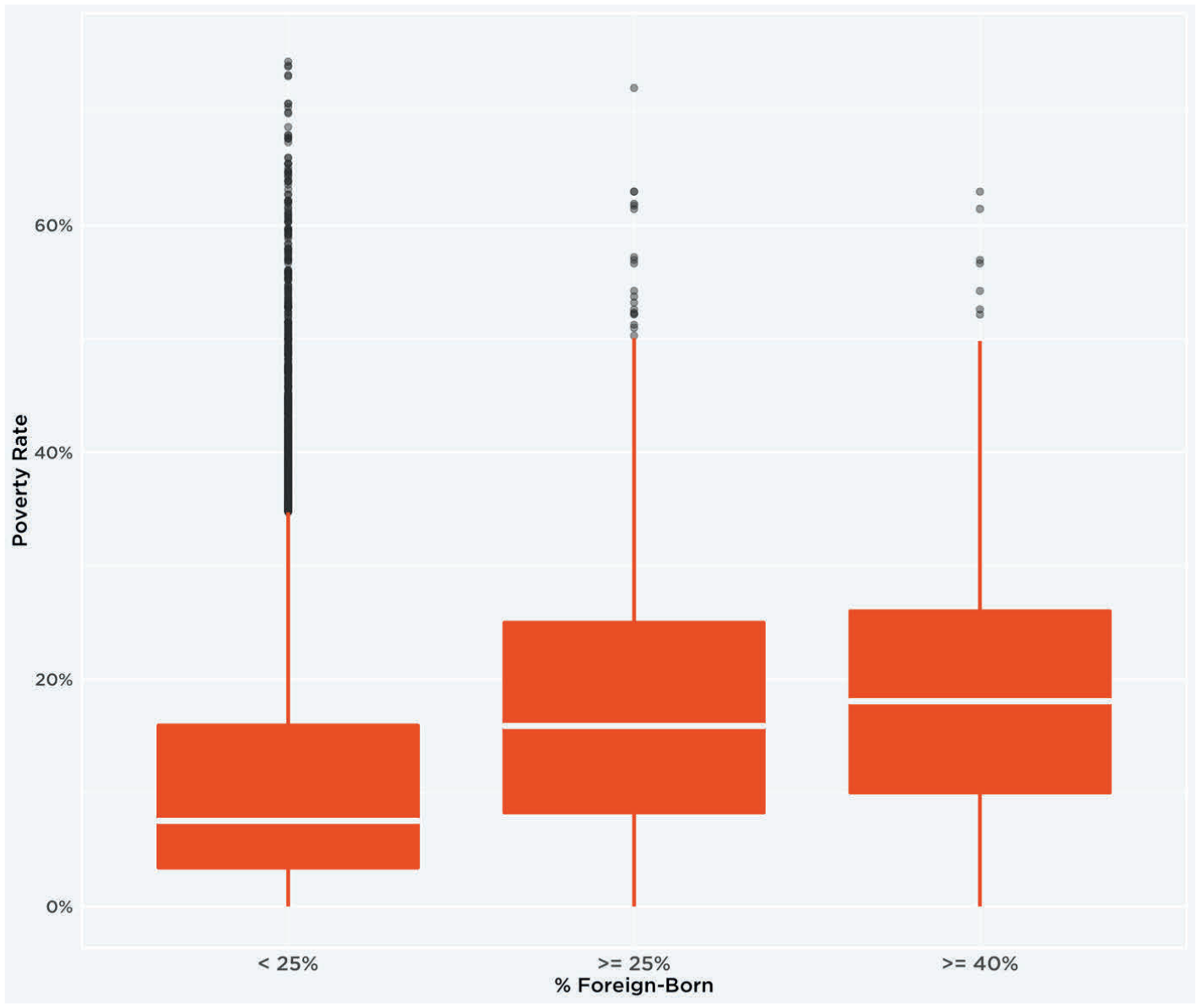
Neighborhood poverty rates by percentage of residents who are foreign-born.
In Table 2, we display the relationship between evictions and immigrant presence in four regression models predicting tract-level evictions. In Model 1, we regress eviction rates on immigrant neighborhood status, controlling for neighborhood poverty rates. The coefficient for immigrant neighborhoods indicates they have eviction rates 8.1% lower than non-immigrant neighborhoods (exponent of −0.084 = 0.919) with similar levels of poverty. As expected, poverty rates are positively correlated with eviction rates.
Results of Negative Binomial Regression Predicting Tract-level Evictions.
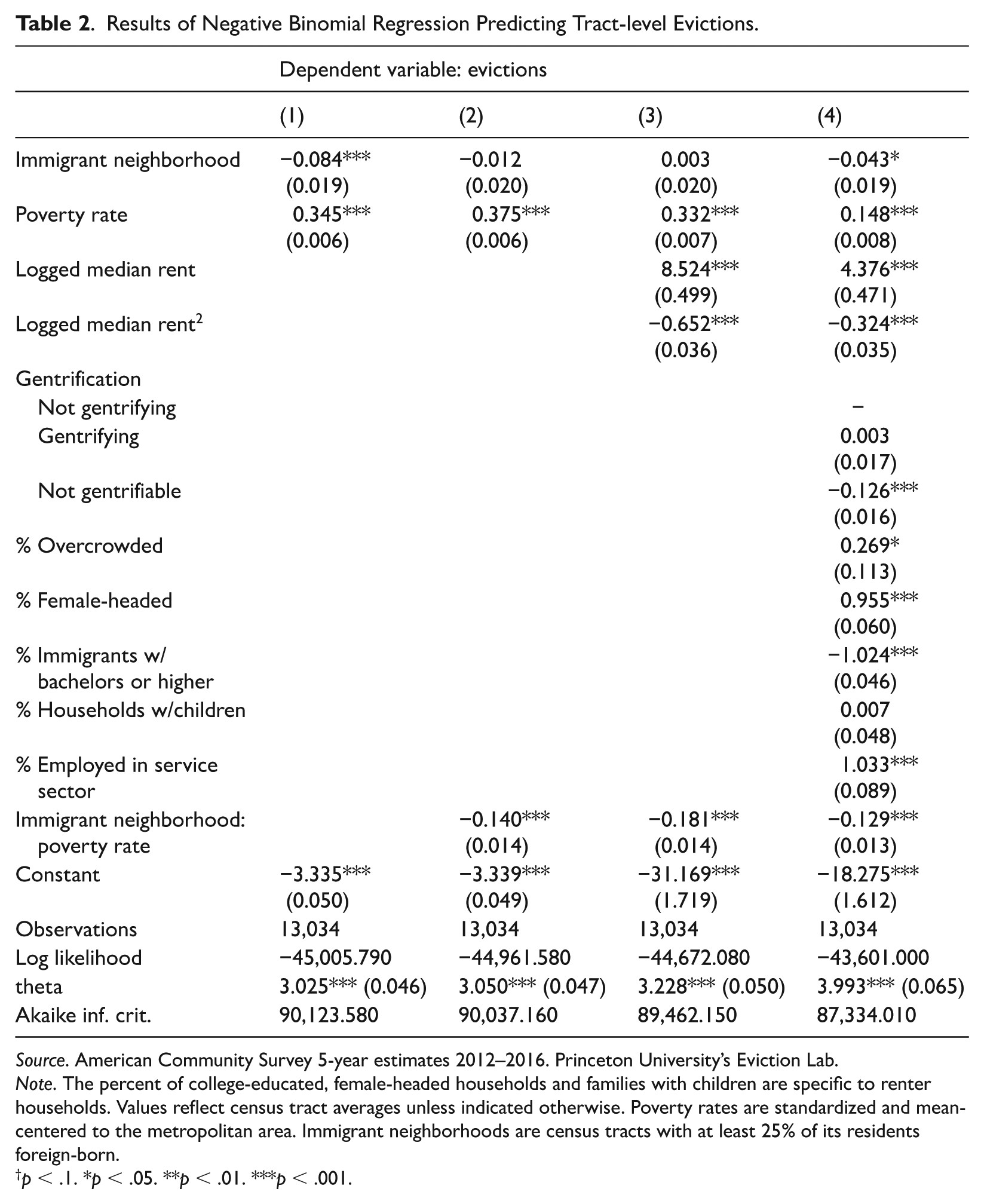
Source. American Community Survey 5-year estimates 2012–2016. Princeton University’s Eviction Lab.
Note. The percent of college-educated, female-headed households and families with children are specific to renter households. Values reflect census tract averages unless indicated otherwise. Poverty rates are standardized and mean-centered to the metropolitan area. Immigrant neighborhoods are census tracts with at least 25% of its residents foreign-born.
p < .1. *p < .05. **p < .01. ***p < .001.
In Model 2, we add the interaction between immigrant neighborhood status and poverty rates. The interaction is negative and statistically significant, and the model fit improves slightly, providing support for Hypothesis 1B that immigrant concentration mitigates eviction risk. The coefficient of the main effect is attenuated and no longer statistically significant, suggesting that immigrant neighborhoods at average poverty levels are predicted to have similar eviction rates to non-immigrant neighborhoods. This interaction effect holds with a similar magnitude after including more neighborhood controls in Models 3 and 4. Results are robust to multiple modeling and sample specifications. 8
In Figure 2, we plot predicted counts of evictions as neighborhood poverty rates increase for immigrant and non-immigrant neighborhoods, controlling for the neighborhood characteristics included in Model 4. The relationship between neighborhood poverty rates and evictions diverges as neighborhood poverty increases. At two standard deviations above the average poverty level, non-immigrant neighborhoods are predicted to have 46 evictions per 1,000 renting households. In similarly poor immigrant neighborhoods, this number drops to 34, a reduction of 26%.
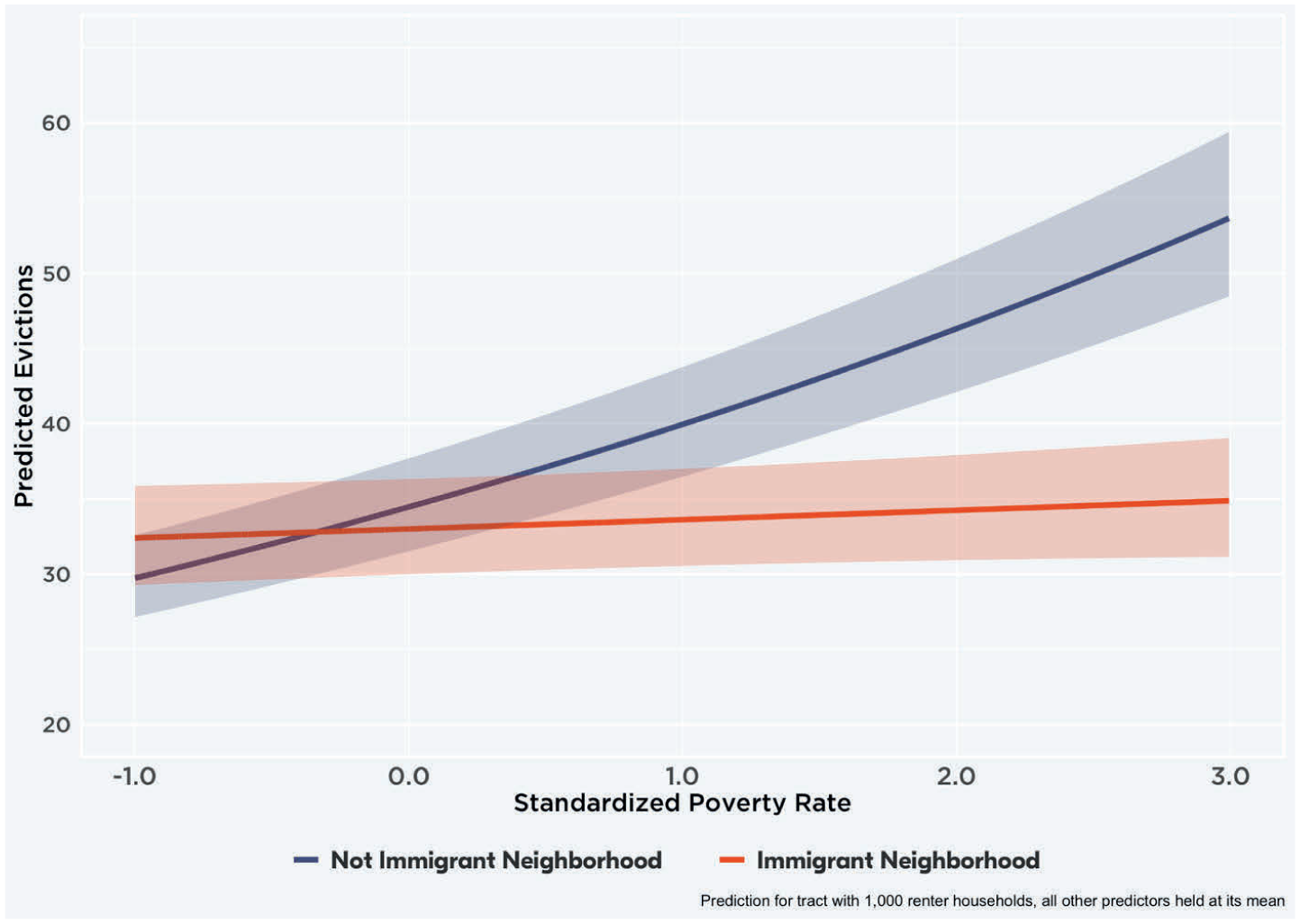
Predicted number of evictions by poverty rates and immigrant neighborhood status.
The relationships between evictions and other correlates support previous findings. Differences in neighborhood median rent partially explain the lower predicted eviction rate in immigrant neighborhoods, suggesting that immigrant neighborhoods generally have rent levels associated with lower eviction risk. Neighborhoods with more female-headed renter households, fewer immigrants with bachelor’s degrees, and more service sector workers are also significant predictors of eviction. Higher rates of overcrowding are associated with increased eviction risk, though we show below that this relationship varies in immigrant and non-immigrant neighborhoods. There is no statistically significant difference in eviction risk between gentrified and ungentrified neighborhoods, supporting previous work showing that most evictions take place outside of gentrifying areas (Hepburn, Louis, and Desmond 2024).
Segmented Contexts: Neighborhood Racial Composition
The extent to which immigrant neighborhoods are protective might vary by neighborhood racial compositions (Portes and Zhou 1993). We replicate our analyses stratified by neighborhood race. Asian immigrant neighborhoods have substantially higher poverty rates than their non-immigrant counterparts while Hispanic and White immigrant neighborhoods have slightly higher poverty rates. Conversely, Black immigrant neighborhoods and neighborhoods without a racial majority have slightly lower poverty rates (see Online Appendix Figure A1). However, the distribution of eviction rates by racial composition shows consistent results: Within each neighborhood racial category, immigrant neighborhoods have lower eviction rates than non-immigrant neighborhoods (see Online Appendix Figure A2). 9
We fit a negative binomial model predicting tract-level evictions by immigrant neighborhood status and neighborhood racial majority while controlling for poverty rates. Figure 3 presents predicted eviction counts by neighborhood type, alongside 95% confidence intervals. 10 Among non-immigrant neighborhoods, White neighborhoods have the fewest evictions, followed by Hispanic, racially mixed, and Black neighborhoods. However, incorporating immigrant neighborhood status complicates this pattern for Hispanic neighborhoods. Majority-Hispanic immigrant neighborhoods have the fewest predicted evictions among all groups at 28.8 evictions in a tract of 1,000 renter households, a 24% reduction from the predicted number of 38 in non-immigrant Hispanic neighborhoods (p-value < 0.05). Black and racially mixed immigrant neighborhoods have slightly fewer predicted evictions than their non-immigrant counterparts. While the Black-White gap in evictions among immigrant neighborhoods is predicted to narrow slightly, it remains large and statistically significant. Black immigrant neighborhoods still have higher eviction rates compared to non-Black immigrant and non-immigrant neighborhoods alike. Together, our results suggest that the protective qualities of immigrant neighborhoods do not extend to all immigrant neighborhoods equally.
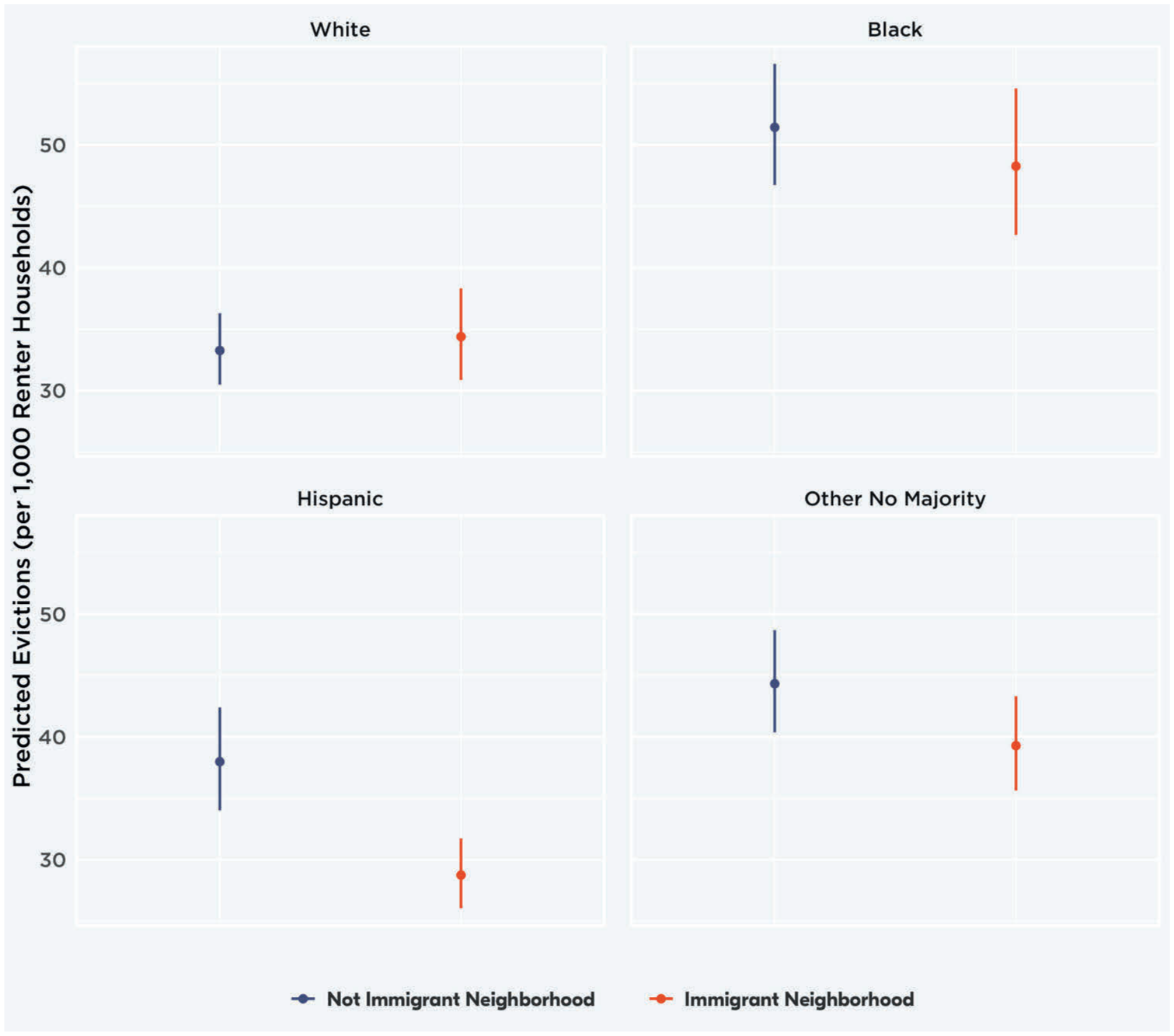
Predicted number of evictions by neighborhood racial majority and immigrant neighborhood status.
Segmented Contexts: Co-ethnic Housing Resources
The quantitative analyses are limited in their ability to disentangle the underlying mechanisms that explain immigrant neighborhood stability and how they vary across neighborhood contexts. To investigate how protective mechanisms stemming from ownership contexts and co-ethnic housing resources contribute to stability, we draw on in-depth interviews from Boston’s Chinatown and Houston’s Gulfton. We distinguish between Chinatown’s enclave housing markets and Gulfton’s secondary immigrant markets, highlighting how co-ethnic housing resources and dynamics, among other individual factors, influence eviction. In Chinatown, social support manifests not only through family and kinship ties but also through landlord-tenant relationships with co-ethnic landlords and local community organizations. These spatially concentrated ties co-constitute the enclave housing market. In contrast, Gulfton’s secondary immigrant housing market is characterized by the spatial concentration of low-rent, substandard apartment complexes that are marketed and targeted at immigrants.
Similarities across Immigrant Housing Markets: Overcrowding, Informality, and Employment
The low eviction rates in poor immigrant communities could obscure informal evictions, which occur beyond the purview of the courts. Informal evictions might be commonplace in these neighborhoods, given some immigrants’ limited English proficiency and undocumented status. However, we did not directly observe any instances of informal displacement, nor did landlords or tenants tell us the practice is routine in their communities.
Rather, in both sites, tenants we spoke with live in crowded housing conditions to minimize housing costs, splitting rent with other families and renting smaller units. Private-market landlords in Chinatown often permit rent-sharing practices, where multiple families share the same apartment. This allows households to pay less than $1,000 a month in one of the most expensive cities in the United States. Jie Zhen Li, who came here from Guangzhou through family immigration, worked two jobs to make her $1,400 rent before she and her husband began splitting the rent with another couple. Meanwhile, in Gulfton, families we interviewed are crammed into one-bedroom apartments, using bunk beds and transforming closets into makeshift bedrooms. For example, Yeimi Soraya Puerto, a Honduran immigrant, pays $740 a month for a 600-square-feet, one-bedroom apartment that she, her husband, and their six young children share. While our main models show overcrowding to positively correlate with evictions overall, running separate models on immigrant and non-immigrant neighborhoods shows overcrowding to only associate with heightened eviction risk in non-immigrant neighborhoods. In immigrant neighborhoods, there is no significant correlation (See Online Appendix Table A13). While overcrowding in most neighborhoods can be a lease violation, spurring eviction, landlords in immigrant neighborhoods appear to be more tolerant of such arrangements, allowing residents in these neighborhoods to split rent between families without additional eviction risk.
Accepting overcrowded housing enables poor immigrant households to make rent. Even so, tenants sometimes fall behind on rent. When this happens, owners and property managers in immigrant neighborhoods extend leniency. In Chinatown, owners we interviewed described how they value familiarity, stability, and community ties over maximizing profits or initiating eviction. When a tenant missed a payment, private landlord Catherine Lee “didn’t have a problem with her.” She explained, “I don’t like having a lot of turnarounds. I like renting to people I know who’ve been there for a long time. I know they’re clean. I know what they do. I know they don’t damage the property . . . . I think it’d be more difficult for me to find a new tenant to develop that relationship.” Because of her own ties in Chinatown, Ms. Lee knows her tenants’ employers, knowledge that provides her with further reassurance. Small-scale Chinatown landlords we spoke with also conveyed a lack of capacity and incentive to navigate the complex (and sometimes costly) eviction court process, preferring to lean on established relationships and mutual expectations instead of outsourcing disputes to the courts. This creates an incentive for landlords to rent to co-ethnics with community ties, upholding Chinatown’s distinct ethnic character. 11
Rather than pursuing court action, Rosemary Yee, who manages several family association properties in Chinatown, calls tenants who do not pay by the fifteenth of the month. “We usually give them some allowance,” she said, “But usually they would at least pay the previous month’s rent.” In some cases,
the tenant is tied to the association, [and] the owner would take special care of this tenant . . . . If they haven’t paid rent for a few months, take it slow, let them be, don’t raise issues. All parties have a mutual agreement.
Such responses to non-payment contrast starkly with the well-documented practice of landlords relying heavily on eviction courts to collect rent and fees and discipline tenants (Gomory 2022; Leung et al. 2021).
In Gulfton, smaller-scale owners we interviewed similarly offer some flexibility for rent collection and evictions. Danny Garcia, an apartment owner and an immigrant from El Salvador, described his rent collection process: “Everybody, almost everybody pays on time, but there are a few tenants that used to come and pay partial sometimes like that. And I work with them.” Ann Young, a Vietnamese immigrant who manages her family’s properties, sees evictions as costly. Unfamiliar with the court system, she outsources the process to an eviction service. “But I try not to use [the eviction service] so much because it’s not cheap,” she said. “And I don’t want to waste my time paying all the court fees.” Due to the monetary costs of an eviction and their proximity to tenants, smaller-scale, less professionalized landlords are more willing to work with tenants.
Likewise, in apartment complexes owned by investors from outside Gulfton, which are more common, the Spanish-speaking property managers we interviewed work with tenants and are flexible with eviction if it suited their needs. Having worked and lived at the same property for almost thirty years, Eva Rodriguez, a US-born Hispanic property manager, has implemented a system of partial payments for tenants with unstable pay schedules. She also personally contacts late-paying tenants. Even at times when her employer has pressed Ms. Rodriguez on rent collection, she has pushed back. Nonetheless, not all managers can push back against owners. Consuelo Almedia, a property manager from Mexico, feels pressure from her out-of-state owner to initiate evictions on late-paying tenants. “I’ve always tried to work with tenants,” she told us, “[But ultimately he] is my boss. So, if he says go to court, I have to go to court.” Beholden to their employers, property managers can offer only limited protection.
That said, leniency from landlords was often unnecessary in both neighborhoods because tenants rarely fell behind. Many families with whom we spoke had never missed a rent payment until the COVID-19 pandemic. And when tenants did fall behind on rent, they often received assistance from family, friends, or local organizations. For example, when a Chinatown tenant from Guangdong and her whole family fell sick to COVID-19, she was grateful she had a relative who brought them groceries and lent them money for rent. Tenants also turned to the Chinese Progressive Association, a local community organization, for information on social programs and assistance with paperwork.
In Gulfton, many residents have received food donations from local churches, as well as information from neighbors or other parents. However, the networks available to Gulfton tenants did not always have the ability or desire to provide financial support. For Miriam Ochoa, an undocumented immigrant from Mexico, her “husband has his aunt, his cousins [in the area], but we don’t have such a very close relationship,” and she worried “they would turn their backs on us.” Furthermore, “we are . . . not used to having debts, as well as loans . . . we do not like that.” The one time her family fell behind, when her husband became sick from COVID, her property manager helped fill out her application for rental assistance.
Miriam’s sentiments were echoed throughout our interviews. Respondents insisted they never fall behind on rent. This was supported by the fact that residents of immigrant neighborhoods are strongly connected to the labor market. In Chinatown, co-ethnic business owners and employers provide employment for immigrant tenants, while many Gulfton residents find work outside the neighborhood in low-skilled, labor-intensive sectors, including construction, landscaping, and cleaning. Although working families in immigrant neighborhoods still experience poverty, poor households with more tenuous connections to the labor market likely face higher eviction risk. 12
Importantly, tenants are able to consistently make rent because rents are considerably lower in both neighborhoods. However, this is so for different reasons in Chinatown and Gulfton. If Chinatown residents feel supported by the community, or even ambivalent about it, Gulfton residents feel trapped.
Enclave Housing Markets: Co-ethnic and Embedded Owners and Tenants
In 2019, the median monthly rent in Boston’s Chinatown was $1,082, compared to the city’s median monthly rent of $1,440. 13 Our interviews reveal how a network of three types of landlords in Chinatown—private landlords, subsidized housing, and family associations—collectively maintain a low-rent market in downtown Boston. These different forms of co-ethnic ownership characterize the enclave housing market, where community ties govern landlord-tenant relationships and contribute to the dense network of social support within the neighborhood.
A key reason behind lower-than-expected eviction rates in Chinatown is the effectiveness of community organizations in securing a combination of federal, state, and local support for housing programs. According to one report, subsidized housing units make up 45% of residential units in Chinatown (Chinatown Master Plan Committee 2020), compared to 19.2% of housing units in Boston (Massachusetts Department of Housing and Community Development 2020). Most subsidized housing in Chinatown was developed by a network of local community organizations, including the Chinese Consolidated Benevolent Association of New England and the Asian Community Development Corporation. The two largest projects, Tai Tung Village and Mass Pike Towers, are products of urban renewal programs. Paul Chan, the first property manager at Tai Tung Village, recounted that “[Chinatown’s] buildings were demolished by urban action, like building the Mass Turnpike Expressway. And those people by law have priority to come back to live in the buildings on that site.” These community organizations continue to actively develop new housing projects in Chinatown, explicitly prioritizing affordable rents for residents and maintaining Chinatown’s ethnic and working-class character.
Those without access to subsidized housing find affordable options from family associations and co-ethnic private landlords. Compared to subsidized housing, family associations provide more informal options where rental decisions are made in a semi-democratic manner. These organizations were historically formed to help Chinese immigrants with housing or jobs and owned real estate in Chinatown, taking up one to two units for their own use and renting out the rest. Rosemary Yee, who manages properties exclusively in Chinatown, oversees “twenty to twenty-five percent” of the family association buildings. She estimated that, “among all the owners [of non-subsidized properties] in Chinatown, the majority, I think, 60% are owned by family associations.” By and large, family associations charge below-market rents. Ringo Yu, the chairman of the Yee Fong Toy Family Association, told us that the association only raises rent at a rate of $25 per year for existing renters. Members of the association who qualify based on shared last names vote on rent prices and increases during meetings. This process of decision-making limits large rent increases, supporting previous observations that evictions drop under more democratic settings (Lempert and Ikeda 1970). That, combined with low turnover, means “for a renter living there for at least two to three years, their rent will become below the market price [by] at least 10 percent,” according to Mr. Yu.
A subset of private landlords in Chinatown also appears to intentionally maintain low rents. These owners typically have long-term ties to Chinatown, having grown up or worked there. Catherine Lee, who was raised in Chinatown, rents out a three-unit building for between $1,050 and $1,500 per unit. “If you know what they’re doing,” she explained, “you have an idea of how much they’re making. You already can compute if it’s doable for them . . . . I don’t think anybody is paying more than 25% [of their income] for their rent in any of my places. So, I know it’s affordable for them.” Nonetheless, not all private landlords share this approach. Newer investors, many of them Chinese immigrants themselves, have raised rent prices dramatically, evicted long-time tenants, and converted properties into short-term or student rentals. New owners, for example, evicted Mei Kwun Wong’s family from 2 Johnny Court, where they had lived for over a decade. While the previous owner, who knew and trusted the Wong family, had only increased rent by $30 over their decade-long tenure, the new owners demanded a rent increase from $930 to $1,900 within two years. These changes suggest long-standing community ties, rather than co-ethnicity, are more important to shaping a management strategy that prioritizes affordability.
Secondary Immigrant Housing Markets: Investor Landlords and Captive Immigrant Renters
In 2019, the median monthly rent in Gulfton was $818, compared to Houston’s median monthly rent of $1,092. 14 Many Gulfton residents we interviewed were drawn to the neighborhood because of its low rents. However, unlike in Chinatown, most apartment complexes are owned by private landlords, investors, and management companies, almost all from outside the community. While multiple community organizations serving immigrants operate in Gulfton, they seldom supply, own, or manage affordable housing. Rather than an intentional preservation of affordable rental housing, as in Chinatown, low rents in Gulfton reflect its low-quality multifamily housing stock. This tradeoff between rent and housing quality—combine with the lack of other affordable options—is a key feature of the immigrant secondary housing market and reflects a more captive rental situation.
In exchange for low rents, Gulfton residents endure unsafe and degrading conditions. Many buildings, especially among smaller-scale complexes in the Southwestern region, have broken or missing windows. Potholes in parking lots, some the size of a car, flood after rainstorms. Playground sets have rusted over and courtyards are overgrown with weeds. Walking through the complexes, dimly lit hallways smell like mildew and cigarettes. Marta Martinez, an undocumented Colombian immigrant who lives in one of the largest complexes, recounted the “garbage everywhere. They don’t sweep for two months. They don’t mop.” Inside the apartments, residents deal with mold, water leaks, broken air conditioners and refrigerators, and pests, issues property managers are slow to address. Sara Myma Teniente, an undocumented immigrant from Mexico, and her family of five have lived in the same one-bedroom apartment for seventeen years. She described her apartment’s conditions:
The water in the bathroom sink overflows. Sometimes during the midnight, around two in the morning, it will start flooding . . . . The [maintenance] men don’t come here as they should. The air conditioner—it’s been about five years—when it’s very hot outside, the air conditioner in here doesn’t work. Now there is humidity . . . . When it rains, the water pours in . . . . I used to have furniture here. My husband took it to the storage. It had mold.
Such conditions, including dampness and mold, could have adverse health consequences (Bush et al. 2006; Mendell et al. 2011). Mayra Enamorado, an undocumented immigrant from Honduras, developed headaches that she believes came from living in a mold-infested apartment. Another tenant, a Honduran mother of three, conveyed concern that the use of chemical treatments for pests would trigger her child’s allergies. Across interviews, renters expressed frustration toward their landlords for poor living conditions, feeling as if “they [we]re treating us like animals,” as Marta Martinez put it.
Involuntary moves in Gulfton more often take the form of leaving failing housing conditions rather than formal evictions. Yet those who want to move due to housing conditions are often unable to find or afford better options. Tired of crowding and water leakages in her previous apartment, Monica Edith Reyes Munoz, an undocumented Guatemalan immigrant, decided to tour another apartment complex in Gulfton. Yet when she walked into the apartment, “you saw graffiti . . . . When you went into the apartment[s], they were dirty inside. Since the people were gone, they hadn’t been maintained, and the garbage hadn’t been taken out.” The property has a reputation for crime. To attract renters, the landlord had waived deposits and charged low rents, offering a two-bedroom unit for just $800. While wary of safety issues, Ms. Munoz’s family was ultimately persuaded by the larger space and low rent and decided to move in. Tenants in Gulfton ultimately trade one set of issues for another. Presented with a concentration of tenants who accept poor housing conditions for lower rents, landlords in Gulfton have little incentive to keep up with maintenance (Desmond and Wilmers 2019; Schmidt 2024). Substandard yet affordable housing quality becomes an unfortunate tradeoff for tenants and comprises a business model for landlords.
Discussion
Analyzing over a million eviction records and 90 in-depth interviews, this study explores eviction outcomes in poor immigrant neighborhoods. We find immigrant neighborhoods to have 26% fewer evictions than comparably poor non-immigrant neighborhoods in many major cities. Just as poor immigrant communities have significantly lower crime and mortality rates than other poor neighborhoods (Eschbach et al. 2004; Graif and Sampson 2009; MacDonald et al. 2013), they also often exhibit unexpectedly high levels of residential stability.
We further investigate how two contextual factors, racial composition and co-ethnic housing resources, shape experiences of residential instability. Quantitative analysis shows that the racial gap in evictions between Hispanic and White neighborhoods disappears after factoring in immigrant concentration. The decline is less significant for Black neighborhoods, which have the highest predicted eviction rates regardless of immigrant concentration. This finding echoes previous research showing that anti-Black discrimination and exclusion continue to structure outcomes among Black immigrants, including in terms of residential segregation and earnings (Hamilton 2020; Iceland and Scopilliti 2008).
Immigrant neighborhoods also vary by co-ethnic housing resources. In Chinatown’s enclave housing market, a dense web of community organizations has successfully secured housing investments, such that nearly half of all rental units in Chinatown are subsidized. Chinatown’s success is atypical given that immigrant populations are underrepresented in subsidized housing programs (Reina and Aiken 2021). Our findings demonstrate that strategic locational placement and local providers connected to the community play an essential role in the relatively high usage of subsidized housing. Nonetheless, legal status might bar some immigrants in other communities from eligibility (Reina and Aiken 2021). Future research should investigate why subsidized housing has become concentrated in some low-income communities and scarce in others, and the role of immigrants and immigrant-focused organizations in this.
Co-ethnic landlords embedded in the community have kept rents low in Chinatown. Just as ethnic economies have informal ways of doing business that benefited co-ethnic workers and employers (Bailey and Waldinger 1991; Zhou 2010), small-scale landlords and embedded relationships facilitate informal understandings and arrangements in Chinatown’s housing market. However, more work is still needed to understand how co-ethnic ownership structures can facilitate, but do not guarantee, community embeddedness that fosters residential stability and tenant power.
Gulfton’s low eviction rates reflect a different type of housing dynamic. Constrained by a lack of other viable options, poor immigrant families in Gulfton accept poor housing conditions in exchange for low rents. Unlike in Chinatown, Gulfton owners are often investors from outside the community who keep rents low to attract prospective tenants willing to accept poor conditions. When tenants fall behind, flexible arrangements, especially practiced by Hispanic property managers, help attenuate eviction risk. The combination of low rents and the flexible property management approaches mitigates displacement pressure routinely faced in other high-poverty communities. However, the origins of these characteristics, as well as the degree to which they protect tenants, make for very different kinds of immigrant housing experiences.
Furthermore, residents in both neighborhoods make tradeoffs in housing quality to make rent, processes that administrative court data do not fully capture (Rosen et al. 2023). These strategies are in part possible because of high tolerance for overcrowding and rent-splitting in immigrant neighborhoods, dynamics that combine with higher employment rates to help renters stay afloat. Such efforts to make rent might also explain our quantitative observation that gentrifying neighborhoods like Chinatown are not more likely to experience evictions, as other studies have found (Hepburn et al. 2024). These findings illustrate that low eviction rates in and of themselves are not necessarily a sufficient indicator of a safe, desirable community. Nuanced accounts of immigrant housing markets, including how immigrants make concessions in matters of housing quality or overall quality of life to pay increasingly unaffordable rents, are required to produce a more comprehensive understanding of housing in America (McConnell 2013; Rosen et al. 2023; Schmidt 2024).
To the best of our knowledge, this is the first study to investigate property ownership within immigrant neighborhoods, adding to a growing literature examining how supply-side actors shape neighborhood outcomes (Dahir and Hwang 2025; Gomory 2024; Rosen 2014). Particularly, we draw attention to co-ethnic ownership and community embeddedness as an understudied mechanism of residential stability in immigrant communities. Chinatown’s history of ethnic property ownership combines with dense social capital to promote both residential stability and decent housing in a prime location. By contrast, instances of co-ethnic ownership are rare in Gulfton. Apartment complexes are largely owned by outside investors who neglect their properties, depressing both the quality and price of housing. Without access to more community-oriented, co-ethnic landlords, residents in Gulfton’s secondary immigrant housing market reflect a captive housing situation.
By distinguishing between heterogeneous types and dimensions of housing experiences outside the mainstream housing market, we contribute to the growing literature on low-rent housing markets (Desmond 2016; Rosen 2020). The comparison between the two neighborhoods raises questions for future research about the local conditions that encourage co-ethnic ownership. For example, the extent to which each type of housing market is available may further vary with metropolitan context. Enclave housing markets might be more available in Boston, given its historical role as an immigrant destination (Singer 2015), while secondary immigrant housing markets might be more abundant in Houston, where multifamily properties and corporate owners proliferate (Gomory 2024).
Studies on immigrant spatial incorporation have typically focused on explaining why residents live in and exit immigrant neighborhoods (Iceland and Scopilliti 2008; Logan et al. 2002), but they have seldom accounted for how housing dynamics within these communities influence these decisions. Importantly, lower eviction rates in poor immigrant neighborhoods suggest protective qualities that allow, even encourage, continuous residence. In Chinatown, the supply of affordable housing and residential stability, on top of community affinity and access to ethnic resources, contribute to residential stability, reinforcing a type of “voluntary segregation” (Zhou 2010). In Gulfton, low rents are the result of harsh tradeoffs, and co-ethnic managers offer only limited protection, yet the lack of affordable alternatives constrains families in place.
While we do not have information on documentation status in our quantitative data, our qualitative observations offer some insight into how the legal statuses of immigrants may have affected eviction patterns. Although it is possible that renters who lack legal status may be more likely to leave without going to court, the majority of Gulfton tenants with whom we spoke did not recall incidents of illegal or informal evictions. Importantly, echoing findings that undocumented tenants are selective in system engagement (Asad 2023), some undocumented renters chose to engage with the eviction court despite their lack of legal status. Mayra Enamorado was facing an eviction at the time of the interview. She feared that leaving before her court date would mar her record. “No, not breaking the lease . . . . It already looks bad. And I think that’s gonna be on my record, right? . . . I’ve never broken my lease.” 15 Nonetheless, given the prevalence of informal arrangements in immigrant communities (Light 2010), individuals who evade formal court evictions by simply moving out might also be the same renters wary of participation in research studies. Future work may more accurately estimate displacement risks based on documentation status, including further qualitative data collection that focuses more exclusively on the role of legal status on engagement with the eviction court system.
As others have noted (Schmidt 2024), barriers in the mainstream housing market, including credit checks requiring social security numbers, limit housing options available to undocumented tenants. They also face significant restrictions from housing assistance programs. This was particularly true during the study period, when policy changes seek to exclude some immigrants from public housing programs (Allen and Goetz 2021). 16 As a result, many undocumented renters accept substandard housing at the lowest cost they can find in the secondary housing market. Landlords in Gulfton take advantage of this captive audience by charging additional deposits and application fees, in exchange for bypassing credit checks. While predatory inclusion of tenants in low-income neighborhoods is not unique to immigrant neighborhoods (Desmond and Wilmers 2019; Rosen 2020), the example of Gulfton shows undocumented residents in immigrant neighborhoods may be particularly vulnerable. In contrast, a lack of documentation does not constitute a barrier to housing in Chinatown. This is in part because of the much smaller population of undocumented immigrants there: Only two of the tenant interviewees in Chinatown are undocumented. Furthermore, private landlords in Chinatown seldom rely on official background checks (or even paper leases); instead, they rely on social networks and word of mouth, offering another example of the informal way of doing business in an enclave housing market. In these ways, legal status (or the lack thereof) matters in different ways depending on housing and immigration contexts.
Our study joins others in adopting a mixed-methods approach to investigate the complex interrelations of immigration, poverty, and neighborhoods (Harding and Seefeldt 2013; Small 2011). This approach allows our qualitative findings to illuminate processes difficult to capture with statistical data, particularly given the reciprocal relationships between many of the relevant neighborhood characteristics. Other limitations in the data remain. First, we cannot infer household-level characteristics, including nativity and race and ethnicity, in eviction records. Rather, we only rely on tract-level measures. Second, while national eviction trends were relatively stable up until 2020, we cannot extrapolate our quantitative results beyond the study period of 2012–2016. 17 Given the later time period of our interview data (2021 and 2022), we were careful to ask interviewees about their full housing history, as well as changes they may have observed. Nonetheless, the differences in the two time periods, including the changes in economic and political conditions, remain a limitation of the study. Finally, our interview data rely on tenants’ and landlords’ own accounts and recollections of their behavior. While we triangulate data sources when available, we do not directly observe behavior. Although respondents have shared examples that might put them in a bad light we cannot rule out social desirability bias in our interviewees’ accounts. Taken together, our findings and their limitations underscore the need to study the interconnection between immigration and housing.
This study holds policy implications. Chinatown serves as a case study demonstrating the importance of subsidized housing for neighborhood stability and well-being. Community organizations focused on neighborhood revitalization might consider the efforts of Chinatown’s civic leaders, who have made significant investments in affordable housing to stave off gentrification pressures and preserve the neighborhood’s cultural character. In documenting pro-social benefits of local ownership arrangements, particularly in Chinatown, this study also provides support for initiatives that promote land ownership for community members, who are responsive to local needs and concerns (Dahir and Hwang 2025; Gomory 2022). Democratic rent-setting practices of Chinatown’s family associations can also serve as a model for how to mitigate rent hikes and displacement pressures amidst America’s housing affordability crisis.
Supplemental Material
sj-docx-1-cty-10.1177_15356841261452619 – Supplemental material for Profit or Protection? Evictions and Housing Dynamics in Immigrant Neighborhoods
Supplemental material, sj-docx-1-cty-10.1177_15356841261452619 for Profit or Protection? Evictions and Housing Dynamics in Immigrant Neighborhoods by Lillian Leung, Renee Louis, Jasmine Rangel and Matthew Desmond in City & Community
Footnotes
Acknowledgements
The authors acknowledge the feedback provided by the members of the Eviction Lab at Princeton University, participants in the Migration, Ethnicity, Race, and Nation workshop at Stanford University, and workshop participants in the Joint Degree Program in Social Policy at Princeton University.

Funding
The authors disclosed receipt of the following financial support for the research, authorship, and/or publication of this article: Research reported in this publication was supported by the JPB and Gates Foundations.
Declaration of Conflicting Interests
The authors declared no potential conflicts of interest with respect to the research, authorship, and/or publication of this article.
Supplemental Material
Supplemental material for this article is available online.
Notes
References
Supplementary Material
Please find the following supplemental material available below.
For Open Access articles published under a Creative Commons License, all supplemental material carries the same license as the article it is associated with.
For non-Open Access articles published, all supplemental material carries a non-exclusive license, and permission requests for re-use of supplemental material or any part of supplemental material shall be sent directly to the copyright owner as specified in the copyright notice associated with the article.
