






Abstract
This study seeks to investigate the ways in which local religious institutions shape mechanisms of informal social control within one of the largest Arab ethnic enclave communities in the northeastern United States, where a high concentration of working-class Muslim immigrants reside. The study draws on three years of ethnographic fieldwork and in-depth interviews with 58 first- and second-generation Muslim-Arab immigrants and 10 community agency members who work in local institutions. The findings reveal the pivotal role two local mosques played in facilitating and mobilizing collective efficacy among Muslim residents to confront neighborhood crime. In addition to promoting social organization and boosting various levels of social control within the community (e.g., private, parochial, public), the analysis shows that local mosques also contributed to the physical revitalization of the Arab neighborhood by investing in vacant land and run-down properties, further improving the physical and economic conditions in and around the ethnic enclave. This study extends the immigrant revitalization perspective by elucidating the distinct ways in which the spatial concentration of Muslim immigrants, along with their religious institutions, can reshape disadvantaged urban spaces.
Keywords
Introduction
Over the past three decades, immigration has emerged as one of the most important and polarizing policy debates in Western countries. In the United States, this debate has been largely shaped by the dramatic increase in the number of non-White immigrants, which has coincided with an increase in anti-immigrant sentiment and deep-seated fears that immigrants bring with them a range of social problems, most notably poverty and crime. These views were reflected in various national polls, indicating that about half of the American public held negative views of Middle Eastern and Latino immigrants, whom they constantly ranked among the least likely immigrant groups to positively contribute to the social fabric of the country, compared with their European and Asian counterparts (Pew Research Center 2015).
Yet, despite these commonly held beliefs about the link between immigration and crime, empirical research in the past two decades has shown that such a relationship is largely unfounded, and that immigration is either negatively associated with, or has no effect on, crime (Ousey and Kubrin 2018). In fact, much of the research in the United States has consistently shown that foreign-born immigrants (i.e., first generation) are significantly less likely than native-born and subsequent generations (i.e., second and third) to engage in crime (Sampson 2008). Similarly, empirical evidence at both the national and local levels suggests that high concentrations of immigrants are negatively related to crime across neighborhoods and cities in the United States (Desmond and Kubrin 2009; Kubrin and Ousey 2009; Martinez, Stowell, and Lee 2010).
In explaining these findings, proponents of the “immigrant revitalization” perspective posit that high concentrations of foreign-born immigrants contribute to the revitalization of disadvantaged neighborhoods through the creation of ethnic enclave economies, the presence of strong social institutions (e.g., intact families, religion), and – by extension – mechanisms of social control, all of which buffer against crime and delinquency in the areas where they settle (Lee and Martinez 2002; Martinez and Lee 2000; Martinez et al. 2010). While this perspective has provided valuable insight on how high concentrations of immigrants in geographic location can contribute to the revitalization of declining urban neighborhoods, there are two areas within this body of work that require further scholarly attention. First, the theoretical development of the immigrant revitalization perspective is deeply rooted in the experiences of a handful of Christian immigrant groups and their ethnic enclaves, most notably Latinos (e.g., Lee and Martinez 2002; Portes and Stepick 1993). At this juncture, we know very little about how high concentrations of Muslim immigrants can influence the institutional and organizational capacity of immigrant neighborhoods, and the implications this may have for crime in the areas where they settle. This is important because immigrant communities and ethnic enclaves are not monolithic in terms of their cultural, institutional, and organizational structures (see Zhou 2014); therefore, their impact on the process of neighborhood revitalization (or lack thereof), as well as their ability to socially organize and control crime, are likely to differ (Ramey 2013).
Second, more research is needed to understand how various immigrant groups, especially in newly formed immigrant destinations, might contribute to the process of urban revitalization not just socially, but also physically. Indeed, while much of the research within this framework has focused on linking immigrant concentration to increased informal social control and neighborhood stability, very little attention has been paid to the process of physical revitalization and the mechanisms that shape it, especially in non-Latino immigrant communities. Within this literature, community organizations have generally been theorized as facilitative rather than as leading actors, enabling and amplifying the bottom-up spatial practices of residents and small business owners rather than initiating physical transformation themselves (see Sandoval 2017; Sandoval-Strausz 2019). Religious institutions in particular have been cast primarily as anchor institutions that promote social revitalization (i.e., providing social infrastructure, facilitating community organization), rather than direct agents of physical development in disadvantaged urban spaces. In many Muslim immigrant communities, religious institutions occupy a central and multi-faceted role in community life that extends beyond just spiritual practices. This may position religious institutions as potentially powerful actors in the process of neighborhood change. Yet, the immigrant revitalization perspective has largely overlooked the role religious institutions may play in the physical transformation of declining urban spaces and how faith-driven investments may shape urban neighborhoods in American cities where large numbers of working-class immigrants settle.
Drawing on three years of ethnographic fieldwork and in-depth interviews with first- and second-generation Arab immigrants (N = 58), as well as community agency members who work in local institutions (e.g., religious leaders, police officers; N = 10), this study aims to illuminate these gaps in the literature on immigrant revitalization and urban sociology by examining how local urban mosques and Islamic centers influence both the social organization and physical revitalization in one of the largest Arab ethnic enclaves in the northeastern United States. In doing so, this study seeks to answer the following questions: (1) How do local urban mosques shape mechanisms of informal social control and the community’s capacity to respond to crime and disorder in their neighborhood? and (2) In what ways do local mosques shape the process of physical revitalization in the Arab neighborhood, and how might these dynamics extend or challenge prevailing theories of immigrant-led urban renewal?
The city where the study took place offers a distinct opportunity to investigate a newly formed – and notably understudied – ethnic enclave community, where one of the highest concentrations of Muslim and Arab immigrants reside. Importantly, Kingston’s 1 Arab community lives in a highly disadvantaged urban setting where high rates of poverty, unemployment, crime, and disorder are present. Thus, the city of Kingston provides a unique opportunity to explore the ways in which Muslim immigrants and their religious institutions – and by extension, mechanisms of social control – function and operate in a highly disadvantaged urban context. As of recent, this ethnic enclave community has become the preferred destination for newly arrived immigrants from the Middle East. Thus, understanding how this type of setting influences Muslim immigrants’ settlement patterns and immigration experiences is imperative, given Pew Research Center’s (2018) latest projection that by 2040, Muslims will be the second largest religious group in the United States after Christians. 2
The Immigrant Revitalization Perspective
Developed by Martinez and colleagues (see Lee and Martinez 2002; Martinez and Lee 2000; Martinez et al. 2010), the immigration revitalization thesis contends that the influx of co-ethnic immigrants to a specific geographic location can help revitalize the area and suppress crime. When immigrants settle in new neighborhoods, they tend to bring with them a host of benefits, including new forms of social, cultural, and religious capital, as well as their entrepreneurial spirit – all of which help strengthen the economic, social, and institutional structures of the neighborhoods where they settle. These conditions help boost mechanisms of social control, especially in disadvantaged urban neighborhoods, where many working-class immigrants settle upon arrival to the United States (Sampson 2008; Vélez 2009). According to this perspective, the large concentration of immigrants from the same countries of origin can rejuvenate distressed cities in four notable ways: economically, socially, institutionally, and physically.
First, the spatial concentration of co-ethnics encourages the creation of ethnic enclave economies which serve immigrant neighborhoods in a multitude of ways, including providing job opportunities to immigrants and access to ethnic goods and services (Portes and Manning 1986). The presence of ethnic businesses not only bolster the economic profile of the neighborhood but also reinvigorate local economies by fueling job growth and generating tax revenues that benefit local communities. The presence of these economic conditions also play a crucial role in the integration of new immigrants by expanding their social networks, resources, and support systems and providing them jobs and income, all of which buffer against the criminogenic conditions (e.g., economic deprivation, social isolation) often found in the disadvantaged urban areas where many working-class immigrants settle (Martinez et al. 2010; Stowell et al. 2009; Vélez 2009).
In addition to reviving the economic structure of depressed neighborhoods, the influx of co-ethnic immigrants into a particular locale can also revitalize the social and institutional structure of neighborhoods. When newcomers settle in neighborhoods, they bring with them their cultural practices and religious traditions into these areas, infusing them with new forms of social and cultural capital and mechanisms of social control (Portes and Rumbaut 2001). In these ethnic settings, residents of these communities tend to enjoy dense social ties and rely on ethnic resources, further strengthening social bonds and community solidarity. Additionally, contemporary immigrants are also more likely than their native counterparts to uphold traditional family ideals, emphasizing the importance of two-parent households and strong family ties, all of which further bolster informal social control, not just within immigrant families (i.e., private controls) but also within neighborhoods where high proportions of immigrant families reside (Barranco, Harris, and Feldmeyer 2017; Portes and Rumbaut 2001). When concentrated in a geographic location, these cultural factors tend to serve a protective function by promoting prosocial norms and higher levels of adult supervision, which discourages young people’s engagement in crime and deviant behavior (Ousey and Kubrin 2009).
Further, immigrants living in ethnic enclaves also tend to be more proactive and involved with their local institutions (e.g., religious, educational, civic organizations) as they engage in activities that meet their everyday needs and reinforce their ethnic and religious identities. In this way, immigrants’ involvement with their local institutions forms the basis of social capital through the development of parochial networks, which in turn strengthen the organizational and regulatory capacity of residents to police unwanted behaviors and fight crime in their communities.
The final and perhaps least studied aspect of the immigrant revitalization perspective is related to how growing numbers of immigrants can contribute to the physical renewal of depressed urban neighborhoods (Sampson 2017). Recently, some urban scholars have argued that when immigrants arrive en masse to a particular neighborhood or city, they tend to buy, renovate, and invest in abandoned public spaces (e.g., vacant land, dilapidated buildings), reducing signs of physical decay in the area (Sampson 2017; Vitiello and Sugrue 2017). This is important because proponents of the immigrant revitalization perspective have posited that reducing physical disorder (e.g., graffiti, litter, abandoned buildings and run-down establishments) as part of this process would inadvertently diminish the number of criminogenic places and with it, crime and disorder in urban areas (Ousey and Kubrin 2018; Sampson 2017; also see Skogan 1992). Yet, despite such arguments, the mechanisms and processes by which the reduction of vacant lands is linked to crime and disorder in immigrant communities are not fully understood, especially in non-Latino immigrant communities.
Indeed, much of what we know about how immigrants physically transform urban neighborhoods has emerged primarily from studies that focused on Latino immigrants and their communities (see Lara 2018; Sandoval-Strausz 2019; Vitiello and Sugrue 2017). Foundational work within this area demonstrates that immigrants have revived declining urban neighborhoods through increased population density, commercial investment, and physical improvement of the housing stock. Scholars also observe that this bottom-up immigrant revitalization process unfolds organically and is primarily rooted in everyday spatial practices that immigrants engage in as they reclaim and (re)appropriate dilapidated urban spaces through ethnic commercial activities and entrepreneurship, renovating and investing in rundown properties, and engaging in property maintenance (Lara 2018; Sampson 2017). Importantly, urban scholars identify ordinary working-class immigrants and small business owners who invest in their properties and take care of their establishments as the primary agents driving urban transformation (Lara 2018; Sandoval-Strausz 2019).
Within this realm, what is less understood is how a high concentration of Muslim-Arab immigrants might contribute to the process of urban renewal in new and emerging immigrant destinations, and whether the underlying mechanisms uncovered diverge from those outlined by scholars in other urban immigrant communities. Understanding how group-specific spatial transformation pathways unfold in various contexts of reception can help us better delineate the mechanisms through which different immigrant groups contribute to the process of urban transformation. The present study aims to build on these findings by identifying some of the mechanisms involved in the process of urban revitalization in an Arab-Muslim immigrant community in the northeastern United States, where the mosque anchors both religious life and a broader infrastructure of social services and community organization. Given how important the mosque is to the daily operations of the neighborhood in this urban context, such features may provide an institutional basis for it to function differently from religious institutions in other immigrant enclaves and to facilitate revitalization through distinct mechanisms.
Local Religious Institutions and Crime in Immigrant Neighborhoods
Scholars have long viewed religious institutions to be an important source of social control. Yet, despite their salience in promoting social organization and enhancing social control in immigrant communities, immigration and crime research in the last two decades has largely overlooked the role that faith-based institutions can play in controlling neighborhood crime. Recently, however, a very small body of work has begun to unpack this relationship by examining the impact that churches have on crime in immigrant neighborhoods (see Harris and Feldmeyer 2015; Harris, Feldmeyer, and Barranco 2018). In keeping with the “immigrant revitalization” perspective, one study found that immigrant concentration tends to play a key role in reducing crime through the presence of religious institutions, especially in emerging – as opposed to more established – immigrant destinations (Harris et al. 2018). With the substantial increase in the number of Muslim immigrants in recent years, relatively scant attention has been paid to how urban mosques operate and function in working-class Muslim immigrant communities, and how they might help their congregants address local problems.
In many immigrant communities, religious institutions occupy a central role in the life of immigrants (Warner 2000). Such institutions tend to offer their congregants a plethora of benefits, providing them a safe space to meet and share their religious practices, as well as offering a wide range of social services (e.g., financial assistance, welfare, counseling, English classes), cultural programs (e.g., after school activities, weekend schools, cultural and educational events), and recreational activities (especially for the second generation). These resources can help immigrant families adapt to their new environment by responding to their everyday practical needs (Cadge and Ecklund 2007; Zhou and Bankston 1998). By functioning as de facto “multi-issue” neighborhood-based organizations that offer services beyond their intended religious function, religious institutions are thus thought of as “a unique type of community organization” that promote social organization and enhance localized mechanisms of social control (Rose 2000:343).
Places of worship in immigrant neighborhoods are believed to encourage voluntary gatherings, increasing organizational participation among congregants, as well as the frequency of social interactions between residents and their local organizations (Bankston and Zhou 1995). These relational networks are likely to strengthen social ties among residents and promote social cohesion in the community. Frequenting neighborhood-based religious institutions, then, further enables the development and maintenance of mutual trust and cooperation among residents, both of which are essential to effectively supervise activities and confronting shared local problems, including crime and disorder (Bursik 1999; Sampson, Raudenbush, and Earls 1997). In this way, the presence of strong religious institutions is believed to play a significant role in reducing neighborhood crime by fostering social organization, which in turn enables residents to mobilize and respond to local threats that violate the social order in their communities (Beyerlein and Hipp 2005; Rose 2000).
The systemic model of crime highlights the protective effects organizational participation can have on shaping mechanisms of social control in communities through the creation of social capital and the development of local friendship networks (Bursik and Grasmick 1993; Sharkey, Torrats-Espinosa, and Takyar 2017). According to this perspective, the community’s ability to self-regulate hinges on the extent to which local institutions are able to stimulate the development and maintenance of social ties and controls at three distinct levels: private, parochial, and public. Private ties and control emerge from intimate relationships, typically between family members and friends. Parochial ties are those that exist between residents and their local institutions as a result of membership or participation in those organizations. Public ties refer to the relationship between residents and agencies or institutions outside of the community (e.g., governmental and nongovernmental agencies, police, city council, politicians). Unlike private and parochial ties, public ties hinge on the community’s ability to access or obtain extracommunity resources and services to strengthen social control (Carr 2003).
Despite the prominence of the systemic model in studying community-level dynamics and their relationship to neighborhood crime, the role of public ties and controls remains understudied, especially in immigrant communities. To this end, what we know about how public social control operates in communities has emerged from a few studies, both qualitative and quantitative (see Carr 2003; Vélez 2001). These studies have found that neighborhood-based organizations that are connected to resources and other formal agencies outside the community were more effective in exerting informal social control and reducing neighborhood crime, especially in disadvantaged areas (see Slocum et al. 2013; Velez 2001; Wo, Hipp, and Boessen 2016). In discussing how informal social control is produced in modern urban neighborhoods, Carr (2003) observed that residents’ reliance on external formal resources (e.g., police, links to local politicians) can significantly enhance the community’s ability to exert informal social control and solve neighborhood problems. Further, the interdependence between the parochial and public levels was indispensable in shaping a self-policing mechanism among residents of the Beltway, a “working-class and lower-middle-class” neighborhood in Chicago (Carr 2003).
The community’s ability to draw on external resources is closely tied with bridging social capital, whereby residents are socially interconnected to networks and agencies outside their community (e.g., civic and advocacy organizations, community associations). Research that examines the relationship between local religious institutions and neighborhood crime suggests that places of worship can vary in the type of social capital they produce, which in turn can differentially affect crime rates. Some of this research has found that churches that generate bridging social capital and have connections to other organizations in the area are associated with lower levels of neighborhood crime compared to churches that generate bonding social capital – the type of social capital that is focused on relationships within the congregation itself (e.g., Beyerlein and Hipp 2005; Desmond, Kikuchi, and Morgan 2010; Shihadeh and Winters 2010). While a fairly large body of work in this area has focused almost exclusively on churches (and to a lesser extent, immigrant churches), very little is known about how the presence of local mosques can influence crime and disorder in neighborhoods where a large concentration of Muslim immigrants reside. Thus, this study aims to build on this body of work by examining how urban local mosques influence various levels of social control in an Arab immigrant community, and how these internal and external networks and ties shape the community’s response to neighborhood crime as well as the process of urban renewal in a highly disadvantaged urban context.
Method
Study Setting
The study took place in the city of Kingston, which is located on the east coast of the United States. With a population of approximately 150,000 residents, Kingston is among the largest cities in its state and is considered one of the oldest industrial cities in the country (U.S. Census Bureau 2014). The city’s socioeconomic profile and crime statistics make it an appropriate place to study the relationship between immigration and crime. Kingston is one of the poorest cities in the state, with a median household income of about $32,000, compared to approximately $70,000 in the state as a whole, and nearly 30 percent of its residents live below the federally established poverty line (U.S. Census Bureau 2014). Further, Kingston has an unemployment rate of over 12 percent, which is almost double that of the state (6.5 percent).
In addition to high rates of poverty and unemployment, Kingston is consistently ranked among the most violent cities in its state, particularly due to its high levels of drug crimes, gun violence, and gang activity. For example, the violent crime rate in Kingston (10.71 per 1,000 residents) is more than three times that of the state (2.85 per 1,000) and more than double that of the broader United States (3.67 per 1,000) (Federal Bureau of Investigation 2014).
With nearly a third (32 percent) of its residents identifying as foreign-born, Kingston is also home to a diverse mix of ethnic immigrant groups, including those of Hispanic, Middle Eastern, and Caribbean descent. While Hispanic immigrants represent around half of the Kingston’s population, Arab immigrants comprise slightly more than 20 percent, with the vast majority residing in East Kingston where 51 percent of residents are foreign-born (U.S. Census Bureau 2014).
The ethnic enclave community in East Kingston is ideal for studying Arab immigrants, not only because of its unique sociocultural context and neighborhood characteristics, but also because of its institutional features. Kingston has one of the highest numbers of religious and cultural centers for Arabs and Muslims, more than any other city in the state. Importantly, one of the largest Islamic Centers in the state is located in Kingston, along with other ethnic and civic organizations. Even though there are more than a dozen mosques and Islamic centers in Kingston, the Muslim participants I interviewed indicated being affiliated with two mosques that primarily served Arab residents: the Islamic Center of Kingston (ICK) and Hassan Mosque. Furthermore, the eastern part of the city offers a unique microcosm of the Arab world with a visible presence of ethnic businesses and services that cater to the needs of Arab and Muslim immigrants in the area. For these reasons, Kingston has become a destination of choice for recent immigrants from various Muslim and Middle Eastern countries, with a large Palestinian majority dominating the Eastern part of the city, followed by Syrians, and a small minority of Christian Arabs from Lebanon.
Data Collection and Sampling
The data for this study was collected as part of a larger ethnographic project that sought to examine the role of institutional and contextual factors in the delinquency risk of second-generation Arab immigrants living in Kingston. While the larger study included both Muslim and Christian immigrant families, this study will only focus on Muslim-Arab families who lived in East Kingston. Relying on purposive and theoretical snowball sampling, participants were recruited using multiple entry points to expand the participant pool of initial contacts in the community and increase diversity in the sample (see Atkinson and Flint 2001). Specifically, five different snowball initiation points were used to recruit participants. The initial wave of participants included contacts provided by the Islamic Center in Kingston (ICK), students and student organizations from local universities, and others who attended various social and cultural events in the community. The data were collected between March 2012 and May 2015.
Overall, 58 Muslim residents participated, including 26 Muslim immigrant parents (14 Palestinians and 12 Syrians) and their 32 children between the ages of 13 and 25. All immigrant parents interviewed were citizens who arrived to the United States through the process of chain migration. The characteristics of the study sample are shown in Table 1. In addition to interviewing immigrant families, I also interviewed 10 local community agency members (e.g., law enforcement officers, religious leaders, employees at two religious institutions). Importantly, four of these community agency members (three police officers and one social worker) did not identify as Muslim or consider themselves to be part of the community. Specifically, the three police officers identified as non-immigrant White men, and one social worker identified as a Christian-Arab woman who worked in Kingston but did not reside there. These interviews were used to gain further insight into the role of local institutions in the community as a whole and among the members they serve.
Sample Characteristics (N = 58).
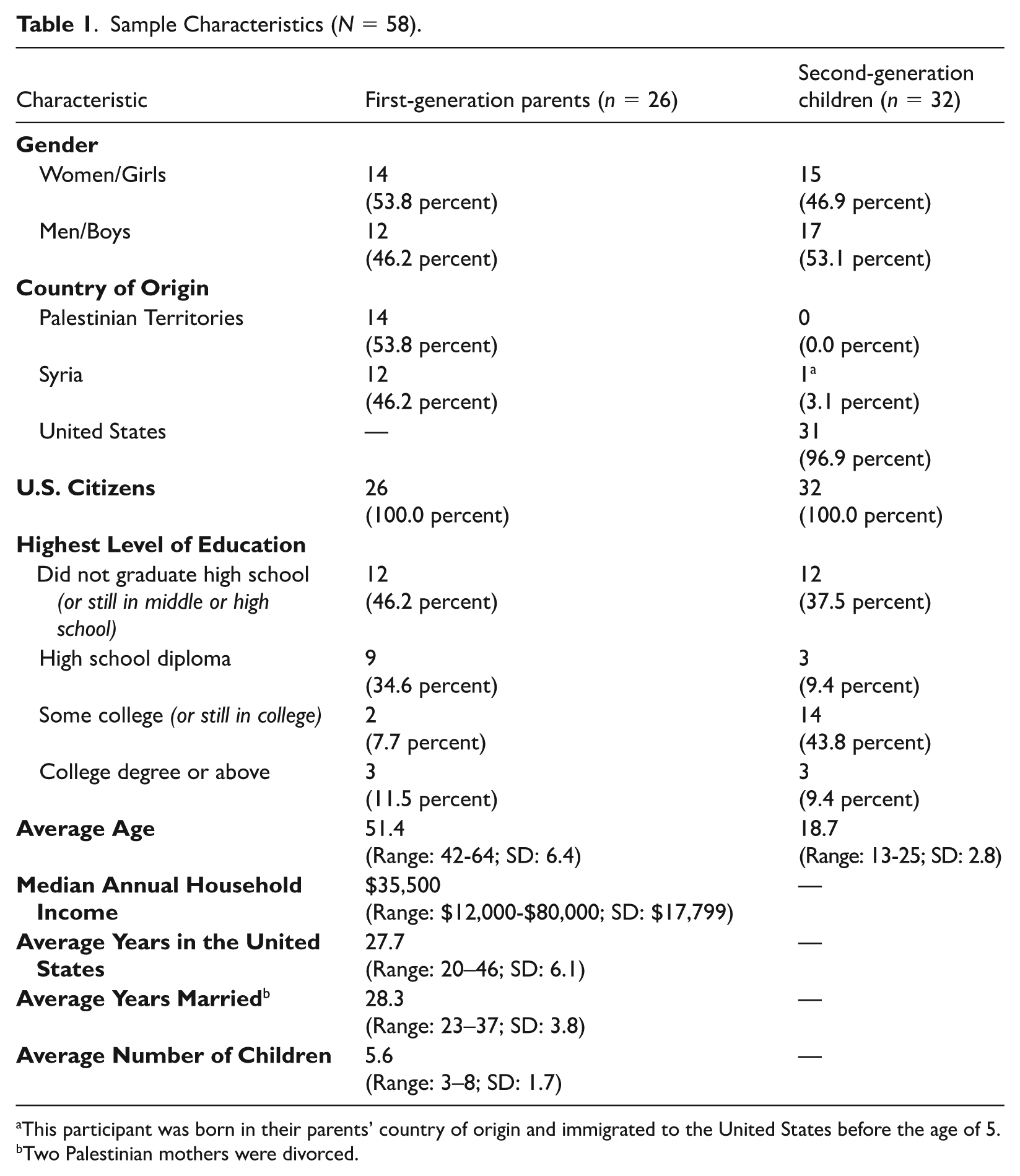
This participant was born in their parents’ country of origin and immigrated to the United States before the age of 5.
Two Palestinian mothers were divorced.
Data were collected using semi-structured interviews, which ranged in length from one to three hours. To ensure accuracy in participants’ responses, all interviews were audio-recorded after consent and assent were obtained from both parents and their children. First-generation participants were all interviewed in their native language of Arabic, while those in the second generation were primarily interviewed in English. All interviews were conducted by the author, who is bilingual, and participants were paid $20 for their time.
Analytic Strategy
All interviews were transcribed, and those conducted in Arabic were translated into English during the transcription process. Interview transcripts and field notes were coded inductively using the constant comparative method outlined by grounded theory (see Glaser and Strauss 1967). To facilitate comparisons between and across groups, I created two datasets in Microsoft Word for (1) first-generation parents and (2) second-generation children. These datasets included excerpts from the transcripts about topics related to participants’ perceptions of their neighborhood, as well as any problems in their local community.
Initial line-by-line, open coding of the interviews and field notes revealed important themes about religion and local religious institutions as participants discussed crime and disorder in their neighborhood. After identifying these recurrent themes, I then revisited the data and engaged in focused coding to identify additional patterns and sub-themes. In doing so, I utilized Boeije’s (2002) multi-step constant comparative method, which includes: comparison within a single interview; comparison of interviews from different groups (i.e., Palestinians and Syrians); comparisons across pairs (i.e., parents and their children; men and women; mothers and fathers); and comparison between families. In the sections that follow, I describe the patterns and themes that were identified during the analysis.
Findings
The Arab Neighborhood: Perceptions of Neighborhood Crime and Disorder
When asked about their neighborhood and community life, both first-and second-generation participants often described the larger city of Kingston as “a war zone,” “violent,” “morally corrupt,” and as a city “full of guns, gangs, and drugs.” Conversely, when discussing their neighborhood of East Kingston, the vast majority of participants perceived the ethnic enclave (which they referred to as “the Arab neighborhood”) as “safe” or “very safe”, while others declared it as “the safest place in town.” As a result of the physical proximity of their neighborhood to other “bad neighborhoods,” first- and second-generation participants reported feeling “surrounded” by crime and violence. Majd, a first-generation Palestinian immigrant, described how this spatial proximity to high crime neighborhoods keeps him “on edge,” pointing to the frequency of violence in nearby neighborhoods:
Every day you hear about people getting shot. There’s a lot of gangs and guns around here; we’re surrounded . . . if you go a few blocks up this way or a few blocks down that way, all you see is gangs and drugs.
It is within this context that first- and second-generation participants reported feeling “wary” and “anxious” about the possibility of a crime “spill over” from adjacent neighborhoods into their own. While these contextual conditions contributed to their overall perceptions of risk, the presence of the ethnic community contributed to their perceptions of safety in their immediate neighborhood. The data show that participants attributed this sense of safety to the large presence of co-ethnics in East Kingston, as well as the perceived communal nature of their cultural practices. Yasir, a 21-year-old Palestinian man, explained why the Arab neighborhood felt safe to him despite being surrounded by crime and violence:
In this community, we all care for each other. So when something happens over here, I don’t necessarily have to be friends with you, but if you’re in trouble, we all help each other out and that’s why this area is so tightly knit compared to other areas in Kingston. There is more commonality between us. And it has to do a lot with the culture we [were] brought up in from our parents who were born in Arabic countries, because most Arabs – the way we live our life is just to do good to others in the community.
Like Yasir, participants felt that the high concentration of fellow Arabs fostered a strong sense of community and social ties among residents through their shared language, cultural practices, and religious traditions. Consequently, first- and second-generation participants tended to view the geographic space of the Arab neighborhood as their cultural and religious haven, leading participants like Hala, an 18-year-old Syrian woman, to exclaim, “it’s more than just a neighborhood for us. It’s our cultural home.” By attaching cultural meaning to the place, participants felt a sense of ownership over the physical parameters of the Arab neighborhood, as well as the need to protect it from those who were believed to pose a threat to its cultural and religious character.
Despite participants’ perceptions of safety in the ethnic enclave, first- and second-generation immigrants identified two main sources of neighborhood problems that, in their view, violated the social order in their community: (1) disorder and violence caused by “outsiders” who often frequented the neighborhood hookah lounge, and (2) the presence of drug dealers. In describing the first problem, participants reported instances of crime, disorder, and incivilities caused by non-Arab residents who visited the local hookah lounge located on Central Avenue, which stretched through the heart of the Arab neighborhood. Recounting the negative effects this establishment had on the quality of life in the neighborhood, Nibal, a 25-year-old Palestinian woman, noted:
We have these outsiders like Hispanics and African Americans coming to our neighborhood, local coffee shops, and they smoke hookah and they get drunk and they party and they’re outside making noise . . . this happens all the time, especially on the weekends. We always hear them; they have no respect for us . . .. Bottles, trash, garbage, fights – all the effects of having a bar around are coming from [the hookah place].
Residents were particularly concerned about the alcohol policy instituted by the hookah lounge, which permitted customers to bring their own bottle (otherwise known as BYOB); thereby making it the only establishment in the Arab neighborhood that allowed alcohol on its premises. Despite being owned by two Arab men from a nearby city, the lounge’s BYOB policy was a point of contention for residents who viewed the business as wreaking havoc on their community by attracting “the wrong crowd” of “outsiders,” namely non-Muslim residents from communities adjacent to East Kingston. Participants shared that instances of public intoxication, property damage, lewd acts, physical fights, shootings, yelling, littering (especially broken alcohol bottles in front yards and driveways), were all too common after patrons left the hookah lounge late at night. Thus, the presence of this business – along with its alcohol policy and the clientele it attracted – was not only viewed as the main source of violence and disorder in the Arab neighborhood, but participants also felt that it undermined their cultural and religious practices. As Rami, an 18-year-old Syrian man, observed: “they are taking our culture and turning it into something ugly and violent. Hookah places usually serve tea with hookah, not alcohol, and now everyone is associating our hookah places with alcohol, drugs, and violence.”
The second neighborhood problem, which involved the presence of a few drug dealers, especially marijuana dealers, who lived within the boundaries of the Arab neighborhood. Akram, an 18-year-old Palestinian man, described who the dealers were and how they were connected to the community:
There are a lot of kids here who come from Jordan and other Arab countries. They come to East Kingston because they know it’s a predominantly Arab neighborhood and get caught up in selling drugs. Most of them come here without parents and end up living alone. They rent out a basement from someone here or they have extended family here like [an] uncle or aunt . . . they just come here to make quick money and then bounce back to the Middle East.
Like Akram, many participants described these “problematic” individuals, whom they often knew by name, as unattached young adults who were “newcomers” from the Middle East and had no meaningful ties or vested interest in the community. This seemed to “bother” participants like Nabil, a 21-year-old Palestinian man, who explained:
What really gets me is that these kids are not even born or raised here. They don’t care about our community like we do. They’re here just to make money and leave. So they end up not contributing to the neighborhood or themselves.
Shedding further insight about the types of drugs these individuals were selling in their community, a second-generation participant, noted:
The drugs that are sold here are not like drugs that are sold in other parts of Kingston . . . Heroin, crack, cocaine, you won’t find here; here it’s all marijuana, you won’t find anything higher than that. At least the Arab guys have the decency not to sell the hard drugs here.
Likewise, another participant added, “You can also find some prescription drugs here and there, too, but it’s not a big thing here, so it’s just prescription drugs and marijuana, and I wouldn’t say it’s an epidemic here.” While many in the second generation believed that these drug dealers were primarily selling their products to non-Arab residents in Kingston, those in the first generation tended to view their presence in the community as a direct threat to the physical and social mobility of their children. As I will demonstrate in the next section, this perceived threat to the second generation prompted Muslim immigrant parents to collectively mobilize in response to these criminogenic influences to protect their children from downward assimilation.
Two Mosques, Two Functions: How Mosques Facilitated Collective Action and Strengthened Social Control
The analysis shows that participants were affiliated with two local mosques – Hassan Mosque and The Islamic Center of Kingston (ICK) – both of which were particularly instrumental in solving the two neighborhood problems reported by participants. While these two mosques served members of the community, they both functioned and operated differently to boost mechanisms of social control and to help residents address crime and disorder in their neighborhood.
Hassan Mosque and the Salience of Private and Parochial Ties
Located in the Arab neighborhood and a short walking distance from participants’ houses, Hassan Mosque was described by many as a small-scale neighborhood mosque where first-generation men congregated to pray “almost on the daily.” In describing how this local mosque fostered a sense of community and strengthened social ties between immigrant neighbors, Qasem remarked:
I usually work long hours, so I don’t have time to socialize . . . The only time I meet my friends, who are also our neighbors, is here at the neighborhood mosque . . . So instead of praying Isha
3
[at home], I just go up the block and then I can pray and, at the same time, meet some friends . . . Like instead of meeting at the local coffee shop, we would make our own coffee at the mosque after the prayer.
Participants like Qasem often spoke about how the location of this mosque made it easier for residents to regularly meet with their co-ethnic neighbors and discuss various issues, including neighborhood concerns. This observation was also shared by many second-generation participants, who viewed Hassan Mosque as the “exclusive hang out spot” for “the old heads,” and labeled it as “the best source of news in the neighborhood.” As one second-generation participant, who on occasions would join his dad at the mosque, observed: “the old heads are always plotting and scheming in there.” Indeed, the analysis shows that these social gatherings, which tended to take place after Isha and Friday prayers, became a regular source of news sharing, where co-ethnics often spoke about issues facing their community. Scholars have associated these types of congregations with generating bonding social capital, whereby members of the same group form close interpersonal networks that can help promote the enforcement of collective norms and sanction those violate them (Coleman 1988).
This process was illustrated in the accounts of various first- and second-generation participants, who detailed how after-prayer conversations helped residents strategize about potential solutions and plans of action to confront common local problems. For example, Samir, a first-generation father, shared how Hassan Mosque provided a physical place for residents to discuss neighborhood issues at length and how ultimately various collective decisions were reached about the presence of drug dealers in the community. Samir noted:
We had several emergency meetings about this at [Hassan] Mosque . . .. what became clear to us is that we need to pay closer attention to who [residents in our community] rent properties to . . . We asked people to be more vigilant and selective in terms of who they rent space to. The Imam
4
and [other congregants at the mosque] helped spread the word, you know, just telling people, “don’t rent to people you don’t know, especially young people who come here without family members.”
In addition to strategizing about how to tackle the drug issue as a community, many participants revealed that these after-prayer gatherings helped congregants organize neighborhood clean-ups in response to the litter left behind by “outsiders” after visiting the hookah lounge. In this regard, Fadel, a first-generation Palestinian father, recounted how the idea for the neighborhood clean-up unfolded organically:
We were really annoyed by the amount of trash these people left after they partied all night . . . Just seeing all these alcohol bottles thrown all over the place was really infuriating . . .. So my friends and I at the mosque, we’re like, we can’t let our neighborhood look like this; so we organized neighborhood clean-ups. You know, nothing big or formal, just a bunch of us would occasionally walk around on the weekends and pick up the trash and alcohol bottles.
Stories like Fadel’s illustrate how Hassan Mosque functioned as an important neighborhood institution that helped mobilize and facilitate collective action among residents to minimize visible signs of physical disorder generated by “problematic outsiders”. While the mosque played an important role in providing a physical space for residents to discuss emerging neighborhood problems and strengthen private and parochial controls within the community, participants also recognized the mosque’s limitations in obtaining resources or assistance from outside of the community. Thus, as part of their strategy to tackle these two neighborhood problems, they collectively sought the help of another, more prominent, local mosque which they believed possessed the social and political capital to help them with shutting down problematic businesses (or at least reversing the alcohol policies at these establishments) and removing drug dealers from the community. As Shadia, a Palestinian mother noted, “We know that our Imam [at the ICK] is well connected. He has connections with the right people [in the city] and he can take care of this for us.”
The Islamic Center of Kingston and Leveraging Public Ties
Unlike Hassan Mosque, the ICK was significantly larger in size and served a broader segment of the Muslim-Arab community (i.e., men, women, and children) from both Kingston and other adjacent cities. Located about a ten-minute drive from the Arab neighborhood in East Kingston, the ICK operated and functioned as a de facto community center, providing social (e.g., financial assistance to families), educational (e.g., Arabic weekend school), cultural (e.g., various cultural events), and recreational (e.g., sports facilities and activities) services to its members, especially those in the second generation. In addition to these functions, the ICK served an important political role. As Nidal, the youth director at the ICK, explained, “[Our imam] always tries to reach out to local politicians and [is involved in] outreach [activities].” This type of congregation is associated with linking social capital, a specific type of bridging social capital, which involves creating social relationships with local leaders or government agencies outside of the community to leverage their power and influence (Hepworth and Stitt 2007).
The analysis shows that when it came to dealing with neighborhood problems, it was the ICK’s connections to various local organizations, agencies, and politicians that ultimately enhanced the strength of the public ties and controls in the community to help residents effectively suppress crime and disorder. This was illustrated when participants reported contacting the religious leadership of the ICK to demand that they intervene on their behalf to solve the two main problems they were dealing with. In their attempt to reverse the BYOB alcohol policy at the hookah lounge, for example, participants urged the Imam to leverage his social and political capital with local politicians and agencies to help them resolve the problem. Hayat, a Syrian mother, recalled:
We complained to the Imam non-stop . . . We told him he had to do something about this . . . he was really working with us to resolve this nightmare. He has a very good relationship with the mayor and other people in city hall. He even arranged a meeting between us and the mayor and other council members, so we could tell them how this place is destroying our lives and how it’s bringing alcohol and drugs into our neighborhood.
During this town hall meeting with the mayor and other local officials, participants reported conveying how the hookah lounge had significantly diminished their quality of life and increased crime and disorder in their neighborhood. Following the meeting, Yasmin, a second-generation woman, described the unrelenting pressure members of her community exerted on the city’s leadership: “We did not let go. . .we kept complaining until they shut the place down.” In fact, many participants credited the ICK for “working behind the scenes” on their behalf with law enforcement officials, the mayor, and other city council members to facilitate this outcome. As Huda, a first-generation mother, explained, “after we complained to the Imam and the mayor, all of the sudden, the police kept raiding the place and then the place was shut down.” Indeed, interviews with Kingston police officers and city hall officials revealed that after residents’ “very active” campaign against the hookah lounge, it was closed due to a “violation for indoor smoking,” triggering a retail license suspension for the business and ultimately, its permanent closure.
Additionally, the ICK was involved in tackling the presence of drug dealers in the Arab neighborhood. According to one ICK official, this particular issue caused immigrant parents “to panic because their children’s futures and well-being were at stake”. For Muslim parents in the sample, the presence of drug dealers in their neighborhood signaled to them that the threat of downward assimilation could become a reality if they did not respond swiftly to local criminogenic influences. Here, too, first-generation immigrants turned to the ICK and its Imam to help them “take down” certain drug dealers that were known to members of the community. Recounting how she and other mothers in the neighborhood quickly organized to request a town hall meeting with the Imam, Aziza, a Palestinian mother, noted:
We trust [the Imam] to take care of it; that’s why we wanted to talk to him personally, as mothers . . .. We told him that “we don’t care who you have to talk to, but please [for the love of god], make sure these people are gone from our neighborhood” . . . We don’t want them here corrupting our kids.
Aziza’s remarks encapsulate the sense of urgency that she and other parents in the sample felt about removing drug dealers from the neighborhood. Mothers and fathers reported urging the Imam, as well as others who worked at the ICK, to “use their connections” with other local agencies – namely, the police department – to remove these individuals from their community. After the various complaints, meetings, and town halls with ICK officials, participants reported witnessing several “drug busts” in their neighborhood by the Kingston Police Department. This sequence of events led the majority of participants to credit the ICK and their close ties to the police with “taking care of the problem.” Because of this, the ICK came to be seen by participants as a crime-fighting institution that always intervened on behalf of the common good. This sentiment was shared by Omar, a 19-year-old Palestinian man, who exclaimed, “[The] ICK is really taking the drug dealers down. . .They give exact spots of where the deals take place. They are trying to clean up the town.” Similarly, another participant provided his own interpretation of how these operations unfolded: “It’s like the old heads feed the information to the ICK and then the ICK is giving the police exact locations and bam! They take them down.”
Interviews with both ICK officials and police officers also revealed the strong ties between the two institutions. One law enforcement official noted, “we have a very close relationship with the ICK. . .We also know that their leaders care a lot about their people. They’re doing good work to help their community. . ..They also know that we’re here if they ever need us.” While officers acknowledged that they were aware of the community’s efforts to deal with the presence of marijuana dealers, they also dismissed the seriousness of the problem because they did not believe that it was a “widespread” community issue, but instead limited to a few individuals. In doing so, police officers used cultural explanations to speculate as to why the community viewed recreational drugs as such a huge problem. One police officer explained, “They are probably very ashamed. . .They are very proud people, and they see the drugs as a very shameful behavior that brings a disgrace to the entire community. . . It’s a cultural thing.” Similarly, another officer noted, “To them, [marijuana] – it’s probably a huge problem, but it’s not as big of a problem as they make it to be. It’s just a few bad apples.” Despite viewing the dealing of marijuana as a minor crime, police officers reported that they ultimately surrendered to the community’s pressure campaign to arrest these individuals.
“Revitalizing the Hood”: Immigrant Mosques and the Process of Urban Revitalization
In addition to helping residents control crime and disorder in their neighborhood by both strengthening and leveraging all three levels of social ties proposed by the systemic model – including private, parochial, and public – the analysis shows that the ICK played a salient role in revitalizing East Kingston by physically and economically investing in areas in and around the Arab neighborhood. When discussing his vision for improving the lives of community members in East Kingston, the Imam of the ICK stated:
We have a great interest in investing in our local community . . . and we try to make [it] better and safer for people. We are also trying to expand. The [ICK], for example, recently bought a few buildings in poor areas of [East] Kingston and we are currently renovating them . . .. We also bought a huge parking lot behind [Hassan Mosque], and we are currently working with people in the community, as well as with [Hassan Mosque], as we are planning to build the biggest community and recreational center for members of our community . . . Little by little, Inshallah [God willing], we are going to transform [East Kingston].
According to Abdullah, who worked at the ICK, “the new center will include a big basketball court and a soccer field, along with a building of classrooms and lecture halls for educational activities and programs.” These educational and recreational facilities were needed as the ICK was quickly running out of space due to high demand to provide these services to their growing congregation. In addition to investing in abandoned and vacant lots, the ICK purchased and renovated dilapidated buildings before renting them to congregants to expand ethnic and commercial businesses in the Arab neighborhood. Shedding light on how the ICK was able to invest in the community in this way, Faisal, a first-generation father and widely respected community member, explained:
Many Arab doctors and lawyers are coming to Kingston to open their businesses and they choose Kingston because there is a big Arab community. Basically, the ICK is buying those old and ruined buildings in [East Kingston] with money that was originally donated by those lawyers and doctors from the [larger] Arab Muslim community [outside of Kingston]. ICK has a lot of wealthy Arab congregants . . . Those doctors and lawyers who are pouring in money, they know that their businesses will be thriving in a place like Kingston.
In addition to directly investing in abandoned and neglected properties, the Imam and other community leaders mobilized wealthy Arab donors to purchase other dilapidated buildings and closed storefronts in the area to transform them into commercial businesses and educational facilities (e.g., preschools). Here, as Faisal indicated, the Imam played an important role in persuading wealthy Arab congregants to invest in the Arab neighborhood as part of their Zakat, 5 highlighting to wealthy congregants the importance of investing in one’s community as part of their religious duty. Faisal specifically described one of the ongoing commercial projects on Central Avenue, where a wealthy Arab businessman had purchased and was transforming a run-down building into a hub of retail stores and commercial offices. This construction project was nearing completion toward the end of my fieldwork. Today, this establishment (also referred to as a mini mall) is considered an extension of the ethnic commercial corridor on Central Avenue. Similarly, the Imam also persuaded another wealthy congregant to purchase the building where the problematic hookah lounge was located. This came after the hookah lounge owners were attempting to reopen the lounge under another name. At this juncture the Imam managed to persuade a wealthy donor to buy the building and transform it into a preschool that would serve residents of East Kingston, including non-Arabs. To do this, the Imam once again worked closely with other local officials and politicians to advance these plans. These initiatives, as Faisal noted, were directly aimed at “cleaning up the area” and removing sources that have the potential to generate crime and disorder in the Arab neighborhood.
Part of the ICK’s strategy in investing in abandoned properties in and around the Arab neighborhood was to remove criminogenic places and reduce signs of physical decay. This was important primarily to the religious leadership at the ICK who viewed East Kingston as “the face of [the] community” and wanted it to “look nicer.” As Abdullah, explained:
We don’t want our community [in East Kingston] to be associated with crime and disorder. This place represents the face of our community . . . it’s our duty to invest in it and make it more beautiful . . . we are focused on removing all the bad spots that create trouble for people and turn them into peaceful and more productive places for our community and for the city.
Indeed, as part of their urban transformation efforts, the ICK strategically targeted neglected and abandoned places that residents often complained about or viewed as problematic and turned them into businesses, offices, recreational facilities, or educational establishments. This revitalization strategy was not lost on Ali, a second-generation Palestinian man, who noted:
What ICK is doing in [East Kingston] is rebuilding the community . . . People were always doing drugs in those [run-down] buildings. Now there are new huge buildings . . .. They also slowly fixed the street, like they put lights and flowers and stuff like that. It looks like a whole different part of town. And now they are renovating even more buildings around here. This part of town is gonna look really pretty in a couple of years. You can see it’s really starting to flourish.
Participants like Ali noticed how projects that were either led by or in cooperation with the ICK were physically transforming criminogenic spaces in and around the Arab neighborhood. The mosque’s revitalization efforts were also observed by the local police, leading one officer to suggest: “Their religious leadership is helping with community revitalization. . .they are building and fixing up bad areas in the city, and they build more businesses for their people.” Likewise, Amina, a second-generation Palestinian woman, concluded, “basically, what [the ICK] is doing is revitalizing the ‘hood’.”
Discussion
The central purpose of this study was to examine how local religious institutions influence both the social and physical revitalization of an urban ethnic enclave, where a high concentration of working-class Muslim immigrants reside. While research investigating the immigrant revitalization perspective has provided valuable insights related to how high concentrations of immigrants can rejuvenate decaying inner-city areas, both socially and physically, the precise mechanisms through which this occurs are still not fully understood (Ousey and Kubrin 2018:68; Ramey 2013; Sampson 2017). By relying on a qualitative research design, this study extends the immigrant revitalization perspective by delineating the mechanisms through which the process of neighborhood revitalization unfolded in a Muslim immigrant community, and the profound ways local religious institutions contributed to that process. Specifically, the data show how participants drew on their local mosques and Islamic centers to mobilize and collectively confront local problems – all of which contributed to the enhancement of various levels of social control within the community (e.g., private, parochial, public), enabling its members to monitor behaviors and control crime and disorder within their community. Similarly, local mosques, played a salient and active role in the physical development of the Arab neighborhood by directly investing in vacant land and run-down properties, further improving the physical and economic conditions in and around the ethnic enclave.
Overall, this study highlights the importance of considering the role religious institutions play in ethnoreligious immigrant communities as they are more likely to rely on their religious institutions to navigate various aspects of social life, including confronting local crime and other neighborhood problems. As the findings indicate, residents of the Arab ethnic enclave shared two main problems that they deemed threatening to the social and cultural order of their community, as well as to the safety and social mobility of those in the second generation: a problematic hookah lounge in their neighborhood and drug dealers living in the community. The ethnic enclave setting, characterized by dense social ties, strong social cohesion, and shared cultural expectations, made it easier for residents to join together to enforce these expectations, which in turn bolstered the community’s ability to exert informal social control with the assistance of two local mosques.
As described above, the Hassan Mosque was used as a physical space, where first-generation fathers often held after-prayer meetings, not only to strategize about how to solve neighborhood problems, but also to proactively take action to restore order in their neighborhood. They did this by (1) organizing neighborhood cleanups in response to physical disorder caused by patrons of the hookah lounge; (2) banding together to control and monitor who rented property in their neighborhood; and (3) reaching the decision to solicit the help of the ICK as an important next step in their fight to restore order. In this way, Hassan Mosque played a significant role in generating bonding social capital, which enhanced both private and parochial mechanisms of social control within the ethnic community.
While bonding social capital was essential in promoting collective action through the generative mechanism of social cohesion and closed networks, residents recognized that relying solely on ethnic ties was not sufficient to combat the criminogenic forces facing their community. Consequently, residents leveraged their social and political capital through a second mosque – the ICK – which enabled residents to activate the mosque’s public ties to politicians and law enforcement and eventually helped them in their quest to restore order in their neighborhood. Thus, it is not surprising that participants viewed the ICK as a prominent crime-fighting institution, and one that they could rely on should neighborhood concerns arise.
Importantly, the findings of this study provide support for – and offer an extension of – the systemic model (see Bursik and Grasmick 1993) and indicate how local religious institutions can play a significant role in fostering, strengthening, and solidifying social ties at the private, parochial, and public levels to control deviance and crime in communities. Specifically, this study revealed how the two local mosques collectively functioned to suppress crime and disorder in the community by: (1) serving as a meeting place where residents could develop their private ties, build trust, and strategize about possible solutions; (2) strengthening parochial ties between the institutions and their congregants through religious and social activities and addressing crime and disorder in the neighborhood; and (3) leveraging public ties by advocating for and connecting congregants with the appropriate local officials, politicians, and agencies to shut down problematic establishments.
In many ways these findings advance a form of new parochialism discussed by Carr (2003), whereby the ability of a community to exert control and suppress urban crime is facilitated by formal agencies outside the community and in cooperation with residents and their local organizations. While these findings extend Carr’s notion of new parochialism, they also complicate it in two distinct ways. First, while residents of the Beltway and East Kingston both relied on the cooperation between their parochial and public ties to suppress neighborhood crime, the mechanisms through which public ties – and by extension, public controls – were activated were different in these two communities. In the Beltway, as Carr noted, “it was formal agents of social control that were instrumental in stimulating the informal social control apparatus” (p. 1268). This stemmed from the fact that private social ties in the Beltway were weakened as residents were reluctant to intervene to solve local problems, especially those pertaining to youth violence. In the absence of strong private ties between residents, informal social control in this community instead emerged directly from the cooperation between parochial and public controls. In the case of Kingston, it was the reverse; it was residents banding together – as informal agents of social control – that stimulated the activation of public controls through leaders at their local religious institutions, which in turn significantly enhanced residents’ ability to exert control and suppress crime and disorder in their neighborhood. Here, even though all three levels of social control worked simultaneously to maintain social order in the neighborhood, for specific types of problems (e.g., violence caused by outsiders), extra-community resources were necessary to solidify informal social control efforts that were initiated by community members. Second, the type of local organizations that were active in leveraging outside resources were also different – in the Beltway, residents relied on their local civic organizations, while in Kingston, residents relied on their local religious institutions to facilitate the connection to outside formal controls (e.g., police department, local officials). While eventually the outcome in both communities was similar (i.e., controlling neighborhood crime), the mechanisms through which informal social control was activated and exerted were different.
Identifying these mechanisms in different types of neighborhoods, especially disadvantaged ones, is important because they might inform us about how to better facilitate informal interventions between communities, their organizations, and other formal entities in a way that can empower residents to take ownership of their communities rather than relying solely on formal institutions to control neighborhood crime. For example, the mechanisms through which public ties are mobilized in religious and homogeneous communities to combat local violence might be different than those in non-religious communities where civic organizations may be more prominent in establishing extracommunity ties. In this regard, Vélez (2001) argues that uncovering how public social control is secured in communities is imperative “given its implication for our understanding of the conditions under which disadvantaged neighborhoods can be politically viable” (p. 859).
Finally, the findings show that the same institutional actor, the mosque, was also involved in the physical revitalization processes in the Arab neighborhood. That is, the same religious infrastructure that mobilized and facilitated collective efficacy and informal social control to address neighborhood crime and disorder also drove physical renewal in the area. Specifically, the results provide evidence that local religious institutions (in this case, the ICK) can play an active and direct role in the physical revitalization of the Arab neighborhood by directly initiating, financing, and facilitating investments in and around the Arab neighborhood. Here, too, the ICK leveraged their social, political, and religious capital with both local officials and wealthy donors from the congregation to promote urban development in East Kingston, converting underutilized buildings and vacant urban public spaces into multifunctional spaces, including a large community center, recreational facilities, educational institutions, ethnic businesses and commercial offices. These investments were possible in large part due to the economic capital that the ICK was able to secure through its ties with wealthy congregants from outside of Kingston who viewed their investment in the Arab neighborhood as their religious duty.
In addition to securing economic capital and directly purchasing properties in the community, the ICK facilitated large investments from wealthy Muslim congregants in specific properties and locations. As illustrated by the findings, these locations were strategically chosen by the mosque to address immediate local needs that were of prime concern to residents (e.g., problematic establishments and spaces that were perceived as generating crime and disorder in the area). To tackle this, the mosque was actively involved in urban planning as part of its broader campaign to suppress crime and disorder in the community. In doing so, physical revitalization was a potent and proactive tool the mosque used to remove physical signs of decay and improve the physical infrastructure of the neighborhood, which ultimately contributed to the replacement of criminogenic spaces with new businesses and establishments that aimed to serve members of the community and the city as whole.
These findings complicate the bottom-up revitalization process found in urban and immigration scholarship, whereby residents and small business owners are the primary drivers of urban renewal (see Lara 2018; Sampson 2008; Sandoval-Strausz 2019; Vitiello and Sugrue 2017). In the case of East Kingston, the process of physical revitalization unfolded differently, revealing a distinct set of revitalization pathways rooted in religious organization, communal obligation, and faith-driven investment in place. This type of parish-led urban revitalization was the driving force behind this particular community’s expansion of the ethnic commercial corridor and improvements to urban public spaces. Importantly, this type of urban renewal found in East Kingston is largely absent in Latino immigrant neighborhoods where churches exist but have less control over the spatial transformation of urban spaces (see Lara 2018; Sandoval-Strausz 2019). These findings challenge the assumption that physical revitalization in immigrant neighborhoods is primarily a resident- and entrepreneur-driven process, and demonstrate that religious institutions can serve as the lead agents of urban revitalization, a mechanism that the immigrant revitalization perspective has not adequately conceptualized (see Lee and Martinez 2002; Martinez et al. 2010; Sampson 2008).
Overall, these results highlight the importance of examining a diverse range of immigrant groups and communities, especially using qualitative methods (see Zaatut and DiPietro 2023). Doing so will not only allow us to capture how social processes unfold at the neighborhood level in different immigrant communities but can also help us uncover how ethnically situated mechanisms of both social and physical revitalization operate and function in declining urban areas across various cities and locales. Thus, future studies should aim to investigate new immigrant groups and destinations – both Christians and non-Christians alike – that have yet to be explored. These studies are likely to yield new insights that can enhance our understanding of the link between immigration, urban change, and crime across different contexts of reception.
Even though this study illuminates how the spatial concentration of Muslim immigrants and their religious institutions can reshape disadvantaged urban spaces and control crime and disorder, there are three central limitations that warrant attention in future research. First, the data for this study were collected between 2012 and 2015, and prior to the election of President Trump (first in 2016 and later in 2024). Over the past 10 years, the political landscape and conversation around immigration and immigration policy have changed dramatically, particularly following the implementation of exclusionary policies that specifically target immigrants (e.g., the Muslim ban, ICE raids to crack down on undocumented immigrants). Given this context, it is possible that if this study was replicated today, it may produce different findings, especially as they relate to levels of trust and cooperation between the Muslim-Arab community in East Kingston and formal institutions (i.e., police officers, local government officials). Thus, future studies should examine the impact of these newly implemented policies on Muslim immigrant communities, and how these changes impact crime and safety.
Second, surveillance policies targeting Muslim Americans and their communities after 9/11 coincided with the data collection for this study, which may have compromised some participants’ responses. Like many mosques across the United States, Kingston’s local mosques were also under intense monitoring and surveillance by law enforcement (see Ali 2016; Gillum 2020). These surveillance programs not only instilled a tremendous amount of fear and anxiety in Muslim communities, but they also undermined community members’ trust in outsiders and government institutions that consistently criminalized them. This is important because, within this context, my own positionality (as someone who was from outside of the community, who was not an American, and who did not reside in East Kingston) may have influenced how participants chose to respond to questions about their community and mosques, steering them to portray themselves or their religious institutions in a positive light. While social desirability is a concern with all research that involves participants, especially in communities that are stigmatized and marginalized, it can also be mitigated through prolonged engagement and rapport-building with participants over a period of time. Ultimately, engaging with community members (both Muslim and non-Muslim) over a period of three years and sharing ethnic, religious, and linguistic characteristics with my participants (i.e., being a Palestinian, Arab, Muslim, and from the Middle East), may have minimized participants’ inclination to give socially desirable answers.
Finally, the sample in this study included immigrants who were citizens and who emigrated to the United States primarily through the process of chain migration. It is possible that the citizenship status of the sample may have influenced the findings of this study. Thus, future studies, especially among Muslim immigrants and their communities, should aim to include different types of immigrants (i.e., undocumented, refugees, permanent residents), as one’s immigration status (and immigration route) can significantly shape their integration experiences and relationships with formal and informal institutions in the receiving country. This is particularly important given changes in the political landscape and the increased targeting of undocumented immigrants, which may severely erode trust between local law enforcement and immigrant communities and compromise public safety.
Footnotes
Acknowledgements
I would like to thank the anonymous reviewers and editors whose careful reading and suggestions substantially strengthened this manuscript. Also, a special thanks to Shannon Jacobsen and Jennifer Wood for reading earlier drafts and offering comments that greatly improved the paper.

Funding
The author received no financial support for the research, authorship, and/or publication of this article.
Declaration of Conflicting Interests
The author declared no potential conflicts of interest with respect to the research, authorship, and/or publication of this article.