







Abstract
Monogamy is often emphasized to the Hispanic youth, but only a few studies consider attitudes toward monogamy. This study fills that gap by examining Hispanic college students’ (n = 347) attitudes using the Monogamy Attitudes and the Emotional (MAS) and Sexual Monogamy Views Scales (ESMVS; Schmookler & Bursik, 2007). MANOVA results indicate the differences based on biological sex and self-reported cheating. College health professionals can use these results to better develop and implement effective sexual education programs for Hispanic college students.
College campuses provide young adults a sense of independence and the pressure to experiment sexually (Ragon, Kittleson, & St. Pierre, 1995). Among undergraduate students, there is a culture of engaging in casual sex or “hooking up” (Bogle, 2008; Stepp, 2007). As a result, being monogamous may prove difficult for many college students in committed relationships (Vail-Smith, Whetstone, & Knox, 2010).
Review of the Literature
Young adults, including college students, are at high risk for sexually transmitted infections (STIs) including HIV because of a combination of behavioral, biological, and cultural factors. Young people have higher rates of Chlamydia and gonorrhea compared to the general population (Centers for Disease Control and Prevention, 2009a) and in 2006, more new HIV infections, primarily sexually transmitted, occurred in young adults than the other age groups (Kaiser Family Foundation, 2008).
Increased risk for STIs is correlated with multiple sex partners and low condom use; 9.7% of college students report two sexual partners (oral, vaginal, or anal intercourse) and 7.8% report four or more partners within the last 12 months (American College Health Association, 2009). Many sexually active college students are known not to use condoms. Of the students who had sexual intercourse in the last 30 days, only 6.0% mostly or always used a condom during oral sex; 51.6% mostly or always used a condom during vaginal sex; and 30.2% mostly or always used a condom during anal sex (American College Health Association, 2009).
Ethnicity and Sexual Health
Racial minorities face significant disparities across STIs and HIV/AIDS. For example, African Americans have experienced the greatest impact with regard to STIs (Centers for Disease Control and Prevention, 2009b) and HIV/AIDS (Kaiser Family Foundation, 2010a). According to a national sample involving U.S. college students, White students report more experiences in oral and anal sex and were less likely to use condoms for oral, vaginal, or anal sex than their Black counterparts. However, Black students report more sex partners, lower use of hormonal contraceptives, and higher rates of adverse health outcomes such as STIs and unintended pregnancy than White students (Buhi, Marhefka, & Hoban, 2010). Asian American and Pacific Islanders (AAPI) are a fast growing population in the United States. Because there is very little health data on this population, it is sometimes referred to as a forgotten minority (Lo, 2003). A comparison study of AAPI and non-Asian college students found that AAPI engaged in less sexual intercourse, had fewer partners, and used condoms more frequently than their non-Asian peers. Interestingly, however, AAPI college students reported significantly higher rates of STIs (Arliss, 2008).
One reason the current study focuses on Hispanic college students is because of a greater risk for STIs. Rates of Chlamydia and gonorrhea are higher among Hispanic individuals when compared to White individuals (Centers for Disease Control and Prevention, 2009b). This increased risk is also true for HIV; Hispanic individuals aged 20-24 years are disproportionately impacted as they represent only 18% of the U.S. young adult population but account for 24% of the new AIDS cases reported among young adults (Kaiser Family Foundation, 2010b).
Studies also indicate that sexually active Hispanic college students are less likely to use condoms than college students from other ethnic groups (Smith, 2003; Valentine, Wright, & Henley, 2003). Gurman and Borzekowski (2004) found that condom use during oral sex among Hispanic college students was associated with being tested for HIV. Condom use among Hispanic college students was also associated with ever having had anal sex with partners of both genders. Student perceptions of condom use and campus norms were also associated with condom use for oral and vaginal sex (Gurman & Borzekowski, 2004; Jemmott, Jemmott, & Villarruel, 2002). Jemmott and colleagues (2002) report that Hispanic college students’ perceptions of normative support are stronger determinants of condom use intentions than beliefs about consequences of nonuse, which is consistent with previous research in this area (Marin & Marin, 1991). African American and Hispanic students experience higher rates of unwanted non–condom use than White students for a variety of reasons to include sexuality-related cultural norms and limited access to quality healthcare (Smith, 2003). This ethnic difference is critical because of the disproportionate rates of STIs and HIV among these populations.
Monogamy and Infidelity
The high risk of STIs, the low condom use and the multiple partners of many college students make the issue of monogamy in college students an important one to examine. Many college students practice serial monogamy, engaging in a series of sexually exclusive relationships (Raj & Pollack, 1995). Whereas, sexual health educators often present sexual exclusivity as a strategy to reduce risk, practicing monogamy can provide a false sense of security for students because they think they have eliminated risk. Serial monogamy still involves several sexual partners and many college students do not ensure that their partners are free of infection before engaging in sexual activity (Voss & Kogan, 2001). Moreover, exclusiveness may decrease condom use as proposing condom use within a relationship perceived as exclusive may appear offensive (Hammer, Fisher, & Fisher, 1996) or interpreted as an indication of infidelity or lack of trust (Wingood, Hunter-Gamble, & DiClemente, 1993). Gender and gender role differences appear to affect the value one places on monogamy. Women value both emotional and sexual monogamy more strongly than men. Both men and women often view monogamy as enhancing to a relationship; however, men are more likely to view monogamy as a sacrifice. With regard to gender roles, masculine individuals value sexual monogamy less than the feminine and androgynous individuals. Additionally, masculine individuals value emotional monogamy less than their feminine counterparts (Schmookler & Bursik, 2007).
Infidelity has a variety of meanings for individuals belonging to different cultures and ethnicities. African Americans’ values regarding infidelity are influenced by racism and discrimination (Boyd-Franklin, 1989) and imbalanced sex ratios (McGoldrick, Preto, Hines, & Lee, 1991). African Americans tolerate but do not approve of infidelity and are more accepting of males engaging in cheating behaviors (Penn, Hernandez, & Bermudez, 1997). Asian Americans’ beliefs regarding infidelity are grounded in a history of patriarchal value (Ho, 1987) which explains their greater level of acceptance of male infidelity and act of blaming the female when males tend to stray in a relationship (Penn et al., 1997).
Gender roles have a critical influence on sexual attitudes and behaviors among Hispanic individuals. Significant differences in sexual attitudes exits between the Hispanic male and female college students (Eisenman & Dantzker, 2004, 2006). Hispanic female college students are more likely to report being told by parents that premarital sex is unacceptable; they are also more likely to agree that “sex should occur only with a person you love” (Raffaelli & Green, 2003) and “adultery of any kind should be illegal” (Eisenman & Dantzker, 2006). Hispanic male college students are more likely to agree that “marriage should not stop a person from having (extramarital) sex” (Eisenman & Dantzker, 2006). Open infidelity is frowned on in the Hispanic culture but considered more acceptable for Hispanic males (Penn et al., 1997).
Most research in this area focuses on infidelity—both attitudes and practices—and little is known about the attitudes of college students toward monogamy and even less regarding Hispanic college students. Currently the largest minority group in the U.S., the Hispanic population is projected to nearly triple between 2008 and 2050 from 46.7 million to 132.8 million. In 2050, approximately one in three (30%) U.S. residents will be Hispanic (U.S. Census Bureau, 2008). Given this factor and their increased risk for STIs, understanding Hispanics and their ideas about monogamy is critical. The goal of this study was to better understand the attitudes of Hispanic college students about monogamy. There were three primary research questions:
Research Question 1: What are Hispanic college students’ attitudes toward monogamy?
Research Question 2: Do Hispanic males and females differ in their attitudes toward monogamy?
Research Question 3: Do individuals who have cheated on their partner have different attitudes toward monogamy compared to those who have not?
Method
Participants
The respondents were mainly female (71.2%, n = 247) and upperclassmen (59.6%, n = 207), or graduate students (13.8%, n = 48). Age of respondents ranged from 18 to 56 years with a mean age of 24.98 years (standard deviation = 7.01). Whereas, all students were considered Hispanic based on the admission paperwork filed with the University, 97.1% self-identified as Hispanic. Others self-identified as multiracial, Mexican American, or Chicana/o. This sample was slightly older and more female than the overall University population. The demographics for the University include 50.9% female, 42.9% Hispanic, 45.5% upperclassmen, and 12.7% graduate students. The average age for all students enrolled at the University is 23.89 years (University of Texas at San Antonio, 2010).
Regarding the relationship status, many were single (43.2%, n = 150), and the second most common status being either engaged or in a committed dating relationship (33.4%, n = 116). There were fewer numbers of married (19.6%, n = 68), divorced (2.3%, n = 8), and separated (1.4%, n = 5) participants. Most identified as heterosexual (94.5%, n = 328) with a similar number identifying as gay/lesbian (2.6%, n = 9) or bisexual (2.3%, n = 8). Slightly more than 40% (40.3%, n = 140) self-reported that they had cheated on their partner; when asked about specific behaviors, 30.8% (n = 107) had engaged in oral, anal, or vaginal sex with a person that was not their partner and 42.9% (n = 149) had kissed or fondled a person’s breasts or genitals that were not their partner’s. Slightly more than half (58.8%; n = 203) reported being cheated on.
Procedure
Email messages soliciting participation in an online survey were sent to 5000 randomly selected Hispanic students attending a Hispanic-Serving Institution in the southwest. The Hispanic designation was based on information submitted for admissions in Enrollment Services Office. A total of 517 individuals consented to participate in the study and answered some questions (resulting in a 10.34% response rate); 347 completed all of the survey. There were no differences in sex, mean age, classification, relationship status, and sexual orientation between those who completed all of the study items and those who only partially completed the study. Results were based on the 347 respondents that completed the entire survey. Institutional Review Board approval was obtained before any part of the project was started.
Instrument
The instrument included a total of 48 questions. Two scales, MAS and ESMVS (Schmookler & Bursik, 2007), were used to examine the students’ attitudes toward monogamy. The MAS was designed to assess how monogamy is viewed in the context of a relationship—either as a positive component that improves the relationship or as a sacrifice that has to be endured for the relationship. The measure consists of 16 items that are rated on a 7-point Likert-type scale (1 = strongly disagree and 7 = strongly agree). The alpha coefficients for the two subscales in this data collection were adequate: MAS – Enhancing = .90 and MAS – Sacrificing = .80.
The ESMVS examines the value placed on both sexual and emotional monogamy. All items pertain to the individual’s attitudes toward his or her commitment in a monogamous relationship. The 11 items for each subscale are rated on a 7-point Likert scale (1 = strongly disagree and 7 = strongly agree). The alpha coefficients for these subscales were also adequate: ESMVS – Emotional = .79 and ESMVS – Sexual = .90. Alphas for all of these subscales meet the minimum .70 that is considered acceptable for research (Garson, 2011).
In addition to the scales, six demographic questions were included. These included age, gender, classification, relationship status, ethnicity, and sexual orientation. Four additional questions asked about the participant’s personal experience with cheating—specifically, (a) if they had ever cheated (using their own definition of “cheated”) (b) if a partner had ever cheated on them (using their own definition of “cheated”), (c) if they had ever engaged in oral, anal, or vaginal sex with another individual while in a relationship that was considered exclusive by both individuals, and (d) if they had ever engaged in kissing or fondling of breasts or genitals with another individual while in a relationship that was considered exclusive by both individuals. Because definitions of cheating vary between individuals, these questions sought to clarify specific behaviors in comparison to “cheating” as a concept. The correlation between those who had “cheated” and those who had engaged in oral, anal, or vaginal sex was φ = .66 (p < .001). Similarly, the correlation between those who had “cheated” and those who had kissed or fondled breasts or genitals of a person not their partner was φ = .72 (p < .001).
Results
To answer the first research question—what are Hispanic college students’ attitudes toward monogamy—basic descriptive analyses were run on both scales. In general, the participants had positive attitudes toward monogamy. For all four subscales, one-sample t-tests showed a significantly (p < .0001) higher mean than the scale midpoint. Table 1 lists the means and p values for t-test results for each of the scales broken down by gender and self-reported cheating. An independent t-test for the four subscales showed no significant differences between those who had been cheated on and those who did not have (or at least know that) a partner cheated on them.
Means and Standard Deviations of Scales for Demographic Groups
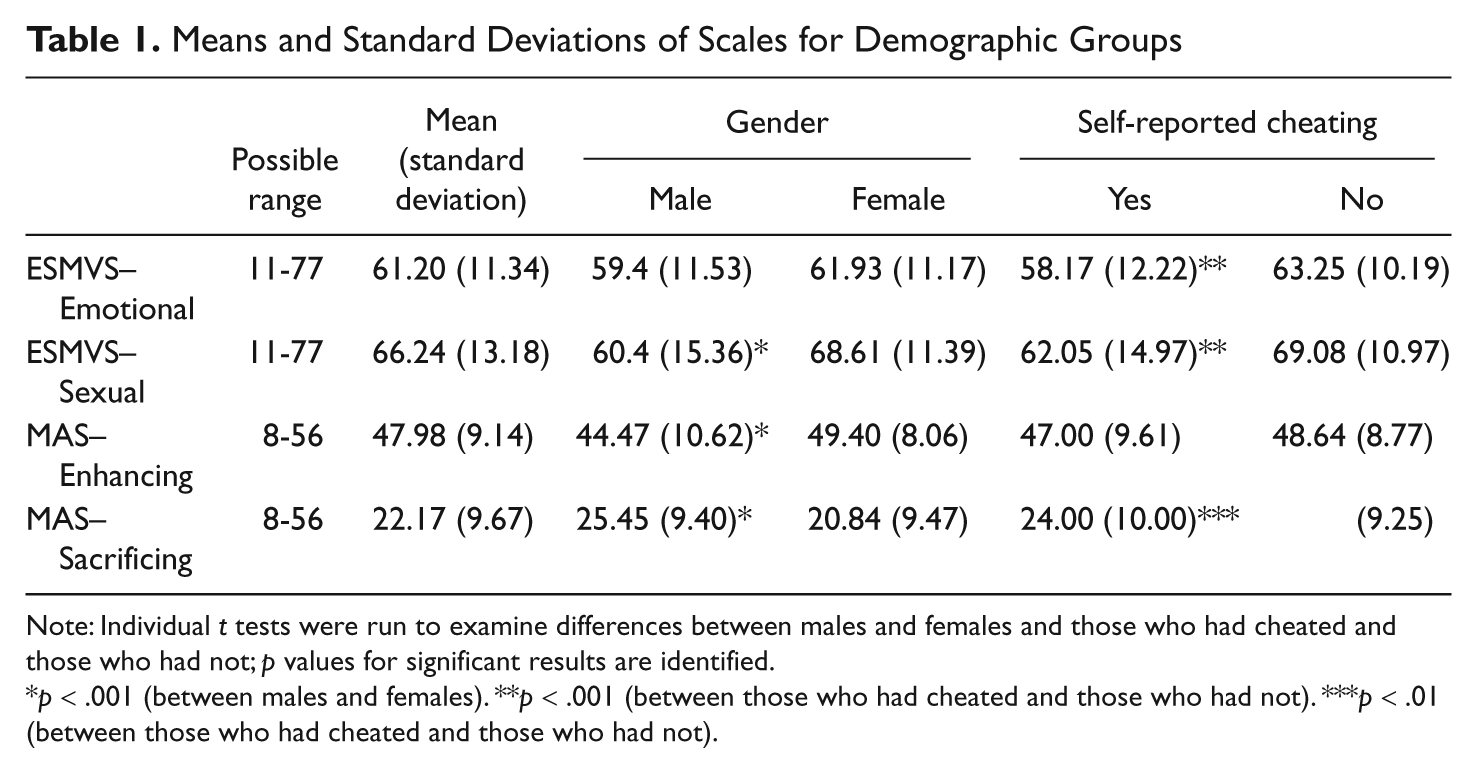
Note: Individual t tests were run to examine differences between males and females and those who had cheated and those who had not; p values for significant results are identified.
p < .001 (between males and females). **p < .001 (between those who had cheated and those who had not). ***p < .01 (between those who had cheated and those who had not).
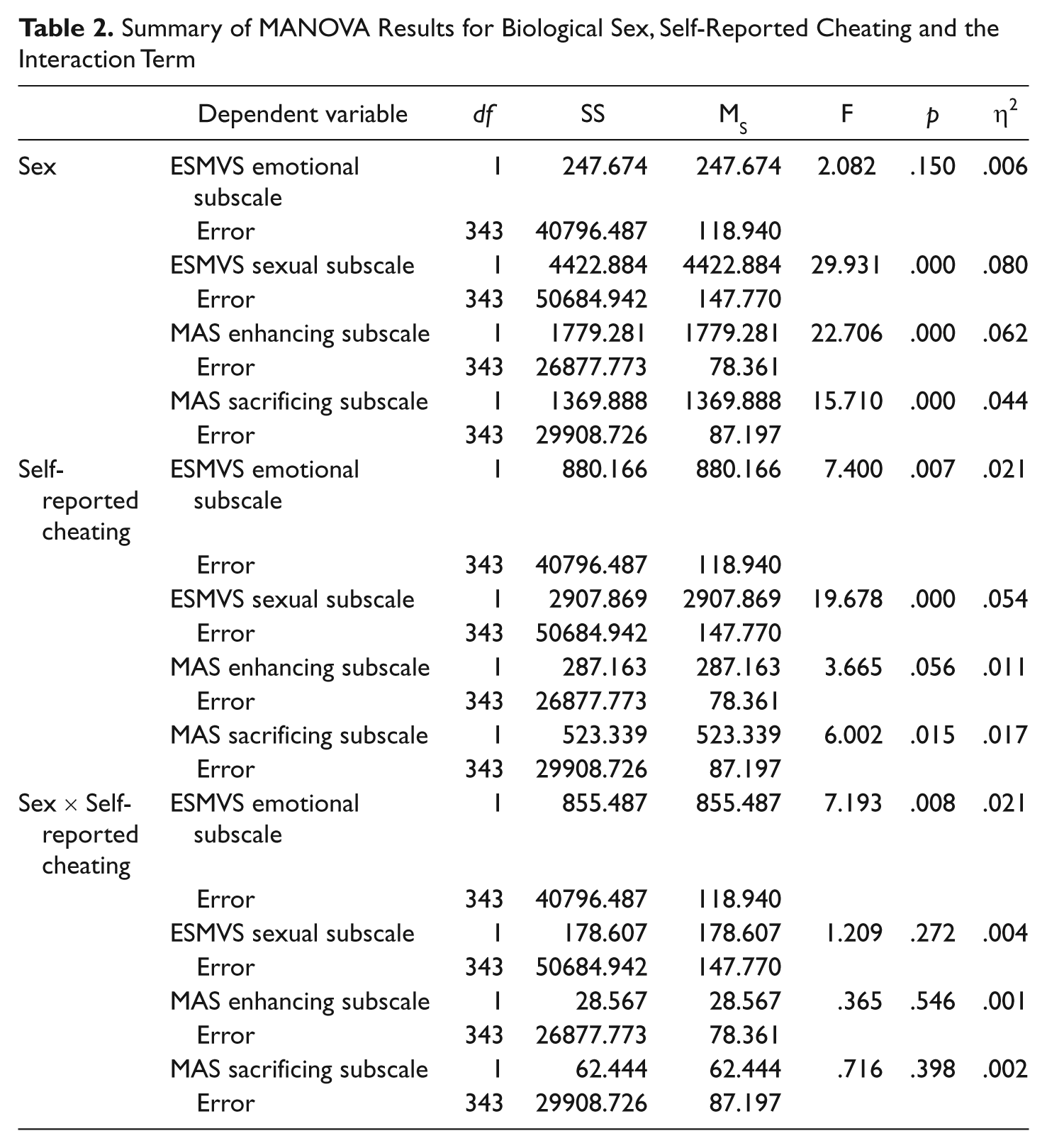
To examine research questions (b) and (c)—differences in how biological sex and having cheated on a partner affected the attitudes toward monogamy—a 2 (biological sex) × 2 (self-reported cheating) multivariate analysis of variance (MANOVA) was performed. The MANOVA revealed that biological sex, Wilks’s Lambda = .865, F(4, 340) = 13.24, p < .001, η2 = .14, self-reported cheating, Wilks’s Lambda = .945, F(4, 340) = 4.97, p = .001, η2 = .06, and the interaction Biological sex × Self-reported cheating, Wilks’s Lambda = .945, F(4, 340) = 2.86, p < .05, η2 = .03, were all significant though with varying levels of effect size.
Univariate analyses indicated differences on three out of the four monogamy dimensions for biological sex. Females valued sexual monogamy more than men did (68.61 vs. 60.4), and demonstrated a stronger valuing of emotional monogamy (61.93 vs. 59.4). Compared to females, males viewed monogamy as more of a sacrifice (25.45 vs. 20.84), but the males did not differ significantly from females in their views of monogamy as enhancing (44.47 vs. 49.40). Three out of the four monogamy dimensions were significant for those who self-reported that they had cheated; those who had cheated had a stronger belief of sacrifice (24.00 vs. 20.93) and lower beliefs in the emotional (58.17 vs. 63.25) and sexual (62.05 vs. 69.08) value of monogamy. There was not a significant difference in the enhancing subscale. Looking at the interaction Biological sex × Self-reported cheating, only the emotional subscale was significant. Females who had not cheated had a much higher mean (64.89) compared to those females who had cheated (57.73) indicating that noncheaters placed a higher value on the emotional aspect of monogamy. Complete Univariate results are found in Table 2.
Summary of MANOVA Results for Biological Sex, Self-Reported Cheating and the Interaction Term
Discussion
Monogamy is often emphasized in the Hispanic culture as the expected norm as well as a positive approach to reducing sexual risk. In this study, the overall attitudes toward monogamy were favorable for both males and females based on subscale averages being significantly different than the midpoint of the scales. In addition, significant differences were found between males and females for the t-test results as well as the MANOVA. Previous research has shown that women value both sexual and emotional monogamy more than men (Schmookler & Bursik, 2007). In this study, this was true for the MANOVA results, but the t-tests showed no difference between males and females value of emotional monogamy. These findings also indicate males were significantly more likely to view monogamy as a sacrifice compared to females which is consistent with previous findings (Schmookler & Bursik, 2007). Traditional gender roles are often supported and reinforced by the Hispanic culture; many Hispanic teens believe that parents give different messages to males and females about sexuality and relationships (National Campaign, 2008). Furthermore, Hispanic college students are more likely to report that they had been told by parents that premarital sex was unacceptable than non-Hispanic college students (Raffaelli & Green, 2003). The term familismo in the Hispanic culture describes the emphasis placed on family relationships and childbearing and aligns closely with the notions of pride and honor related to the female chastity (Cintron, Owens, & Cintron, 2007). The aforementioned cultural influences that restrain female sexuality and support the idea that men are sexual and can be allowed to experience their sexuality with multiple partners is demonstrated by the finding that males perceive monogamy as more of a sacrifice.
In this study, self-reported cheaters viewed monogamy as more of a sacrifice than their noncheating counterparts. Additionally, self-reported cheaters placed less value on emotional monogamy and sexual monogamy. Infidelity may be viewed as a continuum of behaviors ranging from simple flirting to engaging in sexual intercourse to developing an intimate emotional and sexual relationship with a person other than your partner (Buss & Shackelford, 1997). Gender comparisons indicate that significant differences exist regarding definitions of infidelity. Men are more likely than females to not consider oral sex and cybersex cheating (Knox, Zusman, & McNeely, 2008). Male college students report higher incidences in sexual infidelity (Knox, Vail-Smith, & Zusman, 2008; Wiederman & Hurd, 1999) than female college students. Interestingly, males also report feeling guiltier following sexual infidelity, while females report feeling guiltier after engaging in emotional infidelity (Fisher, Voracek, Rekkas, & Cox, 2008). Regardless of type of infidelity, the fact that one partner cheated appears to be indicative of relationship problems. For both genders, relationship dissatisfaction appear to be positively correlated with acts of infidelity (Treas & Giesen, 2000), particularly among college students (Roscoe, Cavanaugh, & Kennedy, 1988).
Approximately, 20% of Hispanic youth report having concurrent partnerships (Doherty, Minnis, Auerswald, Adimora, & Padian, 2007). Moreover, Hispanic males are more likely to report sexual concurrency than non-Hispanic White males (Adimora, Schoenbach, & Doherty, 2007) and Hispanic females are less likely to report sexual concurrency than non-Hispanic White females (Adimora et al., 2002). Interestingly, Hispanic teens often have strong beliefs in relationship continuity and thus often stay in unhealthy relationships because they feel that their boyfriend or girlfriend is the one person they have who is always there for them (National Campaign, 2008). This may be a factor in why there were no differences between individuals who had been cheated on and those who had not experienced a partner cheating on them. Although significant differences in attitudes toward monogamy were found based upon cheating status, biological sex appears to be a more important factor based on eta values.
Relevance of Findings
The findings from this study can be used to create sexual health and relationship education programming for college students, particularly Hispanic college students. Strategies for increasing the value of monogamy as enhancing and decreasing the value of monogamy as sacrificing includes addressing negative cultural gender roles and responses to sexuality (i.e., familismo) and gender differences in definitions of monogamy and infidelity. Information and activities related to enhancing personal growth and empowerment in conjunction with strategies for developing healthy relationships and improving relationship satisfaction should be incorporated as well. Additionally, the differences between true monogamy and serial monogamy should be provided. Serial monogamy often provides a false sense of security with regard to HIV and STI susceptibility. As a result, sexual health programming should include activities designed to enhance comfort and efficacy related to sexual communication and condom use. If college students have a better understanding of what monogamy and serial monogamy are, to include the risks associated with high rates of concurrent sexual partnerships, perhaps they will increase safer sex practices.
The results of this study fill a void in the literature by examining the attitudes of Hispanic college students about monogamy. However, the unique aspect of this study’s focus may also limit the generalizability of its findings. The study was conducted in an area of the U.S. where most Hispanics are Mexican American, so the findings may not be generalizable to other Hispanic cultures as well as other ethnicities. Likewise, without participants of other ethnicities as a comparison, it is difficult to explicitly determine how Hispanic attitudes toward monogamy may or may not differ from other ethnicities. With the participants being a university population, this also may limit how these results may be similar or different if respondents were Hispanics not attending college. As a former commuter college in an urban area, there may also be differences in this University’s overall demographics when compared to other Hispanic-serving institutions that may limit the generalizability.
An additional limitation may be the lack of definition for “cheating.” The correlations between items that asked about engaging in specific sexual behaviors outside the relationship and cheating were high, but the items used in the MANOVA analysis did not include a definition for cheating. Because individuals could self-define cheating, there could be great variation in those who had cheated or believed they were “cheated on.” Finally, the poor response rate is a limitation; the attitudes and behaviors of nonresponders may be different than those who opted to start or complete the survey. Individuals with strong beliefs about monogamy may have self-selected to participate. However, the response rate is similar to other online sexual health studies conducted at this campus.
The results of this study demonstrate the need for future research projects to better clarify the findings. Focus groups that explore the qualitative aspects may provide insight into the gender differences as well as the similarities, specifically the similar attitudes between males and females regarding the enhancing characteristic of monogamy. The role of culture as an influence on attitudes toward monogamy could also be explored. Future quantitative studies could provide comparisons among different ethnicities.
Footnotes
The author(s) declared no potential conflicts of interest with respect to the research, authorship, and/or publication of this article.
The author(s) received no financial support for the research, authorship, and/or publication of this article:Financial support provided by the United States Department of Health and Human Services Office on Women’s Health was used, in part, to purchase an annual subscription to Survey Monkey and collect data related to this article.