







Abstract
The 7-year longitudinal study examined the College Assistance Migrant Program (CAMP) impact on migrant student achievement in the California State University system. Participants included migrant students, Latinos, and general student populations from 2002-2009. The analysis of variance and chi-square test of independence were used to explore statistical differences in persistence, 1st-year and cumulative grade point averages, and baccalaureate degree attainment. When compared with other groups, CAMP students were found to have higher academic achievement.
Introduction
Hispanics represent the largest ethnic minority group, 46.9 million or 12.5%, of the total U.S. population (U.S. Census Bureau, 2008). Current trends illustrate that Hispanics are enrolling at a higher rate within institutions of higher education (IHE) than previous decades (Brown, Santiago, & Lopez, 2003). Despite overall progress of Hispanics in IHEs, children from migrant farmworker families tend to fall behind in academic achievement. Historically, children from migrant farmworker families have been cited as among the most disadvantaged of all groups of students in the country (Green, 2003). For migrant children, dreams of enrolling and succeeding in college are difficult and out of reach due to hardships associated with the migrant farmworker lifestyle.
Plight of the Migrant FarmWorker
Migrant farmworkers and their families have been referred to as an invisible population due to the lack of attention received from the communities in which they reside and work (Nunez, 2009). It is estimated that there are one to three million migrant farmworkers who travel across the country planting, harvesting, and processing crops (Cranston-Gingras, 2003; Kandel, 2008). Migrant families base their decisions on migrating according to the length of seasons, timing of crops, agricultural conditions, rates of pay, and available housing (Chavkin, 1996; Court & Arango, 1998). Migrant families usually live in substandard housing, camps, or barrack-like structures (Whittaker, Salend, & Gutierrez, 1997). Migrant families are often described as close-knit units where family members take responsibility for one another to survive (Court & Arango, 1998).
Migrant families frequently labor 6 to 7 days a week, 10 or more hours per day for wages below minimum wage. Migrant farmworkers’ median weekly earnings are 59% of the average wage and salary worker (Kandel, 2008). The average individual income was from US$10,000 to US$12,499 and family income was from US$15,000 to US$17,499 (Mehta et al., 2005). Thirty percent of all family incomes were below federal poverty guidelines, thereby, exacerbating the need for public assistance (Kandel, 2008; Mehta et al., 2005).
Education Challenges of Migrant Children
Children of migrant farmworkers are considered to be one of the most academically vulnerable student groups in the United States. Factors that contribute to their lack of academic achievement are interrupted schooling, extreme poverty, and dismal living conditions. In addition, migrant children demonstrate a lack of English language proficiency, poor communication skills, feelings of social isolation, and low self-esteem (Leon, 1996; Zalaquett, McHatton, & Cranston-Gingras, 2007).
The migratory lifestyle imposes several obstacles to the enrollment of migrant children in K-12 education systems. School enrollment is difficult due to problems associated with unreliable academic records transmittal, credits transfer across school districts and state boundaries, and a lack of curriculum alignment between states (Ribando, 2002). Approximately 25% of migrant students enroll in school more than 30 days after the school year begins due to the family’s mobility (Cranston-Gingras & Paul, 2008). Consequently, migrant children have to adjust to new friends and adapt to different cultural and academic expectations.
From a school and socialization perspective, moving during the academic year makes it difficult for migrant children to create the social networks and participate in socializing activities. Migrant children have shorter time periods to build comfortable relationships with teachers and other school-aged peers (Vargas, Grskovic, Belfiore, & Halbert-Ayala, 1997). Similarly, it is difficult for migrant children to receive support from school personnel as they are unprepared to meet the unique academic and cultural needs of these children.
Historically, migrant students have the highest school drop-out rate of approximately 50% (Green, 2003). The migrant lifestyle makes it difficult for students to attend school regularly, learn at grade level, accrue credits, and meet all graduation requirements. Migrant students who eventually dropped out of school were found to have moved an average of 17.5 times, as compared with an average of 10.3 moves for migrant students who graduated. Another contributing factor to the high drop-out rate is the fact that 40% of migrant students experience difficulties in the classroom because English is their second language (Cranston-Gingras & Paul, 2008).
The 2007 Comprehensive Needs Assessment (CNA) identified more than 237,096 migrant children enrolled in 4,409 California public schools. Eighty-five percent of migrant children in California are of school age (5 to 18 years old), with Hispanic students accounting for 98%. The CNA reported that migrant children were underprepared when they entered kindergarten, demonstrated lower levels of English and math proficiency, had lower test scores on the California Standards Test, 15% passed the California Academic High School Equivalency Examination (CAHSEE), and were less likely to complete college preparatory coursework (California Department of Education, 2007). Thereby, migrant children were more likely to drop out of K-12 schools and were less likely to enroll in IHEs.
College Assistance Migrant Program
In 1972, the U.S. Department of Education (USDE) created the College Assistance Migrant Program (CAMP) to increase college enrollment and to ensure 1st-year completion of undergraduate studies in IHEs (MigrantStudents.org, 2009). Mandated program services include academic and career advising, tutoring, and social activities to provide a level of support and campus engagement. CAMP performance is measured by (a) the number of students retained after the 1st year and (b) the number of students who enrolled in coursework in the 2nd year. As of 2009, there were 38 CAMPs across the nation, including eight in the state of California (i.e., six campuses of California State University and two community colleges). CAMP receives more than US$15 million annually (USDE, Office of Migrant Education, 2009). Based on an exhaustive online search of research articles, books, and periodicals in education databases (e.g., ERIC, EBSCO, ProQuest), several qualitative and research studies provided insight on migrant students. Qualitative research focused on students’ decision making when entering college (Araujo, 2006; Duron, 1995; Nunez, 2009), support systems for student success (Galaida, 2000; Haro, Rodriguez, & Gonzales, 1994; Machin, 2002; Zalaquett et al., 2007), student self-perceptions after the 1st year of college, and student experiences in CAMP (Cranston-Gingras, Morse, & McHatton, 2004; Reyes, 2007a, 2007b). Quantitative research examined CAMP cost efficiency (Willison & Jang, 2009), federal performance (Monaghan, 2009), and program effectiveness (Riley, 1985).
Purpose of the Study
The purpose of this study was to examine migrant students in CAMP, to determine what, if any, impact the program had on their academic achievement in the CSU system. The study examined persistence, 1st-year and cumulative grade point averages (GPA), and baccalaureate degree attainment. This study addressed one overarching research question: Does CAMP have an impact on migrant student academic achievement?
Method
Participants
The study examined student-level data on migrant students who participated in CAMP at six CSU campuses: Bakersfield, Fresno, Long Beach, Monterey Bay, Sacramento, and San Marcos. The CSU is a public university system consisting of 23 campuses that offer undergraduate and graduate instruction in applied fields and professions (CSU, 2009a). The CSU system (2009a) reported 2002 total enrollment of 38,430 first-time, full-time freshmen. The system-wide average for 1st- and 2nd-year retention was 79.8% and 69.7%, respectively. The cumulative 4th-year, 5th-year, and 6th-year graduation rates were 14.3%, 37.7%, and 48.9%, respectively (CSU, 2009b).
The CSU Annual Outreach Report for 2007-2008 reported that six CSU campuses, examined in this study, received US$1.6 million in federal funding for CAMP. These CSU campuses promoted CAMP services through outreach efforts to more than 12,124 migrant students in 326 California high schools. A student’s eligibility in CAMP was based on the definition of “migrant” from the USDE’s OME. Each CSU campus has the ability to offer additional services, activities, and staff beyond OME mandated CAMP services (CSU, Office of the Chancellor, 2008).
There were a total of three groups used in the study: (a) migrant students who met federal program eligibility and were enrolled in CAMP, (b) Latino students who were not in CAMP, and (c)students from the general student population (e.g., other). A total of 9,698 student records were collected in fall 2002 to spring 2009 with the independent variable of participant group used: CAMP students (336 or 3.5%), Latino students (2,002 or 20.6%), and other students (7,360 or 75.9%). For statistical integrity, all participant groups were mutually exclusive.
Measures
The Campus Solutions student database application of the Oracle PeopleSoft system was used to gather student-level data from each of the six CSU campuses. In 2008, the CSU system completed a system-wide implementation of Oracle PeopleSoft through the Common Management System (CMS) project (CSU, 2009c). CMS contained information in regard to academic advisement, admissions, financial aid, and student records.
Procedures
Student-level data was gathered from Oracle PeopleSoft, to capture student academic achievement. Dependent variables included, 1st-year and cumulative GPA (e.g., 0.0-4.0 scale), persistence (e.g., enrollment in college units), and baccalaureate degree attainment (e.g., did or did not graduate).
The analysis of variance (ANOVA) was used to identify variances between means for 1st-year and cumulative GPA. Post hoc tests (e.g., Scheffe) were calculated to determine variances in means between participant groups. The chi-square test of independence was used to identify group differences for persistence and baccalaureate degree attainment based on federal Pell Grant status, a need-based grant to low-income students. Data from CSU, Monterey Bay were excluded from persistence analyses due to inaccuracies. All data were analyzed using the Statistical Package for the Social Sciences (SPSS) application with the alpha level (p < .05) to determine statistical significance.
Results
Persistence
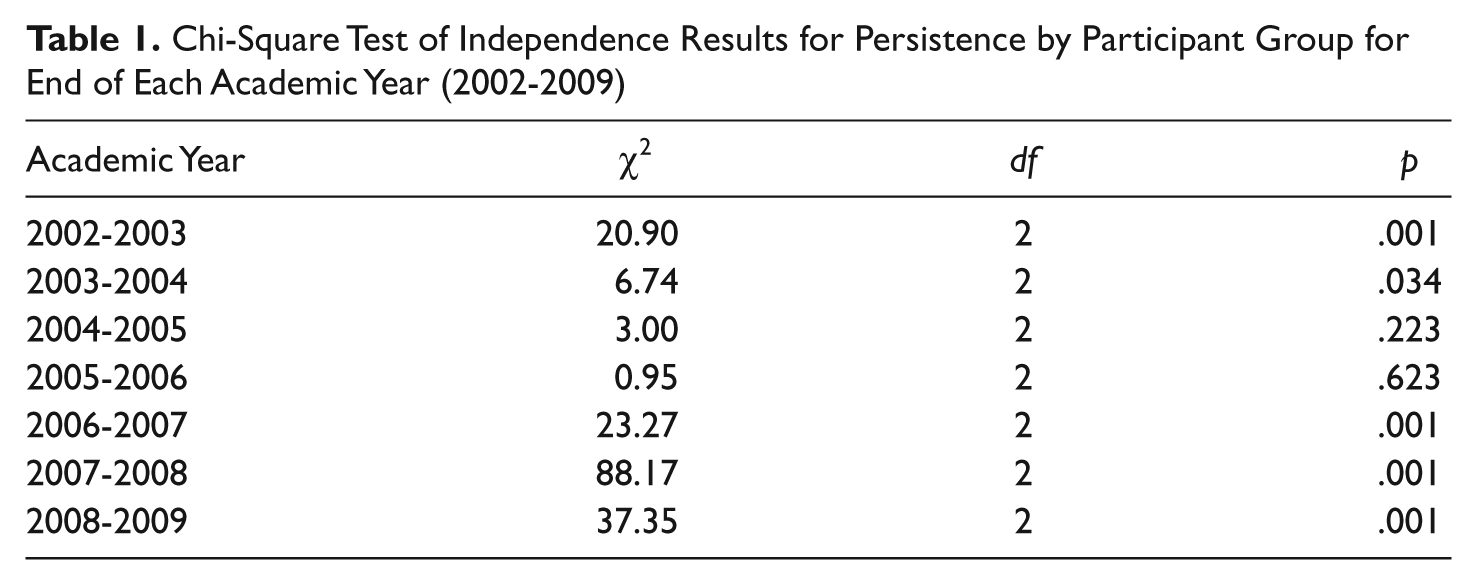
At the end of the 1st year (2002-2003), results indicated a higher rate of persistence for CAMP (95.6%), Latino (94.9%), and other (92.1%) (χ2 = 20.90, df = 2, p < .001). At the end of the 2nd year (2003-2004), there was a statistical difference (χ2 = 6.74, df = 2, p = .034) in student persistence for CAMP (83.3%) when compared with Latino (77.4%) and other (76.8%). Also, results indicated that CAMP students were more likely to be enrolled from 2006-2009 than the two participant groups (e.g., Latinos and other; see Table 1).
Chi-Square Test of Independence Results for Persistence by Participant Group for End of Each Academic Year (2002-2009)
1st-Year and Cumulative GPA
A student’s grant recipient status (e.g., Pell Grant) was used to compare a subgroup of students from Latino and other with similar socioeconomic characteristics of migrant students for 1st-year GPA. Results indicated that there was a significant Student Group × Pell Grant Status interaction, F(2, 8,996) = 14.53, p < .001, partial η2 = .003. For students who received a Pell Grant, there was a significant difference in means of 1st-year college GPA (F = 8.096, df = 2, 8990, p < .001) among CAMP (M = 2.86), Latino (M = 2.63), and other (M = 2.73). Follow-up t tests revealed that CAMP students had significantly higher GPAs than Latinos, t(2163) = 4.57, p < .001 and other, t(7161) = 2.80, p = .005. The partial eta squared was .002, which was a small effect size (see Table 2).
Mean, Standard Deviation, and Number of 1st-Year College Grade Point Average by Participant Group and Pell Grant

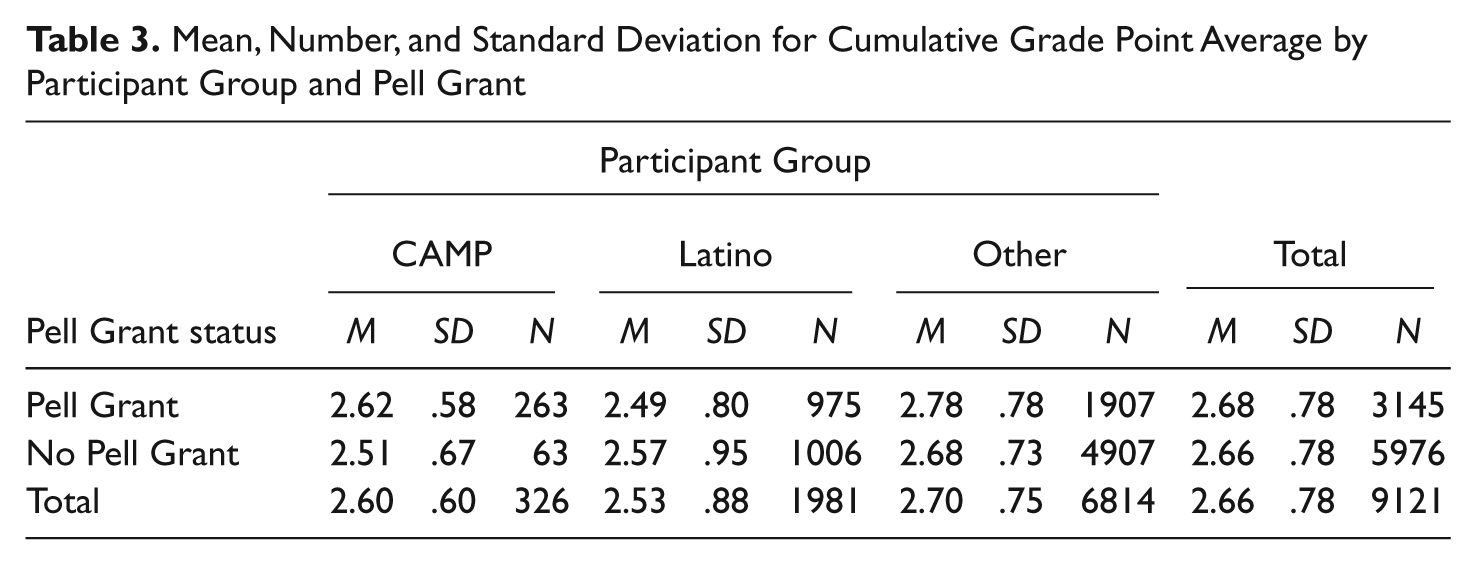
Pell Grant status was also used to compare a subgroup of students from Latino and other with similar socioeconomic characteristics of migrant students for cumulative GPA. Results indicated that there was a significant Student Group × Pell Grant Status interaction, F(2, 9,121) = 9.94, p < .001, partial η2 = .002. There was a significant difference in mean cumulative GPA by participant group (F = 48.468, df = 2, 9115, p < .001) among CAMP students (M = 2.62), Latino students (M = 2.49), and other (M = 2.78). The partial eta squared was .011, which was a small effect size (see Table 3). However, follow-up t tests revealed that CAMP students did not have significantly higher cumulative GPAs than Latinos or other.
Mean, Number, and Standard Deviation for Cumulative Grade Point Average by Participant Group and Pell Grant
Baccalaureate Degree Attainment
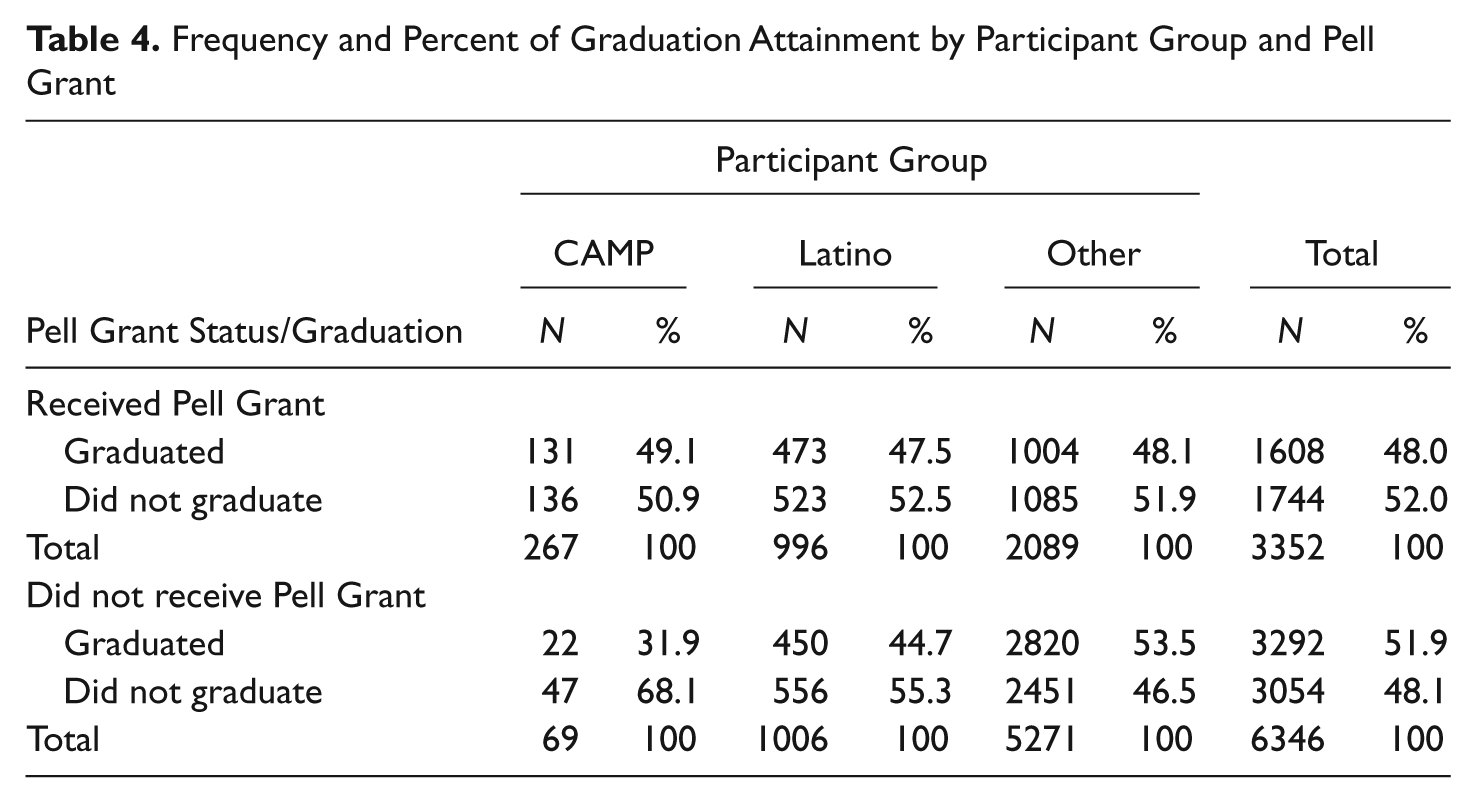
CAMP students who received a Pell Grant had higher graduation rates (49.1%) than the two participant groups, Latino (47.5%) and other (48.1%) (χ2 = 37.19, df = 2, p < .001). These results suggest that CAMP students performed better when they had financial assistance to help them achieve their academic goals (see Table 4).
Frequency and Percent of Graduation Attainment by Participant Group and Pell Grant
Discussion
Overall, results from the study indicate that migrant students in CAMP perform academically at the same level or higher than Latino and other student groups within the CSU system. Specifically, migrant students persisted at a higher rate in the 1st and 2nd year of college; however, high persistence in later years suggests that among other reasons, CAMP creates a positive learning environment where migrant students feel a strong sense of community. Or perhaps, migrant students choose to continue with their education by enrolling in additional units to achieve a minor, certificate, or second baccalaureate degree. However, higher persistence could be attributed to a migrant student’s need to obtain additional work and fewer academic units per semester in order to afford attendance in the CSU system.
Moreover, the results for 1st-year and cumulative GPA indicate differences for students who receive a Pell Grant. In particular, migrant students had higher 1st-year GPA, which suggest that academic skills imparted by CAMP positively affected student achievement. For cumulative GPA, migrant students did not statistically outperform any other group. This suggests that although migrant students enter college with disadvantaged backgrounds, they still are able to perform at the same overall level as any other student in the CSU system.
Finally, the results for baccalaureate degree attainment indicate that migrant students, who receive a Pell Grant, outperformed all other students groups. Despite migrant student’s impoverished backgrounds, this finding suggests that these students better achieve with financial assistance.
The limitations of the study included the lack of a migrant student control group for comparison purposes. In addition, there was a lack of control for other campus program influences that may have had an impact on student achievement. Finally, data integrity was a limitation due to the reliance on institutional research offices being able to provide accurate student-level data.
Further research of migrant students could include quantitative survey instruments and qualitative focus groups, and interviews to identify specific campus activities and program services (e.g., CAMP) that directly support academic achievement. A regression analysis of campus resources and services received, frequency, and perceived value may produce valuable data. In addition, further research could include migrant students not enrolled in CAMP. The intent is to examine any differences in academic achievement of migrant students enrolled or not enrolled in CAMP for comparison purposes. Finally, more than half of migrant students did not persist to graduation. Further research to determine their reasons (e.g., personal, financial reasons) are recommended.
In the CSU system, migrant students had higher 1st- and 2nd-year persistence, higher 1st-year GPA, and higher graduation rates. Despite the disadvantaged backgrounds of migrant students, they were able to achieve their educational goals.
Footnotes
The author declared no potential conflicts of interest with respect to the research, authorship, and/or publication of this article.
The author received no financial support for the research, authorship, and/or publication of this article.