







Abstract
This study examines unique patterns of college engagement and outcomes among Latino undergraduate students attending highly selective institutions in comparison with those from other racial/ethnic groups. The study also identifies predictors of select college outcomes—that is, cognitive, affective, and civic outcomes—for this population. Findings did reveal not only the unique patterns of college experiences and outcomes among Latino college students but also student background characteristics and college environments that contribute to their college outcomes.
According to the 2010 Census, Latinos represent 16% of the total U.S. population and account for more than half of the overall total growth in population in the United States between 2000 and 2010 (Ennis, Rios-Vargas, & Albert, 2011; U.S. Census Bureau, 2011). Although Latinos are the youngest and fastest growing ethnic group in the United States, they are the least educated among all major ethnic groups and have historically experienced low rates of college completion (Fry, 2002, 2004; Gándara & Contreras, 2010; Swail, Cabrera, & Lee, 2004). The U.S. Census Bureau (2011) documented that 13.9% of Latinos had achieved a college degree or higher, whereas 30.3% of Whites, 19.8% of Blacks, and 52.4% of Asian and Pacific Islanders had done so.
Furthermore, Latino college students were found to be underrepresented at selective 4-year institutions—Latinos only represent about 8% of college students enrolled at the most selective institutions (Carnevale & Strohl, 2013) while being overrepresented at open-access, 2-year colleges (Carnevale & Strohl, 2010, 2013). Given this smaller subset of Latino college students at selective institutions, most studies on Latino college students tend to use student samples from community colleges or predominantly Hispanic (or Hispanic-serving) institutions, using a deficit perspective and paying relatively little attention to their actual growth or development during the college years. In other words, most studies seemed to limit their focus to Latino students’ social stratification (Rivas-Drake, 2011; Rivas-Drake & Mooney, 2009), racialized educational inequities (Sólorzano, Villalpando, & Oseguera, 2005; Stearns, Potochnick, Moller, & Southworth, 2010), college access (Zarate & Burciaga, 2010), adjustment difficulties (Fischer, 2007), lack of academic preparation (Berkner & Chavez, 1997; Irizarry, 2012), and their experiences at the community college level (Crisp & Nora, 2010; Hagedorn & Cepeda, 2004; Hagedorn, Chi, Cepeda, & McLain, 2007; Perrakis & Hagedorn, 2010). As a result, there is a missed opportunity to better understand the strengths, richness of diversity, and added value that Latino college students bring to—and get from—the institutions they attend.
This study attempts to address these research gaps by providing some insight into the unique patterns of college engagement and outcomes among Latino undergraduate students attending highly selective institutions. Specifically, this study is guided by the following research questions:
Background and Literature
Academic Engagement and Educational Experiences of Latino College Students
Latino college students appear to experience unique patterns of academic engagement and educational experiences. This student population is often characterized as academically underprepared for college, lacking cultural fit, and having poor coping responses, all of which affect their overall well-being and reduce their chances of succeeding in college (Castellanos & Orozco, 2005). However, more recent findings show that Latino college students tend to not only demonstrate a stronger drive to achieve but also report a higher level of academic effort compared with their peers from other racial groups (Hurtado, Sáenz, Santos, & Cabrera, 2008).
Substantive student–faculty interactions, both in and outside of the classroom, are critical experiences that have been found to develop college students’ (including Latino students’) academic self-concept, foster their motivation to achieve, influence students’ likelihood of persisting academically, and produce better learning outcomes (DeFreitas & Bravo, 2012; Kim & Sax, 2009, 2011; Komarraju, Musulkin, & Bhattacharya, 2010; Lundberg & Schreiner, 2004; Tinto, 1975). Student–faculty interaction has particularly been known to be a strong positive predictor of persistence among Latino college students (Hurtado & Carter, 1997; Komarraju et al., 2010). Optimal conditions for producing such interaction include faculty’s awareness, appreciation, and sensitivity to Latino cultures, an understanding of high impact practices, and their ability to integrate this knowledge when establishing classroom norms, environments, and expectations (Cejda & Hoover, 2010). In contrast, students attending more selective or larger institutions tend to report less frequent and fewer personal interactions with faculty compared with their peers attending less selective or smaller institutions (Hurtado et al., 2011; Kim, Chang, & Park, 2009).
In terms of co-curricular experiences, ethnic minority students were found to spend more time on non-university activities as opposed to formal social activities, which is more characteristic of their White counterparts (Fischer, 2007; Stuart, Lido, Morgan, Solomon, & May, 2011). Such activities include family, religious functions, and time spent alone (Stuart et al., 2011). Ethnic minority college students seemed to be more likely to report spending time in the library, with their families (la familia; Hurtado, Carter, & Spuler, 1996), and engaged in community activities (Stuart et al., 2011). Also, students with lower socioeconomic backgrounds spend more time working (Nora & Crisp, 2009) and less time engaging in cocurricular activities (Pascarella, Pierson, Wolniak, & Terenzini, 2004; Stuart et al., 2011).
Work Engagement Among Latino College Students
Latino college students tend to work while enrolled in college at higher rates than college students of other racial and ethnic groups (Swail et al., 2004). The findings on the impact of students’ work engagement on their college outcomes are inconsistent. While some studies suggest that working while studying tends to have a negative effect on students’ learning and development (Inman & Pascarella, 1998; Nora & Crisp, 2009; Terenzini, Springer, Yaeger, Pascarella, & Nora, 1996), other studies argue that reasonable employment opportunities may positively influence students’ learning outcomes by providing an opportunity to integrate their work experience and academic college experiences (Dundes & Marx, 2006; Pascarella & Terenzini, 2005; Perna, 2010). Despite the mixed findings, students’ work engagement seems to have possible implications for college students’ learning and development, given that the engagement may possibly produce various types of educational moments through, for example, informal training, observation, collaboration, feedback from peers and supervisor, informal interaction with supervisor, task repetition, and problem solving (Perna, 2010).
Role of Diversity Climate on Latino Students’ College Outcomes
Underrepresented minorities are more likely than White students to have greater precollege exposure to people of color, experience a greater tendency to engage in diversity-related activities, have positive interactions with diverse peers, and perceive more racial tension on campus (Harper & Hurtado, 2007; Locks, Hurtado, Bowman, & Oseguera, 2008). Despite the efforts to embrace national and global diversity on college campuses, Latino students’ interactions with diverse peers sometimes result in anxiety, which might negatively affect their self-esteem, sense of belonging, persistence, and other college outcomes (Dovidio, Gaertner, Kawakami, & Hodson, 2002; Hurtado & Ponjuan, 2005; Locks et al., 2008; Strayhorn, 2008). In contrast, studies revealed that positive diversity experiences in college are related to enhanced racial/ethnic attitudes (Antonio, 2000, 2001; Hurtado, Carter, & Sharp, 1995), greater gains in cognitive/intellectual outcomes (Kitchener, Wood, & Jensen, 2000), and increased civic engagement (Bowman, 2011).
Latinos at Selective Universities
Studies about Latino students at selective colleges and universities are few and tend to focus on student experiences rather than specific outcomes beyond persistence. For example, a qualitative study by Rivas-Drake (2008) revealed three major patterns of behavior and thought that demonstrated the various ways a Latino identity is experienced and individually negotiated to be either at odds with or a primary source of motivation and perceived opportunity. Other studies have demonstrated how high school diversity plays an important role in determining successful transition into selective predominantly White institutions (Lopez, 2013) and how minorities are more likely to persist at selective institutions (Melguizo, 2008). Yet these studies do not address the conditions that promote measurable gains in academic or personal development at these institutions.
Despite the prolific interest in Latino college student achievement, relatively little is known about the specific college experiences and optimal conditions under which Latino students have produced desired learning outcomes at selective colleges and universities. We attempt to address this research gap with this study.
Method
Data Source and Sample
The data source used in this study was the 2010 University of California Undergraduate Experience Survey (UCUES). The UCUES is a system-wide, biennial online survey instrument administered by the Center for Studies in Higher Education (CSHE) at the University of California (UC), Berkeley, and the UC Office of the President. Although selectivity of individual campuses may vary, the UC as a whole is widely considered a highly selective university system. The 2010 survey was administered to all undergraduate students across nine UC campuses, yielding 74,410 responses (43% response rate). The online survey contains a set of core questions that are administered to all students, along with one of four modules that focus more intently on different educational experiences (i.e., student life, academic engagement, civic engagement, and a fourth termed the wild card module that is determined by the research interests of individual campuses). The core set of questions does include some aspects of each of the areas covered by the different modules. The data set also includes information from student records, such as high school and current college grade point average (GPA). For data analysis in this study, we only used items from the survey’s core set of questions in addition to institutional data about GPA and race/ethnicity, 1 which is information collected through initial student applications. Using only the core set of questions, we were able to maximize our sample size of Latino students while still retaining important information about their educational experiences.
Given that our study was primarily interested in examining “development” or “gains” in college outcomes among Latino and other students after they were fully exposed to actual college experiences, the analytic sample of the study was limited to junior and senior students (n = 33,415). Of those students, 54% were female, and 14% identified as Latino or Chicano. Other races/ethnicities included Asian American (39%), White (33%), and African American (2%). Among Latino students in our sample, 61.3% were female, 49.3% were nonnative English speakers, and 49.3% were first-generation college students. Furthermore, they were most likely to be from working-class or low-income families (63.2%) and 28.6% were transfer students.
Variables
This study utilized three sets of dependent variables to examine a broad range of college outcomes: cognitive, affective, and civic outcomes. In the interest of more parsimonious statistical models and where statistically feasible, factor scales were utilized. A list of factor scales, factor loadings, and reliability estimates are available from the first author upon request.
The cognitive outcomes were measured by students’ current GPA and a factor scale we created consisting of several individual survey items that measure students’ cognitive skills (see Table 1 for factor loadings and internal consistency on factor scales). Although institutional information on college GPA can be considered the standard in educational research on objective student learning, we believe that measuring grades alone can be misleading because of the high probability of inconsistencies and vagueness in the grading process. Grades may reflect student learning and level of mastery of a given subject matter, but they may also reflect behavioral aspects of attending college (e.g., attendance patterns, class participation) that are not reflective of course learning objectives (Suskie, 2004). The inclusion of self-reported survey items making up the factor scale for cognitive skills provides some balance and an avenue for us to examine students’ own assessment of learning. The affective outcomes were gauged by two survey items that asked students to rate their current proficiency levels in interpersonal skills and self-awareness/understanding. Last, the civic outcomes were assessed by a survey item that asked students to measure their current proficiency level in their ability to appreciate the fine arts and a factor scale we created that assesses students’ civic attitudes. With the exception of GPA, all outcome measures, including those that make up factor scales, were measured by a 6-point Likert-type scale, ranging from 1 = very poor to 6 = excellent. Actual GPA was provided by the institution as part of the data set and was utilized as a cognitive outcome in this study.
Factor Loadings and Internal Consistency on Outcome Measures.
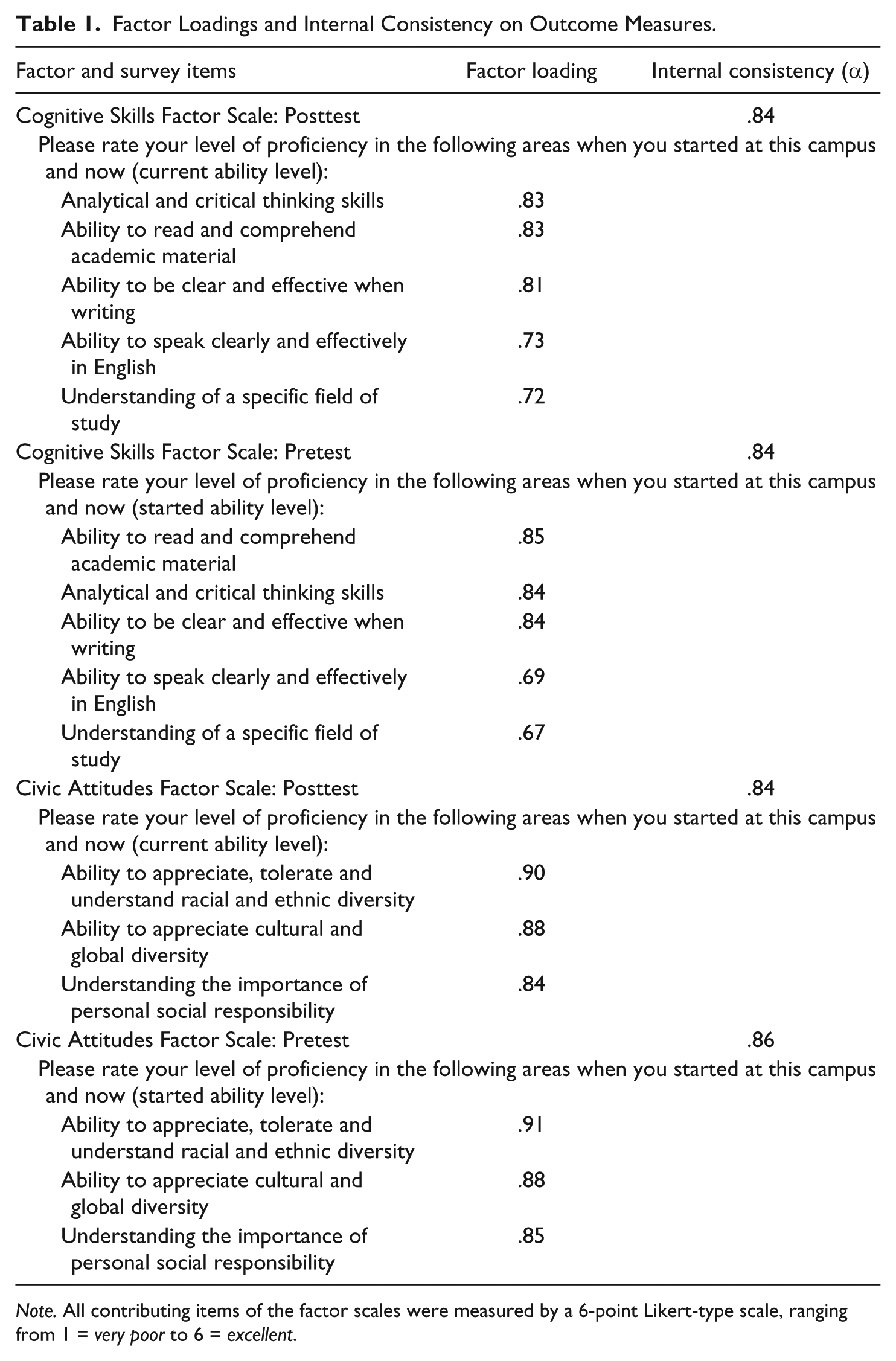
Note. All contributing items of the factor scales were measured by a 6-point Likert-type scale, ranging from 1 = very poor to 6 = excellent.
The independent variables utilized for this study were drawn from the available variables within our data set and included the following: six separate pretest variables that measure the same cognitive, affective, and civic outcomes when they “started” at the institution; four input variables that included student demographics (i.e., gender, socioeconomic status, first-language acquisition, transfer status); six academic college environment variables that included academic discipline (i.e., social sciences, engineering and computer sciences, physical and biological sciences, arts and humanities) and climate for diversity (i.e., climate for personal characteristics and freedom to express beliefs); and 14 factor scales that measure individual college experiences (i.e., quality of instruction and courses in the major, sense of belonging and satisfaction, satisfaction with advising and out-of-class contact, satisfaction with library support, academic involvement and initiative, research or creative projects experience, collaborative work, critical reasoning classroom activity, curricular foundation for reasoning, elevated academic effort, extracurricular engagement, poor academic habits, time employed, and academic time). Many of these composite measures were predeveloped by the CSHE at UC Berkeley. A complete list of variable definitions and coding schemes are available from the first author upon request.
Analysis
Analyses were conducted with IBM SPSS Statistics 21 using Astin’s (1993) Input–Environment–Outcomes (I-E-O) model as the methodological framework. Astin’s I-E-O model relies on three conceptually distinct components of the college experience to effectively examine educational impact: student inputs (i.e., entering student characteristics), environments (i.e., institutional characteristics and climate, individual college experiences), and outcomes (i.e., student achievement, skills, and interests). First, the data set was split by race, and paired-samples t tests were performed using all pretest measures against the outcome measures to determine whether individual racial/ethnic groups, including Latinos, demonstrated significant gains across college outcomes over time. Then, a set of ANOVAs was conducted on the pretest, posttest (outcome), and gain measures to determine whether the mean scores in these measures were significantly different across racial/ethnic groups. Furthermore, we conducted a series of ANOVA to investigate how the patterns of college experiences among Latino students differ from those for other racial/ethnic groups. Last, a series of hierarchical multiple regression analyses were performed for each outcome measure to determine which college experiences predict college outcomes among Latino students.
Informed by Astin’s (1993) I-E-O model, five blocks of independent variables were utilized in the regression analyses: a pretest variable, demographics, student’s major field, climate for diversity, and individual college experiences. Prior to the final regression analysis in which we used the enter method, an exploratory regression analysis was performed on each outcome measure using the forward method. Independent variables that did not significantly add to the regression model were identified and deleted from the final analysis, thus producing a more parsimonious prediction equation.
Results
Gains in College Outcomes Among Latino Students
To address the differences between Latino college students and their peers of other racial/ethnic groups in the development of select college student outcomes over time, we conducted paired-samples t tests and ANOVA. Results demonstrate that the mean changes in all outcome measures of this study were statistically significant at the .001 level across all racial/ethnic groups (see Table 2). All racial/ethnic groups reported significant gains in skills for each outcome measure from their freshman year to their junior or senior year, except for college GPA where all racial/ethnic groups showed a negative change (i.e., decrease) compared with their high school GPAs. Latino students reported the highest gains across all selected outcomes (except for GPA). Although Latino students indicated greater gains over time across outcomes compared with their peers in other racial/ethnic groups, the mean scores in their junior or senior year still remained below their Asian American and White peers for GPA, below their African American and White peers for cognitive outcomes and interpersonal skills, and below their African American peers in self-awareness and understanding, ability to appreciate the fine arts, and civic attitudes.
Differences on Gains in Cognitive, Affective, and Civic Student Outcomes Depending on Student Race/Ethnicity.
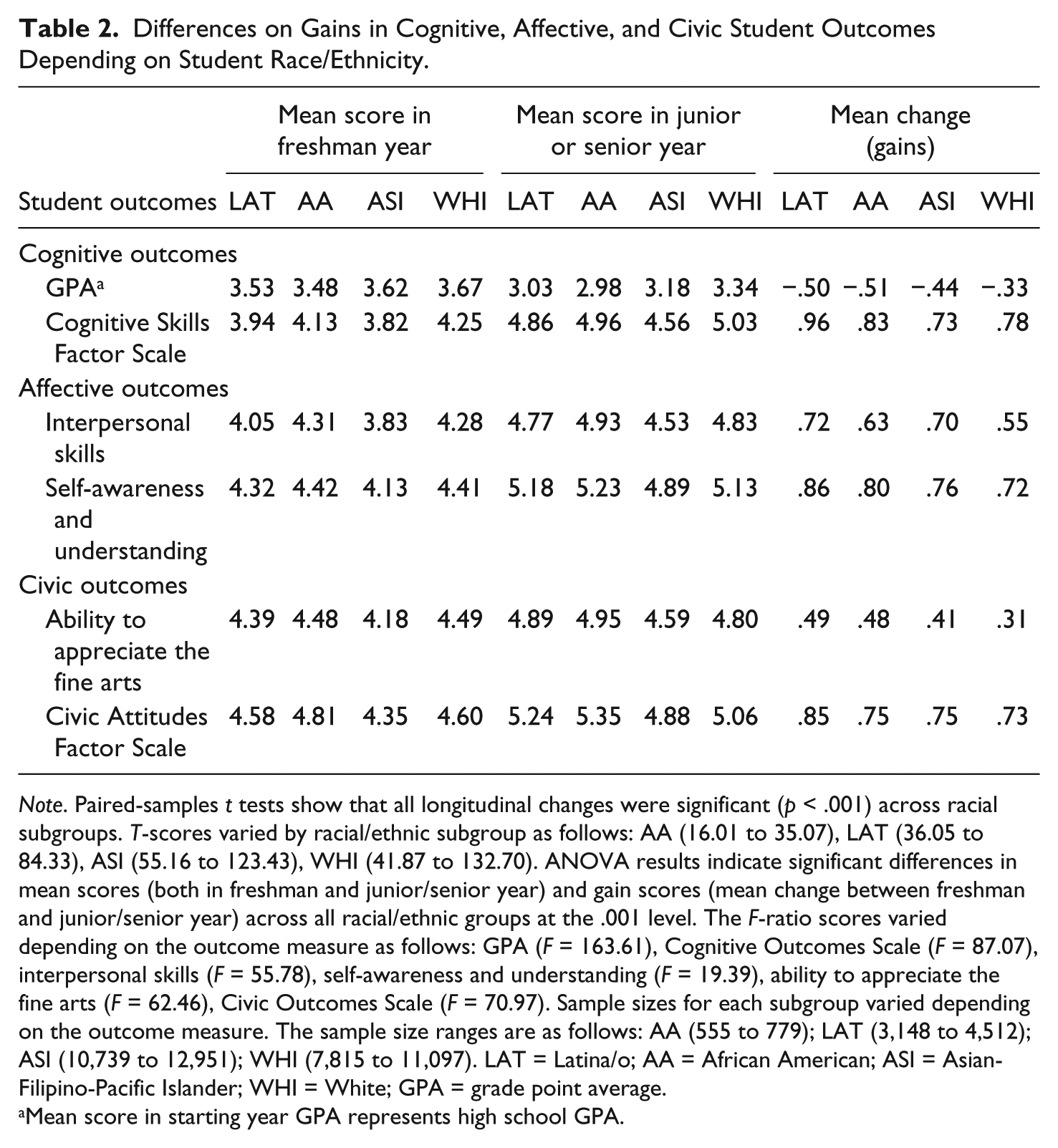
Note. Paired-samples t tests show that all longitudinal changes were significant (p < .001) across racial subgroups. T-scores varied by racial/ethnic subgroup as follows: AA (16.01 to 35.07), LAT (36.05 to 84.33), ASI (55.16 to 123.43), WHI (41.87 to 132.70). ANOVA results indicate significant differences in mean scores (both in freshman and junior/senior year) and gain scores (mean change between freshman and junior/senior year) across all racial/ethnic groups at the .001 level. The F-ratio scores varied depending on the outcome measure as follows: GPA (F = 163.61), Cognitive Outcomes Scale (F = 87.07), interpersonal skills (F = 55.78), self-awareness and understanding (F = 19.39), ability to appreciate the fine arts (F = 62.46), Civic Outcomes Scale (F = 70.97). Sample sizes for each subgroup varied depending on the outcome measure. The sample size ranges are as follows: AA (555 to 779); LAT (3,148 to 4,512); ASI (10,739 to 12,951); WHI (7,815 to 11,097). LAT = Latina/o; AA = African American; ASI = Asian-Filipino-Pacific Islander; WHI = White; GPA = grade point average.
Mean score in starting year GPA represents high school GPA.
Patterns of College Experiences Among Latino Students
To examine the differences between Latino college students and their counterparts of other racial/ethnic groups in the patterns of engagement in college experiences, we conducted a series of ANOVA. Results indicated significant mean differences between racial/ethnic groups across all individual college experiences (see Table 3). In terms of satisfaction with the educational experience, Latino students rated their satisfaction with quality of instruction and courses in the major, advising and out-of-class contact, and library support as equal to or higher than all other racial/ethnic groups. Sense of belonging and overall college satisfaction was the only area where White students reported higher levels of satisfaction than Latino students. With regard to academic engagement, Latino students reported their engagement as higher than all other racial/ethnic groups for critical reasoning classroom activity, curricular foundation for reasoning, and elevated academic effort. On the contrary, Latino students reported lower engagement than their African American peers in collaborative work and research or creative projects experience, lower than their African American and White peers in academic involvement and initiative, and lower than their Asian American and White peers in academic time. When it comes to feelings about the climate for diversity, Latino students reported less positive perceptions on climate for personal characteristics and freedom to express beliefs than their Asian American and White peers. In terms of time employed, Latino students’ ratings were higher than their Asian American and White peers. Perhaps this finding is related to the other findings of this study that Latino students reported lower levels of extracurricular engagement and poor academic habits than all other racial/ethnic groups.
Patterns of College Experiences by Student Race/Ethnicity.
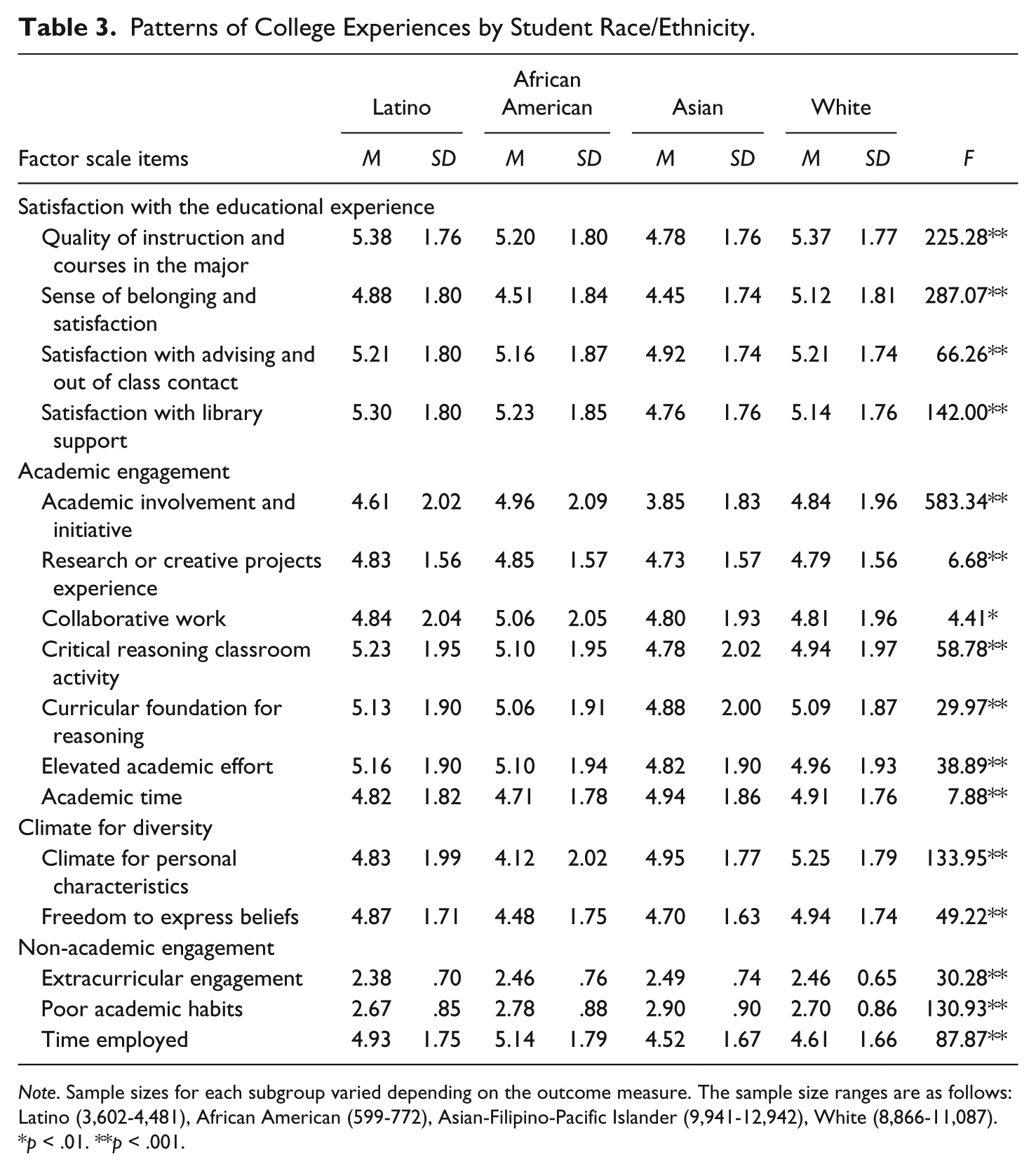
Note. Sample sizes for each subgroup varied depending on the outcome measure. The sample size ranges are as follows: Latino (3,602-4,481), African American (599-772), Asian-Filipino-Pacific Islander (9,941-12,942), White (8,866-11,087).
p < .01. **p < .001.
College Experiences That Contribute to Latino Students’ College Outcomes
To uncover which college experiences predict select student outcomes among Latino college students at highly selective institutions, we conducted a series of hierarchical multiple regression analyses. Several college experiences emerged from the regression analyses that predicted college outcomes among Latino students (see Table 4). Common positive predictors across all selected student outcomes were sense of belonging and overall college satisfaction (β range = .07-.20, p < .001) and academic involvement and initiative (β range = .05-.18, p < .001). Critical reasoning classroom activity also appeared to positively predict all selected student outcomes (β range = .07-.11, p < .001), with the exception of college GPA.
Results of Regression Analyses on College Student Outcomes Among Latino Students.
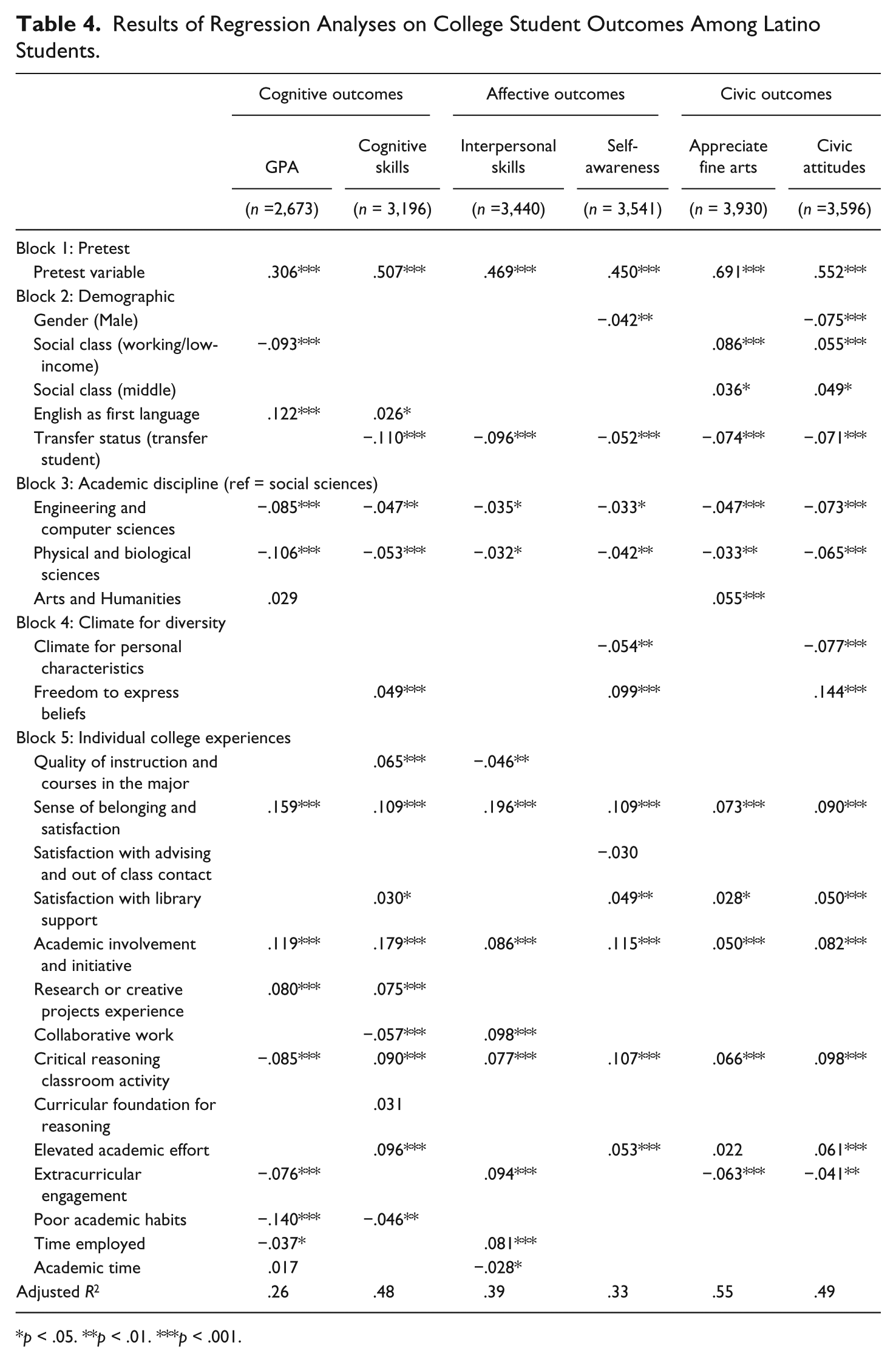
p < .05. **p < .01. ***p < .001.
More mixed findings were observed among other individual college experiences. Most notably, elevated academic effort appeared to positively predict cognitive skills (β = .10, p < .001), self-awareness (β = .05, p < .001), and civic attitudes (β = .06, p < .001), but did not significantly predict other selected outcomes. A similar result was observed when it came to satisfaction with library support for predicting cognitive skills (β = .03, p < .05), self-awareness (β = .05, p < .01), civic attitudes (β = .05, p < .001), and ability to appreciate the fine arts (β = .03, p < .05). Poor academic habits seemed to negatively impact college GPA (β = −.14, p < .001) and cognitive skills (β = −.05, p < .01) while having no significant effect on other selected outcomes. Extracurricular engagement positively predicted interpersonal skills (β = .09, p < .001) while negatively predicting college GPA (β = −.08, p < .001), ability to appreciate the fine arts (β = −.06, p < .001), and civic attitudes (β = −.04, p < .01).
The impact of academic discipline and campus climate on college student outcomes appears to also be mixed, each having various types of impact on different outcomes. Relative to academic disciplines in the social sciences, all college student outcomes for Latino students were negatively predicted by majoring in academic disciplines in engineering and computer sciences (β range = −.03 to −.09, p < .05) and physical and biological sciences (β range = −.03 to −.11, p < .05), while majoring in arts and humanities was a positive predictor of ability to appreciate the fine arts. With regard to campus climate for diversity, freedom to express beliefs positively predicted cognitive skills (β = .05, p < .001), self-awareness (β = .10, p < .001), and civic attitudes (β = .14, p < .001) while remaining insignificant for all other selected outcomes. Climate for personal characteristics was not shown to positively predict any of the selected outcomes but did negatively predict both self-awareness (β = −.05, p < .01) and civic attitudes (β = −.08, p < .001).
Limitations
This study is limited in several aspects. First, the study has some limitations derived from the use of a secondary data set. Our data were not longitudinal and we relied on self-reported pretest and retrospective posttest measures that were gathered simultaneously; hence, they may not accurately reflect actual student gains in outcome areas. Thomson and Douglass (2009) provided evidence of response-shift or self-enhancement bias with the UCUES data set pretest/posttest measures, yet they also showed that the responses did reflect some different patterns of learning that are relevant and important to assessing institutional outcomes and that further our understanding of how different populations may characterize their own learning.
Also, although our data set was very large and contained an extensive set of variables that were valuable to our study, the sample was from a single university system in California and may not be representative of the racial/ethnic diversity of many other universities. Therefore, the results of this study may not be generalizable to students who attend other types of institutions and in other states. Related to this limitation is that, while we considered the University of California system as a whole to be “highly selective,” variations do exist with regard to the institutional selectivity within the system. Because we did not disaggregate our data into individual campuses, these results may not reflect the possible variations of experiences based on a range of institutional selectivity. The data set was also limited in that we were unable to disaggregate the sample into various Latino ethnic subgroups (e.g., Mexican American, Puerto Rican).
Furthermore, while we used Astin’s I-E-O model—which is one of the widely heralded and well-established college impact models—as our theoretical and methodological framework for research design, the framework may not be culturally relevant to Latino students. Although most constructs developed by the UCUES data set have been found to be effective in examining Latino college student engagement (Hernandez, Mobley, Coryell, Yu, & Martinez, 2013), some cultural nuances, such as the influence of family and religion, may have been overlooked within the factor constructs in our data analysis.
Last, because research has indicated that most Latino students in higher education are enrolled at community colleges with intentions to pursue a bachelor’s degree (Rendon & Nora, 1997, as cited in Crisp & Nora, 2010), we believed it was important to include transfer status as a control variable in our regression analyses. The inclusion of transfer students created two methodological issues. The first issue concerns the use of high school GPA as a pretest variable in the regression analysis for college GPA. Students who applied to transfer from community colleges to the University of California were only required to submit college grades, negating the need to submit high school grades. Therefore, the transfer students in our data set were precluded from examination for college GPA. Another methodological issue with analyzing transfer students concerns gains over time. Because transfer students typically enter at a different time (i.e., at the beginning of their junior year) than native students (i.e., students who begin at the institution as freshman), gains measured over time for transfer students can be as little as one academic year and up to two academic years compared with the 2 to 4 years of gains measured over time for native students.
Discussion and Implications
Set in the context of a highly selective university system, our study examined Latino students’ gains in some college outcomes and patterns of college experiences in comparison with those from other major racial/ethnic groups. We also examined the effects of student background characteristics, college environments, and individual college experiences on college outcomes among Latino students. Our findings did reveal how Latino students uniquely experience college at highly selective institutions and how those experiences affect their college outcomes. Those findings are discussed here along with their educational or theoretical implications.
Our results indicate that while Latino students do not report the highest level of skills in any area, they do report the greatest gains in skills across all outcome measures (except for GPA). Researchers may argue that this result may be due to the regression effect (i.e., any student who has a lower level of initial skills tends to obtain greater gains than others do who have higher levels of initial skills). However, our results show that Asian students have the lowest or second lowest initial scores in their freshman year and, theoretically, should have shown the highest gains. These findings suggest that greater gains in college outcomes among Latino students compared with their peers are not only due to the regression effect, but it appears that Latino college students do benefit more from their college experience and perceive their experiences at these institutions as relevant and important to their development and achievement. Likewise, Abraham, Lujan, López, and Walker (2002) found that Latino students at a predominantly Hispanic university valued their college experience for the perceived positive effects on the quality of their lives. Our findings are generally consistent with this finding and suggest that the perceived positive effects observed in Hispanic-serving institutions may also be applicable to other types of institutions (highly selective institutions in this case).
Another positive result from our study indicated that Latino college students tended to have higher levels of satisfaction compared with other major racial/ethnic groups, and, in the case of satisfaction with advising and out-of-class contact, the level of satisfaction was equivalent with White college students. This finding seems to confirm previous findings that have indicated levels of Latino college student satisfaction comparable with those of White students (Fischer, 2007). Previous studies have also documented the effect of college students’ satisfaction on some of the desired outcomes of higher education, including student persistence (Astin, 1993; Bailey, Bauman, & Lata, 1998; Bennett & Okinaka, 1990; Cabrera, Nora, & Castaneda, 1993; Schreiner, 2013), retention (Bruning, 2002; Miller, 2003), GPA (Bean & Bradley, 1986; Fischer, 2007), institutional commitment (Strauss & Volkwein, 2001), and alumni giving (Miller, 2003). Given the previous and current findings, we may argue that the college experiences of Latino students at highly selective research institutions are favorable and meaningful, which may contribute to development in desired educational outcomes at these types of institutions.
The Effect of Background Characteristics on Student Outcomes
When we examined the effects of student background characteristics on college outcomes among Latino students, we recognized several similarities to—and deviances from—the literature. Similar to Hurtado and Ponjuan (2005), first-generation status did not significantly affect any of our selected outcomes. We, therefore, did not even include the variable in our analysis. It is important to note that although our sample consisted of Latinos from a highly selective research university system, about 48% of the Latino students in our sample indicated that they were first-generation college students (i.e., neither parent had earned more than a high school diploma). Prior research has suggested that Hispanic first-generation college students are more intrinsically motivated than non-Hispanic first-generation college students (Próspero, Russell, & Vohra-Gupta, 2012). Perhaps the students in our study found the academic environment interesting for its own sake or perhaps they have a high internal goal-orientation. Although first-generation status was not an important indicator of the college outcomes in our study, it may say something about its methodological utility in future studies for high achieving Latino college students.
Previous research (Astin, 1993; Walpole, 2003) has identified the educational benefits associated with higher socioeconomic status; however, that was not the case in our study. Our study did affirm that low socioeconomic status was predictive of lower GPA. While this result is similar to what others have reported in the literature (Astin, 1993; Walpole, 2003), other results concerning socioeconomic status defy what previous research has found. In our study, neither working-class nor low-income was a significant predictor of cognitive skills. This result was not consistent with Hurtado and Ponjuan (2005) who found that, relative to students from high-income families, Latino students from middle-income families were negatively associated with analytical skills outcomes. Our study also found that lower socioeconomic status was positively associated with civic attitude, whereas Hurtado and Ponjuan found socioeconomic status to be an insignificant predictor of pluralistic orientation. While we did use similar measurements for both cognitive skills and civic outcomes, the discrepancies in our research results compared with the Hurtado and Ponjuan study could be the result of differences in research design, conceptualization, and measurement. Some of their study’s strengths were that the data were longitudinal and included public institutions from an array of geographic locations across the country. They were also mainly interested in how participation in a diversity-focused curriculum affected college outcomes for Latino first- and second-year students (i.e., freshman and sophomore students). Because our study focused on junior and senior students at highly selective universities, the discrepancies could have also been due to differences in the type of institution under investigation, the type of student under investigation, and the increased level of exposure to the college environment.
Language heritage also played a role in positively predicting GPA and cognitive skills for native speakers of English. About 50% of both the Latino and Asian students in our study indicated that they were not native English speakers, suggesting a significant disadvantage for these students. Although previous research has indicated that bilingual children have a distinct advantage in cognitive development (Barac & Bialystok, 2012), it does not appear to extend to the college students in our study. Perhaps there are more complex situational and environmental challenges to overcome for these students. For example, previous research (Kim et al., 2009) has also indicated that the language heritage of nonnative speakers of English, namely Asian American students, was a negative predictor of student–faculty interaction both in and out of the classroom, despite the finding that student–faculty interaction had a significantly positive effect on college outcomes for this group of students. Gándara and Contreras (2010) pointed to evidence that teachers tend to be influenced by the primary language of a learner and hold higher expectations for students of some language heritages than of others. Students may sense this faculty perspective, which may also lead to feelings of discomfort in approaching or engaging with faculty. The findings of this study may indicate a similarity on how language heritage uniquely affects college outcomes for Latino students and other students with language heritages other than English. Higher education professionals may do well to heed prior research that has suggested that more diverse faculty in terms of racial/ethnic background and a critical mass of Latino students may indirectly facilitate the academic performance of Latino college students (Hagedorn et al., 2007). More research is needed to understand how and why language heritage affects college outcomes, as well as what can be done to address this apparent inequity.
A final demographic indicator of college outcomes was transfer status. In this study, transfer status was negatively related to all of our measured outcomes. However, the limitations we discussed elsewhere in this article with regard to evaluating outcomes among transfer students indicate that while these results are troublesome given that most Latino students begin their education toward a bachelor’s degree at community colleges, more research is needed to fully understand the effects of transfer on college experiences and outcomes among Latino students.
Academic Discipline
Relative to Social Sciences, our study found that those Latino students enrolled in majors related to engineering and computer sciences and physical and biological sciences were indicative of lower levels of skills in all selected outcome measures. Researchers have previously expressed concern with how low expectations of some minority groups’ performance in math and science serves to inculcate lower levels of self-efficacy among these groups (Museus, Palmer, Davis, & Maramba, 2011). Institutions could do well to implement programs and services specific to improving the self-concept of Latino students. Previous research has also indicated that Latino students are severely underrepresented in the major fields of science, technology, engineering, and math (STEM; National Science Foundation, 2006), which could explain why majoring in these subject areas has a negative effect on their outcomes. Creating a critical mass of Latino students in STEM majors may create a more favorable environment that enhances their sense of belonging and self-efficacy and enriches their interactions with faculty and peers. As suggested by Cole and Espinoza (2008), higher education institutions need to do more to recruit and retain Latino students in STEM fields, which may increase their likelihood for success.
Climate for Diversity
Indeed, results from our study indicated that individual students’ perceived climate for diversity had a significant effect on some college outcomes. While students’ perceptions of freedom to express beliefs (i.e., political or religious beliefs) had a positive effect on cognitive skills, self-awareness, and civic attitudes, we also found that perceived climate for personal characteristics (i.e., the perception that students are respected regardless of socioeconomic status, gender, race/ethnicity, sexual orientation) appeared to have a negative effect on self-awareness and civic attitudes among Latino college students. This finding is rather counterintuitive because prior research (Bowman, 2011; Kitchener et al., 2000) seems to suggest that positive feelings of acceptance would lead to more positive affective and civic outcomes. However, a possible interpretation is that this finding indicates a lack of challenge to the personal characteristics of Latino college students at these highly selective institutions, which would hinder their growth or development in such outcomes. In other words, development in self-awareness and civic attitudes will not occur in an environment that is devoid of such learning experiences. Still, this does not fully explain the negative association. More research is needed to better understand this confounding effect.
Individual College Experiences
Sense of belonging and satisfaction with the educational and social experience had a positive effect across all selected outcomes among the Latino students in our study. Sense of belonging has been identified in the literature as an important contributor to student success (Hausmann, Schofield, & Woods, 2007; Hurtado & Carter, 1997; Spady, 1971; Tinto, 1993; Tovar, Simon, & Lee, 2009). While most literature on sense of belonging among Latino students treats sense of belonging as an outcome in and of itself (Hurtado & Carter, 1997; Hurtado & Ponjuan, 2005; Maestas, Vaquera, & Zehr, 2007; Strayhorn, 2008), our study highlights the critical importance of sense of belonging to other meaningful college outcomes for Latino college students. The Latino students in our sample did report high levels of college satisfaction; however, they did not report the highest level of sense of belonging. Although their levels are not as low as African American and Asian American students, Latino students trail far behind those of White students. Similarly, academic involvement and initiative (i.e., student–faculty interactions both in and out of the classroom, engagement with studies) also had a positive effect across all selected outcomes among the Latino students in our study. Indeed, our study seems to confirm prior research that identifies student–faculty interaction as a positive indicator of college success among Latino students (Anaya & Cole, 2001; Cole, 2010; Einarson & Clarkberg, 2010; Kim & Sax, 2009; Lundberg & Schreiner, 2004; Santos & Reigadas, 2000). However, the Latino students in our study had lower levels of academic involvement and initiative than White and African American students. These results would seem to suggest that there is room for improvement.
Finally, this study suggests that critical reasoning classroom activity has a positive effect on all selected outcomes of the study (except for college GPA). It is promising that the Latino students in our study indicated the highest level of engagement in critical reasoning classroom activity than any other racial/ethnic subgroup in our study. Giancarlo and Facione (2001) posited that while critical thinking is conceptually connected to higher order thinking, logical thinking, and problem solving, it is also connected with reflective judgment. Beyond just a cognitive process, Giancarlo and Facione recognize that a disposition toward critical thinking also includes personality dimensions (i.e., attitudes and values). In addition, Bernal (2002) argued that, for students of color, unique language heritages, cultures, experiences, and histories have been obscured and ignored within formal education. As such, the importance of culturally responsive pedagogical practices cannot be understated. Instead of the tendency toward prescribing Eurocentric perspectives, teachers of critical reasoning should include the recognition of a diversity of experiences, struggles, ways of learning, cultural heritages, and cultural responses that may be held not just by Latino students but also by all students of color.
This research has direct practical implications for higher education institutions, particularly as institutions grapple with how to best serve the growing national Latino college student population. Findings from this study revealed that Latino students’ college experiences are critical to producing gains in their college outcomes. Given the limitations of this study, we recognize the challenge of the applicability of our findings to other types of campuses in other states, and we hope to inspire more research in the area of Latino college student success at more selective institutions. As higher education institutions strategize to meet the needs of a growing diverse student population, colleges and universities should take note of high impact experiences, particularly ones that create the conditions necessary to generate positive longitudinal changes among Latino college students. By linking institutional decision-making with empirical findings on Latino students’ unique patterns of college engagement, higher education leaders may develop and implement more culturally relevant policies and practices. Most notably, higher education leaders should be reminded that diverse groups of students do not experience college in the same way. Absolute models to achieve select outcomes among all college students are not conducive to producing gains among all students. Prescriptive measures must be considered by institutions to meet the needs of all students, particularly as universities are increasingly held accountable for demonstrating gains in outcomes across all diverse student groups.
Footnotes
Declaration of Conflicting Interests
The author(s) declared no potential conflicts of interest with respect to the research, authorship, and/or publication of this article.
Funding
The author(s) received no financial support for the research, authorship, and/or publication of this article.