







Abstract
Given the ever-growing number of Spanish heritage learners in both universities and colleges, the need has continued to grow for the development of placement exams that accurately measure language ability, are simple to evaluate, and are easy to administer to large numbers of students. This article analyzes the implementation of a placement exam at a large public university, examines the results, and suggests ways to further develop heritage placement exams for Spanish heritage students.
Introduction
Spanish heritage speakers represent the largest heritage language (HL) population in the United States (Hancock, 2002). Many colleges and universities throughout the country struggle to find or develop an exam for the proper placement of heritage language learners (HLLs) in language classes (Fairclough, 2011). The exams that do exist are varied in their structure and what they purport to measure (González-Pino & Pino, 2000). Placement exams for non-HLLs frequently measure reading comprehension and grammatical accuracy, although some are more complex in nature and include other language modalities (Brown, 1996; Zabaleta, 2007). The focus on reading and writing of many heritage exams does not always accurately reflect the language abilities of these students who generally have a more pragmatic verbal use of the language in their daily interactions (Fairclough, Belpoliti, & Bermejo, 2010).
Research into the area of HL assessment is ongoing and vital due to the ever-growing population and need for better instruments to evaluate the skills of HLLs. Much of the research in language assessment has concentrated on second language testing or on bilingual K-12 students (Baker, 2006). Less research has focused on heritage languages at the post-secondary level where an ever-growing population of HLLs can now be found (Fairclough, 2006; Li & Duff, 2008; Valdés, 1995). Many of the current models for heritage placement put less emphasis on the analysis of the domains of language use (i.e., how and with whom the languages are being used) and exclusively analyze the grammatical knowledge of the speakers. The failure to consider the importance that the domains of language use play in proper placement needs to be addressed.
Another type of instrument commonly used in many post-secondary institutions is one of self-placement. The problem with self-placement instruments is that many students lack the tools necessary to analyze their own language abilities, and this lack of metalinguistic awareness makes the use of placement exams even more important. In fact, research suggests that bilingual students too often underestimate their learning capacity on self-placement exams and that decisions based on these scores frequently result in placements that limit opportunities for learning (Ascher, 1990). This study aims to help guide the designers of placement exams increase the accuracy and facility of placement so that HLLs can be properly placed into language classes and thus benefit the most from their education.
Literature Review
The description of HLs is multifaceted due to the diversity that exists among those who identify themselves as such. One commonly used definition offered by Valdés (2000) describes a heritage speaker as a student of language who is raised in a home where a non-English language is spoken, who speaks or merely understands the heritage language, and who is to some degree bilingual in English and the heritage language. (p. 1)
Fishman (2001) further expands the definition of HLLs, stating that HLs are those languages other than English that have a particular family relevance to the learner and need not be spoken or even understood. This definition is especially important to those very low-level learners with passive abilities in the HL, although these learners can be found at all proficiency levels (Carreira, 2003; Fairclough, 2005). Because HLLs bring a wide variety of language experience to the classroom, it is important to keep in mind the different types of proficiency that they have with the language. The American Council on the Teaching of Foreign Languages (ACTFL, 2012) defines language proficiency as “what individuals can do with language in terms of speaking, writing, listening, and reading in real-world situations in a spontaneous and non-rehearsed context” (para. 2). HLLs often have a high degree of oral and aural proficiency but are much less proficient in their reading and writing. Previously, many of the higher proficiency HLLs were identified either as bilingual or native-speaking students or for those lower proficiency students, they were often integrated into classes for non-native speakers. However, researchers and teachers have realized that this population differs from both native speakers of Spanish and native speakers of English in their use and abilities with the different language modalities (Valdés, 2000).
The rationale for the proper placement of heritage speakers derives from the fact that although HLLs may possess stronger verbal skills, they lack the grammatical and literacy skills most second language learners acquire from classroom language instruction. Lingxin Yan (2003) found that 88% of the Spanish HLLs in her study said they used their HL at home for stories, family background, moral values, and discipline. These subjects developed strong verbal skills between family members, but the HLLs did not receive the extensive formal instruction in literacy, grammatical structures, and other language modalities that is common with the education of non-HLLs. HLLs in the foreign language (FL) classroom often become bored because although they are able to communicate verbally, they lack skills in written discourse necessary for academic success (Potowski & Carreira, 2004; Valdés, 2006). In addition, HLLs being present in the traditional FL classroom may make learning difficult for second language learners as well. Peyton, Lewelling, and Winke (2001) found that non-heritage students had a negative view of HLLs because of their perceived native-like abilities with the spoken language. The non-heritage students saw the speakers as taking the course for an “easy” grade and viewed the HLLs as “studying a language they already know” (p. 1).
One of the concerns for developing proper placement is the practicality of the instruments being used. Fairclough (2011) states that although many foreign language programs use standardized computerized exams to place incoming students, “most university heritage language programs in the United States rely on questionnaires, self-placement, interviews, and locally designed exams to place their students” (p. 274). These instruments require a great deal of resources to grade and subsequently place HLLs into the proper classes. She states that there is a need for a placement exam for HLLs that “requires a short time to complete, and that is computerized, thus providing automatic, instant scoring” (p. 274).
Several methods have been used to attempt to properly place students. Placement exams can use productive and/or receptive skills to place students. Many programs use tests of grammatical knowledge to place students. Students answer a number of questions and, based on the number of correct answers, they are placed in a certain class (Alarcón, 2010). Other research has examined using vocabulary knowledge to place HLLs (Fairclough, 2011; Fairclough & Ramírez, 2009; Lam, Perez-Leroux, & Ramírez, 2003). These studies have been carried out with varying results but all have found that lexical knowledge can be used to place certain HLLs. Fairclough (2011) found that the use of high frequency words was useful in separating lower level learners but failed to distinguish higher level learners due to a ceiling affect. Although the variety of placement tests varies from institution to institution, these tests are often based on the goals of the individual programs.
One of the ways that researchers are exploring the development of HL placement exams is through a better understanding of the sociocultural composition of HLLs. By gathering information from HLLs about their linguistic and cultural profiles, attitudes, behaviors, and motivations, studies have contributed, among other things, to a better understanding of what students bring to the university HL classroom (Alarcón, 2010; Jensen & Llosa, 2007). Alarcón (2010) states, The HL learner profile becomes even more intricate when accounting for additional issues these students bring into the classroom, such as the amount of previous language(s) exposure, the quality and frequency of social interactions in the HL, identity and cultural questions, attitudes toward the HL, and unique linguistic strengths and weaknesses.
The difficulty lies in finding a way to incorporate such aspects of a HLL’s life into a proper placement exam as well as determining how these aspects influence language proficiency and placement. Researchers need to investigate the bilingual range of heritage language learners in different competencies, not just grammatical competence (Kondo-Brown, 2002). Given that HLLs form part of the culture of the language that they are studying, they tend to have a more vested interest in their reasons and motivations for taking language courses (Beaudrie & Ducar, 2005). These considerations need to be factored in to the existing verbal and written portions of a placement exam.
One of the potential advantages of proper placement of HLLs is increased retention in universities. Many of these students struggle integrating themselves into the university setting. Gloria, Castellanos, Lopez, and Rosales (2005) found that the lack of social support negatively affected retention rates of Hispanic students. In addition, many of the HLLs are first generation college students who are unfamiliar with post-secondary institutions. Choy (2001) found that students who are first generation have twice the dropout rate when compared with their peers. One of the benefits of proper placement of HLLs is that they often end up in classes with other HLLs where they not only have comparable linguistic proficiency but also share a similar sociocultural background. In addition, proper placement allows students to interact with other first generation students and help them in feeling less isolated, which can lead to greater retention (Hahs-Vaughn, 2004).
Research Questions
The two research questions that guided this research are as follows:
Method
Participants
The participants in this study were 277 Spanish HL students, mainly freshmen, who were entering the university without having previously taken any university classes. The majority of the students were of Mexican descent. As part of the new student orientation, all students (heritage and non-heritage) had to take an exam to determine their proper placement into a language class. The non-heritage students were placed into a variety of classes whereas the HLLs were placed as follows: 100 students in Spanish 103 (beginning Spanish for HLLs), 79 students in Spanish 203 (intermediate Spanish for HLLs), and 98 students in Spanish 253 (advanced Spanish for HLLs).
Procedures
This study used a blended research design using both qualitative and quantitative analyses of the data gathered during this study to try to better understand heritage learner placement. This study is descriptive in nature while also looking for correlations between how and with whom the Spanish language is used by the HLLs and their overall proficiency. To determine who the heritage students were and properly place them, the following procedures were used at the time of the data collection. All heritage and non-heritage students were given a 10-question survey before taking one of two placement exams. The survey asked yes or no questions about the students’ exposure to and usage of Spanish both in and out of the home (see the appendix). Because students do not always identify themselves as HLLs, especially low-level HLLs with limited receptive skills, this instrument effectively helped to make the determination of who the HLLs were. Students who marked two or more “yes’s” on the survey were taken to an exam room to take a paper-and-pencil heritage placement exam and the rest of the students went to a computer lab to take the computerized exam for non-heritage students. After the heritage students completed the exam, the 10-question survey of language use was stapled to the placement exam.
Once the HLLs completed their placement exam, they were given to graduate students who had been trained in placing of the HLLs into four levels: Span 103, Span 203, Span 253, and Span 353. Only six students were placed into Span 353, so they were not included in this study due to sample size. The placement of the HLLs was based on overall proficiency, ability to complete the tasks, and the number and type of errors committed by the students. For example, students’ correct use of aspect was considered much more important to placement than the proper use of accent marks and weighted accordingly. Most of the exams were graded by one trained graduate student but whenever the placement of a student was unclear, two or more raters would evaluate it to determine proper placement, and if necessary, a short oral interview would be conducted.
The three levels of classes can be explained by the following descriptions: The Span 103 class was for students who had passive or receptive skills in Spanish, but who encountered difficulty in speaking. The curriculum fostered fluent conversation skills and covered basic grammatical elements such as the use of verbal tenses, gender assignment of irregular nouns, false cognates, and so on. The Span 203 group was designed for students who could understand most spoken Spanish as well as speak on a limited range of topics. The curriculum introduced students to the written form of Spanish. The Span 253 group was for the students who could speak and understand Spanish with some degree of fluency on a wider range of topics, but who had limited ability with the complexities of the Spanish writing system. The class covered the writing system and counted toward the Spanish major or Spanish minor of students pursuing Spanish degrees.
Instruments
The placement exam consisted of two instruments. The first was a 10-question survey (see the appendix) of receptive and productive language use given to all students to determine whether they were HLLs or not. The questions were designed to take into consideration the different domains in which the heritage speakers either used Spanish or were exposed to the language. These questions also determined with whom Spanish was used. This instrument was piloted previous to the gathering of the data. The second instrument was composed of three sections and only given to those students who were determined to be HLLs by the 10-question survey of language use. The three sections were as follows: (a) 10 questions in Spanish about general knowledge and demographics. The students were given the option of answering these questions in English or Spanish. This section, labeled “Language awareness,” was intended to measure students’ basic knowledge of the Spanish language. (b) A translation section, labeled “Bilingual skills,” included seven questions. These sentences were selected to test students’ abilities in four distinct areas: phrasal expressions, the use of gustar, the use of the subjunctive, and the use of aspect. This section also included many vocabulary words that have a standard translation common among monolinguals, but are often mistranslated by the Spanish heritage population. (c) The final section consisted of a short composition in which students could choose from one of three options that were selected to elicit responses using the past tense. The design of these instruments was based on previous research studies in HL placement and HLLs (Ascher, 1990; Lam et al., 2003; Valdés, 2000) as well as the experience of the test designer.
Results
From the data collected, a qualitative and quantitative analysis of the answers provided by HLLs was carried out to measure their performance. The author analyzed the data using inferential statistics and an ANOVA with post hoc Tukey pairwise comparisons to determine whether a significant difference existed between the level of placement and the domains of language usage as described in the 10-question survey. The analysis of the data was post hoc because the original purpose of the exam was placement. Thus, the placement of the students was not affected by the research because the students had already been placed before any of the data were analyzed.
1. How do heritage learners of different levels use Spanish both inside and outside the home before they start their university classes?
To better understand how heritage learners’ use and exposure to Spanish were representative of their overall placement, the students were divided according to their affirmative response on each of the questions from the 10-question survey. The purpose of this was to look at common characteristics of HLLs who placed into different levels of classes. In Figure 1, the questions to which the students responded “yes” are listed according to the level into which they placed using the placement exam. It can be seen that the students who placed into the more advanced Span 253 used and were exposed to Spanish in the widest variety of settings; they exhibited both active and passive use of the language. These students varied the most from the other levels in their viewing and listening of Spanish and in all of the statements regarding speaking. The fact that students spoke Spanish with different members of their family and community resulted in subsequent higher class placement. The students who placed into Span 203 stated that they used Spanish in some cases but they were also exposed to a large amount of Spanish by those around them. These students also spoke Spanish in the home but were much less inclined to use it outside that setting. They were also much less likely to view any television or listen to programs in Spanish. These were two of their main distinctions from the students who placed into Span 253. The Span 103 students demonstrated a very limited active use of the language with some exposure mainly coming from their grandparents and less from the parents, which is common with heritage students at this level. This group also viewed very little Spanish television and listened to the radio in Spanish infrequently, which reflects their overall integration into English-speaking mediums. These receptive heritage learners are unique in that they often understand certain topics conveyed to them in Spanish, especially relating to the home and family, but are not able to respond orally in Spanish especially given their limited range of vocabulary.
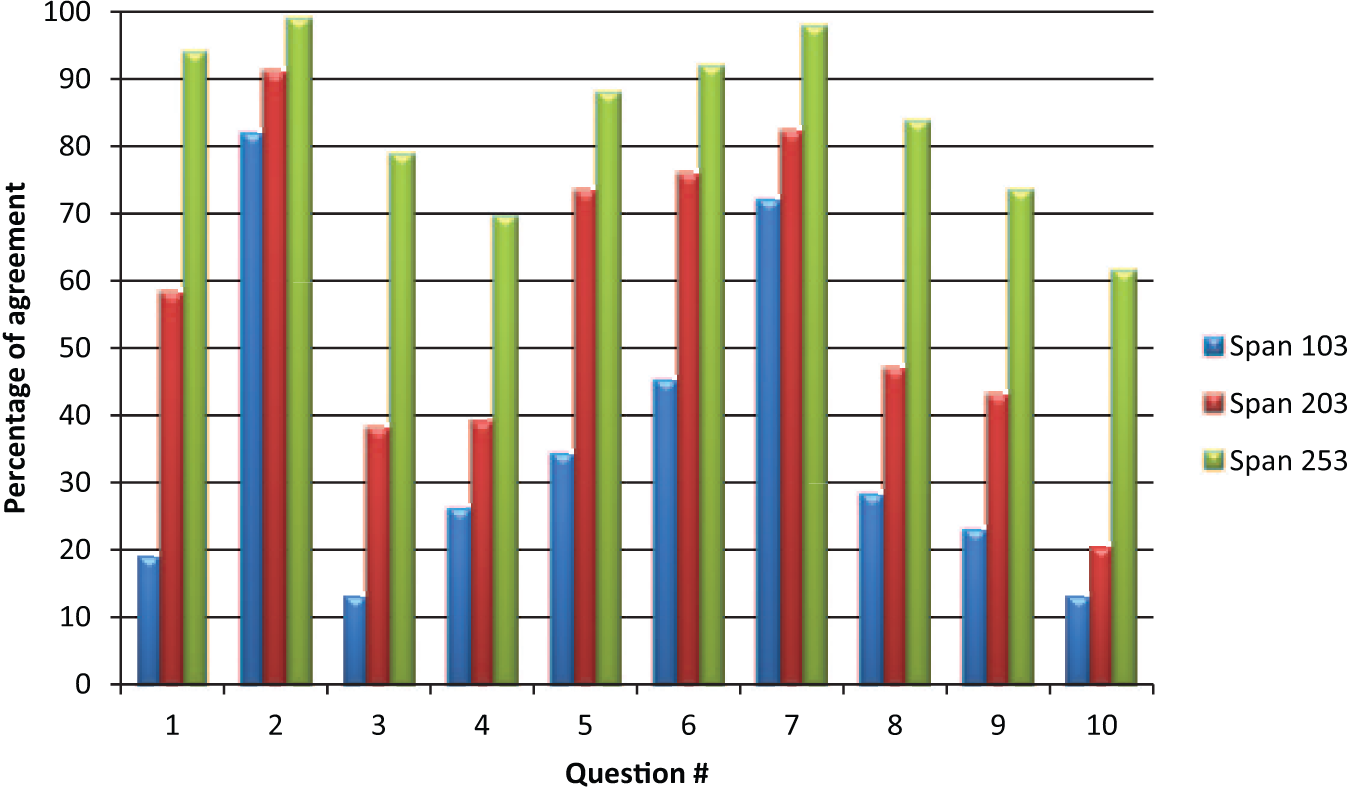
Affirmative responses to 10-question survey of domains of language use according to final class placement.
The differences in the percentages of affirmative responses between the different class levels varied greatly depending on the question (see Figure 1). On some of the questions, there was a difference of more than 40% between class levels whereas with some questions, the difference was as little as 8%. All of the groups had a high level of agreement regarding hearing Spanish in the home as children as well as being spoken to in Spanish by their grandparents. The students who placed into the higher levels distinguished themselves especially in productive skills. Questions 1, 3, 5, 8, and 9 all asked about speaking to different groups in the HLLs’ social and familial structure. These questions show the greatest difference between the Span 103 level and the upper levels. The productive use of language is definitely a determinant of language level and thus could be used for placement even in self-reported data.
2. How do the heritage learners’ exposure to and use of Spanish both inside and outside the home predict Spanish language ability and placement?
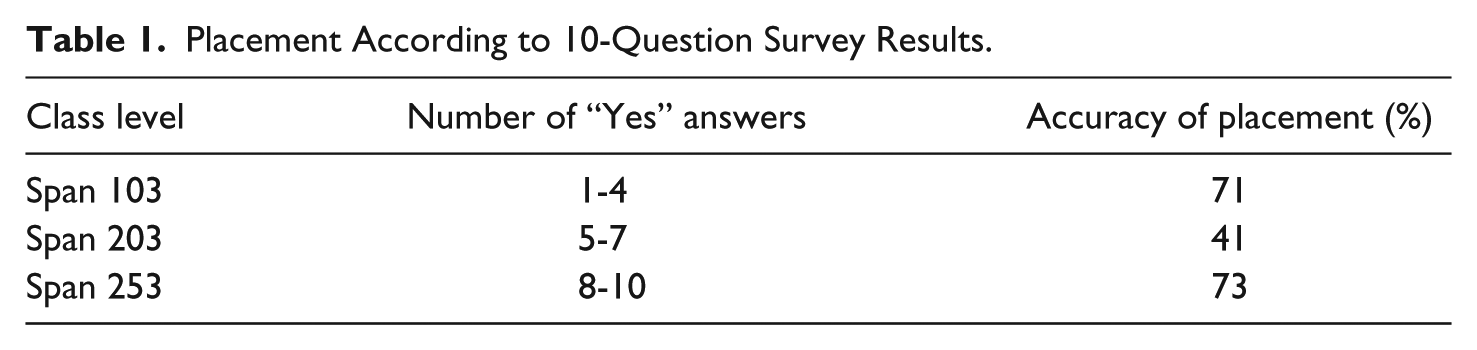
After all of the HLLs had been evaluated and assigned to a class based on their performance on the full placement exam, the initial 10-question surveys (see the appendix) were compared with the results of overall placement exam to determine whether certain domains of language use correlated with the final class placement. In the 10-question survey of language use, it was found that counting the number of “yes” answers by the students had some degree of accuracy in the placement of low-level and high-level HLLs. When the students answered “yes” 1 to 4 times, this correlated to their accurate placement into Span 103, as determined by the placement exam, more than 71% of the time. Placing the HLLs into Span 203 was more difficult considering only the domains of language use. When students answered “yes” 5 to 7 times, the results using just the survey only placed them with 41% accuracy when compared with the placement exam. The rest of the students of this level were evenly divided between the other two levels based on the number of affirmative responses. However, when the students answered “yes” 8 to 10 times, this correlated to their accurate placement into Span 253, as determined by the placement exam, more than 73% of the time. Results showed that the use of a simple survey of the domains of language use accurately placed many of the heritage learners at the upper and lower levels. The refinement of such an instrument could lead to a higher level of accuracy in placing HLLs and could be used as a quick and efficient instrument for placement given that the current instrument would misplace almost a third of the students. Table 1 shows the percentage of students who could have been accurately placed by simply using the number of affirmative responses to the 10-question survey on the domains of language use as compared with the results from the placement exam, which included multiple sections to evaluate overall proficiency.
Placement According to 10-Question Survey Results.
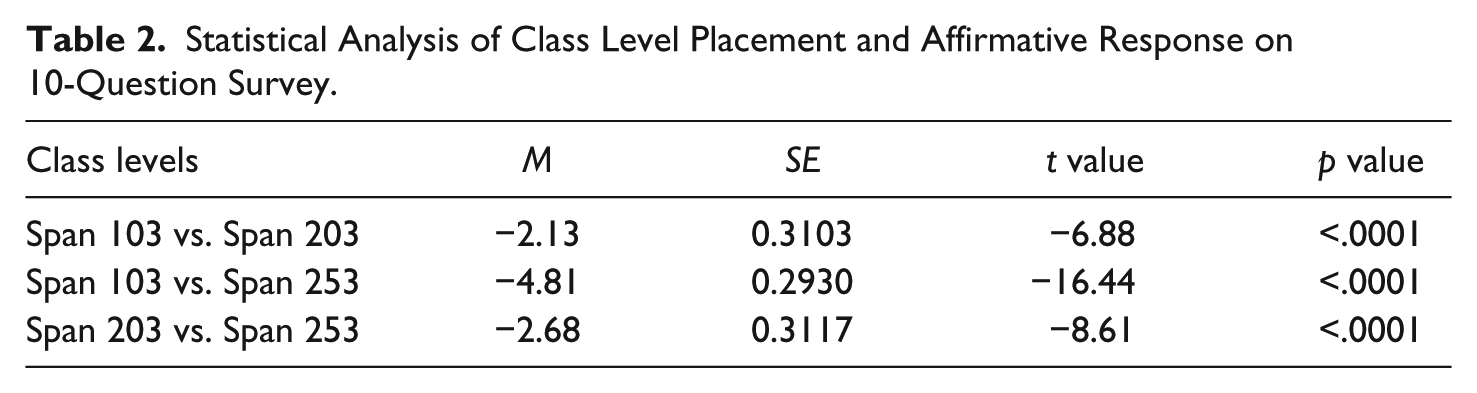
An ANOVA with post hoc Tukey pairwise comparisons was used to determine whether a significant difference existed between levels based on the totals from the 10-question survey. The results showed that for all three groups there was an F value of 135.54 and p < .0001. When comparing Span 103 with Span 203 and Span 253, the mean score was 3.55 with a standard error of 0.2062 and p < .0001. When comparing Span 203 with Span 103 and Span 253, the mean score was 5.68 with a standard error of 0.2320 and p < .0001. When comparing Span 253 with Span 203 and Span 103, the mean score was 8.37 with a standard error of 0.2083 and p < .0001. The mean in the aforementioned statistics is the average number of affirmative responses. Table 2 shows the comparison of the different class levels based on final placement and number of affirmative responses to the 10-question survey. These data show how the domains of language use between the different levels varied significantly across all classes.
Statistical Analysis of Class Level Placement and Affirmative Response on 10-Question Survey.
Discussion
Because many institutions do not have placement exams for HLLs, the need exists for the development of placement exams that are accurate in their placement, simple to evaluate, and are easy to administer to large numbers of students. Placement exams need to include not only an evaluation of the linguistic ability of the students but also the domains of language use. This study shows how the use of a simple 10-question survey on the areas where languages are spoken and heard as well as the interlocutors with whom different languages are used can be an indicator of proficiency and used as such for placement. According to the data from this study, the use of the 10-question survey accurately placed more than 70% of the students for the Span 103 and Span 253 levels. This is relatively accurate for a short instrument but still misplaces around 30% of the students. The accuracy of the placement of the students for Span 203 was less than 50%. Although this level of placement is not sufficiently accurate for most programs, the post hoc investigation into the answers on the 10-question survey revealed that a more concise instrument may be effective in heritage learner placement, especially in schools where limited resources would not permit a more elaborate exam. This is supported by the fact that although the accuracy was not where it needed to be, there were significant differences between all of the class levels regarding their use and exposure to Spanish on the 10-question survey.
An analysis of the results revealed different patterns of language use within the HLLs’ social networks that were then reflected in their overall proficiency. One can see in Figure 1 a progressive development from Span 103 to Span 253 where each subsequent level shows a greater number of answers of “yes” on every question meaning more direct use of Spanish and more exposure to the language. Part of the difficulty in placing the Span 203 students is due to the fact that they have skill sets in both the higher and lower levels, and they are exposed to and use Spanish with greater variation than the other levels tested. The 10-question survey would need to be refined through more research to determine whether or not it could be used to place students with a greater degree of accuracy, especially at the Span 203 level. One way to possibly improve accuracy would be to lengthen the survey so that more questions that distinguished between the different levels are used to place the students. Another possibility would be to substitute the yes/no questions with a scale from 0% to 100% where the HLLs would put the degree to which each of the questions is a “yes.” This could also be done with a Likert-type scale for each question where HLLs could choose their level of agreement with each question. In addition, more questions could be added, such as “Student’s age when Spanish was spoken in the home,” “Time in student’s life when Spanish was used,” and so on. These questions would give a better idea of when their use and exposure to Spanish occurred in the students’ lives. It is possible that some of these activities took place during a certain period in the HLL’s life but not in the recent past. This might help in the accuracy of the placement of the HLLs.
Further research could also determine whether accuracy could be increased, especially for the intermediate level HLLs, through the previously mentioned means, while still maintaining a placement exam that is easily graded and administered. This is especially important because many programs do not have the resources (time and money) necessary to evaluate complex instruments. Given the significant differences found between these groups of HLLs, it seems that the development of a more specific and refined instrument would be able to increase the accuracy of the placement of HLLs.
Conclusions and Future Research
It was found in this research that greater understanding of the domains of language use offer valuable insights into understanding the proficiency and placement of HLLs. The rationale for this study began with the need for more research in the development of heritage placement exams that accurately place HLLs (Beaudrie, 2012). Although many institutions have developed instruments and more research has been forthcoming, 1 there remains a need for more empirical data about proper placement and students’ success after placement (Beaudrie & Ducar, 2012). There is also a need to develop better instruments to place these students in the proper level. However, as such instruments are beginning to be implemented in different HL programs, studies measuring the success and accuracy of the instruments need to be conducted (Wilson, 2012). Overall, the goal is to better address the needs of HLLs through more accurate placement in the classroom and a greater understanding of their language abilities.
Research into placement exams also benefits other areas, such as curriculum development to assist those who have HLLs in the FL classroom. Programs with HLLs can benefit from studying the types of errors and writing styles of these learners to incorporate the necessary pedagogy into their classes. Schools that do not offer heritage language classes can use placement exams to help HLLs in the FL classroom by designing activities that can help these learners progress and develop greater language skills.
Analyzing and deciding an HLL’s aptitude can be a difficult task because the HLL’s proficiency and the settings in which he or she grows up vary greatly. Some students are taught to read and write their HL from a very young age; others are merely able to verbally communicate with their family members. Yet others are unable to communicate in their HL beyond the level of a 5-year-old when they are expected to start school and learn English so they can succeed in the American school system. Proper test development should take all of these factors into account when deciding a student’s placement. When creating a test, knowing how HLLs use their language outside the classroom can help one to understand which areas are best to focus on. Many researchers suggest that placement exams need to be developed locally to address the abilities and needs of the heritage population that resides in a certain geographical area as well as the curricular design of individual programs (Beaudrie & Ducar, 2012; MacGregor-Mendoza, 2012; Potowski, Parada, & Morgan-Short, 2012). Research is needed to confirm whether a placement exam could be developed to accurately assess the level of proficiency of HLLs from different parts of the United States. Although a wide range of U.S. Spanish is used throughout the country, are there certain features that could be tested to place students into a level of proficiency such as the heritage speakers’ language use within their social networks, along with certain lexical and grammatical characteristics?
Placement exams only work if students are followed after the placement to see whether they are in the best class for them. Because the students in this study were not followed to see whether the accuracy of initial placement works, a longitudinal study into the success of the students would have been beneficial. Future research should follow HLLs who have taken placement exams to determine whether placement was accurate and students were successful where they were placed (Beaudrie & Ducar, 2012). Too often, exams are developed and students are placed but little follow-up is conducted to determine the success of the placement by measuring students’ success.
Future research also needs to see how proper placement influences the retention of HLLs, not only in the language classes but also in other disciplines. Hispanics are continuing to enroll in colleges and universities at an increasing rate. In the fall of 2012, more Hispanics who graduated from high school, many of whom are HLLs, enrolled in universities (69%) than non-Hispanic Whites (67%) who graduated (Fry & Taylor, 2013). Despite these increases in enrollment, these students are still more likely not to graduate than their non-Hispanic White peers (Fry & Taylor, 2013). Proper placement can address some of these concerns and lead to increased satisfaction as well as assist in creating a more supportive environment in the HLLs’ language classes. Proper placement would not be the only factor in student success and failure, but it could definitely provide students with a better chance for success. It would also be useful to compare how traditional foreign language students compare with HLLs on similar types of placement exams. Many non-heritage learners initially were placed into the section to take the heritage placement exam. Did those students who answered “yes” on a certain number of questions have some of the same linguistic background as heritage speakers, or did they simply live in communities where they are more likely to be engaged in certain linguistic behaviors?
Finally, because more HLLs are being exposed to formal instruction in high school, what is the influence of high school classes on language production and use among HLLs? Are these students changing their linguistic behavior because of these classes or is their language fossilized to some degree? These are some of the questions that are currently being addressed and need further study as researchers continue to make great gains in the area of HL placement. While further research is needed to address the needs of many different speakers and communities, continued efforts to develop better placement instruments by schools and teachers alike will lead to greater success in this area.
Footnotes
Appendix
Declaration of Conflicting Interests
The author declared no potential conflicts of interest with respect to the research, authorship, and/or publication of this article.
Funding
The author received no financial support for the research, authorship, and/or publication of this article.