







Abstract
Hispanic-serving institutions (HSIs) should realign their organizational approach in order to liberate themselves and their students. As colonized institutions enrolling colonized people, HSIs must recognize their history of colonialism before moving toward an organizational model grounded in decolonization. The Organizational Framework for Decolonizing HSIs has nine elements and is grounded in organizational theory, yet it challenges the white normative ways in which postsecondary institutions have been studied and the models that have been used to organize them.
Hispanic-serving institutions (HSIs), defined as nonprofit, degree-granting institutions that enroll 25% or more full-time equivalent undergraduate Raza 1 students, now enroll over 60% of all college students who identify as Raza, and confer 60% of all associate’s degrees and 40% of all bachelor’s degrees to this group (Cunningham, Park, & Engle, 2014, Excelencia in Education, 2016; Harmon, 2012). But as HSIs increase in significance, there is continual pressure to define what it means for postsecondary institutions to be “Hispanic-serving.” This article calls on scholars and practitioners to consider this question through a lens of decolonization, more specifically, through the lens of “coloniality of power” that began with the conquest of Latin America by European forces, yet continues in modern times as seen through the political, economic, and social subjugation of racially, culturally, and ethnically minoritized people (Quijano, 2000, 2007). Arguably, this coloniality of power is what plagues HSIs, inhibiting their ability to fully serve Raza students from enrollment through graduation. In proposing an organizational framework for HSIs that is grounded in decolonization, this article calls on HSIs to organize for the empowerment and liberation of racially minoritized students.
An organizational framework specifically for HSIs must recognize that they are institutionally diverse and have a variety of missions. What most have in common, however, is that serving Raza students is not the historical mission of these institutions. Instead, HSIs must actively embrace what it means to liberate Raza students alongside their historical organizational mission. Continuing to operate as they have traditionally done so, with little regard for the racial and cultural ways of knowing of Raza students, is negligent on their part. This article offers an organizational framework that recognizes that Raza, as a colonized people, are subjected to educational domination as a result of their position within modern society. This framework is designed to work with any institution that is committed to the liberation of Raza, regardless of type (2-year or 4-year), control (public or private), or mission (e.g., research, liberal arts, religious). Suggestions are offered for reorganizing and transforming priorities, practices, and processes, with the goal of disrupting the historical values espoused by institutions of higher education, and instead focusing on organizational approaches that are Raza centric, or considerate of the unique needs and ways of knowing of Raza people.
Why Decolonize HSIs?
A call to decolonize HSIs is grounded in the history of colonization in the United States system of higher education, which is politically and economically tied to the transatlantic slave trade and indigenous genocide (Wilder, 2013). The term “decolonization” is not used in the literal sense to call for the repatriation of indigenous land and life, as suggested by Tuck and Yang (2012), but rather as a term that recognizes the “colonial matrix of power” that is grounded in historical coloniality and operates in four realms of modernity, including economic, political, civic, and the epistemological realms (Cervantes & Saldaña, 2015). From this perspective, coloniality, much like white 2 supremacy, is a system at play within all aspects of modern day U.S. society.
The argument to decolonize HSIs is also supported by the fact that the coloniality of power is intertwined with race, as colonization allowed for the subjugation of conquered groups based on a false assumption of biological and hierarchical differences by race (Quijano, 2000, 2007). Chicanx scholars have specifically used the theoretical term “mestizaje” to describe the racial and cultural mixing that resulted from historical exploitation, subjugation, and dehumanization of indigenous people in Latin America (Pérez-Torres, 2006). This call to decolonize HSIs, therefore, is grounded in race and acknowledges that the identity of Raza people in the United States is connected to colonization and continues to subjugate Raza people in modern day as a result of a systemic racial order in the United States (Hernández, 2016).
The process of racialization has led to the exclusion of Raza people along the entire educational pipeline. A racial caste system resulting from the forces of colonization subjected mestizos, or those of mixed Spanish and Indian heritage, to the lowest levels of society (Menchaca, 2008) and forced them into mission schools, which were intended to rid them of their culture, politics, and economy (MacDonald, 2004). Between 1513 and 1821, access to education for Raza was determined by skin color, race, ethnicity, and national origin (MacDonald, 2004). The end of the Mexican American war in 1848, ratified by the Treaty of Guadalupe Hidalgo, solidified a long history of exclusion of Raza from all levels of education in the United States (MacDonald, 2004; Menchaca, 2008). At the postsecondary level, exclusion dates back to the founding of the United States system of higher education in 1636, when access was limited to most, regardless of race (Cohen & Kisker, 2010). Yet, egregious race-based educational practices have undeniably limited access to higher education for racially minoritized groups and have hindered institutions from effectively serving them.
The negative effects of colonization can be seen in segregated schooling patterns and exclusionary policies for Raza students. Although little has been written about the participation of Raza students in higher education prior to World War II, racial segregation at the primary and secondary levels limited Raza students’ access to postsecondary education. Unlike the de jure segregation that Black Americans experienced based on race, Raza children were discriminated against based on unwritten policies related to language, standardized tests scores, and personal hygiene (G. G. González, 2008; MacDonald, 2004). At the postsecondary level, policies such as the Servicemen’s Readjustment Act of 1944 (GI Bill) also had limited democratizing power for Raza (Muñoz, 2007).
Raza began to push for equity at the postsecondary level in the 1960s, as leaders of the Chicano and Puerto Rican movements fought for culturally relevant curricula, equitable admission programs, and Raza faculty (Muñoz, 2007). Despite the success of youth movements at advocating for increased access to higher education for Raza students, Acuña (1988) posited that the movement died by the end of the 1970s, with university administrators lessening their commitment to Raza students. Although large strides have been made in creating opportunities for Raza students, they continue to be underrepresented at every level of the educational pipeline and have low representation in 4-year universities, are concentrated in 2-year community colleges, and have low transfer and graduation rates (Cuádraz, 2005; Solórzano, Villalpando, & Oseguera, 2005; Solórzano & Yosso, 2000). Research also shows that Raza students often experience unwelcoming environments at historically white universities (Yosso, Smith, Ceja, & Solórzano, 2009). These realities are the remnants of the coloniality of power and the historical exclusion of Raza from education.
When HSIs gained federal recognition in 1992, it was a victory for Raza students. Educational leaders and advocates fought a long battle, starting in 1979 with the Hispanic Higher Education Coalition’s (HHEC) testimonies during the reauthorization hearings for the Higher Education Act (Valdez, 2015). With a commitment on behalf of the federal government to invest in institutions that enrolled a large percentage of Raza students, a small effort was made to address previous educational injustices that had long-term implications for these students. Yet, HSIs are still failing to produce equitable outcomes for Raza students (Contreras & Contreras, 2015; Contreras, Malcom, & Bensimon, 2008). Arguably, the coloniality of power must be recognized before HSIs can reconcile the patterns of oppression and exclusion that have kept Raza students on the margins at the postsecondary level.
Theoretical Foundation
There is a void within organizational theory that centers antiracist approaches and decolonizing ideologies. Sociologists and organizational behaviorists have been theorizing about organizations for decades, dating back to Max Weber’s work on organizations as bureaucracies, and Frederick Winslow Taylor’s ideas about scientific management. These early scholars laid the groundwork for organizational theory, with their ideas about organizations continuing to be relevant nearly 100 years later. Some of the most developed, tested, and disputed theories of organizations include environmental theories, such as resource dependence theory, population ecology theories, and institutional theory; theories of organizational culture and organizational identity; and social movement theory (Garcia, 2015a). Yet these theories are nearly void of coloniality and race, likely because they were developed within white organizations (often postsecondary institutions) where colonial mentality and whiteness is normative, rarely questioned, and regularly performed (Cabrera, Franklin, & Watson, 2017). Arguably, the most effective way to study HSIs is through an organizational lens, particularly as a way to encourage HSIs to “take social action in order to dismantle racist structures and discriminatory policies that continue to plague students of color in the postsecondary pipeline” (Garcia, 2015a, p. 93). This article draws from some of the most common organizational frameworks used in higher education, including bureaucratic, political, cultural, collegial, and anarchical (Birnbaum, 1988; Manning, 2013). Within each of these approaches, theorists have laid out various dimensions, including authority, goals, decision making, ways of operating, division of labor organization, span of control, and staffing (Manning, 2013). Less attention has been given to alternative approaches to organizing, including those that are grounded in race and coloniality.
Chesler, Lewis, and Crowfoot (2005) proposed a framework for organizing antiracist postsecondary institutions. The framework includes eight distinct dimensions to be used to assess various stages of the institution’s antiracist development including mission, culture, power, membership, climate, technology, resources, and boundary management. The authors argue that even as organizations progress toward becoming antiracist, they often reinforce white hegemonic values and undermine any attempt to achieve racial equity within the organization. As such, these dimensions must be considered as important ways to disrupt whiteness within the organization. A second model is the Multi-Contextual Model of Diverse Learning Environments (MMDLE), which is a useful approach for understanding postsecondary organizational structures that center on the experiences of people of color (Hurtado, Alvarez, Guillermo-Wann, Cuellar, & Arellano, 2012). Hurtado and colleagues highlight three organizational dimensions to consider in an attempt to achieve equity in educational outcomes for racially diverse people including compositional, historical, and organizational. Both of these models were useful in developing a framework for organizing HSIs.
Postcolonial organizational theories, although nearly as uncommon as race-centric frameworks, are also growing in popularity within organization studies. As noted by Prasad (2012), postcolonial organizational scholarship,
is firmly rooted in the recognition that the Western discourse of management—broadly understood here as an evolving set of interdependent and mutually reinforcing networks (of ideas, institutions and practices) that ongoingly (re)-produce Western management “knowledge” as well as Western management practices/institutions—is deeply complicit with the discourse of modern Western colonialism and neo-colonialism. (p. 21)
Postcolonial organizational theory has been used in the last few decades to critique Eurocentrism and to challenge and reorient dominant organizational perspectives, particularly within management (Prasad, 2012). In higher education, there is also a growing body of research that uses decolonization as an organizational framework, particularly within Canadian institutions (Battiste, Bell, & Findlay, 2002). Battiste et al. (2002) proposed eight organizational dimensions for addressing the need for recognizing indigenous knowledge within postsecondary education, including (a) relationship with elders, (b) ethical guidelines, (c) educational materials, (d) sui generis (distinctive citizenship) curriculum, (e) critical indigenous mass, (f) dialogues and networks, (g) indigenous resistance, and (h) coda (recognition and teaching of Indigenous knowledge). These ideas were also incorporated throughout.
Organizational Framework for Decolonizing HSIs
Grounded in an ideology of decolonization and antiracism, the Organizational Framework for Decolonizing HSIs is a way to effectively fulfill the mission and purpose of “serving” Raza students (and all racially minoritized students) at HSIs. The framework is holistic and addresses both internal and external aspects of the institution.
Purpose
The first dimension is purpose. Although postsecondary institutions, administrators, and legislators spend a significant amount of time talking about “outcomes,” with this framework there is a shift to overall purpose, which may or may not include traditional outcomes. This approach resists graduation and degree completion as the only legitimized outcomes, assuming that the organization should fulfill other purposes, including enhancing members’ racial and cultural understanding of self and others (Garcia, 2016, 2017). In assuming an organizational identity that values Raza people, decolonized HSIs should work toward the advancement of knowledge related to understanding the racial and cultural history, values, languages, epistemologies, and methodologies of people with indigenous roots in the colonized Americas.
Decolonized HSIs should work toward the development of critical consciousness and democratic participation, with a specific focus on the development of reflective (Anzaldúa, 2002) and/or oppositional consciousness (Sandoval, 1999). Moreover, they should work toward the overall holistic development of students, which may include advanced academic self-efficacy (Cuellar, 2014), civic engagement ( R. G.González, 2008), or the development of racial/cultural identity (Garcia, Patrón, Ramirez, & Hudson, 2016). Although the institution’s purpose should shift from purely academic outcomes to more holistic endeavors, it should continue to be concerned with academic progress, incorporating multiple indicators, including the attainment of a degree, the completion of a certificate, successful transfer to another institution, and single-term course completion.
Mission
The second dimension is mission, which is grounded in antiracist, anti-oppressive, decolonizing ideologies. Much can be learned from Tribal Colleges and Universities (TCUs), as they teach cultures and languages of Indian nations, preserve and revitalize Native culture, and respond to and empower Native communities (Guillory & Ward, 2008). Decolonized HSIs should do the same, centering the experiences of Raza people in the curriculum and within the classroom, with the goal of fulfilling the purpose of promoting racial and cultural understanding. Moreover, the mission of the institution should be to sustain the environment, recognize the land as originally inhabited by indigenous peoples, and revitalize the local community. Although HSIs are different from TCUs, in that a majority of TCUs are located on tribal lands, HSIs tend to be situated within communities that are predominantly Raza. A core mission of the institution, therefore, should be to work with and for local communities. This includes working for and promoting equitable educational, health, and legal outcomes in these communities.
Membership
The third dimension, membership, is grounded in an ideology of racial and cultural mixing (i.e., mestizaje), not with the intent of erasing difference or assimilating members, but instead with the intent of valuing and respecting all ways of being and knowing. Despite the designation of HSIs being entangled with the Raza identity, decolonized HSIs should not be exclusionary spaces. Quite the opposite, members should be from various racial, ethnic, cultural, national, and religious backgrounds and united by their desire to disrupt dominant structures such as white supremacy, patriarchy, heteronormativity, Christian dominance, and racist nativism.
Membership includes students, faculty, staff, alumni, trustees, and community partners who must believe in the mission and work toward the purpose. Students, therefore, shall be admitted based on their desire to learn about the race and culture of colonized people now living in various parts of the Americas. Students should also have a desire to learn with and from diverse communities while working toward the enhancement of local communities and the promotion of equitable outcomes for minoritized groups. This has nothing to do with academic training, as indicated by historically oppressive indicators such as high school grade point average (GPA) and standardized test scores, but rather is determined through admissions methods that are holistic and allow students to highlight their desire to work toward liberation. Faculty, staff, and administrators, similarly, should be hired based on their ability and knowledge to work toward the decolonization of the institution and the liberation of Raza and other minoritized students.
Importantly, this framework calls for the inclusion of alumni, trustees, and community partners. Although these members are essential to all postsecondary institutions, their role is missing from the current scholarship on HSIs, and may be missing from organizational conversations within practice at HSIs. With the continual decrease in state and federal support for institutions of higher education, HSIs must develop a plan for engaging alumni, philanthropists, foundations, and community partners (Drezner & Villareal, 2015). Moreover, like the people hired to work at HSIs, those appointed as trustees must be committed to the ideals of decolonization and antiracism.
Technology
The fourth dimension is technology, which includes all inputs, or forms of delivery, that lead to the intended purpose, mission, and outcomes of the organization. This may include curricular and cocurricular options that are centered on the racial and cultural ways of knowing of Raza, decolonized pedagogical approaches, and anti-oppressive policies and practices for educational delivery. This is an essential dimension, as nearly all members interact with, experience, develop, and/or deliver the curriculum, pedagogy, or services of the institution. There are numerous examples of how these practices are being transformed at HSIs (e.g., Garcia & Okhidoi, 2015; Cervantes, 2015; Martinez & Gonzales, 2015; Núñez, Murakami-Ramalho, & Cuero, 2010). And although many have called for “culturally relevant practices” in HSIs, here the call is for decolonized curricular, pedagogical, and support services, falling in line with a critical lens and with the purpose of liberating Raza.
In recognizing that curricula and pedagogy have historically been used as tools for colonization, meaning they have always been intended to “Americanize,” assimilate, and acculturate those from minoritized background (de los Ríos, 2013), decolonized HSIs must aim for technological practices that are grounded in principles of liberation. This means that the curriculum, or what is taught, should center the experiences of racially minoritized people, including their history and current state of oppression, while privileging their ways of knowing. This is challenging considering that only 2% of the courses being taught at HSIs are centered on a racial/ethnic experience (Cole, 2011) and often times, this type of curriculum is limited to ethnic studies programs (Garcia & Okhidoi, 2015). Within a decolonized HSI, all courses and all departments across the institution, including those within the social sciences, natural sciences, humanities, education, social work, arts, engineering, computer science and so on, should utilize books, address topics, and teach histories that are racial/ethnic centric. Within the classroom, students should be encouraged to explore their own identities, resist oppressive structures, and engage with their communities with the goal of consciousness development (de los Ríos, 2013).
Governance
The fifth dimension is governance, which has been an essential concept for postsecondary institutions since their founding. Depending on who is defining it, governance may encompass several different elements, including rules, authority, and decision-making processes within the institution (Austin & Jones, 2016). In this framework, governance is centered on authority, decision making, and organizational structure, while “rules” are considered separately as community standards. Drawing on concepts of indigenous governance, a decolonized HSI shall be theoretically rooted in pluralism and integrity, rather than sovereignty and self-determination, which are legal terms that may not be necessary at the organizational level (Reilly, 2006). Pluralism, instead, refers to authority and decision making both at the micro-level and a macro-level of the organization.
Governance within a decolonized HSI includes the rejection of centralized reporting structures, bureaucratic hierarchies, and single authority. More specifically, there should be a rejection of the power structure that dominates most institutions of higher education, with decision making falling into the hands of mostly white men who base their leadership practices on white normative standards (Ledesma & Burciaga, 2015). Instead, leadership and authority are shared, decentralized, and evenly distributed. There is intentionality in ensuring that those who have been historically marginalized within power structures are granted full access to leadership and decision making, including Raza and other minoritized groups (e.g., women, queer, indigenous). This is essential, as there is evidence that Raza-identified people are missing within the faculty and administrative ranks of HSIs (Gonzales, 2015; Ledesma & Burciaga, 2015).
At the micro-level of the organization, there shall be autonomy in decision making, policies, and structures. This type of governance structure may be most conducive to postsecondary institutions, as they are typically decoupled or loosely coupled, meaning that micro-level aspects of the organization often work toward different goals and means (Weick, 1976). With this organizational approach, this type of governance is valued and reinforced, meaning that individual programs and departments are given the autonomy to determine their own purpose, goals, and outcomes, while simultaneously working toward the antiracist, decolonized mission of the university. Even further, at the micro-level, there is autonomy in determining the best approaches for liberating Raza people within the organization.
Community Standards
Rather than rules, the sixth dimension is community standards, which are dynamic and fluid. In a decolonized organization, members develop rules, regulations, and policies as needed to protect the community and to progress as a community. Community standards are complimentary to the decentralized governance structure in that standards can and should be created by multiple people within the organization, including students, faculty, and staff. The community standards should be grounded in the mission and purpose of the institution, with the goal of liberation, democratic citizenship, and critical consciousness. By including all members in the development of standards, the desired outcomes include civil integrity, involvement and ownership of the community, moral and intellectual development of those involved, and utilization of alternative methods for conflict resolution and accountability (Illsley, 2000).
Justice and Accountability
The seventh dimension has to do with justice and accountability within the community. The idea of justice is grounded in a restorative process, which is growing in popularity within K-12 schools, and should be considered within a postsecondary setting. Restorative justice practices are centered on relationship building, social networking, personal responsibility, and community restoration (Macready, 2009; Teasley, 2014). Moreover, restorative principles include seeing all members of the community as valuable contributors, resources, and learners capable of problem-solving and developing socially, emotionally, spiritually, and educationally through a restorative justice process (Ashworth et al., 2008). There is evidence that these practices are effective in school environments that enroll large percentages of racially minoritized students, as an alternative to punitive practices often used with these populations (Ashworth et al., 2008). Within a decolonized HSI setting, justice and accountability should be grounded in similar principles, leaving these elements of the organization to community members in a decentralized, communal way. When people are harmed within the community, the leaders within the community must facilitate networking and shared learner, with the goal of healing the community, rather than criminalizing people who may have harmed others. Restorative justice practices may be used as alternatives to judicial hearings, academic hearings, and other hearings in which people are held accountable for their actions as members of the community.
Incentive Structure
The next dimension is the incentive structure. Incentives should advance the mission and purpose of the organization, which is to develop all members into critically conscious, democratic participants working in solidarity for the advancement of the internal and external community. As such, within a decolonized HSI, people shall be rewarded for acting in ways that fall in line with the other elements of the framework. For all faculty, staff, and administrators, tenure, promotion, and advancement should be determined based on progress and commitment to admitting and enrolling a diverse group of people, providing an educational environment that is decolonized, and working toward the enhancement of people’s racial and cultural ways of knowing. Incentives are not grounded in individualism and personal advancement. With extensive knowledge on the negative experiences of faculty and staff of color (Mayhew, Grunwald, & Dey, 2006; Turner, González, & Wood, 2008), even within HSIs (Garcia, 2015b), the incentive structure must be created with the goal of retaining the diverse group of people within the organization. This includes valuing scholarship that is grounded in racial/cultural methodologies, evaluating teaching based on decolonized approaches laid out in the technology section, and incorporating service to the internal and external community, including mentoring and advising students from minoritized groups, in reward structures.
External Boundary Management
The final dimension is external boundary management, which includes the ways in which the organization works with external entities including boards of trustees, neighborhood associations, elected officials, local governments, community partners, and other HSIs. The foundational values of collectivism and community that are embedded within a decolonized organization shall extend into this final dimension. The relationship that institutions have with elected officials, local, state, and federal governments, and foundations that support their mission are essential, especially considering the reliance that HSIs have on these entities for financial stability and progress (Ortega, Frye, Nellum, Kamimura, & Vidal-Rodríguez, 2015). Moreover, HSIs must connect with the Hispanic Association of Colleges and Universities (HACU), the main organization lobbying on behalf of HSIs and their students. Other important external relationships worth considering are those with community partners and other HSIs. In building relationships with other HSIs, institutions have the ability to mentor one another, reassess their current initiatives and thinking, learn from one another, and engage in actions that are mutually beneficial (Hurtado, González, & Calderón Galdeano, 2015).
Implications and Conclusions
The Organizational Framework for Decolonizing HSIs has implications for multiple stakeholders, including students, administrators, faculty and staff at HSIs, and the communities housing HSIs (see Table 1). It calls for HSIs to recognize the effects of imperialism and the coloniality of power that has subjugated Raza students within education. It is also holistic, calling on HSIs to address recruitment and retention issues, focusing primarily on the value of racial and ethnic diversity, as well as promotion issues for administrators, faculty, and staff, calling attention to elements within the organization that are often tainted by unconscious bias toward minoritized people. It also challenges stakeholders to rethink the purpose and mission of postsecondary institutions, the role of community, the value of racial and cultural ways of knowing of minoritized people, and a decentralized approach to organizing. This type of framework will allow for democratic participation of all people, including students, administrators, faculty, staff, and external community members.
Organizational Framework for Decolonizing HSIs.
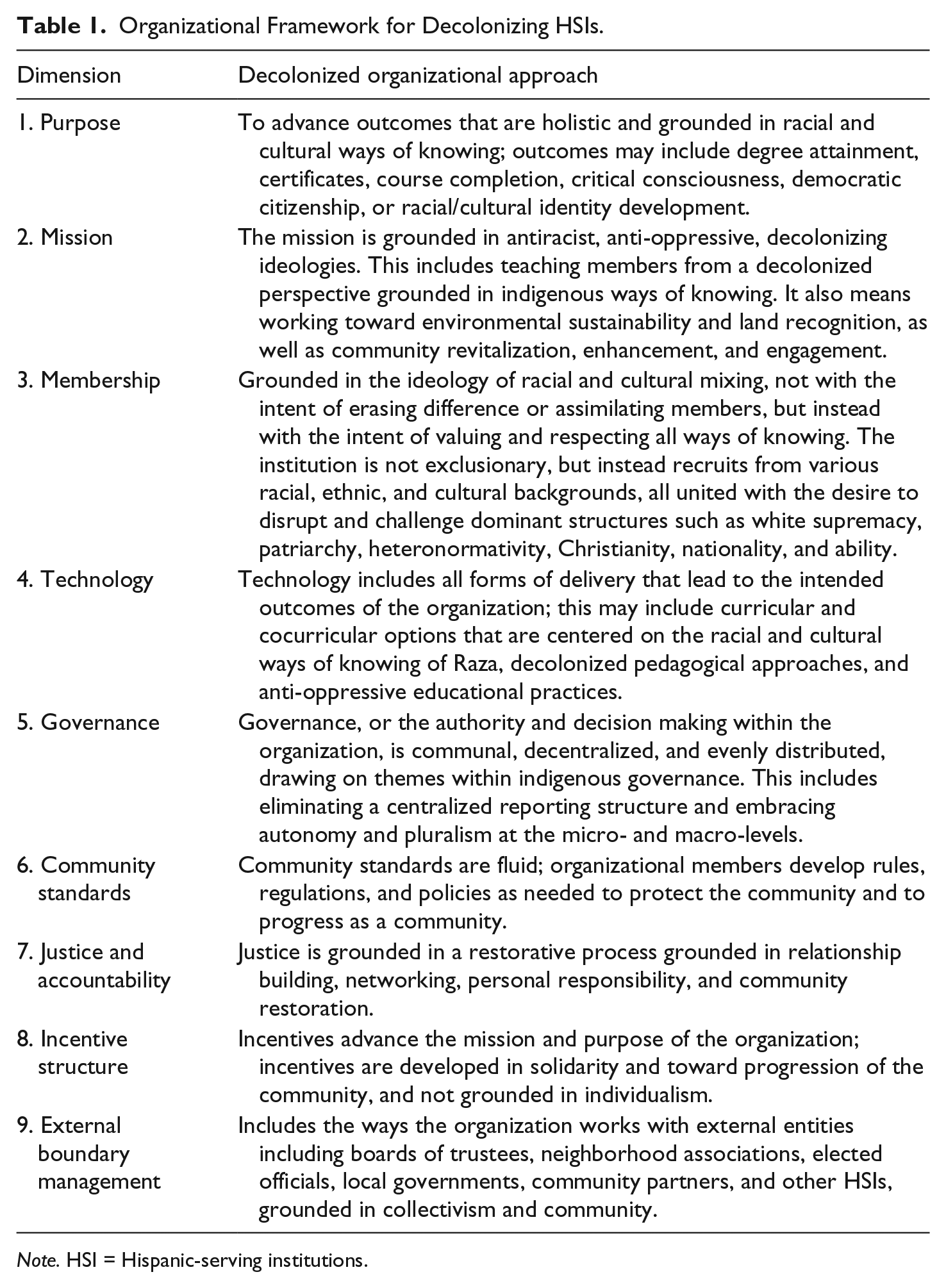
Note. HSI = Hispanic-serving institutions.
The framework also has significance to legislators at the state and federal level. As various entities grapple with the best ways to hold postsecondary institutions accountable for providing an affordable, high quality educational experience, this framework pushes them to think beyond traditional metrics of success. There are many ways for postsecondary institutions to be successful; this framework encourages legislators to allow HSIs to define what success looks like for them. In reality, as state and federal governments continue to divest in postsecondary education, HSIs may be more inclined to fully liberate themselves, without the threat of funding and regulations from external stakeholders, who may not have the interests of all students in mind.
As the fastest growing racialized group in the United States and in postsecondary education, it is essential to focus on the educational needs of Raza. Even further, there must be greater attention given to the institutions that are federally recognized as educating a large percentage of Raza: HSIs. HSIs, however, must first recognize themselves as colonized institutions, meaning they must acknowledge that they have been expected to operate and organize like white, Western institutions. Postsecondary institutions in the United States were established alongside the birth of this nation and are now accountable to state and federal governments that have a developed a set of standards based on white, Western ways of functioning. To decolonize HSIs, institutional leaders must recognize that traditional values and approaches to leading postsecondary institutions are grounded in colonization and imperialism, which is why Raza students have not reached a level of equitable outcomes. The Organizational Framework for Decolonizing HSIs presented here calls for a centering of Raza students’ histories, cultures, languages, epistemologies, and methodologies, as well as a disruption of white normative approaches to organizing postsecondary institutions. The goal of the framework is to liberate Raza people.
Footnotes
Acknowledgements
The author acknowledges the American Association of Hispanics in Higher Education for commissioning her to write this article and for providing her the space to think about the decolonization of Hispanic-serving institutions.
Declaration of Conflicting Interests
The author(s) declared no potential conflicts of interest with respect to the research, authorship, and/or publication of this article.
Funding
The author(s) received no financial support for the research, authorship, and/or publication of this article.