







Abstract
Using research focused on best practices, focus group information, and data analytics, the Title V: Focus on Student Success (FOSS) Grant created a model for the development, implementation, and evaluation of a summer bridge program. Results included increased academic performance indicators in first-year Hispanic college students. Validation for this work is based on 4 years of data at Laredo Community College, a 2-year public Hispanic Serving Community College along the Texas (United States)–México border.
Introduction
Student retention through college graduation is one of the major problems faced by all institutions of higher education. It is the mission for most colleges and universities, and it affects the reputation, the financial stability, and the viability of the institution. Consequently, a major question in higher education is, “What impacts student success?” Both colleges and universities are continuously involved in various activities to retain, transfer, and graduate students, and these meet with varying degrees of success.
Community colleges, where this research was conducted, serve as the gateway to careers or as the entry to a 4-year university. Yet, community colleges have their own set of challenges. One in five community college students transfer to a 4-year university. Of those students who transfer, 60% earned a bachelor’s degree within 4 years (Institute of Educational Sciences [IES], U.S. Department of Education, the National Center for Education Statistics, 2016). These numbers increase for those students who complete their associate’s degree before heading to a 4-year institution. Seventy percent of the transfer students who earned an associate’s degree prior to transferring to a 4-year institution earn a bachelor’s degree within 4 years compared with 54% for those who transfer before graduating.
Compared with 4-year institutions, community college retention and graduation rates are much lower. Retention rate in the studies reviewed was the percentage of first-time, first-year undergraduate students who continue (or complete) at that school the following year. At 2-year institutions, the overall retention rate for first-time, full-time, degree-seeking students was 61% compared with 74% for 4-year institutions (IES, U.S. Department of Education, the National Center for Education Statistics, 2016). In Texas, for example, 56% of students who enrolled full-time at a university graduated compared with only 18% of those who attend a community college (A Profile of State and Institutional Performance Characteristics, 2017). Community colleges enroll 38% of undergraduates and a much higher proportion of non-White, low-income, and first-generation college students. In addition, the lack of college readiness and the need for remedial education contributes to the concerns. Regardless of these limitations, community colleges must provide the academic and social preparation needed for the student success. Nuñez and Elizondo (2013) in “Closing the Latino/a Transfer Gap: Creating Pathways to the Baccalaureate” cogently and succinctly concluded that to create pathways to the bachelor’s degree, various efforts must come into play: early and sustained interventions, new methods for delivery of developmental education, and culturally relevant programs.
Literature Review
Many theoretical frameworks have been used to understand and support student retention. Tinto’s Model of Student Retention has had the greatest influence. Whether a student persists or drops out, Tinto stated that student retention can be strongly predicted by the students’ degree of academic, social, and cultural integration at the institution. Tinto’s model has been widely used to study retention in colleges across the nation; including community colleges (Tinto, 2012). Although some scholars have criticized Tinto’s model, it was used to frame this summer bridge program evaluation at a public Hispanic-serving community college. Research on student retention has been revised and expanded over the years to include demographic characteristics (and finances), academic preparation, academic engagement, and social engagement. However, institutions cannot change students’ demographic characteristics, finances, or academic preparation, but they can directly affect academic and social engagement through summer bridge programs, one of the efforts mentioned by Nuñez and Elizondo.
Research on Summer Bridge Programs
Summer bridge programs support post-secondary success by providing intensive, short-term academic and social resources while introducing college expectations and the cultural contexts of the institution. They typically are offered in the summer between high school graduation and the first term of college and vary in content, program size, and timeframe. Most involve five characteristics: an in-depth orientation to college life and resources, academic advising, academic coursework, academic support to prepare students for the rigors of college academics and college life, and social support to build strong networks among students (and faculty) to foster to a greater sense of connection to the institution (IES, U.S. Department of Education, the National Center for Education Statistics, 2016).
With summer bridge programs showing much promise, many studies have focused on their implementation, but the researchers fail to evaluate and answer some major questions: Do summer programs work? And, if so, how? Only a few studies have used evaluation techniques to answer these questions. Studies, such as Pascarella and Terenzini (2005) and Walpole et al. (2008), compared the retention rates and academic progress of summer bridge program participants. Both studies found that summer bridge participants were more likely to persist to the second year and had a higher grade point average (GPA) than those who did not participate in a summer bridge program. Cabrera, Miner, and Milem (2013) also tracked retention and persistence rates, finding that both retention (p < .05) and persistence (p < .001) for participants were significantly higher than the rates for students who did not participate in a summer bridge program. More recently, Douglas and Attewell (2014) tracked a cohort of more than 10,000 degree-seeking students and reported that students who attended bridge programs had significantly higher graduation rates and second-year retention rates than non-bridge students. Bir and Myrick (2015) also found that participants of a summer bridge program achieved significantly greater GPA, 1-year retention rates, and second-year retention rates (p < .05). These studies attest to the positive effect summer bridge programs have on academic success. However, the demographics of the target population in the studies were not predominately Hispanic. In addition, the specific components of the summer bridge programs were not shared. More research must be done to identify the specific, positive and essential components of effective summer bridge program in targeted populations such as at Laredo Community College (LCC) with a predominately Hispanic population (96%).
Research Questions
The questions that guided this research were as follows:
Definitions
Using the definitions by the National Student Clearinghouse Research Center, retention is defined as continued enrollment (or degree completion) within the same higher education institution from fall of first year to fall of second year. First-time status are students included in the study who (a) showed no previous college enrollment in the 4 years prior to entering the cohort year and (b) had not previously completed a college degree. Pass rate is defined as the percentage of students passing the gatekeeper course with a grade of “C” or better and a GPA ≥ 2.00. LCC Gatekeeper courses include English 1301 (College-Level Writing), History 1301 (Survey of American History), and Math 1314 (College-Level Algebra). Retention rate, college GPA, credit hours earned, and gatekeeper pass rates were identified in this study as academic performance indicators.
Method
The Summer Bridge
The Title V: FOSS Grant is a 5-year (2012-2017) collaborative grant program funded by the United States Department of Education and awarded to LCC, lead institution, and Texas A&M International University (TAMIU), partner institution, in fall 2012, Grant Proposal Award Number: P031S120095.
A summer bridge program, the Summer Bridge, was designed to enhance the academic quality of students’ 2-year community college experience to increase retention, completion, and graduation at the community college level. The Summer Bridge is a 2-week summer program offered approximately 2 weeks prior to the beginning of each fall semester. There have been three summer bridges from 2013 to 2015, each consisting of workshops. Workshops were 1- to 3-hr sessions conducted on specific content that followed most of the recommendations laid out by key researchers and the five key characteristics. These workshops were spearheaded by the FOSS staff, but taught by faculty with expertise in that specific course. In particular, intense, 4-hr preparatory mini-courses in English 1301, Math 1314, and History 1301 (LCC gatekeeper courses) were conducted for the purpose of exposing students to course content and course standards, and to increase faculty interaction. Gatekeeper “courses” consisted of mini-lectures, assignments, quizzes, and a final exam. Each year, the program design was modified (and enhanced) using data (prediction indicators) and student feedback. Table 1 lists all summer workshops throughout the years.
Summary of Summer Bridge Workshops throughout the Years.
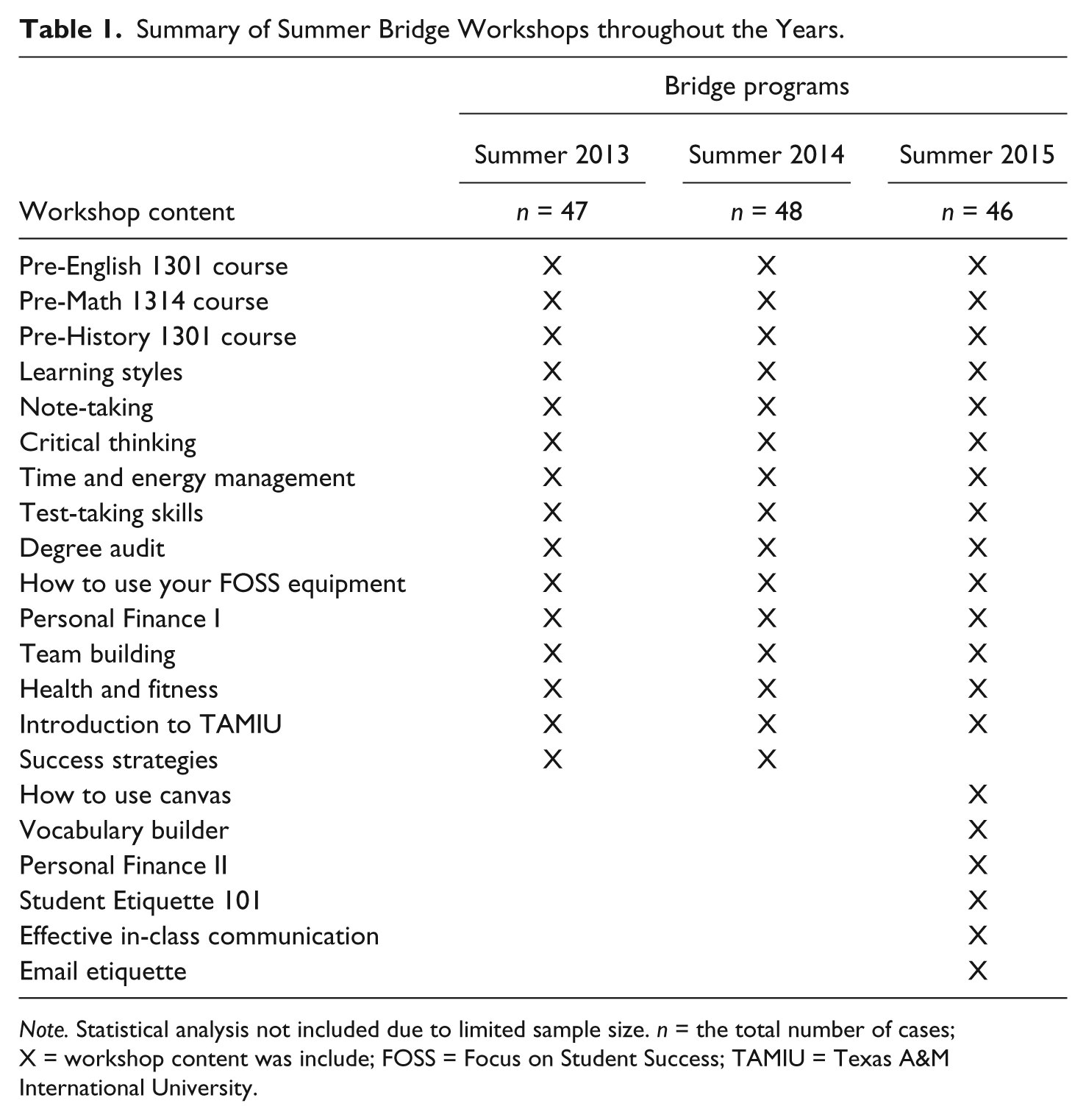
Note. Statistical analysis not included due to limited sample size. n = the total number of cases; X = workshop content was include; FOSS = Focus on Student Success; TAMIU = Texas A&M International University.
Sample
To secure the sample, graduating seniors from all local high schools were recruited through class presentations, email, telephone, and written follow-up requests. The Summer Bridge was an optional program for which students were able to self-select to participate. The requirements to participate in the Summer Bridge program were as follows: students must (a) be a first-time, full-time (enrolled in at least 12-credit hours for the upcoming fall semester) incoming LCC student; (b) complete a Free Application for Federal Student Aid (FAFSA) application; (c) be enrolled in at least one of the gatekeeper courses for the upcoming fall semester; (d) be a 4-year degree-seeking student with intentions to transfer to TAMIU; (e) have a minimum high school GPA of 2.5; and (f) complete an the interview with a staff member.
Summer Bridge participants were assigned to the intervention (treatment) group. The control group consisted of students with the same characteristics who elected not to participate in the summer bridge and received standard LCC services. The control groups were identified at random by the LCC Institutional Effectiveness Department. Each summer, students were assigned to a cohort and tracked longitudinally (up to student’s graduation). There were three cohorts (n = 141) with interventions and three control groups (n = 150) in the sample. A total sample size of 291 (n = 291) was gathered: 99% Hispanic, 63% female (and 37% male), and 90% received FAFSA awards.
Procedure
Data were collected from two sources. The FOSS Grant gathered student demographics, participation, workshop scores, bridge surveys, and enrollment information. This information was collected at the beginning of each fall semester. Data, such as targeted academic indicators (term GPA, cumulative GPA, credit hours attempted, credit hours earned), gatekeeper pass rates, retention, progression, and graduation were obtained from the student data file from the Office of Institutional Research for both the intervention and control groups. This information was collected at the end of each fall semester.
Statistical Analysis
Descriptive statistics were used to identify general characteristics of Summer Bridge participants in the sample compared with the control group. A series of t tests and propensity-matched models explored differences in groups. Analyses were conducted using the Statistical Package for the Social Science (SPSS) version 22 (2013, IBM-SPSS Inc.). A cutoff value of α < .05 was used to assess statistical significance. Throughout the research, linear equations were carried out to identify student success predictors.
Results
The main question prompting this study is whether the Summer Bridge made a difference in academic performance indicators (gatekeeper course pass rates, GPA, earned credit hours, and fall-to-fall retention rate). Students who participated in the 2013 Summer Bridge outperformed the regular semester pass rates by 21%, 13%, and 8% in History 1301, Math 1314, and English 1301, respectively. The following year (fall 2014), the trend continued. The pass rates for students in the Summer Bridge were higher than non–Summer Bridge participants and additionally increased from the year before by 14%, 12%, and 8% in History 1301, Math 1314, and English 1301, respectively. Notably, cohort 2015 had the greatest increases compared from all of the previous years. Compared with fall 2013 FOSS pass rates, students in Cohort 2015 increased 26%, 32%, and 25% in History 1301, Math 1314, and English 1301, respectively (see Table 2).
Summer Bridge and Non–Summer Bridge Outcome Statistics.
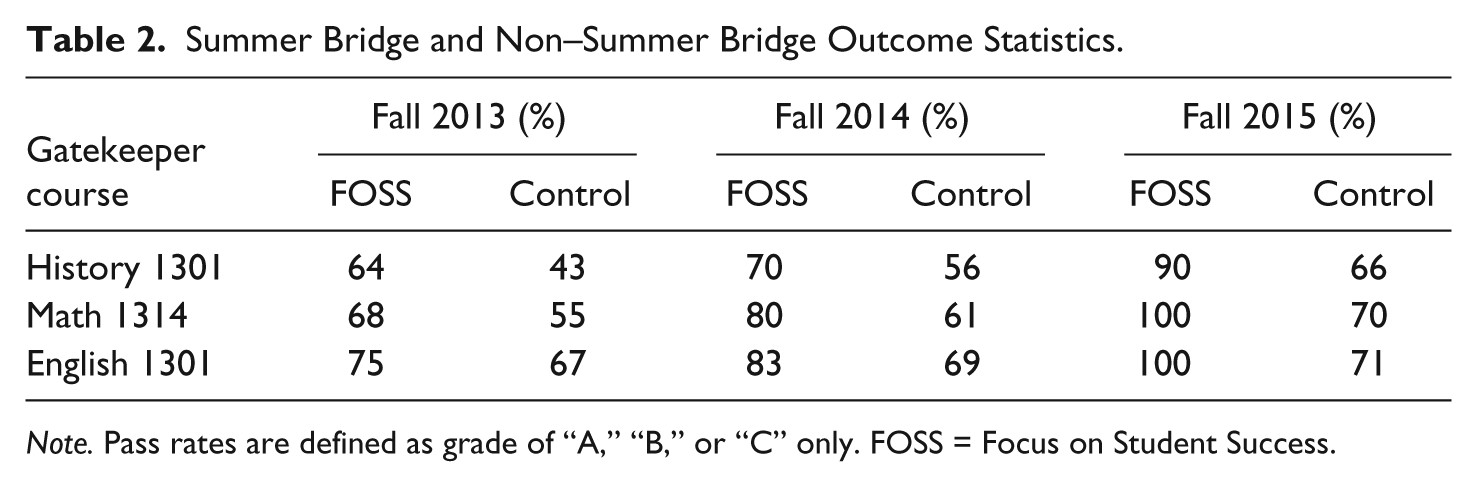
Note. Pass rates are defined as grade of “A,” “B,” or “C” only. FOSS = Focus on Student Success.
In the second stage of analysis, pass rate letter grades (“A,” “B,” “C,” “D,” “F,” and “W”) were transformed into numerical formatting using the GPA scale. The relationship between attending the Summer Bridge and not attending was examined by comparing the pass rates in gatekeeper courses GPA, term GPA, earned credit hours, and fall-to-fall retention for each cohort. Cohort 2014 and 2015 had significantly higher pass rates for English 1301, Math 1314, and History 1301, higher semester GPA, and greater earned credit hours. The fall-to-fall retention rate for cohort 2015 was also found to be significantly higher (Table 3).
Academic Outcome of Summer Bridge Students Compared With Control Group.
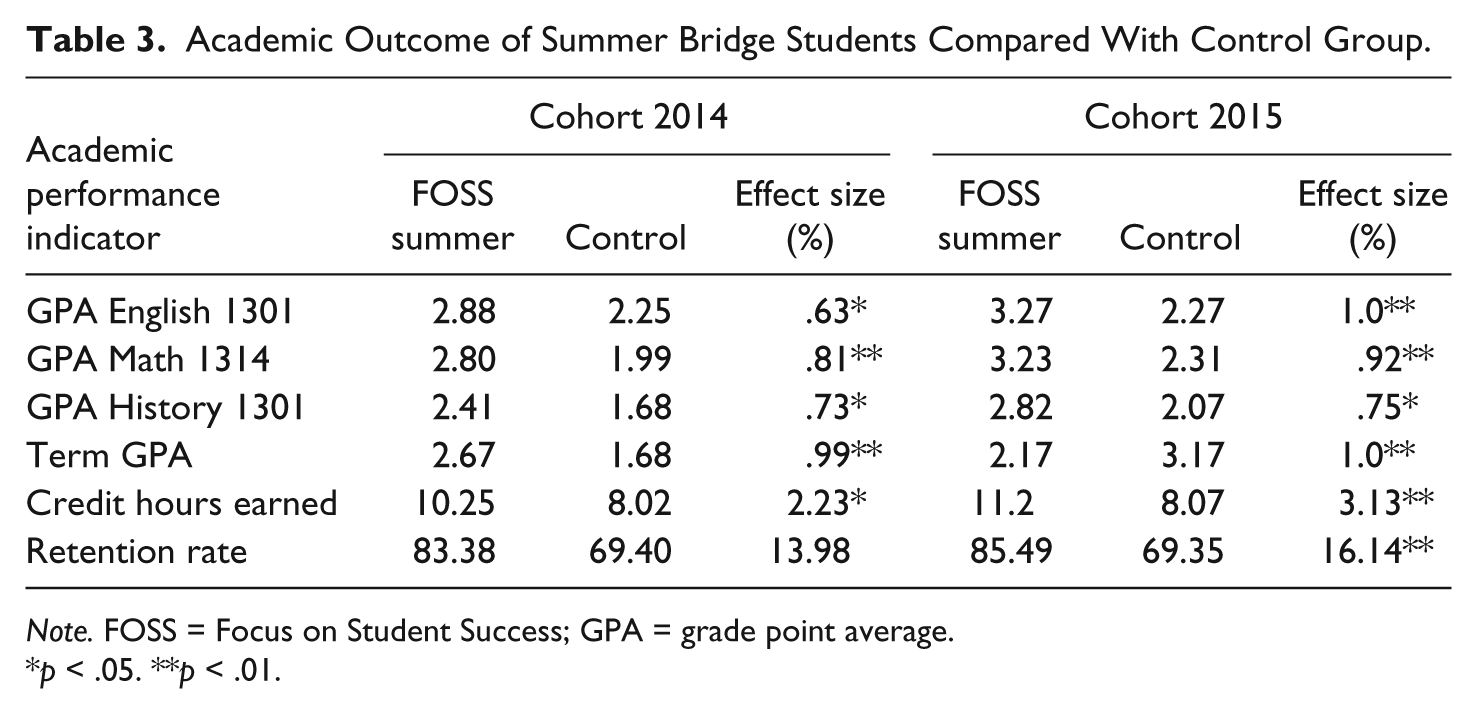
Note. FOSS = Focus on Student Success; GPA = grade point average.
p < .05. **p < .01.
Discussion and Implications
The 2013 Summer Bridge generated positive results in that pass rates for the gatekeeper courses for the first cohort exceeded the pass rate for the control group and the overall pass rate in the three gatekeeper courses for the college overall. It was the first Summer Bridge program, and it was carried out with well-intentioned and well-thought-out plans and activities. Subsequently, the authors were prompted to perform a review of the results with an eye to identifying the specific components of the summer program, which contributed to its success. There were two goals set after the review of the first Summer Bridge. The first goal was to refine the components so that the summer bridge would result in higher success rates. Second, the goal was to recruit more students and have more students fully complete the Summer Bridge. These goals were in place for the 2014 and 2015 Summer Bridge.
Each year, Summer Bridge had bigger and greater positive results. This was due to the consistency in collecting and monitoring data. A vital tool for success was the honing and refining of workshops to get the maximum benefits. Each workshop in the Summer Bridge was reviewed for its impact “effectiveness” and shortened, replaced, or eliminated as needed. Refer to Table 1 for the changes in Summer Bridge workshops throughout the years.
Greater positive results were also due to the greater number of Summer Bridge participants who participated and completed the Summer Bridge. Recruitment and engagement efforts were driven with the idea of creating a centralized theme based on pop culture. This was done by researching the “most” televised or social media crave at that time. According to Clapton (2015), people are exposed to elements of popular culture in one way or another and this can aid in stimulating students and developing their excitement for a course. The theme for two summers was based on the blockbuster books and movies, The Hunger Games Trilogy. The actual title and motto was, “May Success Be Ever in Your Favor” and it became synonymous with FOSS. Content from the books (and movies) were incorporated into the presentations and activities for each workshop, which created engaging learnable content relevant to student culture. Specifically, course content in the areas of American History, College Math, and English was related to themes carried out in The Hunger Games movies. Issues leading to the Civil War, algebraic theorems, and persuasive writing were part of learning and engaging content used. Consistent use of media, such as viewing The Hunger Games movie prior to the start of the Summer Bridge, allowed curiosity to “hook” students into the summer program material. Continued use of movie clips, music, and social media connected the realm of learning to entertainment. In addition, the use of gamification and hands-on activities stimulated and retained interest. Gamification is the process of applying gaming designs to education to make them more engaging and entertaining for the learner. The trend continued in the following Summer Bridge.
In summer 2017, students were engaged with a theme centered around the incredibly successful book and HBO blockbuster, A Game of Thrones: A Song of Ice and Fire by George R. R. Martin. The theme was “Summer Is Coming” echoing the book’s “Winter Is Coming.” Gamification and digital media, including a 3D playboard titled “Battle Across Laredo Community College for the Control Over the Realm of All Students” was used. Again, the premise was to make learnable content engaging and relevant to students.
The way forward is to continue research on summer bridge programs to identify the specific components that make them effective. The Model for Effective Summer Bridge Programs may assist researchers with this. The model was developed by the authors in 2013 and enhanced each year based on summer bridge findings (Figure 1). Summer bridge programs must contain content that (a) prepares students academically for the rigors of college work, (b) focuses on emotional quotient, (c) provides the college experience which should include campus tours and faculty interaction, and ultimately (d) focuses on enhancing leadership traits needed for success. For these components to be effective, learnable content must be engaging and culturally relevant to today’s college student. To do this, the content for each of the components must include (a) connection to pop culture, (b) physical and virtual interaction, (c) consistent use of media, and (d) gamification. Finally, the model proposed must have the following foundation to work: (a) offer content that is student relevant to motivate, engage, and retain today’s student; (b) set the stage for the expectation for success early to establish purpose and goals; and (c) be culturally relevant to the population being served.
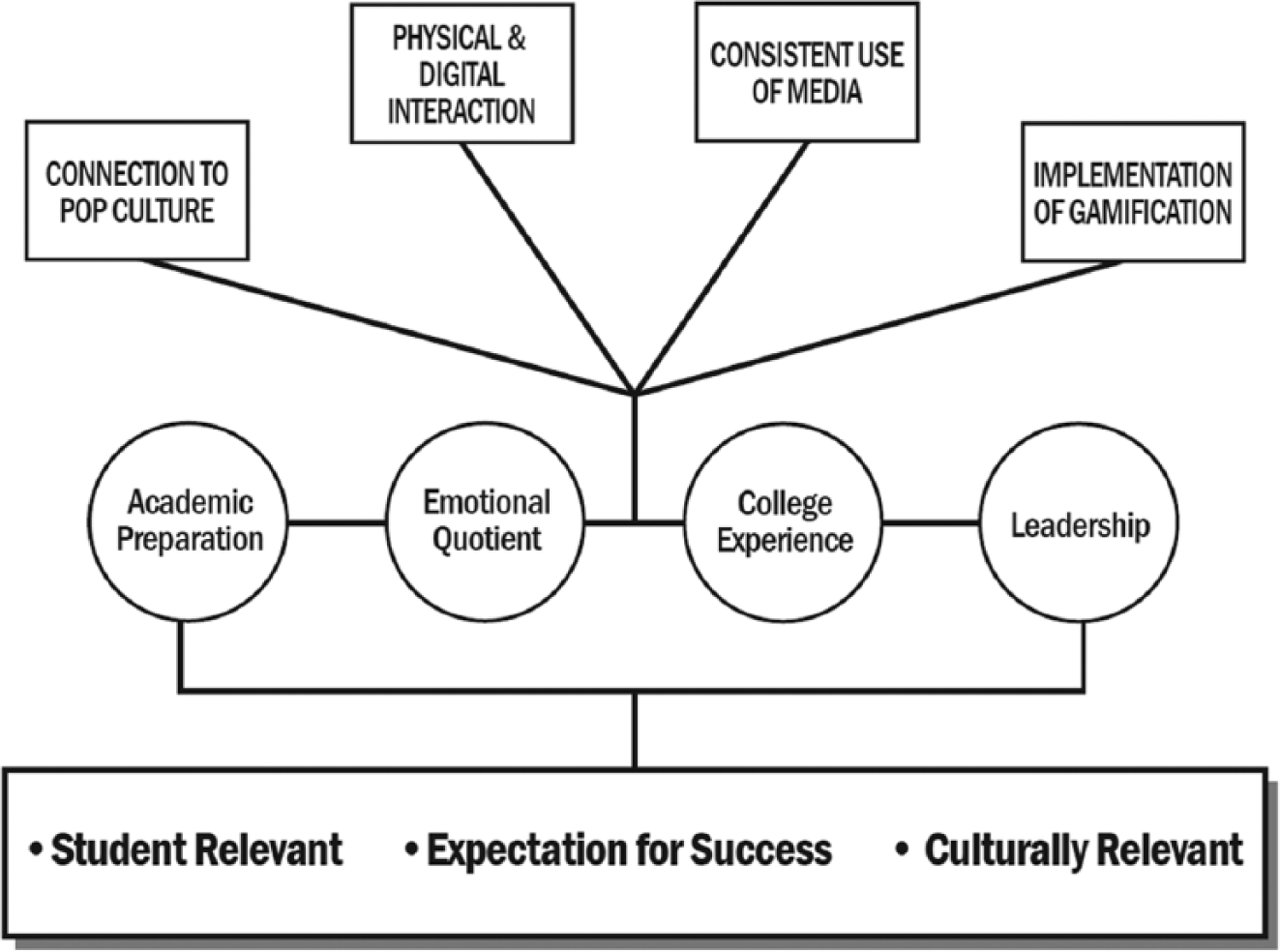
Model for effective summer bridge programs.
Currently, much of what is reported in research studies on interventions does not follow set protocols for research. According to IES, what practitioners glean from published reports on Summer Bridge Programs are a set of reassuring stories instead of standardized replicable research. The What Works Clearinghouse (WWC) defines the standards for identifying “effective” research interventions. These standards are detailed in the IES WWC website. In a WWC Intervention Report on Summer Bridge Programs undertaken by the IES, Department of Education, in July 2016, a total of 137 studies were included but only 31 were eligible for review using their standards. An additional 106 studies did not meet the eligibility standards for review at all (U.S. Department of Education, WWC IES, 2016). Only one (Murphy, Gaughan, Hume, & Moore, 2010) met the WWC standards and showed positive results in one area: completion and graduation. This study was at a selective university and did not include Hispanic students. Most of the research on summer bridge programs has been at institutions where the demographics do not include Hispanic students. Therefore, making generalizations on what works with Hispanic students is difficult.
In conclusion, to refine the knowledge of what works in summer bridge programs, specifically for Hispanic students, research projects should follow the WWC standards for “effectiveness.” The specific “effective” characteristics should be shared. Studies should meet group design standards to include standardization of research methods, increasing the number of students in the study, pooling projects, adjusting for variations, and sharing results. But, most importantly, the components of those programs must be engaging and relevant for today’s college students, who are members of a socially and technologically engaged generation. These students expect information to be not only interactive and engaging, but most of all, timely, on-demand, and relevant to their culture.
Footnotes
Authors’ Note
This Scholarly article was commissioned for the 12th Annual Conference of the American Association of Hispanics in Higher Education, 2017.
Declaration of Conflicting Interests
The author(s) declared no potential conflicts of interest with respect to the research, authorship, and/or publication of this article.
Funding
The author(s) disclosed receipt of the following financial support for the research, authorship, and/or publication of this article: This study was supported by Title V Grant Proposal Award Number P031S120095.