







Abstract
This project creates the first educational pipeline for the state of Texas. It incorporates middle school as a key transition point, differentiates between advanced degree achievement among Latinas/os and Chicanas/os, and fashions a secondary pipeline with a narrower age range. Findings indicate that the move from eighth grade to ninth is a critical juncture; that more adult Latinas/os and Chicanas/os lack any academic credentials among all ethnic groups; and that current generations experience similar inequitable achievement rates as older generations.
It has been nearly 15 years since Solórzano et al. (2005) first constructed a Latina/o education pipeline using U.S. Census data. This article replicates the methods used by these and other subsequent scholars (Chao Romero, 2012; Pérez Huber et al., 2006, 2015; Rivas et al., 2007; Solórzano et al., 2005; Yosso & Solórzano, 2006), applying it for the first time to the Texas educational landscape. It is an apt project, as today, the majority of public school students in Texas schools are students of color and over half of this population is Latina/o or Chicana/o. 1 Historically, Texas has funded its schools inequitably, impacting predominantly Latina/o and Chicana/o districts and schools generationally (Alemán, 2007). Inconsistencies with experienced, high-quality teachers (Peske & Haycock, 2006) have relegated Latinas/os, Chicanas/os, and other students of color in Texas to chronically disproportionate educational outcomes (Valenzuela, 2016). Moreover, deficit notions of immigration or migration (Pérez et al., 2010) and language (Foley, 1997; García & Guerra, 2004) exacerbate problems for Latina/o and Chicana/o students in Texas’ public schools.
As scholars educated in Texas K-12 schools who now research and teach at a Hispanic-serving institution in our home state, we are attuned to the unchanging inequalities that result in lower graduation rates for Latinas/os and Chicanas/os at all stages of the educational pipeline, across the nation. We sought to build an educational pipeline for the state of Texas in the hopes of calling attention to these lasting discrepancies for a state whose future leaders, educators, and decision-makers will be drawn from a majority-Latina/o and Chicana/o population. Drawing on critical race scholarship that uses U.S. Census data to construct a visual representation of educational attainment levels for Latina/o and Chicana/o students in comparison with other ethnic groups across the nation (Pérez Huber et al., 2006; Solórzano et al., 2005; Yosso & Solórzano, 2006), this essay advances a visual snapshot of the educational attainment for the Latina/o and Chicana/o population in Texas.
Building on educational pipeline models that have evolved over the past decade, we incorporate middle school as a key transition point for the first time, differentiate between advanced degree achievement among Latinas/os and Chicanas/os in Texas, and fashion a secondary pipeline with a narrower age range than previous samples. As a result, our educational pipeline reveals that (a) the move from eighth grade to ninth may function as a substantial leakage point in the trajectory of Latina/o and Chicana/o students in Texas; (b) Latinas/os and Chicanas/os have the largest proportion of adults without any academic credentials and the smallest proportion with bachelor’s degrees and beyond among all ethnic groups in Texas; and (c) that the current generations of Texas’ Latinas/os and Chicanas/os experience similar inequitable achievement rates as older generations of Latinas/os and Chicanas/os in Texas.
We organize our work in five sections. The first section contextualizes the history of education for Latina/o and Chicana/o students in the state, providing the social, political, and historical background that informs the figures represented in the educational pipelines. We then trace the evolution of the scholarship that has produced educational pipelines for Latina/o and Chicana/o students. Next, we present the methodology we used to craft the Texas Latina/o and Chicana/o educational pipelines. We then detail the findings revealed by the newly constructed educational pipelines for Texas. Finally, we conclude with the next steps for this project.
A Brief History of Unequal Education in Texas
In the 170 years since the signing of the Treaty of Guadalupe Hidalgo—the treaty which ended official hostilities in the Mexican American War—Chicanas/os and Latinas/os in Texas have been socially, politically, and legally relegated to a second-class citizenship (Center for Public Policy Priorities, 2016; Johnson, 2003; San Miguel & Valencia, 1998) and inadequate and inequitable education education. Whether via overt segregation in public schools (Donato, 1997), underfunded schools (Alemán, 2007), or racialized admissions procedures at universities (Horn Catherine & Flores Stella, 2003), the decades after the Treaty’s signing included sustained struggle, advocacy, resistance, and incremental change in the lives of Latinas/os and Chicanas/os in Texas. As San Miguel and Valencia (1998) point out, the Treaty of Guadalupe Hidalgo brought about the fraudulent transfer of millions of acres of private property, the subjugation of millions of citizens marked as “Mexican” (Acuña, 1988), as well as a lack of property ownership, minimal access to high quality and rigorous academic programs (Alemán, 2013), and the denial of Chicana/o and Latina/o youth access to the state’s flagship institution (San Miguel, 1983).
From the onset of both the republic’s “founding” and the state’s incorporation into the Union, Mexican American students were legally forced to attend inferior schools. Valencia (2008) outlines how federal and state policies enabled the separation of youth based on race and language; how students of color attended schools in dilapidated buildings and had less qualified teachers; how teachers and administrators with deficit views of and low expectations for Mexican American children hindered their success; and how discipline was meted out more harshly to Mexican American students than their White counterparts, even for “infractions” like speaking Spanish (Acuña, 1988; Menchaca, 1995; San Miguel & Valencia, 1998; Spring, 2016; Wilson, 2003).
Despite these institutionalized disadvantages, Mexican American families, leaders, and youth resisted and challenged unequal schools, segregation practices, and discriminatory school policies. Valencia and Black (2002) describe the ways in which Mexican American communities, despite having little access to legislative or institutional power, continued to organize against and advocate for students’ educational rights. Groups such as the League of United Latin American Citizens (LULAC), the American G.I. Forum, and the Mexican American Legal Defense and Educational Fund (MALDEF) were all created from these efforts. De León (1974) describes how Mexican American parents and leaders in San Angelo, Texas, sustained an almost 5-year boycott of the city’s public schools when town officials refused to allow Mexican American children equal access to schools. Resisting this oppression, Mexican Americans formed community-based schools. Salinas (2001) discusses how in small, rural communities in South Texas, the escuelita movement held the most promise and wielded the best results for Mexican American school children who were categorically denied opportunities. Fashioned to inculcate young students with a love of learning via a culturally and linguistically relevant curriculum taught by teachers with high expectations and a caring ethic, escuelitas are a model for what public schools, especially for students of color, should be like today. Just as inequity in funding, segregation, and low expectations have been the norm for Mexican American students in Texas education, so has the legacy of activism and organized resistance by Mexican American communities been constant. Whether in the form of boycotts, legal challenges, or student walkouts, the struggle for equal educational opportunity has been a mainstay.
Literature Review
When introduced in the early 2000s (Pérez Huber et al., 2006; Solórzano et al., 2005; Yosso & Solórzano, 2006), the diagrams mapping the Latina/o and Chicana/o educational pipeline provided a compelling visual representation of educational inequities long documented by researchers and government data and chronically experienced by Latina/o and Chicana/o communities. Using 2000 decennial Census data, the percentages for high school degree completion, college enrollment, associate’s degree completion, bachelor’s degree completion, graduate school enrollment, master’s degree completion and doctoral degree completion for those who self-identified as non-White Latinas/os were used as waypoints to lay out a trajectory beginning in elementary and ending with a PhD.
The graphics in the initial set of publications included a comparison of the educational attainment of Latina/o and Chicana/o, African American, Native American, Asian American, and White students across the nation using those aforementioned markers of educational attainment (Chao Romero, 2012; Pérez Huber et al., 2006, 2015; Solórzano et al., 2005; Yosso & Solórzano, 2006); a breakdown of educational attainment among Chicanas/os, Puerto Ricans, Cubans, Dominicans, and Salvadorans across the nation (Pérez Huber et al., 2006, 2015; Solórzano et al., 2005; Yosso & Solórzano, 2006); a pipeline of the educational trajectory that added community college enrollment, transfer, and completion rates of Latinas/os and Chicanas/os (Rivas et al., 2007; Solórzano et al., 2005); and a diagram of the postsecondary educational pipeline for Latina/o and Chicana/o high school graduates in the California higher educational system (Rivas et al., 2007; Solórzano et al., 2005). What these pipelines revealed was that nationally, Latinas/os and Chicanas/os have the lowest high school and college graduation degree attainment compared with Whites, Blacks, Native Americans, and Asians. It also illustrated that Chicanas/os have lower levels of educational attainment across all markers compared with Cubans, Puerto Ricans, and Dominicans. In California, about twice as many Chicanas/os enroll in community college than in a 4-year institution, but only 33% of all Chicanas/os who enroll in college end up earning a degree. Together, the configuration of the figures helped to concretize the salience of race in educational access and opportunity, underscoring “the racialized structures, policies, and practices that guide higher education” (Solórzano et al., 2005, p. 289) that are often masked by meritocratic and colorblind ideologies. Its particular focus on the transition points thwarting educational attainment for Latina/o and Chicana/o students generated policy and practice recommendations to repair the “serious and persistent leaks in the Chicana/o educational pipeline” (Yosso & Solórzano, 2006, p. 1).
These pivotal images were sharpened, with the work of Covarrubias (2011), Pérez Huber et al. (2014), and Covarrubias and Lara (2014). These scholars disaggregated the national and statewide snapshot on Latina/o and Chicana/o educational attainment to account for the generational status, citizenship, income level, and gender of Latinas/os. This research revealed “disparate within-group educational outcomes” (Covarrubias, 2011, p. 104) along gendered lines for both noncitizens and for working class Latinas/os and Chicanas/os (Covarrubias, 2011; Covarrubias & Lara 2014; Pérez Huber et al., 2014). In particular, women of any citizenship status and class outperform their male counterparts in educational attainment; noncitizen Mexican origin students are less likely graduate from high school, college, or graduate school than U.S.-born Chicanas/os (Covarrubias, 2011; Covarrubias & Lara 2014); and higher socioeconomic status increases educational attainment for Mexican origin Americans, but these gains based on class status still result in lower attainment rates than Whites across all income levels (Covarrubias, 2011). Unlike the original educational pipeline which used data from the 2000 decennial Census, these later studies relied on 2012 data, either from the American Community Survey (ACS) or from the March Supplement of the Census Bureau’s Current Population Survey (CPS) for the multiple disaggregated educational pipelines.
While early educational pipelines were accompanied by policy recommendations, Covarrubias (2011) and others (Covarrubias & Lara, 2014; Covarrubias & Veléz, 2013) began to theorize how to integrate an intersectional analysis. Conceptualized as Critical Race Quantitative Intersectionality (CRQI), this framework disaggregates Census data to counter the homogenization of “historically diverse populations with unique histories and particular educational experiences” (p. 275). The authors argue that CRQI aims to reveal how academic pathways are contingent on the unique intermingling of race, gender, class, and citizenship for people of Mexican origin. Other scholars have similarly pursued this approach to reveal the overlapping layers of disenfranchisement that complicate the educational journey for students of color based on their various social positions (Covarrubias & Liou, 2014; Jang, 2018; López et al., 2018).
Covarrubias et al (2018) extended CRQI by marrying it to testimonio. Referred to as CRQI + T, the goal of pairing educational attainment data with individual and collective testimonial accounts of schooling is to minimize deficit interpretations of the causes of inequitable educational outcomes by offering sociohistorical context through the educational narratives of people of color. These testimonios exemplify the groundtruthing approach Vélez and Solórzano (2017) advocate. Inspired by Geographic Information System (GIS) mapping practices that align digital surveys of a landscape with on-the-ground observations and evidence, educational attainment statistics are corroborated through individual and collective accounts.
These methodological developments have not necessarily resulted in innovative educational pipelines about Latina/o and Chicana/o students. Rather, pipelines have been updated with 2012 data (Pérez Huber et al., 2015). Scholars have continued to restate the policy recommendations previously outlined as little improvement has occurred in educational attainment for Latina/o students since the pipelines were first introduced. Moreover, the transition points mapped along the educational trajectory have remained unchanged.
School transitions, particularly between middle school and high school, have shown to be challenging for young adolescents (e.g., Barber & Olsen, 2004). Changes in school structure, class sizes, perceived teacher support, and academic expectations of students contribute to the already stressful developmental phase teenagers experience generally (Barber & Olsen, 2004; Eccles et al., 1993). For minoritized students, this transition may be further exacerbated by stereotyped expectations of their academic abilities (or perceived lack thereof) and their receiving schools’ level of cultural competence (Holcomb-McCoy, 2007). In their longitudinal study, Reyes et al. (2000) found that their sample, comprised mostly of Latino (76%) eighth-grade students in the base year, experienced a decline in grades after each transition. Though some of the students were able to recover, others dropped out of school entirely. The authors discuss the role culture may play in the transitional experience for urban minority youth as they balance their school culture with their home culture. The eighth to ninth transition, then, is an important juncture to examine in seeking to understand the Latina/o and Chicana/o educational pipeline.
This project is the first to build an educational pipeline for Texas across various ethnic groups, the first to fix middle school as a key transition point (in addition to high school degree, college degree, and graduate/professional degree attainment of the previous pipelines), and the first to compare attainment across age groups.
Who We Are, Where We Work, and Our Purpose
Although at different stages of our academic careers (professor, associate professor, and assistant professor) with different disciplinary training, we (the three coauthors) are all relatively new faculty members at a Hispanic Serving Institution (HSI) in South Texas. We are also all first-generation faculty, with a vested interest in the educational experiences of the Latina/o and Chicana/o communities to which we belong. In addition, the history and mission of our home institution—the University of Texas at San Antonio (UTSA)—led to our current collaboration.
After years of contentious efforts, UTSA was founded in 1969 to redress the fact that working class Latina/o and Chicana/o communities living in one of Texas’ largest cities had been “underserved by higher education” (De Oliver, 1998, p. 274) for years, as the majority of these families “could not afford to send their children to an out-of-town university” (p. 274). The original promise of the legislative bill that authorized the monies to build UTSA was to determine a site that was accessible to the “socioeconomically underprivileged populations of the inner city” (p. 277) that were majority Latina/o and Chicana/o. Ultimately, the campus was built in the city’s outer suburban fringe, closer to the city’s relatively affluent White populations. It took a lawsuit filed by MALDEF in 1987 to demonstrate that this particular suburban campus had yet to meet the needs of the city’s and region’s Latina/o and Chicana/o population. As a result, a satellite campus was finally built in the city’s urban core in 1997, amid a predominately Latina/o and Chicana/o neighborhood.
Currently, our respective departments are all housed on this downtown urban campus. Yet, as we began meeting students enrolled in our courses, we noticed how few of them came from the adjacent K-12 schools or the school districts in our city’s inner core. This observation prompted us to examine the efforts our institution made to build pathways from the student population in our own backyard and drew us toward the Latina/o and Chicana/o educational pipeline scholarship. Given our combined areas of expertise and academic and personal interest, we collaborated to build Texas’ first Latina/o and Chicana/o educational pipelines as a first step toward advocating for policy recommendations in addressing the enduring inequities.
Method
Like our predecessors, we use descriptive statistics collected by the U.S. Census American Community Survey (2011-2015 5-year estimates) to construct a snapshot of Latina/o and Chicana/o educational attainment in the Texas. The American Community Survey interviews a random sample of the U.S. population on a monthly basis to gather demographic, social, economic, and housing information. We used the U.S. Census online tool, Data Ferret, to download ACS data on respondents’ racial background, Hispanic 2 background, and self-reported levels of education attained.
Our sample consisted of 826,478 Texans who were between 25 and 85 years old at the time of data collection. There were slightly more females (52%) than males in our sample. More than half (56%) identified as non-Hispanic and White, 10% identified as Black only, 4% identified as Asian only, and less than one percent (0.16%) identified as members of a Native American tribe. Hispanics who reported having Latin American ancestry (coded as “Latina/o”) represented 29% of our sample. Because the Census asks about Hispanic ancestry and racial background separately, a substantial overlap exists between those that identify as “White only” and as “Hispanic.” To allow for comparisons between Latinos/os and racial groups, we recoded the variables as follows: “Latinas/os” in our sample were identified as those who indicated they had a Hispanic origin, and also listed a Latin American country as a place of origin (e.g., México, Perú, Venezuela, Costa Rica, Cuba); those who indicated they were Spaniard were not included in the Latina/o category. “White” adults in our analyses refer to individuals who indicated they did not have Hispanic origin and that they were White.
We constructed the pipelines in two phases. In the first phase, we replicated the previous pipelines (including all adults 25 and older), but with the added transition between eighth and ninth grade. Our eight educational attainment categories were thus less than ninth grade, some high school, high school diploma or equivalent, some college, associate’s degree, bachelor’s degree, master’s or professional degree, and doctorate degree. High school completion was calculated by summing all respondents who indicated they had completed high school (or its equivalent) as their highest level of education or above.
Acknowledging that the broad age range would capture a diversity of generational and policy influences, we narrowed the age range in the second phase. We used the Texas Higher Education Coordinating Board’s 3 criteria of 25- to 34-year-olds to identify young adults in the state. This narrowed our sample to 157,254 Texans. This smaller sample was evenly split between males and females. Unsurprisingly, Latinas/os and Chicanas/os comprised a larger proportion (38%) of young adults than of all adults in the sample (vs. 29%). Meanwhile, non-Hispanic, White respondents made up a smaller proportion of young adults (45%) compared with the entire adult sample (vs. 56%). This is consistent with Pew Research Center estimates that report the median age for Latinas/os has been lower than that of other racial and ethnic groups for several years now (Patten, 2016). Other racial groups remained relatively the same: 11% were Black, 5% were Asian, and less than one percent (0.40%) were Native American.
It is important to note that within the Texas context, when we refer to Latinas/os, we are primarily also referring to those of Mexican descent. In both our samples, the vast majority (87%) of those who were identified as Latina/o also indicated that their Hispanic origin was Mexican. The next largest subgroup comprised those who indicated they had a Salvadorian background (3%) and everyone else indicated heritage from one of 20 Latin American countries or categories.
Findings
Similar to the snapshot offered by earlier pipelines for educational attainment across the nation and in California, the Texas Latina/o and Chicana/o pipelines (Figure 1) revealed that Latinas/os and Chicanas/os in Texas have the lowest levels of educational attainment at every educational benchmark for all ethnic groups. Notably, our analysis also suggested the significance of the move from eighth grade to ninth for Latina/o and Chicana/o students, a markedly different transition point than for other racial groups. It also demonstrated that Latinas/os and Chicanas/os have the smallest proportion of adults with academic credentials. In addition, we found that the current generations of Latinas/os and Chicanas/os experience similar inequitable achievement rates as older generations of Latinas/os and Chicanas/os. The key findings are detailed below.
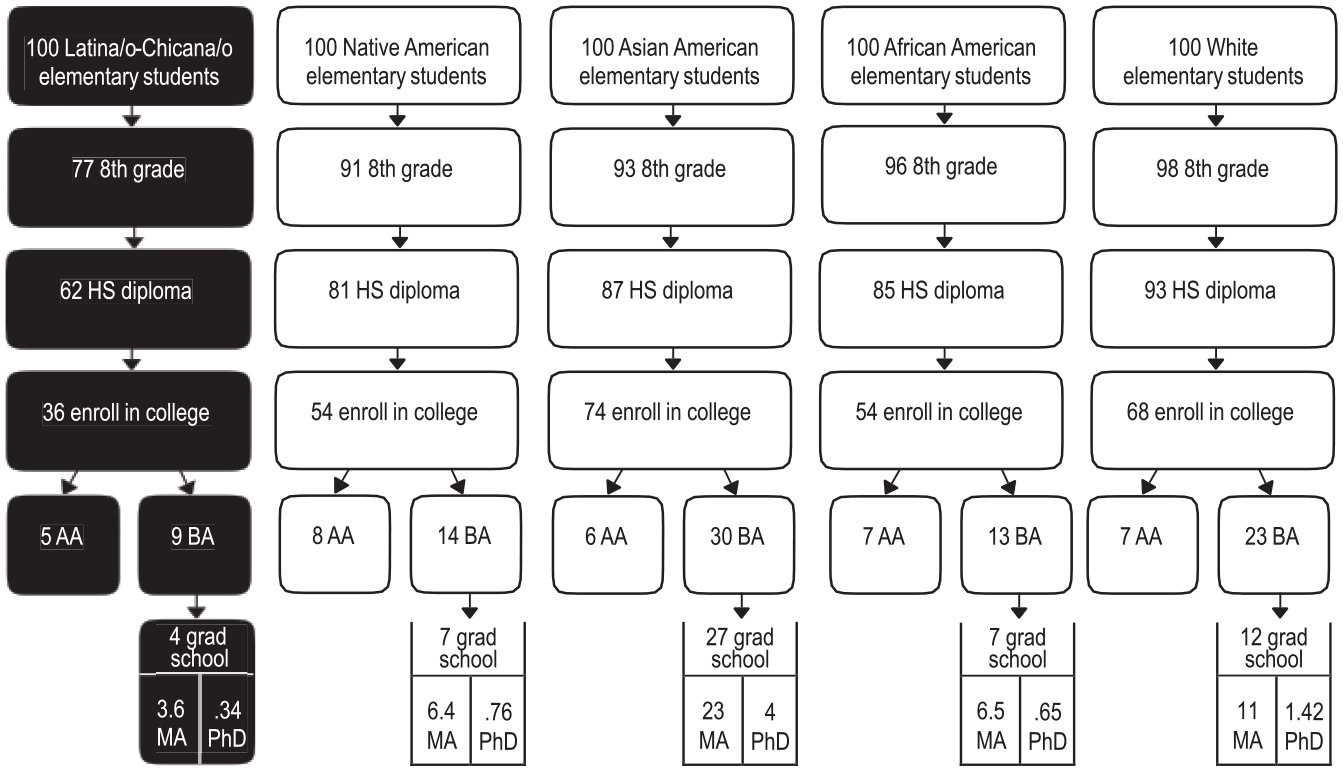
Educational attainment by ethnic group (+ 8th grade), Texas, 2011-2015 ACS Census data.
Latina/o and Chicana/o Educational Snapshot in Texas
The transition to ninth grade reveals itself to be a crucial leakage point along the educational pipeline for Latina/o and Chicana/o students in Texas (Figure 1). Nearly a quarter (23%) of Latinas/os and Chicanas/os reported having attained less than a ninth-grade education. For comparison, 8% of all Texans statewide indicated the same. There is a 15-percentage point difference between those that reported attending some high school years and those that reported earning at least a high school diploma or equivalent. This suggests that little more than 60% of Latinas/os graduated from high school. Following the pipeline analogy, about half of these high school graduates will have enrolled in college, but less than 10 will have earned a bachelor’s degree. Four will have enrolled in graduate school, three of which would be master’s degrees. Consequently, out of a hypothetical group of 100 Latinas/os and Chicanas/os who enrolled in elementary school, only about 17 will have earned any kind of academic credential. Moreover, it means only one out of every 300 Latina/o or Chicana/o students will have earned a doctoral degree.
Latina/o and Chicana/o Racial Comparisons in Texas
When compared with other racial groups, Latinas/os and Chicanas/os have the largest proportion of adults without any academic credentials and the smallest proportion with bachelor’s degrees and beyond (Figure 2). As indicated in the previous section, 23% percent of Latina/o and Chicana/o Texans indicated they had only attended school until eighth grade or less. This is substantially higher than the proportion of Native Americans (9%), Asians (7%), Blacks (4%), and Whites (2%) who said they had less than a ninth-grade education. Moreover, these figures indicate a middle school push out rate two and half times worse than Native Americans face, the group with next highest level of eighth-grade minimum educational achievement. In addition, Latina/o and Chicana/o students have the highest push out rate for high school (15%) among all ethnic groups, compared with 11% of Black students, 10% of Native American students who attended high school, but did not graduate with a diploma or equivalent. Only a handful—5% of Asian and 6% of White students—get pushed out of high school in Texas. Consequently, nearly 82% of Latinas/os and Chicanas/os in Texas lack a college degree, compared with 73% of Blacks, 71% of Native Americans, 57% of Whites, and 37% of Asians.
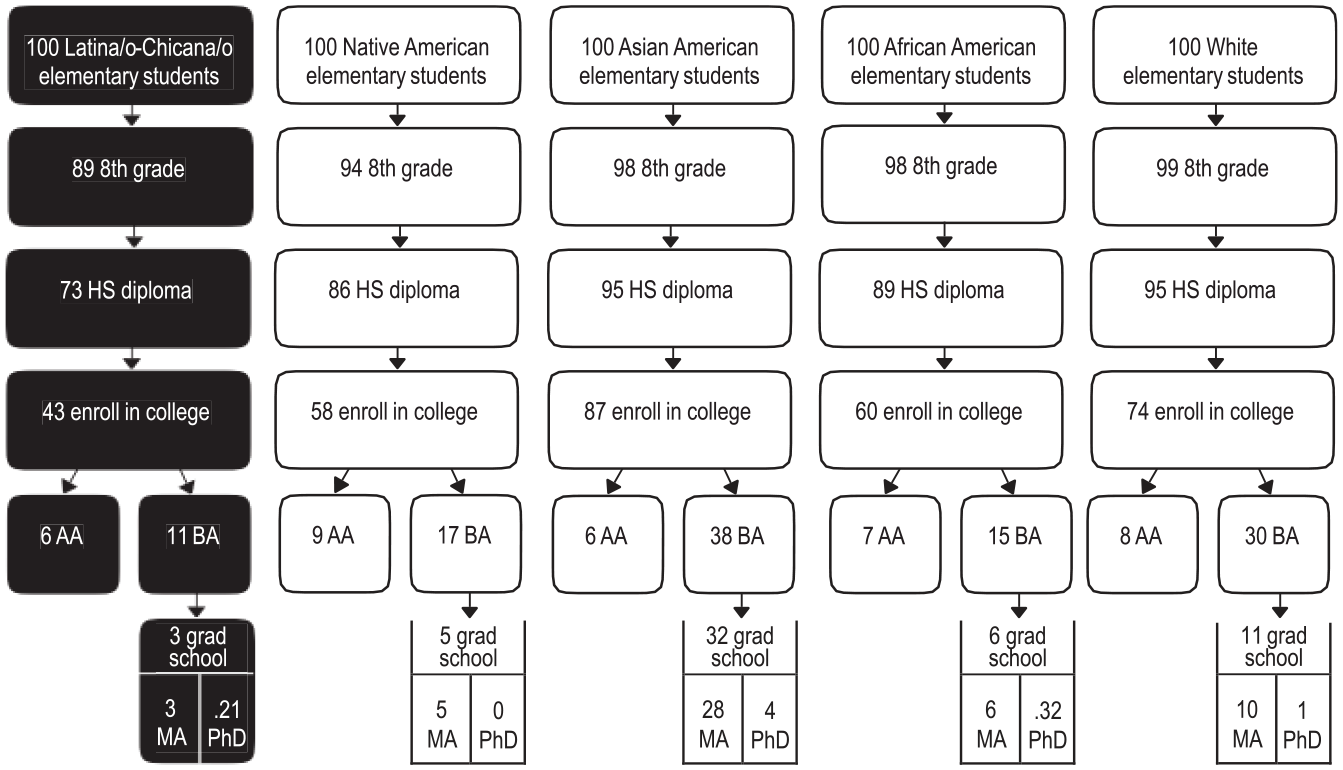
Educational attainment by ethnic Group (25–34), Texas, 2011–2015 ACS Census data.
On the other end of the educational spectrum, Latinas/os and Chicanas/os have the smallest proportion of adults indicating they had earned a postsecondary degree. Only 13% of Latinas/os and Chicanas/os had earned a bachelor’s degree (9%), master’s degree (4%), or doctoral degree (0.34%). This is much lower than Native Americans (21%) who had earned a bachelor’s degree or higher, Blacks (20%), Whites (35%), and Asians (57%). In addition, it appears that only half of Latina/o and Chicana/o students and Black students in Texas who enroll in college earn a degree of any kind, considerably lower than the 63% of White students and 85% of Asian students who enroll in college and graduate with a postsecondary degree.
Latina/o and Chicana/o Educational Snapshot for Young Adults in Texas
When recreating the Latina/o and Chicana/o educational snapshot for young adults, we found very similar patterns of educational attainment as we did for the adult population as a whole. For young Latina/o and Chicana/o adults, 15% indicated having attained at least a bachelor’s degree (11% attained a bachelor’s degree, 3% had earned a master’s or professional degree, and 0.21% had earned a doctorate degree). This was only two percentage points higher than for the full Latina/o and Chicana/o adult population. However, the percentage of Latinas/os and Chicanas/os indicating they had less than a middle school education among young adults was 11% (vs. the 23% for all Latina/o and Chicana/o adults). This offers a more optimistic outlook for young Latinas/os, but this rate is still higher than for other racial/ethnic groups. Six percent of Native Americans, 2% of Asian, 2% of Black, and 1% of White young adults (25 through 34) in Texas indicated having only an elementary school education. Moreover, the rates of degree attainment for younger Latinas/os and Chicanas/os enrolling in college remain relatively the same, with less than half of them earning a degree by the time they are 34.
Discussion: Texas Latina/o and Chicana/o Educational Pipelines
This essay is the first stage of a project to construct pipelines of the educational attainment for Latina/o and Chicana/o students in the state of Texas. For this stage, we extended the established methodology for educational pipelines by adding a focus on the transition from middle school to high school, differentiating the levels of advanced degree achievement among Latinas/os and Chicanas/os, and developed a secondary pipeline with a narrower age range than the original sample (25–34 years old). These adjustments revealed stark disproportions in attainment levels for Latina/o and Chicana/o students compared with other racial groups at both the early and late stages of the educational trajectory, as well as underscored the need for college-going initiatives for Latina/o and Chicana/o students prior to eighth grade, as well as for interventions that ensure Latina/o and Chicana/o students enrolling in college attain a degree.
We acknowledge that educational attainment using Census data is widely and readily available (Schak & Nichols, 2018). What is unique about this endeavor is the cogent way these configurations allow for comparison across ethnic groups. As a visual representation of K-20 educational inequity, limited higher education access, and the history of academic inequality for Latina/o and Chicana/o students, educational pipelines impact the ways critical race scholars of color teach, partner with community members and organizations, conduct research, and advocate for underrepresented and first-generation college students.
Next Steps
That advocacy is the next phase of our project. We have begun to investigate the intersections of various social categories by delving into the existing data, as modeled by previous scholars (Covarrubias, 2011; Covarrubias & Lara, 2014; Pérez Huber et al., 2014). For instance, we seek to map out the relation of gender, class, and citizenship status with the educational attainment of Latinas/os and Chicanas/os in Texas. Fashioning such pipelines can reveal the distinctions in educational attainment between working class Latina/o and Chicana/o students and more affluent Latina/o and Chicana/o students in the state. We also intend to build pipelines that are region-specific (i.e., across the southwestern United States, as well as south, north, east, west Texas) and neighborhood-specific (i.e., by zip code and by school district), narrowing in on particular areas of the state to anchor educational attainment to the educational institutions of specific geographic areas. Indeed, we encourage critical race scholars to build educational pipelines that reflect their own state or region as a way to direct local stakeholders to develop policies that directly impact existing disparities Latina/o youth face in their school systems. Third, we have collected qualitative data from various stakeholders including parents, administrators, students, and teachers who viewed the pipeline we developed here as a pedagogical tool to engage conversations regarding the educational attainment for the Latina/o and Chicana/o populations in Texas. To date, we have asked nearly 100 participants to make sense of these disparities, revealing the utility of this visual device to concisely depict structural inequities predicated on racial hierarchies. We intend to share these findings in future manuscripts. Finally, an important outcome of this research project is a policy brief that draws from both the pipeline and qualitative data to recommend ways of ameliorating the educational attainments gaps Latina/o and Chicana/o students who are tailored to key decision-makers, especially addressing the crucial eighth to ninth grade transition. Ultimately, our goal is to employ these educational pipelines to increase awareness and spur conversations that generate opportunities for targeted interventions by change agents at those pivotal crossroads in Texas’ educational system where interventions are needed most.
Footnotes
Acknowledgements
We acknowledge Dr. Alejandro Covarrubias for training us in constructing the educational pipeline. We are grateful for his expertise, guidance, and collaborative spirit.
Declaration of Conflicting Interests
The author(s) declared no potential conflicts of interest with respect to the research, authorship, and/or publication of this article.
Funding
The author(s) received no financial support for the research, authorship, and/or publication of this article.
