







Abstract
Demographic shifts have transformed the racial and ethnic composition of the U.S. undergraduate population. Data from the American Community Survey are used to analyze Latino undergraduate enrollment as well as factors that contribute to the matriculation of undocumented Latino young adults. The article concludes with an overview of the implications of the growth of the Latino population and the experience of undocumented students on educational practices and policies.
Introduction
Demographic shifts in the U.S. population have brought about recent reductions in undergraduate enrollments in higher education. The number of undergraduate students in the country dropped from 18.1 million in 2010 to 16.8 million in 2017, a 7% drop (McFarland et al., 2019). While National Center for Education Statistics (NCES) population projections suggest that the number of undergraduate students will increase between 2017 and 2028, the growth is expected to be relatively small, inching up from 16.8 to 17.2 million, a growth of 3% (McFarland et al., 2019). Accordingly, colleges face rising competition for undergraduate students.
Because of the youthfulness of the Latino population, scholars have observed that higher education institutions will depend even more heavily on Latino students to fill college classrooms in the 21st century. For example, nearly two decades ago L. Olivas (2002) asserted that Latino students represented a substantial part of the nation’s future undergraduate students. Drawing on the disproportionate growth of Latinos at the K-8 level, L. Olivas (2002) called attention to the significant increase in Latino enrollment that was coming down the pike with Latinos expected to make up 22% of the nation’s undergraduate enrollment by the mid-2020s. Recent demographic trends suggest that the importance of Latinos for higher education is even firmer today than when L. Olivas (2002) offered his prophetic words. Indeed, the gain of 6.4 million Latino children between 2000 and 2017 nearly offset the loss of 7.2 million non-Hispanic (NH) White children (author’s estimates based on American Community Survey data).
While the declining overall U.S. undergraduate enrollment alongside the tremendous growth of that of Latinos is fairly known at the national level, there is more limited information on these trends across states. For example, the NCES’s annual The Condition of Education series does not provide data on students in higher education for states. Yet, due to the absence of federal immigration and educational policies related to undocumented students, states have become increasingly important in the construction of policies to facilitate the enrollment of undocumented students. Approximately 20 states have enacted policies to offer in-state tuition to undocumented students who graduated from local high schools, while others have not (National Conference of State Legislatures, 2019; M. A. Olivas, 2020). Hence, understanding the growing importance of Latinos as current or future undergraduate students across states has never been as important as today.
This article uses data from the American Community Survey (ACS) to conduct two specific analyses. First, the analysis examines Latino undergraduate enrollments between 2000 and 2017 at the national and state levels with comparisons to several NH racial groups. Second, the analysis investigates the relationship between residence in a state offering in-state tuition and college enrollment among Latino foreign-born noncitizens (FBNCs) 18 to 24 years and assesses the enrollment gap between FBNCs and citizen young adults. The article concludes with the policy implications of the increasing importance of Latinos for the sustainability of higher education and the continued forces that make it difficult for Latinos to enroll, persist, and ultimately graduate from colleges.
Literature Review
While it is clear that Latinos represent an essential part of the equation for the growth of the nation’s undergraduate enrollment, it is also recognized that Latino enrollment will not occur easily and without planned intervention (Flink, 2018). Indeed, research has shown that a significant portion of Latino youth were born outside of the United States and came to this country with limited formal education (Teranishi et al., 2011). In addition, many Latino youth are English-language learners (ELLs), with their numbers increasing over the last few decades (Flink, 2018; Kanno & Cromley, 2013). Many Latino ELL students may need remedial English and related forms of instruction before tackling a college degree (Flink, 2018). Unauthorized Latino students are less likely than U.S. citizens to complete high school and attend college (Greenman & Hall, 2013). Furthermore, many Latino students have limited economic resources, making it difficult to meet college tuition costs (Flink, 2018). To compound matters, many are first-generation college students, who cannot rely on their parents to help them navigate the higher education system (Flink, 2018). Moreover, approximately half of Latino students who enroll in higher education attend 2-year community colleges (Krogstad, 2016), thus creating an additional barrier to transition to a 4-year institution to pursue a bachelor’s degree (Crisp & Nora, 2010; Crisp & Nuñez, 2014). Finally, recently there has been much animosity against Latino immigrants that has served to exclude and marginalize them with many Latinos reporting feelings of not belonging on the campuses where they are enrolled (Flores & Chapa, 2009; Nuñez & Murakami-Remalho, 2012).
Yet, it is Latino FBNCs who have many of these traits that make it particularly difficult for them to matriculate in college (Flores & Chapa, 2009). This represents a tremendous loss of human capital and economic resources for the country, translating to limitations on the demographic dividend (Nuñez & Murakami-Remalho, 2012) that the United States can reap from a large Latino youth population making the transition from the K-12 system, to enrollment in higher education, and subsequently to the workforce. Unfortunately, the U.S. Congress has failed to pass the Development, Relief, and Education for Alien Minors Act (DREAM Act) to allow undocumented young adults to gain access to educational and workforce opportunities since it was first proposed in 2003 (Flores, 2010; M. A. Olivas, 2020). While President Obama established in 2012 the temporary Deferred Action for Childhood Arrivals (DACA) through an executive order (Amuedo-Dorantes & Sparber, 2014), which allows a certain segment of Dreamers to legally attend college and work, President Trump has called for the termination of the program with the Supreme Court scheduled to consider the case shortly. Without federal support for the DREAM Act, about 20 states have enacted policies to allow undocumented students who graduated from local high schools to pay in-state tuition (National Conference of State Legislatures, 2019; M. A. Olivas, 2020), thus making college enrollment more affordable for these students.
Research has shown that state bans on in-state tuition negatively impact high school graduation (Bozick & Miller, 2014) and enrollment in college (Villarraga-Orjuela & Kerr, 2017) among Latino FBNCs, while other studies have observed that states that extend in-state tuition to undocumented students positively influence college enrollment among Latino FBNCs (Flores & Chapa, 2009; Flores, 2010). For example, Flores (2010) found that the level of college enrollment of Latino FBNCs rose after a given state passed legislation to allow undocumented students to pay in-state tuition. In addition, Flores and Chapa (2009) observe the favorable enrollment impact that undocumented students receive when they live in states that offer in-state college tuition. Moreover, Amuedo-Dorantes and Sparber (2014) found that Mexican FBNCs living in states with in-state tuition for unauthorized immigrants were more likely to be enrolled in college than those living in states that do not have this policy. The second part of the investigation conducted below involves multivariate analyses to test two hypotheses derived from the literature:
Method
The author leveraged data from the 2000 to 2017 American Community Survey (ACS) public use files obtained from the IPUMS (Integrated Public Use Microdata Series) (Ruggles et al., 2019) to conduct the analysis. These data collected annually offer several important strengths including being based on individual-level data, offering large samples, and containing state identifiers. These assets allow for the generation of annual estimates of Latino undergraduate enrollments for the United States and the 50 states and the District of Columbia and for the construction of individual-level variables that will be used in the multivariate analysis.
The analysis carried out below involves two segments, which are described below.
Undergraduate Enrollment
The first analysis conducted below is a descriptive overview of changes in the undergraduate enrollment of Latinos between 2000 and 2017 to assess the relative growth of Latinos. Latinos, who can be of any race, are persons who identify as being of Hispanic or Latino origin and whose ancestry is from Spanish-speaking countries in México, the Caribbean, Central America, South America, or Spain. While the focus of this part of the analysis is on Latinos, NH Whites, Blacks, and Asians and Pacific Islanders are used as comparison groups.
The undergraduate enrollments are based on a question on the ACS survey that asked respondents who were currently enrolled in school, the specific grade or level in which they are attending. Persons who responded that they were enrolled as a “college undergraduate” were identified as undergraduate students. Unfortunately, the author was unable to separate undergraduate students by type of institution (2-year institutions, 4-year institutions, etc.). Each individual-level observation contained in the ACS has a specific sampling weight—called “person weight”—that allows for the generation of population estimates for a given population (e.g., the Latino population). The person weight denotes the number of persons in a given geographic area (e.g., nation, state, etc.) that the individual in the sample represents. These population estimates are used in the analysis to assess changes in undergraduate enrollments for Latinos and NH Whites, Blacks, and Asian and Pacific Islanders between 2000 and 2017.
The ACS estimates for students enrolled as undergraduate students are somewhat higher than the actual counts of the National Center for Education Statistics (NCES). For example, while the NCES counted 16,760,331 undergraduate students in 2017 (NCES, 2018), the ACS estimates 18,115,616 undergraduate students, 8.1% higher than the NCES figure. Undoubtedly, the difference stems from the distinct ways the ACS and NCES collect information for students enrolled in higher education. While the ACS involves self-report (or another household member providing information) on enrollment as an undergraduate student, the NCES obtains its count directly from “degree-granting institutions” that “grant associate’s or higher degrees and participate in Title IV federal financial aid programs” (McFarland et al., 2019, p. 156) based on the enrollment in the Fall semester. The ACS data likely are better at capturing the fluidity associated with enrollment in higher education, while the NCES data are more standardized.
Multivariate Analysis Explaining College Enrollment
The second part of the analysis focuses exclusively on college enrollment in 2017, the last year for which data are available, among Latinos who recently completed high school with the data derived from the 2017 ACS (Ruggles et al., 2019). The analysis features two segments.
First, the focus is on Latino FBNCs 18 to 24 years of age who are high school graduates but who have not completed a bachelor’s degree. This part of the analysis includes only Latinos who were born outside of the United States, are not U.S. naturalized citizens, and migrated to the United States before they were 18 years of age. The latter criterion serves to exclude individuals who were likely to have completed their high school degree prior to coming to this country and thus not eligible for in-state tuition. The final sample consists of 4,000 persons.
This sample is used to examine the first hypothesis predicting that Latino FBNC high school graduates who live in states that offer in-state tuition to undocumented students are more likely to be enrolled in college compared with their peers who live in states that do not offer this benefit. Logistic regression is used to conduct the analysis. The dependent variable is a dichotomous variable with a value of “1” given to persons who were currently enrolled in college in 2017 and a value of “0” to those who were not currently enrolled. The independent variable is residence in a state offering in-state tuition to undocumented students, which is a dummy variable with a value of “1” given to persons who lived in one of the 20 states that offered in-state tuition to undocumented students as of 2017 and a value of “0” to those who resided in the 30 states and the District of Columbia that did not make this allowance. The states were categorized into one of two groups based on whether they have a policy that provides in-state tuition based on two sources of data: National Conference of State Legislatures (2019) and M. A. Olivas (2020). The 20 states with in-state tuition in 2017 include California, Colorado, Connecticut, Florida, Hawaii, Illinois, Kansas, Maryland, Michigan, Minnesota, Nebraska, New Jersey, New Mexico, New York, Oklahoma, Oregon, Rhode Island, Texas, Utah, and Washington.
The logistic regression model also includes three control variables. The first is a dummy variable measuring limited English proficiency with a value of “1” assigned to persons who speak a language other than English at home and who speak English “not well” or “not at all” and a value of “0” to those who speak English at home or who speak a language other than English at home but who speak English “well” or “very well” (the latter is the reference category). Individuals with limited or no English proficiency are less likely to be enrolled in college (Kanno & Cromley, 2013). The second control variable is a female dummy variable with a value of “1” given to females and a value of “0” to males (the latter is the reference category). Research has shown that females are more likely to enroll in higher education (Sáenz & Ponjuán, 2009). The third control variable is a dummy variable labeled “ever married” with a value of “1” designated to persons who are currently or had been previously married and a value of “0” to those who have never been married (the latter is the reference category). Research has shown that persons who have been ever married are less likely to be attending college compared with their peers who have never been married (Flores & Chapa, 2009).
The second segment of the multivariate analysis focuses on the likelihood of college enrollment in 2017 among Latino FBNCs in comparison to Latinos who are U.S. citizens. The sample for this segment of the analysis is expanded to include all Latinos 18 to 24 years of age who are high school graduates but who have not completed a bachelor’s degree. As in the first segment of the multivariate analysis, foreign-born persons who migrated to the United States at age 18 or older were excluded from the analysis. The sample used for this part of the multivariate analysis consists of 40,039 individuals from the 2017 ACS.
This sample is used to test the second hypothesis that Latino FBNC high school graduates are less likely to be enrolled in college compared with those who are citizens, but that FBNCs who live in states offering in-state tuition to undocumented students receive a bump in their enrollment compared with their counterparts. Logistic regression analysis is used to test this hypothesis. The dependent variable is a dichotomous measure with persons who are enrolled in college in 2017 receiving a value of “1” and those not attending college a value of “0.” The three predictor variables of interest in the analysis include (a) a dummy variable labeled “FBNC” with persons who are not citizens receiving a value of “1” and those who are citizens a value of “0” (the latter is the reference category); (b) a dummy variable measuring residence in a state offering in-state tuition to undocumented students with persons who live in one of the 20 states offering in-state tuition in 2017 assigned a value of “1” and a value of “0” to those living in a state that does not make this allowance (the latter is the reference category); and (c) an interaction term between residence in a state offering in-state tuition and FBNC. The three control variables described above for the first multivariate analysis are also used in this segment of the analysis. The second hypothesis would be supported if FBNC is negatively associated with college enrollment and the interaction term is positively related to being enrolled.
Results
The results are presented in two parts. The first part of the results consists of the descriptive analysis examining undergraduate enrollment trends among Latinos and the comparison NH racial groups. The second part of the findings section focuses on the multivariate analysis associated with the explanation of college enrollment.
Changes in Undergraduate Enrollment
The overall U.S. undergraduate student population increased 46% between 2000 and 2017, rising from 12.4 to 18.1 million during this period. Enrollment peaked at approximately 19.8 million in 2011 and has declined slowly ever since. The Latino undergraduate enrollment grew 2.5 times between 2000 and 2017, rising from 1.4 to 3.5 million (Figure 1). The number of undergraduate NH Asian and Pacific Islanders (63%) and NH Blacks (60%) expanded at moderate levels and that of NH Whites (21%) grew more modestly. Latinos also led the way in absolute growth in undergraduates with an increase of 2.1 million compared with 1.7 million NH Whites. Thus, of the approximately 5.7 million undergraduate students that the United States added between 2000 and 2017, Latinos accounted for the largest share at 37% followed by NH Whites at 29.5%.
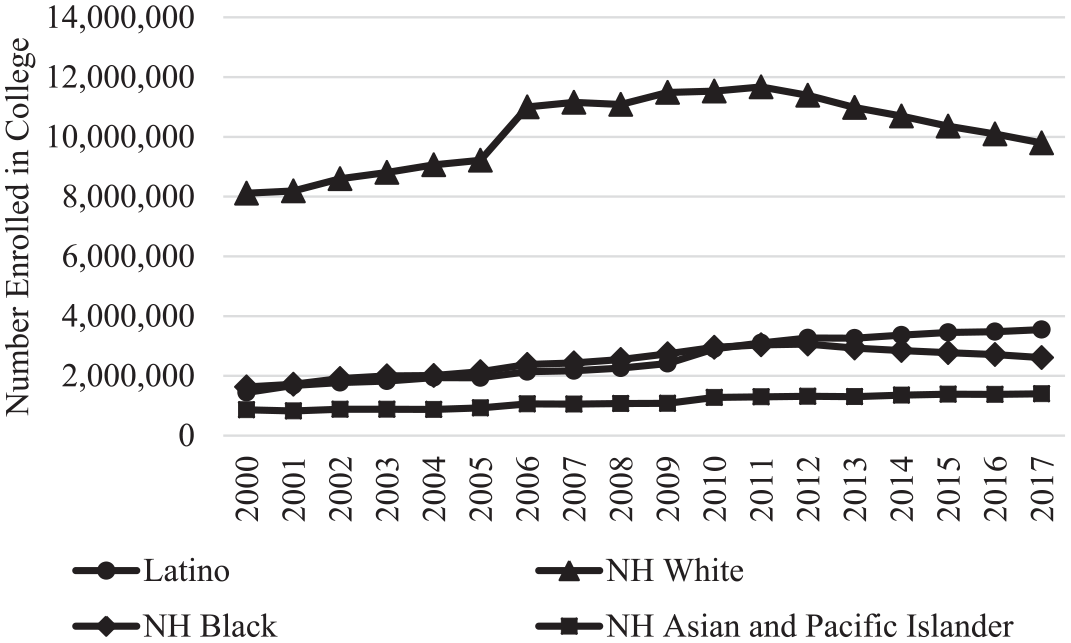
Number of undergraduate students in the United States for selected racial and ethnic groups, 2000–2017.
The racial and ethnic composition of the nation’s undergraduate population shifted sharply between 2000 and 2017. The NH White percentage share of all undergraduates dropped from 66.3% in 2000 to 54.8% in 2017, while the Latino portion rose from 11.8% to 19.8%.
Despite the widespread growth of undergraduate enrollment between 2000 and 2017, there have been significant changes in enrollment of undergraduate students more recently. While the nation’s undergraduate enrollment rose by 5.1 million between 2000 and 2008, it declined by 170,093 between 2009 and 2017 (Figure 2). The drop was due primarily to a significant turnaround among NH Whites from a growth of 3.0 million undergraduates between 2000 and 2008 to a loss of 1.7 million between 2009 and 2017, along with similar trends, but at a much lower level, among NH Blacks (growth of 921,000 in 2000–2008 and a decline of 125,000 in 2009–2017). In contrast, there was a major growth in Latino undergraduate enrollment across the two time periods, rising from an increase of 819,000 students between 2000 to 2008 to a growth of 1.1 million between 2009 and 2017. Thus, while NH White undergraduate students declined by 13% and NH Black students dropped by 1.3% between 2009 and 2017, the enrollment of Latinos rose by 48%. The NH Asian and Islander population also experienced gains in enrollments between the 2000–2008 and 2009–2017 periods.
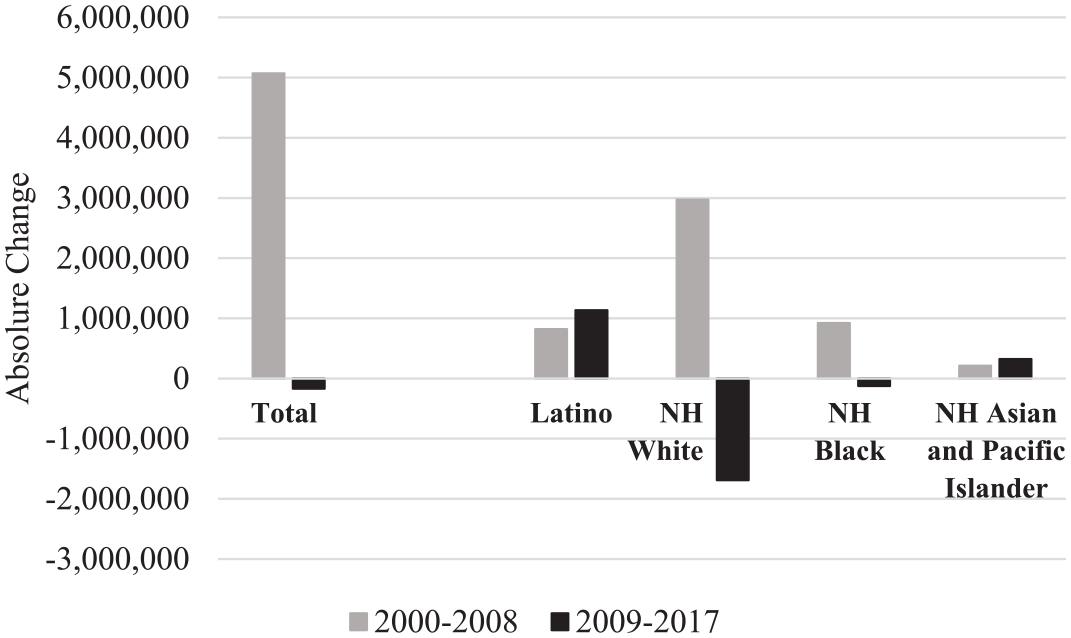
Absolute change in number of undergraduate students in the United States in the 2000–2008 and 2009–2017 periods and for selected racial and ethnic groups.
The national trends are also apparent across states. All states and the District of Columbia experienced growth between 2000 and 2008, but only 15 and the District of Columbia replicated undergraduate enrollment gains between 2009 and 2017 (Figure 3). Again, the national trend is due primarily to the significant decline of NH White undergraduates between 2009 and 2017. NH White undergraduate students increased in 50 states between 2000 and 2008, but in only two between 2009 and 2017 with similar, but more muted, trends among NH Blacks (47 states increased Black enrollment in 2000–2008, but only 19 in 2009–2017). In contrast, the number of states with increasing Latino enrollments actually increased from 47 in 2000–2008 to 49 in 2009–2017 with similar trends for NH Asian and Pacific Islanders.
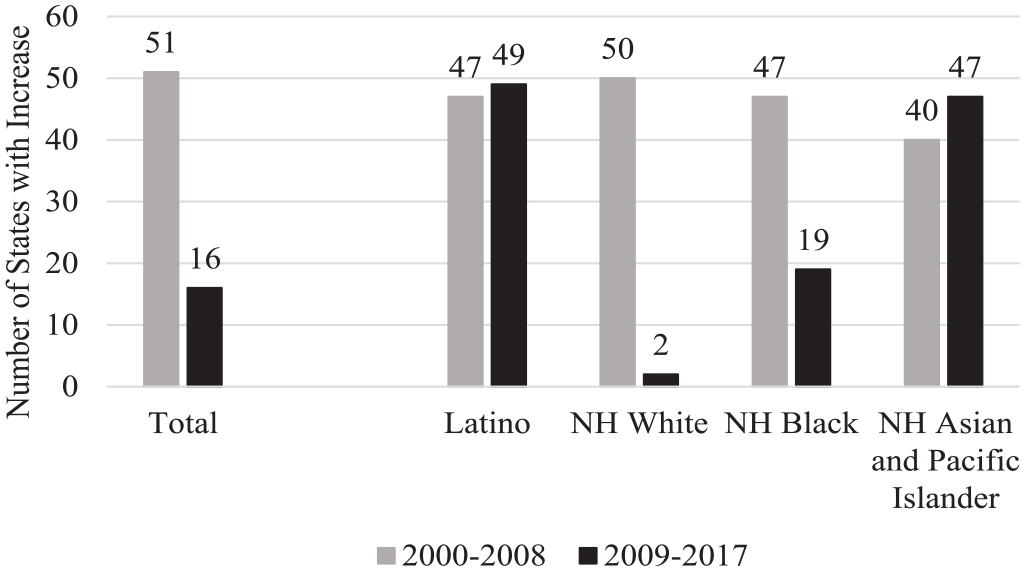
Number of states and the district of Columbia with increases in undergraduate students in the 2000–2008 and 2009–2017 periods and for selected racial and ethnic groups.
The states that maintained overall growth in 2000–2008 and 2009–2017 include Arizona, California, Colorado, Delaware, District of Columbia, Florida, Louisiana, Massachusetts, Nevada, New Hampshire, New Jersey, Rhode Island, South Carolina, Tennessee, Texas, and Washington. However, only three had absolute gains exceeding 90,000 in 2009–2017 (California, 205,297; Texas, 188,261; and Florida, 91,452). The vast majority consisting of 36 states and the District of Columbia experienced growth in the 2000–2008 period and loss in the 2009–2017 period. States with the most drastic changes from absolute gain to absolute loss include New York (335,715 in 2000–2008 and −37,548 in 2009–2017), Pennsylvania (315,382 and −65,632), Illinois (219,435 and −105,808), Ohio (204,650 and −93,396), North Carolina (189,305 and −28,657), and Michigan (181,928 and −82,196).
There are major differences between Latinos and NH Whites with respect to population change in the 2009–2017 period. Latino undergraduate growth more than offset NH White undergraduate decline between 2009 and 2017 in the District of Columbia and nine states (Arizona, California, Florida, Nevada, New Hampshire, New Jersey, South Carolina, Tennessee, and Texas). The most dramatic differences associated with growth of Latino undergraduates and loss of NH White undergraduates between 2009 and 2017 occurred in California (Latinos: 340,180 vs. NH Whites: −190,505), Texas (176,622 vs. −72,285), Florida (100,460 vs. −45,192), New York (63,147 vs. −127,396), and Illinois (35,957 vs. −118,247). These data clearly suggest that higher education institutions across the country are already becoming increasingly dependent on enrollment of Latino undergraduates while they sustain losses in NH White undergraduates.
Unfortunately, there are barriers that prevent easy transition of Latino students from high school graduates to their enrollment and graduation from college. In the literature review, the author outlined a variety of factors that make this shift difficult. One of these involves the Latino college enrollment gap between Latino FBNCs and their peers who are U.S. citizens.
Logistic Regression Analysis Explaining College Enrollment
The logistic regression analysis is conducted in two parts, each corresponding to the two hypotheses that are tested. The first hypothesis, focusing on Latino FBNCs 18 to 24 years of age who are high school graduates, surmises that FBNCs who live in states that offer in-state tuition to undocumented students are more likely to be enrolled in college than those residing in states that do not offer this benefit.
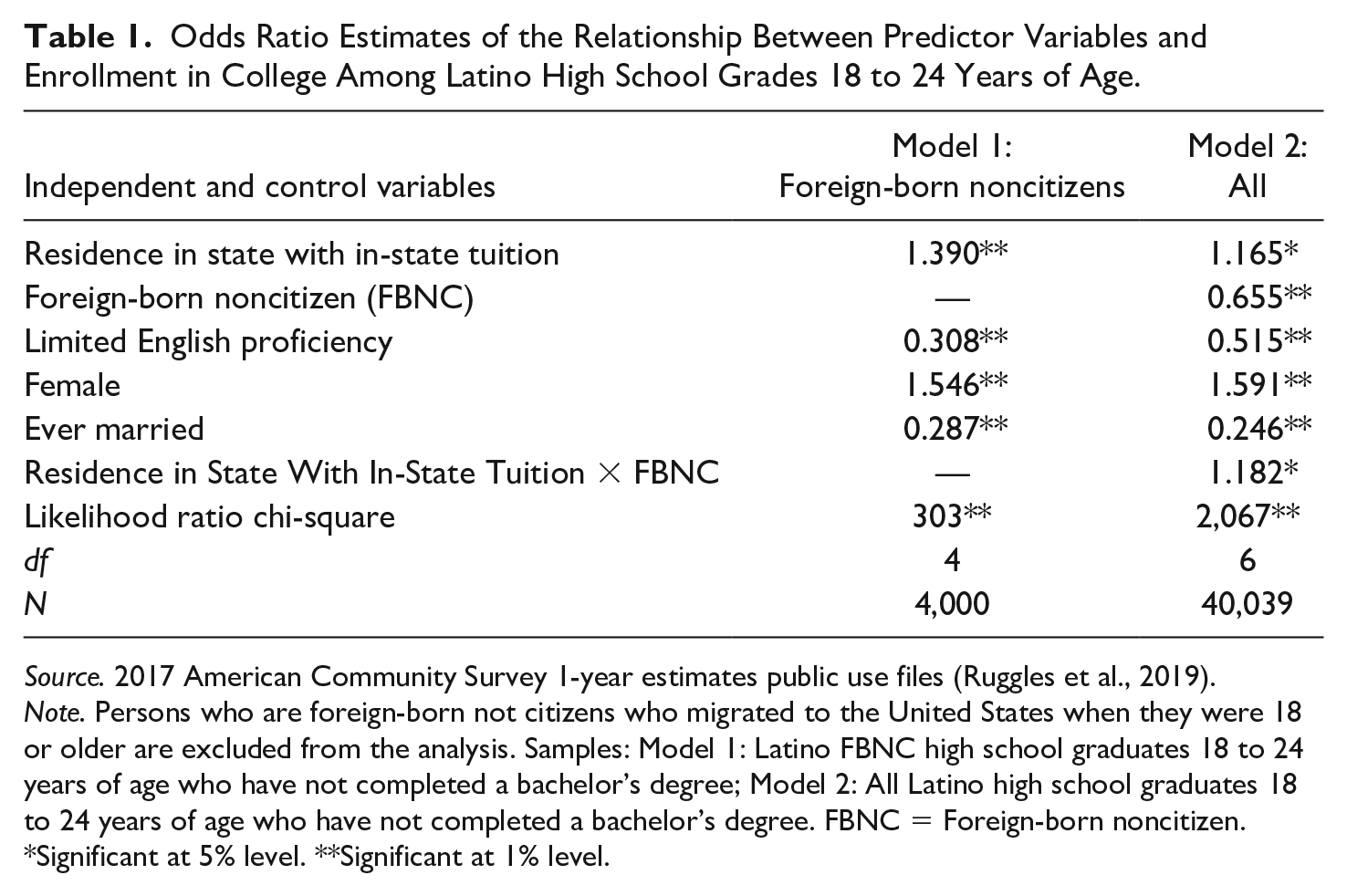
The odds ratio estimates from the logistic regression analysis testing this hypothesis are presented in Table 1 (Model 1). The relationship between residence in a state with in-state tuition and college enrollment is statistically significant. Latino FBNC high school graduates who live in a state with in-state tuition for unauthorized students have odds of being enrolled as undergraduates that are 39% higher than those who live in states that do not have such legislation. Thus, the first hypothesis is supported. In addition, the three control variables are significantly associated with college enrollment. Persons with limited English proficiency and those that have ever married are less likely to be enrolled in college than their respective counterparts, while females are more likely than males to be attending college.
Odds Ratio Estimates of the Relationship Between Predictor Variables and Enrollment in College Among Latino High School Grades 18 to 24 Years of Age.
Source. 2017 American Community Survey 1-year estimates public use files (Ruggles et al., 2019).
Note. Persons who are foreign-born not citizens who migrated to the United States when they were 18 or older are excluded from the analysis. Samples: Model 1: Latino FBNC high school graduates 18 to 24 years of age who have not completed a bachelor’s degree; Model 2: All Latino high school graduates 18 to 24 years of age who have not completed a bachelor’s degree. FBNC = Foreign-born noncitizen.
Significant at 5% level. **Significant at 1% level.
The focus now turns to the examination of the college enrollment gap between Latino FBNC high school graduates 18 to 24 years of age and their peers who are U.S. citizens. The current analysis involves the examination of the hypothesis predicting that Latino FBNC high school graduates are less likely to be enrolled in college than those who are U.S. citizens, but that FBNCs receive an enrollment bump when they reside in a state that offers in-state tuition. The results are presented in Table 1 (Model 2). The findings show that FBNC is significantly related to college enrollment. Latino FBNCs have odds of being enrolled in college that are 34.5% lower compared with persons who are U.S. citizens. In addition, residence in an in-state tuition state is also significantly related to college enrollment. Latino high school graduates who live in a state granting in-state tuition have odds of being a college student that are 16.5% higher than those of their peers who live in states that do not make this allowance. The three control variables are significantly related to enrollment in the same way as in Model 1.
Moreover, the interaction term is statistically significant. Thus, Latino FBNCs who live in a state with in-state tuition have odds of enrolling in college that are 18.2% higher than those of Latinos who are U.S. citizens and who live in states that do not offer in-state tuition. While the predicted enrollment bump is borne out, there continues to be a citizen–noncitizen gap in enrollment that is reduced but not eliminated. The odds of FBNCs being less likely to be in college drops from −34.5% (odds ratio estimate for FBNC in Model 2) to −16.6% (derived from −34.5% [odds ratio for FBNC] + 18.2% [odds ratio of interaction term]). In sum, the odds of FBNCs being enrolled are still negative (−16.5%), but not as deep (−34.5%) as they would have been if the analysis did not account for whether the states of residence offer in-state tuition.
Conclusions and Implications
Demographic shifts associated with an aging NH White population and a youthful Latino population have contributed to changes in the nation’s undergraduate students. Latinos now make up the major portion of growth in the nation’s undergraduates. Undergraduate enrollment declined by 1.7 million for NH Whites between 2009 and 2017 but increased by 1.1 million for Latinos. While 49 states sustained declines in their NH White undergraduate enrollments between 2009 and 2017, 48 states plus the District of Columbia experienced gains in their Latino undergraduate students. These trends will undoubtedly continue given a decline of 7.2 million children between 2000 and 2017 among NH Whites and an increase of 6.4 million children among Latinos (author’s estimates from the ACS data). Furthermore, examination of the most typical undergraduate students—high school graduates 18 to 24 years of age without a bachelor’s degree—shows that the number of NH Whites in this group peaked in 2009 at 14.1 million and fell to a low of 12.5 million in 2017 (author’s estimates derived from ACS data). In contrast, there have never been more Latino high school graduates 18 to 24 without a bachelor’s degree than in 2017, the last year for which data are available. These data point to the increasing importance of Latinos for the sustainability of the nation’s many colleges in the coming decades.
Nonetheless, Latino youth continue to experience significant challenges in making the transition from high school to college. These difficulties include limited economic resources, but they also relate to the unique demographic profile of Latino young adults, many of who are undocumented, who have limited English fluency, and who are first-generation college students. The results of the analysis presented here show that Latino FBNC young adults are less likely to be enrolled in college than their peers who are U.S. citizens. However, the findings show that they are more likely to pursue a college education if they live in a state that offers in-state tuition for undocumented students who graduated from local high schools.
Thus, one of the major implications from the researchers’ findings is that there is a critical need for the enactment of immigration and educational policies that facilitate the transition of undocumented students from high school to college. Higher education leaders need to work with their K-12 counterparts as well as with community leaders from other industrial sectors to increase the number of states offering undocumented students in-state tuition to attend college and the enactment of a national immigration policy that provides Dreamers and DACA holders a path toward citizenship. The attainment of U.S. citizenship status among Latino youth will undoubtedly benefit higher educational institutions that will increasingly depend on Latino students to maintain their enrollments. The nation, states, and communities stand to more fully reap the demographic dividend (Nuñez & Murakami-Remalho, 2012) associated with a maturing Latino young adult population when they become naturalized citizens and can take advantage of educational and employment opportunities and contribute to the greater public good.
As of 2017, 30 states and the District of Columbia did not offer in-state tuition to undocumented students who completed their high school degrees locally. Twenty-two of the 31 states (including District of Columbia) had declines in their overall undergraduate populations between 2009 and 2017. More than 120,000 Latino FBNC high school graduates 18 to 24 years of age without a bachelor’s degree live in the 31 states that do not allow unauthorized students to pay in-state college tuition, accounting for 21.5 % of all such FBNCs in the country (author’s estimates derived from ACS data). Of the 31 states, seven had more than 5,000 Latino FBNC high school graduates 18 to 24 years of age without a bachelor’s degree: Arizona (15,744), North Carolina (14,885), Georgia (11,824), Virginia (11,012), Nevada (10,857), Pennsylvania (7,493), and Indiana (5,521). Five of these seven states experienced declines in their undergraduate students between 2009 and 2017.
There are additional programs and practices to help connect and prepare Latino youngsters to higher education to provide more seamless avenues to college. Such efforts are particularly important for first-generation students and groups that have historically been marginalized from higher education. For example, collaborative P-20 partnerships linking the community, the K-12 system, and higher education institutions are increasingly popular (Núñez & Oliva, 2009). Núñez and Oliva (2009) have identified common elements of successful P-20 collaborations, which include “trust among stakeholders, communication between stakeholders, targeted financial resources, human resources (including personnel dedicated to the partnership), and data collection or systems to monitor progress” (p. 334). In addition, given that approximately half of Latino college students are attending 2-year community colleges (Krogstad, 2016), it is imperative that strategies be developed to retain students and transition them to 4-year institutions. In this regard, the theoretical work of Nora and Rendon (1990) is instructive. They approach the individual student in a wholistic fashion linking student background factors to student initial commitments, to student academic and social integration, and to student predisposition to transfer. The model provides a guide for student counselors and educators to help Latino students transition from 2- to 4-year programs.
Student debt is increasingly problematic for students in general, but particularly for persons with limited resources such as Latinos. The lack of financial resources or financial aid impede Latino students from enrolling in college as well as in making the transition from community colleges to 4-year institutions (Crisp & Nora, 2010). In addition, more hours of work, especially off-campus, also hinders enrollment and persistence (Crisp & Nora, 2010). Nora (2003) refers to these impediments—work and lack of financial resources—as factors that pull away students from entering college and from successfully completing their school. Therefore, financial resources are extremely important for Latinos. To this end, colleges and universities are increasingly developing “free tuition” programs for students with limited resources. This is a favorable trend. However, one concern regarding these programs is that they sound better than they actually deliver. For example, the free tuition comes primarily from Pell grants with students still having significant expenses not covered, especially with respect to living expenses, book purchases, and so forth (Powell, 2017; Smith, 2018). For colleges and universities to attract the large pool of Latino students, they will need to create attractive financial packages that will help meet the great majority or all of the expenses of students with limited resources. Certainly, colleges and universities will need to put together enticing financial packages to maintain or increase their enrollments in the new demographic environment of higher education.
In sum, over the last three decades the growth of Latinos in higher education has been quite impressive. Latinos are the biggest contributors to the U.S. undergraduate population. Yet, Latinos face many challenges related to a diverse population that includes undocumented students, English-language learners, first-generation college students, and persons with limited economic resources. Higher education institutions will rely increasingly on Latinos to fill their classrooms. They will also need to play an active and collaborative role in easing Latino students’ transition from the K-12 level to success in higher education (Núñez & Oliva, 2009).
Footnotes
Declaration of Conflicting Interests
The author(s) declared no potential conflicts of interest with respect to the research, authorship, and/or publication of this article.
Funding
The author(s) received no financial support for the research, authorship, and/or publication of this article.