







Abstract
Few studies have investigated the usefulness of internships at Hispanic Serving Institutions (HSI). Focusing on a 4-year public university (HSI), this study examined differences between the internship and the non-internship students, and changes across the semester for development. A structured internship appears to have some value; including increased interaction with faculty outside the classroom, confidence in verbally expressing ideas, and class presentations.
Over the last 25 years, the number of students taking college internships has greatly expanded. In 1992, only 17% of students reported doing an internship during their college years (Waxman, 2018). In 2008, more than half of them reported being an intern and by 2017, 62% said that they were. Often these internships are linked to a designated college course where students regularly discuss the internship experience as well as engage in other career development activities. While some internships are paid, about half are not, which has important consequences for minority students who often need paid employment (Crain, 2016; Waxman, 2018).
Previous studies have found some positive effects of internships and service learning experiences, which, draw on real-world activities to illuminate course concepts and ideas (George et al., 2015; Gilbert et al., 2014; Hiller et al., 2014). However, one of the major criticisms of internships in particular is that they often do not lead to paid work opportunities, and students have to pay tuition to get course credit for unpaid work (Crain, 2016). Compared with non-internship students or those with paid internships, studies have found that students who complete unpaid internships have more challenges in seeking employment and lower satisfaction with their internship (Crain, 2016; Perlin, 2012; Waxman, 2018).
Much of the research that has been done on internships has focused on traditional college students (Crain, 2016). Few studies have examined the usefulness of internships for students from nonresidential colleges, which poorer, first-generation and minority college students are more likely to attend. The majority of U.S. college students live off-campus with the proportion increasing substantially in more urban areas (Dedman, 2018). In addition, African American and Hispanic students, who are often first-generation college students, are increasingly making up a larger share of the 4-year college population, constituting 12% and 20%, respectively, at public institutions (National Center for Education Statistics, 2020). An assessment of what taking an internship for credit does for students at Hispanic Serving Institutions (HSI) would be particularly valuable given their time, energy, and money-related costs.
Focusing on a nonresidential HSI that offers a 4-year public college education, this study examines differences between internship and non-internship students and changes across the semester for internship students in their confidence in career readiness, engagement with faculty and other authorities, academic-related skills, and willingness to help their communities. The findings show that structured internships at a representative HSI appear to have some value, including increased interaction between faculty and students outside of the classroom, and confidence in verbally expressing ideas and presenting in class.
Minority Serving Institutions and Demographic Changes
Over the last two decades, the proportion of students from minority backgrounds attending college has increased substantially. According to the U.S. Department of Education, since the 1980s the minority undergraduate enrollment rate has grown by 146% (Flores & Park, 2013). From 2010 to 2019, the percentage of African American students, age 25 and older with a bachelor’s degree or higher rose from 19.8% to 26.1%; Asians from 52.4% to 58.1%; and Hispanics from 13.9% to 18.8% (U.S. Census, 2020). These increases are occurring at the same time that the U.S. minority population in general is growing. As of 2019, the Hispanic community has become the largest ethnic minority group, representing 18.5% of the U.S. population in 2019 (U.S. Census, 2019). For many Latino students, higher education can greatly improve their quality of life and social mobility.
Minority-serving institutions (MSIs) have played a major role in supporting students from underrepresented populations in obtaining an education. MSIs initially emerged in response to a history of inequity, significant demographic changes, and a lack of minority people’s access to majority institutions (Gasman & Conrad, 2013). Now an integral part of American higher education, MSIs—specifically Historically Black Colleges and Universities, Tribal Colleges and Universities, Hispanic Serving Institutions (HSIs), and Asian American and Native American Pacific Islander Serving Institutions—have carved out a unique niche in the nation, serving the needs of low-income and underrepresented students of color (Gasman & Conrad, 2013). The focus of our study is the usefulness of internships for students at HSIs.
Like other MSIs, over the last 25 years the United States has seen rapid growth in the number of higher education institutions designated by the federal government as HSIs. To receive this designation, these institutions’ undergraduate full-time equivalent enrollment must be at least 25% Hispanic with at least 50% of the Hispanic student body coming from low-income backgrounds (Hispanic Association of Colleges and Universities, 2021). These institutions are accredited, degree-granting and public or private nonprofit colleges or universities (Cailloux, 2014; Gasman & Conrad, 2013). They were created to increase Latino/as’ access and achievement in higher education (Zakarian, 2020). In 2018–2019, there were 539 HSIs located in 27 states, the District of Columbia, and Puerto Rico (Excelencia in Education, 2020)
The invention of HSIs in the 1980s was grounded in the theory that institutions enrolling larger concentrations of Latino students would adapt their institutional practices to serve these students better (Santiago & Andrade, 2010). For example, many students at HSIs do not have English as their first language, creating challenges for learning and excelling in English language classes. With their HSI designation, these institutions are better positioned to orient resources, such as English language development, for a large Hispanic-speaking student population, as well as offer courses and opportunities that are of specific interest to this population.
Barriers to Success
Although the number of Hispanic/Latino students attending and graduating from college has increased over the last 25 years, there are many barriers that impact their experience in college and after graduation. From the perspective of Latina/o Critical Theory several factors, including race, class, gender, language, immigrant status, and accent, intersect to contribute to lower rates of academic achievement among Latina/o college students (Gonzalez, 2016) and influence their economic mobility after college.
Once in college many Latina/o students may find that the curriculum does not represent their own histories, most of the faculty are not from the same racial/ethnic background as the students, experience challenges of being a “non-traditional” student, and have to contend with micro aggressions. Most Hispanic Serving Institutions (HSIs) were initially predominately white institutions. Because of demographic changes, they later obtained an HSI designation, but they typically retained many of the same policies, infrastructure, and faculty demographics that were not necessarily meant to serve a growing Latino/a student population (Morales, 2020). Many Latino/a students in higher education are also first-generation college students, from low-income backgrounds, have less academic preparation than their peers, and are geographically concentrated in a small number of states and institutions of higher education throughout the United States (Santiago et al., 2004). In particular, the obligation of having to balance learning in college with earning a paycheck can have a major impact on experiences during college and after graduation (Carnevale et al., 2015).
Regarding the career paths of students of color, there are additional employment-related barriers. African American males, for example, often lack the social capital of a professional network that can support acquiring job opportunities, may have to contend with negative perceptions based on their name or other affiliations, such as fraternities, that would identify them as Black and also encounter racial micro aggressions (Suddeth, 2015). Latino/a students are likely to experience similar types of discrimination regarding their college experiences and employment prospects. Internships may be one opportunity that could help Latino/a and other minority students overcome at least some of the barriers to academic and career success. At the same time, many internships are uncompensated, creating an extra burden for low-income students who have to forego valuable paid work to make time for the internship and pay tuition for the opportunity.
Internships and Experiential Learning
A number of studies have examined internships and experiential learning, which uses real-world activities to illuminate classroom subjects (George et al., 2015; Gilbert et al., 2014; Hiller et al., 2014; Thompson et al., 2016). This work has found some positive outcomes. In their meta-analysis of 62 studies of service learning programs, Celio et al. (2011) found that compared with students who did not participate in an opportunity, those who did demonstrated significant gains in five areas—attitudes toward self, school and learning, civic engagement, social skills, and academic performance, with the largest gains exhibited in the final category. Likewise, Warren’s (2012) analysis of 11 studies found that service learning increased college students’ learning outcomes. And Hiller et al.’s (2014) outcomes assessment of Temple University’s internship program found that some aspects of career preparedness improved for the interns relative to non-internship students.
While research has found that internships and service learning opportunities have some positive student outcomes, the biggest criticism of internships in particular is that they often do not lead to paid work opportunities. In addition, students have to pay tuition to get course credit for unpaid work, which may be a particular challenge for students at Minority and Hispanic Serving Institutions (HSIs or MSIs). In a 2016 report by the NACE Foundation, Crain (2016) examined how unpaid internships impact factors such as full-time employment and job satisfaction. He found that compared with students who completed a paid internship, unpaid interns were 10% less likely to rate their experience as “extremely beneficial,” and 6 months after obtaining their degrees, they were more likely to still be seeking employment. Several other studies have found similar differences between paid and unpaid internships (Perlin, 2012; Waxman, 2018).
Much of the research that has been done on internships has focused on traditional college students who live on residential campuses. Indeed, we could not find a single study that explicitly focused on internship activities at 4-year HSIs or MSIs. The research that comes closest is a 2016 study of the impact of academic service learning on students from four City University of New York community colleges (Ellerton et al., 2016) all of which have a HSI or MSI designation. Although Ellerton et al. (2016) examined a wide range of different outcomes, they found only one statistically significant difference. Service learners were more likely than others to report that they would likely volunteer in the next 12 months.
The focus of Ellerton et al.’s (2016) study was community college students and service learning, which is different from internships, which are more oriented toward building career-related skills and advancement. An assessment of what taking an internship for credit does (and does not) do for students at a HSI would be particularly valuable given that research has found that internships may have a limited impact and the only study with a large minority student population found just one statistically significant effect. Moreover, as noted above, students from HSIs and MSIs more generally often need to financially contribute to their households while in college. Hence, an unpaid internship that requires several hours of unpaid work and a separate internship class can be costly. For these reasons, we study the results of an internship program at a 4-year college with both a MSI and HSI designation. Our study focuses on four areas of development: (a) perceived usefulness of an internship; (b) confidence, communication, and engagement with others; (c) academic-related skills; and (d) community involvement and willingness to help others. Our major research question is What effects does a formal internship program have for students from a four-year college with a MSI and HSI designation? We hypothesize the following:
Data and Methods
The data for this study were collected during the 2019 Spring Semester at a moderate sized nonresidential public 4-year college located in a large Northeastern City. As already noted, the college has both a Minority Serving and Hispanic Serving Institute (MSI and HIS) designation (45% Hispanic, 19% Black) where almost half of the students (47%) are first-generation college students, and half are foreign born (John Jay College of Criminal Justice, 2013). About 75% of internships listed by the college are unpaid. While most academic programs at the college do not require an internship, several of them allow students to take up to three internships for three credits each.
Our study evaluates the primary internship program at the college which is run through a centralized center with faculty from the students’ majors largely overseeing the internship class. The requirements for this program are the same regardless of major. All of the students must complete 96 hours (8–10 hours per week) of workplace related work, and finish the accompanying course, which meets for 15 hours throughout the semester, resulting in a letter grade. While the college offers majors in a wide range of areas (e.g., sociology, psychology, etc.), it focuses heavily on justice-related issues, resulting in a high proportion of criminal justice and criminology majors. In addition, the college does not have separate schools (e.g., School of Education) and some majors (e.g., nursing, education) are not offered. The centralized internship program and requirements where everyone interns for the same number of hours and the lower level of diverse majors enhances the context for discussion of informed comparisons.
To assess differences between internship and non-internship students, as well as changes over the semester for internship students, we utilized a pen and paper survey. The survey questions focus on four substantive areas (i.e., career, engagement with faculty/others, academic, and helping others) that previous research has suggested internships or service learning engagement may shape (Ellerton et al., 2016; Hiller et al., 2014).
To assess the reliability and validity of the survey questions, we did several things. First we drew on previous survey studies (i.e., Ellerton et al., 2016; Hiller et al., 2014) and discussions with faculty and staff that closely collaborate with the internship center to provide input into areas that they thought an internship would influence. We wanted a realistic understanding of what these internships might hypothetically do for students, especially given their short duration and the college’s justice-related focus. From there we developed the survey and pretested it on a group of internship and non-internship students. After examining the distribution of the responses to assess reliability (i.e., do they seem to consistently measure the same things for the internship and non-internship groups), we conducted focus groups with the students and staff to generate feedback on the surveys’ validity (i.e., do they seem to be measuring what we want them to measure). From there, we further revised the questions and worked with the research team to see if they made sense given the context.
For most questions we use a seven-category outcome (see Table 1 for all variable ranges). There is some debate about whether a five- or seven-category outcome is better (Babakus & Mangold, 1992; Devlin et al., 1993; Lewis, 1993; Preston & Colman, 2000). While some education-related studies use a 5-point scale (e.g., Ellerton et al., 2016), within the literature five category outcomes are not ubiquitous (e.g., Hiller et al., 2014). Based on our pretest and discussions with students and faculty, seven categories seemed most appropriate for many of our survey outcomes.
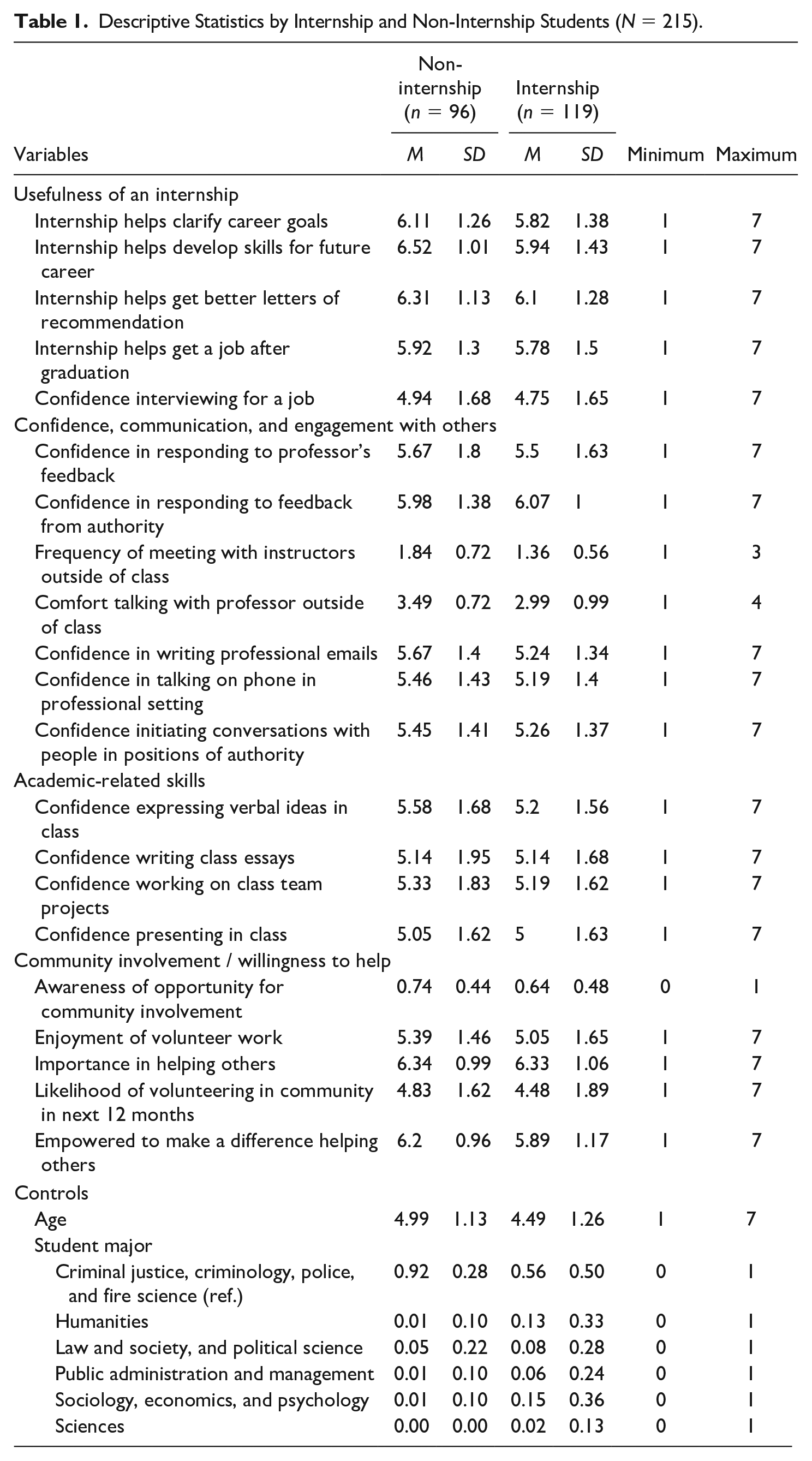
Descriptive Statistics by Internship and Non-Internship Students (N = 215).
The first set of questions were administered to students who attended the internship orientation on February 1, 2019. The second survey administration occurred at the end of the Spring 2019 semester when the internship students had completed approximately 3 months of their semester-long internship and was administered in their internship class.
Since this study was also interested in how internship students differ from those who did not complete a formal internship, a third survey was administered to a comparison group of non-internship students at the end of the Spring 2019 semester. We surveyed classes in majors or programs that offered the internship opportunity and when possible tried to select classes with upperclassman, which would better match the internship students’ college class. We excluded students who had previously completed an internship through the college (there were very few). The study received Institutional Review Board approval.
Table 1 offers insight into the content of the survey questions, as well as descriptive statistics. For all but three outcomes, the variables ranged from 1 = not confident/ poor/ extremely unlikely/ strongly disagree to 7 = very confident/ excellent/ extremely likely/ strongly agree. For the question that asked about the frequency of meeting with instructors outside of class, the response ranged from 1 = never to 3 = multiple times. For a question that asked about a students’ comfort in talking with professors outside of class, the responses ranged from 1 = never met to 4 = very comfortable. Finally, for a question that asked if students were aware of opportunities for community involvement, they could respond 0 = no or 1 = yes.
Our questionnaire also asked students to provide their major drawing on a list of 11 “major” categories, as well as write-in options. To be more easily analyzed as a set of dummy variables, we recoded these into a smaller group of majors. About 73% of people in the internship-only group (n = 84), which we use in our longitudinal analysis, provided a major that we could categorize and their breakdown by major was as follows: (a) criminal justice, criminology, police and fire science (68%); (b) humanities (11%); (c) society and law, and political science, which runs the former program (9%); and (d) public administration and management (8%). When we compare the internship (n = 119) to non-internship (n = 96) students, we have a larger group of internship students since the data were collected at one-time period and did not require matching student names. The majority (95%) of internship and non-internship students provided information on their majors. For the comparative analysis, the breakdown of non-internship versus internship students by majors was (a) criminal justice, criminology, police and fire science (92% vs. 56%); (b) humanities (1% vs. 13%); (c) law and society, and political science, which runs the program (5% vs. 8%); and (d) public administration and management (1% vs. 6%); science (0 vs. 2%); sociology, economics, and psychology (1% vs. 15%). In our analysis of internship versus non-internship students, we include major as a control, and in our internship-only sample, we assess whether or not major affects changes between W1 and W2.
Based on previous research and theory (Ellerton et al., 2016; Hiller et al., 2014; Warren, 2012), we also considered a range of control variables that might shape the outcomes. These include gender, race, whether students are living with family, financial aid status, college class (i.e., junior vs. senior), whether the internship was unpaid, and GPA. But, aside from major, which was only significant in a few models, age was the only other significant control variable. Age was measured with seven categories where higher numbers indicate an older age (1 = 18 and younger to 7 = 31 and older).
While the response rates were high (i.e., 100% at the beginning of the internship, 95% at the end of the internship, and 90% for the non-internship comparison), we had a lot of difficulty matching the names of the internship students across the two time periods (only 87 from a potential 132). The majority of students who could not be matched appear to have decided to drop the internship after taking the survey during orientation and before classes began, or enroll after the survey was administered. In addition, an estimated 10% of students at the college have a Deferred Action for Childhood Arrivals designation, possibly discouraging them from providing identifying information.
Analysis
We present two sets of results. First, we use regression analysis techniques to examine differences between internship and non-internship students. For all of the outcomes that are on a 7-point scale, we use ordinary least squares (OLS) regression techniques. For the one outcome that is dichotomous, we use logistic and for the remaining two that are on 3- and 4-point scales, we use ordered logistic. To save degrees of freedom and because they are the only significant controls, we include age and major in our multivariate analysis. We listwise delete across our sample, losing about 12% of cases. For all of the outcomes, we then produce marginal values for internship and non-internship students based on the regression results and controlling for age and major.
To examine changes in the outcomes for internship students at the beginning and end of the semester, we use one-sample paired t tests. This analysis provides a more accurate (and stringent) assessment of the “effect” that internships may have on students over the semester. We are focused on within-person change and do not have any variables that changed substantially over the internship semester. When we listwise delete across this sample, we lose three cases, which is about 3% of the sample. In a separate analysis, we also look to see if major affected change scores between W1 and W2, finding only three differences, which we report in the results’ section.
As noted above, we hypothesize that when there are differences internship students (compared with non-internship students), and students at the end of their internship (compared with the beginning) will be more likely to report that an internship is useful for their future job prospects, are more confident communicating and engaging faculty and other people in positions of authority, have more confidence in academic-related skills, and greater interest in and awareness of opportunities to help their community. Because of our hypotheses, we are able to anticipate the direction of expected relationships (University of California, Los Angeles, 2021). For this reason, we rely on a one-tailed significance test with a .05 p value. In addition, our sample size for the internship-only group is quite small (n = 84), limiting the power to detect significant effects, especially over the course of the relatively short single semester. We present results for .10 (light gray) and .05 p values (darker gray).
Results
The first set of results presented in Table 2 focus on differences between internship and non-internship students. Seven of the 21 outcomes show a significant positive increase for internship versus non-internship students. Specifically, internship students were more likely to report that an internship would help them develop skills for a future career. They were more likely to meet and talk with instructors outside of class and had more confidence in writing professional letters/emails and talking on the phone in a professional setting. In addition, internship students were more aware of opportunities for community involvement and felt empowered to make a difference. Several of the R2s are quite small, explaining a minimal amount of the overall variance. But, four of the outcomes—internships help develop skills for future career, frequency of meeting with instructor, comfort in talking with professor outside of class, and confidence in writing professional letters—explain 6% or more of the variance.
Regression Analysis of the Influence of Participating in a Formal Internship for Explaining Academic and Job-Related Outcomes, Controlling for Age and Student Major a (N = 215).
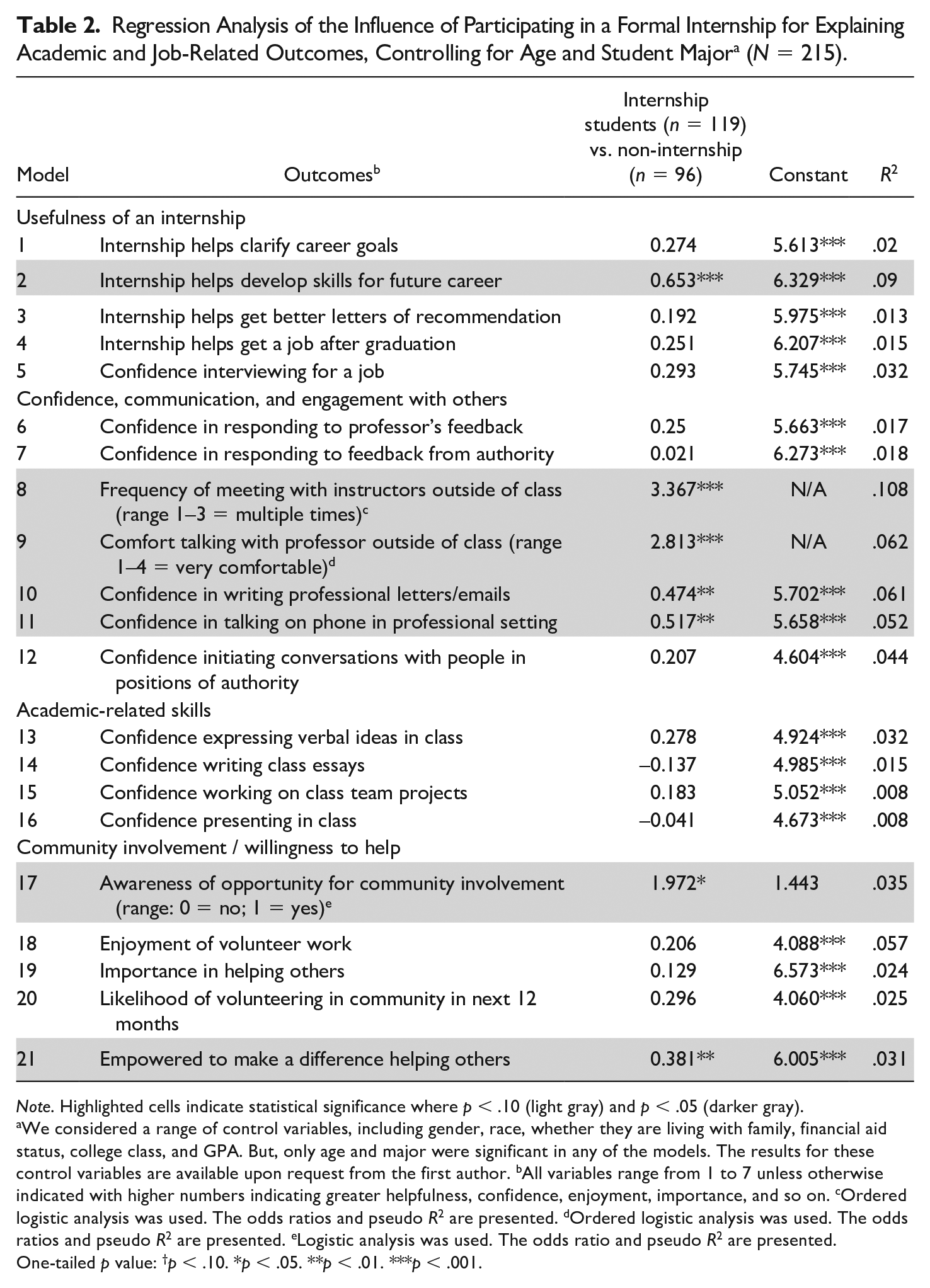
Note. Highlighted cells indicate statistical significance where p < .10 (light gray) and p < .05 (darker gray).
We considered a range of control variables, including gender, race, whether they are living with family, financial aid status, college class, and GPA. But, only age and major were significant in any of the models. The results for these control variables are available upon request from the first author. bAll variables range from 1 to 7 unless otherwise indicated with higher numbers indicating greater helpfulness, confidence, enjoyment, importance, and so on. cOrdered logistic analysis was used. The odds ratios and pseudo R2 are presented. dOrdered logistic analysis was used. The odds ratios and pseudo R2 are presented. eLogistic analysis was used. The odds ratio and pseudo R2 are presented.
One-tailed p value: †p < .10. *p < .05. **p < .01. ***p < .001.
The first two columns in Table 3 present the marginal values based on Table 2’s regression analysis and controlling for age and major. These estimates provide insight into how the internship and non-internship students differ from each other, but not whether the internship itself was related to the difference. The second set of columns focus on changes over the semester and provide a more rigorous assessment of how the internship itself and the accompanying class may have influenced the outcomes. Similar to what we saw in the first analysis, over the semester internship students became more comfortable talking with professors outside of class and marginally more likely to meet with them. In terms of academic skills, participation in the internship was related to increased confidence in expressing ideas and class presentations. Somewhat surprising, we find that by the end of the semester, students felt that an internship was less likely to help them clarify their goals and they were less confident in responding to feedback from authority figures (e.g., supervisors) (p < .05 with a two-tailed test).
Marginal Values, Means, and Significant Differences Between Internship and Non-Internship Students, and Internship Students at the Beginning and End of the Semester.
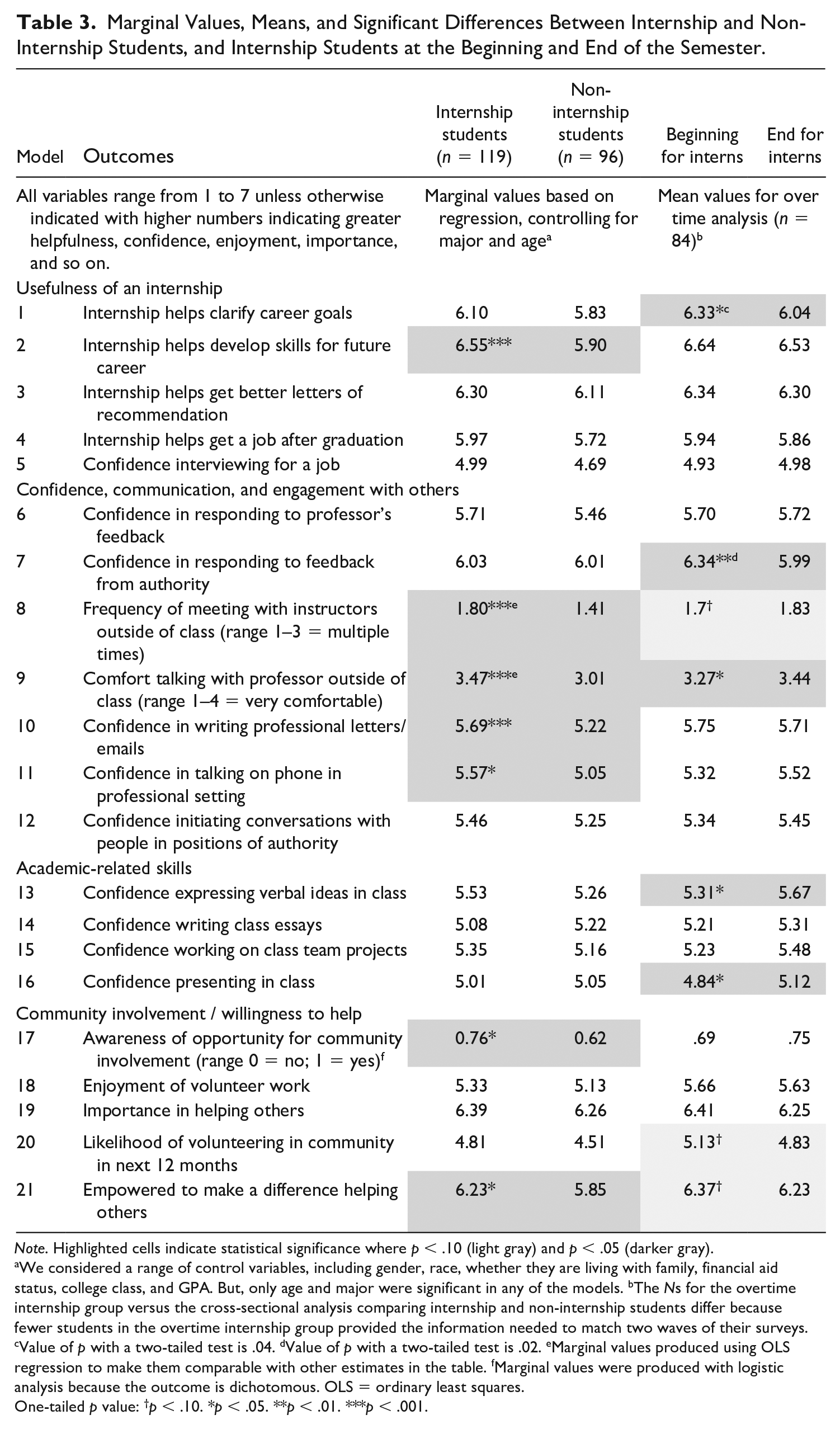
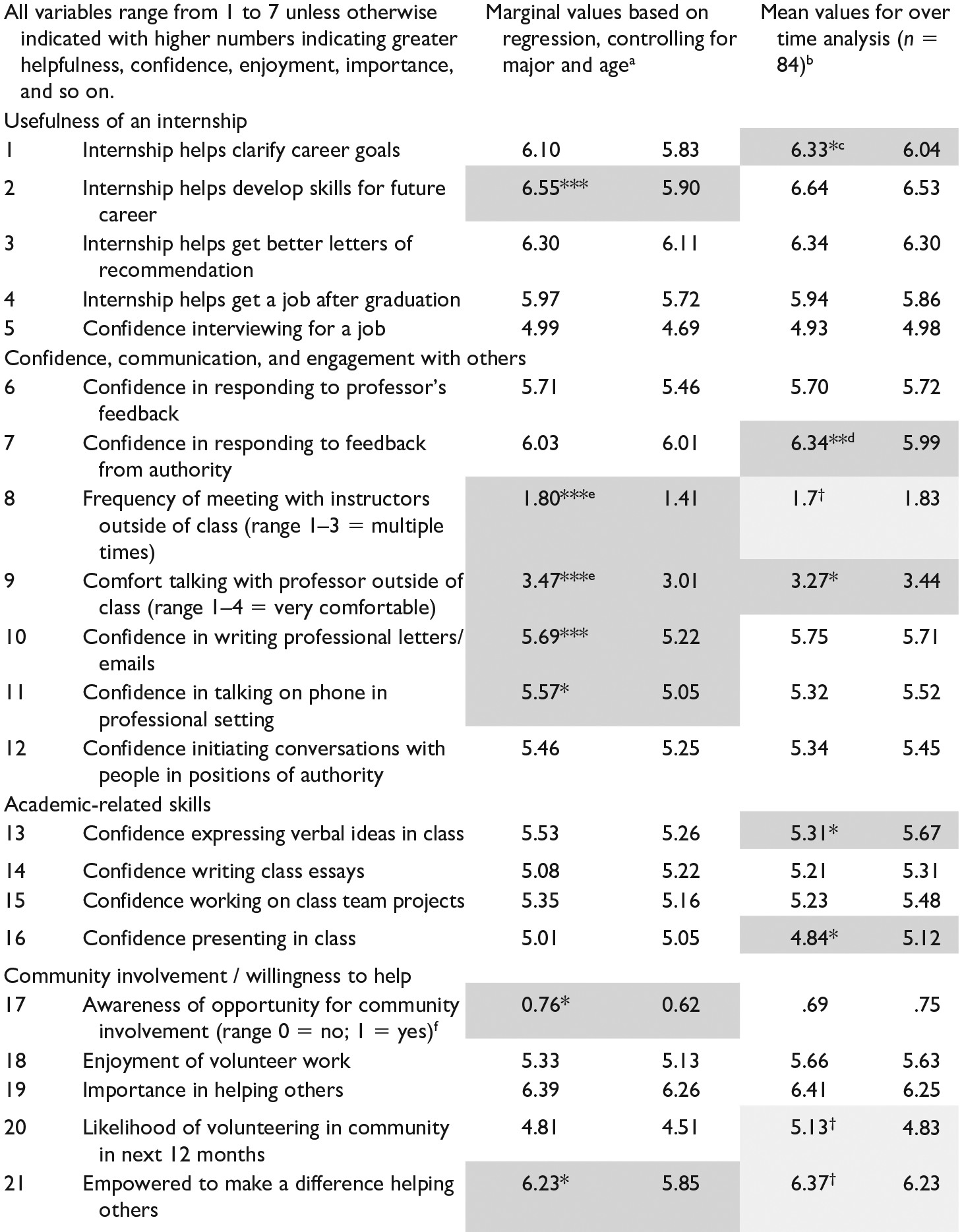
Note. Highlighted cells indicate statistical significance where p < .10 (light gray) and p < .05 (darker gray).
We considered a range of control variables, including gender, race, whether they are living with family, financial aid status, college class, and GPA. But, only age and major were significant in any of the models. bThe Ns for the overtime internship group versus the cross-sectional analysis comparing internship and non-internship students differ because fewer students in the overtime internship group provided the information needed to match two waves of their surveys. cValue of p with a two-tailed test is .04. dValue of p with a two-tailed test is .02. eMarginal values produced using OLS regression to make them comparable with other estimates in the table. f Marginal values were produced with logistic analysis because the outcome is dichotomous. OLS = ordinary least squares.
One-tailed p value: † p < .10. *p < .05. **p < .01. ***p < .001.
In a separate analysis, we used change score models to assess whether or not students’ major affected the change between T1 and T2. We found just three differences. Students who majored in law and society or political science were more likely than students from the humanities or criminal justice, criminology, police and fire science to report that they met with their professors outside of the classroom and felt comfortable writing professional letters. Likewise, they were more likely than students in other majors to say that they felt confident in responding to feedback from people in positions of authority.
Discussion and Conclusion
This study examined differences between students who did and did not complete a formal internship as well as changes over the semester for internship students at a 4-year Hispanic Serving Institution (HSI). There were several significant differences. However, for one outcome—confidence in interacting with professors outside of class—we found both over time increases, as well as significant differences between the internship and the non-internship student comparison.
A number of studies have found positive benefits for students interacting with professors outside of the classroom (Cox et al., 2010; Cuseo, 2018; Trolian et al., 2016), which colleges tend to encourage. The findings from this study suggest that internships may create additional opportunities for this type of engagement. Colleges may want to consider highlighting this benefit and make students and faculty aware that an internship, especially one that includes an accompanying class, may confer this added benefit.
Our over time analyses also suggest that either the internship itself or the accompanying course may be responsible for increased confidence in verbally expressing ideas in class. The content of internship classes at the college in this study vary across the different majors and programs, though they all share some similarities. All of the courses are likely to include discussions and presentations related to the students’ internships, as well as some form of professional development, such as discussions about micro aggressions or revision of a resume or cover letter. In addition to increased confidence in verbal expression, at the end of the internship, students also reported more confidence in making classroom presentations. It is possible that the internship and accompanying class provided an opportunity for students to discuss and present practical details about their experience, which increased their confidence in presenting and speaking in class. Future research might consider the wide array of ways that internship classes differ from others in form and content, and how these factors may increase students’ confidence in expressing themselves.
Compared with the beginning of the term, at the end internship students were less likely to say than an internship helped them clarify their career goals. At the beginning of the internship, many students likely had high hopes that it would bring clarity, which may have been a motivating factor for being an intern. But, the internship experience may have led them to question their career interests. This is not necessarily a bad thing. Faculty and staff may be able to capitalize on this finding by encouraging students to take an internship not only to discover what they want in a career, but also what they do not want to do. Future survey questions should clarify whether students are more likely to feel that the internship itself is not as useful as they anticipated for clarifying their career goals, or if the internship experience made them rethink their career goals.
We also found that compared with the beginning of the internship, at the end students reported responding more poorly to feedback from people in positions of authority, such as supervisors. However, they did not feel any differently about how well they reacted to feedback from professors. Taken together, these findings suggest that the internship experience provided them with an opportunity to better assess their ability to receive guidance from supervisors in a workplace environment. In other words, before doing the internship, students may have had limited experience with supervisors in a professional setting. During the internship semester, they may have learned more about themselves and become a little less confident in how well they could respond to feedback from people in positions of authority. Since they would have been taking classes all along, it is unsurprising that there was no change in their ability to respond to feedback from their professors.
There are some study limitations upon which we hope future research will improve. As noted, our sample size for the longitudinal analysis is relatively small and does not capture all of the internship students. In addition, only about three and a half months passed between the two survey waves. Hence, this was a fairly stringent test of within-person change. In a separate analysis, we also examined the influence of college major between the two waves, finding that students who majored in law and society or political science, which runs the former program, had better outcomes than students with humanity and crime-related majors in two areas—meeting with professors outside the class and writing professional letters, as well as more confidence in getting feedback from authority relative to all other majors. More research is needed to better understand if the majors themselves produced these outcomes, or if these internships are different in ways for which we could not account. In our study, some key internship aspects (e.g., length, class time, general content) were the same regardless of program or major. At other colleges, these characteristics may vary much more widely with some students engaging in much longer or intensive internships (e.g., major in education), which may produce different outcomes.
Despite the limitations of this study, the lone study that was done on experiential learning at Minority Serving Institutions found only one change over time—an increase in awareness of opportunities for community involvement (Ellerton et al., 2016). There are many differences between their study and ours. But, it seems that the current study of the internship program at a 4-year HSI is associated with more positive results than the service learning experience that Ellerton et al. examined at four 2-year MSIs.
Future research might consider conducting interviews or focus groups to better understand the processes underlying the major findings, such as why the internship students are interacting more with faculty outside of the classroom. Likewise, now that we have an understanding of some of the areas that are affected by participation in a formal internship, future surveys should ask more specific questions in those relevant areas. In addition, a survey of differences in the experience of internship programs at MSIs versus colleges with few minority students would illuminate the extent to which benefits vary. Finally, a lot of the criticism directed at internships focuses on their limited contribution for helping graduates secure college entry jobs (Crain, 2016; Perlin, 2012; Waxman, 2018). An evaluation of how internships for students at HSI and MSIs are related to graduates’ career advancement would be especially helpful.
This study provided insight into the positive outcomes that students at a minority-serving nonresidential urban college provide. Our study found some benefits, though there were several areas that were minimally affected. Students, faculty, and college staff need to carefully consider the tradeoff of encouraging formal internships for students from HSIs, as many might be able to get much needed wages elsewhere and could avoid paying tuition for an additional course.
Footnotes
Acknowledgements
The authors would like to thank Chantel Wright in help to coordinate the study, and Bosco Villavicencio and Alondra Rangel for helping to collect and prepare the data.
Declaration of Conflicting Interests
The author(s) declared no potential conflicts of interest with respect to the research, authorship, and/or publication of this article.
Funding
The author(s) disclosed receipt of the following financial support for the research, authorship, and/or publication of this article: This study received funding support from the Career Engagement Faculty Fellowship Program with the Experiential Learning/Internship Team at the Center for Career and Professional Development of John Jay College of Criminal Justice.
