







Abstract
We report on a qualitative research study that identifies both challenges and successes resulting from the implementation of a Peer Education program at an urban, Hispanic-serving, Tier 1 Research University. By drawing on the experiences of 29 peer educators, we demonstrate the ways that combining peer mentoring and tutoring provided benefits for those who were not only served but those who served them. Lessons learned are shared.
As more universities qualify as Hispanic Serving Institutions (HSIs), for many the focus has moved from admitting enough students to be labeled an HSI to serving the diverse student bodies that exist on campus. Efforts to improve Latinx student experiences, called “servingness” (Garcia et al., 2019), on these campuses have gained attention in recent years. The definition of an HSI requires 25% of students to be Hispanic, a threshold created by the federal government in 1992. However, many HSIs are more diverse than the designation suggests and making a commitment to serving all students is imperative (Garcia, n.d.). Our campus is one of only 16 universities in the nation that is both Latinx-Serving and a Carnegie R-1 “Very High Research Activity,” combining support services and research opportunities.
The space created and studied for this project was called the IDEAS (Innovation, Diversity, Excellence, Access and Success) Center. The IDEAS Center sought to increase the number of Latinx, first-generation, and high-need students who are academically prepared to enroll and complete their degrees by addressing “gaps” in student services and faculty development. The IDEAS Center was created to support the needs of Latinx and other high-need students. While Hispanic-Serving Institutions are labeled as such because of the number of Latinx students enrolled, in practice many HSIs serve more than Latinx students and have deep diversity (Garcia et al., 2019). Research on HSIs often centers exclusively on the outcomes for Latinx students, but the context at State University (pseudonym) required a different kind of service to Latinx students. As it will be shown later, 32.04% of the students served by the IDEAS Center are Latino students and we did it through a diverse group of PEs, not a largely Latinx one. As an HSI, the Center’s goal was to ensure the PEs responded to the intersectionality of experiences for our diverse student population, which included Latino as one element of a complex identities in addition to race—like ethnicity, first-generation, sexual orientation. Thus, the Center opted for PEs who could also engage with students’ myriad dentifications, many of which were similar to the Latino population on campus (e.g., 86% were first-generation, 36% were transfer students; Rodriguez & Gonzalez, 2020).
As such, in this qualitative research study we focus on the Peer Education (PE) program in the IDEAS Center. It utilizes a peer-led, holistic approach for supporting traditionally underrepresented populations, including Hispanic and First-Generation college students. For this study, we sought to understand the challenges and successes experienced by the Peer Educators, as they worked to meet student needs. This PE approach has been successful at supporting our students, and the lessons learned can guide other HSI institutions seeking to better support their FG, transfer, and Latinx students.
What Does the Literature Say?
Becoming an HSI does not automatically make an institution one that intentionally serves Hispanic students (Garcia et al., 2019). Intentionality is important; it demonstrates the institution’s commitment to ensuring student needs are addressed in and outside the classroom. Choosing servingness (Garcia, n.d.) requires explicit actions to directly impact both academic (e.g., completion, persistence) and non-academic outcomes (e.g., self-worth, civic engagement). This cannot be delegated to a few, but need to be institutional to ensure the institution is committed to improving student outcomes. A key aspect of servingness is improving students’ overall experiences. By “validating and positively influence sense of belonging,” students are able to see themselves as part of a community; mentoring and support programs directly impact students’ progress in academic programs, and in developing needed anchors for persistence (Garcia, n.d., Tinto, 2010). Peer tutoring (PT) and peer mentoring (PM) raise persistence rates among college students. PT promotes student success while complementing faculty instruction (Bakare & Orji, 2019; Provencio et al., 2018); it also empowers students to function as academic examples for those less prepared (Contreras & Contreras, 2015). In addition, the more skilled partner reinforces their own understanding and reinforces self-esteem (De Backer et al., 2015). Through these interactions, a greater understanding of class material emerges, personal connections develop (Arco-Tirado et al., 2020), and students’ identities are transformed through their sharing of experiences (Rodriguez & Gonzalez, 2020).
Unlike PT, PM provides a less structured opportunity to support students’ needs. Contreras and Contreras (2015) note that mentored students had higher persistence and graduation rates, and when combined with trained faculty, mentoring provided yet another tool to assist in the success of all students, not just those who may be FG or considered “at risk” for attrition. PM in higher education traditionally pairs a student with a staff or faculty member or pairs a more experienced student with a lesser experienced student to facilitate social support (Fleming, 2017). According to Tinto (2010), this connection correlates to increased retention and satisfaction (Chavez & Ysais, 2017). Social integration and feeling supported increase persistence and foster an inclusive environment (Favero et al., 2018). Palmer and Maramba (2015) found that FG students benefit greatly from “caring agents” (e.g., family, peers) who can provide information on navigating college; they also found caring agents to be crucial in facilitating conversations about college life. Much of the existing literature accounts for PT and PM between college students and elementary school children, which indicates a need for more research at the university (Colvin, 2015; De Backer et al., 2015; Goodlad, 2013).
Research points to the need for a combination of peer mentoring and tutoring (Goodlad, 2013). A peer mentor/peer tutor model benefits both students and peer mentor/tutor by improving social networks, while increasing knowledge retention, motivation, and persistence (Colvin, 2015). Common benefits of being a PM/PT include helping fellow students, becoming more familiar with the subject material, becoming better students themselves, and facilitating a variety of social connections (Taylor et al., 2014). Common complications with this approach include the following: (1) struggles with roles and expectations (Straus et al., 2013), (2) lack of thorough training (Goodlad, 2013), (3) difficulties with new learning models (Räisänen et al., 2020), (4) establishing appropriate boundaries, and (5) inadequate understanding of course materials (Colvin, 2015). It is important to mitigate these risks when combining the overall beneficial approaches.
Method
This qualitative case study evaluates the implementation of a PE approach at an HSI, from the PE perspective. We treat the IDEAS Center as a single case, with multiple participants, all detailing their individual experiences as a part of the collective group (Yin, 2009). This study was not part of the ongoing evaluations conducted as part of the grant (Amaro-Jiménez, et al., 2020). Instead, its focus is on qualitative data collected to answer the following research question: What lessons can be learned from the successes and struggles of PE participating in the IDEAS program?
Setting
A large, urban university in the Southwest, there are 49,461 students, with 18,425 online. Of the 24,534 enrolled in on-campus programs in the 2019–2020 year, 32.1% were Hispanic, 12.5.2% African American, 14.5% Asian, and 27.7% White. FG students represented 42.5%. A 48.46% of students enrolled were transfer, with 31.4% of this population being Hispanic. Five years ago, stakeholder data collected indicated a lack of initiatives available for FG, transfer and Hispanic students on campus. A little over a year after receiving the HSI designation, a 5-year Title V grant (IDEAS) was designed to support students through combined PM/PT.
Participants
Participants were all PE who worked for the IDEAS Center in the AY 2019–2020 (minimum of 1 semester), the fifth year of the program’s implementation. At the end of the Fall 2019 semester, all the PE working for IDEAS were invited to participate in a semi-structured interview. A total of 28 PE agreed to be part of the study (see demographics in Table 1).
PE Demographics.
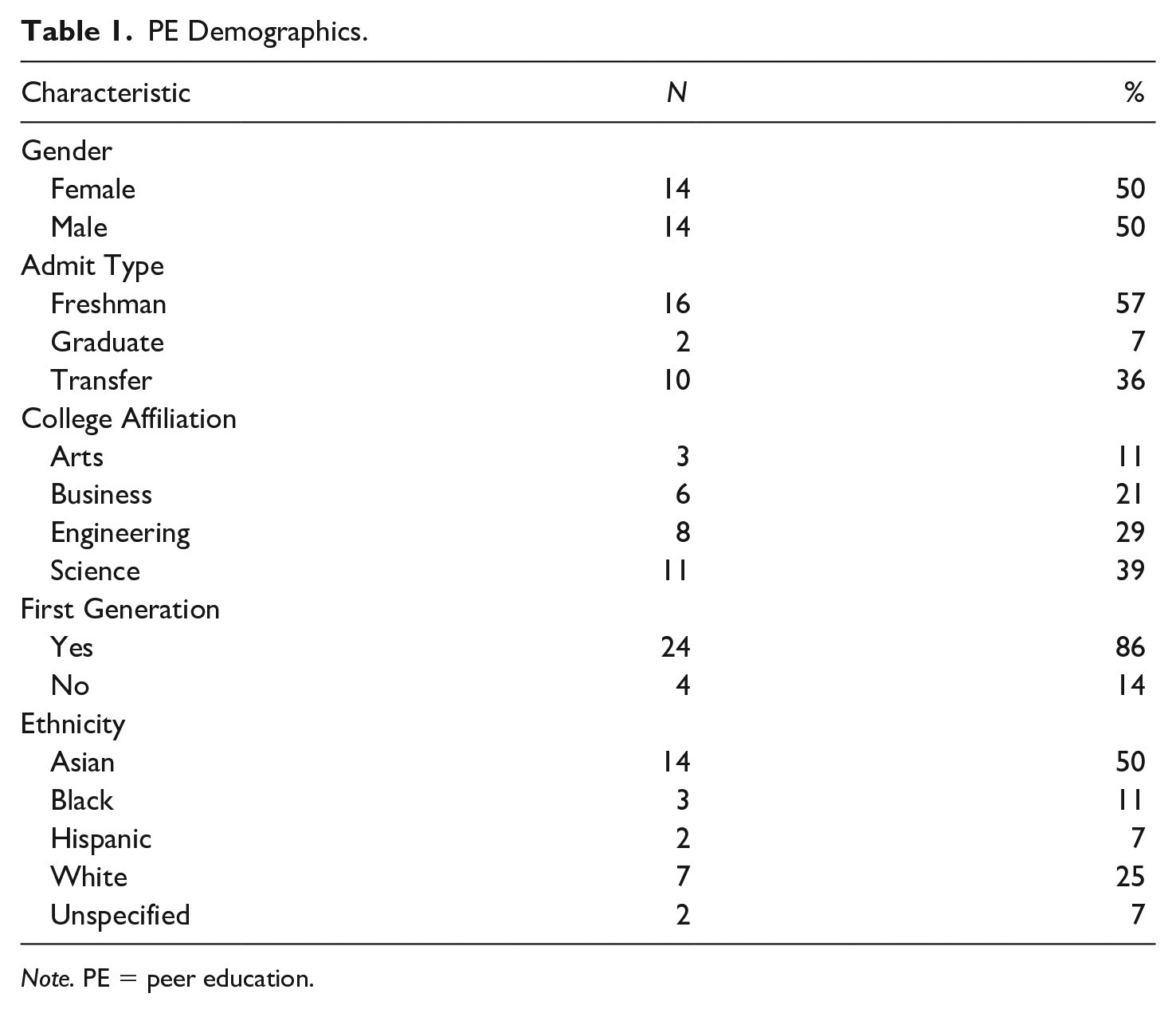
Note. PE = peer education.
The IDEAS Program
Institutional data indicated more support services needed to be available for transfer, Pell Grant, Black, Latinx, and Military students as well as students taking courses outside of the traditional 8–5 school day. Prior to IDEAS, student services were available past 5 PM, on weekends, and all tutoring services cost money and required an appointment. Thus, the IDEAS Center was structured to be walk-in, on-demand, and free with PE available Monday-Sunday. The space was designed to be comfortable and group-oriented, with flexible seating areas that had multiple places to plug in technology (something other spaces on campus lacked). With moveable partitions doubling as white boards, students created their own insulated space with walls and were able to work, study, and take breaks as needed. In AY 2019–2020, the program served 2,454 undergraduate students, of which 34.30% (N = 841) were transfer students, 32.04% (N = 796) were Latinx, 60.30% (N = 1,479) were first-generation college students, and 50.70% (N = 1,243) were recipients of the Federal Pell grant. A 97.5% of all served were undergraduates.
Data Collection and Analyses
Fourth Author (graduate research assistant at the time) conducted semi-structured, 20–30 min individual interviews. There were six questions falling under the following categories: (1) background, “Tell us about yourself (your background, your degree, etc.) and your educational trajectory/pathway,,” (2) reason why and expectations for becoming a PE (3) challenges and eye-opening experiences, and (4) impact on personal, academic, professional trajectories question dealt with the ways in which being a PE had helped and/or hindered their personal, academic, and professional trajectories, if at all. All interviews were audio recorded. To ensure trustworthiness, an approved university vendor first transcribed each interview verbatim, first and fourth author cross-checked that the transcriptions were accurate and complete, and deidentified the transcripts (assigned a number and pseudonym). The data were axially coded the data using NVivo, employing a spiral data analyses technique (Creswell & Poth, 2018), in three steps. First, we looked for overall trends in the data regarding challenges and rewards the PE experienced. We then began organizing/managing the collected data, reading and memoing emergent ideas. And third, we began to classify codes into themes, developing and assessing interpretations, and finally representing and visualizing the data. Codes were first marked as challenges and successes. We then analyzed the variety of challenges and successes marked and collapsed those into overarching themes. This meant the themes were categorized under these headings, and conceptualized this way in data analysis. Analyses were done across the diverse group of participants, and they were not categorized by race, gender or ethnicity. Instead, we looked for salient themes, found across all the participants.
Study Limitations
One of the limitations of this study is that it was focused only on the PEs. While needed for these research questions, we recognize a need to focus on the students served in the future. Further research indicating a continuity or disconnect from the PEs’ perspectives would be invaluable. In addition, studies that look at both participant groups together would be beneficial. The COVID-19 closings and the move of all services online also needs to be addressed. Very few campuses were prepared to pivot and offer this kind of service to students immediately upon campus closure; data focused on this move, student interactions with PE, and benefits and challenges of the services provided are important for the field at large.
Findings
Challenges of the Peer Education Approach
While PE were learning on the job and serving many students every day, there were also challenges they encountered. Highlighting these initial difficulties is important as they lend depth to the analysis of the program’s growth. Three challenges seen most often in the data were (1) feeling unprepared, (2) learning flexibility, and (3) meeting needs.
Feeling unprepared
While PE considered themselves content area experts, many felt unprepared to work with students from other disciplines (Colvin, 2015). Because previous PT on-campus was limited to specific subjects, many PE believed their responsibility was to share everything they knew about the courses they were initially hired to cover. However, they quickly learned the fluid nature of this job and the combined approach used toward meeting students’ needs, as Michael stated: “I was quite scared, because . . . you think you need to be the person who’s just spilling knowledge, and you just have all the answers.” This was not a unique perspective; many described challenges that arose from feeling they were not experts all the time. Being a PE meant that they had to be available to anyone who came in for help; Mary stated: “So at first it was really challenging. Because we get the hardest questions. Like, it’s a walk-in visit. So, they just come and pick a course and then they might ask you the most difficult questions that they couldn’t figure out.” The PE had to relax into the complexity of this role and learn to be comfortable working with a variety of students. This required flexibility.
Learning flexibility
PE, as they continued working with students, identified learning flexibility as a key challenge. Michael explained: “But I’ve noticed in the job, you have to be very flexible. Each student is different. It’s not like you can start every conversation, every session, the same way. You have to adjust to each student.” Adjusting to each student took time and effort. For many, this adjustment entailed approaching their work from various angles, a challenge, though one they embraced. Tammy explained: “ . . . not everyone gets the same topic in the same way, so if someone doesn’t get it one way, you have to try to explain it in another way that’s more relatable to them.” They employed a variety of strategies, including returning to personal resources from previous courses. One PE stated, I have my old textbooks and, like, study tools that I leave here, so that if I ever need them, I can bring them out to students. And, like, try to go back through my old notes and see if I can remember it from that, too.
This approach and the associated challenges were new because the program was unique to the campus.
Meeting needs
One of the biggest challenges faced was knowing how to meet individual student needs. Some students sought the PE’s support after having worked a full shift, others came to campus with their children, and others were attempting to balance work, life, and academics. Part of the training the PE received was how to combine tutoring and mentoring so they could focus on the hows and whys of what they were learning, rather than helping students complete assignments. PE were trained in the art of asking questions and in inquiry models. As a model that was often unfamiliar to those served, this presented unique challenges. Elmer explained, “Sometimes they’ll be: ‘Do this for me,’ and, ‘Why can’t you do this for me?’” For PE, having to communicate why their role was different was not easy; Marilyn described a student encounter this way: “ . . . she wanted me to provide the answer . . . And then I told her I cannot tell her the answer. She was mad at me and that was hard to handle.”
Drawing the line between being supportive of students’ needs versus not doing their homework, not surprisingly, proved to be an ongoing challenge. While they wanted to support students as much as possible, their role also implied mentoring students into college-related expectations: Some will actually start skipping class and they’ll come just to tutoring . . . But sometimes you just catch them, you’re, “Wait, have you actually gone over this in class?” They’re, “Oh, I don’t go the lecture, anymore.” That’s where the mentoring comes in. “Your parents are paying for that class or you may be paying for the class, so go to class. I’ll help you with additional topics but you need to study it and learn it initially.”
This quote really identifies the PE’ mentoring abilities and recognizing the challenge of helping students succeed long term, rather than focusing on a single problematic assignment. PE’ goal was to ensure students understood key concepts/topics to support their educational journey, but often there was the initial challenge of helping students understand the whys.
Successes of the Peer Education Approach
While the PE highlighted some challenges from the work they did, they also were eager to point out their successes, with three of them being the most prevalent: (1) sharing personal experiences, (2) filling a need, and (3) being part of a safe space.
Sharing Personal Experiences
Hiring PE who reflected the students served was a priority. IDEAS was very intentional in hiring PE whose backgrounds and college experiences resembled those of the overall university (e.g., 86% were first generation, 36% were transfer), to ensure that they could capitalize on their own personal experiences and college journeys when working with students. An important success of this hiring intentionality was seeing the PE become not just someone the students could relate to, but it gave them an opportunity to see themselves as role models for others. As Mariah explained, “I’ve been there and I’m—and I’m a student, so I’m still there. . .I let them know that they can come to me and [say], “I don’t know how to adjust to life on campus. I don’t know how to handle these classes.” PE being able to reflect on their own experiences (“I’ve been there”) and being approachable meant our participants saw themselves as mentors very quickly.
At the same time, sharing stories of overcoming hurdles became synonymous with serving as a PE, and they leveraged these experiences to help students navigate those obstacles they were currently facing: I helped the student that was like a sophomore, just letting him know it’s okay, you’re not dumb; I went through the same thing. And then giving him advice on what professors to take that might be able to explain it a little bit better.
Any situation in which PE found themselves helpful to students was marked as a success. They were particularly fond of recalling times when they were able to help students recognize their potential via a mentoring while tutoring (“You’re not dumb; I went through the same thing) and how academic advice often flowed organically (“giving him advice on what professors to take that might be able to explain it a little bit better”). Discussing similar experiences helped normalize struggles for the students they served, and the PE regularly drew on their own learning journeys: It’s a relationship too. Especially you have these students being super vulnerable coming up to you and saying, “Hey, I need help.” That takes a lot of vulnerability on a person to say, “I’m not getting this. I need to do something about it.” I think the only way to also let them know too is to also be vulnerable in front of them too . . . it’s okay if you don’t always know the answer. If you are at least willing to say, “I’m going to help you find the answer with you—together, we’ll do it together.”
Vulnerability and not being alone (“we’ll do it together”) led PE to reflect on their own journeys and to fill needs in ways that were not available to them.
Filling a need
Many PE wished for particular kinds of help when they first transferred to our campus. Thus, they reimagined their own experiences with their current students in mind. Becoming the person students could go to was a success many spoke about, listing it as a need rarely met on large campuses. Juan said, I’m a transfer student and I really had to learn how to study different and stuff once I came to [Institution] ‘cause there’s a lot difficult, more difficult. So I was like, okay, I feel like I’m really suited for that position.
Just being a transfer student, knowing what is was like to switch to an R-1 (“I really had to learn to study different”) during their student careers, gave them a starting place to helping others. Michael stated, . . . when I transferred here, yeah, it was hard for me. I had to drop classes. I had to learn to study again. Like I basically had to learn it all ‘cause I was a FG college student and I didn’t have anybody to ask for to help. But now I can be that person to ask for help for them, you know.
Traditional program structures—degrees, majors, advising—did not provide the kind of unique help many transfer students on campus look for (“I didn’t have anybody to ask for help”), but these PE were able to become “that person to ask for help.” Michelle added, “So the IDEAS program really stuck out to me, because it was geared towards FG college students and transfer students, and I’m both. So, I was, like, “You know, that’s—I feel like I could really connect there.” They were drawn to the program for this reason initially (feeling like they “could really connect”), and it became an ongoing success for them.
Being part of a safe space
Building safe spaces with the students they worked with was a success PE discussed. One of their major tasks was to ensure students understood that seeking help was an important and necessary step. For Alison, this role was important, and building a space free of judgment was imperative: “The openness students feel when they have a peer tutor who can guide them. They don’t feel comfortable talking to professor, but here they do.” Students learn in spaces where they feel safe. Friendship on the part of the PE was important to many. Nadia stated, If the students feel like they are friends, they can come to us about anything, and then they will feel more comfortable with us, and it will be an easier—they’re not intimidated. That way it will be way easier for them to learn.
PE seeing connections between student comfort (“they can come to us about anything”) and that making it “way easier” for students to learn was a success the community of PE liked to emphasize. PE relied on developing relationships with the students served, so that students would feel comfortable to revisit this safe space—and not just once, but for any future supports. As Diana mentioned: “Students can just come in, ask question and hang out around until later, and make more connection with students than maybe other places.”
For the PE, being part of an environment where students felt safe and comfortable to hang out was easy given that IDEAS was created to emulate a relaxed home environment; they wanted students to come in for help from a PE, but they could also simply visit to use the resources available. This comfort and connection were consistently mentioned as invaluable to serving students. One PE mentioned, . . . ’cause it kind of feels like a giant living room, almost, and I feel like that’s really cool, that you can, like, move the whiteboards around whenever. And it’s really, like, it seems like it’s built around comfort, around, like, productivity and being comfortable while you’re being productive. And I feel like that’s very helpful. ‘Cause I feel like if it wasn’t that way, not very many people would come and just chill here. Because people do just come and, like, study here and have their study groups here . . . They just come and they use this environment because it’s a conducive environment to learning.
The PE functioned as a metaphorical safe space, while the Center was a literal one. PE talked about students knowing the space was not just a conducive learning environment, but a safe space for them on campus, a place where they felt comfortable to ask questions, voice opinions, and share experiences. Consequently, a “safe space” created a rewarding learning environment for those who needed motivation and/or mentoring. Mariah explained it this way: When I very first started this job, my very first student that I tutored in . . . we kind of just built a connection, and ever since then, she’s been coming back almost weekly, just to chat. And I think that’s been really meaningful, because she was also a transfer student and she was very timid and, I guess, scared, coming in. So I think we connected on that level, and she’s just been coming back and just chatting.
The Center’s flexibility and the fluid nature of the PE’s responsibilities allows for some back and forth between mentoring and tutoring or a shift closer to just one, like Mariah described. Being able to be that person who can make a difference in someone’s life was seen as an invaluable outcome/success, and one that many did not anticipate having. All the PE described becoming the go-to person for the students they worked with and spoke about how impactful this became for them. One PE summed the experience up this way: “But it’s been good, it’s been a blessing, truly.”
Implications and Conclusion
When studying the implementation of any program, it is important to look at the replicable pieces of the project as well as the benefits to the people involved. Thus, we first discuss elements of the project that made it successful and transferable to other institutions. Next, we discuss the human elements, looking specifically at the implications related to the PE. While there were challenges that helped the project improve, over time it simultaneously assisted vulnerable student populations on our campus and grew student leaders.
However, we will first highlight a study limitation: it is solely focused on PE perspectives. While necessary for this initial analysis, there is a need to focus on the students served and the context of the last year. Further research comparing their perspectives, looking at both groups together in a single study as well as would be beneficial. In the COVID-19 pandemic, IDEAS immediately moved its services online with very little transition time. Studying the services provided in this context are vital as we move forward post-pandemic.
Positive Project Features
The combination of tutoring and mentoring
As we highlighted above, combining elements of tutoring and mentoring into a single job description for PE benefited both the PE and the student served (Goodrich, 2018), though this presented some challenges for the PE. Combining two traditionally separate services allowed for ultimate flexibility at the Center. Students were able to drop by when convenient, whether they had an academic or a social question or both, even if they did not they needed the latter. Often these two concepts overlap and separating them into separate services for students is another hurdle students traditionally need to overcome to receive help. The flexibility of the Center was a strength, and the attention given to the development of this model was the foundation for that.
The flexibility of time and space
Recognizing the unique needs of our student population was the foundation of the Center. An understanding of transfer students and their schedules outside of the university, plus a survey of current services offered, helped us see the gaps in services. Each university is unique, as is the climate and the students they serve. This initial look, independent of previous ideas about services needed is a vital starting point for programs meant to serve both academically and socio-emotionally. At the same time, while flexible scheduling was needed (i.e., extended hours, weekends) and flexible PE were needed to be able to step in and help with questions around a variety of academic contents and student needs, the flexible space in the library was also an important piece. The library being open 24/7, and the flexible learning space being open to students even when mentors were not available gave them a space to congregate and work together. This community aspect of their work was vital (Hardman, 2016). In addition, the online options available on a campus with a large online population were immensely valuable and another element of flexibility. This allowed for the Center to reach outside of the physical space and assist even more students on campus.
The importance of professional development
Part of treating PE as professionals involved ongoing professional development. This piece of the program is imperative. While many programs offer training for mentors or tutors, ongoing professional development is rare (Gaunt et al., 2012). For IDEAS, there was more than initial training module; PE were given continuous, on-going support in their jobs, able to learn and grow as professionals as they worked there. This targeted professional development was beneficial to the mentors themselves, but also indirectly benefits the students served—as their mentors became more confident and capable over time.
Final Thoughts
Combining approaches traditionally treated as separate has its challenges, but consolidating services resulted in unanticipated support for students. These academic and socioemotional supports work in tandem. While the PE may have not had every answer needed to support students, cultivating a community of learning beyond the physical space provided them with tools and knowledge needed to be successful. This community is one that they will continue tap into as they continue their educational journeys. For us, one of the most important successes of IDEAS has been creating a safe learning community that is responsive to the academic, linguistic, cultural, and socioemotional needs of the students served and those who serve them. As our findings show, even though the majority of our PE were not Latino themselves, our PEs understood the experiences of those being served and helped build a sense of belonging for Latino, FGs, and other students who often feel marginalized, even at an HSI. Future studies should also investigate the ways in which HSIs are supporting the success of not only Latino students but others as well. Much can be learned about how HSIs enact additive practices to support student learning and success, and what can be done to capitalize on these efforts that ultimately will shape their academic, educational, and professional trajectories.
Supplemental Material
sj-docx-1-jhh-10.1177_15381927211052654 – Supplemental material for When It “Feels Like a Giant Living Room”: Implementing Peer Education at an Urban, Research-1 Hispanic Serving Institution
Supplemental material, sj-docx-1-jhh-10.1177_15381927211052654 for When It “Feels Like a Giant Living Room”: Implementing Peer Education at an Urban, Research-1 Hispanic Serving Institution by Carla Amaro-Jiménez, Vandana Nandakumar, Holly Hungerford-Kresser, Oliver Patterson, Maria Martinez-Cosio and Jennifer Luken-Sutton in Journal of Hispanic Higher Education
Supplemental Material
sj-docx-2-jhh-10.1177_15381927211052654 – Supplemental material for When It “Feels Like a Giant Living Room”: Implementing Peer Education at an Urban, Research-1 Hispanic Serving Institution
Supplemental material, sj-docx-2-jhh-10.1177_15381927211052654 for When It “Feels Like a Giant Living Room”: Implementing Peer Education at an Urban, Research-1 Hispanic Serving Institution by Carla Amaro-Jiménez, Vandana Nandakumar, Holly Hungerford-Kresser, Oliver Patterson, Maria Martinez-Cosio and Jennifer Luken-Sutton in Journal of Hispanic Higher Education
Footnotes
Declaration of Conflicting Interests
The author(s) declared no potential conflicts of interest with respect to the research, authorship, and/or publication of this article.
Funding
The author(s) disclosed receipt of the following financial support for the research, authorship, and/or publication of this article: The IDEAS Center was funded through a U.S. Department of Education Title V Grant.

Author Biographies
References
Supplementary Material
Please find the following supplemental material available below.
For Open Access articles published under a Creative Commons License, all supplemental material carries the same license as the article it is associated with.
For non-Open Access articles published, all supplemental material carries a non-exclusive license, and permission requests for re-use of supplemental material or any part of supplemental material shall be sent directly to the copyright owner as specified in the copyright notice associated with the article.
