






Abstract
The impact of coronavirus disease 2019 challenged schools and credential programs to adjust pedagogy, but rapid changes impeded equitable practices to K-12 grade English Learners (ELs). The framework stems from critical multicultural education. Data represented 81 credential candidates across three universities. Study confirmed that ELs lacked access to online learning, active engagement with peers/teachers, and differentiated instruction due to rapid changes and uncertainties to their programs.
Bilingual teachers have always been in short supply in California, particularly as the English Learner (EL) population statewide remains as one of the highest in the nation, and districts’ preference toward bilingual teachers who can interact with linguistically diverse parents and students (Montaño et al., 2005). There is urgency for the recruitment and quality preparation of bilingual teachers, due to the passing of Proposition 58—California’s Multilingual Education Act (2016) eradicating two decades of jurisdiction under Proposition 227 (1998)—legislation against bilingual education, which caused California to suffer detrimental consequences in the shortfall of bilingual teachers and the dismantling of bilingual programs.
The impact of the pandemic [coronavirus disease 2019 (COVID-19)] on school closures not only challenged public schools and teacher credentialing programs to adjust pedagogy in remote or hybrid formats but also unveiled the systemic disparities and lack of resources for many K-12 students, particularly students and families of our most vulnerable populations. It is a moral imperative that educators provide equitable practices to all K-12 students and families through a quality education that advocates, advances, and improves the outcomes for linguistically and culturally diverse students. Therefore, schools and credential programs cannot improve the issues facing ELs without considering effective modes of instruction that include purposeful online engagement through in-person interactions and access to differentiated instruction, a fragile impediment to equity in educational responsibility.
This research stems from a U.S. Department of Education (DoE), 5-year National Professional Development grant titled Project ACCEPT—Aligning the Common Core for English Learners, Parents and Teachers: A Professional Learning Community in Dual Language Education awarded to our Hispanic-Serving Institution (HSI) at a California State University (CSU). A goal of the project is to improve the education of Bilingual Learners/ELs (the term ELs continues to be used by the US DoE), and the preparation of bilingual teacher candidates (TCs) to meet the needs of the linguistically and culturally diverse populations at their clinical practice sites. The Bilingual Authorization (BILA) is a program approved by the state of CA Commission on Teacher Credentialing and has continually grown at our university from 14 candidates in 2016 to 56 candidates in 2020—the participants have quadrupled in the last 4 years. The BILA allows the holders to provide instruction to ELs in English and their primary language.
The research questions for this inquiry include the following:
Theoretical Perspectives
This inquiry frames our practice in critical multicultural education (Nieto & Bode, 2012; Sleeter & Carmona, 2017). Teacher education programs explicitly rooted in tenets of social justice, equity and diversity approach teaching as the transformative act of enhancing students’ learning, expanding their access and opportunities both in and beyond school (Cochran-Smith et al., 2009; Darling-Hammond et al., 2002). Teachers who value diversity and equity in their classrooms also develop strong trusting and reciprocal relationships with their students (Pang, 2018). This culturally responsive mind-set begins with the concept of “learning about my students,” which fosters a caring, student-centered environment that nurtures the language development of students, recognizes students’ cultures and strengths, and builds on the learning processes needed for individual academic growth (Gay, 2018; Pang, 2018). Therefore, teacher preparation programs need to engage candidates in designing research-based pedagogical strategies (e.g., scaffolding, differentiation), and creating lessons specifically for their EL students (e.g., flexible groupings, interdisciplinary lessons, language objectives, proficiency levels; Hernández & Daoud, in press). Moreover, with the response to online and hybrid learning, the need to scaffold, differentiate, and provide meaningful instruction to ELs is a critical indicator to their learning and engagement.
Literature Review
Caring teachers know their students; specifically, they take the time to learn about their students’ abilities, learning styles, and interests to design equitable instruction (Pang, 2018). Teachers and TCs reflect upon and design their socially just and equitable pedagogy to maximize students’ learning potential using both individual and structural orientations (Chubbuck, 2010). Traditional classroom learning had been a well-established modality for teachers and clinical practice supervisors. This is paramount for teachers of ELs who need to scaffold their instruction during class based on their students’ language proficiency, as well as their background knowledge of the content. Hence, building upon students’ background knowledge is an effective student engagement strategy and motivation to develop language and content mastery, as well as to make curriculum culturally and socially relevant to students’ lives (De Jong & Harper, 2005; Faltis et al., 2010).
However, with the rapid change of modality from in-person instruction to online learning due to COVID-19 pandemic race to remote instruction, the ability for teachers to differentiate and scaffold instruction diminished in the transition, causing students to see the internet as an impediment to learning, lacking classroom intimacy, and teacher/peer support (Paul & Jefferson, 2019). When students are not comfortable with the instructional medium, they may avoid online activities; their grades decline, and their educational interest might vanish, as face-to-face instruction has numerous benefits not found in its online counterpart (Xu & Jaggars, 2014), such as auxiliary tools to maximize classroom performance (Paul & Jefferson, 2019). During online learning, students tend to rely on self-motivation and self-direction, as to potentially withdraw from class if they do not receive similar results as their face-to-face instruction that in turn may frustrate the student, hinder performance, and discourage learning (Paul & Jefferson, 2019). This has severe consequences for the 4.9 million ELs in the United States who face limited access to digital devices or the internet, lack understanding of English resources, and unable to work independently without support from their teachers (Mitchell, 2020).
With the pivot to online learning in spring and fall of 2020, it is important to understand how teachers used knowledge of their ELs to plan their instruction and ensure student engagement that led to meaningful content and language learning. According to the International Society for Technology in Education (2016) Standards, an “empowered learner” is a student who takes an active role in their learning through an online setting. However, recent studies show that not all ELs engaged in distance learning due to lack of internet, technology resources, and absenteeism (Vizcarra, 2020). A study on pre-service English teachers’ beliefs (Subekti, 2020) found detrimental effects of online learning in these areas: (a) inadequate support of infrastructures or resources for their students, (b) pre-service teachers’ limited pedagogical skills in effectively switch to online learning, and (c) the lack of teacher–student and student–student social connections that disrupted the learning process. In addition, Subekti (2020) found two perceived good practices used by pre-service teachers, as the combination of synchronous and asynchronous modes to eliminate learners’ challenges and promote learning effectiveness. However, also noted was the need for pre-service teachers’ to better understand the learners’ struggles that manifested in their own facilitation, as they not only lacked pedagogical skills, but adopted the same confirming beliefs and posturing of their mentor teachers.
A learning community increases educator effectiveness and results for all students when they are focused on continuous improvement, collective responsibility, and pedagogical clarity to curriculum (Alfaro & Hernández, 2016), particularly when instruction is delivered through online/hybrid models that are unfamiliar to teachers, students, and parents. Correspondingly, abrupt changes to modes of instruction have negatively affected populations, particularly ELs (Mitchell, 2020; Parent Institute for Quality Education [PIQE], 2020; Subekti, 2020; Vizcarra, 2020).
Method
Participants
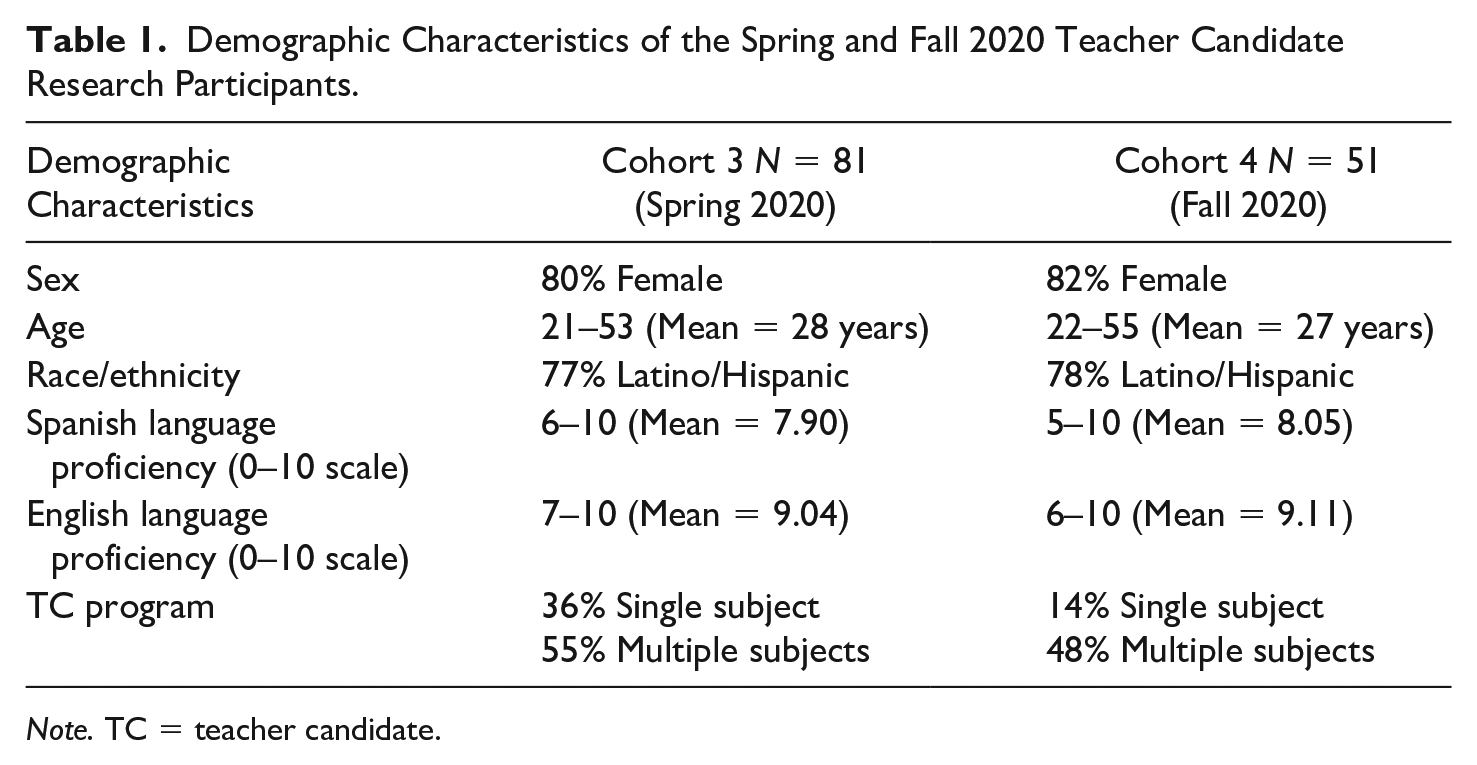
The mixed-methods study examined the experiences of K-12 students, especially Latinx Spanish-speaking ELs, during the COVID-19 school transitions to online instruction, through the perspectives of their TCs. These data were drawn from a larger 5-year longitudinal study comparing the experiences and preparedness of TCs in a BILA program and Comparison Groups (CG) with no bilingual training, named as the Teacher Pathways research project. The perspectives of TCs (Cohort 3—spring 2020 and Cohort 4—fall 2020) were measured and compared. The 81 TCs in Cohort 3 (2019-2020) were drawn from three CSU campuses: one with a BILA program and the remaining two without a BILA program. The 51 TC students in Cohort 4 (2020-2021) were drawn from the CSU campus with a BILA program. Table 1 summarizes the demographic characteristics of Cohorts 3 and 4.
Demographic Characteristics of the Spring and Fall 2020 Teacher Candidate Research Participants.
Note. TC = teacher candidate.
The university is a HSI with a current Latinx student population of 47%. The university has had a long-standing commitment to the education of ELs through district partnerships (e.g., clinical practice sites, supervisors, cooperating teachers). The BILA provides a depth of knowledge in research/theory with strong academic and content literacy in two languages, building upon the initial credential requirement of a California Authorization to Teachers of Els, an endorsement embedded across all our credential courses. Courses develop candidates’ understanding of culturally responsive pedagogy and second language acquisition in integrated and inclusive classrooms.
Data for these analyses were taken at two time points; during spring 2020 at the onset of COVID-19 lockdowns and the rapid shift to off-campus instruction (Cohort 3), and during fall 2020 as COVID-19 continued (Cohort 4). The TCs from spring 2020 to fall 2020 differed in as much as the spring 2020 TCs made the transition from in-person teaching and learning during their credential program, while the 2020 fall TCs’ experiences had been exclusively online.
Procedure and Measures
As part of the larger program of research, online survey data are collected from TCs and former TCs at three points during the academic year: Fall, Spring, and early Summer. The overarching aim of the Teacher Pathways research project was to test the efficacy of additional BILA programming on teaching credential students’ feelings of preparedness to teach Latinx Spanish-speaking EL students. Questions pertaining to the shift of instruction in response to COVID-19 were added to the online surveys for spring 2020 and fall 2020. Topics included: modes of instruction, perceptions of student engagement, issues of equity between EL/non-EL K-12 students, challenges faced by K-12 students and their families, impact on lesson planning, student assessment, lesson differentiation, and scaffolding. The spring 2020 survey was launched in May 2020, and the fall survey was launched in December 2020.
Response Rates
Data from longitudinal research are often biased by low per-survey response rates. Using our Tailored Panel Management protocol (Estrada et al., 2014), we achieved a response rate of 88% and 84% for spring and fall, respectively. We feel confident that our responses came from a representative sample of credential students from these programs.
Data Analysis Approach
This manuscript focuses primarily on the qualitative and descriptive data in participant surveys. We analyzed both quantitative and qualitative data to assess the impact of COVID-19 on instruction and disparities between K-12 students in the general population and ELs. Surveys had a series of scale items that aligned with the open-ended questions. TCs gauged the level of disparity in engagement for ELs in both the 2020 spring and the fall semesters. TCs focused on equity issues of access and engagement for ELs and TC support systems during COVID-19. We asked the TCs to rate What percentage of your K-12 class is currently engaged with instructional activities? and What percentage of your ELs is currently engaged with instructional activities? These rates were compared for the spring and fall 2020 cohorts. Teacher credential participants were also asked to rate their satisfaction on a scale of 0—“Not at all satisfied” through 10—“Completely satisfied” with the following: Please rate your level of satisfaction with the quality of the direction you are receiving from your university clinical supervisor for adapting your K-12 instruction? How satisfied are you with the quality of your Teaching Credential Program during COVID-19? How satisfied are you with the quality of your Bilingual Authorization Program during COVID-19?
We coded the verbatim responses to each open-ended question and identified themes. We then tabulated these themes across all the open-ended questions. The themes were compared across the spring and fall 2020 semesters to identify patterns of consistency and change as the new modes of instruction continued into a second semester. Finally, we identified representative verbatim quotes that best illustrated each theme.
Findings and Discussion
Online surveys administered in spring and fall 2020 with TCs collected data about the impact of COVID-19 on classroom teaching, lesson planning, and assessment. The study examined modes of instruction, the level of student engagement, especially for ELs, and the credential candidates’ satisfaction with the support received from their cooperating teachers, university clinical supervisors, and professors.
In spring 2020, the ability of Cohort 3 (BILA and CG Teacher Candidates) to provide engaging instructional activities to ELs indicated: 56% of BILA TCs and 49% for CG across K-12 grade students. The only difference was being that BILA TCs provided instruction in English and Spanish. Although BILA TCs were higher in engaging ELs through distance learning (56%) than the CG, the results of our study paralleled the CA state averages with distance learning during COVID-19 school closures where only 55% of ELs were engaged during online instruction (Vizcarra, 2020). The themes in spring 2020 addressed the following: (a) diminished instruction for ELs, (b) equity issues of access and engagement for ELs, and (c) supportive systems for TCs during the rapid change to online teaching. These themes are discussed below.
Theme 1—Diminished Instruction for ELs Unveils Systemic Inequities
Modes of instruction for Cohort 3 (spring 2020) included online instruction (39%), pre-recorded lectures (20%), printed materials (16%), and other modes (3%). These figures correlated closely to former BILA and CG TCs in Cohorts 1 and 2 who were teachers under full-time contracts. However, TCs did not indicate a distinction between synchronous and asynchronous instruction or how much time they spent weekly on in-person instruction with ELs. It’s unknown how local schools allocated online instructional time for K-12 grade ELs needing designated (targeted instruction by proficiency levels) or integrated (differentiated content instruction) English Language Development (ELD) tied to CA ELD Standards (2012) or if districts required differentiated instruction based on proficiency levels assessed by the CA Department of Education’s English Language Proficiency Assessments for California.
However, Cohort 3 indicated that instruction at their clinical sites was different from their normal routines and breath of planning and assessments, not indicative of their common lesson development which demanded differentiating instruction and monitoring any focus students (e.g., ELs, students with special needs, at-risk students). Cohort 3 reported the inability to monitor the progress of ELs due to missing work, assigning credit/no credit for participation rather than assessment of mastery, and allegations of students potentially cheating on assignments due to unsupervised home environments. They described direct instruction as diluted, simple, and dimmed lessons for all students with minimal peer and teacher interactions as a systemic halt on quality education in the following, I’ve been meeting with my CT and students twice a week from 1-2pm just for office hours and quick mini lessons on the work packets. Use Google Meets as our platform of communication. Not teaching anything new, only reviewing math concepts. (Cohort 3, BILA-TC#1213, spring 2020) It has been rather difficult to engage and reach all students. I have had to use several online resources such as Google Classroom, Google Meets, Screencastify, and now Canvas to organize and plan instruction. COVID-19 has changed my instruction because I am now unable to decrease the level of apathy, reach all my students daily, and I cannot guarantee that all will be engaged. (Cohort 3, CG-TC#1153, spring 2020)
These quotes exemplify systemic inequities identified by TCs that affected EL students’ access to quality education during COVID-19, particularly in the online environment.
Data collected fall 2020 for BILA Cohort 4 demonstrate similar situations persisting at the clinical practice sites even though districts took measures before their fall semesters started in requiring summer trainings on digital platforms (e.g., Google Classroom, Zoom) with cooperating teachers and distributing technology tools to teachers, students, and families. We were unable to collect data for the comparison TC groups due to COVID-19 university lockdowns, uncertainties in their instructional delivery, and modes of online/hybrid programs offered to TCs. This TC described a typical day during clinical practice that clearly demonstrates students’ limited access to quality instruction, The impact of COVID-19 has shortened instruction way too much. We don’t have enough time with the students. We do two groups for 3 hours each and it’s just not enough. We only do math and reading. They are supposed to do work on their own at home, but a lot of students just don’t do it. (Cohort 4, BILA TC#1237, fall 2020)
This quote continues to demonstrate a diminished curriculum at the districts where ELs lack appropriate instruction to improve their English skills as mandated by the California state K-12 grade frameworks and standards.
Theme 2—Equity Issues of Access and Engagement for Underserved ELs
In spring 2020, Cohort 3 stated that they had no control of who and how their students participated through online instruction. They described how their K-12 students were negatively affected by distance learning, particularly EL students who were facing equity and access issues in their instructional programs. We asked TCs to estimate the percentage of EL students who were engaged in instructional activities. During the spring semester, K-12 grade student engagement was low, particularly for EL students, just 43% of whom were engaged with instructional activities, compared with 52% of students in general. This indicates that almost 60% of EL students were underserved by the new instructional formats. EL students’ engagement in instructional activities increased by 50% from spring to fall, however, the 62% EL student engagement was significantly lower than the 73% of students in general (see Figure 1),
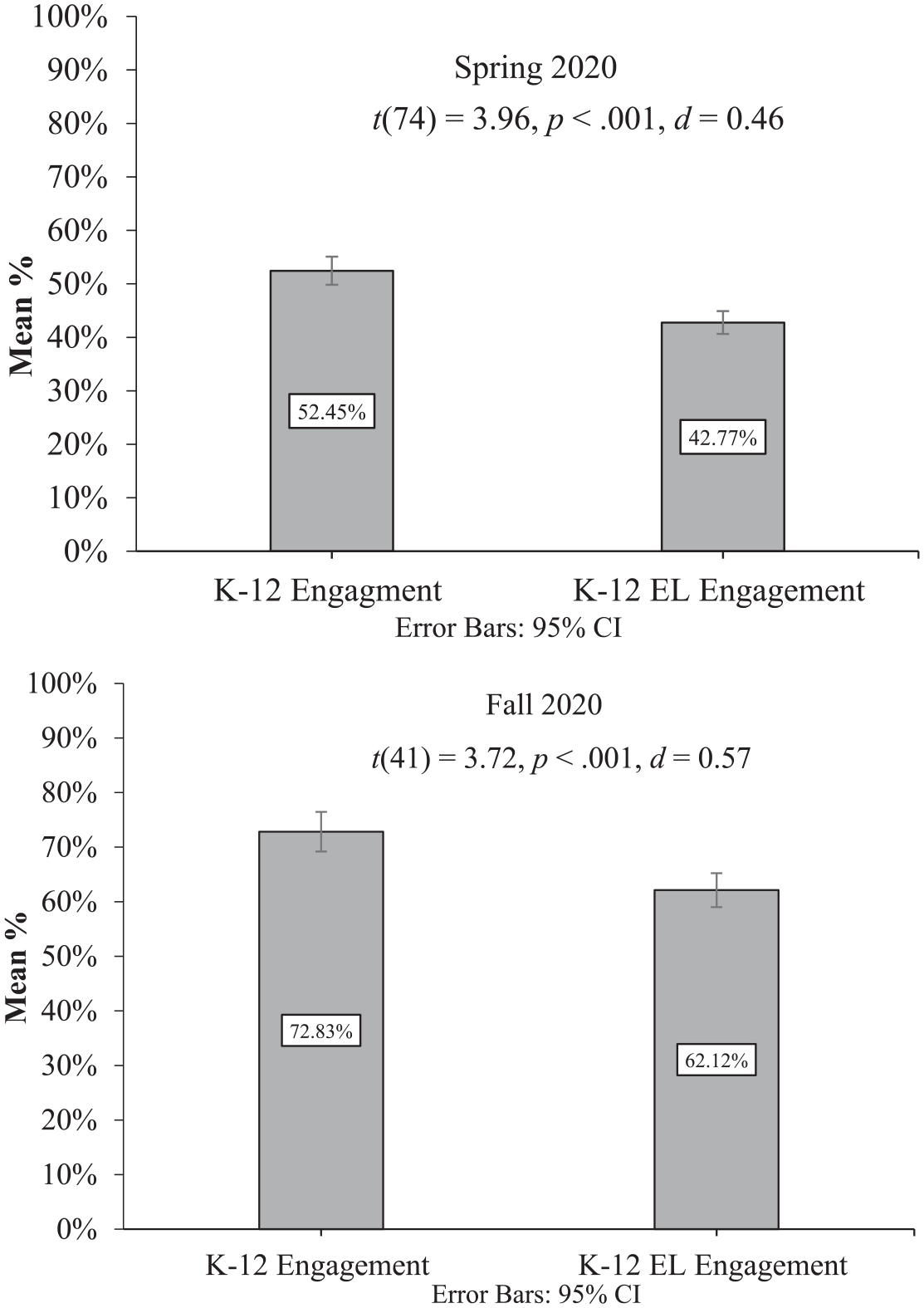
Teacher credential candidates’ perceptions of student and EL student engagement with the new instructional activities during COVID-19—Spring and Fall 2020.
TC comments indicated the following concerns for EL students at their clinical practice sites: (a) lack of internet access at home or reliable connectivity (e.g., Google Classroom, Zoom), (b) increased absenteeism from classes, and (c) lack of peer interaction and instructional support. Consequently, Cohort 3 affirmed how lack of access to distance learning and in-person engagement potentially exacerbated the difficulties faced by EL students in understanding assignments/tasks, submitting work, and inability to appropriately monitor their learning. A noteworthy proposition illustrated that regardless of the CSU credential program where TCs we enrolled, Cohort 3 demonstrated a genuine concern for the school education of vulnerable populations, as indicated by the following, The students who needed the intervention the most are the ones who do not have the resources to log on to the virtual meetings. It has been a challenge to reach these students and give them the extra assistance they need. (Cohort 3, BILA-TC#1159, spring 2020) I am no longer able to teach and assess my students. My focal students are now having to navigate through this with little to no support due to connection issues, zero internet access, etc. This will affect them greatly. (Cohort 3, CG-TC#1218, spring 2020)
TCs were able to identify inequities that adversely affected EL students, but did not have the tools to address them and provide an environment that was conducive to learning.
Evidently, issues outlined above with Cohort 3 concerning lack of K-12 student’s internet access, increased absenteeism, and missed opportunities for peer interaction and instructional support remained unresolved for Cohort 4 in the fall 2020 with BILA TCs experiences with EL students. Here are comments from BILA TCs that allude to the inability to use breakout rooms during online instruction to differentiate lessons due to supervision issues, also, the lack of access to materials through the internet and disparity in connectivity for rural areas of our county. In some cases, the TCs can see names or photographs on students’ screens, but there is no participation or engagement of such students during online learning, making it difficult for the TCs to monitor or observe participation and/or understanding of the lesson. Other concerns are related to district liability issues that require a credential teacher working with K-12 students at all times, even during small breakout rooms for online instruction; I try to be energetic when teaching but is difficult to maintain this, because all I see is black squares with pictures on it. It is hard to gauge where students are at and whether I’m going too fast or too slow. I try to keep a solid pace. Overall, I feel like I’m doing the best I can, given the circumstances. (Cohort 4, BILA-TC#1240, fall 2020)
Clearly, TCs were unable to implement effective strategies and activities they were learning in their teacher credential program due to constraints posed by online teaching platforms and district policies.
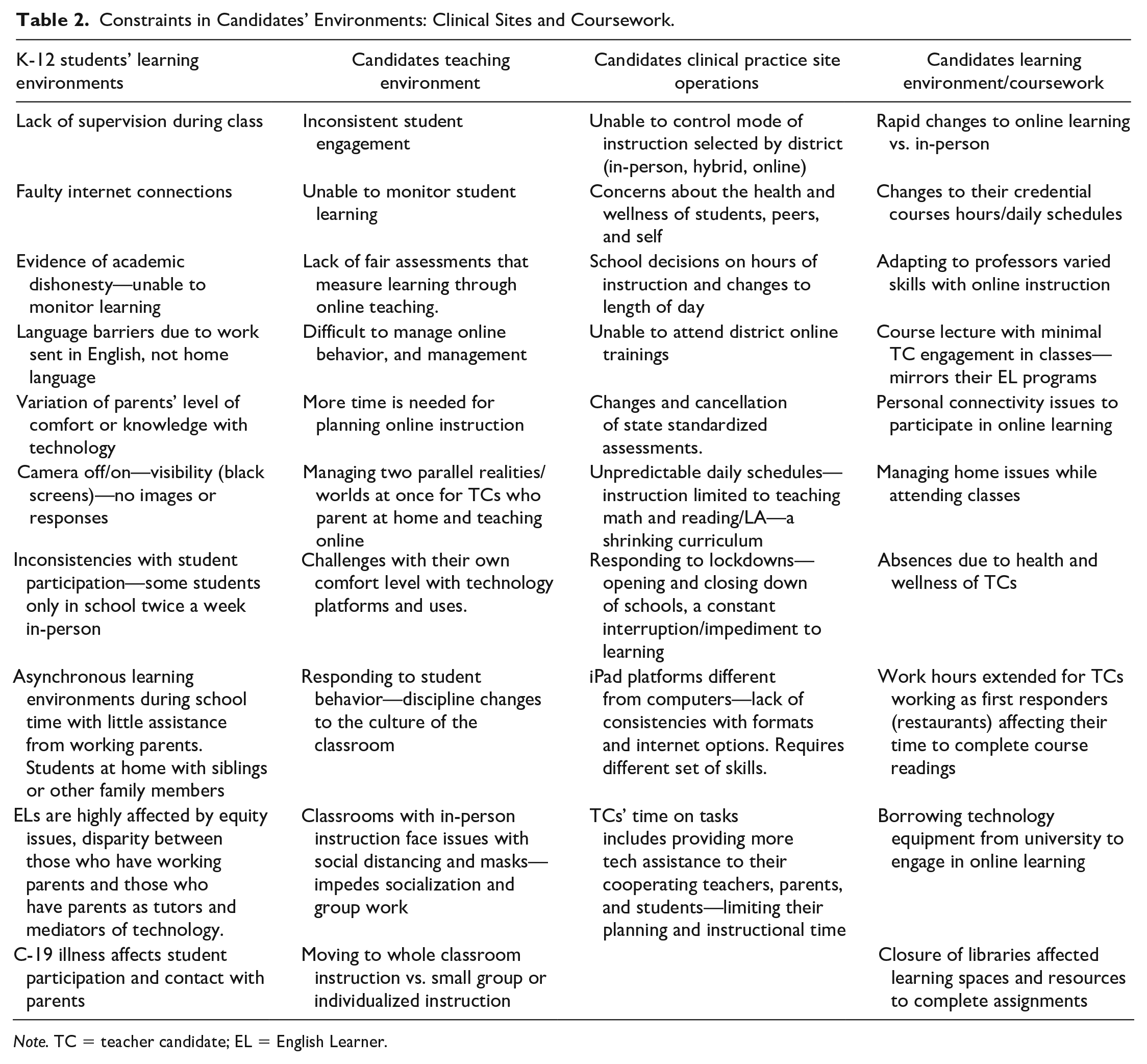
To summarize the learning environments of the TCs during their clinical practice, the following chart demonstrates four areas from the data analysis for BILA TC Cohort 4 fall 2020, in which TCs indicated what they were not able to control during their coursework, field work, and their experiences with ELs during COVID-19 online instruction: (a) their K-12 students’ learning environments, (b) the TCs’ teaching environment at their clinical sites, (c) the TCs clinical practice site operations, and (d) the TCs’ learning environment for coursework.
Theme 3—CSU Support Systems During COVID-19 for TCs
Despite rapid changes from in-person instruction to distance learning during COVID-19 school closures in spring and fall 2020, TC Cohorts felt supported by their credential programs and conveyed no negative consequences to their education. Although remaining high, the levels of satisfaction with the quality of direction TCs were receiving from their university clinical supervisor, the quality of the credential program overall, and the quality of their BILA program decreased from spring 2020 cohort to the fall 2020 cohort (see Figure 2).
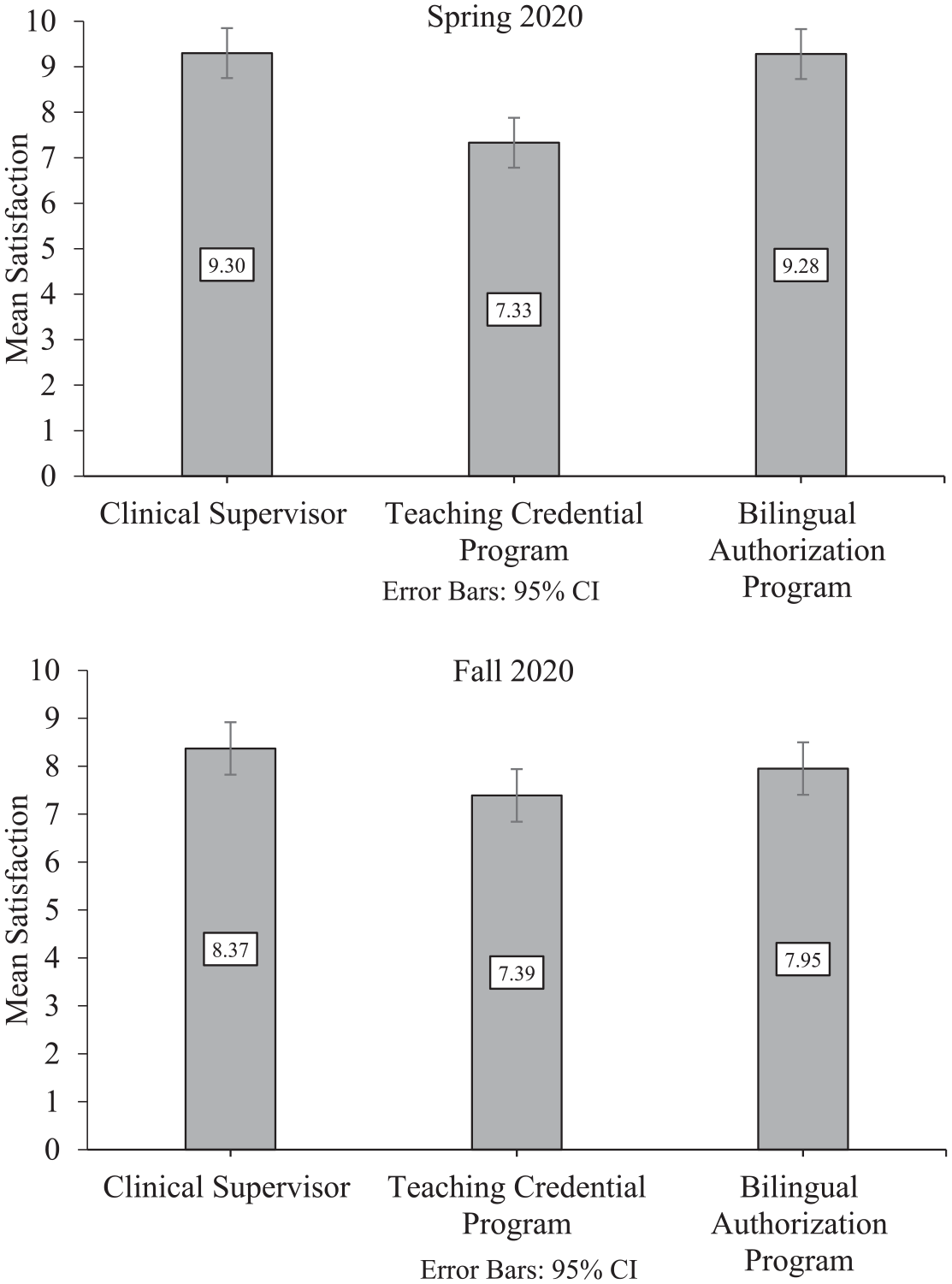
Teacher credential candidates’ satisfaction with their credential program during COVID-19—Spring and Fall 2020.
Constraints in Candidates’ Environments: Clinical Sites and Coursework.
Note. TC = teacher candidate; EL = English Learner.
Although Cohort 4 (fall 2020) noted being supported by their programs and instructors, they did note challenges with online instructional modes perhaps not being as rich as in-person instruction in developing relationships, modeling, student engagement, and instructors’ level of comfort with online instruction. Notably, these are parallel comments made by TCs about their K-12 grade level students’ access and experiences to online learning, particularly for ELs. In addition, students described stressors due to online learning that are not related to the support or quality of the program, but personal challenges such as having their own children at home during their credential course learning and/or teaching; balancing increased workloads; needing more support, practice and hands-on activities to comprehend and complete assignments, They are still holding us to the same expectations, and I feel that is the right way. I feel that they are doing everything that we are supposed to do and that makes me feel prepared. They are sharing a lot from their experiences and the program has been very supportive. (Cohort 4, BILA-TC#1228, fall 2020)
TCs understood that their instructors were doing the best they could to support them, just as they were doing in turn with their students.
TCs in Cohort 3 (spring 2020) also reported that their cooperating teachers had high levels of proficiency with online platforms, this correlated to self-reported knowledge of distance learning from in-service teachers in Cohorts 1 and 2. In addition, TCs used positive remarks to describe their university field supervisors as “supportive, flexible, understanding, and available” with similar comments about their university professors.
In general, TCs in Cohort 4 (fall 2020) stated that their teacher credential and BILA programs have met their expectations regardless of the impact from COVID-19. However, TCs noted that they needed more support and practice on assignments during online instruction; consequently, these are similar concerns posted about their regular credential programs. TCs have only completed their fall semester and still need to finish their programs this spring 2021: I was placed in a bilingual setting (clinical practice) and have been receiving a quality biliteracy education in my course. (Cohort 4, BILA-TC#1269, fall 2020) I would have hoped for more instruction, practice, and examples on how to successfully create a bilingual lesson plan. (Cohort 4, BILA-TC#1248, fall 2020)
Contrarywise, the compounding issues and stressors reported by TCs in Cohort 3 during spring 2020 were related to the pending uncertainties of state licensure requirements, not their university credential programs. They stated uncertainties in completing their credentials due to state mandates, cancellation of tests, and required assessments, such as the Teaching Performance Assessment [California Teacher Performance Assessments (CalTPAs) or (edTPAs)–from Stanford Center for Assessment Learning and Equity (SCALE)], and California’s Variable Term Waiver (California Commission on Teacher Credentialing (CCTC), April 6, 2020) in response to COVID-19 that allowed candidates up to 1-year extension to complete credential requirements. These uncertainties created anxiety and tensions at the end of the spring 2020 semester about their future employment opportunities and job qualifications.
For students in Cohort 4 entering the credential program in fall 2020, they received information about the state’s credentialing situation and policies to waive credential entry exams. Candidates were provided a 2-week grace period to drop the program if it did not meet their expectations. Therefore, students who started their credential programs in fall 2020 were aware of the state waivers and new provisions, unlike students from Cohort 3 who were caught in the pandemic lockdowns in the middle of their credential programs (spring 2020).
TCs in both Cohort 3 (spring 2020) and Cohort 4 (fall 2020) reported that ELs have been negatively affected by online and hybrid instructional modalities implemented by K-12 schools in CA due to the COVID-19 pandemic. TCs in both cohorts reported lower student engagement in instructional activities for ELs as compared with all students in their classes. TCs in Cohort 3 attributed some of the decreased engagement to internet access and connectivity issues, as well as to limited peer interaction and support. In Cohort 4, TCs cited similar reasons for low EL student engagement but provided specific examples that indicated circumstances they were not able to control in their teaching environments.
In conclusion, TCs believed that the online format contributed to their ELs’ inability to understand tasks and assignments. They reported that the online environment made it difficult to appropriately monitor EL students’ learning and language development. They also highlighted the absence of culturally responsive teaching that builds upon EL students’ cultures, language, and learning styles that increase academic achievement (Gay, 2018; Pang, 2018).
Regarding their own learning environments, TCs in both cohorts felt their teacher online credential programs met their expectations and provided them with the support they needed. However, some TCs also identified learning experiences that parallel those of their EL students such as needing more support and practice comprehending assignments. The online format presented challenges to TCs’ teaching practices that negatively affected K-12 grade EL students, such as spending more time in whole class instruction versus small group or individualized instruction. TCs reported spending time on technical assistance that limited their planning.
Limitations
The data collected on the impact of COVID-19 on teacher preparation were questions appended to an existing survey from the grant examining the effectiveness of the BILA teacher preparation program at a CSU in improving the instruction of ELs. The appended questions to the existing survey were developed early in the transition to distance learning at both the K-12 and higher education levels. Future administrations of the survey will need to be adjusted to account for factors that continue to come to light, including the impacts of distance learning on the socioemotional well-being of K-12 students in synchronous or asynchronous instruction. Finally, this is a relatively small sample of teachers and TCs from three CSU teacher preparation programs and generalizations must be considered accordingly.
Scholarly Significance of Study/Contribution to the Field
This study confirms accepting educational responsibility for underserved student populations during COVID-19 school closures, particularly for ELs who lacked access to online learning, active engagement with peers and teachers, and differentiated instruction by proficiency levels. But among lessons learned, an equitable distance learning mode of instruction needs attention to the socioemotional well-being of K-12 grade students and their TCs—as both groups were not emotionally prepared to face these abrupt environmental changes and uncertainties in their schooling/credentialing with the added trauma of COVID-19 health factors and family life. In addition, the study recommends face-to-face interactions through synchronous virtual instruction and purposeful engagement of ELs that allow for monitoring of students’ progress and socioemotional needs, over asynchronous instruction where teaching and learning become an invisible and silent task. Teacher education programs rooted in principles of social justice and educational equity teach TCs to use the wealth of knowledge they learn about their EL students’ backgrounds, language abilities in Spanish and English, home lives and responsibilities, and learning styles to guide their pedagogy. During COVID-19, TCs were unable to fully capitalize on these culturally responsive practices that help them provide equitable educational opportunities for their EL students. We need to ensure that TCs are well prepared to address the equity needs of ELs, whether in-person, hybrid, or virtual, while considering the multidimensional hurdles and sanctions that may impede their academic growth.
Footnotes
Acknowledgements
The authors acknowledge student research assistants Charlene Andreason, Nancy Moreno, Kianna Avilez, Hayley Stevenson, and Brianna Salazar for their outstanding work collecting and managing the data used in this research. They would also like to express their sincere gratitude to all the current and former teacher credential students who participated in this study.
Declaration of Conflicting Interests
The author(s) declared no potential conflicts of interest with respect to the research, authorship, and/or publication of this article.
Funding
The author(s) received no financial support for the research, authorship, and/or publication of this article.
