







Abstract
In this paper, we focused on the decade of philanthropic funding before the current increase in philanthropy to HSIs (2006/2018). We offered a descriptive overview detailing which philanthropic foundations have provided the largest share of support, the HSIs receiving these gifts, and the areas of focus targeted by these donations. We contributed to the scholarship on philanthropic giving to HSIs using an original dataset.
In recent months, MacKenzie Scott, noted philanthropist, has given boldly and widely to Minority Serving Institutions (MSIs) across the nation, including many Hispanic Serving Institutions (HSIs) (Gasman, Hines, et al., 2022; Redden, 2021). HSIs such as Lehman College (NY), Mount Saint Mary’s University (CA), and Whittier College (CA) received $30, $15, and $12 million, respectively (Redden, 2021). The presidents of these institutions, shocked by the gifts, referred to them as transformative given that they were the largest gifts in the institutions’ histories and came amid the COVID-19 pandemic (N. Anderson & Lumpkin, 2020). These donations generated conversations on Twitter and in HSI circles around philanthropic giving to HSIs (Schwartz, 2021; tweets from June 17, 2021) overall given the prominence and importance of these institutions. Twitter users wondered what kind of research had been conducted to date on HSIs and philanthropy. To that point, little is known about philanthropic giving within the HSI context or to HSIs.
Latinx college enrollment has grown annually between 2000 and 2018, increasing by 148% from 1.4 million to 3.4 million (Brown, 2014; Hussar et al., 2020). As a result of this growth, institutions have sought to embrace their designations as HSIs at faster rates, working to find ways to better serve Latinx students, engage the surrounding Latinx community, and hire more Latinx faculty (G. A. Garcia, 2019). According to a report entitled 25 Years of Hispanic-Serving Institutions (HSIs) 1994–2019 (Excelencia in Education, 2021), the 569 HSIs in the nation serve 1.49 million Latinx undergraduate students. Sixty-seven (67%) of Latinx undergraduate students are enrolled at HSIs, resulting in a 94% increase in HSIs over the past 10 years. In 2010, there were 293 HSIs and there are now, as mentioned, 569 of these colleges and universities. HSIs are diverse in make-up and location with 4-year institutions accounting for 56% of them and 2-year institutions making up the balance; 67% of HSIs are public institutions. They are in 30 states as well as the District of Columbia and Puerto Rico. Of note, HSIs are geographically concentrated in four locations: California (175), Texas (100), Puerto Rico (64), and New York (35) (Excelencia in Education, 2021).
Hispanic Serving Institutions are colleges and universities that enroll at least 25% Latinx undergraduate students and have 50% low-income or Pell Grant eligible students and lower institutional expenditures than comparable institutions; they were first designated in 1992 under the Higher Education Amendments (P.L. 102-325) (Castro Samayoa & Gasman, 2018). Research related to HSIs began to appear in the late 1990s and early 2000s, but has been sparse up until recently (Benitez, 1998; Benitez & DeAro, 2004; Dayton et al., 2004; De Los Santos & De Los Santos, 2003; Laden, 2001, 2004; Santiago, 2006). Several scholars have written about these institutions, mainly focusing on whether, and how they serve Latinx students (Conrad & Gasman, 2015; Contreras et al., 2008; G. A. Garcia, 2019; G. A. Garcia et al., 2019; Gasman et al., 2008; Hurtado & Ruiz Alvarado, 2015; Nuñez et al., 2015, 2016; Santiago, 2012). “Servingness” is regularly explored because all but a few HSIs were not established with the purpose of educating Latinx students like their Historically Black College and University counterparts were for African American students (Conrad & Gasman, 2015; G. A. Garcia, 2019).
Still, even with this increase in research, there has been almost no scholarship attending to the issue of philanthropy and HSIs. Of course, philanthropy as a topic overall for research is scarce as noted by Walton (2019), Drezner (2011), and Lindahl and Conley (2002). However, given that HSIs educate large numbers of low-income, first generation Latinx students, it is vital that we begin to understand philanthropic support of these institutions and its role regarding HSIs.
In this paper, we focus on the decade of philanthropic funding before the current increase in philanthropy to HSIs; the period from 2006 through 2016. Our analytic period relies on making use of the census of information available in The Foundation Center’ directory, which we describe in our methods section. Additionally, the period covers the years preceding the Great Recession of 2008 into the more recent renaissance of increased philanthropic giving (Ashenfelter & Rouse, 2000; Piketty, 2017). Our focus on philanthropic giving to HSIs offers a descriptive overview detailing which philanthropic foundations have provided the biggest share of support, the HSIs receiving these gifts, and the areas of focus targeted by these donations. We contribute to scholarship on philanthropic giving to HSIs through our use of an original dataset based on major U.S. foundations’ annual reports, joined with secondary data from the Integrated Postsecondary Education Data System (IPEDS) maintained by the National Center for Education Statistics.
Literature Review
Philanthropy is an often-overlooked area of research among higher education scholars, resulting in a haphazard body of scholarship, which is dispersed across many disciplines (Drezner, 2011; Lindahl & Conley, 2002; Walton, 2019; Walton and Gasman, 2008). As Drezner (2011) notes in his meta-analysis of philanthropic research, most publications related to philanthropy and fundraising are reflective essays by practitioners. Moreover, the research that does exist is scattered across a variety of research venues; there hasn’t been much of a “field of research” on the topic of philanthropy. It was not until 2017 that Drezner launched a journal—Philanthropy & Education—that specifically focuses on philanthropy and education (Teachers College, Columbia University, 2017). There have been nine issues published since 2017, and although the journal’s contribution has added rigor to the field, none of the articles have focused on Hispanic Serving Institutions, Historically Black Colleges and Universities (HBCUs), or other MSIs, nor race and ethnicity as it relates to philanthropy. Prior to this journal, the Council for the Advancement of Education (CASE), which is a professional organization for fundraisers, had a research publication, but it is now defunct. The CASE journal focused on practice-oriented articles related to fundraising and published three articles related to HBCUs or philanthropy in communities of color (Gasman, 2001; Gasman & Anderson-Thompkins, 2003). Occasionally, articles related to philanthropy are published in mainstream higher education, sociology, history, social work, and nonprofit management journals, but rarely do these articles focus on MSIs, beyond those mentioned in this article.
Philanthropic research focused on HSIs remains almost nonexistent. As such, we have included literature that spans the breadth of what is available on the larger topic. Of the available work, research related to HSIs, and philanthropy can be categorized into three overarching areas: Why foundations give to HSIs, Latinx alumni giving at HSIs, and approaches used by HSIs to secure philanthropic donations. In many ways, these three areas overlap as they are each at the heart of the sustainability of HSIs.
Why Foundations Give to HSIs
Forde (2019) produced a dissertation entitled “Determinants of Giving to Hispanic-serving Institutions,” which examined factors that influence and motivate foundations as they make decisions about financially supporting HSIs. Based on semi-structured interviews with a dozen foundation officers, Forde explored how foundations’ decisions are shaped by the identity and characteristics of HSIs as well as the role of institutional advancement offices. Forde argues that foundation officers’ knowledge (or lack thereof) of an institution’s designation as an HSI is not a determining aspect in foundations’ decision to donate to a given institution, though foundation officers do express an interest in supporting low-income, first generation, and students of color. Forde also found that professionals in offices of institutional advancement had little impact on foundation giving. Instead, the reputation, accomplishments, and vision of presidents and other high-level institutional leaders were integral to funding success. She determined that many foundations are rethinking the ways they have worked with colleges and universities in the past and moving toward a model that invokes collaboration among institutions, including potential HSI grantees. Lastly, she found that above the type of institution (i.e., its status as an HSI), foundations were interested in issues of student success and institutional transformation. Though Forde’s (2019) findings rely on qualitative research for a subset of foundation officers, the broader, though limited, scholarship on philanthropic giving at HSIs also suggests that institutions’ effectiveness in procuring funds has undergone important shifts over time.
Latinx Alumni Giving at HSIs
Lucka (2015) authored a dissertation pertaining to alumni giving entitled “Young, diverse alumni and the impact of affiliation, affinity, belonging, and engagement on philanthropy at Hispanic serving institutions and non-Hispanic serving Institutions.” This dissertation explores alumni giving within three California State University system universities. Luka explored affiliation, affinity, sense of belonging, and engagement of alumni of color, especially in relation to HSI designation. Findings demonstrate statistical significance related to HSI designation and ethnicity, in belonging over time, and regarding engagement. Lucka also found that HSIs need to work hard to establish a campus community that fosters giving back, and work to alleviate issues of detachment among students; they need to engage the “servingness” aspect of their HSI designation. Although both Forde (2019) and Lucka (2015) conducted research related to the overarching idea of philanthropy or giving at HSIs, their approaches were fundamentally different in design and focus, with Forde more interested in foundation relationships with HSIs and Lucka more interested in HSI relationships with young alumni.
Approaches Used by HSIs to Secure Philanthropic Donations
In his dissertation, Arriola (2005) explored “The Utilization of a Market-driven Strategy for Fundraising at a Hispanic Serving Institution.” In this study, he sought to learn why and how one HSI—the University of Texas-Pan American—developed a market-driven approach to corporate fundraising and how successful this approach has been in terms of increasing corporate support. Arriola found that using a market-driven approach had a positive impact on the institution’s ability to generate funds from the corporate sector and strengthened fundraising at the HSI overall.
Also interested in the practices of advancement offices, Mulnix et al. (2004), contributed “Institutional Advancement Activities at Select Hispanic Serving Institutions: The Politics of Raising Funds,” to the literature. In this article, the authors explore the impact of state politics on fundraising success. They examined the role of government relations, sponsored programs, and fundraising at HSIs, finding that these institutions are subject to substantial political and state pressure, and under the watchful eye of state legislatures especially around issues of institutional health and graduation rates. The authors suggest that HSIs have strong lobbying efforts and a well-planned out institutional advancement structure. Both Arriola (2005) and Mulnix et al. (2004) suggest that HSIs need to further educate donors and policymakers about their unique contributions to local, state, and national communities to increase financial support for HSI students and initiatives.
Rather than comprehensive accounts of HSIs and philanthropy as a sector of higher education in the United States, these studies tend to focus on one or a few institutions to build case studies or comparison across institutions, describing the conditions of philanthropic or corporate giving for given colleges and universities. Most of these studies rely on qualitative interviews, documents, short surveys, or institutional dashboards for their analyses.
Philanthropic Research Related to Other Types of Minority Serving Institutions
Of note, although HSIs and HBCUs are quite different, they share a lack of extensive research overall, and in terms of research related to philanthropy. The topic of HBCUs and philanthropy has been explored at a greater rate, mainly due to their existing much longer than HSIs. However, this exploration is not substantial. Much like HSIs, there are just a few thematic areas where the research exists. These include: individuals’ philanthropy focused on student and alumni giving (Cohen, 2006; Drezner, 2010; Gasman & Anderson-Thompkins, 2003; Gasman & Bowman, 2012, 2013; Hunter et al., 1999; Williams, 2010), corporate and foundation giving (Gasman, 2010; Gasman & Drezener, 2008), and historical examinations of philanthropy’s role in the development of HBCUs (J. D. Anderson, 1988; E. Anderson & Moss, 1999; Freeman, 2010; Gasman, 2007; Peeps, 1981; Williamson, 2017). Of note, we published an article in 2022 that pulls from the same larger dataset presented in this article, but that focuses on HBCUs (Gasman, Castro Samayoa, et al., 2022). By and large, philanthropy in special sectors (e.g., MSIs) has not been priority for most scholars that conduct research related to philanthropy.
Methods
Our study provides a descriptive understanding of the philanthropic trends related to HSIs. Following Murray’s (2013) approach exploring philanthropy’s role in university-based science research, we used a descriptive review of philanthropic trends in HSIs by building an original dataset of philanthropic giving to HSIs, and supplemental secondary data from the Integrated Postsecondary Education Data System (IPEDS). Given the literature’s lack of ability to describe the landscape of philanthropic contributions to HSIs across institutions longitudinally, we were guided by the following research questions: 1.) How much has each accredited HSI received in philanthropic contributions between 2006 and 2016? 2.) Which HSIs have received the largest amounts of philanthropic contributions between 2006 and 2018? 3.) Which funders have given the most financial support to HSIs between 2006 and 2016? 4.) Which programmatic areas receive the greatest support at HSIs? 5.) What funding mechanisms do philanthropic organizations use to support HSIs (e.g., directly to individual organizations or through collective grants)?
To answer these questions, we used two approaches. First, we retrieved data from IPEDS, focusing on institutions designated as HSIs, and aggregated the reported amounts for private gifts noted in the Finance Component surveys submitted by HSIs covering the fiscal years from 2006 to 2018 (see Appendix A for an overview of all variables collected). Next, we manually retrieved the contributions by individual philanthropic foundations to HSIs. Using the names of HSIs listed on the OPE eligibility Matrix (n = 431), we examined The Foundation Center’s database as a starting point, to locate foundations that provided donations to any postsecondary institution from 2006 to 2016 (these data did not include 2017 and 2018, unlike the secondary data from IPEDS). For these foundations, we reviewed publicly available annual reports and extracted references of gift-giving directed to HSIs. In total, we identified 60 philanthropic foundations. For each donation, we noted the institutional recipient (HSI), the funder (philanthropic organization), the year of the gift, the total amount of the gift, the purpose for each donation. We also made note of whether a gift was a multi-year commitment and listed the total amount in the year when it was first conferred. In addition to donations to individual HSIs, we also included philanthropic donations given to intermediary organizations, such as Excelencia in Education or the Hispanic Association of Colleges and Universities.
Analytic Approach
As researchers committed to equity and justice in higher education, we approached this descriptive analysis of HSIs’ philanthropic trends through perspectives attentive to our individual identities and social locations. Attention to our positionality is just as instructive for descriptive studies of financial data (i.e., this manuscript), as it is for research drawing from interpretive qualitative approaches (N. M. Garcia et al., 2018). Researchers’ understandings of social realities facilitate the iterative processes of data construction, interpretation, as well as description. The four authors of this paper include: a White woman, a queer, Latino man, and two Black men. In addition, one of the authors works at an HSI, two authors work at an MSI, and one attended an HBCU as an undergraduate. Three of the authors are bilingual. For all of us, understanding how structures of racism, classism, and sexism shape the fiscal health of postsecondary institutions aligns is essential. We seek to advance a more equitable future for educational opportunities. We thought it necessary and important to describe the landscape of gift-giving for HSIs through a lens that does not ascribe varying patterns of gift accrual as indicative of institutional deficiencies. As such, we aim to challenge symbolic and actual harm that has resulted from research that assumes that disparities in fiscal outcomes at HSIs, or any MSIs, are caused by institutional failures and shortcomings. In contrast, our intent is to identify opportunities for further work that can more closely explore the structures accounting for the differences emerging from our research.
Limitations
We note that there are limitations informing the claims we can make based on our data. We have made every effort to build a census of reported data for HSIs by private foundations between 2006 and 2016. If there are foundations without comprehensive public records, we recognize that they may be missing from our database. Likewise, data derived from IPEDS requires care to avoid errors in joins across multiple years (Jaquette & Parra, 2014). Manual extraction of data is known to be subject to data entry errors (Paulsen et al., 2012) and we took caution to develop a protocol for data entry, as well as verifying the data entry by replicating the process for a random subset of collected data at multiple intervals of our data collection process. These limitations notwithstanding, we find that our longitudinal overview of HSIs receipt of philanthropic gifts offers an important contribution to the literature on philanthropy in higher education. Of note, given the rapidly changing demographics in the United States and among HSIs, some current HSIs may not be a part of these data.
Findings and Discussion
We answer our five research questions by drawing from aggregate tabulations of our dataset with data on HSIs’ gifts from 2006 to 2018 and data on individual philanthropic organizations donations between 2006 and 2016, as such our time periods vary when we consider whether the information is focused on HSIs as recipients or whether we’re considering philanthropic organizations’ donations. We address our questions below:
Philanthropic Contributions Received by Each Accredited HSI between 2006 and 2018, and HSIs That Received the Largest Gifts During This Period
Between 2006 and 2018, HSIs collectively received over $14,615,628,890 (CIP adjusted) in gifts (See Table 1), including private gifts, gifts for capital development, and individual contributions. Table 1 shows the 15 HSIs receiving the largest amounts in gifts (see Appendix B for a complete list of all HSIs by year). The 15 HSIs that have received the largest sum in philanthropic contributions between 2008 and 2018 are the University of Arizona, the University of California-Irvine, the University of Houston, the University of California-Santa Barbara, Texas Tech University, the University of New Mexico, the University of Texas Health Sciences Center at San Antonio, San Diego State University, Nova Southeastern University, Miami Dade College, Mt. San Antonio College, the University of California-Santa Cruz, the University of St. Thomas, New Mexico State University, and the University of North Texas. While these institutions represent approximately 3.4% of the HSIs in the dataset, they account for 46% of all gifts reported by HSIs during this this period (2008–2018).
Total Gifts (Including Private, Capital, Contributions, and Contracts) Disbursed Between 2008 to 2018, Select HSIs (CIP Adjusted).
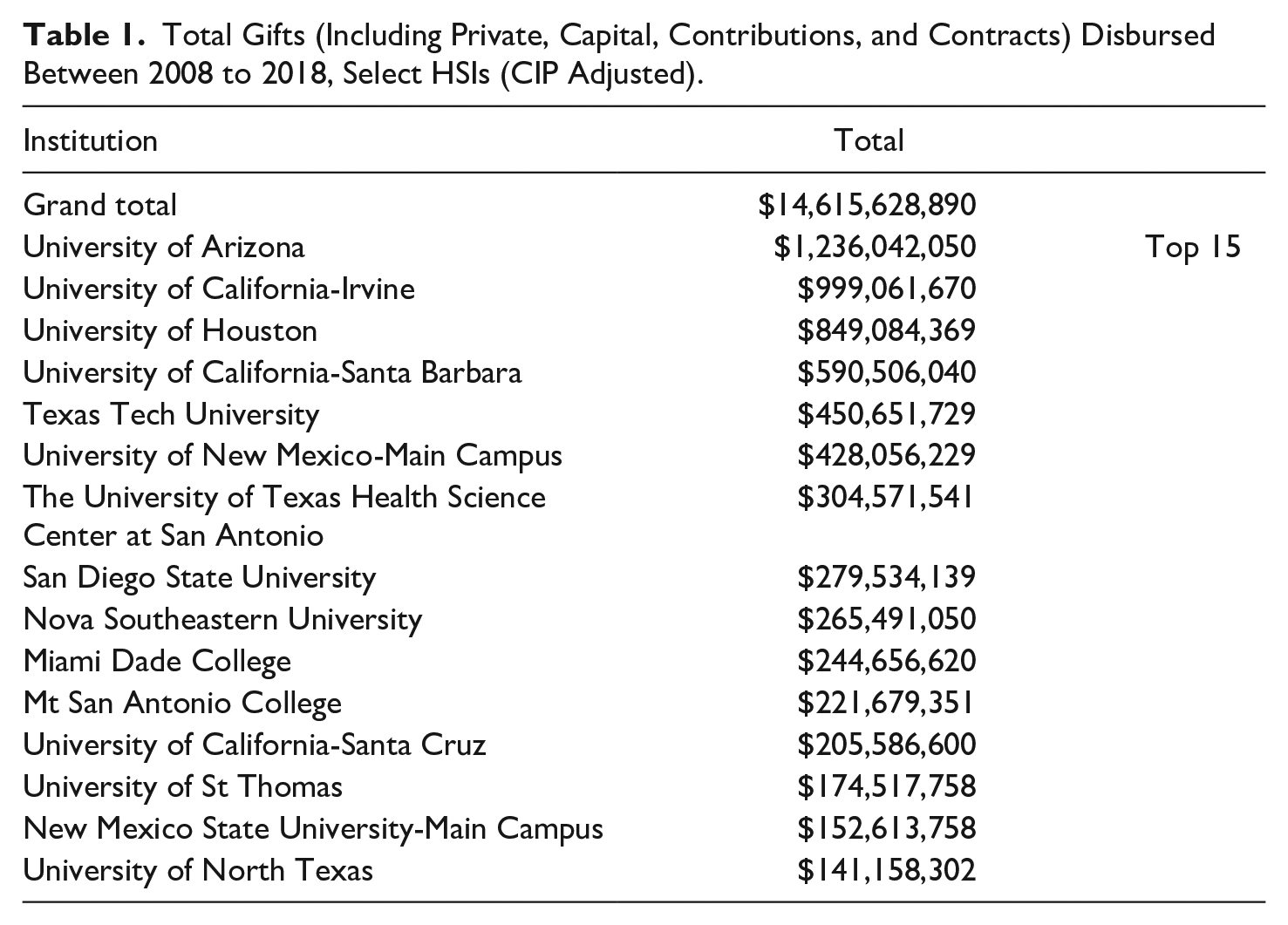
When we look more closely at these 15 institutions, we notice that all but four—Mt San Antonio College, the University of St. Thomas, Nova Southeastern University, and Miami Dade College—are large public universities, which tend to have larger fundraising infrastructures that assist in securing more philanthropic contributions (Martinez & García, 2020). Miami Dade College is also large and public but represents the community college sector in Florida. The remaining institutions receiving the largest amount of philanthropic funding are part of the systems in California, Texas, Arizona, and New Mexico. Of note, Florida International University, one of the very largest HSIs does not fall in this group, but just below it in terms of philanthropic support. The University of Texas at San Antonio is similarly placed. Notably, as well, the first five institutions within this list are all institutions with high research activity per Carnegie Classification standards, which is indicative of additional institutional factors enabling these institutions to secure external support (Martinez & García, 2020).
HSIs That Received the Largest Financial Support From Philanthropic Organizations Between 2006 and 2016
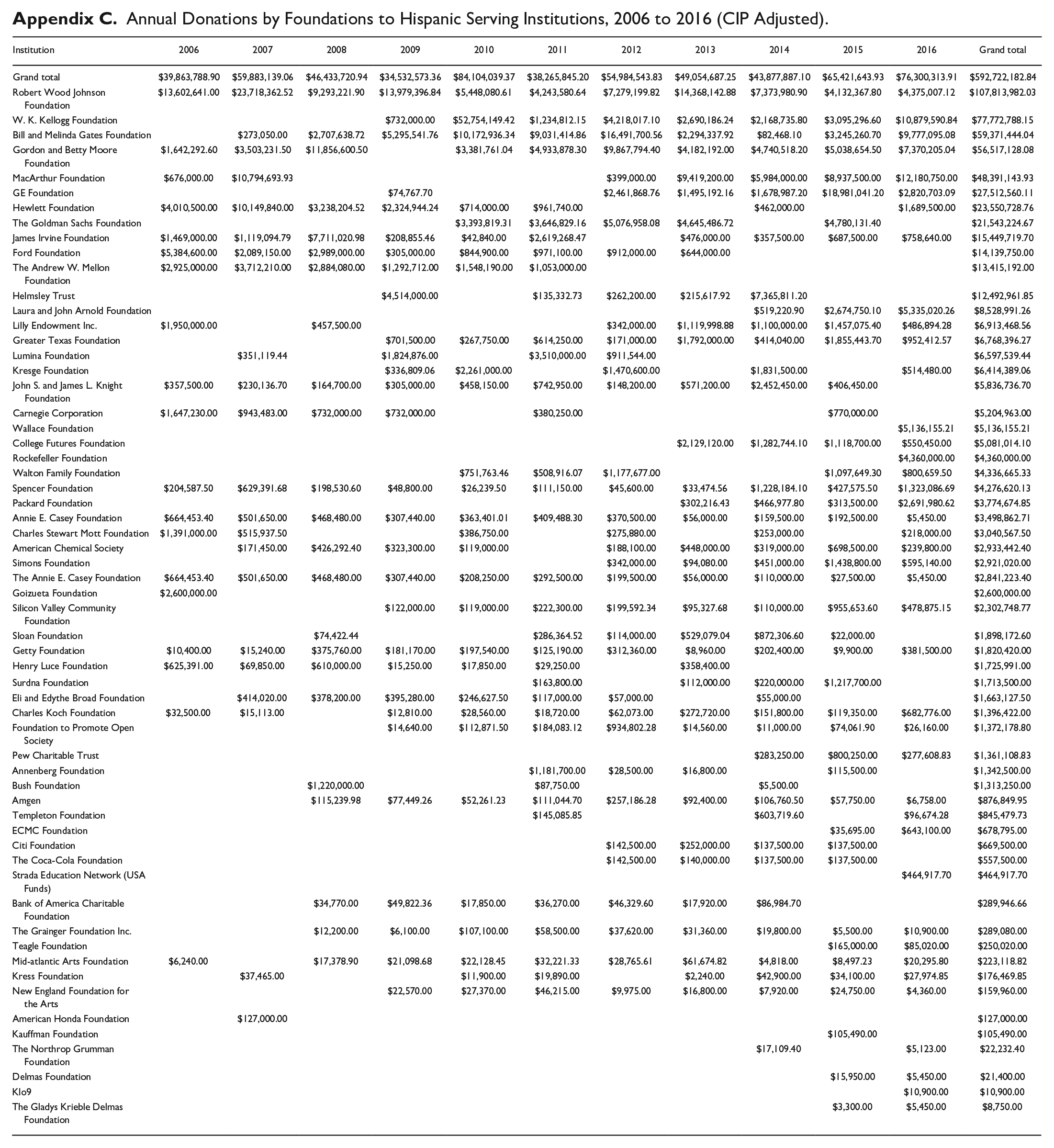
Drawing from our review of the annual reports from the 60 foundations that have gifted support to HSIs, we present a table with the 10 organizations that disbursed the largest cumulative total in gifts to HSIs between 2008 and 2016 (see Table 2). The top 10 organizations donated a cumulative $452 million dollars (CIP Adjusted), accounting for 76% of the $592 million donated by all 60 foundations between 2008 and 2016 (see Table 2; Appendix C shows the complete list).
Annual Donations by Select Foundations to Hispanic Serving Institutions, 2006 to 2016 (CIP Adjusted).
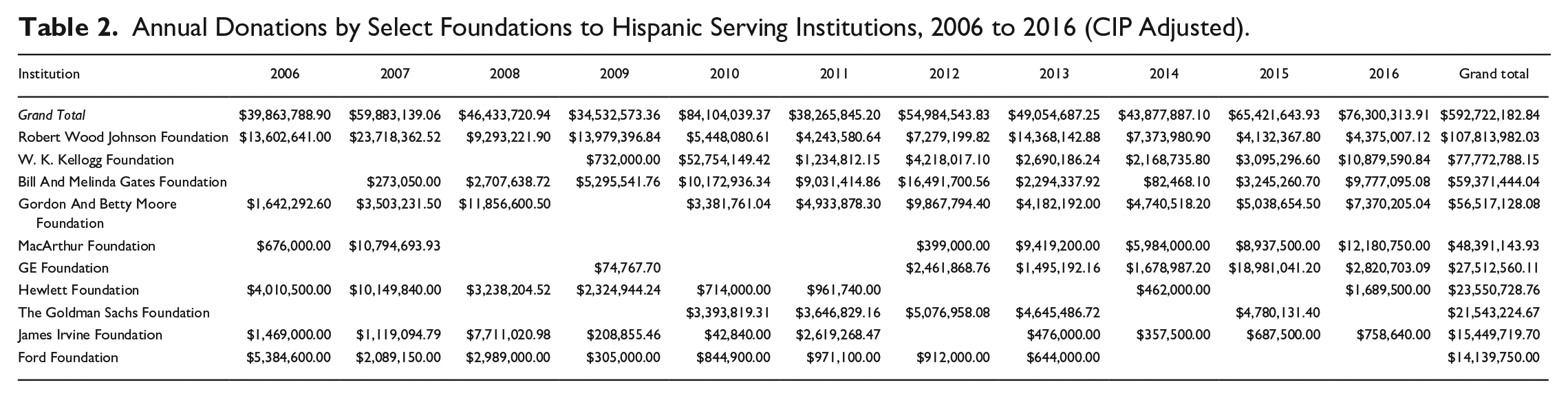
The foundations that gave the most financial support to HSIs between 2006 and 2016 (in decreasing order of gift size) include: the Robert Wood Johnson Foundation, the W. K. Kellogg Foundation, the Bill and Melinda Gates Foundation, the Gordon and Betty Moore Foundation, the MacArthur Foundation, the GE Foundation, the Hewlett Foundation, the Goldman Sachs Foundation, the James Irvine Foundation, and the Ford Foundation. Of note, the only one of these funders that has given consistently to HSIs—meaning every year—over this 10-year period is the Robert Wood Johnson Foundation. Aside from a small contribution of less than $75,000, the GE Foundation’s contributions began to increase in 2012 during this period, with most funds given in 2015. Likewise, the Goldman Sachs Foundation began giving to HSIs in 2010, with gifts totaling between $3–5 million each year.
Programmatic Areas at HSIs That Receive the Greatest Philanthropic Support
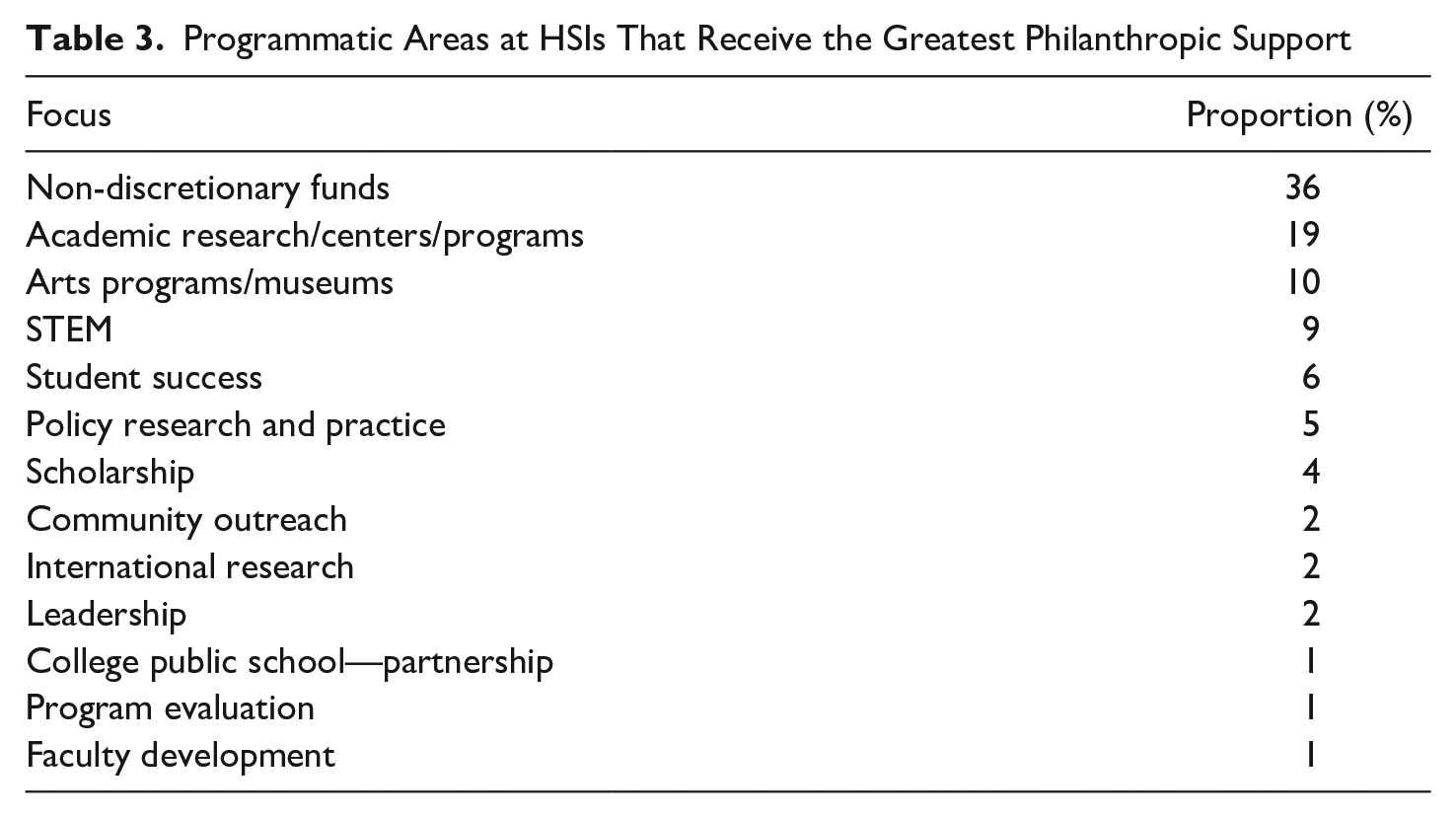
The programmatic areas that received the greatest support at HSIs over this 10-year period include non-discretionary funding; academic research/centers/programs; arts programs/museums; STEM; student success; policy research and practice; and scholarships (See Table 3). Some examples of contributions include a grant for $300,000 from the Ford Foundation to Florida International University “To serve as national and international hub of scholarly and artistic activities with respect to Cuba and Cuban diaspora;” a grant for $300,000 from the Ford Foundation to San Francisco State University “to disseminate the findings of the Empower Latino Youth Project’s research on Latino youth sexuality through publications, community briefs and social media” and a grant for $150,000 from the Knight Foundation to Miami Dade College to “to establish Miami as a city of refuge for persecuted writers.”
Programmatic Areas at HSIs That Receive the Greatest Philanthropic Support
Funding Mechanisms Used by Philanthropic Organizations to Support Hispanic Serving Institutions
In addition to direct funding of HSIs, philanthropic foundations also use two other methods to support these institutions: multi-college/university funding (e.g., consortia) and intermediary organizations. In our research, we found six multi-college/university grants over the 10-year period. Funders awarding multi-institutional grants included: The Spencer Foundation, the Kresge Foundation, and the Ford Foundation. Of note, the Spencer Foundation gave most of these grants, and these grants were awarded to foster collaborative research across HSIs that applied for them.
Intermediary organizations totaled $8,002,794 donations between 2006 and 2016 and included the following organizations: the Hispanic Association of Colleges and Universities, Excelencia in Education, the Hispanic Federation, and the Center for Minority Serving Institutions. These organizations received funds for general operating support or to either provide programs for HSIs, conduct research related to HSIs, or to provide sub-grants to HSIs for capacity building or the strengthening of programs. Funder that gave to organizations to support HSIs included ECMC Foundation, the Kresge Foundation, Lumina Foundation, the Mellon Foundation, and the Kellogg Foundation. Grants include $1 million from the Kresge Foundation to Excelencia to “refine, assess, and replicate effective practices for accelerating Latino college attainment” and $25,000 from Lumina Foundation to the Hispanic Association of Colleges and Universities for general operating costs.
Implications and Recommendations
Our review of philanthropic gift giving to HSIs offers several implications for researchers, institutional leaders at HSIs, and foundations. For researchers, our data show individual philanthropic organizations’ gifts to specific HSIs over time, which offers a more granular insight into the sources of external support for HSIs than extant scholarship. Future scholarship can further extend these descriptive insights by addressing the issue of lacking administrative databases within this domain of scholarship on philanthropy in education.
The manual extraction of foundations’ support for HSIs is a resource-intensive endeavor that requires investments to ensure that data are updated every fiscal year. Our research demonstrates how HSIs could benefit from a comprehensive and collaborative approach that collects information on philanthropic giving to their higher education sector and that extends beyond the available data from federal repositories (e.g., IPEDS). Unfortunately, no entity collects philanthropic information that is specifically sorted by type of MSIs. Our project is the first to do so. It is possible to manually review The Foundation Center’s Candid website, cross referencing their data with the federal list of MSIs. However, this approach is highly labor intensive. Of note, these data are also behind a paywall, that is only accessible with a personal subscription or if an institution’s library has a general subscription—making use of these data difficult for new scholars who might not have access to research funds.
Despite these challenges, the insights from the descriptive results herein offer the path forward for future scholarship. Researchers could focus attention on philanthropic organizations that have consistently supported HSIs. These institutions offer a targeted study for qualitative insights into philanthropic actors’ strategy and decision-making with respect to the inclusion and expansion of support for HSIs within these organizations’ portfolios.
For institutional leaders, we note how—much in the same way that foundations have a history of supporting clustered institutions and intermediary organizations—foundations themselves can benefit from collective grantmaking targeted to HSIs as an effort to coordinate the funding priorities and capacity for long-term impact.
Research focused on HBCUs suggests a potential avenue for HSIs to build upon, namely: telling the HSI story more fully. That is, by cultivating a broader narrative on the unique contributions of HSIs as a collective institutional type and bolstering the individual stories of success at the campus level, we might expect increased giving on the part of philanthropists (Gasman & Bowman, 2012). Too few HSIs build on their HSI status and contributions to Latinx students and communities, embracing the “serving” aspect of being an HSI (G. A. Garcia, 2019).
Conclusion
Our research and the data in this paper reveal the trends in philanthropic gift-giving to HSIs in the early decades of the 21st century. As we move further into the new century, colleges and universities have been forced to adjust amid the Coronavirus, political turmoil throughout the nation and the world, and a significant drop in undergraduate enrollments. These larger contextual factors will exacerbate the conditions that HSIs face to support the education of their students. Foundations and HSIs can use this retrospective account to further understand which institutions can benefit from continued support and the areas for additional growth.
Supplemental Material
sj-xlsx-1-jhh-10.1177_15381927221126616 – Supplemental material for Hispanic Serving Institutions and Philanthropic Support: A Retrospective Overview, 2006–2018
Supplemental material, sj-xlsx-1-jhh-10.1177_15381927221126616 for Hispanic Serving Institutions and Philanthropic Support: A Retrospective Overview, 2006–2018 by Marybeth Gasman, Andrés Castro Samayoa, Kemuel Benyehudah and Anthony Fowlkes in Journal of Hispanic Higher Education
Footnotes
Appendix
Annual Donations by Foundations to Hispanic Serving Institutions, 2006 to 2016 (CIP Adjusted).
| Institution | 2006 | 2007 | 2008 | 2009 | 2010 | 2011 | 2012 | 2013 | 2014 | 2015 | 2016 | Grand total |
|---|---|---|---|---|---|---|---|---|---|---|---|---|
| Grand total | $39,863,788.90 | $59,883,139.06 | $46,433,720.94 | $34,532,573.36 | $84,104,039.37 | $38,265,845.20 | $54,984,543.83 | $49,054,687.25 | $43,877,887.10 | $65,421,643.93 | $76,300,313.91 | $592,722,182.84 |
| Robert Wood Johnson Foundation | $13,602,641.00 | $23,718,362.52 | $9,293,221.90 | $13,979,396.84 | $5,448,080.61 | $4,243,580.64 | $7,279,199.82 | $14,368,142.88 | $7,373,980.90 | $4,132,367.80 | $4,375,007.12 | $107,813,982.03 |
| W. K. Kellogg Foundation | $732,000.00 | $52,754,149.42 | $1,234,812.15 | $4,218,017.10 | $2,690,186.24 | $2,168,735.80 | $3,095,296.60 | $10,879,590.84 | $77,772,788.15 | |||
| Bill and Melinda Gates Foundation | $273,050.00 | $2,707,638.72 | $5,295,541.76 | $10,172,936.34 | $9,031,414.86 | $16,491,700.56 | $2,294,337.92 | $82,468.10 | $3,245,260.70 | $9,777,095.08 | $59,371,444.04 | |
| Gordon and Betty Moore Foundation | $1,642,292.60 | $3,503,231.50 | $11,856,600.50 | $3,381,761.04 | $4,933,878.30 | $9,867,794.40 | $4,182,192.00 | $4,740,518.20 | $5,038,654.50 | $7,370,205.04 | $56,517,128.08 | |
| MacArthur Foundation | $676,000.00 | $10,794,693.93 | $399,000.00 | $9,419,200.00 | $5,984,000.00 | $8,937,500.00 | $12,180,750.00 | $48,391,143.93 | ||||
| GE Foundation | $74,767.70 | $2,461,868.76 | $1,495,192.16 | $1,678,987.20 | $18,981,041.20 | $2,820,703.09 | $27,512,560.11 | |||||
| Hewlett Foundation | $4,010,500.00 | $10,149,840.00 | $3,238,204.52 | $2,324,944.24 | $714,000.00 | $961,740.00 | $462,000.00 | $1,689,500.00 | $23,550,728.76 | |||
| The Goldman Sachs Foundation | $3,393,819.31 | $3,646,829.16 | $5,076,958.08 | $4,645,486.72 | $4,780,131.40 | $21,543,224.67 | ||||||
| James Irvine Foundation | $1,469,000.00 | $1,119,094.79 | $7,711,020.98 | $208,855.46 | $42,840.00 | $2,619,268.47 | $476,000.00 | $357,500.00 | $687,500.00 | $758,640.00 | $15,449,719.70 | |
| Ford Foundation | $5,384,600.00 | $2,089,150.00 | $2,989,000.00 | $305,000.00 | $844,900.00 | $971,100.00 | $912,000.00 | $644,000.00 | $14,139,750.00 | |||
| The Andrew W. Mellon Foundation | $2,925,000.00 | $3,712,210.00 | $2,884,080.00 | $1,292,712.00 | $1,548,190.00 | $1,053,000.00 | $13,415,192.00 | |||||
| Helmsley Trust | $4,514,000.00 | $135,332.73 | $262,200.00 | $215,617.92 | $7,365,811.20 | $12,492,961.85 | ||||||
| Laura and John Arnold Foundation | $519,220.90 | $2,674,750.10 | $5,335,020.26 | $8,528,991.26 | ||||||||
| Lilly Endowment Inc. | $1,950,000.00 | $457,500.00 | $342,000.00 | $1,119,998.88 | $1,100,000.00 | $1,457,075.40 | $486,894.28 | $6,913,468.56 | ||||
| Greater Texas Foundation | $701,500.00 | $267,750.00 | $614,250.00 | $171,000.00 | $1,792,000.00 | $414,040.00 | $1,855,443.70 | $952,412.57 | $6,768,396.27 | |||
| Lumina Foundation | $351,119.44 | $1,824,876.00 | $3,510,000.00 | $911,544.00 | $6,597,539.44 | |||||||
| Kresge Foundation | $336,809.06 | $2,261,000.00 | $1,470,600.00 | $1,831,500.00 | $514,480.00 | $6,414,389.06 | ||||||
| John S. and James L. Knight Foundation | $357,500.00 | $230,136.70 | $164,700.00 | $305,000.00 | $458,150.00 | $742,950.00 | $148,200.00 | $571,200.00 | $2,452,450.00 | $406,450.00 | $5,836,736.70 | |
| Carnegie Corporation | $1,647,230.00 | $943,483.00 | $732,000.00 | $732,000.00 | $380,250.00 | $770,000.00 | $5,204,963.00 | |||||
| Wallace Foundation | $5,136,155.21 | $5,136,155.21 | ||||||||||
| College Futures Foundation | $2,129,120.00 | $1,282,744.10 | $1,118,700.00 | $550,450.00 | $5,081,014.10 | |||||||
| Rockefeller Foundation | $4,360,000.00 | $4,360,000.00 | ||||||||||
| Walton Family Foundation | $751,763.46 | $508,916.07 | $1,177,677.00 | $1,097,649.30 | $800,659.50 | $4,336,665.33 | ||||||
| Spencer Foundation | $204,587.50 | $629,391.68 | $198,530.60 | $48,800.00 | $26,239.50 | $111,150.00 | $45,600.00 | $33,474.56 | $1,228,184.10 | $427,575.50 | $1,323,086.69 | $4,276,620.13 |
| Packard Foundation | $302,216.43 | $466,977.80 | $313,500.00 | $2,691,980.62 | $3,774,674.85 | |||||||
| Annie E. Casey Foundation | $664,453.40 | $501,650.00 | $468,480.00 | $307,440.00 | $363,401.01 | $409,488.30 | $370,500.00 | $56,000.00 | $159,500.00 | $192,500.00 | $5,450.00 | $3,498,862.71 |
| Charles Stewart Mott Foundation | $1,391,000.00 | $515,937.50 | $386,750.00 | $275,880.00 | $253,000.00 | $218,000.00 | $3,040,567.50 | |||||
| American Chemical Society | $171,450.00 | $426,292.40 | $323,300.00 | $119,000.00 | $188,100.00 | $448,000.00 | $319,000.00 | $698,500.00 | $239,800.00 | $2,933,442.40 | ||
| Simons Foundation | $342,000.00 | $94,080.00 | $451,000.00 | $1,438,800.00 | $595,140.00 | $2,921,020.00 | ||||||
| The Annie E. Casey Foundation | $664,453.40 | $501,650.00 | $468,480.00 | $307,440.00 | $208,250.00 | $292,500.00 | $199,500.00 | $56,000.00 | $110,000.00 | $27,500.00 | $5,450.00 | $2,841,223.40 |
| Goizueta Foundation | $2,600,000.00 | $2,600,000.00 | ||||||||||
| Silicon Valley Community Foundation | $122,000.00 | $119,000.00 | $222,300.00 | $199,592.34 | $95,327.68 | $110,000.00 | $955,653.60 | $478,875.15 | $2,302,748.77 | |||
| Sloan Foundation | $74,422.44 | $286,364.52 | $114,000.00 | $529,079.04 | $872,306.60 | $22,000.00 | $1,898,172.60 | |||||
| Getty Foundation | $10,400.00 | $15,240.00 | $375,760.00 | $181,170.00 | $197,540.00 | $125,190.00 | $312,360.00 | $8,960.00 | $202,400.00 | $9,900.00 | $381,500.00 | $1,820,420.00 |
| Henry Luce Foundation | $625,391.00 | $69,850.00 | $610,000.00 | $15,250.00 | $17,850.00 | $29,250.00 | $358,400.00 | $1,725,991.00 | ||||
| Surdna Foundation | $163,800.00 | $112,000.00 | $220,000.00 | $1,217,700.00 | $1,713,500.00 | |||||||
| Eli and Edythe Broad Foundation | $414,020.00 | $378,200.00 | $395,280.00 | $246,627.50 | $117,000.00 | $57,000.00 | $55,000.00 | $1,663,127.50 | ||||
| Charles Koch Foundation | $32,500.00 | $15,113.00 | $12,810.00 | $28,560.00 | $18,720.00 | $62,073.00 | $272,720.00 | $151,800.00 | $119,350.00 | $682,776.00 | $1,396,422.00 | |
| Foundation to Promote Open Society | $14,640.00 | $112,871.50 | $184,083.12 | $934,802.28 | $14,560.00 | $11,000.00 | $74,061.90 | $26,160.00 | $1,372,178.80 | |||
| Pew Charitable Trust | $283,250.00 | $800,250.00 | $277,608.83 | $1,361,108.83 | ||||||||
| Annenberg Foundation | $1,181,700.00 | $28,500.00 | $16,800.00 | $115,500.00 | $1,342,500.00 | |||||||
| Bush Foundation | $1,220,000.00 | $87,750.00 | $5,500.00 | $1,313,250.00 | ||||||||
| Amgen | $115,239.98 | $77,449.26 | $52,261.23 | $111,044.70 | $257,186.28 | $92,400.00 | $106,760.50 | $57,750.00 | $6,758.00 | $876,849.95 | ||
| Templeton Foundation | $145,085.85 | $603,719.60 | $96,674.28 | $845,479.73 | ||||||||
| ECMC Foundation | $35,695.00 | $643,100.00 | $678,795.00 | |||||||||
| Citi Foundation | $142,500.00 | $252,000.00 | $137,500.00 | $137,500.00 | $669,500.00 | |||||||
| The Coca-Cola Foundation | $142,500.00 | $140,000.00 | $137,500.00 | $137,500.00 | $557,500.00 | |||||||
| Strada Education Network (USA Funds) | $464,917.70 | $464,917.70 | ||||||||||
| Bank of America Charitable Foundation | $34,770.00 | $49,822.36 | $17,850.00 | $36,270.00 | $46,329.60 | $17,920.00 | $86,984.70 | $289,946.66 | ||||
| The Grainger Foundation Inc. | $12,200.00 | $6,100.00 | $107,100.00 | $58,500.00 | $37,620.00 | $31,360.00 | $19,800.00 | $5,500.00 | $10,900.00 | $289,080.00 | ||
| Teagle Foundation | $165,000.00 | $85,020.00 | $250,020.00 | |||||||||
| Mid-atlantic Arts Foundation | $6,240.00 | $17,378.90 | $21,098.68 | $22,128.45 | $32,221.33 | $28,765.61 | $61,674.82 | $4,818.00 | $8,497.23 | $20,295.80 | $223,118.82 | |
| Kress Foundation | $37,465.00 | $11,900.00 | $19,890.00 | $2,240.00 | $42,900.00 | $34,100.00 | $27,974.85 | $176,469.85 | ||||
| New England Foundation for the Arts | $22,570.00 | $27,370.00 | $46,215.00 | $9,975.00 | $16,800.00 | $7,920.00 | $24,750.00 | $4,360.00 | $159,960.00 | |||
| American Honda Foundation | $127,000.00 | $127,000.00 | ||||||||||
| Kauffman Foundation | $105,490.00 | $105,490.00 | ||||||||||
| The Northrop Grumman Foundation | $17,109.40 | $5,123.00 | $22,232.40 | |||||||||
| Delmas Foundation | $15,950.00 | $5,450.00 | $21,400.00 | |||||||||
| Klo9 | $10,900.00 | $10,900.00 | ||||||||||
| The Gladys Krieble Delmas Foundation | $3,300.00 | $5,450.00 | $8,750.00 |
Declaration of Conflicting Interests
The author(s) declared no potential conflicts of interest with respect to the research, authorship, and/or publication of this article.
Funding
The author(s) received no financial support for the research, authorship, and/or publication of this article.

Author Biographies
References
Supplementary Material
Please find the following supplemental material available below.
For Open Access articles published under a Creative Commons License, all supplemental material carries the same license as the article it is associated with.
For non-Open Access articles published, all supplemental material carries a non-exclusive license, and permission requests for re-use of supplemental material or any part of supplemental material shall be sent directly to the copyright owner as specified in the copyright notice associated with the article.
