







Abstract
This study aimed to validate a multidimensional instrument for assessing distance teaching-learning. It combined factors measuring motivation with instructional material and the teaching-learning experience with peers and teachers. The instrument was administered to 2,984 higher education students in Chile, demonstrating its statistical validity and adequate fit indicators. Consequently, this instrument can confidently evaluate online learning in higher education.
Introduction
The health emergency has renewed the attention to distance teaching-learning (Rodríguez-Triana et al., 2020), which has led to an interest in understanding the role of instructional materials (Hamora et al., 2022) and online interaction experiences in teaching-learning experiences (Miao et al., 2022). In this sense, the distance learning modality involves the activation of psychological processes associated with the construction of learning to connect with critical pedagogical aspects, such as a possible reduction of motivation to learn under this modality (Louvigné et al., 2017). Perhaps the most important implication of the constructivist perspective on motivation is the design of learning activities based on individual needs. As Wigfield and Cambria (2010) point out, learning activities linked to students’ learning needs are more effective and produce more meaningful learning. In an e-learning process, it allows students to continue to seek to learn even after formal instruction sessions.
Numerous scholars argue for consistently incorporating learner motivation within teaching-learning endeavors, which holds particularly true in instructional practices within digital media, where motivation assumes a paramount role and merits inclusion as a strategic instructional component (Barger & Byrd, 2011; Keller, 2008, 2016). Traditional considerations of motivation toward online learning have been primarily channeled through the lenses of motivational materials and Keller’s (2008, 2016) model. However, the COVID-19 pandemic’s unique circumstances have underscored the need to expand Keller’s model to accommodate additional dimensions. Moreover, recent research focuses only on the motivation associated with instructional materials. Only a few of them include measures focused on the perceptions of students about relationships with peers (e.g., Douglas et al., 2023; Inan et al., 2023; Pi et al., 2023), and fewer address how students perceive their relationship with teachers (i.e., Makovec Radovan & Radovan, 2023).
Beyond the COVID-19 pandemic-induced shift to emergency remote education, the issue of student motivation within technical vocational higher institutes in Chile remains a challenge (Saadati & Celis, 2022). Drawing from the synthesized background literature, this study proposes a comprehensive model to evaluate the holistic experience of distance courses operating in emergency higher education. This model is applicable across various distance modalities, encompassing synchronous interactions with teachers and peers. The proposed model is structured around two intertwined dimensions: (1) the nexus of motivation and instructional materials, and (2) the assessment of teaching-learning activities. This research strives to provide a framework for assessing and enhancing the distance teaching-learning experience by delving into these dimensions.
Technical Vocational Higher Education in Chile
Technical vocational higher education in Chile focuses on training advanced technical skills, leading to a higher-level technical degree (four semesters), and professional degrees without a bachelor’s degree (eight semesters) (CNA, 2020; MINEDUC-UNESCO, 2017). Since 1981, the Chilean TVHE system has been developed mainly through private institutions (Zapata & Tejeda, 2016), which is associated with the effects of the market model of Chilean education established in the dictatorship era (Bellei, 2015; Valiente et al., 2020). In this context, TVHE has grown enormously in Chile in recent years, reaching 40% of total higher education enrollment (MINEDUC, 2021).
Theoretical Framework
The theoretical framework underpinning this study rests on a constructivist approach to the Expectancy-Value Theory (Keller, 2008, 2016). This framework collectively elucidates the motivation-learning nexus in online educational landscapes, thus supporting the dual levels of the proposed instrument: motivation toward instructional materials, aligned with Keller’s (2008, 2016) model, and motivation toward synchronous online activities, which has proven to have a positive impact in motivation and learning (Wang et al., 2023).
The expectancy-value theory is a particularly relevant approach to studying the relationship between learning and motivation in digital environments. This theory posits that an individual’s motivation to engage in an activity is driven by their expectations of success (expectancy) in the activity and their perception of how satisfying the task is in fulfilling personal needs (values). This approach has been explored in the field of digital learning, yielding pertinent (Eccles & Wigfield, 2002; Keller, 2008) It has also been investigated with relevant results in the field of learning in digital environments (Barger & Byrd, 2011). Along these lines, Keller (2008, 2016) developed the ARCS model of Motivation, a model based on factors influencing students’ motivation. This model identifies four motivational factors that help the development and maintenance of learning: attention, relevance, confidence, and satisfaction. This model shows the effectiveness of instructional designs based on a motivational model where the first factor is to capture students’ attention to arouse their interest and stimulate their curiosity to learn. The second factor, relevance, is about connecting the learning activities with the learners’ personal needs and goals to achieve a positive attitude toward the activity. The third factor, confidence, is about strengthening the learners’ belief and feeling that they will succeed. Finally, satisfaction refers not only to the achievement of the task but also to the satisfaction that the task itself produces, which can be promoted by teachers through rewards, social values, the quality of instruction, and the availability of resources for learning. Evidence has shown that successful work around these factors significantly increases the likelihood of necessary learning outcomes, while underdeveloped work on these factors can have a negative impact on teaching-learning processes in digital environments (Keller, 2010, 2016).
Liao and Wang (2011) applied the ARCS model using an experimental design that allowed them to establish that planning from a motivational perspective has a direct and positive impact on students’ satisfaction with objectives, materials and methods, teacher characteristics, learning climate, assessments, and overall satisfaction with the subject. Furthermore, Reynolds et al. (2017) explored through a multiple case study implementation of the ARCS design model and concluded that motivation influences students’ engagement with learning.
Other scholars indicated that constructivist theory offers a conceptual framework for understanding motivation as a product of social negotiation within group learning contexts. This negotiation of motivation is inseparable from instructional processes and the learning environment, creating a cultural norm of joint activity between learners and their social context. This may result in the interaction between interests, cognitions, and affective engagement and their motivated behaviors (Sivan, 1986).
Recent research in remote education has focused on students’ perceptions and experiences with distance learning during the period of increased health restrictions (Aristovnik et al., 2020; Bashir et al., 2021; Muthuprasad et al., 2021; Vadakalu Elumalai et al., 2020). These studies account for a set of elements necessary in the design of an effective online learning environment. Among the factors that affect the success of online classes are administrative support, course content, course design, instructor characteristics, learner characteristics, social support, and technical support (Vadakalu Elumalai et al., 2020).
Evidence from a self-administered instrument applied to students in India and Saudi Arabia who attended virtual classes during the pandemic period, positive associations are found between these seven independent factors and the quality of online learning reported by students (Vadakalu Elumalai et al., 2020). The administrative capacity of a higher education institution to plan and design online courses and to provide social and technical support to its students and faculty; the technological skills and capacity of the faculty member to provide detailed feedback; and the technological skills and infrastructure of the students are all highly predictive of the effectiveness of an online course. In the same vein, Aristovnik et al. (2020) showed that university students’ overall satisfaction with their institution’s performance during the pandemic is positively related to student’s satisfaction with the digital material used in lectures (recorded videos) and with perceived teacher support (providing sufficient and appropriate feedback on exams). Muthuprasad et al. (2021) explore students’ perceptions of online education and identify key elements for online course success, including the nature of the content, infrastructure, instructor competence, preparation, and student follow-up.
The constructivist perspective posits that student engagement in distance education includes making good use of time and energy for learning through digital instructional materials and engaging in meaningful interactions with the teacher and other students during class (Dixson, 2015). However, the literature on online learning environments must sufficiently emphasize how effectively teachers and students can interact and communicate in virtual contexts (Trespalacios et al., 2021). This is in two senses: (1) to improve class participation and student learning and (2) to develop a sense of school community without the infrastructure that typically brings students together in a face-to-face social context. Evidence shows that, when comparing different study modes, students perceive online learning as ineffective in promoting student participation and interaction while simultaneously being limited in developing a sense of community (Komolafe et al., 2020). Complementarily, research on the effectiveness of learning in virtual environments shows that the intentional and varied use of technologies plays an important role in fostering the development of school community and connectivity. Elements such as the use of interactive learning methodologies, include: multimodal discussion forums; the provision of timely and detailed feedback from the teacher; and the use of shared platforms (i.e., GoogleDocs, wikis, blogs) and social networks to connect with peers and teachers can help improve participation and connectivity in virtual environments (Trespalacios et al., 2021).
To date, most research has preliminary focused mainly on motivation associated with instructional materials, and only a few studies considered the perceptions of students about relationships with peers (e.g., Douglas et al., 2023; Inan et al., 2023; Pi et al., 2023), and a smaller number of studies address how students perceive their relationship with teachers (Makovec Radovan & Radovan, 2023). We argue that this aligns with the pre-pandemic notion of distance education, which often involved minimal interaction with teachers and peers (Shankar et al., 2023).
To sum up, in the post-pandemic era, drawing from the needs and experience, these integrations of two theoretical frameworks furnish a comprehensive scaffold that supports and validates the two levels of the instrument—motivation toward instructional materials and motivation toward synchronous activities—enabling a holistic exploration of the dynamics underlying online learning experiences.
Method
Instrument
The instrument started with a socio-demographic section, inquiring about the participants’ demographic information, including gender, age, commune of residence, year of high school graduation, mode of high school, study day, career, location, working hours per week, internet access (connection and device), previous experience in distance learning courses, among others. The main section of the instrument comprises two parts, each corresponding to distinct facets of distance course evaluation: (1) motivation with instructional materials, (2) effectiveness of course design and communication with peers. The first section draws from the Instructional Materials Motivation Scale (IMMS) questionnaire (Keller, 2010), while the second part integrates a compilation of items sourced from various instruments, including those by Dixson (2015), Komolafe et al. (2020), and Muthuprasad et al. (2021).
In the first part, which evaluates students’ motivation toward instructional materials, we adapted items from the IMMS questionnaire based on Keller’s (2010) ARCS model (Attention, Relevance, Confidence, and Satisfaction) of motivation. This section is intended to measure reactions to self-directed instructional materials. Keller (2010) emphasizes the ARCS model’s adaptability to specific contexts. To provide this adaptation with context, we specifically considered online mathematics courses. This choice was deliberate, as each study program at both institutions incorporates at least one mathematics course, ensuring a more precise contextual fit. Therefore, the IMMS survey was slightly modified to fit the context. The original items were translated into Spanish and worded in the same direction, where 1 is less motivated and 5 means fully motivated. The initial version of this section included 36 items with a five-value Likert-type scale to measure these subscales. The items were distributed as follows: 12 items for attention, 9 items for relevance, 9 items for trust, and 6 items for satisfaction.
In the second part, a total of 12 items were carefully selected and adapted from Muthuprasad et al. (2021), Komolafe et al. (2020), and Dixson (2015). These items evaluated the learning activities within an online mathematics course across two key dimensions: (a) the extent to which it enables students to manage their time and engage with their teacher, and (b) its capacity to facilitate peer-to-peer communication.
The first dimension, encompassing eight items, assessed perceptions of learning, teacher communication, time management, assessment methods, performance, professional expectations, skills development, and the teacher’s availability to address queries during class. In contrast, the second dimension, focusing on communication with peers, consisted of four items that gauged the degree to which the online course fostered connections among students, including knowledge sharing, mutual support, promotion of interaction, and collaboration. As described, the initial version of the instrument comprises a total of 48 items, in addition to the demographic sections.
Participants
A purposive sample of second-year students from two institutions offering 2 and 4 year Higher Technical and Vocational Education (HTVE) programs. These institutions are the larger and prominent institutions of the HTVE education system in Chile, reaching nearly 100,000 students each, which account for more than 30% of the total enrollment of that kind of education.
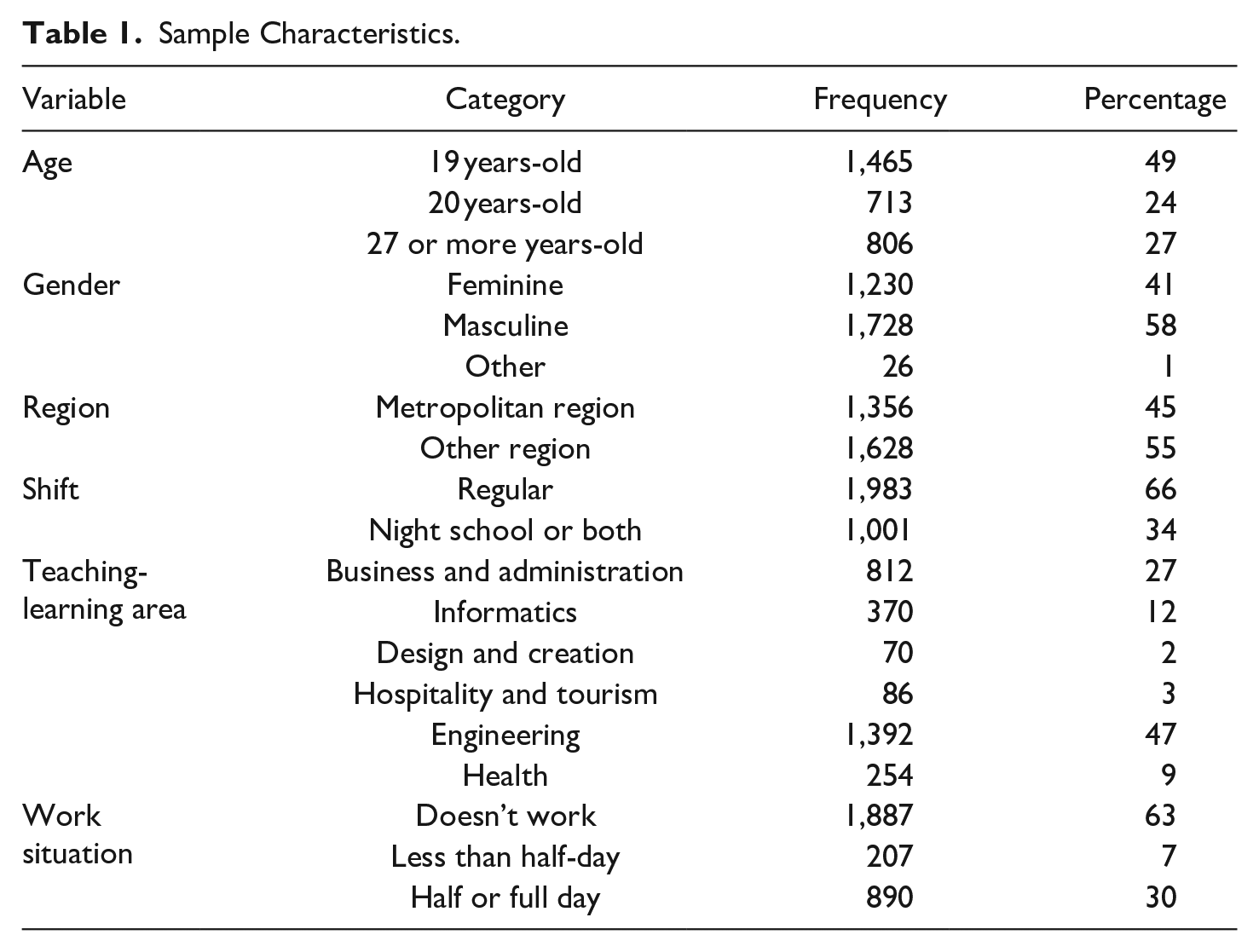
Considering both institutions, the study population is approximately 40,000 students in the second year of their degree in 2021 (the period in which the data were collected). It was decided to conduct the research with these students to obtain a sample that covers the study cycle of both two-year and four-year degree programs. At the same time, this decision made it possible to include students who, for the most part, were in their first year of studies during 2020, the year to which the questions in the questionnaire refer. It should be noted that this type of large purposive sample design, focusing on one or more institutions with a profile that allows for a broad understanding of an education system, has been frequently used in research on the integration of digital technologies in higher education training processes (Gulbahar, 2008; J. Han et al., 2018; Muianga et al., 2019; Tondeur et al., 2010; Zhang et al., 2020). In the end, a sample of 2,984 students was obtained, corresponding to 7.5% of students with the indicated profile in both institutions. The sample characteristics are presented in Table 1.
Sample Characteristics.
Procedure and Analysis
Developing and testing the validity evidence of the instrument follows the Standards for Educational and Psychological Testing (AERA et al., 2014; Bostic et al., 2019) as the framework. These Standards establish five sources of validity evidence: test content, response processes, internal structure, relations with other variables, and consequences of testing, which are described in this paper as follows:
The internal structure validity examines how the test items are related to the conceptual framework of the construct. This can be evaluated using techniques such as confirmatory factor analysis to determine the consistency of item relationships. Therefore, a Confirmatory Factor Analysis (CFA) was performed, and some possible relationships between variables were explored. CFA provides evidence to support the internal structure validity of a measurement instrument by verifying the number of underlying dimensions and the pattern of item-factor relationships, that is, factor loadings (Rios & Wells, 2014, p. 109). Adequate goodness-of-fit indices should be CFI > 0.90 and RMSEA < 0.08 (Byrne, 2016). In addition, internal consistency reliability was checked to estimate the accuracy coefficient from a set of actual test scores by calculating Cronbach’s alpha.
Evidence-based relationships with other variables include examining the relationship between the test and other measures, as empirical evidence suggests. For this purpose, by the available literature, evidence of convergence of this tool’s variables with the participants’ age criterion was used by examining the level of correlation. Evidence of convergence versus evidence of differentiation is obtained when measures of different constructs show a high correlation.
Following these standards and considering these different sources of narrative evidence, the results of a complete and accurate assessment of the validity of the questionnaire are presented in the findings section. Consequential validity based on the positive or negative consequences of using the results based on this instrument, the positive attributes, the educational system, the school, and the classroom content will be discussed further in the discussion section.
Ethical Aspects
The project was evaluated and approved by an ethics committee of the institution to which the researchers are affiliated. All information provided by the students was recorded in such a way as to maintain total anonymity and confidentiality. The responsible for the care of these measures is the Responsible Researcher, who must keep the data for 36 months from the closing date of the fieldwork. The students read this information and marked their agreement with these conditions on the form before answering; they gave their informed consent to participate and proceed with the questionnaire.
Results
Internal Structure Validity
The instrument used consisted of 41 items assessing students’ experience of learning mathematics online during the pandemic. Following Kline’s (2010) recommendations, the data were regarded as normal since they have skewness between −0.91 and 0.37 and kurtosis between −0.72 and +0.76, in the range within ±3 and ±7, respectively.
Confirmatory factor analysis (CFA) was used to assess a model composed of six latent variables: Attention (Atte), Confidence (Con), Satisfaction (Sat), Relevance (Rel), Teacher-Centered Activities (TCA), and Peer-centered activities (PCA). In this model, TCA were included items like Learning (L), Communication with teacher (CT), Time (T), Evaluation (E), Performance (P), Professional (Pr), Skills (S), Teacher attention to questions (TAQ), and PCA were covered items as Peer communication (PC), Peer questions (PQ), Knowledge exchange (KE), and Peer relationship (PR). The best model fitted with the data was a second-order model in which the six latent variables presented as first-order factors, and there were also two second-order factors called Motivation toward Materials and Evaluation of Activities (Figure A1 at the appendix).
Eleven items with low factor loadings were removed to fit the model with the data. It means, the initial measurement model (model 1) was modified by removing the problematic items. The items removed were: “When I started the course, I was under the impression that it would be easy for me”; “The course content is related to things I already knew”; “There were stories, images or examples in the course that showed me how this material could be important in real life”; “Passing the course was important to me”; “I liked the course so much that I was motivated to learn more about the topic”; “The exercises in the course were too easy”; “I found the course entertaining”; “The course material is interesting”; “The course guides were brief and clear”; “When I passed the course I felt good”; “The online modality facilitated the conversation with my professors.”
As a result, the 30 items remained in the last model (Table 2). The improved model (measurement model 2) adequately fits the data (Chi-Squared = 6,665, df = 614, CFI = 0.93, NFI = 0.93, RMSEA = 0.057, SRMR = 0.033). In addition, all items had high loadings on their respective factors (Table 2), and small correlational residuals were observed (Kline, 2010). This model provides evidence in favor of the proposed theoretical structure.
Standardized Loading Factors and Reliability.
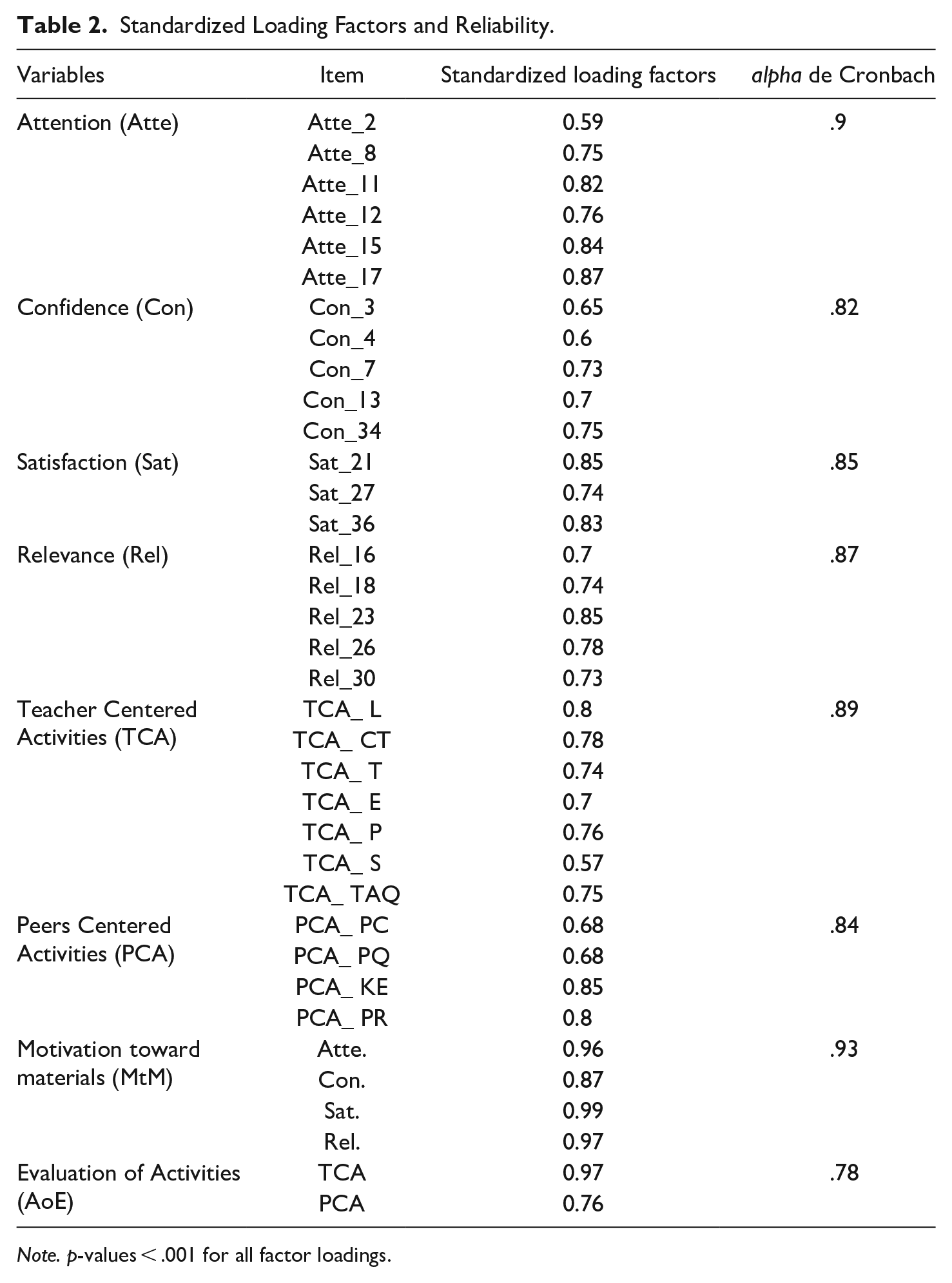
Note. p-values < .001 for all factor loadings.
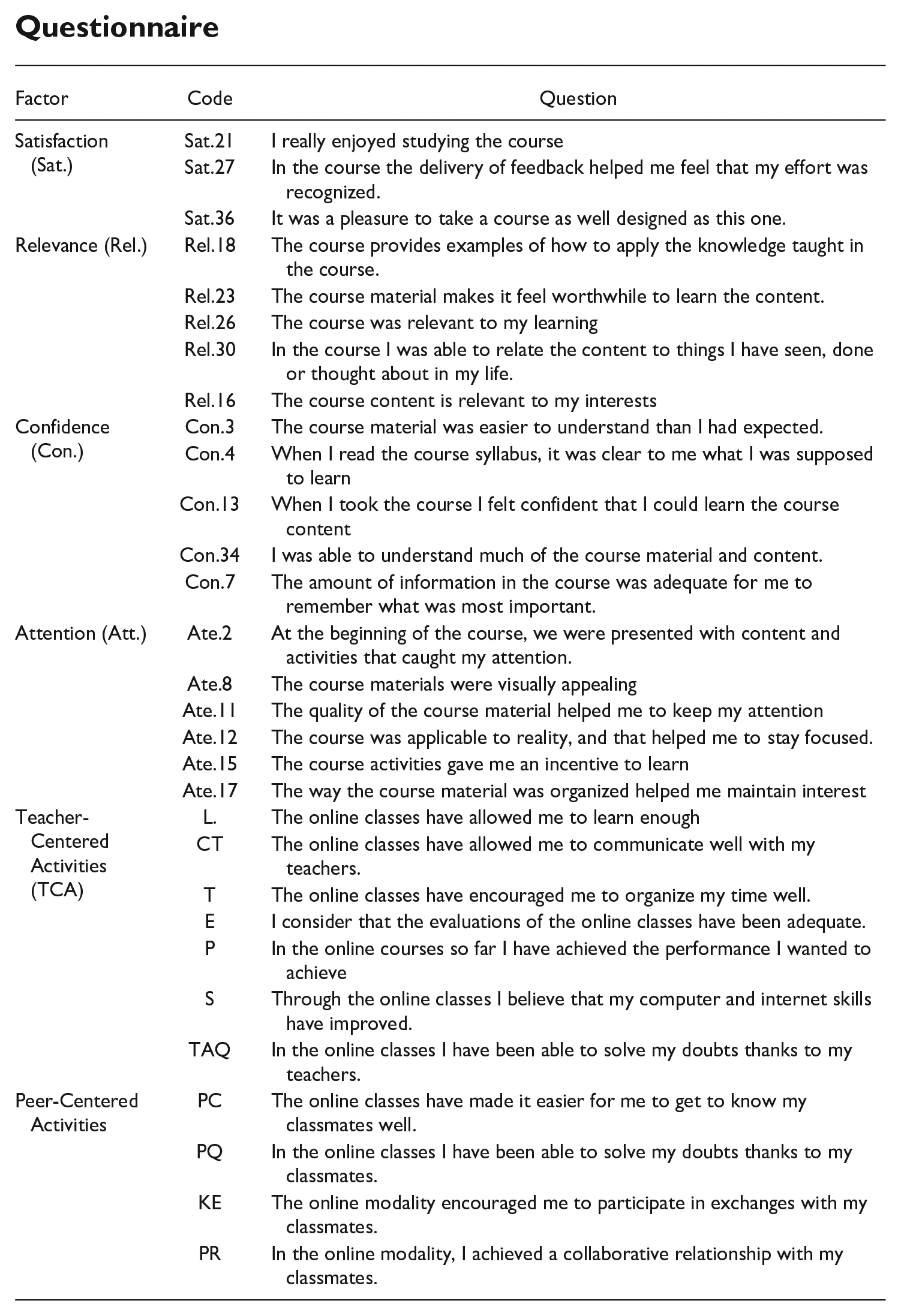
After identifying the factor structure and eliminating problematic items, items that remained in the confirmatory factor analysis (CFA) model were selected to measure the variables under study, resulting in eight items for Attention, three items for Satisfaction, seven items for Confidence, six items for Relevance, eight items for Learning Experience, and four items for Peer Communication Experience. The final questions can be found in the appendix.
Cronbach’s alpha coefficients, which measure the internal consistency of the items on a scale, were all greater than .85 for all factors. This indicates that the selected items reliably measure the variables under study. Considering the previous results, we concluded that the instrument variables are sufficiently reliable to assess students’ experience of teaching and learning mathematics online during the pandemic.
Figure 1 presents the correlations between the variables measured by the instrument used in the study. It was observed that all correlations between variables were positive and statistically significant. The variables associated with motivation were highly correlated, with values of .79 or more. Similarly, the two experience-related variables, learning experience, and peer communication experience, were highly correlated with a value of .68.
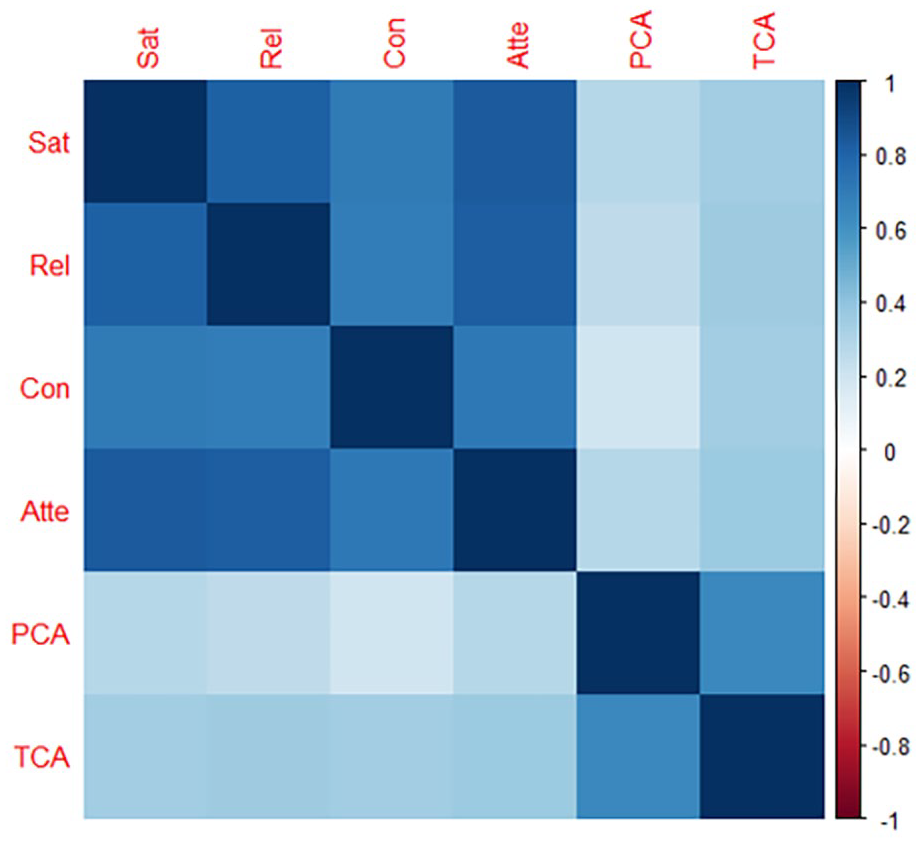
Correlation between dimensions.
Among the motivation and experience variables, it was found that learning experience showed a higher correlation, around .4, with the four motivation variables. This means that students with a more positive perception of their learning experience during the online course reported a higher level of motivation, including attentiveness, confidence, relevance, and satisfaction with their mathematics course. These findings suggest that a satisfactory learning experience can positively affect students’ motivation in the context of online mathematics teaching and learning during the pandemic.
Evidence of Relationships with Other Variables
To check for evidence of validity in this area, we examined two factors of motivation that the instrument was designed to measure, along with the external variable of participant age. Pearson’s correlation coefficients revealed that motivation toward Materials (r = .05, p < .05) and Evaluation of Activities (r = .11, p < .001) showed a positive and statistically significant correlation with the age of the students (i.e., the older the age, the higher the satisfaction). Statistically significant and positive relationships were also found between the subscales of motivation toward materials (Satisfaction r = .04, p < .05; Relevance r = .05, p < .05; and Attention r = .07, p < .001) and the subscale of Evaluation of Activities (TCA r = .12, p < .001; and PCA r = .08, p < .001) with the age of the participants. These statistically significant and substantial relationships provided evidence of validity based on relationships with other variables consistent with what has been observed in previous research (Morin et al., 2019). This positive correlation between instrument measures and participant age shows evidence of convergence. As for confidence, a positive correlation with participant age was observed, although it did not reach statistical significance (r = .03, p = .07).
Discussion and Conclusion
In crafting the instrument in this study, we considered an integration perspective that entailed the fusion of two theoretical frameworks. This approach involved a method of items pooling, where we wove together items from the instrument developed by Keller (2016) with selected items from questionnaires developed by Muthuprasad et al. (2021), Komolafe et al. (2020), and Dixson (2015). By employing this combined approach, we have created a comprehensive instrument that captures essential elements of instructional design and student learning experiences. The psychometric results of factorial structure and reliability lead us to the conclusion that the questionnaire has a good psychometric quality according to the empirical evidence analyzed. One proof of the suitability of this instrument is that it allows the measurement of differences by age, as the literature in this context has shown in previous research (Morin et al., 2019).
One of the remarkable features of this instrument is its ability to independently assess two distinct aspects of online education when measuring students’ motivation: motivation related to instructional materials and motivation associated with the dynamic interactions of teaching and learning practices in an online course. The latter includes direct communication with both peers and teachers, which is important in the context of “synchronous learning.”
The new contribution of this study is to move forward beyond the mere motivation with instructional online materials to a more complex understanding where interaction and relations are crucial in the teaching-and-learning process (H. Han & Johnson, 2012; Ong & Quek, 2023; Schmitz & Hanke, 2023). This aspect is of paramount importance for higher education institutions in Chile and other countries where distance education has evolved significantly since the global pandemic, driving higher education to adopt many of the teaching-and-learning digital activities in regular courses and creating new online programs (Morales Parada & Nova Rodríguez, 2021).
Our research underscores the positive potential of distance education when autonomous work is complemented by synchronous activities with teachers (Lee et al., 2021) and peers (Luo et al., 2017). Furthermore, it introduces fresh insights into the ongoing discussion about the definition of blended learning (b-learning), as there is a growing need to redefine the concept of “presence” in this context (Phirangee & Malec, 2017, Valverde-Berrocoso et al., 2020).
Within this context, a noteworthy argument emerges, suggesting that a positive learning experience can improve students’ Motivation, influencing their academic performance. If students positively perceive their learning experience, they are more likely to feel motivated to participate in learning activities and put more effort into their work. Previous research has shown that motivation is a key factor for success in online learning (Teng & Yang, 2023). One of the future challenges is to explore what happens to these experiences and their relationship to performance in learning tasks.
Furthermore, the learning experience is significantly related to students’ motivation (Kuo et al., 2014). In this sense, the results of this study suggest that in the specific context of online mathematics teaching and learning during the COVID-19 pandemic, the learning experience can positively impact students’ motivation. While it can be argued that motivation is also related to the learning experience, we suggest that future studies explore a causal relationship between these variables, seeking to test the hypothesis that if students are motivated to learn, they are more likely to pay attention to learning activities, feel more confident in their ability to learn, find the content more relevant, and feel satisfied with their learning.
An inherent limitation of this study lies in its temporal context. The results provide a robust stepping stone for future inquiries within distance education research, where self-learning materials converge with synchronous interactions with peers and teachers. In conclusion, such an instrument for measuring student motivation carries significant weight for educational institutions in Technical and Vocational Higher Education, especially in subjects like mathematics, where students’ motivation has been a concern (Saadati & Celis, 2022). In the post-pandemic era, where online education is anticipated to assume a more prominent role, it becomes crucial for institutions, especially those in the Technical and Vocational Higher Education sector, to evaluate the impact of online learning on their students’ experiences. Armed with this insight, they can design classrooms that integrate self-directed online interactions involving both teachers and peers, ultimately boosting student motivation and, consequently, enhancing academic performance.
Footnotes
Appendix
| Factor | Code | Question |
|---|---|---|
| Satisfaction (Sat.) | Sat.21 | I really enjoyed studying the course |
| Sat.27 | In the course the delivery of feedback helped me feel that my effort was recognized. | |
| Sat.36 | It was a pleasure to take a course as well designed as this one. | |
| Relevance (Rel.) | Rel.18 | The course provides examples of how to apply the knowledge taught in the course. |
| Rel.23 | The course material makes it feel worthwhile to learn the content. | |
| Rel.26 | The course was relevant to my learning | |
| Rel.30 | In the course I was able to relate the content to things I have seen, done or thought about in my life. | |
| Rel.16 | The course content is relevant to my interests | |
| Confidence (Con.) | Con.3 | The course material was easier to understand than I had expected. |
| Con.4 | When I read the course syllabus, it was clear to me what I was supposed to learn | |
| Con.13 | When I took the course I felt confident that I could learn the course content | |
| Con.34 | I was able to understand much of the course material and content. | |
| Con.7 | The amount of information in the course was adequate for me to remember what was most important. | |
| Attention (Att.) | Ate.2 | At the beginning of the course, we were presented with content and activities that caught my attention. |
| Ate.8 | The course materials were visually appealing | |
| Ate.11 | The quality of the course material helped me to keep my attention | |
| Ate.12 | The course was applicable to reality, and that helped me to stay focused. | |
| Ate.15 | The course activities gave me an incentive to learn | |
| Ate.17 | The way the course material was organized helped me maintain interest | |
| Teacher-Centered Activities (TCA) | L. | The online classes have allowed me to learn enough |
| CT | The online classes have allowed me to communicate well with my teachers. | |
| T | The online classes have encouraged me to organize my time well. | |
| E | I consider that the evaluations of the online classes have been adequate. | |
| P | In the online courses so far I have achieved the performance I wanted to achieve | |
| S | Through the online classes I believe that my computer and internet skills have improved. | |
| TAQ | In the online classes I have been able to solve my doubts thanks to my teachers. | |
| Peer-Centered Activities | PC | The online classes have made it easier for me to get to know my classmates well. |
| PQ | In the online classes I have been able to solve my doubts thanks to my classmates. | |
| KE | The online modality encouraged me to participate in exchanges with my classmates. | |
| PR | In the online modality, I achieved a collaborative relationship with my classmates. |
Declaration of Conflicting Interests
The author(s) declared no potential conflicts of interest with respect to the research, authorship, and/or publication of this article.
Funding
The author(s) disclosed receipt of the following financial support for the research, authorship, and/or publication of this article: This research was funded by the National Commission of Education (CNED) of Chile. Support from ANID/PIA/Basal Funds for Centers of Excellence FB0003 is gratefully acknowledged.
