







Abstract
Despite the growing trend in research on Latino men, one aspect that is missing is the experience of formerly incarcerated individuals. Using the asset-based framework of Community Cultural Wealth, the authors explore how formerly incarcerated Latino men become Streetwise Scholars, going from incarceration into higher education. Findings demonstrate how Streetwise Scholars are able to apply the capitals gained from their lived experience to successfully navigate higher education institutions.
Conversations around equity and social justice in higher education attempt to involve students who are often missing from the conversation and provide them with the support needed to be successful and have full access to education (DeTurk & Briscoe, 2020). On any day, the United States can have upwards of two million people incarcerated, of whom 95% will be released (Sawyer & Wagner, 2023). While incarcerated, some individuals will begin to take courses and work towards a college degree or credential (Castro et al., 2018; Conway, 2023). For those individuals who decide to pursue an education upon their release, research on their experience is limited. Formerly incarcerated students are not a new population in higher education, but only recently have they begun to receive attention (Abeyta et al., 2021; Contreras-Garcia, 2023; Hernandez et al., 2022). Despite this growing body of literature, there is still a need to further examine the experiences of Latino students beyond a racial or gendered experience (Hernandez, 2019; Martinez et al., 2023). While there is increasing research that analyzes the experiences of Latino men in higher education (i.e., Abrica & Martinez, 2016; Arámbula Turner, 2021; Rodriguez et al., 2021), literature that examines Latino men who are formerly incarcerated is missing. The purpose of our study is to explore how formerly incarcerated Latino men become Streetwise Scholars, going from incarceration into higher education. The following questions guided this study: (1) How do formerly incarcerated Latino men students utilize their lived experience to find success in higher education? (2) How do formerly incarcerated Latino men students use their lived experience to navigate higher education?
Much of the current literature surrounding the incarceration experience and education of men of color focuses on how education impacts the student, such as reduction in recidivism, education while incarcerated, or dealing with microaggressions (Giraldo, 2016; Mercer, 2009). Within community college literature, there is an increased focus on the experiences of men of color and the challenges they face, in particular Latino men (Abeyta, 2020; Castro & Cortez, 2017; Rodriguez et al., 2021). Despite this growing trend of Latino men in the community college, little research focuses on the unique experiences of Formerly Incarcerated Latino Men (FILM), given that the community college is their main entry point into higher education. This study takes on an anti-deficit perspective surrounding Latino men who identify as formerly incarcerated students and presents them as streetwise scholars, validating their knowledge acquired through lived experience (Halkovic, 2014; Hernandez, 2019; Pérez et al., 2018). In a personal communication between two of the authors, Hernandez and Duran (personal communication, September 24, 2020), they defined Streetwise Scholars as: Students or graduates who possesses the skills, attitudes and knowledge as a result of surviving difficult and dangerous environments capable of translating their knowledge into navigating foreign or unfamiliar institutional environments such as post-secondary education and/or the professional field.
This study builds on previous research that used asset-based lens to illuminate how formerly incarcerated Latino men access the needed resources to excel in higher education as opposed to leaving education (Castro, 2014; Hernandez, 2019; Pérez et al., 2018). Additionally, we explored the FILM’s experiences as they navigated from community college to their current educational place or accomplishments. Through their narratives, participants define success on their own terms and discuss how it’s led them to their current educational outcomes.
Formerly Incarcerated Students in Higher Education
Formerly incarcerated students are a growing population within higher education that has received minimal examination (Abeyta, 2020; Hernandez, 2019). According to a recent report conducted by the Vera Institute of Justice (Smith & Digard, 2020), a project that collects data on currently and formerly incarcerated college students in California, higher education participation among justice-involved students, students who have been legally impacted through incarceration or the juvenile justice programs, in California has grown exponentially since 2018 (Yücel, 2023; Cavendish, 2014). For a vast majority of these students, community colleges serve as the main entry point into higher education that allows them to then transfer to a 4-years institution and potentially pursue graduate school (Abeyta, 2020; Hernandez et al., 2022).
As a result, many community colleges have developed programs to serve formerly incarcerated individuals through re-entry and support programs for higher education that aim to support students through their transition back into education (Abeyta et al., 2021; Yücel, 2023). Additionally, several states, such as Louisiana and New York, have passed legislation that prohibits questions about an individual’s criminal history in college applications (Phoenix & Steib, 2021; Jung, 2016).
Runell (2017) explored the educational pathways of students in a higher education program for formerly incarcerated individuals at a large state university in the northeastern United States. This university program played a key role in propelling the desistance process for research participants as students were able to make a connection to the university, preventing them from returning to their previous involvement, which led to incarceration (Runell, 2017). Additionally, this research specifically investigated how their post-incarceration educational experiences served as a “hook for change” and impacted street influences, financial constraints, stigma, and academic and social development (Runell, 2017, p. 894).
In order for formerly incarcerated students to be successful, they must be provided with consistent support, as a lack of resources can lead to failure and depression (Abeyta, 2022; Copenhaver et al., 2007). However, because of the limited research and understanding of formerly incarcerated students, faculty and staff rarely know how to support these students (Copenhaver et al., 2007). Ultimately, it is important for educators to understand how students can used their lived experience to be seen as holders of knowledge, fostering a streetwise scholar identity leading to success in higher education versus being viewed as unprepared to succeed in post-secondary education (Hernandez, 2019).
As research on formerly incarcerated individuals has expanded, so has the focus on Latino men and Latinas/os that have been incarcerated, which captures their unique reentry experiences (Abeyta, 2020; Hernandez, et al., 2022). For Latino men, the focus has also been on the transition through higher education and using their previous knowledge to find success within academia (Abeyta, 2020; Hernandez, 2019; Hernandez et al., 2022). Abeyta (2020), for instance, highlighted the strengths and knowledge used by students to succeed in higher education and move away from a carceral identity into a student identity. Further, research on formerly incarcerated Latino men has begun to challenge the stigmas that are associated with having been incarcerated (Abeyta, 2022). Given the limited research, continued research on formerly incarcerated Latinas/os/xs is necessary as institutions seek to support this growing population.
Theoretical Framework
Community Cultural Wealth (Yosso, 2005) was selected as the guiding framework for this research study as it allows for the holistic exploration of the lived experiences of participants from an asset-based lens of critical analysis. Community Cultural Wealth examines six forms of capital that students of color experience in college: aspirational, linguistic, familial, social, navigational, and resistance. This framework explores the talents, strengths, and lived experiences that students of color bring with them to their educational environment (Yosso, 2005). This study focused on the application of four of the capitals: aspirational, navigational, social, and resistant. These capitals are applied to explore the lived experiences of the participants.
According to Yosso (2005), having the ability to maintain hope and dreams for the future in the face of real and perceived barriers can be considered a fundamental aspect of aspirational capital. For Formerly Incarcerated Latino Men, the aspiration of achieving an education is a space of infinite possibilities despite institutional and personal barriers. Navigational capital refers to the students’ skills and abilities to navigate social institutions, which include educational spaces such as colleges and universities. Additionally, students’ navigational capital empowers them to maneuver within unsupportive or hostile environments (Yosso, 2005). Another important capital taken from this framework for the analysis of the study includes social capital, which is described as a form of capital that includes peers and other contacts within their networks for student success and emphasizes how students utilize these contacts to gain access to college and navigate other social institutions (Yosso, 2005). Lastly, resistant capital has its foundations in the historical experiences of communities of color in securing equal rights and collective freedom. The sources of this form of capital come from parents, community members, and a historical legacy of engaging in social justice (Yosso, 2005). This historical legacy of resistance plays a crucial role in Formerly Incarcerated Latino men’s journey to personal freedom through educational attainment.
Methods
In order to understand the experiences of formerly incarcerated Latino men, we used a qualitative approach. A basic qualitative study (Merriam & Tisdell, 2015) was used for this paper that allowed the researchers to understand and make meaning of the experiences of formerly incarcerated Latino men. Individual semi-structured interviews were used to give participants an opportunity to share their story individually rather than finding a collective story. Using semi-structured interviews also allowed for in-depth data collection from participants and allowed the researchers the ability to follow up on participants’ responses. Participants were asked questions about their background, experience with incarceration, and transition into higher education.
Recruitment and Sample
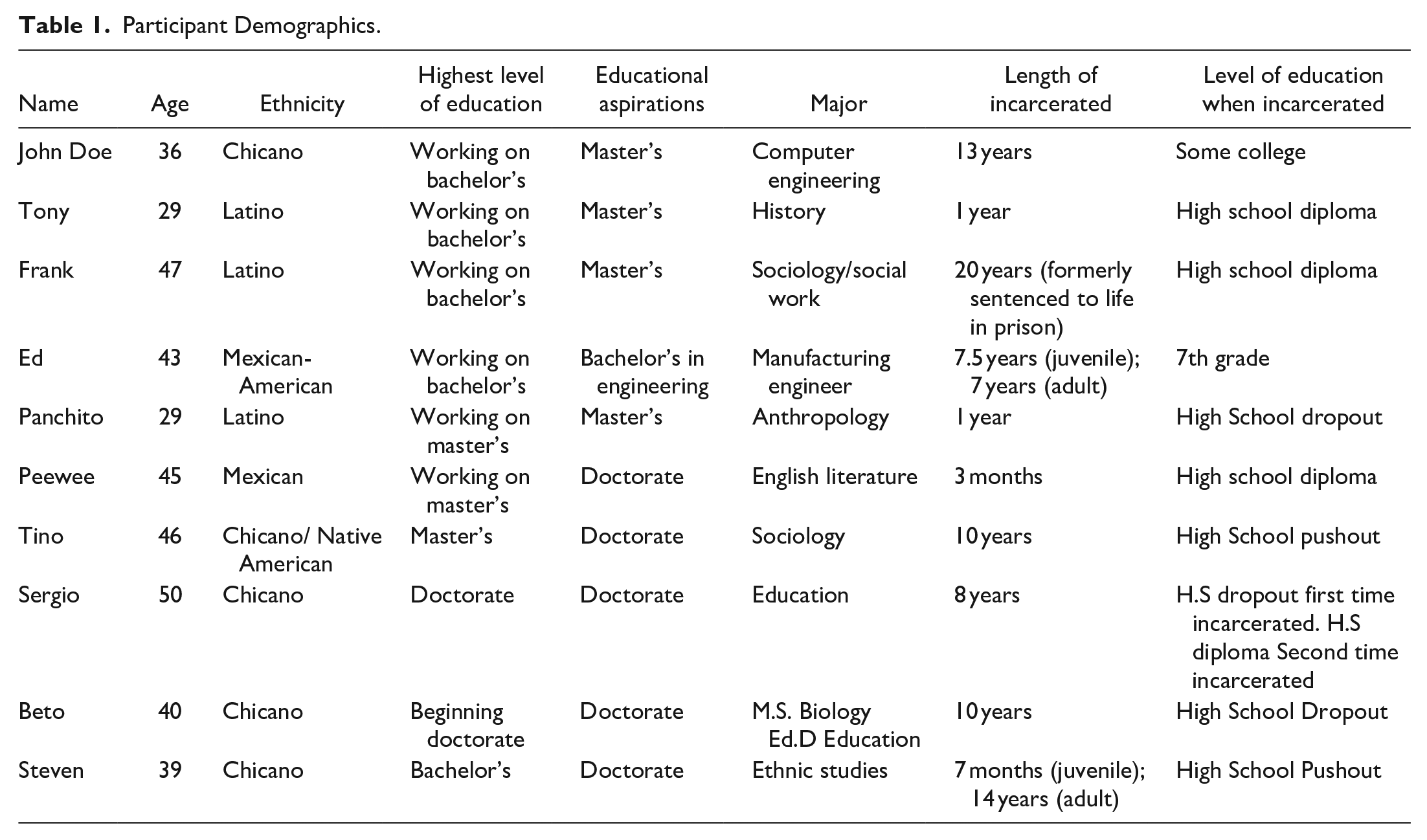
The findings of this study are part of a larger study of formerly incarcerated students in higher education. For this article, we focused on the experiences of 10 Latino men who had experienced incarceration and navigated higher education to be successful in employing their knowledge and skills that were part of the sample. Snowball sampling (Heckathorn, 2011) was used to recruit participants with the following criteria for students: identified as Latino, had a conviction history, transferred from a community college, and students enrolled at a 4-years university and/or graduate program. Participants were invited to partake in an interview through email; once a participant was interviewed, we asked for recommendations for other students who would qualify for the study. Table 1 demonstrates that formerly incarcerated students are in different stages of their educational journey, the length of incarceration varies, with some having multiple instances as a youth and adult, and they are all enrolled in a diverse set of disciplines. Despite incarceration, participants did not have limitations to fields or degrees that they opted to pursue. We differentiate between a high school dropout and a high school pushout but refer to a high school dropout as someone who may not have seen education as a viable option and left on their own, while a high school pushout is someone who left school as a result of oppressive school policies and practices, such as suspension and excessive discipline (Mireles-Rios et al., 2020).
Participant Demographics.
Data Collection
Data collection consisted of 10 one-on-one semi-structured interviews that provided the researchers with an understanding of the experiences of participants in higher education. Using semi-structured interviews allowed for flexibility to either follow the set questions or transition and follow up on responses to get richer data, which allowed the researchers to glimpse how participants employed their Community Cultural Wealth capitals to navigate higher education (Lichtman, 2013). Interviews were audio recorded, with the length of interviews varying from 30 to 90 min. As a part of the protocol, participants were asked questions related to their higher education experience and explored issues such as experiences while incarcerated, skills learned during incarceration, and how they were able to apply the skills gained to higher education. Once interviews were completed, interviews were transcribed verbatim to begin data analysis.
Data Analysis
The data analysis consisted of a four-step process, which included preparing, exploring, and coding the data; refining findings; identifying themes; and validating the findings (Clark & Creswell, 2017). Upon receiving transcriptions, we observed our field notes to identify emergent themes. To focus the analysis, we used Community Cultural Wealth to highlight the students’ capitals and how they used them (Yosso, 2005). Although we coded all six forms of capital, for this paper, we focus on four capitals: aspirational capital, navigational capital, social capital, and resistant capital. In order to ensure the trustworthiness of the data, we employed methods such as journaling, peer debriefing, and member checking (Ortiz, 2003). One of the researchers has experience with incarceration and has a criminal record, which helped to gain a more in-depth perspective in analyzing the data because the researcher without these experiences does not have insight into the data as a person with lived experience would (Milner, 2007). To further solidify our trustworthiness, we also engaged in dialogic engagement with the second and third authors to clear any forms of bias in interpreting the data (Ravitch & Carl, 2020).
Positionality
Our personal experience has an impact on our research and allows us to understand the data we are analyzing. The first author, Joe Louis Hernandez, began his journey at a community college and recently received his Ph.D. in higher education and identifies as formerly incarcerated. Joe Louis is a community college professional working in Southern California, directing a program that supports students who have been incarcerated or impacted by the criminal justice system. The second author, Eligio Martinez Jr., is a faculty member at a teaching institution and researcher who works closely with programs geared at supporting men of color in higher education. The third author, Oscar Duran, identifies as system-impacted because of his younger brother’s direct experiences with incarceration and has seen the negative and long-lasting effects that this phenomenon has on the familial structure. Oscar is also a community college practitioner in southern California, working for a student support program that specifically provides services, guidance, and mentorship to formerly incarcerated and system-impacted students to help them navigate higher education successfully and transition into the 4-years university and/or workforce.
Findings
In navigating higher education, participants discussed the Yosso’s (2005) Community Cultural Wealth capitals they possessed when viewed through which arose from the participant’s lived experience and their understanding of their success. All 10 formerly incarcerated Latino men participants discussed the various capitals they accessed to succeed in their educational journeys. Four forms of capitals emerged as significant to the participants’ experiences. First, in Using Aspirational Capital to Beat the Odds, participants demonstrate aspirational capital, highlighting how formerly incarcerated Latino men drew on past experiences that allowed them to persist regardless of challenges Second, in Surviving to Thriving, participants employed navigational capital, showing how they used their lived experience to traverse postsecondary education to achieve their goals. Third, Opening Up Doors discusses how participants employed social capital to develop and engage in relationships to help them persist on their academic journey. Finally, Against the Odds discusses how participants applied resistant capital by using their stories and success to shatter stigmas and break through barriers so that future formerly incarcerated students can also triumph in their educational pursuits. A discussion of how participants used each of the capitals is detailed below.
Using Aspirational Capital to Beat the Odds
Aspirational capital is the ability to maintain hope and dreams for the future in the face of real and perceived barriers (Yosso, 2005). For formerly incarcerated Latino men, the aspiration of obtaining an education offered a second opportunity at life and a space for financial mobility despite barriers of inequality. Using their unique lived experiences allowed many of these students to apply their learned knowledge outside of the classroom, into the academic environment in their journey to fulfill their aspirations. For example, Panchito, a graduate student, described how the life he led pushed him to use these negative connotations of him as fuel to continue fighting for his dreams. Panchito said: “Navigating that, my life, and understanding the odds were against me, I always challenged myself like, ‘Screw this, I’m going to beat the odds!’” The challenges presented throughout his life allowed Panchito to be motivated and confident in his ability to succeed. Although society may still hold negative stereotypes, stigmas, and a lack of understanding and/or education towards this group of individuals in our communities, aspirational capital remained intact for Panchito.
Aspirational capital allowed participants to stay motivated throughout their academic journeys even when others around them did not believe in them. This allowed them to develop a strong mentality and resilience despite viewing the odds as being stacked against them. Frank, an undergraduate student reflected on his experience: Even then, I will still be pushing to do well and people would say, ‘what are you doing that for? I ain’t going to help you, you’re just going to end up being the smartest lifer on the yard.’ I still have this motivation that even though people said you can’t do it, or the situation seemed like you can’t do it, I would still push forward.
Aspirational capital was almost tangible for Panchito and Frank; they described their experiences with such passion to achieve what others said they would never be able to accomplish. Participants were also very cognizant of their past, but this did not deter them from continuing to show their aspirational capital as they looked toward the future. As Frank added: Yes, I did things. I wish I could take them back, but I can’t. This is what I’m at now. This is what I’m doing. I’m trying to be the person that I might be, I was intended to be, but it just took me longer than others, maybe.
Frank understood that even though his journey was non-traditional and non-linear and wished he could have done things differently, he recognized that he could not change what he had done. Despite this, he acknowledged that there was nothing wrong with taking the time he needed to succeed and become the person he intended to be.
Furthermore, the resilience Frank showed by accepting and not letting the choices he made in the past define his future is evident when he expresses himself. Similarly, Pee Wee, a graduate student, took his past pain and struggles and turned them into strength and motivation. He aspired for more and saw in Malcolm X a role model with a similar way of thinking. Pee Wee shared: I think about my success. I look at all the pain that I’ve been through, and I put in so much work. I’m dedicated. For me I think what makes me a successful student is that I have this attitude that Malcolm X said, if you want freedom, you take it.
PeeWee’s aspirational capital was fueled by his determination to succeed no matter what, influenced by heroes such as Malcolm X. Aspirational capital was crucial as participants navigated higher education and was reflected in their experiences. Ed, an undergraduate student, drew from his experiences to aspire to give himself a new life. Ed stated, Well, if I did this for all the wrong reasons, I could use that same mentality to do it for all the “right reasons,” in terms of like giving myself full-fledged to something that could have killed me, that could have ended me with life, or something, I could turn that into giving myself to something positive, that could give me life and a career.
Ed drew from his past and viewed his willingness to turn his life over to actions that could have ended his life as a source of motivation to invest in his education. Instead of ending his life, Ed knew that education or a career could provide a new life for him and understood he needed to commit to his new life in order to succeed.
By finding ways to turn their previous lived experiences into motivation for their present as they prepare and dream of a better future, formerly incarcerated Latino men continued to push forward in their educational trajectory and their lives. More than that, they wanted to be able to give a voice to their own experience instead of allowing others to try to define them. Ultimately, despite the negative experiences that might still arise occasionally for participants, their ability to maintain their hopes despite the barriers presented to them allowed them to use their aspirational capital to turn experiences into action.
Navigational Capital as a form of Surviving to Thriving
Participants discussed how they navigated institutions based on their previous experiences. Navigational capital refers to the knowledge people of color used that assisted them in maneuvering various institutions; formerly incarcerated Latino men used their knowledge to persist and find success in their educational journey. Formerly incarcerated Latino men particularly observed how their previous experiences allowed them to survive in dangerous environments and how they translated that into higher education to thrive. Participants could connect their past experiences to education and adapt previous knowledge. Sergio, a doctoral program graduate stated, “There’s what I learned in there like how to maneuver and strategize and being able to talk to, as they say, go from an inmate mind to a convict mind, that could help me out here in the world.” Sergio points to the capitals he possessed and applied to his education and discusses the strategies and maneuvers he used, which he referred to as going from an “inmate mind to a convict mind.” He acknowledged that to survive his imprisonment, he had to be in a different mindset, which he applied to thrive and navigate higher education.
Learning how to navigate higher education was critical for students as they attempted to adapt to a new environment. Panchito, a graduate student expanded on his experience: I’ve learned how to navigate in these societies, the environments that we grew up in, in a way where I don’t allow barriers to stop me, and I think I never have. I think even when I was on the street, if I was looking for something, I was going to get it regardless.
Like Sergio’s indication of navigation, Panchito hinted at not letting barriers or obstacles get in the way of reaching his goal. Although he does explicitly state how he would get to his goal, Panchito knew that he would pursue and achieve his desired outcome. In addition to speaking on how he navigated barriers, Panchito understood that to accomplish his goals, he would have to apply pressure. He further reflected, “What were the pressure points, and how I would be able to get favorable outcomes when I’m challenging the system.” In his pursuits of education, he understood how to navigate barriers and what these barriers weak points were to challenge the system to accomplish his goals. Ultimately, Panchito reached his goal of attaining his master’s degree, which, in essence, is a challenge to an inequitable system.
Other participants also discussed how they employed navigational capital to thrive at institutions of higher education and reflected on how it did not matter where the starting point was but rather about how you navigate higher education. Steven, an undergraduate student, stated, “I understand that it’s not always all about the starting point. It’s how you do the job and how you make those connections that allow you to kind of open up other doors.” Steven recognized the importance of accomplishing tasks and how those actions would put him in a position to develop relationships, allowing him to access resources. These participants found that navigational capital constituted their state of mind, overcoming barriers and relationships that would allow them to be successful as they persisted in their previous life and now in higher education.
Social Capital Helped Open Up Doors
Social Capital was very prevalent in the participants’ experiences and was a key form of how they applied community cultural wealth to their lives from their lived experiences. Social capital includes the different social networks the students tapped into and the community resources they had at their disposal as well (Yosso, 2005). One example of how formerly incarcerated Latino men used their community resources is given by Tino, a graduate student who reflected on how a faculty member gave him hope through their actions. Tino stated: Ever since I was, finally went to her class and ever since then, my entire community college experience, she was there to help me with my papers, help us with the group we were starting, and it’s just interesting. She gave me hope.
Through their actions, this faculty member provided support in many ways for Tino, but most importantly, they provided hope. The faculty member was also able to turn the support into access to resources for Tino and his peers. Faculty were also critical in advocating and supporting the creation of a student group for formerly incarnated students, which provided additional opportunities for them.
Once participants learned how to turn their social capital into something more concrete, like networking and building relationships, new possibilities opened for them as they continued to strive towards their goals and learned new skills along the way. Beto, a doctoral student explained: “Being able to have access to this new economic theme, resources, and individuals that I can leverage conversations with, and influence some change or create a new opportunity that wasn’t existing before.” Beto described how he used his capital to benefit himself and others with similar backgrounds. He looked to connect with new individuals and create new opportunities.
Additionally, it is extremely important to recognize that many of these students seek their first educational opportunities at the community college. There are many reasons for this, but one of the most common ones is the accessibility and affordability factor (compared to 4 years and/or privates). Therefore, community colleges are a place where many students seek out support and learn how to gain social capital. Panchito, a graduate student, explained how he felt about the community college: I felt like at community college I really got the support. It really did feel like a community. I just feel like not at the university level, it’s more like you got to fend for yourself. It’s just not the same support system that I felt I had at community college.
This transition that Panchito reflects on is something that many students experienced, and it highlights the differences in cultures that exist at community colleges and 4-years institutions. The lack of connection to the institution made him use the skills he learned in community college to survive and do well after he transferred, highlighting the value of social capital.
For other participants, joining a student organization, a student support services office, or a leadership role like student government, gave them a sense of belonging on campus. This engagement provided new opportunities and access to additional resources. Beto, a doctoral student, described his involvement with the Associated Student Government as positive and opening doors for him. Beto shared: “That actually opened up the door to me getting involved with student government, and I ultimately ended up getting into a leadership role in student government as an AS President and student trustee for our district.” From his initial involvement, Beto gained a leadership role that ultimately set him up for a higher, more influential role within his institution and district. Having an initial opportunity, or as he said, opened the door, allowed him to connect and serve his campus.
Beyond providing opportunities and support, social capital also allowed students to develop confidence and visualize larger goals for themselves. Steven, an undergraduate student, discussed how Social Capital provided him with new opportunities in life. Steven stated, I wanted to be an academic. I wanted to be a scholar. Then I want personal aspiration, but I feel like if this is to survive shit, not shit to survive but you have a job that I can live off of. I know that I can do that just with the Master’s degree and teach at a community college. Again, teaching at community college and because of the connections that I made throughout community college.
Steven’s access to social capital influenced his outlook for the future. Because of his community college networks, he now aspires for a career and not just a job. This also gave him the confidence to pursue a graduate degree once he completes his bachelor’s. Furthermore, his wants and goals have moved to the academy as a scholar, which would allow him to live.
Social capital significantly impacts how participants navigate their institutions by providing access to individuals and resources that can support them and boost their confidence. In combination with the rest of the capitals, when applied together, it can be a powerful way for the students to develop positive outlooks for their future. Social capital can also provide students with hope and connection to new career opportunities, which can transform their lives, moving them from surviving to thriving.
Using Resistant Capital Against the Odds
Resistant capital focuses on the knowledge and skills that students use to challenge and overcome inequality in their personal experiences (Yosso, 2005). During the interview, 6 out of 10 participants spoke of behaviors they learned to challenge either the perception of being incarcerated or liberating resources for other formerly incarcerated students. Ed, an engineering major, often fought the perception that others held about people had had been incarcerated. As Ed shared: The only thing I can take from that is that in terms of saying somebody that came from a negative background can turn it around and make it something positive, that goes through the naysayers that, someone who says that, “You’ll never change,” It contradicts that idea and it turns it on his face, when they’re looking at the person.
Ed reflected on the importance of shattering the stigma associated with his past and showing that change is possible. This also gave him the motivation to continue and reach his goals. Pushing against the stigma of incarceration or being branded a “Felon” challenged the belief that he was done and has no hope. Similar to Ed, Sergio saw his educational attainment as resisting what even his family believed was possible for him. Sergio stated: Then, the crazy stuff I did to counter the naysayers that I encountered along the way, whether it be your own family is trying to lovingly say, “How are you going to pay for it?” Or this or that, or people out there saying, “You’re a convicted felon. You’re done.” Or what is a degree going to do for you?” Those types of environmental stuff I blinded out.
Using his education to resist the deficit perception about him, Sergio “blinded out” and ignored comments made towards him to keep moving, despite few people believing in him. As he navigated education, he had to block out the negativity that others would bestow on him. Earning his doctoral degree is the ultimate act of resistance against people who did not believe in him.
Another form of resistance for participants was through the engagement and development of research and programs that support formerly incarcerated students. Research can challenge negative connotations surrounding student populations. Steven, an undergraduate student, discussed challenging the misconception about people have been incarcerated are “animals.” He realized that a way to challenge this came through research and the production of knowledge on this student population. As Steven shared: It’s important for us to be able to produce knowledge from– Also, having the training and what I mean by training I don’t necessarily mean that you have to have a PhD and shit but definitely had done– Have an understanding of what are the implications of that research and what land are you fucking doing that research too because if you’re just doing it to fucking continue to perpetuate this fucking myth that we just a bunch of animals out there, then fuck you.
Steven echoed Ed and Sergio’s sentiment, but he challenged deficit-based research that often perpetuates stereotypes about formerly incarcerated Latino men. Steve understood the need to develop new research to demonstrate how formerly incarcerated Latino men are succeeding in higher education.
Expanding our understanding of formerly incarcerated Latino men is important given the impact it has on policies and the way programs are developed to support this population, which impacts how students access resources. Beto also talked about sharing resources from an academic setting with those in the community. Beto stated: I do a lot of work on and off-campus to be able to do that and to, again, win that credibility with folks to leverage my credibility in the neighborhood with the educational backing that I can come with and leveraging the resources from academic settings into the community as well.
Beto reflected on the importance of having credibility in both higher education and the neighborhood and using that credibility to bring higher education to the hood. Most important for Beto is the access he creates for his community since colleges and universities are not recruiting or promoting higher education in the neighborhood. Participants discussed how they use their capital to break the stigma of incarceration, challenge deficit research, and provide access to those in the community.
Discussion and Recommendations
The purpose of our paper was to explore how formerly incarcerated Latino men utilized Community Cultural Wealth in their pursuit of higher education. Through our findings, we focus on how participants employed aspirational, navigational, social, and resistant capitals. Aspirational capital allowed participants to continue to move forward and overcome barriers related to their past experiences. Their desire to overcome the negativity surrounding their lives encouraged them to push through any challenge to reach their academic goals. Navigational capital allowed participants to apply their previous knowledge to their educational pursuit. Participants turned what others would view as deficient into positives that helped them navigate higher education. Resistant capital allowed students to persevere despite the opposition they may have experienced from peers and the institution. Participants employed social capital to develop connections with institutional agents to support their navigation of higher education. These connections also allowed formerly incarcerated Latino men students to build confidence and begin to aspire for more than they imagined possible.
Our application of Community Cultural Wealth to the experiences of formerly incarcerated Latino men highlights the assets they possess and enter higher education with. It also allows participants to challenge deficit-perspectives that may exist about formerly incarcerated Latino men and how they use those perceptions as motivation to continue to excel academically. Further, our study also begins to demonstrate how institutions can create supportive environments for Latino men, both through faculty engagement and mentoring, and how institutions can take the initiative to engage formerly incarcerated Latino men in campus activities.
To better serve formerly incarcerated Latino men in higher education, it is important for institutional agents to approach their work and interaction with students through the asset-based and anti-deficit approach. Everything from the language used to engage the student to the resources offered must be culturally relevant and sensitive to the student’s lived experience. For example, faculty could intentionally include course material on the syllabus highlighting the Community Cultural Wealth framework so that students may make those connections and find their strengths reflected within the literature assigned to them.
Additionally, it is imperative that institutional agents be intentional about recognizing the presence of formerly incarcerated students on their campus and take the necessary steps to provide specialized support for their success (Contreras-Garcia, 2023). This could be achieved by providing professional development courses or “ally training” to all eligible staff and faculty so that they may familiarize themselves more with the resources the campus has to offer this student group. Lastly, institutions should be intentional during the search and hiring process to bring on board staff, faculty, and administrators who have lived experiences with incarceration. This would be beneficial for the institution because of the knowledge and expertise they could provide for working with this student population and, more importantly, because this could allow students to connect with them, through similar experiences and be able to find role models that reflect their journeys, obstacles, and resilience (Hernandez, 2023).
Conclusion
In this paper, we position formerly incarcerated Latino men students as possessing capital that has not been recognized by the field of higher education. We seek to achieve two goals with our research: first, add to the growing literature on Latino men in higher education. Second, to broaden the current scholarly activity surrounding students who have been incarcerated. In Sáenz and Ponjuan (2009) wrote about Latino men vanishing into the prison industrial complex. Today, we begin to address this issue by exploring the educational experience of those who have taken a longer road to complete their educational goals. Given the number of individuals incarcerated and released every day across the country, understanding their educational experiences after their release is important (Sawyer & Wagner, 2023). By highlighting the Community Cultural Wealth capitals these students possess, we add to research on formerly incarcerated Latino men students (Abeyta, 2020).
In addition, this research will continue the development of a Streetwise Scholar identity that focuses on the strengths and skills developed as a result of incarceration and a life lived in the streets and how this knowledge is employed to move from surviving to thriving in higher education (Hernandez, 2019; Hernandez & Duran, personal communication, November 3, 2019). Contreras-Garcia (2023) writes of the importance of the development of programs to help formerly incarcerated Latino men students succeed through the allocation of funds, proper staffing, and professional development. Findings from this article can help in the development of support programs that can positively impact the experiences of formerly incarcerated Latino men students in higher education. It can also help guide the development of professional training to help support FILMs in higher education. Finally, this article continues to expand on the literature that uses Yosso’s (2005) Community Cultural Wealth framework to expose mainstream research to the capital possessed and utilized by communities of color and marginalized student populations.
Footnotes
Declaration of Conflicting Interests
The author(s) declared no potential conflicts of interest with respect to the research, authorship, and/or publication of this article.
Funding
The author(s) received no financial support for the research, authorship, and/or publication of this article.
