







Abstract
This article examines the landscape changes of San Francisco's Chinatown resulting from urban redevelopment after World War II. It describes the contested process of community development and documents the intricacies of Chinatown's spatial struggles. Socially constructed as a space of “otherness,” San Francisco's Chinatown illustrates the ways in which urban redevelopment process interacted with the social and cultural tensions of a plural and liberal urban society. It also reveals how the existing categories of ethnicity and cultural identity have been renegotiated over time.
Keywords
In the 1950s and 1960s, the first wave of urban renewal occurred in American cities. It was characterized by the state-sponsored bulldozer that remade downtowns, encouraging scattered private-market gentrification. Federal and city governments played a crucial role in the process of urban regeneration. 1 A second wave of urban renewal followed in the 1970s and 1980s, when political support for gentrification waned. The state intervened less directly in the process of urban renewal, and instead, “federally inspired, locally implemented laissez-faire governance” became prevalent through reregulating public policies for providing incentives for urban redevelopment. 2 The fiscal crisis of 1973 prompted a major shift in urban policy as cities faced the difficulties of trying to revive declining neighborhoods, improve devalued land, and control violence. The strategy for dealing with these problems was restructuring the economy and searching for new sources of wealth. 3 In the process, the Keynesian model of welfare proved unable to contain the inherent conflicts of capitalism. Neoliberalism, which promotes “market resolution” and less governmental intervention within the marketplace, replaced Keynesianism and became the dominant form of governance in the United States. In this new mode, the market was perceived as the essential means of reviving the urban economy. 4 The new agenda for urban land planning prioritizes the global circulation of capital and other resources in urban space, all for the sake of capital accumulation. 5 This is especially true in what Sassen calls “global cities” or “world cities,” which, according to her, play a strategic role in the management of the global economy by providing the states with a major competitive advantage on a world scale through increasing the “global control capability” in the global system of production. 6
This spatial logic of modernism has been employed by developers and other proponents of urban growth who use the vocabulary of urban renewal to create new lines of segregation between the rich and the poor, the powerful and the disenfranchised. Many scholars have analyzed the increasingly fragmented and divided urban form. For example, Davis argues that the urban forms in the city of Los Angeles are fragmented and dispersed according to a division between “fortified cells” and “places of terror.” 7 The pattern of urban segregation based on the rhetoric of urban renewal represents a new spatial strategy to gain access to and command over the resources belonging to unprivileged groups. 8 Exclusion by race and by class was integral to urban redevelopment, in which profit was made from dispossession of the unprivileged through imposing the categories of rationality, order, and normality in the discourse of urban planning. 9
This article contributes to the existing literature on postwar urban redevelopment through the lens of landscape changes in an ethnic community under the forces created by the urban redevelopment and racial ideology of contemporary society. It examines the dynamic and contested process of postwar community development in San Francisco’s Chinatown from the 1950s to the 1980s and documents the intricacies of urban renewal as a complex rhetoric at the center of Chinatown’s landscape changes. On the one hand, the city’s revitalization projects marginalized the ethnic enclave by constraining it with physical barriers and encroaching on it with the uncontrolled expansion of downtown commercial and financial sectors. On the other hand, a productive economy caused property values to rise, which led to the eventual dislocation of low-income populations. The rise of a postindustrial economy generated a “privatist political culture” that privileged capital accumulation and market forces. 10 However, the urban pro-growth machine was challenged by the development of minority spaces, which negotiated and contested the contradictory structures of modernity and liberalism. By examining the context-specific struggles over space in San Francisco’s Chinatown, this article has emphasized the ways in which the urban redevelopment process was intermingled with the social and cultural tensions inherent in a plural and liberal urban society. The issue of race permeated the grassroots struggle over the housing and landscape changes in Chinatown, which revealed the exclusionary kernel of urban renewal and redevelopment policies. The interplay of macroeconomic forces, community political struggles, and housing needs has been integral to the process of community redevelopment in San Francisco’s Chinatown.
The City and the Chinatown Community
San Francisco was one of the earliest cities to emerge from the immigration waves brought by the California Gold Rush of 1849. By 1875, San Francisco had become the largest city on the Pacific Coast and benefited from thriving economic activities such as mining, agriculture, fishery, and logging in the surrounding areas. Following the 1906 earthquake and fire, San Francisco experienced its second upsurge of growth. After the conflagration destroyed the whole downtown area, the city was rebuilt as a new cosmopolitan urban center with modern high-rises. Completion of the Golden Gate and San Francisco Bay Bridges in 1937 facilitated the large influx of automobiles and led to the construction of parking facilities downtown. After World War II, San Francisco’s third wave of development took place, resulting in a new skyline of international-style high-rises. The growing importance of San Francisco and the Bay Area in trans-Pacific trade and military relations provided a strong stimulus for the city’s postwar economic growth. 11
With city planners and developers’ strategic efforts to transform a West Coast port into a regional, national, and international corporate and service center, San Francisco was expanding at a rapid pace that profoundly influenced the city’s urban-renewal efforts and impelled its transformation after World War II. 12 The San Francisco Redevelopment Agency was established in 1948, to assume a strong leadership in the city’s postwar urban renewal program. In 1955, city business elites united to form the Blyth–Zellerbach Committee that assumed responsibility for providing necessary financial, administrative, and other resources for downtown redevelopment. Using Manhattan as their model of development, the committee created the San Francisco Planning and Urban Renewal Association (SPUR) to promote a downtown plan calling for city infrastructures to accommodate the growing needs of tourism and commerce. By the late 1950s, a powerful coalition launching San Francisco urban redevelopment had formed. 13 From 1965 to 1983, about thirty-six million square feet of new office space had been constructed in downtown San Francisco. Skyscrapers such as the Bank of America Tower and the Transamerica Pyramid significantly transformed the skylines of the city. To accommodate the nation’s economic shift from a manufacturing to a service industry, San Francisco was repositioned in the evolving economy through spatial reorganization and land-use changes. As efficient and profitable forms of land use, high-density high-rises became essential for the city to prosper in the processes of urban economic restructuring and maintain its central role in transnational trade. 14
While the downtown area grew quickly, urban redevelopment often occurred at the cost of extensive destruction of old neighborhoods that had been occupied by people of color, 15 as well as low-income and working-class residents, which generated enormous social problems. During World War II, African Americans came in droves to San Francisco, most of them coming to work in the war industry and as military personnel. In the 1950s, an influx of Asians arrived under a series of refugee acts and reformed immigration laws. With the increasing presence of African, Asian, and Latino populations, San Francisco gradually changed into a “city of color.” 16 To recapture the centrally located neighborhoods occupied by minorities after the whites moved out, urban renewal was employed as a mechanism to reclaim central urban spaces and reshape the city’s racial contours. The city found general public support for downtown growth. However, as happened elsewhere, disadvantaged social groups, particularly racial minorities, did not benefit but instead became victims of the vigorous urban redevelopment. Thus, when the city decided to evict residents of the Western Addition and the South of Market so it could tear down whole blocks of these neighborhoods, there were outbursts of resistance. With the eruption of the civil rights movement in the city beginning in 1964, these formerly excluded groups gradually procured the rights to participate in the political administrative system and to negotiate the city’s redevelopment projects. Neighborhood activism became continuous and unified. 17
These social, economic, and political transformations of the postwar era significantly impacted the development of San Francisco’s Chinatown. When the city of San Francisco was established in 1848, the Chinese had settled in an area around Portsmouth Plaza, the hub of the city at that time. Most of the Chinese were brought to America as contract laborers to work for California gold mining companies that wanted a reliable supply of cheap labor. With the increasing presence of the Chinese, Chinatown gradually came into shape at the beginning of the 1850s and was soon recognized as a distinct neighborhood in the city. 18 Because Chinese could not own land due to the 1882 Chinese Exclusion Act, the Chinese had to take long-term leases and pay high rents to settle in the Chinatown area. As a historically urban ethnic ghetto, Chinatown was known for its overcrowding, dilapidated housing, and lack of amenities. 19
In 1943, the United States repealed the Chinese Exclusion Act of 1882 (which prohibited the immigration of Chinese laborers), and in 1965, the institution of the Immigration and Nationality Act abolished Asian quotas. From 1940 to 1970, Chinatown’s population increased by about 25 percent per decade and propelled the expansion of Chinatown. 20 Based on the 1970 census, the Department of City Planning defined a core and noncore area of Chinatown. Core Chinatown included a seventeen-block area bounded by Kearny, Pacific, Powell, and California Streets, with a concentration of restaurants, stores, and residential units (Figure 1). The noncore area of Chinatown consisted of ten census tracks, mostly residential areas. The low-income ethnic enclave was then, and still is today, surrounded by upper-income, largely white neighborhoods and the expanding financial district.
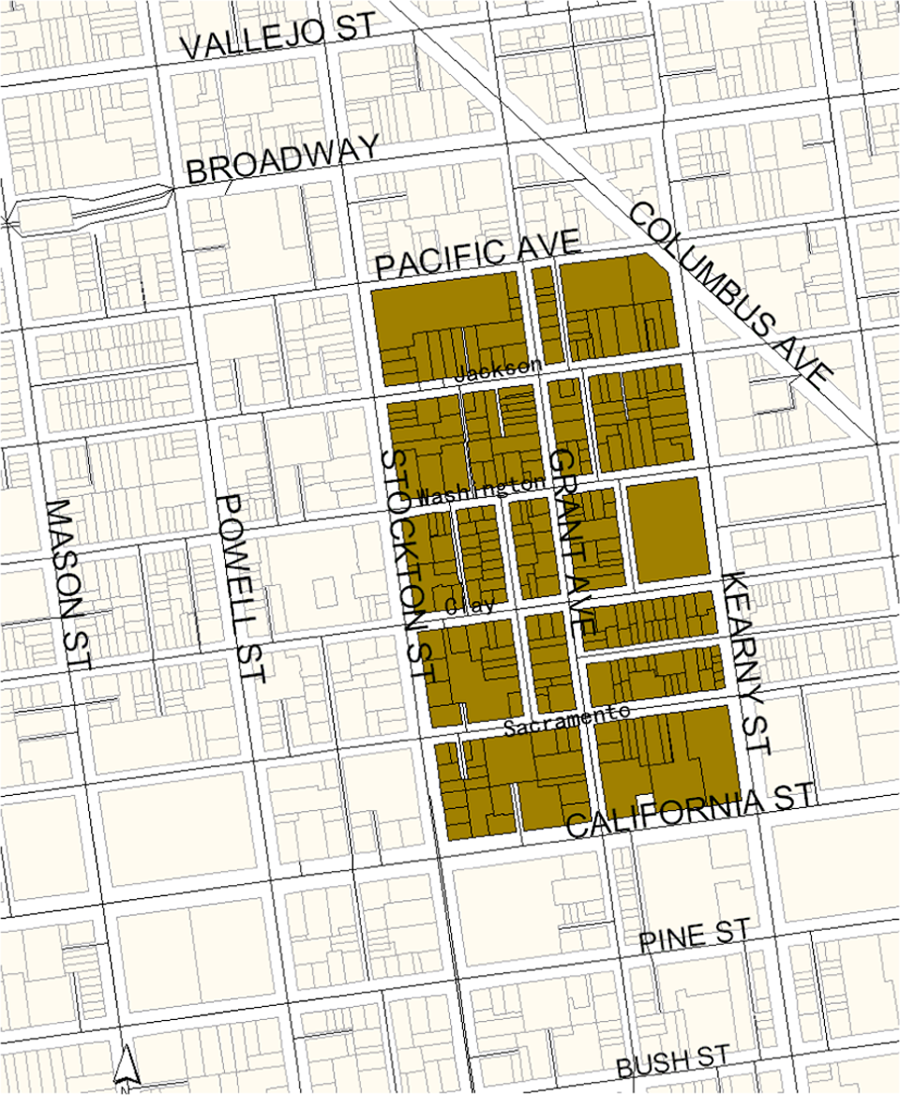
The dark area shows the core of San Francisco’s Chinatown, whose population was more than 90 percent Chinese, according to the 1970 census account. Graphic by author, based on the GIS data provided by the San Francisco City government at http://gispub02.sfgov.org/website/sfshare/index2.asp.
Housing and Recreational Crisis
Since the end of the nineteenth century, San Francisco’s Chinatown has been known for its substandard housing and crowded living environment. According to a report conducted by the US Congress Housing Committee in 1948, “The great majority of them [the Chinese] live crowded together in rickety and dilapidated tenement houses… Apartments which would be deemed small for the accommodation of a single American are occupied by 6, 8, or 10 Chinese.” 21 The report suggested that several factors contributed to the housing problems in Chinatown: predominant bachelor populations with a sojourner mentality, the growth of the numbers of families, racial segregation and restrictive covenants, geographic constraints for expansion, dilapidated buildings not complying with city code, and lack of sanitary facilities in the tenement buildings. 22 After World War II, the housing situation in Chinatown only worsened, but new repressive restrictions were imposed to protect the surrounding, wealthier areas from receiving the undesirable overflow. A permanent injunction issued by Superior Judge James Conlan barred the Chinese from occupying apartment houses on Nob Hill where owners signed a compact in 1932 restricting the area to Caucasians.
The arrival of GI (refers to the soldiers of the United States Army) brides brought a sudden increase to Chinatown’s population after World War II, while the repeal of the discriminatory immigration law in 1965 also facilitated a major influx of Chinese immigrants. With the significant increase in the immigrant population and the constricted boundaries of Chinatown, housing deficiency became an urgent problem faced by the city government and community institutions. Many Chinatown residents lived in houses with poor conditions. According to the 1965 Community Renewal Programming Report, 77 percent of the dwellings in San Francisco’s Chinatown–North Beach area were designated as substandard or seriously substandard.
23
This was partly because Chinatown was the most densely populated area of San Francisco; there were from 120 to 179.9 people per gross acre compared to 24.6 people citywide.
24
In a study presented to the Chinatown–North Beach Economic Opportunity Commission, Chinatown housing was described as follows: In Chinatown, the community bathroom is a virtual way of life…60 percent of the housing lack separate bathrooms…Another facility that is commonly shared in many Chinatown apartments is the kitchen; that is, if a resident is fortunate to have such a facility…Depending on the building and its location, 50 to 100 people may have to be served from one common kitchen…In some apartments where heat is lacking, the (cook) stoves serve also to heat the deficient buildings in cold weather…Apartments in Chinatown are deficient in the lack of natural and in many cases of proper artificial lighting….
25
The 1970 census classified some 13.4 percent of Chinatown’s housing as overcrowded and about a quarter of the Chinatown population lived in this kind of overcrowding. 26
In 1939, the United States Housing Authority provided 1,365,000 USD for San Francisco’s Chinatown to build low-income housing, but because the high cost of land in Chinatown exceeded the federal standard, the project was deferred. At the urging of the San Francisco Junior Chamber of Commerce, the local housing authority, and Chinatown’s community organizations, the city appropriated some funds to purchase two and a half acres of land in three separate lots in Chinatown in 1941. The housing project known as Ping Yuen (Tranquil Garden) Housing, which is located on Pacific Avenue and has 234 living units, remained the major affordable housing for the community until today, despite controversies regarding the segregated occupancy of the Chinese American residents. 27 North Ping Yuen, added later, is a building of eleven stories and 194 units, most of which are dedicated to senior housing. Ping Yuen has been deemed a successful project built upon strong coalitions and activism among residents and community organizations to improve Chinatown’s housing conditions. It also inverted the stereotypes of high-density public housing as a failure in the United States. 28 Regardless of its success, however, the demand of low-income housing continued to be overwhelming in Chinatown. There was a long waiting list of individuals and families hoping for a rare vacancy at Ping Yuen. Among the approximately 700 Chinese applications for city public housing in 1968, nearly all were for units in Ping Yuen. In 1969, the number of Chinese applicants increased to 900, while the number of available public housing units remained unchanged. 29
The residents of Chinatown would not or could not look elsewhere for housing because the ethnic enclave provided them with a sense of physical safety and social security. The fear of social isolation because of language and cultural difference was one of the major reasons that the Chinese wanted to stay in Chinatown. Also, in Chinatown, they lived within walking distance of workplaces, residences, shopping, educational facilities, banking services, hospitals, and other community services, a feature that appealed to immigrants who could not afford a car and relied on public transportation systems for commuting.
The growing population of San Francisco’s Chinatown was generally considered a key factor responsible for the worsened living conditions in Chinatown. However, despite the fast growth of Chinatown in the decade following World War II, in the next decade (1960–1970), the population grew only 1.8 percent (from 55,091 to 56,013). 30 The most significant demographic changes were those of age, gender, and household composition. Accordingly, between 1960 and 1970, the age group between fifteen and twenty-four increased 84 percent, and young adults then comprised 17.6 percent of Chinatown’s total population. The number of senior Chinese residents also increased 16.5 percent, comprising 14.4 percent of the population. Meanwhile, the ratio between male and female residents tended to be more balanced, and the family population increased by 5.8 percent. 31 Thus, attributing the housing crisis in the 1960s and 1970s solely to the increasing number of Chinese immigrants was not entirely accurate. A more important factor causing the housing shortage in Chinatown was the polarization of the population between the young and old, both of whom earned less income than adults in their middle years, combined with the shrinking availability of housing stock. 32
During the 1960s, around 1,442 housing units were lost in San Francisco’s Chinatown, a decline of 5 percent. The loss of housing units was more severe in the core area of Chinatown, where a 14.2 percent decrease in available housing units was recorded. 33 As the 1970 Chinatown census concluded, the loss of housing units was worst in tracts having a high concentration of low-income residents, while the higher-income residential areas gained. 34 The 1,590 new housing units in the adjoining neighborhoods of Chinatown, such as Russian Hill and Northern Waterfront areas, were all aimed at upper-income and high-middle-income populations and, hence, did not alleviate Chinatown’s primary housing crisis. 35 Commercial developments also replaced some of the housing. The city’s growth-oriented agenda prioritized the interests of private profit-making, while the desires and needs of working-class and low-income communities were neglected.
In addition to a severe housing shortage, the lack of recreational spaces was a great concern to the community. According to a study conducted by students at University of California, Berkeley, the funds appropriated for recreational purposes in Chinatown by the city’s Parks and Recreational Department ranked among the lowest per capita from 1961 to 1969 compared to other parts of the city. Chinatown’s public recreational spaces included the Chinese playground (0.58 acres) built in 1927, the Chinese Recreational Center (0.55 acres) from the 1950s, and the historic Portsmouth Square (1.21 acres). 36 These recreational spaces were far from sufficient for the 9,124 people living in the core area of Chinatown in 1970. Regardless, a group of Chinese developers formed a company known as the City of San Francisco Waverly Parking Plaza Corporation in 1966, aiming to develop a parking lot to replace the Chinese playground. Concerned community members contested the plan by asking for whom the garage was intended, given that few of the residents in Chinatown’s core area owned automobiles. 37 With the congested conditions of Chinatown, they also argued that a new parking lot would bring more traffic into the community, which would worsen the traffic congestion and raise safety problems for the residents, especially young children. 38 The entire Chinatown/North Beach area had only ten square feet of outdoor recreational space per person, which was much lower than the average city standards of ninety square feet per person. 39 The scarcity of the outdoor recreational space posed severe dilemmas for the community’s health and well-being.
To address the housing and recreational space crisis in San Francisco’s Chinatown, the San Francisco Department of City Planning conducted the “Chinatown 701 Study” in 1970. One of its objectives was to increase the standard housing stock for low- and moderate-income households in the Chinatown/North Beach area through facilitating new construction and rehabilitation of old buildings. Although the study was well intended, its success was limited by the government’s dominant agenda of promoting urban growth. In the new urban political economy perspective, “exchange value” of land is often dominant in land-related activities. However, “use value” concerns that emphasize utility rather than profitability of urban space motivate community members to seek ways to protect their home from the destruction of capitalistic investment. 40 The conflict of interests led to political mobilization and battles of the community for land-use control.
Urban Renewal and the International Hotel Controversy
The “Manhattanization” of San Francisco was accelerated by the city’s desire to maintain its central position in cross-Pacific trade and also to participate fully in the nation’s corporate capitalism. 41 While the urban renewal movement upgraded the city’s infrastructures, it unfortunately also led to the demolition of low-income housing, causing massive displacement of the poor. Hartman has observed that “by and large it has been the city’s low-income and third-world population and its blue-collar workers who have been uprooted and evicted for the benefit of those with larger bank accounts, more political clout, and lighter skins.” 42 Thus, urban renewal in San Francisco was conducted with a hidden cost paid by the underclass for the benefit of others.
One of these neighborhoods was Manilatown, located at the intersection of Kearney and Jackson Streets, near the northeast edge of San Francisco’s Chinatown. Manilatown was dismantled when the cheap hotels in the enclave were demolished as part of urban renewal. Under the rubric of “slum clearance” and “blight removal,” the city redevelopment groups aggressively captured as much downtown land as they could. Among the important moments of San Francisco’s urban movements, the protest of the demolition of the International Hotel (I-Hotel) in Manilatown was engraved in history. The hotel was claimed as the last remaining building of Manilatown. The three-story, 150-room residential hotel was built in 1854 and rebuilt in 1907, after it fell in the earthquake (Figure 2). In the 1920s, the hotel became a home base for Filipino manongs (older brothers) and Chinese men who were seasonal workers. But in 1946, the SPUR proposed a plan for neighborhood urban renewal that aimed to eliminate urban blight by demolishing such structures. This meant that by the late 1960s, Manilatown had been gradually replaced with profitable high-rise office buildings, although the hotel itself lingered. The need for parking lots and other commercial endeavors also drove people out and caused the demolition of low-rent hotels.
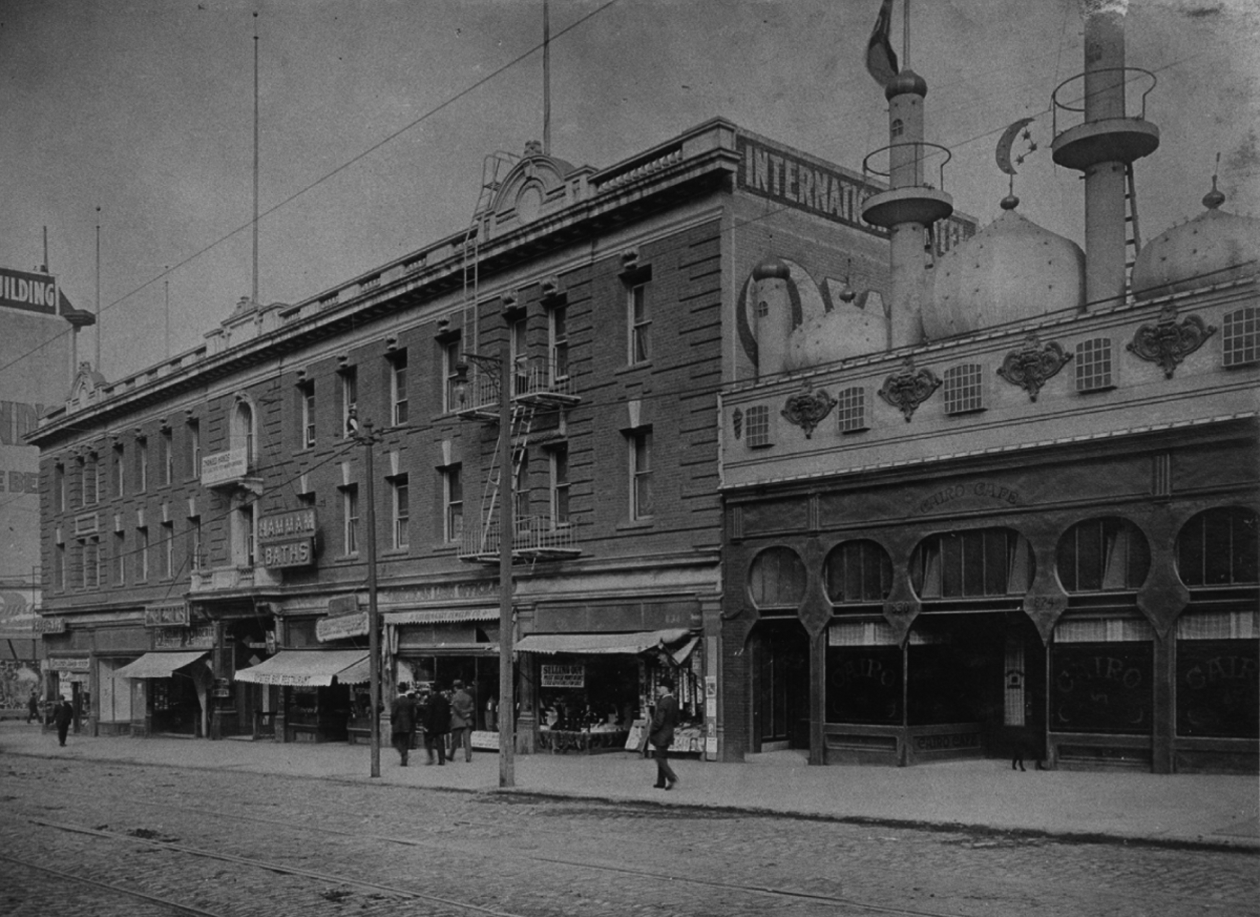
View of the International Hotel on the left, undated. Note the introduction of another form of exoticism in the Islamic-style café next door, with horseshoe arches, bulbous domes, and slim “minarets.” Source: Manila Heritage Foundation.
In 1968, Milton Meyer and Company bought the I-Hotel under the management of real estate magnate Walter Shorenstein in order to build a multilevel parking garage at the site to alleviate the parking problem of the expanding financial district. In the name of “getting rid of a slum,” the company sent eviction notices to the hotel tenants. 43 Most tenants of the hotel were single retired farmworkers and seamen who could barely speak English and lived on social security retirement benefits. 44 The tenants organized the United Filipino Association (UFA) to fight against the eviction, declaring the I-Hotel “the last outpost” of the once bustling Manilatown. In 1969, the UFA successfully obliged the hotel owner to sign a three-year lease with the existing tenants, a triumph of a wide-ranging coalition of individuals, private organizations, and civic institutions that had fought to protect the I-Hotel. However, soon after the lease was signed, a suspicious fire occurred, killing three tenants and destroying the north wing of the building. After the fire, Shorenstein canceled the new lease agreement, but under pressure from the city and the general public, he eventually agreed to a new lease, in which the tenants would be responsible for rehabilitation of the building and bringing it up to code. The renovation of the I-Hotel depended on volunteer groups that included church groups, UC Berkeley students from the Third World strike and other students, the American Jewish Congress, and individuals who were sympathetic to the plight of the hotel tenants. 45
In 1972 when the three-year lease was due, the International Hotel Tenants Association (IHTA), which had replaced UFA, requested three promises from Shorenstein: that “the International Hotel be maintained, and will continue to be designated as low-income housing; a ‘reasonable and human’ lease be drawn up with the tenants group; there be no further demolition of Shorenstein-owned, low-income Filipino housing until other such housing is available in the area.” 46 Shorenstein agreed to postpone demolition of the I-Hotel but then in 1974 sold the hotel to the Four Seas Investment Corporation owned by investors based in Bangkok and Hong Kong. After taking over the building, the new owner received a Superior Court order requiring that the I-Hotel be refurbished to comply with city housing, plumbing, building, and electrical codes or be razed. In response, the Four Seas decided to vacate the building within a month. 47 The controversy that had revolved around the hotel six years ago once again raged around the city. With public support, the hotel tenants refused to leave and placed a sign declaring “We Won’t Move” at the hotel’s entranceway. In October 1974, the IHTA organized the tenants to protest in Chinatown and demanded the new owner to lift the eviction notice, repair the hotel, sign a long-term lease, and give the tenants an option to buy the building. Their requests received support from the city’s Human Rights Commission, which called for a long-term agreement that would keep the hotel for low-rent housing and community services. However, the request didn’t get support from the city or the investment company. 48
In 1975, the Four Seas formally filed an application for a demolition permit for the I-Hotel and proposed to build a Far East Trade Center at the site. Despite all the opposition and protest, the city officials approved the application. The IHTA fought back by taking their cases to the Board of Permit Appeals. In March 1976, the City Permit Appeals Board held a public hearing meeting, in which representatives from Chinatown organizations and other supporting groups vigorously denounced the worsening housing conditions of the area resulting from the expansion of the financial district. The representatives of the Four Seas, however, emphasized the “horrible” conditions of the building and the urgent need for property improvement. A flurry of lawsuits ensued, with several eviction dates set and lifted. The Board of Supervisors eventually agreed to allocate 1.3 million USD to buy the I-Hotel, but a judge later ruled that the city had no right to buy the hotel and sell it back to the tenants. 49
Overwhelmed with the pressure of eviction, many elderly Filipino and Chinese tenants started to move out of the I-Hotel. By 1976, only 80 of the 130 tenants remained. By the time a new eviction date was set for December 15, 1976, the I-Hotel had become a rallying point for tenants and their supporters to form a human barricade around the building to prevent eviction. Fearing violence, the judge reprieved the order of eviction. On June 17, 1977, the I-Hotel was listed in the National Register of Historic Places because it had been a cultural center for Filipino American and Filipino immigrants in the 1920s and made its name by housing the famous “hungry i” nightclub, where many entertainment stars launched their careers. Despite the nomination, the I-Hotel tenants were evicted from the building on August 3, 1977. More than 1,000 angry supporters sought to prevent the eviction by forming a human barricade, but Special Weapons And Tactics teams forcefully broke down the barrier. Within thirty-six hours, the last tenant had been removed.
The I-Hotel was eventually demolished by the end of 1977. However, the controversy remained more than a political statement for the elderly Filipino and Chinese tenants. Underlying the issue was the desperate shortage of low-income housing in the downtown area and the city’s insufficient response to that need. 50 But there was pushback because the struggle to save the I-Hotel galvanized Asian American activists to engage in “what would become a symbolic fight against capitalism and the plight of urban removal.” 51 It was also a fight against racial discrimination. With the rising civil rights movement, Asian Americans—like other disempowered minority groups—had become a political group that coalesced to fight for civil rights and citizenship. Holston and Appadurai argue that violence is a form of social action and that transition to democracy brings its own forms of violence that includes “a sustained expansion of political and socioeconomic rights for the urban poor.” 52 Thus, the violent confrontation at the I-Hotel was an insurgent social action for the Asian American minority to challenge the hegemonic form of urban renewal. These kinds of social movement of the urban poor and minorities also create new sources of citizenship that engender new notions of membership, entitlement, community, and a new transnational politics. 53
Not only the Chinese living in San Francisco’s Chinatown but also Chinese immigrants in other cities showed their sympathy and support for the I-Hotel tenants. They perceived the fight as “the struggle of all Chinese who are forced to live in ghettoes like Chinatown” and the “resistance to discrimination and oppression” of exploitable cheap labor. 54 Many residents of San Francisco’s Chinatown participated in the I-Hotel fight. Accompanied by the long-existing discontentment with “over-priced, over-crowded, over-rotten slums the landlords created” in San Francisco’s Chinatown, the residents provided tremendous support to the I-Hotel battle. 55 In New York’s Chinatown, donations and petitions gave the I-Hotel groups financial and political support. The I-Hotel struggle inspired the residents of San Francisco’s Chinatown to fight gentrification, housing discrimination, and urban removal. In a larger sense, it also was a catalyst for Asian American activism nationwide.
With the gradual demolition of Manilatown, Chinatown, which was located near to Manilatown, was also threatened by downtown expansion. From the mid-1970s to the mid-1980s, some 1,700 housing units in Chinatown were converted to office use, while a flux of overseas Asian capital boosted the commercial and residential rents to a new height and drove small-scale merchants and residents out of the neighborhood. 56 However, unlike Manilatown, Chinatown thrived, transforming from a bachelor society to a family-oriented community. Its particular socioeconomic conditions and land-use patterns, in a level, helped protect it from state-imposed urban redevelopment projects and sustained its very survival. The land values in the heart of San Francisco’s Chinatown were extremely high—comparable to the adjoining financial district. In 1972, land costs of Chinatown core area ranged from 40 to 60 USD per square foot, and even in the extended area of Chinatown, the costs were still high, ranging from 15 to 30 USD. 57 Although the inhabitants paid for this in the form of high rent, the elevated values also protected them by making it very expensive to acquire land for redevelopment. In addition, the original land-use patterns of Chinatown consisted of small and fragmented parcels, which made it extremely difficult to assemble a decent size of land for redevelopment. The dense concentration of its residential population also posed a dilemma because of the burden of tenant relocation. 58
Although the particular social structure and land-use pattern of San Francisco Chinatown were key factors in preventing the intrusion of large-scale redevelopment projects, they also created obstacles to obtaining low-income housing for the community. The high cost that discouraged developers from buying land in Chinatown made Chinatown ineligible for federal funds for low-income housing projects, which favored projects on low-cost lands. There were two major types of land use in Chinatown—commercial and residential. The mixed use of the built environment was important in sustaining the community because revenue-generating commerce helped to offset the high land costs of the area. 59 However, the principal beneficiaries of Chinatown’s thriving business were a small group of Chinese elites who possessed sufficient capital and social resources to afford the expensive rents. In contrast, the majority of the Chinatown residents struggled on the poverty line. The unique problems of Chinatown placed the residents in a vulnerable position by making it unlikely that the neighborhood would be selected for federal housing assistant programs, despite its overriding needs. Federal bureaucratic procedures and regulations for assistance program were not designed to accommodate the specific conditions of Chinatown. 60
Programs to improve the community’s recreational areas also failed to meet the official criteria for funding. 61 According to the community report, due to the limitation of Chinatown’s land-use patterns, proposed recreational spaces usually had to take an innovative approach, incorporating “mini-parks, joint use of school facilities, use of eminent domain, spot renewal, and relocation coordination.” 62 The realization of these programs required the involved agencies to collaborate and respond effectively and creatively to unique situations. Unfortunately, until the 1970s, the institutional organizations in Chinatown had not obtained sufficient human and capital resources to coordinate these kinds of programs. 63 In consequence, federal funding was rarely allocated to build recreational facilities for the community.
As an ethnic neighborhood located in the city’s center, San Francisco’s Chinatown was hit by urban renewal movements that determined to make downtown San Francisco a commercial, financial, and administrative center of West Coast America. But this met with resistance because Chinatown was also a thriving residential neighborhood with a strong sense of identity. Resisting the encroachment of the financial district and battling for affordable housing and a healthy living environment required the residents to constantly claim and maintain their rights to the social and physical space of Chinatown.
Fighting for Affordable Housing
San Francisco’s Chinatown was, after Manhattan, the second-most densely populated area in the United States. Its substandard housing conditions and congestion were ranked the worst in San Francisco. 64 In 1966, the city’s Economic Opportunity Council designated four targeted areas for the anti-poverty program, which included Western Addition, Hunters Point, the Mission, and Chinatown. The former three communities were actively engaging in community building with a strong ideology of political empowerment. Chinatown, however, showed little enthusiasm. Fainstein and her colleagues have suggested that this was because the community’s “organizational leadership had been highly conservative.” 65 The community virtually opposed the designation of Chinatown as an impoverished area and did not mobilize the poor to participate in anti-poverty programs. 66 Thus, there were complaints about the Chinatown leadership that stressed the importance of social services without building the community’s organizations. 67 Chou states that the indifference of the poor residents to the anti-poverty program resulted from the “fear and suspicion of revolution and politics” that had long existed among the Chinese immigrants. 68
Clearly, there were internal historical factors leading to San Francisco Chinatown’s indifference to the anti-poverty program. But its failure was also due to the insensitive design of the program itself, which tended to ignore the specific needs and anxieties of the community. 69 First, the publicity and emphasis on problems such as poverty, crime, unemployment, and unsanitary environments called attention to the miserable conditions of the poor, which negatively impacted the community’s tourism and commercial development. In 1970, Chou observed, “Tourists no longer visit Chinatown, recently publicized as a ghetto torn by crime, delinquency, poverty, and exploitation. Businesses in the community go downhill; Chinatown’s once stable economy becomes less stable.” 70 The program also failed to mediate the high rate of unemployment in Chinatown because the persistent form of “ghetto living” constrained the mobility of residents and limited their opportunities to find jobs outside Chinatown. Chou stresses the importance of the city making “constructive efforts” to provide an open and equal job market for the unemployed Chinese, which would rescue them from the increasingly competitive employment situations in Chinatown, as well as providing the city with a large source of workforce. 71 Chou’s point was valid; however, the firmly entrenched racial hierarchy and the sociocultural dilemma presented major obstacles for the Chinese immigrants seeking work opportunities outside Chinatown.
Despite their rejection of the city’s anti-poverty program, Chinatown activists and residents strived for a better community life. Especially concerned about the desperately needed low-income housing, the community activists and residents were allied in negotiating with governmental institutions and private-property owners, seeking opportunities to mediate the severe housing shortage in Chinatown. Community members made constant efforts to acquire available lands within the Chinatown area for low-income housing development and to convert existing buildings to affordable housing.
One of the early efforts made by Chinatown activists in the fight for low-income housing occurred in 1972, when a site at the southwest corner of Stockton and Sacramento Streets was opened to redevelopment. Situated between the core areas of Chinatown and Nob Hill, the block was occupied by dilapidated residential structures and unimproved parcels that were used for parking. Among the eleven residential buildings, seven were seriously substandard, one of which had been closed by the city and remained unoccupied. Considering the modest relocation of tenants that developing the site would have involved, Chinatown Coalition for Better Housing (CCBH, founded in 1972 in an effort to advocate and organize for affordable housing) proposed to tear down the existing buildings and construct subsidized low- to moderate-income housing in their place. But when the budget of the US Department of Housing and Urban Development (HUD) was slashed in the fall of that year, the federal matching funds for the Stockton–Sacramento redevelopment project, also known as Mei Lun Yuen, were no longer available. Concerned about the cutting of federal funds, some 200 community members—mostly senior citizens—gathered in Portsmouth Square and walked five blocks to the HUD Embarcadero Center offices to demonstrate. The demonstration received a lot of publicity in the local media but failed to obtain funds from HUD. 72
After the demonstration, representatives of the CCBH met with HUD officials in Washington, DC, to urge the allocation of federal funds. Although impressed by the cohesive, well-organized, and wide-ranging community support, the HUD officials indicated that their funds were committed to relief for hurricane damage in Pennsylvania. However, on July 23, 1973, a US district judge ordered HUD to release funds for federal housing subsidy programs. 73 To attract the support of HUD, the Mei Lun Yuen project’s nonprofit developer, the Presbyterian Church in Chinatown, invited financial involvement from a private developer, the San Francisco-based firm of Arcon. The church agreed to take charge of the housing portions of the project, and the firm would be responsible for the commercial portions, including 8,000 square feet of shops and a 195-space underground garage. But the Nob Hill Association, Nob Hill Neighbors, and the 840 Powell Street Home Owners Association objected to the Mei Lun Yuen project and sued HUD on the grounds of the increased traffic, congestion, noise and air pollution, as well as the possibility of blocking the view that might result from the placement of the commercial garage. These and other disputes delayed the construction of Mei Lun Yuen housing, but they did not prevent it. Finally, in 1979, a groundbreaking ceremony for the Mei Lun Yuen project took place, and in 1982, the first Chinese senior housing project was completed.
In addition to the construction of new public housing for the low-income population in Chinatown, the Chinatown activists strived to convert the existing buildings to residential use. In 1972, a Young Women's Christian Association (YWCA) residence club at 940 Powell Street became available for redevelopment. The seven-floor building was a popular residence club with a capacity of 165 rooms. It was designed by architect Julia Morgan in 1932 to provide shelter for young women who were new to the city. The occupancy rates of the building had sharply declined since the 1970s, due to the rigid rules set by YWCA, originally to regulate the behavior of the young female tenants. 74 In recognition of the declining occupancy rates and the consequent financial problems, the YWCA board appointed a task force on housing to suggest an alternative use of the club facilities. Considering the building’s proximity to Chinatown, the task force sought advice from the Ad Hoc Committee on Housing of the Clay Street YWCA in order to incorporate the opinions of the Chinese community on alternative uses. The Ad Hoc Committee’s preliminary and final reports suggested that the building could be used as Chinatown senior housing, permanent family housing, or temporary housing for immigrant families to comply with the community’s urgent needs for low- and moderate-income housing. The report envisioned that the Chinatown community would benefit from the federal subsidy program that the YWCA could use to rehabilitate the residence club. 75
In 1973, during the national fiscal crisis, President Nixon declared a temporary suspension on all new public housing, and HUD froze funds for low- and moderate-income housing projects. The policy change and the continuing decline of occupancy rates at the Residential Club prompted the eventual closure of the club. In December 1973, the downtown YWCA reaffirmed their commitment to the housing conversion and asked an eight-member committee to draft plans for the financial feasibility of the project. Construction started in November 1979. The project not only provided senior housing units but also community spaces in which educational and social services and childcare were offered.
The success of the Mei Lun Yuen senior housing and the conversion of the YWCA residence club were grounded on consolidated supports and widely agreed on community values. However, when such projects involved dislocation or commercial interests, internal schisms and conflicts within the community were exposed and revealed a more complicated and multifaceted picture of the transforming social, political, and cultural landscape of Chinatown. In 1984, Self-Help for the Elderly was awarded a 27 million USD housing grant from the federal government. They proposed to build low-income housing for the elderly through a public–private partnership. The joint project—called Orangeland (named after the local landmark market)—was a 19.5 million USD, 220,000-square-foot development project located at the corner of Stockton and Jackson Streets. For thirty-five years, the Orangeland produce market and surrounding shops had supplied the Chinatown residents with groceries, herbal medicine, and other living necessities. The new development proposed to remove the market and replace it with commercial and residential buildings, which would displace about sixty immigrant families. The new construction would contain an eleven-story, seventy-unit senior housing facility financed by a HUD grant, largely on an adjacent school district parking lot leased to a private developer for seventy-five years. In return, the developer would be allowed to build a seven-story building accommodating restaurants, retail stores, underground parking, and thirty-five market rate condominiums on the site.
Despite the community’s struggles for affordable housing, the Orangeland project aroused concerns. Many community groups such as the CCBH, the Chinatown Neighborhood Improvement Resource Center, Asian Neighborhood Design, the Asian Law Caucus, the Chinatown Transportation Research and Improvement Project, the Orangeland Merchants Association, and the Orangeland Tenants Association resisted the project. Some of these opposing organizations had played a crucial role in fighting for the low-income housing in Chinatown. They believed that the relocation plan was inadequate to resettle the displaced families. Some residents of the existing buildings, mostly new immigrants, feared they would be left homeless if no adequate housing in Chinatown was provided for them, especially as the vacancy rate in Chinatown was extremely low. Generally, there was concern that the rent of the new commercial units would skyrocket to match other high rents in the area, so that small business owners would be forced out of Chinatown. In May 1985, some 400 people attended the Orangeland project hearing. The Chinatown groups were divided into two sides. On one side, opponents voiced their concerns about the proper relocation of the 176 people who would be displaced by the project. On the other side, the Orangeland supporters emphasized the severe housing shortage for the elderly, pointing out that more than 6,000 seniors had applied for 145 units at Mei Lun Yuen, one of the few low-income housing projects in Chinatown. 76 They argued that it was a precious opportunity for the community to obtain low-income elderly housing through a public–private partnership. In fact, everyone was in support of the senior housing, but they were split on the use of the site for commercial development, which would require demolition of the two mixed-use buildings and further aggregate the area’s congestion problems by bringing in more traffic. The controversial Orangeland project was approved by the San Francisco Planning Commission a week after the hearing. But given the zoning regulations in Chinatown, special permission for the Orangeland project was required to relax the height permit of the building, and this was rejected by the board of supervisors. Despite the developer’s promise to donate a portion of the land for the senior housing in exchange for city approval for the entire project, the board vowed to support the senior housing only if it were not tied to the commercial development. 77 The battle was eventually won by the tenants who successfully blocked the eviction of the immigrant families and the construction of the Orangeland project.
In the Orangeland project controversy, the needs of the two most vulnerable groups in Chinatown—the elderly and the immigrant families—collided. 78 The internal schism among the community groups was founded on the severe shortage of low- and moderate-income housing and anxiety regarding gentrification. Chinese American activism in lobbying for affordable housing gained wide political support. The successful mobilization for the construction of Mei Lun Yuen and the conversion of the YWCA residence club into a subsidized senior housing were the result of efforts made by Chinese American activists who lobbied for social provisions and social justice. Based on racial claims and the desire to preserve Chinatown as a vital living community, Chinese Americans and Chinese immigrants launched crusades for public assistance to improve housing for senior residents and low-income families. These politics, constructed on an ethnic basis, gave voice to a racial minority; however, they somewhat failed to resolve the dilemma of diversity within the ethnic community, and social groups representing different interests continued to compete for limited social provisions. 79 Whereas private investment still played a dominant role in the transformation of Chinatown, community groups and grassroots organizations had established their entitlement to participate in the redevelopment endeavors. Cost and availability of affordable housing had become a central issue for the community, which was highly politicized and involved conflict over power and resources. The community organizations used the political process and public–private partnerships to advocate for low-income groups and affordable housing. They achieved some success. However, their influence was limited by insufficient resources and capacities, given the magnitude of the demand. 80
Conclusion
In San Francisco, as in many other US cities, the decades spanning the 1950s to the 1980s involved minority groups in the process of urban redevelopment and opened up the political administrative systems that had previously excluded them. 81 The struggles of Chinatown activists and residents in the postwar urban renewal movements illuminated the ambivalence and complexity reflected in the process by which the landscape of Chinatown was transformed. The state redevelopment agenda has served as an arena of social conflict about space, power, and identity.
Chinatown suffered from dilapidated conditions and the possibility of gentrification due to heightened demand for office and commercial space after World War II. The changing demographics also aggravated the housing crisis in the community and its need for more outdoor spaces. In addition to community development pressure, overseas investors and the expansion of San Francisco’s financial district drove up the community’s real estate values. These pressures led to worsened conditions in Chinatown, but they were also the catalyst for a new sense of mission to preserve Chinatown from urban encroachment and neighborhood displacement. Community organizations launched powerful political activism to retain the ties of Chinese Americans and Chinese immigrants. From the activism involved in saving the I-Hotel to ethnic politics making claims to improve housing and community facilities, the existing categories of ethnicity, cultural identity, and racial ideology have been contested, renegotiated, and reconstituted.
Urban change is not just shaped by economic and physical forces, but it is also shaped by competing social, cultural, and political forces. Beyond what Harvey calls the “structured coherence” of production and consumption, the intersection of social and economic speculation plays a crucial role in the process of urban transformation. 82 Community groups in San Francisco’s Chinatown struggled to steer the spatial transformation in the direction of satisfying their need for affordable housing, while business groups pushed development in the area and created a real estate boom. In this case, the market value of capitalism that prioritized the exchange value of urban space conflicted with the social and cultural desires for use value of space. This conflict and political battles over space in Chinatown generated and reinforced group identity. Chinatown, as an insurgent sociopolitical space, has contained the distinct cultural values and economic purposes of the marginal groups. Ethnicity became a mobilizing force that enabled group politicization and helped the community to retain autonomy within its urban habitat. 83 The act of political mobilization to defend the social needs of Chinese immigrants from the state’s imposition of the growth machine strengthened group identity and empowered the community in its political endeavors. In this way, “minoritized space,” a notion stated by Laguere as a mechanism of the hegemonic power of the dominant group, 84 also empowered the subaltern minority who developed it as an infrastructural basis of resistance and ultimately support.
Footnotes
Declaration of Conflicting Interests
The author(s) declared no potential conflicts of interest with respect to the research, authorship, and/or publication of this article.
Funding
The author(s) received no financial support for the research, authorship, and/or publication of this article.