






Abstract
Introduction:
Basilar artery occlusion (BAO) causes mortality up to 90%.
Methods:
A total of 99 patients with BAO received either endovascular (endovascular mechanical recanalization and/or intra-arterial with optional intravenous thrombolysis [IVT] as bridging concept) or conservative medical treatment (IVT and/or medical oral therapy). Outcome parameters were measured in accordance with the thrombolysis in cerebral infarction (TICI), National Institutes of Health Stroke Scale (NIHSS), and modified Rankin Scale (mRS) scores.
Results:
In all, 78% underwent endovascular and 22% conservative medical treatment. The NIHSS at admission was 20 in both the groups. Postprocedurally, 36% (95% confidence interval: 26%-48%) of the endovascular group and 9% (21%-64%) of the conservative group reached TICI 3 (P = .017). In all, 30% of the endovascular group and 9% of the conservative group were documented with TICI 2b (P = .057). At 90 days follow-up, 45% (31%-60%) of the endovascular-treated patientsand no patient (0%-25%) of the conservative-treated group reached mRS ≤2 (P = .012).
Conclusion:
Endovascular treatment of BAO provides a better chance to survive this severe condition with good clinical outcome.
Introduction
Posterior circulation strokes caused by basilar artery occlusion (BAO) account for about 20% of all ischemic strokes. 1 The BAO is known as a catastrophic disease with dismal natural course.2,3 The rate of death or severe disability associated with BAO is up to 90%.4,5
Former studies reported that early recanalization of BAO seems to reduce mortality and improve outcome.6–8 Recanalization in BAO may be achieved by intravenous thrombolysis (IVT), intra-arterial thrombolysis (IAT), 9 endovascular mechanical recanalization (EMR),10–12 or combination of these techniques.13–15
With the combination of these strategies, high recanalization rates may be achieved. 16 However, reliable data are still lacking. Trials have shown the safety and efficacy of IVT given within 4.5 hours after onset of stroke symptoms in accordance with the European Cooperative Acute Stroke Study III (ECASS III)17,18 and IAT given within 6 hours, 19 but unfortunately these trials did not report explicitly in patients with BAO.
The EMR has been used either as a monotherapy or as an adjunct to IAT or IVT and has several potential advantages, including an extended time window for treatment, the capacity to be used in anticoagulated patients, and the documented higher recanalization rates (up to 82%).20,21 Endovascular treatment has evoked controversy because of the lack of large randomized clinical trials. 22
The objective of our study is to report the outcomes of patients with BAO depending on the different treatment strategies performed in a high-volume stroke center. We compared endovascular treatment, including EMR and/or IAT with or without IVT as bridging concept, to conservative medical treatment with or without IVT.
Methods
Study Population
All consecutive patients, prospectively registered in a nationwide database, who were admitted to our stroke unit presenting with posterior circulation stroke caused by BAO from 2005 to 2012 were analyzed.
Clinical parameters were identified through medical records review. Information on age, gender, vascular risk factors, medication history, baseline and follow-up stroke severity measured by National Institutes of Health Stroke Scale (NIHSS), and information on functional outcome at discharge and at 90 days assessed by modified Rankin Scale (mRS) were collected. Good clinical outcome was defined as mRS score ≤2 and mRS of 3 as a moderate clinical outcome. Death was defined with a mRS of 6. 6 Our stroke neurologists documented clinical progress.
For the primary analysis, we divided our patients into 2 groups: the endovascular group (including combination therapies of EMR ± IAT ± IVT) and the conservative group (including IVT ± medical antithrombotic treatment).
Radiological Investigations
All patients were analyzed through computed tomography (CT) scan including a computed tomography angiogram (CTA) on admission or magnetic resonance imaging (MRI) with diffusion-weighted sequences and magnetic resonance angiography (MRA). The BAO had to be confirmed by CTA, MRA, or selective cerebral intra-arterial digital subtraction angiography.
The BAO was defined as complete obstruction of the flow in the proximal, middle, or distal portion of the basilar artery. Patients with bilateral vertebral artery occlusions with retrograde fillings of the basilar artery were excluded. The first CT scan was obligate within 24 hours or at the time of clinical deterioration.
Classification of Revascularization
Revascularization was measured according to the recanalization of the primary occlusive basilar artery, and reperfusion was measured by the thrombolysis in cerebral infarction (TICI) score.21,22 An independent diagnostic neuroradiologist (M .M.) reviewed TICI scoring and the diagnostic radiological procedures.
Treatment
Patients admitted to our stroke unit were monitored and received prophylaxis of deep-vein thrombosis, according to the stroke guidelines. 18 Patients who were excluded from EMR or IVT obtained oral antiplatelet treatment as secondary medical prophylaxis.
Patients received IVT based on ECASS III within 4.5 hours from the onset of stroke symptoms17,18 and for IAT within 6 hours. 18 In our internal guidelines for IAT ± EMR, we extended the time window up to 12 hours in patients with BAO if unconsciousness was lasting less than 4 hours.
We complied with the SITS-MOST criteria (Safe Implementation of Thrombolysis in Stroke-Monitoring Study) for IVT exclusion and inclusion. 23 The IVT was administered according to the admittance criteria of the European Medicines Agency. 24 In case of a confirmed BAO, the patient was transferred immediately to the angiography suite under ongoing IVT as bridging therapy.
First, as only IAT was available in our center, patients were treated with this method. When mechanical revascularization methods were launched, they were the first choice for the treatment of large vessel occlusion. Devices were selected as they were abounded on the trade market. We then used the pharmacological thrombolysis (IAT) only when the clot was not accessible with the available devices or as an adjunct to mechanical strategies. The IVT was used as single conservative therapy or as bridging therapy for planned endovascular treatment. Conservative medical therapy, meaning aspirin and clopidogrel (as secondary prophylaxis), low-molecular-weight heparin, and IVT only were used when endovascular treatment options were not available. Mainly, a combination of these strategies was applied.
Endovascular Therapy
All neurointerventional procedures were performed under general anesthesia by 1 neurointerventionalist (M.K.) on a biplane high-resolution angiography system (Neurostar; Siemens, Erlangen, Germany) via femoral approach.
Generally, a 6Fguiding catheter (Envoy; Codman Neurovascular, Raynham, Massachusetts) and, in case of very tortuous vessels, a long sheath (St Jude, Minnetonka, Minnesota) was used, because these give better support during catheter manipulation and the possibility to use a distal access catheter (Concentric Medical, Mountain View, California). Procedural performance was in accordance with the former studies. 25 The interventional procedure was terminated when recanalization was achieved or according to the treating physician’s criteria (usually no longer than 2 hours of procedure time without recanalization).
Postinterventional Treatment
The first day after the procedure, oral medication with aspirin (100 mg) was started, if there was no contraindication revealed by the 24 hours postprocedural CT scan. In cases of additional acute stenting, the patients were treated with both aspirin (100 mg) and clopidogrel (75 mg).
Complications
An intracerebral hemorrhage (ICH) was defined as severe, when an increase in 4 or more points in the NIHSS score occurred within 24 hours in concordance with the evidence of any blood on the 24-hour head CT/MRI scan. Intracerebral hemorrhagic transformation in the infarction area without clinical deterioration was defined as mild-to-moderate hemorrhage.
Other complications such as the need for decompressive surgery and all intraprocedural or periprocedural complications were also documented.
Statistical Analyses
Descriptive statistics were done using means and standard deviations. For comparison of mRS and NIHSS scores over time and among both the groups (EMR vs conservative group), the data were tested for normality. Two repeated measures analyses of variance with 1 fixed factor (EMR vs conservative group) were applied, and the corresponding Fisher least significant difference tests were used as post hoc tests. The 95% confidence intervals (CIs) for means and differences were computed. Cross-tabulation tables with Pearson chi-square and Fisher exact tests were computed for comparisons of discrete variables. The 95% CIs for percentages were computed based on Pearson-Clopper values. A P value less than 5% indicated a statistically significant difference.26,27,28
Results
From May 2005 to July 2012, 99 patients with BAO were registered in our database. Mean age of all the patients was 69 years (range, 31-94 years), including 52% women and 48% men in the endovascular-treated group and 36% women and 64% men in the conservatively treated group (without statistical significance between the groups; P = .23). Complete BAO was documented in all the patients at the time of admission. An overview of the 2 treatment groups is given in Table 1.
Overview of the Endovascular and Conservative Group.

Abbreviations: BA, Basilar artery; DAC, distal access catheter; EMR, endovascular mechanical recanalization; IAT, intra-arterial thrombolysis; ICH, intracerebral hemorrhage; IVT, intravenous thrombolysis; mRS, modified Rankin Scale; NIHSS, National Institutes of Health Stroke Scale; TICI, thrombolysis in cerebral infarction.
aStatistical significant difference between both groups.
Risk Factors
Most common risk factors for all the patients were high blood pressure 85% (84 of 99) followed by hypercholesterolemia 62% (61 of 99). In all, 46% (45 of 99) were documented with atrial fibrillation, 39% (39 of 99) with coronary heart disease, 36% (36 of 99) with current smoking, 33% (33 of 99) with diabetes, 8% (8 of 99) with carcinoma, 5% (5 of 99) with current alcohol abuse, and 3% (3 of 99) with artery dissection.
Duration Time to Treatment
Overall, 18 patients showed an unclear onset caused by fluctuating symptoms. According to the time when patients have been noticed last without neurological deficits, we could evaluate a mean time from symptom onset to treatment of 4.29 hours (range 1-18).
Clinical Results
An overview of NIHSS and mRS scores is given in Figures 1 and 2.
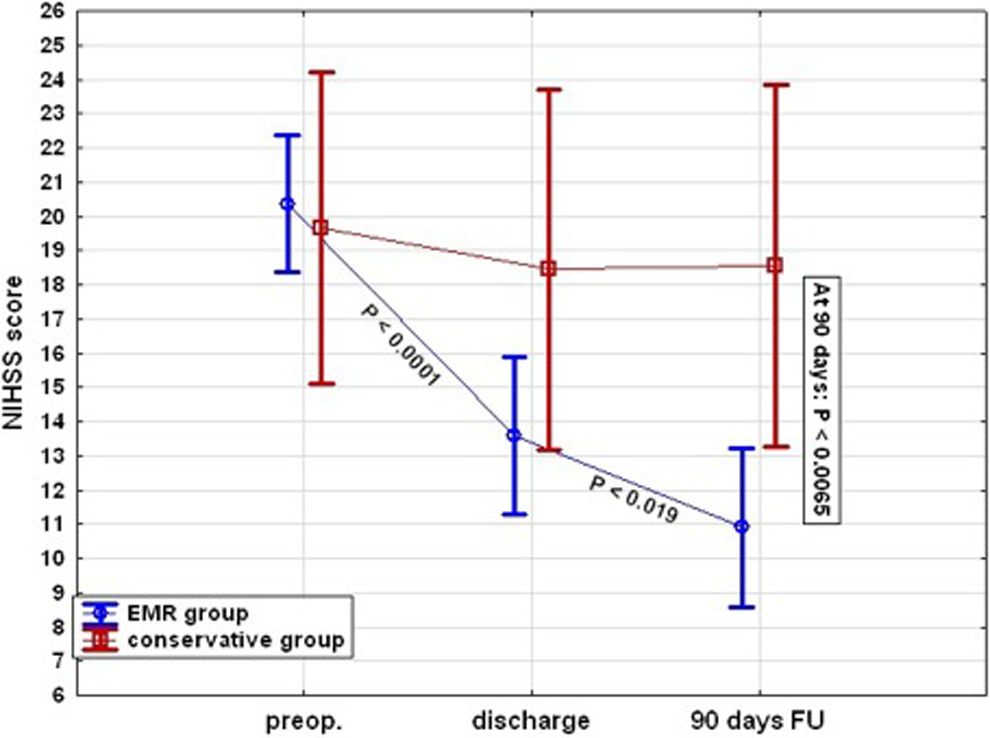
Categorized whisker plot with 95% confidence interval of mean National Institutes of Health Stroke Scale (NIHSS) scores between endovascularly and conservatively treated patients measured at 24 hours posttreatment, at the time of discharge, and at 90 days of follow-up.

Categorized whisker plot with 95% confidence interval of mean modified Rankin Scale (mRS) scores between endovascularly and conservatively treated patients measured at 24 hours posttreatment, at time of discharge, and at 90 days of follow-up.
At 90 days, the mean NIHSS score is significantly lower in the endovascular toward the conservative-treated group (P < .0065). In all, 45% (95% CI: 31%-60%) in the endovascular-treated group and none (95% CI: 0%-25%) in the conservative-treated group were documented after 90 days with mRS ≤2 (P = .012). All but 2 patients were documented after treatment with posterior circulation strokes.
Endovascular Treatment
In all, 78% (77 of 99) was treated endovascularly. These patients had a mean duration time to neurointervention of 4.19 hours (range: 1-18). The different endovascular treatment combinations are given in Table 2.
Overview of Different Therapeutic Combination Options Within the Endovascular Group.

Abbreviations: EMR, endovascular mechanical recanalization; ICH, intracerebral hemorrhage; IAT, intra-arterial thrombolysis; IVT, intravenous thrombolysis; mRS, modified Rankin Scale; NIHSS, National Institutes of Health Stroke Scale; TICI, thrombolysis in cerebral infarctiona. aStatistical significant difference.
Thrombectomy alone was performed in 67 patients. The following devices were used: the Catch device (Bait Extrusion, Montmorency, France) in 15%, the MERCI Retrieval System (Concentric Medical) in 43%, the Phenox clot retriever (Phenox GmbH, Bochum, Germany) in 3%, the Solitaire FR device (Covidien/ev3, Irvine) in 13%, the Angio jet Ultra (Medrad, Warrendale) in 3%, the TREVO Retriever (Concentric Medical) in 18%, and the ReVive (Micrus, Codman and Shurtleff, Raynham) in 5%.
In 12% (8 of 67) of the patients, recanalization could not be achieved after a mean of 2.4 passes (range: 1-7) with the first chosen thrombectomy device and a second device having to be applied. In all, 5% (3 of 67) of the patients were treated additionally with a basilar artery stenting. The following stents were used: 2 Wingspan stents (Boston Scientific, Natick, Massachusetts) and 1 Pharos Vitesse stent (Micrus, San Jose, California).
Recanalization and Clinical Outcome Parameters in the Endovascular Group
After endovascular treatment, we registered 36% TICI 3, 30% TICI 2b, 14% TICI 2a, and 20% TICI 1 recanalizations.
Overall, 18 patients developed an ICH. In all, 21% (16 of 77) of the ICHs were severe and resulted in bad outcome; 3% (2 of 77) did not show a distinctive clinical deterioration as patients did not worsen over 4 points in NIHSS. Four (5%) patients were treated through decompressive surgery of the posterior fossa because of EMR failure and massive cerebellar infarction.
The mean NIHSS was 20.4 (95% CI: 18.4-22.4) preoperatively, decreased significantly at discharge to 13.6 (95% CI: 11.4-15.9, P < .0001), and further significantly decreased to 10.9 (95% CI: 8.6-13.2) at 90 days of follow-up (P < .019, Figure 1).
After 90 days, 51 patients were available for follow-up. In all, 45% were registered with mRS ≤2 and 16% with mRS of 3. A total of 40% (31 of 77) of all the endovascular-treated patients died.
Recanalization and Clinical Outcome Parameters in the Conservatively Treated Group
In all, 22% (22 of 99) of the patients received IVT and/or conservative secondary medical treatment. Within these patients, 5 received IVT and the others conservative secondary medical prophylaxis.
These patients were documented with a mean time to treatment of 5.14 hours (range, 1.3-12). At admission, their mean NIHSS score was 19.6 (95% CI: 15.1-24.3) that did not change over time. In all, 9% (2 of 22) scored TICI 3, 9% (2 of 22) TICI 2b, none TICI 2a, and 82% (18/22) TICI 1 posttreatment, whereas all patients who received conservative medical treatment only belonged to group TICI 1. One (5%) of these patients developed a severe ICH and died within 3 months; another one developed a asymptomatic ICH.
At discharge, we documented a mean NIHSS score of 21.6 (range, 10-28) in this group of patients.
After 90 days, only 1 patient was registered with mRS of 3 and 6 (46%) patients with mRS of 4-5. Overall 68% (15 of 22) of all the medically treated patients died. Of the 15 patients that died, 93% (14 of 15) were documented with TICI 1 (see Figure 3).
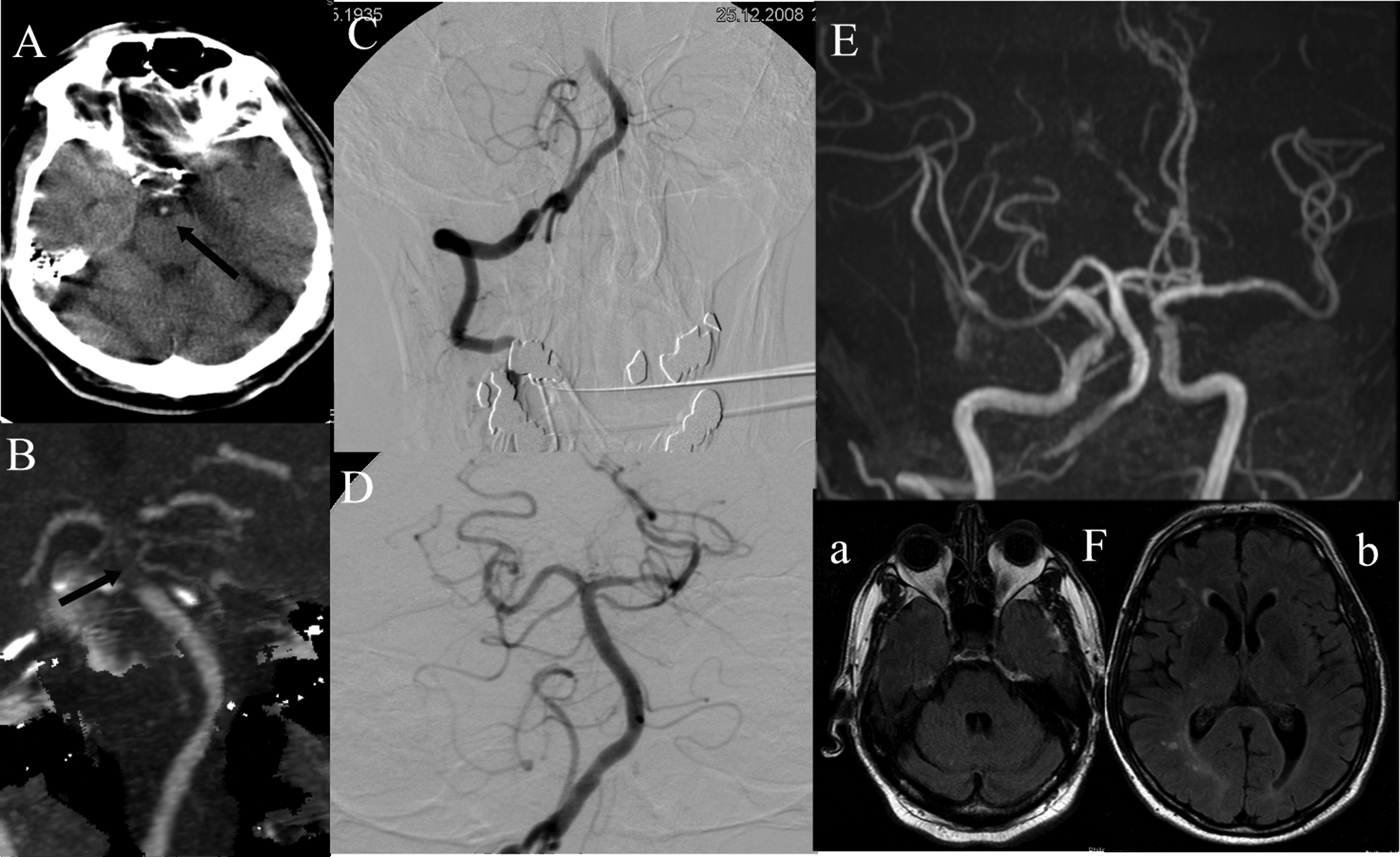
In a 76-year-old male, a thrombectomy with a Solitaire stent was successfully performed, 2.45 hours poststroke onset. A, Conventional CT showing hyperdense distal basilar artery (arrow), despite severe motion artifacts. B, The CT angiography (MIP reconstruction) showing the occlusion of the BA. C, DSA, ap view revealing the distal BA thrombosis (arrow). D, DSA, ap view postthrombectomy shows the complete recanalization of the BA. E, The 14 days posttreatment, the 3D time of flight MR angiogram confirms the recanalization of the BA. F, a and b, MRI FLAIR sequence showing no recent lesion 2 weeks after interventional procedure. ap indicates anteroposterior; BA, basilar artery; CT, computed tomography; DSA, digital subtraction angiography; FLAIR, fluid-attenuated inversion recovery; MIP, maximum intensity projection; MR, magnetic resonance; MRI, magnetic resonance imaging.
Patients who Died and Survivors in the Endovascular Group
Patients who died were significantly older (P = .018), had less TICI 3, and 2b recanalizations and significantly more scored TICI 1 (P = .0008). Patients who died were registered with a higher number of hemorrhages (P = .0032) than patients who survived.
Comparisons Between the Different Groups
Both comparisons between the endovascular and the conservatively treated patients and the corresponding NIHSS and mRS scores are illustrated in Figures 1 and 2, respectively. A comparison of survivors and patients who died within the endovascular-treated group is given in Table 3.
Overview of the Patients who Died Versus Survivors Within the Endovascular Group.

Abbreviations: CI, confidence interval; ICH, intracerebral hemorrhage; mRS, modified Rankin Scale; NIHSS, National Institutes of Health Stroke Scale; TICI, thrombolysis in cerebral infarction.
aStatistical significant difference between both groups. The relative risk of having a severe ICH is 4.5 times (95% CI: 1.7-12, P = .0015) higher than in survivors.
Discussion
Posterior circulation strokes, caused by BAO, are the most fatal subtypes. BAO is associated with an 80% to 90% mortality rate in the absence of treatment. 29 Recanalization of BAO appears to be the single most important predictor of improved outcome. 30
In patients with BAO, thrombolysis administered either as IVT or as IAT combined with EMR is the treatment of choice 31 despite the lack of large randomized clinical trials. The Australian Urokinase Stroke Trial (AUST) is the only 1 randomized controlled trial that assessed the efficacy of IAT in BAO until now. This trial analyzed 16 patients and observed good clinical outcome more frequently in IAT-treated patients (50%) compared to the placebo group (12.5%). 22
In our large cohort of patients with BAO, more endovascular-treated patients were documented with TICI 3 and 2b in comparison to conservatively treated patients (P = .017). The total good recanalization rate of 66% of our patients is consistent with former studies, where recanalization rates of 67% to 82% were reported but without focus on BAO outcome specifically.13,21,32 Accordingly, our results revealed a recently published study in 46% of the 28 patients with successful recanalization of the BAO. 33 Our results can be explained by our relatively short duration to treatment time and the multimodal therapeutic recanalization approach we used.
Vessel recanalization is essential to improve the patients’ condition. 34 On contrary to the literature, where no difference between IVT, IAT, and antithrombotic conservative treatment is reported in patients with BAO, 1 we found that our patients improved more with any kind of endovascular treatment than with IVT and/or pure medical treatment (P = .012) due to vessel recanalization. More than half (61%) of the patients achieved mRS ≤3 outcome after 90 days, whereas in the medical group, only 8% achieved similar neurological status.
In detail, 45% of the endovascular group was registered with mRS ≤2 at 90 days and none of the conservative group (P = .012). A recently published study that analyzed 28 patients with BAO who received thrombectomy documented a favorable outcome of mRS ≤2 in 57%. 33 An explanation could be that we treated only patients with complete BAO, whereas in this study, only 75% of the patients were registered initially with complete vessel occlusion. In accordance with the TICI score at the time of admission, the patients had a better clinical status than in our series.
With our data, we can confirm that the isolated usage of IVT in the case of BAO or only medical treatment did not improve the patients’ outcome in accordance with the prior reports who presented on the treatment of BAO that only 34% of 121 patients treated with IVT achieved mRS ≤ 2, but 34% died. 1 A previous meta-analysis showed the proportion of patients with a favorable outcome even after lower IVT that ranged from 3 (19%) of 16 to 12 (24%) of 50. Mortality was 40% to 70%. 35 Again, these data show that BAO is a severe disease and needs a multimodal approach.
Many studies reported that large-vessel occlusion needs a more aggressive treatment to reach vessel revascularization. 35 Analyzing only the patients within the endovascular group, successful recanalization was significantly higher in patients treated with bridging therapy and IAT than in patients treated with IAT alone (P = .007) or in patients treated with IAT and thrombectomy without bridging therapy (P = .0027). Controversially, no significant difference could be documented between patients treated with the remaining therapeutic strategies we used. These results can support the theory that the multimodal usage of recanalization methods may become the treatment of choice.
Poor outcome in BAO was documented in former studies for 60% to 90%. 30 A similar mortality rate between endovascular- and medical-treated patients was reported. 13 In contrast, we registered a significant difference between the 2 groups. In all, 10% of the endovascular-treated and 46% of the conservative-treated patients died (P = .006) within our observation period.
These patients were of higher age than the survivors, and mostly the basilar artery could not be recanalized (TICI 1 in 39% of the died and in only 7% of the survivors; P = .0008). These results confirm that successful recanalization is associated with significant survival benefit.29,36
Former studies reported that there was no superior outcome in patients treated within 6 hours and patients treated after 6 hours in BAO. 30 We can confirm these findings as patients who achieved endovascular treatment and improvement in symptoms had a mean time to treatment of approximately 4 hours. No statistical significant differences in mRS between the patients treated below 6 hours and after 6 hours were found (P = .99) at 90 days control. This confirms the theory that the brainstem is more tolerant to longer periods of ischemia than the cerebral hemispheres. 8
In all, 23% of the endovascular group developed an ICH in contrast to the conservatively treated group documented only with 9%. Within the endovascular-treated patients 21% and only 5% within the conservative-treated patients were documented with a severe ICH—for each group resulting in death. In accordance with our findings, an ICH rate of 29% in endovascular-treated patients with BAO demonstrated the Multi MERCI trial. 37 Pfefferkorn et al reported that about 1 of the 16 patients developed a secondary ICH after IVT and thrombectomy. 16 The higher ICH rate of 21% in our endovascular group correlates potentially with the aggressive multimodal treatment. However, 60% of the endovascularly treated patients survived due to favorable recanalization. Of these patients, 50% were documented with mRS ≤2 and 17% documented with mRS of 3. As the prognosis in acute BAO in untreated or only conservatively treated patients is very poor, a more aggressive approach to recanalization therapy is justified, which may be effective and safe in selected patients, although those patients show a higher bleeding rate. 16
The extended endovascular treatment has the potential to reduce the mortality rate and leads to a better outcome in patients with BAO. Combining recanalization modalities is not associated with an inferior outcome, despite a higher hemorrhage rate. The inhomogeneous treatments and the small patient numbers are limitations of our study. Further investigations, especially randomized trials, are necessary to clarify which of the different treatment options is superior.
Conclusion
The key to successful treatment of BAO is complete recanalization that can be achieved through endovascular treatment. Isolated intravenous thrombolytic or conservative medical treatment for BAO proves to be insufficient for recanalization.
Footnotes
Declaration of Conflicting Interests
The author(s) declared no potential conflicts of interest with respect to the research, authorship, and/or publication of this article.
Funding
The author(s) received no financial support for the research, authorship, and/or publication of this article.