






Abstract
Objectives:
Remote endarterectomy (RE) is a relatively minimally invasive procedure as an alternative to femoropopliteal above-knee bypass for the treatment of long-segment superficial femoral artery (SFA) occlusion. The objective of this study was to report our experience and to evaluate the long-term outcome.
Design:
Single-center nonrandomized retrospective study with prospective collection of patients’ data.
Methods:
Twelve patients (11 men; mean age 72 years, range 55-81 years) with long (>10 cm) SFA occlusion underwent RE followed by stent (aSpire) placement at the distal end of the endarterectomy. All patients had at least 2 tibial vessels outflow. Indications were severe claudication in 9 (75%), rest pain in 1(8%), and gangrene in 2 (17%) cases. Technical, hemodynamic success rates and clinical improvement were recorded. Assessment of patency and limb loss was made at a mean follow–up of 50 months (range 12-66 months).
Results:
Technical success rate was 100%. Immediate hemodynamic and clinical improvement were 92% and 75%, respectively. The mean increase in the Ankle-Brachial pressure index was 0.24. The primary, primary-assisted, and secondary patency rates were 50%, 83%, and 100%, respectively. The perioperative mortality rate was 8% (one death due to myocardial infarction). There was no early (30-day) reocclusion. During the follow-up, 5 (41.6%) cases underwent 7 reinterventions, all by endovascular means. The amputation rate was 16% (2 of 12).
Introduction
Peripheral arterial occlusive disease is a highly prevalent disease ranging from 4.5% to 29% worldwide and affecting more than 20% of individuals older than 75 years. 1,2 The management varies from conservative treatment (best medical) to endovascular intervention or open surgical procedure. 3 In studies, patency rates are related to the type and level of the lesions and also with the treatment method. Transatlantic Inter–Society Consensus (TASC II) recommended that endovascular therapy is the treatment of choice for type A femoral popliteal lesions and surgery for type D lesions. 3 Endovascular treatment includes various modalities such as atherectomy, angioplasty, and stenting. 4 When compared with open surgery, endovascular treatment offers a lower procedural morbidity and mortality, reduced costs, and hospitalization, but on the other hand the success rate is lower with occlusive disease. 4 -6
Remote endarterectomy (RE) is a relatively minimally invasive procedure performed through a single groin incision aiming to transect the atheromatous core of the superficial femoral artery (SFA) using special rings and cutter. At the distal end of the endarterectomized segment, a stent is deployed to ensure smooth transition to the popliteal artery. 7 Remote endarterectomy may be an alternative to femoropopliteal above-knee bypass with comparable long-term patency rates of 61% to 69% at 3 years. 8 The objective of this study was to report our experience with RE in the treatment of long SFA occlusion and to evaluate its long-term outcome.
Materials and Methods
Patients
This is a single-center, nonrandomized retrospective study with prospective collection of patients’ data. Remote endarterectomy was the first choice of treatment for all patients included in this study. Patients’ inclusion criteria were: (1) long segment (>10 cm) SFA occlusion and (2) reconstitution of the popliteal artery above the knee with a least 2 distal tibial arteries runoff. All patients had TASC C and D SFA lesions. None of the patients had history of previous endovascular procedure. Demographic data, risk factors for atherosclerosis, and Rutherford classification 6 for clinical presentation were recorded. All patients underwent preoperative assessment including measurement of Ankle-Brachial pressure index (ABPI). Duplex ultrasonography (DUS) and either digital subtraction angiography (DSA) or computed tomography angiography (CTA) was performed for the evaluation of the atherosclerotic lesions and determination of TASC level. Previous ipsilateral lower limb revascularization procedures were also recorded. The study was approved by the ethical committee of our institution in accordance with the Helsinki Declaration
Remote Endarterectomy Procedure
All procedures were performed by the same team of vascular surgeons with special interests in endovascular surgery in an operating environment equipped with a mobile digital C-arm angiographic system (Philips BV Endura; Philips Medical Systems, Release 2.2.3, the Netherlands). Regional (ie, spinal or epidural) anaesthesia was used in all patients. After a small longitudinal groin incision, the common femoral, superficial femoral, and profunda femoral arteries and all the collaterals were encircled with slings. After intravenous administration of 5000 UI Heparin, the femoral arteries were excluded from circulation using vascular clamps. An arteriotomy was made from the origin of the SFA distally, and an endarterectomy was performed between the inner and the outer media. The intima core was transversely cut at the origin of SFA and dissected distally for 2 to 4 cm, followed by dissection of the intima core beyond the occluded SFA segment using the Vollmar ring stripper (Vollmar dissector, Aesculap, South San Francisco, California) in a gentle and slow-rotating fashion under fluoroscopic guidance. The ring stripper was exchanged with the appropriate size Moll ring cutter (Mollring Cutter; LeMaitre Vascular, Inc, Burlington, Massachusetts) to cut the atheromatous core at the distal end of the dissection, and then both the cutter and the atheroma were removed together with slight traction. An angiogram was performed to define the end point of the endarterectomy and to confirm a patent femoropopliteal segment. Under fluoroscopy, an angled tip 0.035-in Terumo guidewire (Terumo, Terumo Corporation, Tokyo, Japan) was passed across the distal SFA endarterectomy end point, and an aSpire stent (aSpire stent, LeMaitre Vascular) was deployed to ensure smooth transition to the poplital artery and to prevent any further dissection. Completion angiography was performed to verify patency of the popliteal artery (Figure 1). The endarterectomy of the femoral bifurcation was closed using a bovine pericardium patch (XenoSure Biologic Vascular Patch; LeMaitre).

Completion angiography verifying patency of the femoropopliteal segment. Notice the preservation of the superficial femoral artery collaterals.
Postoperative Follow-Up
All patients were enrolled in a postoperative surveillance program, including clinical assessment, ABPI measurement, and DUS at 1, 3, 6, and 12 months and 1-year intervals thereafter. Patients with worsening clinical (deterioration of pain-free walking distance) or hemodymanic (drop of ABPI> 0.15 from previous assessment) status were further evaluated with DSA or CTA. Patients were given dual antiplatelet therapy (Aspirin 100 mg and Clopidogrel 75 mg) for 6 months followed by lifetime administration of Clopidogrel 75 mg.
Definitions and Study End Points
The primary end points were any reocclusion or surgical intervention prior to occlusion. Secondary end points were recurrent significant stenosis, limb salvage, or death. Technical and hemodymamic success and clinical improvement were defined according to the reporting standards document for dealing with lower extremity ischemia provided by the Society of Vascular Surgery and International Society of Cardiovascular Surgery. 9 Technical success was defined as residual stenosis of less than 30% as demonstrated on intraoperative arteriography. Hemodynamic success was defined as an increase in the ABPI by more than 0.1, and clinical improvement was defined as an upward shift by at least 1 clinical Rutherford category, except when actual tissue loss existed, in which case there should be moving up of at least 2 categories.
Statistical Analysis
Statistical analysis was performed using the SPSS version 18.0. Differences in mean preoperative and postoperative ABPI were compared using the Student t test. Patency analyses were performed using the Kaplan-Meier life table method.
Results
From June 2007 to February 2010, 12 patients (11 men, mean age 72 years) fulfilling the inclusion criteria underwent RE followed by stent placement at the distal end of the endarterectomy. Patients’ demographics and characteristics are summarized in Table 1. The indication for surgery, in most of the cases (75%), was severe limiting claudication.
Baseline Patient Characteristics.

Abbreviations: ABPI, ankle-brachial pressure index; TASC, transatlantic intersociety consensus; SD, standard deviation.
Technical success was achieved in all cases. Along with RE, a number of patients underwent additional revascularization procedures (Table 2). In 3 patients, transluminal angioplasty and stenting of the inflow arteries was performed. The mean length of the SFA occlusion was 19 cm (range, 10-24 cm), and the mean length of the endarterectomized segment was 32 cm (range, 20-38 cm). The mean hospital stay was 6 days (range, 2-15). Hemodynamic and clinical improvement rates were 92% and 75%, respectively. Table 3 demonstrates the changes in clinical category and ABPI index. The mean increase in the ABPI was 0.24 (P < .001). The perioperative mortality rate was 8% (1 patient died due to myocardial infarction). An early procedure-related complication was observed: a lymphorrhoea successfully managed conservatively. The patient was discharged on the 15th postoperative day. Additionally, 1 patient developed pulmonary infection, but he was discharged in good condition after 8 days under oral antibiotics. There was no early (30-day) reocclusion.
Additional Procedures Along With SFA Remote Endarterectomy.

Abbreviations: SFA, superficial femoral artery; CFA, common femoral artery; T/A, transluminal angioplasty; CIA, common iliac artery; EIA, external iliac artery.
Postoperative Clinical and Hemodynamic Changes.

Abbreviations: ABPI, ankle-brachial pressure index; RC, Rutherford category.
Late Outcomes
The mean follow-up period was 50 months (range, 12-66 months). The primary, primary-assisted, and secondary patency rates were 50%, 83%, and 100%, respectively (Figure 2). The mean primary and primary-assisted survival rate were 33 (standard deviation [SD] ±7.4) and 60 (SD ±3.5) months, respectively. During the follow-up, 5 (41.6%) cases underwent 7 endovascular reinterventions. The indications for reintervention were restenosis of more than 70% on DUS and drop of the ABPI more than 0.15 or worsening the pain-free walking distance. In all 5 cases of restenosis, a percutaneous balloon angioplasty with stent placement was performed. Occlusion occurred in 2 patients, and a Viabahn stent graft (W. L. Gore & Associates, Flagstaff, Arizona) was placed. More than half (57%) of the reinterventions were performed within the first year postoperatively. Limb salvage after 5 years follow-up was 84%, with 2 below-knee amputations. In 1 patient, the amputation was due to infection. In another patient, with critical limb ischemia at initial presentation, the amputation was due to progression of the atherosclerosis disease to tibial arteries with patent femoropopliteal segment. During follow-up, 1 patient died from a cause not related to the operation.
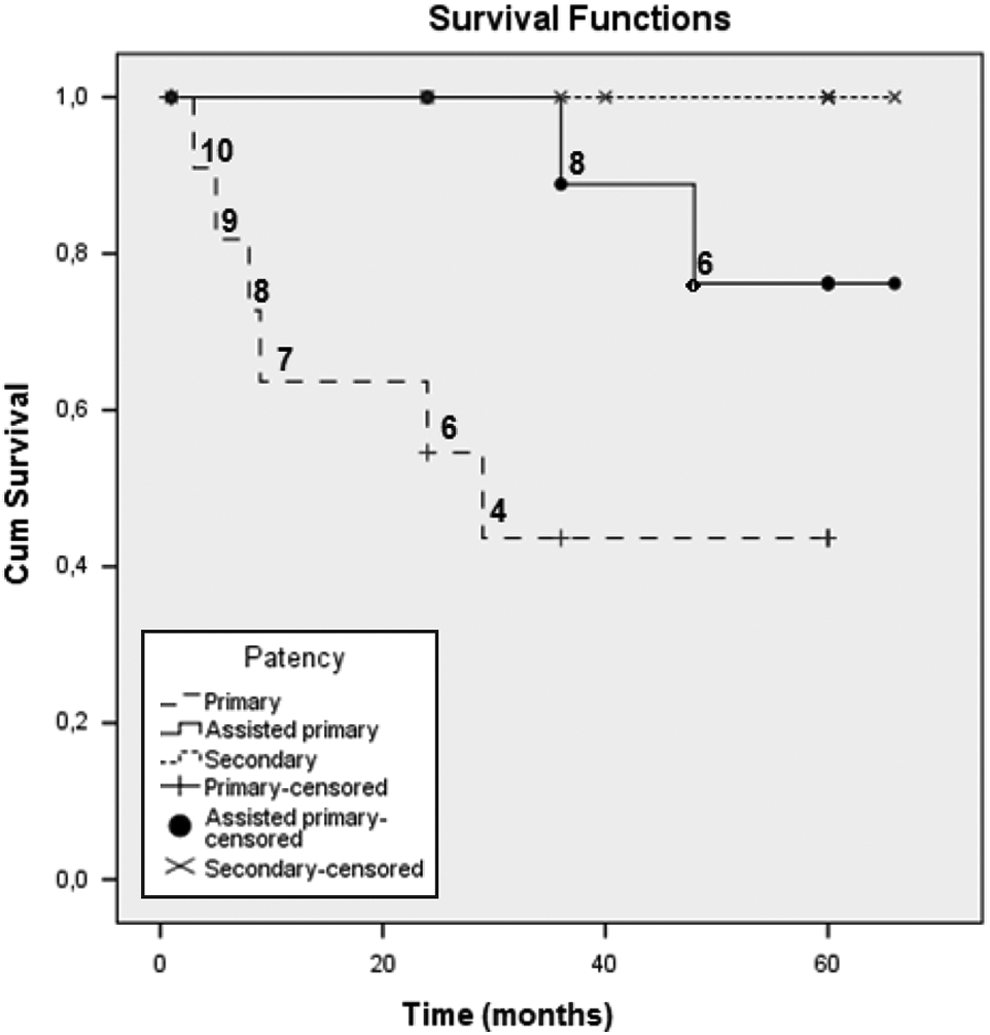
Kaplan-Meier survival analysis of primary, primary-assisted, and secondary patency rates of remote endarterectomy. Numbers indicate patients at risk of each time interval.
Discussion
Remote endarterectomy is a relatively minimally invasive procedure combining surgical femoral dissection with distal endovascular intervention, providing an alternative treatment option in patients with multiple stenoses and/or long segment SFA occlusion. 7,8,10,11 It is a hybrid procedure designed to recanalize the occluded SFA, to avoid surgical bypass sparing the saphenous vein for later cardiovascular or peripheral surgery, and to avoid the use of conventional prosthetic grafts. 12 In addition, RE can be performed as an alternative treatment when other endovascular techniques failed or in patients ineligible for major open surgery. 13
This study reports our experience with this procedure and evaluates its feasibility and long-term outcome. Despite the small numbers of this study, RE seems to be feasible, as all procedures were successfully completed. Other studies also reported high technical success rates, with low complication rate. 8,11,12,14 -16 The most common reasons for technical failure were SFA calcification and perforation accounting for 78% of the technical failures. 17 For this reason, patients with heavy calcification of the SFA should probably not be considered for endovascular procedures generally. In our series, patients with extremely heavy calcification of the SFA were not qualified for RE. In the existing literature, the majority of reported complications were technical, such as SFA injury, distal embolization, and access site complications. 17 Most of them could be treated percutaneously or conservatively. In our study, only 1 procedure-related complication occurred that was treated conservatively. The mean hospitalization in our study was 6 days, much longer than other reported studies in which the mean in hospital stay ranged from 1.3 to 3.1 days. 17 This was due to complications not related to the procedure.
Ho and Moll first described the RE with the Moll ring cutter in 1995 and after the intimal core removing, they placed at the distal end point a short balloon-expandable Palmaz stent under fluoroscopic guidance to prevent any further dissection. 18 Five years later, they proposed to cover all the endarterectomized SFA with an endograft additional to the distal stent placement. 19 Ali et al followed the same technique with a placement of a Viabahn stent graft at the endarterectomized SFA with low primary patency rates. 16 It appears that the advantage of opening the branches with the RE was lost in these cases. In all of our cases, we deployed the aSpire covered stent that is a helical construction combining the components of a vascular stent and a surgical graft to tack down the intimal flap. It is made from nitinol with a shape of a double spiral. Only the spiral skeleton is encapculated with polytetrafluoroethylene and, unlike tube-shaped covered stents, is less likely to cutoff supply to arterial side branches. 15,20 -22 It provides radial strength whilst allowing conformability to the vessel lumen. It is also flexible enabling it to withstand the torsional stresses typically found in the femoropopliteal segment. Despite the promising characteristics of the stent, no evidence exists to justify the superiority of this stent over the others used.
Most of the studies reported the patency rates at 12 and 24 months. The reported weighted mean cumulative primary and assisted primary patency rates ranged from 57% to 77% at 2 years. 17 Only 2 studies reported the long-term (5 years) results. 23,24 The primary and assisted primary patency rates were 16% to 38% and 48% to 60%, respectively. However, in our study the long term patency rates were considerably higher and comparable to prosthetic femoropopliteal bypass. 3
There is a study which compared the RE versus supragenicular bypass for SFA occlusion with reversed saphenous vein or PTFE graft. 25 Despite randomization, the study had limitations as most of the patients scheduled for bypass surgery had a single-vessel distal runoff and consequently more severe symptoms than the patients scheduled for RE. Although not significant, the trial results show a trend for better primary patency rate in favor of bypass (73%-61%). The assisted primary rates were 73% and 75%, respectively, and secondary patency rates 79% for both groups. Subdividing between vein and prosthetic grafts, the study confirmed the superiority for vein (89% vs. 63%), with comparable primary patency rates for RE and prosthetic grafts. In addition, Gabrielli et al compared RE versus subintimal angioplasty and stenting, and it was demonstrated that RE had a significant higher primary (63% vs. 48%), assisted primary (70% vs. 52%), and secondary patency rates (72% vs. 54%) at 3 years of follow-up. 11 Larger well-randomized trials are needed to evaluate the outcomes of RE when compared to other procedures in order to draw definite conclusions.
The main disadvantage of RE is the large number of reinterventions to maintain patency. Patients should undergo an intensive clinical and duplex surveillance program postoperatively. 26,27 In our study, the reintervention rate was 58%, and 4 of 7 reinterventions were performed within the first year postoperatively. Early restenosis caused by neointimal hyperplasia should be early distinguished and treated. 19 After the first year, the restenosis rate declines and is thought to be caused by progression of atherosclerosis rather than neointimal hyperplasia. 19 The restenotic lesions are equally distributed in the endarterectomized SFA, including the stented arterial segment. 26 Therefore, future prevention of neointimal hyperplasia seems to be the key to successful prevention of restenosis progressing to reocclusion. 25 Gisbertz et al combined cryoplasty after RE with promising patency rates. 28 Gabrielli et al in a multivariate analysis confirmed that hypercholesterolemia and critical limb ischemia are significant predictors of reocclusion. 11 Derksen et al found that age and gender were predictors for restenosis. 21 In univariate analysis, women showed significantly more restenosis ratio than men. 21
Nevertheless, in the literature, most of reinterventions were performed using endovascular techniques and thus maintaining the minimal invasive character of this procedure. In our study, all reinterventions were treated by endovascular means. Another advantage of this technique is that most studies demonstrated considerable clinical improvement after RE. 8,16,23 -25 In addition, reocclusion of the SFA was not associated with worsening of symptoms compared with the preoperative state, or with an increased amputation rate, which might be explained by the reopening and preservation of SFA collaterals. 8,13 All but one of our patients had improved symptoms after RE. Furthermore, with RE the saphenous vein is preserved for future intervention should it required. Also, in case of a long femoro-distal bypass with no enough venous conduit, RE can be used to eliminate the length of the venous conduit. This procedure constitutes an appealing alternative to the use of synthetic material for lower extremity revascularization. 29
Remote endarterectomy is a minimal invasive procedure adjust in the armamentarium for the treatment of long segment SFA disease. The role of RE needs to be clarified as in today’s endovascular age with the development of gene and drug therapy, drug eluting stents and balloons, cryotherapy, brachytherapy and other atherectomy devices, RE seems to be performed more and more rarely. RE carries comparable patency rates to synthetic bypass surgery 25 and higher patency rates than subintimal angioplasty. 11 It can be used in patients that requires concomitant common femoral artery endaretrectomy or in areas of the world that have limited access to new endovascular technologies such as atherectomy devices.
Conclusion
Our study demonstrates that in patients with long SFA occlusion and reasonable tibial outflow, RE is a feasible and successful relatively minimally invasive procedure. Long-term patency and amputation rates are comparable to other revascularization techniques. However, close surveillance is important as most of restenoses requiring reinterventions occur within the first year postoperatively. Nevertheless, most if not all of these reinterventions can be performed by endovascular means, maintaining the minimally invasive concept of the initial procedure.
Footnotes
Declaration of Conflicting Interests
The author(s) declared no potential conflicts of interest with respect to the research, authorship, and/or publication of this article.
Funding
The author(s) received no financial support for the research, authorship, and/or publication of this article.