







Abstract
Research is needed to better understand the academic instruction needs of students with significant cognitive disabilities who are English learners and the classroom practices of their teachers. In this qualitative study, we interviewed 10 teachers to learn how they identify and meet the unique needs of this student subpopulation. Our findings suggest that teachers generally do not view disability- and language-related needs as separate and that approaches to instruction tend to follow those perceptions. Some expressed a desire for more support from language professionals in the classroom, whereas others thought their special education classrooms adequately meet student language development needs. Finally, although the teachers we interviewed went to great lengths to engage families in supporting instruction, some reported dissatisfaction with and barriers to those relationships. We discuss our findings in light of the current literature, the study’s limitations, and implications for future research and practice.
The small subset of students with significant cognitive disabilities who are English learners (ELs) is receiving increased state and national focus because of the Every Student Succeeds Act (ESSA, 2015). Specifically, the law requires that states provide, for the first time, an alternate English-language proficiency assessment for students with significant cognitive disabilities. These assessments are based on alternate English-language proficiency achievement standards (Rooney, 2017). To date, there is no federal or state definition of who will take these assessments, and the identification of students in this subgroup remains a challenge (Christensen, Gholson, et al., 2018; Karvonen & Clark, 2019). Students with significant cognitive disabilities who are ELs have complex language acquisition and academic needs. School leaders must not only identify these students but also understand the unique characteristics that influence how they learn and demonstrate what they know and can do.
Students with disabilities and ELs have historically been treated as distinct subgroups in state reporting for large-scale assessment and accountability. In recent years, there has been recognition of the overlap of students with disabilities and ELs (Park & Thomas, 2012). Despite the small population size, students with disabilities who are also ELs are now a third group referenced in the ESSA (2015). ELs comprise 11% of students with Individualized Education Programs (IEPs; National Center on Educational Outcomes, 2018); between <1% and 26% of students with disabilities are EL, depending on the state (U.S. Department of Education, 2020). Most educational research has examined ELs with high-incidence disabilities and has focused on their identification and placement (e.g., DeMatthews et al., 2014; Sullivan, 2011). Much less is known about the instructional experiences of students with significant cognitive disabilities who are also ELs.
Students with the most significant cognitive disabilities comprise approximately 1% of public school students. Estimates vary regarding the size of the population of students with significant cognitive disabilities who are also ELs. Estimates are based on assumptions related to students’ access to and utilization of EL services and participation in alternate assessments based on alternate achievement standards. For example, one estimate places the total percentage at 0.09% of all public school students (Thurlow et al., 2016). This estimate was obtained by taking 1% of the 9.5% of students in the United States who participate in EL programs. This method assumes that students with significant cognitive disabilities who are ELs are fully included in EL services, which is not necessarily the case (Gholson, 2018). Karvonen and Clark (2019) studied students with significant cognitive disabilities who took Dynamic Learning Maps (DLM) alternate assessments. They identified 8.1% of students who took the assessment as ELs based on formal EL service enrollment, and another 5.8% of students were identified as likely ELs based on teacher-provided survey responses. Likely ELs were students who did not receive or were not eligible for EL services but whose teachers indicated that the students’ primary, home, or instructional language was not English.
Without reliable information about a student’s English-language proficiency, it is difficult to identify whether language-acquisition challenges are related to a student’s disability or language learner status (Thurlow et al., 2016). Because of this ambiguity, some students with significant cognitive disabilities and limited communication skills may not be included in a formal language-evaluation process and, as a result, may not receive English-language development services (K. K. Liu et al., 2015), despite their eligibility for language services under the federal policy (Kangas, 2018). Instead, students with significant cognitive disabilities who are also ELs are likely to be served primarily in self-contained special education classrooms without language services as part of routine instruction (Christensen, Gholson, et al., 2018; Gholson, 2018; Kangas, 2018).
Students with significant cognitive disabilities face several challenges when acquiring language, and these challenges may be compounded if the student’s first language is not the language of instruction, typically English. For example, students with intellectual disabilities tend to struggle with phonological working memory, information processing, and analytic reasoning in general, all of which affect the timing and tempo of their language development (van der Schuit et al., 2011). Yet, students acquiring a second language rely strongly on phonological short-term memory and analytic reasoning abilities to develop both vocabulary and syntactic and pragmatic knowledge in the new language (Paradis, 2011). Students with significant cognitive disabilities who are ELs must not only navigate potentially delayed development of their native language resulting from their disabilities but also the acquisition of a second (or sometimes third) language. These students may also encounter misperceptions from teachers regarding their potential to successfully develop more than one language or misguided concerns that learning a second language may derail overall language development (e.g., Marinova-Todd et al., 2016).
Special educators who work with ELs must possess numerous competencies to meet students’ language- and disability-related learning needs, including knowledge of language and linguistics, culture, individual differences, responsive instruction, and appropriate assessment, among others (Ortiz & Robertson, 2018; Rivera et al., 2016). Teachers must also be able to engage parents in their children’s education; forming open and informal communication and positive relationships is especially crucial for immigrant and language-minority students (Calderón et al., 2011). Unfortunately, even highly effective special educators may lack the skills to provide culturally and linguistically responsive environments for their students who are ELs (Paneque & Barbetta, 2006). Although there have been calls for integrating information on English-language acquisition into special educator preparation programs (More et al., 2016), it is unclear the extent to which programs currently adopt the practice. A study of special educators of students with moderate to severe disabilities found teachers are not well equipped with training, resources, or administrative support for instructing students who are ELs (Mueller et al., 2006). Limited research exists to provide teachers with evidence-based resources from which to draw (K. K. Liu et al., 2015). Following an exhaustive search of the literature, K. K. Liu et al. (2015) found only eight studies that examined English-language arts strategies for students with significant cognitive disabilities who are ELs and none that provided definitive conclusions on the overall effectiveness of instructional strategies.
Although the field has generated considerable literature on the instruction of the broader population of students who are ELs, we do not know to what extent this transfers to special education or to the subset of students who have the most significant cognitive disabilities. Students with significant cognitive disabilities who are also ELs are primarily served in special education classrooms (Gholson, 2018), often without access to language services (Christensen, Mitchell, et al., 2018), and are taught by special educators who frequently lack the proper supports to ensure an equitable education (Mueller et al., 2006). The field needs a better understanding of teachers’ instructional approaches, challenges, and successes aimed at meeting students’ disability- and language-related academic needs. The ways teachers describe and currently approach meeting students’ disability and language acquisition needs may help to inform instruction for students in this population. This study explores how teachers identify and describe the methods, needs, and challenges for educating students with significant cognitive disabilities who are ELs.
Method
We conducted semi-structured interviews with teachers of students with significant cognitive disabilities who are ELs and used qualitative analytic methods to identify themes related to our research question.
Recruitment
We identified teachers for participation among those whose students took DLM alternate assessments in the 2017–2018 school year. DLM assessments are large-scale academic achievement assessments in English-language arts, mathematics, and science. Assessments were administered for statewide accountability purposes in 18 states to approximately 90,000 students with the most significant cognitive disabilities.
We asked all 18 state education agencies that adopted DLM assessments to opt into the study using a Qualtrics survey. State representatives responded yes or no to the question, “Does your state give permission for teachers in your state to be included in the master list?” Eight of the 18 state education agencies volunteered. Next, we used the methods described by Karvonen and Clark (2019) to identify teachers in participating states who had experience teaching students with significant cognitive disabilities who are ELs. Specifically, we used DLM assessment enrollment data to find confirmed ELs and responses from the First Contact survey (Nash et al., 2016) about learner characteristics to identify likely ELs.
DLM assessment enrollment records are uploaded to the assessment management system by local education agencies. The enrollment record includes information about whether the student is eligible for or receives EL services. A teacher was considered eligible for this study if their student’s enrollment record indicated that they received language services in any of the following forms: (a) Title III funded, (b) state English for Speakers of Other Languages (ESOL)/bilingual funded, (c) both Title III and state ESOL/bilingual funded, (d) monitored ESOL student, (e) eligible for ESOL program based on an English language proficiency test but not currently receiving ESOL program services, and (f) receives ESOL services and not supported by Title III and/or state ESOL funding. These students were considered confirmed ELs because they were eligible for or received formal language services.
The First Contact survey collects information from teachers about their students’ characteristics, including students’ primary language. Teachers complete the First Contact survey in the DLM online assessment management system for every student who takes the assessment. Teachers were eligible for participation in the study if they responded no for any of the three language items on the First Contact survey for one or more of their students: (a) Is English the student’s primary language? (b) Is English the primary language spoken in the student’s home? and (c) Is English the primary language used for the student’s instruction? These students were considered likely to be ELs but were not necessarily enrolled in formal language services.
All teachers of students with significant cognitive disabilities who were confirmed or likely ELs were eligible to participate in the interviews. This included teachers of any of the tested DLM subjects (English language arts, mathematics, and science) and all grades (Grades 3–12). Using extracts from the DLM assessment management system, we identified 4,310 teachers with at least one rostered student who was either a confirmed or likely EL (range, 1–19 students; M = 1.97; SD = 1.62). When selecting teachers to contact for interviews, we first prioritized having representation from all eight participating states, followed by teachers who were likely to be the most information-rich cases: those with the most students with significant cognitive disabilities who are ELs. In some less populated states, the identified teachers only had one student. We wrote an R script to select teachers for the study. The script first combined data files from participating states and then sorted cases within the state on the number of focal students rostered to each teacher. The script sampled teachers from each participating state up to the total count of teachers we believed we could reasonably interview and compensate.
We iteratively emailed teachers interview invitations in five batches and conducted preliminary analysis after each batch to evaluate the data for saturation. In the first batch, we emailed 49 teachers across the eight states, and six teachers responded to schedule an interview. In the second batch, we emailed 39 teachers across the eight states, and four teachers scheduled an interview. In the third batch, we emailed 40 teachers in the five remaining states that did not yet have representation, and two teachers scheduled an interview. In the fourth batch, we emailed 23 teachers in the remaining two states that did not have representation, and one teacher scheduled an interview. In the fifth batch, we emailed 10 teachers from the one remaining state without representation, and one teacher scheduled an interview. In total, we emailed 161 teachers selected using the previously described script. Of the 15 teachers who responded to schedule an interview, 10 participated in an interview. Following the 10th interview and preliminary data analysis, researchers concluded interview responses had become saturated and did not produce new insights (L. Liu, 2016); therefore, we did not recruit additional participants. Participants received a US$50 honorarium following the interview.
Participants
The 10 participating teachers were from six states on the east coast and midwestern regions of the United States, in districts ranging from rural to urban. The teachers had different levels of experience working with the target population in a variety of instructional settings. For instance, one participant taught in a bilingual special education program, while others taught in monolingual, self-contained special education classrooms. We did not obtain information about teachers’ ethnicities or cultural backgrounds, nor did we ask whether they were themselves bilingual. In one case, the teacher’s second-language skill could be inferred from the information she volunteered, but no other teachers gave an indication that they spoke a language other than English, and most said that they did not speak or understand their EL students’ languages or only knew limited words. Table 1 describes the experience and caseloads of each participating teacher; dashes appear where the information was not provided. Based on the DLM enrollment and First Contact survey records used to recruit teachers, the participants taught a total of 46 students with significant cognitive disabilities who are ELs (range, 1–9; M = 4). However, when asked about their caseloads, some participants reported numbers that differed from our records; we include their self-reported counts in Table 1 (N = 68; range, 1–25; M = 7).
Participating Teacher Experience and Caseloads.
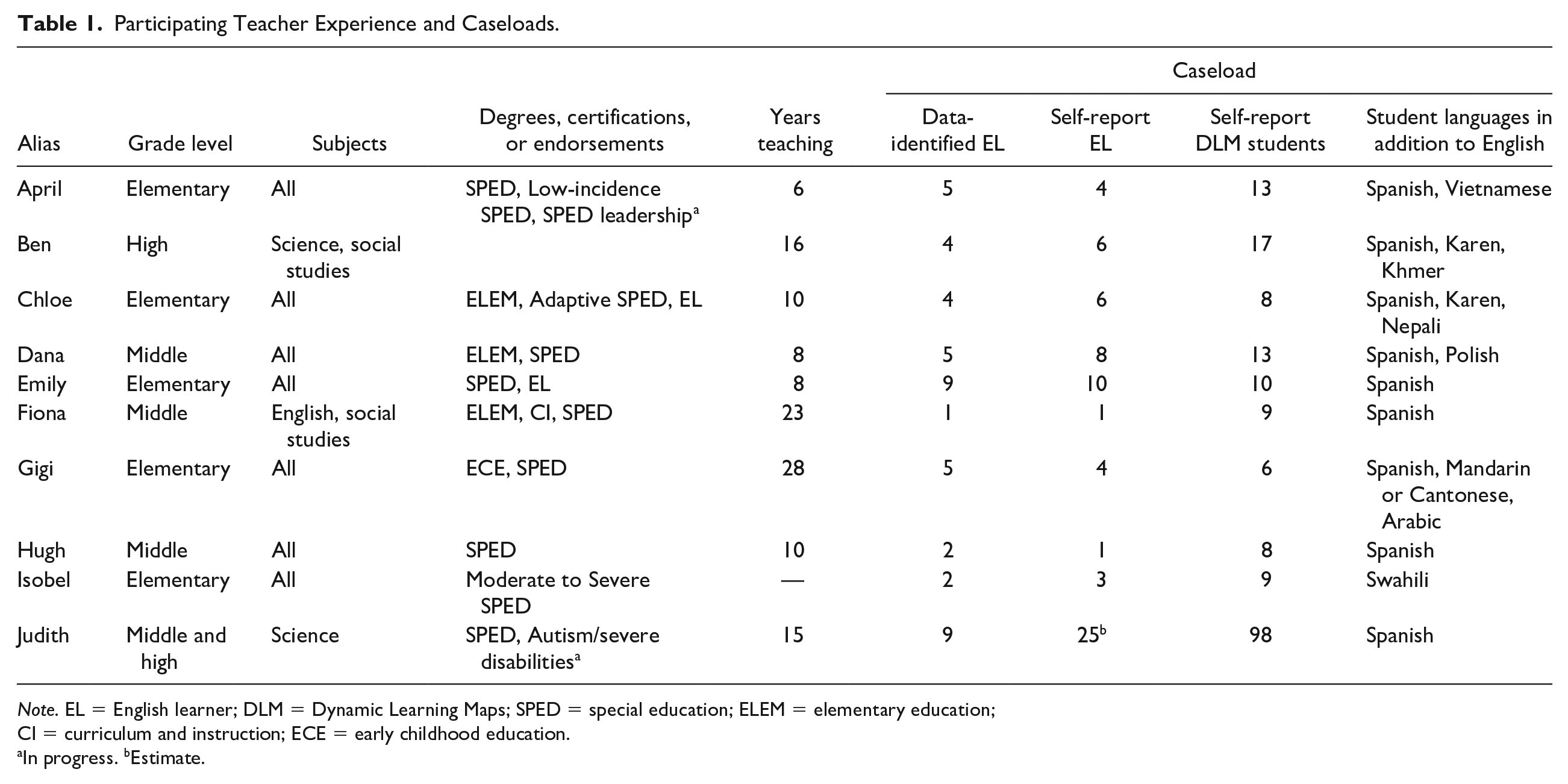
Note. EL = English learner; DLM = Dynamic Learning Maps; SPED = special education; ELEM = elementary education; CI = curriculum and instruction; ECE = early childhood education.
In progress. bEstimate.
Student demographic data were available through DLM system data not collected systematically via interviews. Based on the recruitment records, the sample (N = 46) represented students in grades 3 to 11, 14 of whom were female. Intellectual disability (24%) and autism (24%) were the most common primary disability categories. Twenty-four (52%) students were confirmed ELs and received services through Title III and/or state ESOL/bilingual programs or were eligible for ESOL but did not receive services. The remaining 22 (48%) students were identified as likely ELs through the First Contact survey responses. Teachers indicated that for 16 of these 22 students, the primary language spoken was not English. Of the six students for whom English was the students’ primary language, the teacher indicated that the primary language spoken at home was not English. During their interviews, some teachers provided information about their students’ home language; this information was also available in the records of eight students. Students most commonly spoke Spanish, but teachers also discussed working with students who spoke other languages (see Table 1).
Data Collection
We used a semi-structured interview protocol designed for this study. We based the protocol on a review of the literature and iteratively refined it before conducting interviews. Table 2 provides the interview questions used for this study. Questions were structured under three broad topics: (a) the teacher’s background, including experience, expertise, and training; (b) the teacher’s students, including caseload, identification of ELs, description of students’ needs, and approaches to communicating with students’ parents; and (c) the teacher’s instruction, including approaches and general challenges to academic instruction for these students. Within these interview segments, interviewers probed for additional information related to instructional decision-making, accessibility considerations, or challenges teachers encountered.
Interview Questions.
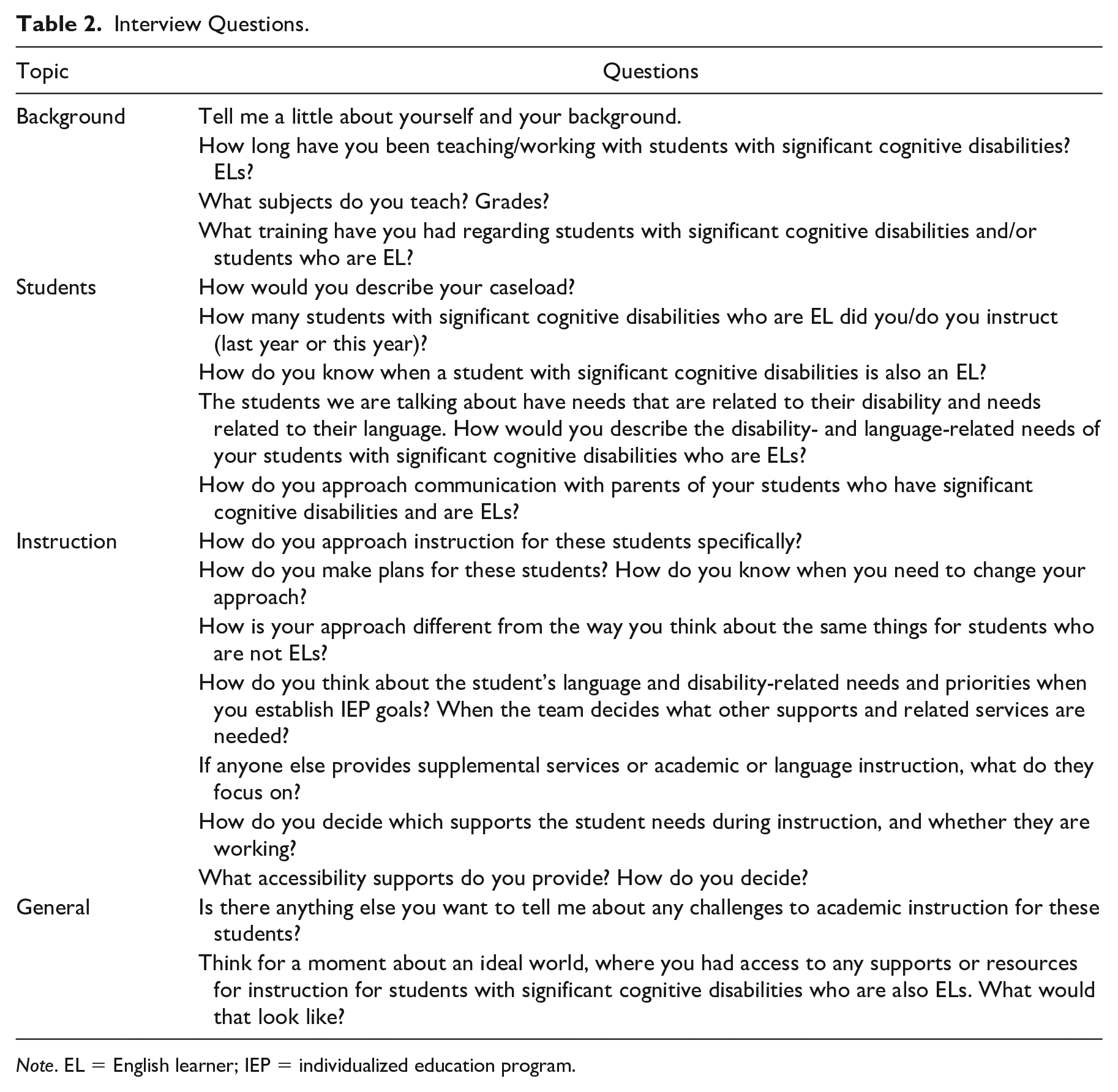
Note. EL = English learner; IEP = individualized education program.
Four researchers (two co-authors and two research assistants) individually conducted the 10 interviews in spring 2018. At the beginning of each phone interview, the interviewer reviewed informed consent information and indicated the audio interview would be recorded through the phone conferencing system. Interviews followed a semi-structured format (Patton, 1990) that included questions from the interview protocol and allowed for probing as additional topic areas emerged in the interviews. Interviews lasted approximately 60 min. All audio recordings were exported from the phone conferencing system and transcribed verbatim by an external transcriber for subsequent analysis.
Data Analysis
Five researchers (four coauthors and one research assistant) conducted the coding process. We developed a preliminary coding protocol before reading the transcripts. The initial codes and code definitions were developed according to anticipated categories and ideas that we expected to be associated with the research question, based on the available literature. We independently read the first transcript and applied the codes to short sections of text. A research assistant combined the set of coded transcripts into a single document to show overlap in code use, and the research team met to discuss discrepancies. We iteratively refined the protocol, adding or removing codes and editing definitions as needed. We continued this process of independently coding each transcript and meeting to discuss discrepancies until no further changes to the protocol were identified (after six interviews were coded). The final coding protocol contained 24 codes within three broad categories: Teacher, Student, and Instruction (the codebook is available from the first author). Pairs of researchers recoded earlier transcripts with the final list of codes, and two researchers reconciled any coding discrepancies. The research assistant assigned final codes and the themes to the text using Dedoose qualitative data analysis software (Dedoose Version 8.0.35, 2018) and extracted code and code cooccurrence reports.
We adopted a generic inductive approach to analysis (L. Liu, 2016) to allow for flexibility in methodology, as other established methodologies did not quite fit the objectives of the study. The inductive approach was best aligned with the purpose to describe the experiences and perspectives of teachers and to summarize their descriptions into succinct and meaningful themes while efficiently reducing a large textual dataset (Thomas, 2006). Preliminary themes emerged based on the coded transcripts. The researchers discussed and refined the themes using the code reports and code cooccurrence report. For example, once we identified a theme around students’ language- and disability-related needs and wrote a preliminary description of the theme, we then reviewed an extract of all coded transcript segments related to the theme to ensure the description was complete and representative of the range of perspectives. We also used the code cooccurrence report to identify information-rich segments (e.g., where responses on disability- and language-related needs intersected with descriptions of instructional delivery).
Finally, the five researchers developed vignettes (Miles & Huberman, 1994) for data reduction and triangulation (Patton, 1999). Vignettes were based on the transcripts and were meant to illustrate how teachers described themselves, their students, and their approaches to instruction. The vignettes were each a page or less and included brief quotes, where relevant, to capture the teacher’s voice and tone. We randomly assigned each researcher one to three vignettes to write independently. A second researcher reviewed each vignette alongside the original transcript for accuracy and completeness. The coding team used vignettes to confirm that the themes identified from the coding process encompassed the content and tone of the interviews.
Trustworthiness and Credibility
We implemented several procedures to ensure the trustworthiness and credibility of the findings. As a form of perspective triangulation (Patton, 1999), we interviewed teachers from a range of states and educational contexts. During interviews, we used probing techniques, asked clarifying questions, and incorporated checks of our understanding to fully capture and verify participant views. We coded verbatim participant transcripts and used the codebook to promote consistency in coding. Four researchers with different backgrounds in K–12 education coded the transcripts in pairs. The inclusion of multiple researchers with a range of backgrounds provided a variety of perspectives on how the content of the transcripts related to the research question and identified themes (Patton, 1999). The coding team met regularly to debrief and reconcile any differences in transcript coding. We also used multiple analytic techniques (codes and vignettes) to make sense of the data relative to the research question. The team approach to writing and reviewing vignettes increased faithfulness and accuracy of the interpretation of the interview content. Finally, one researcher who had helped develop the initial coding scheme and a vignette but who did not participate in all of the coding and analytic discussions independently audited the transcripts, code reports, and vignettes to verify that the findings accurately represented the interviews.
Positionality
The coauthor researchers hold doctorates in educational psychology, educational research, educational leadership, and developmental psychology. All are White monolingual females with prior research, assessment, and/or teaching experience with students who are eligible for DLM assessments. Three had experience teaching ELs in general or special education. These experiences may have influenced our interpretation of the data.
Findings
Three themes emerged from the coded transcripts and vignettes. These themes are related to identifying and describing students’ disability- and language-related needs, approaches to services and instruction, and family engagement. For the sake of conciseness, we refer to students with significant cognitive disabilities who are also ELs as “focal students” in this section.
Identifying and Describing Students’ Disability- and Language-Related Needs
Participants identified 68 focal students on their caseloads although our records only indicated there were 46 focal students. Participants most often identified EL status from information in IEPs, screeners, or prior participation in EL services. State-derived or locally derived home language surveys (e.g., Linquanti & Bailey, 2014), with questions similar to those on the DLM First Contact survey, are often used as a preliminary screener for the broader population to determine which students should be formally assessed to determine EL status. In our study, five participants reported this type of survey was used to identify students’ EL status. In some cases, teachers described this information as being combined with additional information to determine students’ EL status. Seven participants reported that students’ EL status was predetermined before the students entered their classroom. One participant reported they informally identified their students’ languages on their own, although this informal approach did not lead to official EL classification. Another participant relied on information provided by the EL teacher. Emily, the teacher who provides bilingual special education services, wondered about the process of student assignment to her classroom: Is it because they have a Hispanic last name? Because . . . clearly there are these students who are placed in our classroom who, yes, maybe their native language . . . is Spanish, but they’ve been in a self-contained monolingual classroom for the past 3 years.
With few exceptions, teachers spoke about disability- and language-related instructional needs as linked and did not often distinguish those needs from one another. When they did distinguish between the two, they tended to believe the need was due to disability rather than EL status. Speaking about a student becoming tongue-tied or not finishing a thought, Dana stated, A lot of those things, I kind of don’t see them as being EL problems; I see them as being a symptom of their disability. Sometimes it’s hard to understand, how do you separate the two? Is this a problem because you’re bilingual . . . or is it just something that comes along with being autistic, or having Downs [syndrome]?
This thought was almost exactly reiterated by Isobel as she explained the challenge of identifying the cause of a student’s difficulty with understanding a concept. She said, The biggest challenge . . . is knowing the difference between the two. Is this a case where I need to use a translating service . . . or is this a case where they’re just not going to understand this concept no matter what because of the cognitive level that they’re at?
Conversely, when discussing how quickly his focal student was acquiring English vocabulary, Hugh illustrated a more nuanced view and hypothesized about how language and disability might be intertwined. Questioning his focal student’s disability classification based on her rapid progress with English sight words, Hugh wondered “whether a lot of her disability was because of a lack of exposure [to education] at a young age,” adding, “I haven’t thought of her as an ESL [English as a second language] student most of this year because she’s made such goals.” Without understanding the underlying causes of student responses, or how disability and language together might be influencing student responses, special education teachers without EL training may naturally default to a disability lens to interpret student behavior.
Approaches to Services and Instruction
Service delivery models, educational goals, and instructional strategies were largely driven by disability and were often characterized as good strategies for students with significant cognitive disabilities, regardless of their EL status.
Services and goals
Districts appeared to differ in how they approached providing EL services to students with significant cognitive disabilities. Some teachers indicated that their districts do not provide EL services for students with significant cognitive disabilities because, while students have not demonstrated proficiency in English, language proficiency was believed to be related to their disability and disqualified them from EL services. For example, Chloe shared her perception that her six focal students were not receiving EL services because “[the district] dismissed them from the services to keep them from having to take the [state English language proficiency assessment] . . .They’re saying that the cognitive abilities slash disabilities have nothing to do with their language development in English.” This perspective was contrasted with students who received EL services and were perceived as unlikely to demonstrate language proficiency due to their disability. Gigi said, “Most of my students do not test out because they can’t reach those levels. So they will always be ELL [English language learners], and that’s really a byproduct of their disability.”
Six participants described students receiving EL services, either in the student’s typical classroom or in a pullout model. For some students, teachers believed that having a bilingual paraprofessional in the special education classroom was sufficient to meet students’ EL service needs. Isobel said, “these students would normally be pulled out into small groups or to work one on one with the ELL instructor. But my students aren’t because they’re already receiving that sort of instruction within our classroom.” Judith described a close collaborative working relationship with an ESL teacher in her school who provided “push-in” services in the classroom but was also available for brainstorming and problem-solving during conversations in the hallway between classes.
Most participants indicated that their focal students’ IEP goals were very similar to those for their peers with significant cognitive disabilities who were not ELs. Although many participants said they included general language development goals on students’ IEPs, the goals were usually not specific to ELs and were often the same as or similar to the goals for their non-EL peers. Fiona shared that while her student’s IEP included EL supports, there were no goals for his English learning. She added, “They [ruled] out it was the language barrier, which is what I would agree with . . . It’s not the language barrier that stops him progressing; it’s his cognitive abilities.” In Fiona’s case, local policy contributed to her student not having EL goals because “if that was the issue, he wouldn’t qualify for special education services.”
In contrast, Emily, the bilingual educator, explained that the language goals in her students’ IEPs were language-specific, sharing that what students can demonstrate varies by the language they are asked to use. She and her partner-teacher wrote two goals for each subject, one English and one Spanish. Emily also inserted examples of a focal student’s Spanish writing in her IEP to help a subsequent non-bilingual teacher recognize the student’s writing skill level independent of English-language ability. Chloe collaborated closely with the school’s speech-language pathologist in developing and supporting IEP language goals, even as her students were exited from formal EL services. Seven participants indicated speech-language pathologists provided services for their EL students’ language goals in English.
Instructional strategies
Generally, teachers emphasized the commonalities between strategies effective for students with significant cognitive disabilities and students who are ELs. Very few teachers described approaching instruction or accessibility supports differently for the focal population than for their non-EL peers.
Participants largely believed that their classrooms met the instructional needs of the focal population. They indicated that the strategies and supports that were helpful for non-ELs were also helpful for ELs, describing them as overlapping strategies. Gigi, whose focal students all have autism, stated that “a lot of the strategies that we would use with students with autism [such as picture-supported vocabulary] are the same strategies that we would use with English language learners, so there’s a lot of crossover.” Similarly, Judith said, “There’s a lot of overlap between what is good instruction and evidence-based instruction for students with autism and . . . students who are English language learners.” Most participants felt they were helping their students acquire English by providing an English language-rich environment and implementing special education strategies to address language challenges. The instructional strategies generally fell into two categories: visuals and language-rich environments.
Nine of the teachers described using visuals during instruction to provide language support. Sometimes this helped students understand what the teacher was saying. Other times, students selected from visuals when providing a response. Teachers labeled classroom items in English, used picture books, used varying sizes and types of pictures, and, when a verb’s meaning could not be conveyed in pictures, they acted it out. Teachers said that they do these things in their classrooms regardless of the number of ELs they have. Dana explained, I have pictures everywhere, I have cards around my neck, if I’m asking you to stop, I hold up a picture of a stop while I’m saying stop, like we marry a lot of words with pictures so if you don’t understand what I’m saying to you, you understand a visual that represents those things . . . . So that’s kind of integrated throughout all of the subjects here, because that’s what they need overall because of their cognitive disabilities, it’s not directly related to language.
Chloe shared that the picture supports she uses have helped support her focal students who were struggling because of their English-language development. She said, I can lay some pictures out for them to choose from, and my, I have one particular [student] that, he knows so, so much, it’s just that vocabulary, and I can have those pictures available for them and he can point to the exact right thing every single time. So I know he knows what it is, he just can’t always remember the English word for it.
Chloe and Dana’s uses of picture supports differed from each other. While Chloe used the pictures to support the student in providing a response, Dana used the visuals to teach vocabulary.
Teachers discussed providing a classroom environment rich in oral language, where students were fully immersed in the English language. In addition to teachers and paraprofessionals providing verbal instruction in the classroom, Ben also prioritized having focal students talk to each other. He said, “One of the things we make them do is try and talk to each other. That’s a real challenge, but to express themselves verbally to each other academically, we try and get them to talk about whatever it is.” Teachers repeatedly emphasized the constant language use in their classrooms to practice using vocabulary words and general language, even when students were not working on language goals. When discussing differentiating between ELs and other students, Isobel said, I don’t know that I treat them differently because the nature of my classroom is such that everybody needs a lot of language instruction. So, they probably get a little bit more of what they need . . . talking to them, getting extra vocabulary help, and language help. But the whole class is getting that sort of instruction because there is that need for all of them.
Teachers said that they repeated many language and academic tasks to facilitate language acquisition for ELs. Isobel stated, When I’m teaching them, I’m giving them a lot of repetition of vocabulary. I need to go back to very basic words like ball, this is a ball, showing a picture of the ball, and focusing on English vocabulary that they don’t already have.
Both language-rich environments and visuals were intended to help support vocabulary development in English. Several teachers saw value in bridging between the student’s primary language and English through specific vocabulary words. Monolingual teachers used a range of strategies. Some intentionally planned for using vocabulary in both languages during a lesson, whereas others improvised based on student responses during instruction. Some teachers mentioned using, or allowing students to use, Google Translate for assistance with translating a word. Chloe said that she tries to learn a few words in the languages her students speak at home, including Spanish, Karen, and Nepali. When a student used an unfamiliar word in Spanish, April projected Google image search results onto the whiteboard so that the student could identify the picture associated with the word he was using, and April could provide the English word. Gigi described working with a student whose verbal utterances were not always clear and checking with the student’s mother or colleagues to see whether the student was speaking a recognizable word in her native language. Dana attempted to speak limited Spanish with students but found the students resisted using their native language. She shared that one student said, “School is for English, home is for Spanish.” Teachers also described relying on the aid of bilingual paraprofessionals to communicate with focal students. Ben shared that he believes “students learn best in their native tongue” but that one of his focal students “doesn’t respond well in her native language either.” Dana corroborated this point, saying that although some students have native language supports in their IEPs, she and her team haven’t found that it makes a difference whether we’re speaking to them in the native language or not . . . They perform the same on the task . . . I haven’t seen it make a big difference having that native language support.
However, this experience was not shared by Emily and Chloe, the teachers with EL endorsements.
Family Engagement
Teachers used a variety of approaches to contact and build relationships with parents for the purpose of supporting focal students’ learning. Teachers addressed language barriers by using translators during IEP meetings, translating documents to be sent home, or using translators on phone calls. One bilingual teacher was fluent in her students’ home language and directly communicated with parents; other teachers worked with bilingual school staff or students’ siblings to facilitate communication with families. While some teachers described meeting with parents only during IEP meetings, others described calling, emailing, and texting parents. Dana sent surveys to parents to collect more information about their child and their goals, but it was not clear if these were in English or in the home language. April described how regular home visits helped her build relationships with her students’ families and make sure the student’s needs were being met at school: I go at the beginning of the year to everybody’s house, but if I follow up a lot and I go a lot, that is because their parents are pretty much reaching out to me. So, there will be times parents will call and they’ll ask me to come over . . . They’ll cook. If there’s something they want to talk about, they’ll talk about it with me.
In contrast to April’s experience, many teachers reported difficulty in establishing and maintaining contact with their students’ families. This could be due, in part, to families’ cultural views of educators. Chloe remarked, They tend to just kind of nod and say okay . . . They see me as a person of authority, that knows more, and so they just say okay, I believe you, and then they don’t have any questions or anything . . . Maybe when it comes to the academic school portion, they just personally don’t know what to ask.
In addition to these cultural differences in relationships among teachers and parents, teachers also observed that parents of students with significant cognitive disabilities who are ELs often have other priorities beyond their children’s education that may affect parents’ involvement. Gigi shared that some of her students’ families’ priorities are focused on basic care and safety needs: We’ve got students who live in homeless shelters, you now that kind of thing, there’s a lot of real poverty, in the school, in the district, it’s just how it is. It’s really like a survival issue. For some of them it’s those kinds of things, and those things that make it hard for them to come in and have those conversations.
Speaking about one parent in particular, Chloe similarly explained, She’s just trying to deal with being able to function here in the United States with a much different life than what she’s used to, and she also came from a refugee camp, so her concerns and her priorities are food and shelter and clothing and cleanliness right now. She’s not worried about whether or not her child can read and get a job someday.
Although teachers shared that communication was a challenge with most parents, they did share isolated examples of parents engaging in discussion. Topics ranged from questions about ways to support learning or behavior at home, health- and disability-related questions, and transition planning and what the student’s life would be like outside of school. As Gigi described, “There’s always a concern about, you know, language, how their child, will their child speak? Will their child be able to communicate?”
These examples indicate the variety of strategies teachers use and the challenges they encounter when communicating with focal students’ parents to encourage involvement in and support for students’ learning. All participants described taking steps to build trusting relationships, and each expressed a desire for open communication with parents.
Discussion
Students with significant cognitive disabilities who are ELs have complex language needs. Findings suggest not all students with significant cognitive disabilities who are ELs receive EL services, which may affect how they acquire and maintain language proficiency. This study highlights the challenges involved in identifying and serving these students.
We recruited teachers for this study by using student records to locate known ELs and likely ELs, intentionally casting a broader net because we suspected ELs were underidentified. Our participants then identified nearly 50% more students on their caseloads than what our numbers indicated. It is possible our definition of likely ELs was too narrow, and prevalence estimates from earlier research (e.g., Karvonen & Clark, 2019) may still be low. Or, participants may have overidentified students with significant cognitive disabilities as ELs, through various formal and informal identification methods.
Several participants reported that their ELs were identified through home language surveys, with or without more systematic assessments. It is encouraging that some districts are including students with significant cognitive disabilities in their EL screening practices for all students. However, there are potential pitfalls to relying on home language surveys for this population. These include an inability to distinguish between language acquisition and disability-related communication issues and challenges in gathering evidence of the student’s expressive and receptive communication, regardless of the communication mode (Shyyan et al., 2018). When participants reported using informal methods to decide which of their students were ELs, these judgments may have led to both under- and overidentification. If the EL status label is used to justify classroom placement or to exempt students from large-scale English-language proficiency assessments, this may obfuscate the true service needs for students with significant cognitive disabilities.
The EL label signifies a student with a significant cognitive disability is not yet proficient in English and therefore needs services and supports to achieve English-language proficiency so that they can make progress in the general curriculum when taught in English. Yet with few exceptions, participants reported that they did not distinguish disability- and language-related needs for students with significant cognitive disabilities who are ELs. Many said it was hard to discern whether cognitive or language barriers prevented students from expressing their knowledge, and some said they believed cognitive disabilities were the primary source of difficulty for students. These views are consistent with those reported in other studies of beliefs and practices among education professionals (e.g., Marinova-Todd et al., 2016). Rather than discussing EL student needs as they pertained to broader academic instruction or other aspects of their education, most teachers in our sample described their focal students’ receptive and expressive communication in English, which may suggest some limitations in their view of students’ learning needs.
We did not collect information about participants’ own cultural or linguistic backgrounds. If our sample was like the national population of special educators (i.e., primarily white females), their own lack of experience with learning English as a second language or navigating schools from a different cultural perspective may reinforce the tendency to view students through a dominant disability lens (King Thorius et al., 2018). This tendency may be even stronger when teachers work in segregated or self-contained settings and have little access to colleagues with more experience providing linguistic supports.
The way teachers view students’ language support needs, as unique, indistinguishable, or disability-dominated, may also affect their approaches to instruction. Several participants expressed a belief that the strategies common for instructing students with autism, especially those that focus on language, were also beneficial for their ELs. Few teachers in our sample described using specific or evidence-based second-language strategies to facilitate English-language development. This may be due to a lack of teacher knowledge or self-efficacy to implement strategies effectively (e.g., Paneque & Barbetta, 2006) or lack of training. Only two teachers in our study described having EL certification in addition to their special education licensure, and many teachers expressed a desire for more training on providing instruction to the focal population. The majority of participants in this study described no differentiated language supports for their ELs. Without these services and supports, teachers may miss students’ demonstrations of knowledge and skill or miss opportunities to deepen students’ English-language development.
In the early stages of language development, building a sufficient vocabulary base through “rich and varied language experiences” (Calderón et al., 2011, p. 110) is required to progress to more complex language concepts (Paradis, 2011). There is little research about second-language development for students with significant cognitive disabilities, many of whom communicate primarily using one or two words, signs, or symbols at a time (Nash et al., 2016). Given the limited evidence base on supporting the complex use of vocabulary for students in the focal population (K. K. Liu et al., 2015), educators may need to borrow and adapt vocabulary-building practices found to be effective for students with high-incidence disabilities (e.g., Kennedy et al., 2012). The practice of using picture-supported text can complicate the development of reading and writing skills for students with significant cognitive disabilities (Erickson et al., 2010). As this may also occur in students with significant cognitive disabilities who are EL, teachers may wish to consider text-based instruction.
As there is limited research into effective instructional strategies for students with significant cognitive disabilities who are ELs, new ideas may come from the literature for effective strategies for ELs in general education. Both bilingual and structured English immersion programs can positively affect the reading achievement of language-minority students without disabilities, but some elements of the students’ native languages must be present in the classroom environment (Calderón et al., 2011; Ortiz & Robertson, 2018). Studies have found that ELs achieve better academic outcomes and acquire second languages more quickly when they receive some instruction in their native language (Collier & Thomas, 2004; Goldenberg, 2008). For the most part, teachers in our study did not or were unable to provide multilingual classroom environments for their students.
We observed some differentiation in approaches taken by teachers with and without EL endorsements. Emily and Chloe, who had EL endorsements, included language-specific goals in students’ IEPs and supported speech-language pathologists and EL professionals’ goals for their ELs. These teachers explained that although all their students with significant cognitive disabilities have language challenges and goals, what their ELs can demonstrate varies by language. These teachers saw value in designing unique IEP and instructional objectives for their ELs. Their approaches differed from others who did not describe language-specific IEP goals, did not widely incorporate students’ home languages during instruction except through the use of translation to overcome barriers, and used picture support to build students’ vocabulary. The distinction between participants with and without EL certification highlights the value of training on English-language development.
Finally, we asked each of the teachers in our sample to share details about their communication and relationships with their focal students’ families. They described a range of communication strategies and a spectrum of intimacy between them and the families. In every case, teachers expressed wanting strong connections but described linguistic and cultural barriers to developing these connections. We know that family engagement in a child’s education is beneficial for all students, but especially for immigrant and language-minority students (Calderón et al., 2011; Goldenberg et al., 2006) and for students with significant cognitive disabilities (K. K. Liu et al., 2015). Teachers should communicate with families about instructional goals and students’ complex support needs and engage caregivers as effective advocates for their children’s needs. For ELs, close relationships with families could aid in identifying students’ knowledge, skills, and understandings in their home language and identify links between content and students’ home language and culture (K. K. Liu et al., 2015).
Limitations
We acknowledge the small sample of teachers included in this study. Despite distributing five rounds of invitations to participate in interviews, we received limited responses indicating interest in participating and experienced attrition prior to conducting the interviews. Furthermore, the timing of interviews (late spring) coincided with the end of the school year, which likely contributed to low response rates. Despite the small sample size, interview responses did appear to reach saturation, so additional interviews were not scheduled. The desire to include representation from all eight participating states also affected the sampling method and resulted in some teachers being included in the study who only taught a single student from the focal population, despite our aim to include the most information-rich participants. Most participants described having more than 10 years of teaching experience and were likely trained in programs that did not address the focal population, which may have affected how they approached instruction and IEP goal setting for their students. Following the interviews, we did not conduct member checking with the interview participants and instead relied on consensus among the research team and multiple analytic techniques to establish credibility and trustworthiness. Bearing these limitations in mind, this study nevertheless provides novel insights into the ways some teachers approach instruction of students with significant cognitive disabilities who are also ELs and how teachers talk about their students’ academic and language needs.
Implications for Research and Practice
This study focused on the intersection of language and disability. Many participants did not have balanced understandings of both dimensions or how the dimensions interact with one another during identification or instruction. More basic research is needed on how language and disability intersect within this very heterogeneous population. Exploratory research might produce new or adapted, grounded theoretical models that could inform the development of future assessments and more effective instructional methods.
More research is needed to develop and evaluate the technical quality of EL identification methods for students with significant cognitive disabilities. This process will require strategies for ensuring accessibility, capturing evidence of students’ expressive and receptive communication using various communication modes, and potentially relying on input from those who are familiar with students’ idiosyncratic communication. Assessment developers will need to be careful defining the threshold for English-language proficiency to avoid false negatives (i.e., identifying an EL as a non-EL) that could have unintended consequences for equitable educational opportunities. More research is also needed to validate alternate English-language proficiency standards: What is the minimum amount of English a student with a significant cognitive disability needs to be ready to access and make progress in the general curriculum? Finally, given the lack of research on evidence-based instructional practices for this population, intervention research should also be prioritized to evaluate which strategies work. It will be important for those studies to include students who are confirmed members of the population. To promote high expectations, promising interventions should be selected and adapted from those that are effective for students with high-incidence disabilities.
This study also has practical implications. Appropriate identification requires clear definitions and inputs from staff with the right expertise. States should define who students with significant cognitive disabilities are and who among that population may be an EL. For example, in a state that views a significant cognitive disability as a constant trait that affects all domains of learning, a state may wish to provide consistent assessment participation guidelines and definitions about the disability-related characteristics for the tested population across alternate academic assessments and alternate English-language proficiency assessments. States and districts should encourage local evaluation teams to include educators with both special education and EL expertise.
Evaluation teams should also collaborate to design education programs that consider students’ disability- and language-related priorities and needs. Models and guidelines are needed to help educators learn how to design and implement IEPs that address students’ English language present levels of performance, support needs, and goals (e.g., Parker & Christensen, 2018). Because students with significant cognitive disabilities who are ELs may demonstrate their knowledge differently in each language, or have capacities unique to each language, it is important for special educators to be adequately trained to identify ways to encourage students to demonstrate all their knowledge, skills, and understandings, regardless of the language being used. This training could take the form of professional development, formal coursework or certification, or opportunities to plan collaboratively with EL professionals. With many demands on their time, special educators may need building and district staff to create supportive conditions to prioritize this type of professional development. Preservice and in-service special education preparation programs could also provide more opportunities for candidates to learn about EL strategies, collaborative teaming, and culturally competent approaches to working with parents.
Footnotes
Acknowledgements
The authors thank Brianna Beitling and Elizabeth Kavitsky for their contributions to the drafts of this manuscript.
Editor-in-Charge: Stacy K. Dymond
Declaration of Conflicting Interests
The author(s) declared no potential conflicts of interest with respect to the research, authorship, and/or publication of this article.
Funding
The author(s) received no financial support for the research, authorship, and/or publication of this article.
