






Abstract
The objective of this study was to investigate the performance of 3 brain-computer interface (BCI) paradigms in an amyotrophic lateral sclerosis (ALS) population (n = 11). Using a repeated-measures design, participants completed 3 BCI conditions: row/column (RCW), checkerboard (CBW), and gray-to-color (CBC). Based on previous studies, it is hypothesized that the CBC and CBW conditions will result in higher accuracy, information transfer rate, waveform amplitude, and user preference over the RCW condition. An offline dynamic stopping simulation will also increase information transfer rate. Higher mean accuracy was observed in the CBC condition (89.7%), followed by the CBW (84.3%) condition, and lowest in the RCW condition (78.7%); however, these differences did not reach statistical significance (P = .062). Eight of the eleven participants preferred the CBC and the remaining three preferred the CBW conditions. The offline dynamic stopping simulation significantly increased information transfer rate (P = .005) and decreased accuracy (P < .000). The findings of this study suggest that color stimuli provide a modest improvement in performance and that participants prefer color stimuli over monochromatic stimuli. Given these findings, BCI paradigms that use color stimuli should be considered for individuals who have ALS.
Introduction
Neuromuscular disabilities such as amyotrophic lateral sclerosis (ALS) or brain stem stroke can leave a person with no physical ability to communicate. Commercially available augmentative and alternative communication (AAC) devices may be an option for those without speech due to ALS but these devices require some residual motor control. Advanced stages of ALS can result in the loss of all motor control except eye movement, and at that point the person is considered locked-in. Once a person has reached a locked-in state, commercially available AAC devices may no longer be effective.
A noninvasive brain-computer interface (BCI) provides a method of access that does not require physical movement; instead it relies on detection of electroencephalography (EEG) response. 1 Furthermore, several studies have demonstrated the efficacy of a noninvasive BCI in a home environment with ALS patients.2-4 Invasive methods of BCI (eg, electrocorticography and single unit recording) have also been shown to be effective 5 ; however, these methods require surgery, are more costly, mostly tested in epileptic patients, and are difficult to setup and support by an in-home caregiver. EEG-based BCI is relatively easy to set up because the electrodes are placed on the scalp (no surgery required) and training for the user only takes a few minutes. 6 At this time a noninvasive BCI best suits the needs and abilities of the user, caregiver, and environment found within the home of an ALS patient.
One of the biggest challenges to BCI is the low signal-to-noise ratio of event-related potentials (ERPs) in the EEG. 1 BCI researchers attempt to resolve this through 2 approaches: (1) signal processing7-12 and paradigm design13-17; the current article will focus on the latter. Paradigm design should take into consideration all aspects of the visual presentation of the BCI from the spelling grid design to the methods by which the visual ERPs are elicited. The number of parameters that must be set by the paradigm is considerable; however, visual attention research may provide guidance for selecting optimized parameter values to maximize BCI performance and paradigm development. Enhancing visual attention and using visual processing components of stimulus properties (eg, color and motion) has been demonstrated to increase component amplitude and improve signal-to-noise ratio.18-20
Visual attention principles can be used as a guide for multiple design decisions in ERP-based BCI paradigm development. One of the design decisions for BCI spellers is choosing which groups of characters will be flashed together. Characters are typically grouped in order to maximize speller speed with one of the more commonly used paradigms relying on groups based on rows and columns. 21 The efficacy of the row/column paradigm is reduced by 2 frequently occurring types of errors: adjacent flash distraction and reduced ERP amplitude due to consecutive flashes of the same item. Visual attention principles suggest that these errors may be related to the flanker task distraction and the attentional blink, respectively.22,23 Taking these principles into consideration, the design of a checkerboard paradigm controls adjacent item flashes and prevents consecutive flashes of the same item. The checkerboard paradigm has demonstrated a minimization of errors observed with the row/column paradigm and significant improvement of performance. 24
Other attempts to improve performance include varying the number of items in a flash group; Guger et al 6 compared a single character flash with the traditional row/column paradigm, and Pan et al 25 examined single character flash and a regional based flash. These studies showed less accurate performance in the single character condition. Going beyond flash groups, BCI researchers have implemented different types of stimuli to enhance visual attention and the subsequent ERPs. To enhance the N200 (N2) ERP component, Hong et al 19 used motion onset instead of flashing items for character selection. The color processing component was augmented by Takano et al 20 by implementing a blue-to-green item flash that outperformed the traditional gray-to-white item flash. 20 Facial recognition has also shown to significantly improve BCI performance by using the N170 component in healthy participants and those with neurodegenerative diseases.26-30 Other researchers have implemented a nontraditional matrix (Hex-o-spell) and examined the use of covert attention. 31 Each of these studies provides valuable information as to how a BCI paradigm can be designed to take advantage of visual attention principles.
Ryan et al 32 expanded on the success of the checkerboard paradigm and the blue-to-green item flash paradigm, with 2 types of color paradigms and compared them to a standard condition that presented gray letter that changed to white. The first color condition, gray-to-color, changes gray matrix items to 1 of 9 unique colors that differ from all adjacent item colors. In the second condition, color intensification, each item was assigned a different color from the adjacent items and the item then intensified its assigned color (eg, red-to-bright red). The traditional gray-to-white paradigm was used as control for the 2 color conditions. The gray-to-color condition resulted in an enhanced color processing ERP component and statistically improved performance as compared to the gray-to-white and the color intensification conditions. Moreover, 53% of participants preferred the gray-to-color condition, 25% preferred gray-to-white, and 22% preferred the color intensification condition.
While the results in demonstrated the potential for checkerboard and color-based paradigms, the experiments were conducted in a non-disabled population, as are the majority of BCI studies, including the studies mentioned above (exempting 3 participants with ALS in Townsend et al 14 ). Furthermore, the majority of participants are college age and the average age of ALS onset is between 40 and 60 years of age. 33 For BCI research to reach its full potential it must be examined within the target population and in the intended environment.
The current study examines the BCI performance of participants with ALS spelling in a row/column with gray-to-white item flash (RCW) paradigm, a checkerboard with gray-to-white flash (CBW) paradigm, and a checkerboard with gray-to-color flash (CBC) paradigm. The CBC paradigm implemented the same nine unique colors used in. 32 We hypothesized that the CBW and CBC conditions would result in higher accuracy and information transfer rate than the RCW condition. We also hypothesized that that participants will prefer the CBC paradigm to the CBW and RCW paradigms.
Methods
Eleven participants diagnosed with ALS were recruited for this study (for demographic information, see Table 1. Participants were selected with the requirement of a diagnosis of ALS (el Escorial definite). All participants were referred by ALS support groups or ALS clinics. Eight of the 11 participants were tested in their home. The remaining 3 participants (ie, participants 6, 7, and 9) were tested at the Duke University ALS clinic. The study was approved by the East Tennessee State University Institutional Review Board and the Duke University Institutional Review Board.
Sex, Age at Participation of Study, Years Postdiagnosis of ALS, ALSFRS-r Score at Time of Participation, and BCI Experience in Number of Sessions Including the Current Study.
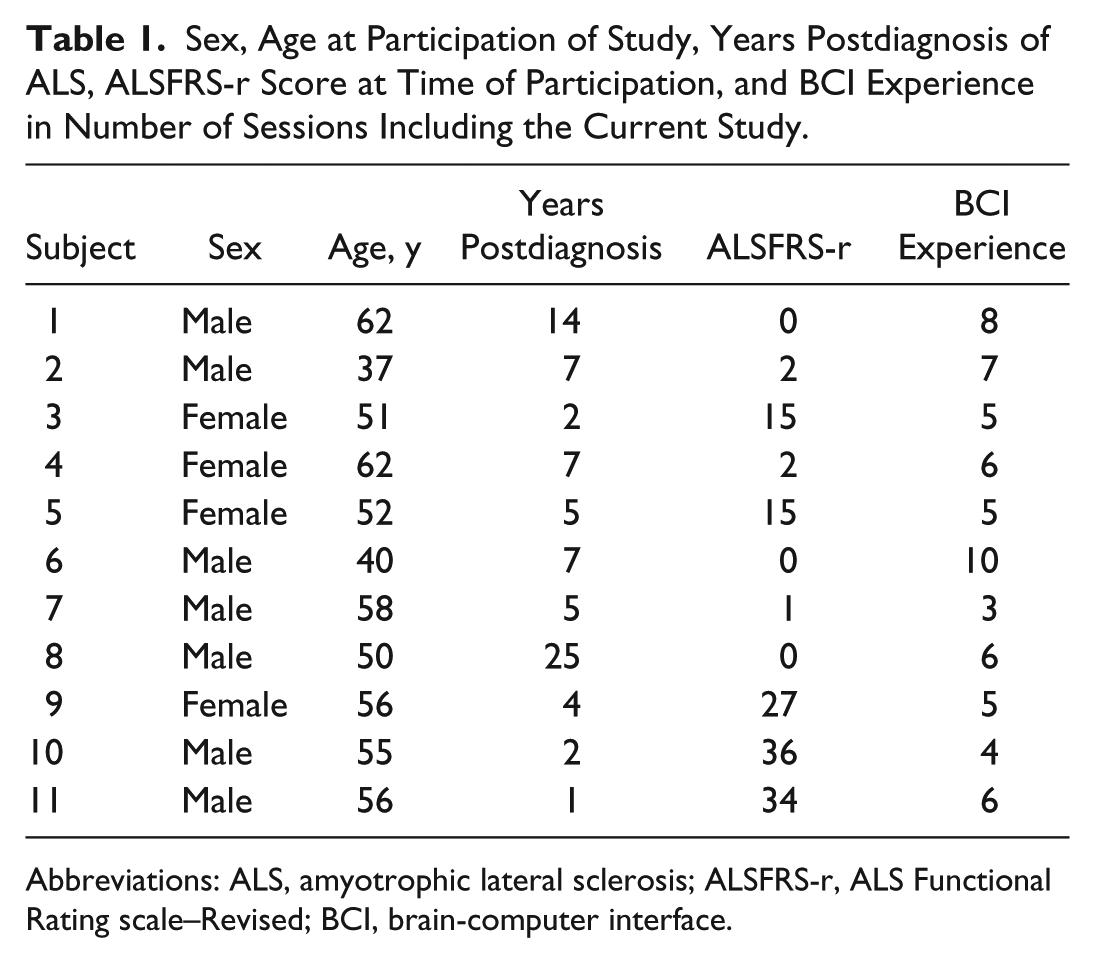
Abbreviations: ALS, amyotrophic lateral sclerosis; ALSFRS-r, ALS Functional Rating scale–Revised; BCI, brain-computer interface.
The current study compared 3 conditions (see Figure 1). Each participant completed all 3 conditions in a pseudo-randomized order (Latin square). The RCW condition flashes entire rows or columns of items in random order. The CBW condition flashes groups of items in a quasi-random order. The RCW and CBW conditions had the same flash stimulus properties, the items were gray when not being presented (stimulus off) and then changed to white when presented (stimulus on). The CBC condition used the same presentation method of the CBW and consisted of items represented in gray (stimulus off) that changed to a color that was different for the 8 surrounding items (stimulus on). Henceforth, the color changes in each of the 3 conditions will be referred to as “flash(es)” for consistency with prior research. The duration of the flash (stimulus on) was 187.5 ms and time between flashes (stimulus off) was 62.5 ms, consistent across conditions.
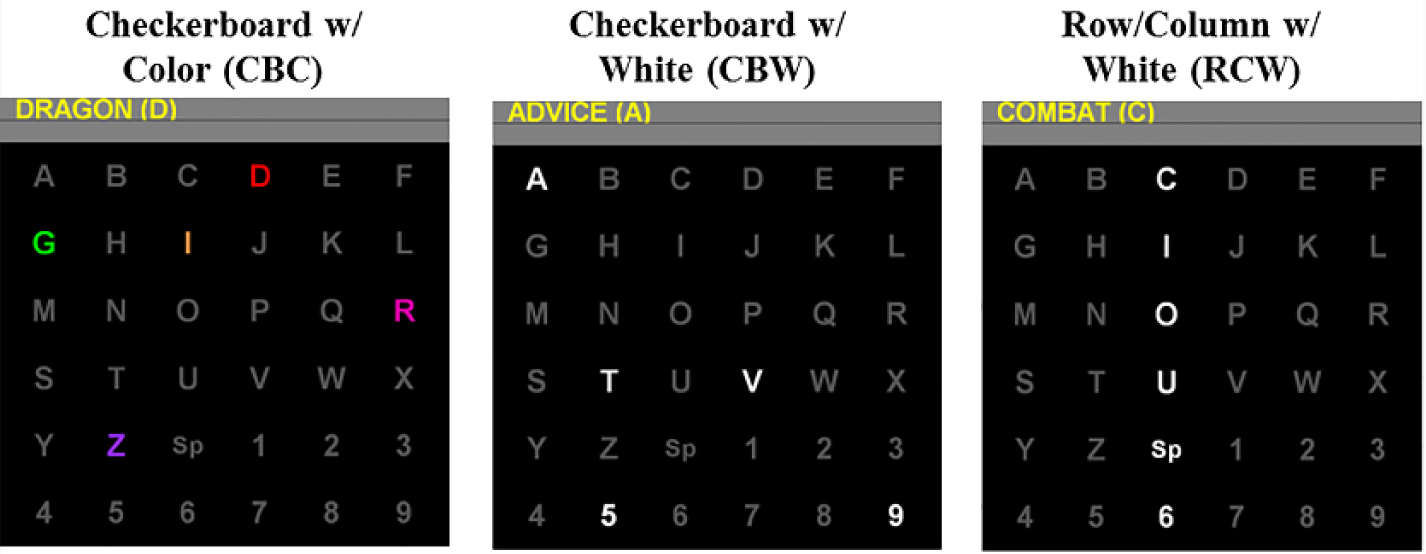
The 3 conditions examined: Color (CBC), Checkerboard (CBW), and Row/Column (RCW).
Stimulus presentation and online processing was conducted with BCI2000. 34 Each participant sat approximately 1 m from the computer monitor that displayed the 6 × 6 matrix. EEG data were recorded from sixteen electrodes (see Figure 2) and referenced to the right mastoid. Impedances were reduced below 20.0 kohm before recording. Kappenman and Luck 35 found minimal impedance-related attenuation of the P300 when a 0.5-Hz high-pass filter was used. The participants were instructed to attend to the item they wanted to select (ie, target) by either counting or repeating the letter silently in their head each time the target flashed and to ignore the nontarget items.
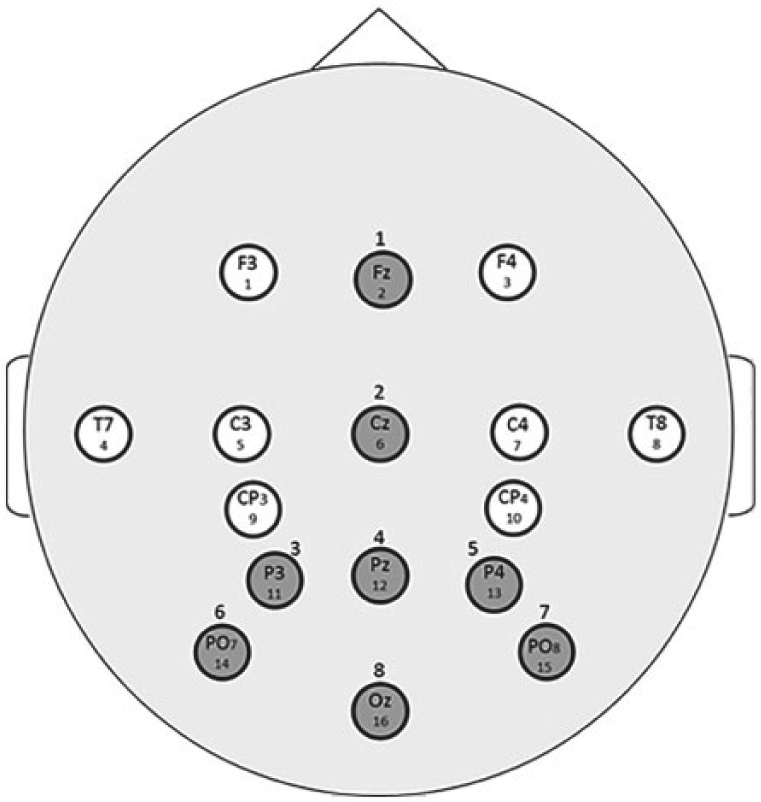
The 16 channels of EEG data collected. Classification channels are presented in gray.
The EEG was amplified by a g.tec (Guger Technologies) 16-channel amplifier (amplification to ±2 V before ADC; high-pass and low-pass filters set to 0.5 Hz and 30 Hz, respectively; digitization rate of 256 Hz). Only 8 electrodes were used for classification (Fz, Cz, P3, Pz, P4, Po7, PO8, and Oz, highlighted in gray in Figure 2). 36 A random word generator was used to obtain 5 six-letter words (ie, 30 character selections). The EEG data from the 30 item selections served as training data for a stepwise linear discriminate analysis (SWLDA) solution, which was then used for online response classification and feedback for an additional 30 selections. 7 EEG was downsampled to 20 Hz before SWLDA was performed. For calibration and online testing, the number of stimulus presentations was held constant at seven sequences per item selection during calibration and online testing phases of the study. A sequence is defined as 2 flashes of every item in the matrix. It should be noted that the CBW (and CBC) presentation constraints require more flashes to complete a sequence. In the RCW paradigm entire rows and columns are presented for each flash therefore, it requires 12 flashes for 1 sequence. The constraints of the CBW paradigm only allow items that are not adjacent to flash resulting in 18 flashes to present one sequence. This results in the CBW (and CBC) paradigms requiring an additional 3000 ms of items flashing per selection.
Participants were given a survey to assess their opinion of which condition facilitated their attention to the target, and in which condition the nontargets produced the most distraction.
Measures and Statistical Analyses
The performance measures used in this study were accuracy and information transfer rate. Each participant was also administered a survey with regard to which paradigm they preferred in their final session (ie, Considering the 3 paradigms, which one did you prefer CBC, CBW, or RCW?). Accuracy was determined by the number of correct selections out of the 30 selections made in the online portion of the session. Information transfer rate (ITR) is an objective measure that combines number of possible selections (eg, number of items in the matrix), accuracy, and the number of selections completed in a minute. 37 The performance measures (ie, accuracy and information transfer rate) of each condition were analyzed by a repeated-measures analysis of variance (ANOVA). The survey results were analyzed with a chi-square goodness-of-fit test.
Offline Analysis of Jumpwise Channel Selection
The eight electrode locations used for classification in this study (see Figure 2, highlighted in gray) were selected based on the results of a previous study. 36 Recently, an electrode selection method called “Jumpwise” selection has been introduced. 38 The method uses SWLDA to determine electrode locations that account for the most unique variance between target and nontarget ERPs. After Jumpwise selects the electrodes, a subsequent SWLDA uses features from the selected channels to derive classification coefficients. Using a 32-channel montage, Jumpwise selection of 8 electrode locations showed statistically higher ITR and accuracy than the “standard 8” electrode locations in offline, and online studies.37,38 The same offline analysis was performed on the 16-channel data collected here.
Offline Dynamic Stopping Simulation
An offline simulation using dynamic stopping was performed to obtain accuracy and ITR measures. 39 This Bayesian technique examines the probability of character selection after each flash. Once one character reaches the threshold of .9 probability the flashing is stopped and that character is selected. Implementing dynamic stopping online would increase the validity of the dynamic stopping results over offline simulation. Nevertheless, dynamic stopping was used offline to obtain a consistent amount of data across participants for the possibility of further offline analysis. That is, online dynamic stopping would result in inconsistent flash presentations and data collected across participants.
Results
A repeated-measures ANOVA was performed on the accuracy outcome. The mean accuracy in the CBC condition was higher than the CBW and RCW conditions (89.7%, 84.3%, and 78.7%, respectively); however, there was no statistical difference between the conditions, F(2, 20) = 3.2, P = .062. The mean ITR was higher in RCW condition than in the CBC and CBW conditions (9.28, 7.68, and 6.99, respectively); however, the only significant difference was between RCW and CBW, F(2, 20) = 5.016, P = .04, pairwise comparison, P = .024. The CBW (and CBC) flash presentation constraints require more flashes to complete a sequence (see Methods section). Thus, even though the observed accuracy in the RCW condition was 11% lower than CBC condition, the IRT in the RCW condition was higher than the CBW and CBC conditions.
An additional 2-way ANOVA was performed to analyze ITR of each condition by each of the 7 sequences. The main effect of condition was not significant, F(2, 120) = 1.09, P = .357; however, the main effect of sequence and the interaction of condition and sequence were significant, F(6, 120) = 3.63, P = .004 and F(12, 120) = 3.60, P < .001, respectively. A post hoc Holm-Sidak analysis found the only significant difference of conditions was within the first sequence. In the first sequence the CBC condition had significantly higher ITR than CBW and RCW, P = .042 and P = .001, respectively (see Figure 4).
A chi-square goodness-of-fit test of the survey results revealed that the frequency of condition preference was significantly different than the frequency expected, χ2(2) = 8.91, P < .05. Of the 11 participants, 8 preferred the CBC and 3 preferred CBW condition.
Waveforms
To compare waveforms, ERPs from the target and nontarget stimuli were averaged by condition. The waveforms did not result in any statistical differences between conditions.
Offline Analysis of Jumpwise Channel Selection
To assess the impact of channel selection in ALS participants, an offline analysis was performed with the data collected in the present study. The Jumpwise selected electrodes did not differ statistically from the standard 8 channels. These results suggest that the standard eight electrodes were an effective subset for the participants in this study.
Offline Dynamic Simulation
A 2 × 3 repeated-measures ANOVA was performed to analyze the online static (ie, 14 flashes of each character) performance measures and the offline dynamic (ie, flashing stopped when probability reached 0.9) performance measures. In the analysis of the accuracy measure, the main effect for dynamic stopping significantly decreased the number of flashes necessary for character selection F(1, 10) = 29.02, P < .000. The mean online static accuracy was 84.24% and the mean of offline dynamic was 78.30%. In the analysis of ITR, the main effect for dynamic stopping significantly increased F(1, 10) = 12.58, P = .005. Mean ITR of the online static was 7.99 and the mean of the offline dynamic was 16.14.
Discussion
The CBC condition combines the visual attention driven constraints of the CBW paradigm with the attention enhancing aspect of a salient color change. These elements facilitate one another in a single paradigm. The statistical analysis did not yield significant differences between these conditions. Nonetheless, the data showed an 11% increase in accuracy, which is exemplified by the preference of the checkerboard paradigms.
The survey provided a very clear difference in personal preference. CBC and CBW were preferred eleven to zero over the RCW paradigm. Participants commented that in the RCW condition nontargets were more distracting than the nontargets in the CBW or CBC conditions. The participants that preferred the CBC condition commented that the colors facilitated their attention to the target. Those who preferred the CBW condition commented that the flashing colors of the CBC non-targets were distracting. These results suggest that personal preference should be considered when a BCI system is used in-home.
The personal preference likely reflected the CBC and CBW’s ease of use over RCW resulting from the visual attention problems associated with the RCW. Although the attention problems associated with the flanker effect and attentional blink did not evolve into statistical differences in performance, these attention issues did affect preference.22,23 Individuals with ALS may require the extended use of a BCI on a daily basis; therefore, personal preference should be strongly considered when a system is implemented in-home.
The increased ITR of the RCW over the CBW and CBC paradigms is a result of more items being presented per flash in the RCW paradigm. A previous study, with a higher number of participants, has shown that when the number of sequences are optimized for the participant there is a significant increase in ITR of the CBW over RCW. 24 In the current study, the performance curves (see Figures 3 and 4) revealed higher initial accuracy and ITR in the CBC condition for all participants. Collecting seven sequences reduced final accuracy differences between the 3 paradigms and RCW showed higher ITR at later sequences. The sequence performance curves suggest that a dynamic classifier would improve the online performance of CBC over RCW.
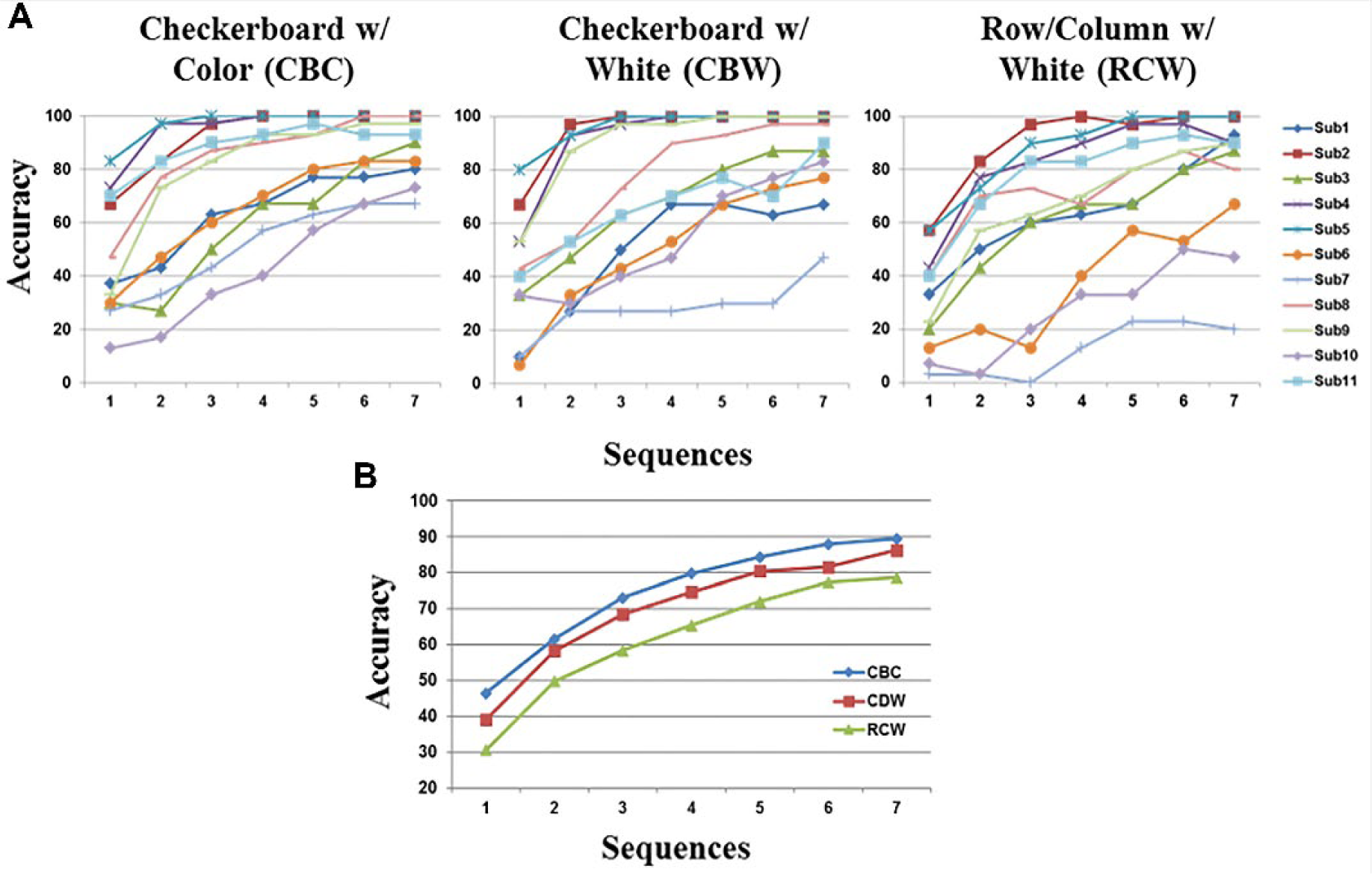
(a) Post–data collection, an offline analysis of percent correct scored by number of sequences in the average for each participant was analyzed and presented as a performance curve. (b) Percent correct for each condition averaged across participants. The CBC (gray-to-color) condition resulted in consistently higher accuracy than the RCW (row/column) condition.
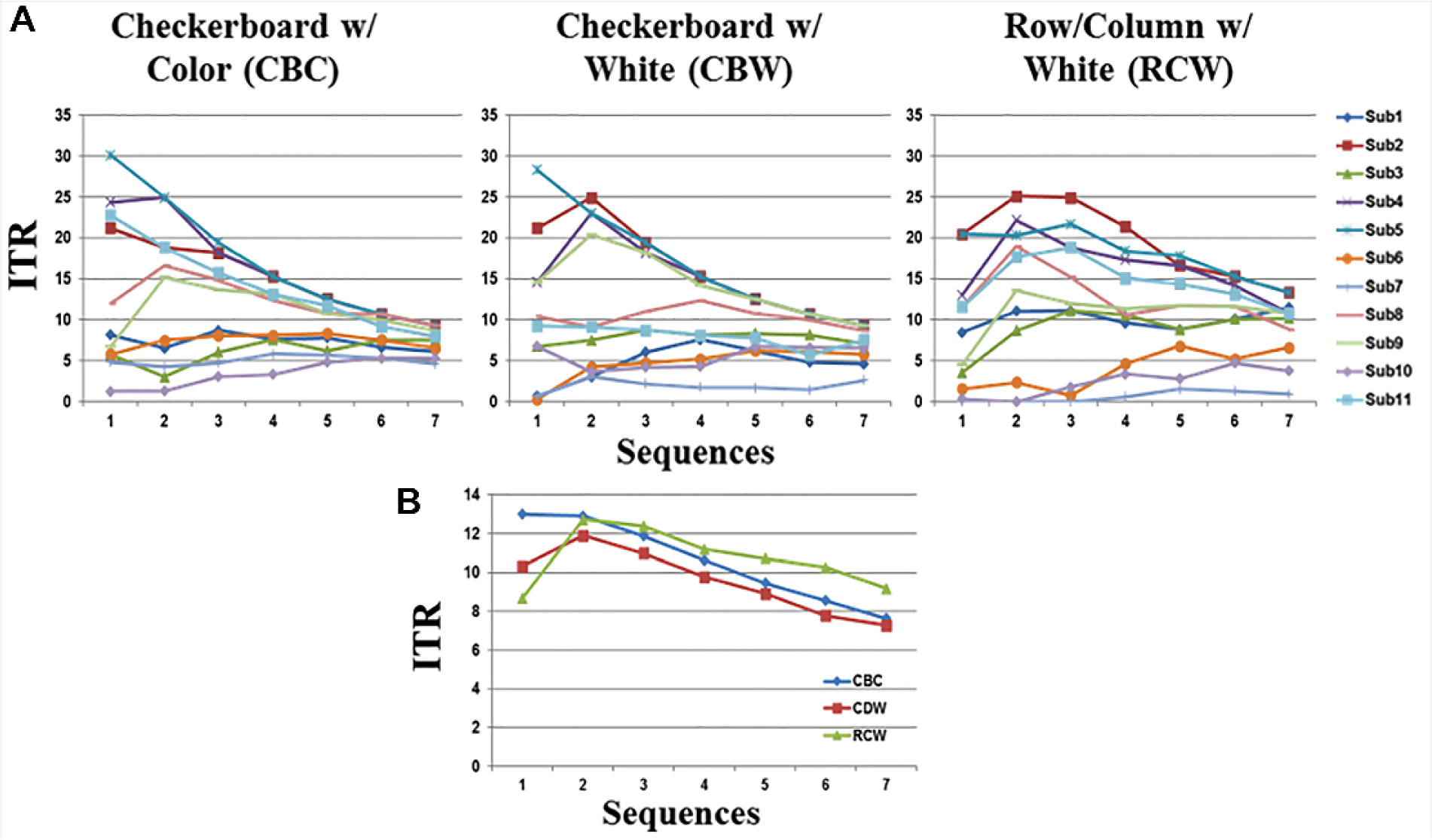
(a) Post–data collection, an offline analysis of information transfer rate (ITR) by sequence for each participant was analyzed and presented as a performance curve. (b) ITR for each condition averaged across participants.
The dynamic offline simulation revealed an increase in ITR over the static sequence used online. The dynamic classifier reduced the necessary sequences (eg, flashes) to make a selection. The increase in speed came at the cost of reduced accuracy. This is a common trade off when trying to improve BCI performance. The dynamic classifier stopping threshold of 0.9 could be increased at the cost of additional flash presentations, requiring more time. There are several dynamic classifiers and it is possible that other dynamic classifiers may provide better performance than that found in this study.39-41
The waveform analysis yielded no significant differences between conditions. A previous study in nondisabled users examining similar conditions revealed a color-processing component (ie, positive peak window from 113 to 310 ms) in the CBC condition that was statistically higher in amplitude than in the CBW condition. 32 Participants did perceive a color change by confirming that the characters flashed in the CBC condition varied in color. It is possible that the progression of ALS could have affected the visual sensory processing tracks of the stimuli 42 ; however, there are competing theories about how these tracks are affected by ALS. 43
The results of this study suggest the need for a BCI with color stimuli and dynamic stopping for an ALS population. There is evidence of increased performance and enhanced personal preference with the system examined in this study. These improvements are incremental and crucial to the development of a reliable BCI system.
Study Limitations
The main limitation of this study is the small number of participants and subsequent lack of statistical power. This is exemplified by the uptrending performance curve of CBC over RCW and CBW (see Figure 3) with no significant differences. Given the relatively small number of people with ALS, recruitment is difficult and exacerbated because much of the data are collected in participants’ homes, which is resource intensive. Nonetheless, people with ALS are an end-user population and it is our assertion that the ultimate efficacy of BCI use will not be realized in laboratory-based studies. Another potential limitation of the current study is that all of the participants had prior experience with the RCW and CBW paradigms and no experience with CBC paradigm. Therefore, it is possible that the participants were biased toward the novel color paradigm. Moreover, standard measures of satisfaction such as the QUEST BCI and NASA TLX were not implemented limiting the depth and generalizability of the participants’ condition preferences. 44 Further studies should include a user-centered design for evaluating BCI applications. 45 Another limitation of the results is the measure ITR, due to the comprehensive design ITR outcomes can be distorted by the input measure of matrix size, accuracy, and presentation rate. 24 Further studies should include multiple measures (eg, Dal Seno et al 46 ). A final limitation is that only 3 stimulus presentation conditions were used in the current study. The three conditions examined here are not representative of all possible BCI paradigms and further testing should include multiple paradigms. Invasive methods could have yielded improved signal-to-noise ratio; however, the noninvasive methods used here have resulted in similar BCI performance to electrocortocography. 47
Conclusions
The participants with ALS in this study all preferred a version of the checkerboard paradigm over the RCW and showed a strong preference for the color paradigm as compared to the two achromatic conditions. The offline dynamic stopping paradigm significantly increased ITR. In addition, the color paradigm produced a modest, although statistically insignificant, improvement in performance. Given these findings, BCI paradigms that use color stimuli should be considered for individuals who have ALS.
Footnotes

Authors’ Note
Preliminary results have been presented at the 42nd Annual Meeting of Society for Neuroscience, New Orleans, LA, USA (October 2012).
Author Contributions
DBR contributed to conception and design; contributed to acquisition, analysis, and interpretation; drafted manuscript; critically revised manuscript; gave final approval; agrees to be accountable for all aspects of work ensuring integrity and accuracy. MAC contributed to analysis and interpretation; critically revised manuscript; gave final approval; agrees to be accountable for all aspects of work ensuring integrity and accuracy. CST contributed to design; contributed to acquisition, analysis, and interpretation; critically revised manuscript; gave final approval; agrees to be accountable for all aspects of work ensuring integrity and accuracy. LMC contributed to design; contributed to acquisition, analysis, and interpretation; critically revised manuscript; gave final approval; agrees to be accountable for all aspects of work ensuring integrity and accuracy. KC contributed to design; contributed to acquisition, analysis, and interpretation; critically revised manuscript; gave final approval; agrees to be accountable for all aspects of work ensuring integrity and accuracy. EWS contributed to conception and design; contributed to acquisition, analysis, and interpretation; drafted manuscript; critically revised manuscript; gave final approval; agrees to be accountable for all aspects of work ensuring integrity and accuracy.
Declaration of Conflicting Interests
The author(s) declared no conflicts of interest with respect to the research, authorship, and/or publication of this article.
Funding
The author(s) disclosed receipt of the following financial support for the research, authorship, and/or publication of this article: This study was supported by the National Institute on Deafness and Other Communication Disorders, National Institute of Health (R21/R33 DC010470-01) and the National Institute of Biomedical Imaging and Bioengineering/National Institute of Neurological Disorders and Stroke, National Institute of Health (EB00856).