







Abstract
Chaco Culture National Historical Park was founded to protect and preserve the archaeological remains of a complex pre-Hispanic American Southwestern society. The 1987 celebration of the Harmonic Convergence in Chaco Canyon forced the park to re-examine its museum collection policies. A new cultural use of the park arose with modern “offerings” left in archaeological sites by non-Native visitors. At the same time, Native American descendant communities were finding their political voices and making themselves heard by federal land managers. Managing the physical manifestations of competing cultural uses has evolved over time at Chaco, in response to descendant communities, “New Age” practitioners, and researchers.
Keywords
In 1907, Chaco Culture National Historical Park (Chaco Culture), in northwest New Mexico, was founded to protect and preserve the architectural and other cultural remains of the indigenous Chacoan society that flourished between 850 and 1150 CE. For the first eighty years of its existence, the park’s museum collection policy was straightforward because the objects accessioned represented the continuous Native American occupation of the land. That changed in 1987.
Two things happened that year: Chaco Culture became a UNESCO World Heritage Site and the Harmonic Convergence was celebrated in Chaco Canyon. The Harmonic Convergence event was proposed by José Arguelles, a New Age author (Fox 1994). Arguelles used Mayan and Aztec calendars and a purported planetary alignment to call for a convergence of the spiritual willpower of tens of thousands of people on August 16–17, 1987 to save the planet from destruction. Gatherings of New Age practitioners were planned at so-called “power points” in Stonehenge, Mount Shasta, Niagara Falls, the Great Pyramids, Central Park, Teotihuacan, and Chaco Canyon.
Chaco Canyon, specifically the great kiva Casa Rinconada, was determined to be one of the places where good vibrations would help launch a New Age (Finn 1997). Casa Rinconada is an isolated great kiva in Chaco Canyon. Great kivas are interpreted as large ancient structures used for ceremonial gatherings. The initial Harmonic Convergence movement was amorphous; the park struggled to determine if there was an individual or group actually organizing the event in Chaco. Eventually, enthusiasts in Santa Fe coalesced into a committee and requested a permit for a public gathering in Chaco.
An estimated 900–1,200 people attended the two-day event. They crammed into Casa Rinconada, the plazas of great houses Pueblo Bonito and Chetro Ketl, and six other locations in the park (Figure 1). They brought drums and gongs with them, danced, chanted, and meditated (Bensinger 1988). They also left things behind. The stabilized firebox in Casa Rinconada had been designated as the official spot for offerings. In preparation, park staff placed 75 cm of sterile soil on top of a filter fabric in the firebox (Chaco Culture National Historical Park 1987). The Santa Fe group that was granted the permit was informed that offerings made during the event would be respectfully collected but would not be retained by the park. This decision was made by Superintendent Tom Vaughan, a former National Park Service (NPS) curator who had given a great deal of thought to the issue. The park did not want to officially approve the deposition of offerings because of the precedent it would set. However, park management also began to consider the implications of an emerging new cultural use of the park and debated how to handle the continuation of the practice of leaving offerings in the park. In the interim, in order to preserve the interpretive integrity of the ancient sites, park rangers collected individual offerings left in places other than Casa Rinconada both before and after the Harmonic Convergence. These items were later accessioned into the museum collection.
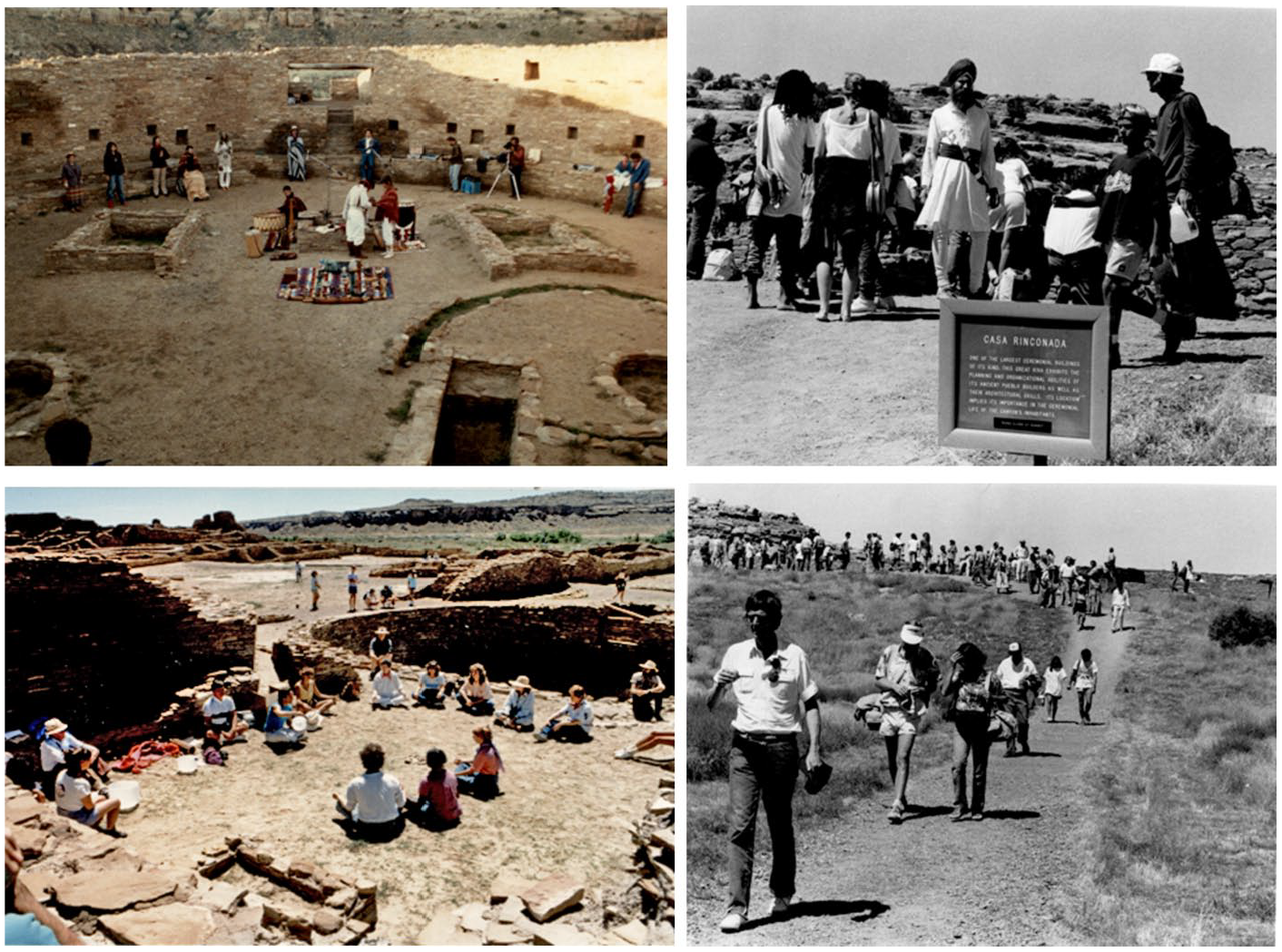
(Clockwise from top left) Harmonic Convergence attendees setting up in Casa Rinconada (N77531), outside Casa Rinconada (N77536), on the trail in Chaco Canyon (N77527), and at Pueblo Bonito (N77525).
Pilgrimages Past and Present
The decision to retain the non-Harmonic Convergence offerings was influenced by recognition that those who left the offerings were practicing a modern version of a pilgrimage. The pilgrimage model has been proposed as an explanation for the cultural development of Chaco Canyon as the center of the ancestral Southwestern world in the tenth to twelfth centuries (Kantner and Vaughn 2012; Malville and Malville 2001; Mills 2002; Plog and Watson 2012; Renfrew 2001; Toll 1985). Puebloan people still make pilgrimages today (Fox 1994), including to shrines in Chaco Canyon. 1 Unlike the concept of pilgrimage in archaeological models, which implies large groups of people convening in Chaco at the same time, modern Puebloan pilgrimages are made by individuals or small groups to shrines known only to them (e.g., Stoffle et al. 1994, 27–33). Tribal offerings are usually ephemeral, such as corn pollen, meal, cobs, husks, smut, and even soil from a corn field (Brugge 1999, 107).
From the beginning of official consultation between the park and descendant tribes in 1990, tribal representatives have described Chaco Canyon as sacred (Chaco Culture National Historical Park 1990–2009 NAGPRA Records; see also Begay 2004; Brugge 1992; Kuwanwisiwma 2004; Swentzell 1985) and the NPS has interpreted the sites as sacred spaces. Western notions of the sacred are often bound up in practices of reverence and veneration, and some non-descendants have responded to the idea of Chaco Canyon as sacred in highly creative ways (e.g., Bensinger 1988). However, non-descendants have no ritual knowledge of the landscape and no frames of reference for reverential behavior other than Western practices. The only “shrines” available to them are the existing archaeological sites open to the general public. Although some offerings are found in inconspicuous places in the sites, many locations are not subtle, nor are the offerings. The range of objects left makes clear both the private nature of the offering and the lack of ritual coherency in New Age practices. In the beginning, offerings tended to be either a single object or a small group of objects, such as shells, crystals, feathers, tobacco, and the like. The offerings left between 1987 and 1989 fit into a single museum storage box. Occasionally large numbers of crystals, or in one case, a thirty-five-pound crystal, were left, but those were the exceptions. Over time, a strong personal streak has become more evident, along with a trend toward more elaborate handicrafts (Figure 2).
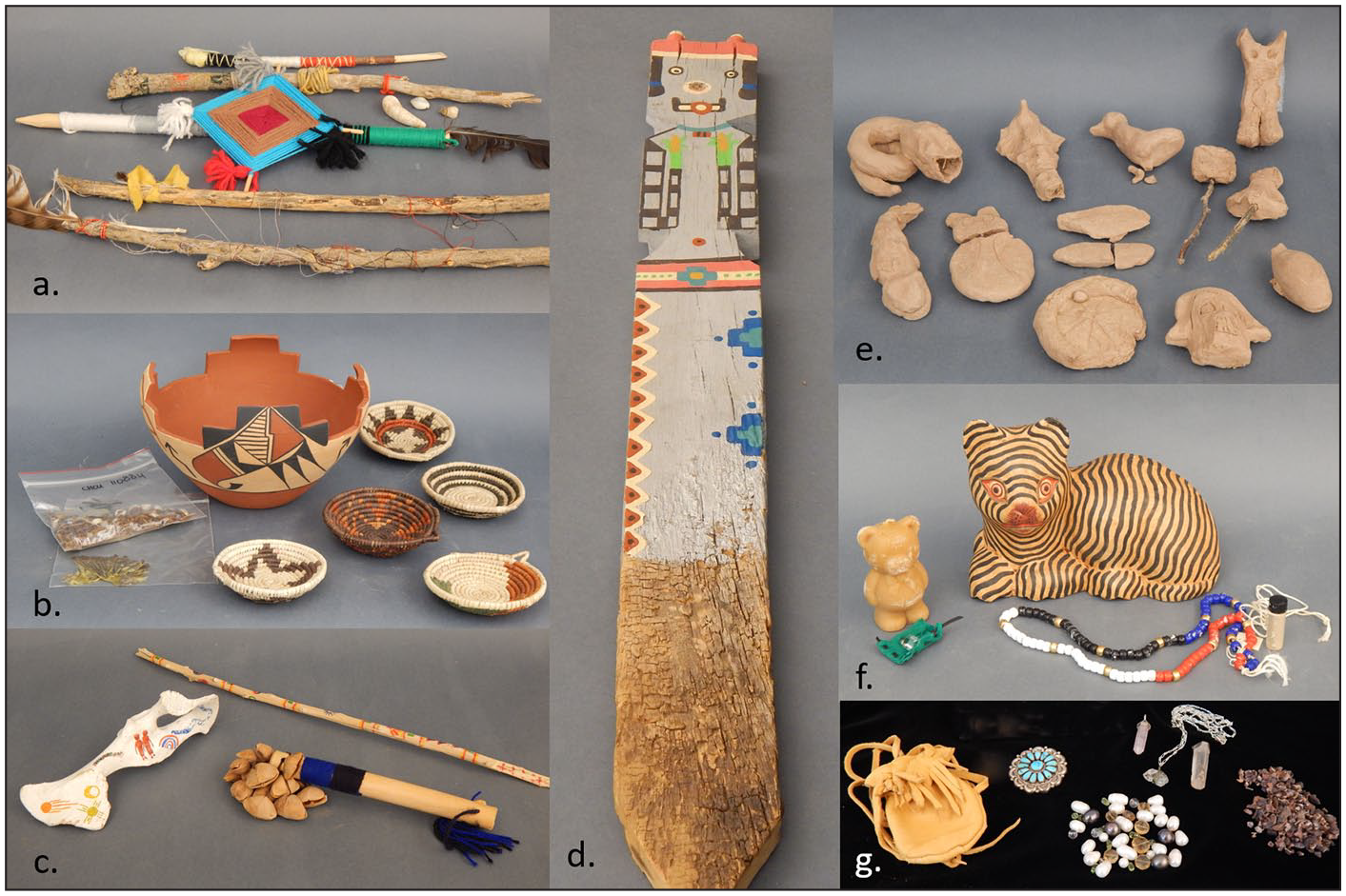
Modern Offerings left in Chaco Canyon (a) CHCU 63833, CHCU 45125, CHCU 79453, CHCU 45122; (b) CHCU 110884; (c) CHCU 92698, CHCU 92668, CHCU 92714; (d) CHCU 68264; (e) CHCU 115173; (f) CHCU 63820, CHCU 45109, CHCU 48823; (g) CHCU 132817.
By the late 1980s park managers faced two basic questions: First, what is the value of the New Age offerings? And more pragmatically, does the long-term curation of New Age offerings significantly impact Chaco Culture’s ability to care for the objects in its collection directly related to the reason the park was created? The second question is more easily addressed.
Effect on Collections Management
After the 1987 Harmonic Convergence, 357 offerings were collected from the Casa Rinconada firepit, including crystals, jewelry, food, and sweet grass wands. These items were accessioned into the museum collection in order to document the exercise of the NPS voluntary destruction deaccession authority (NPS 2000). The park’s original plan was to rebury the modern offerings and map the burial location. However, local Navajo residents expressed concerns about burying the objects and suggested they be placed in the Chaco Wash and be allowed to wash away downstream—a form of the traditional practice of letting offerings “return to the earth” through the natural decay process. This voluntary destruction option was approved by the NPS Regional Curator and the objects were formally deaccessioned. In July 1988, the park superintendent and archaeologist deposited the items into the Chaco Wash near the park’s western boundary.
The cultural practice of leaving offerings in Chaco Canyon that began with the Harmonic Convergence has tapered off but has never stopped. Casa Rinconada continues to be the preferred depositional site, despite the fact that the interior of the great kiva has been closed since 1996. Eighty-two offerings (49 percent) have been recovered from Casa Rinconada. The next most preferred location is Pueblo Bonito, where thirty offerings (18 percent) have been made over the last thirty-three years. In addition to great houses, offerings have also been left in non-archaeological contexts, such as on or near a modern trail, or by a boundary marker.
Yearly numbers fluctuate, but have never come close to the number of objects left during 1987. The trends are interesting. There are two peaks between 1987 and today: one in 2000–2001 and one in 2012–2014 (Figure 3). The years 2000–2001 mark the beginning of a new millennium and 2012 was the year that doomsday cultists decided that the Mayan long-count calendar would end, leading to the end of the world. Perhaps the rise in offerings was in response to these cultural stress times for New Age religious practitioners. Despite the continued practice of leaving offerings, the absolute numbers of offerings have remained low. The current effect on collections management of these New Age objects is minimal, because, proportionately, the number of objects is miniscule. The 1,381 ceremonial objects currently curated represent only .0005 percent of the total 2.6 million objects and archives in the collection and take up very little storage space.
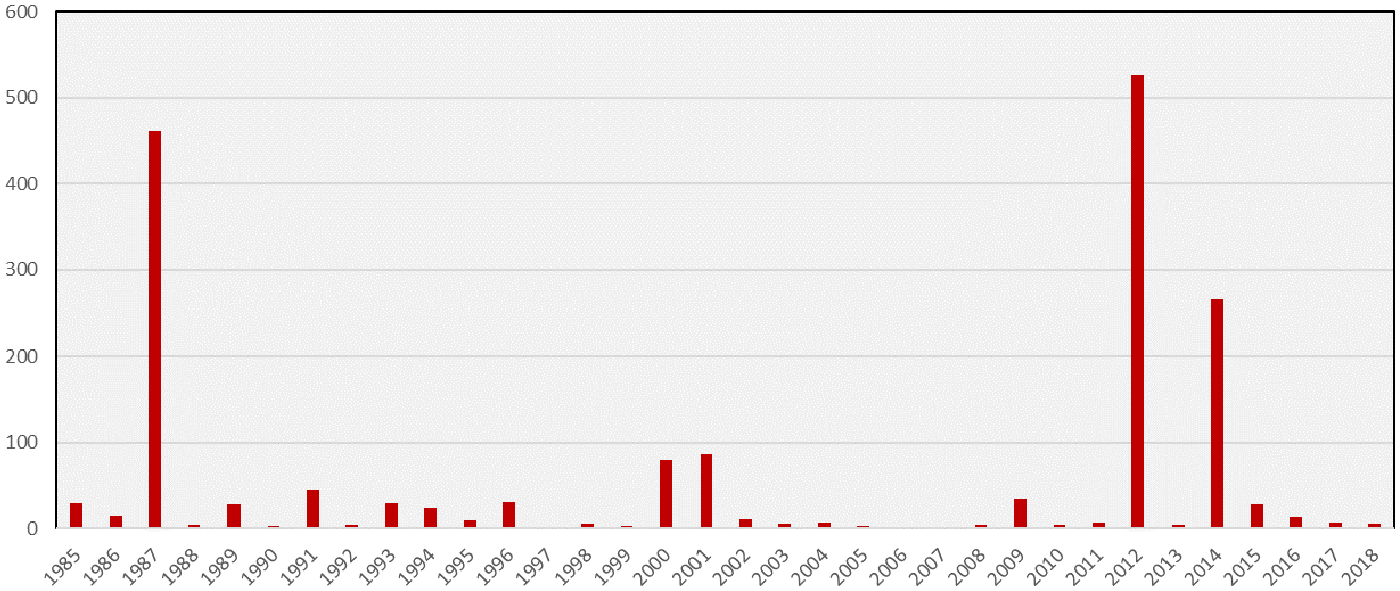
Number of objects received as offerings from 1985 to 2018 in the Chaco Culture National Historical Park Museum Collection. Courtesy of National Park Service, Chaco Culture National Historical Park.
Value of New Age Collections
In the early 1990s, park archaeologist Dabney Ford and curator Phillip LoPiccolo began advocating for retention of the New Age offerings to document an evolving ceremonial use of the park for future ethnographers and archaeologists (Finn 1997, 172). Ford and LoPiccolo pointed to the Vietnam Memorial, which had to address the issue of offerings from the day it opened in 1982. This, along with the fact that researchers had shown interest in this aspect of our collection (e.g., Finn 1997; McLeod 2016), is why we continue to accession and catalog these types of objects, subject to a few guidelines. This policy has been articulated in the park’s Scope of Collection Statement since 2003. 2
Tribal Concerns
A critical concern in the decision to curate modern New Age offerings was the reaction of the representatives of the 26 Native American Pueblos, Tribes, and Nations the park consults with on issues of cultural heritage management, since curation implies value. One of the more self-aware participants in the Harmonic Convergence described the gatherings as largely “a bunch of white folks playing Indian out in the middle of the desert” (Bensinger 1988, 159), which is why many tribal groups view the New Age movement as cultural appropriation (McLeod 2016).
The use of Casa Rinconada for New Age rituals particularly angered tribal members who began advocating for the closure of the interior of the kiva to non-descendants.
3
Celestino Gachupin of the Pueblo of Zia explained the sanctity of the great kiva to Pueblo people: “It’s like a journey back into the underworld were we originated. . ..Only in a certain frame of mind can we go in there. It has to be after fasting. We have to be specially dressed, have moccasins, carry our cornmeal. . ..” (Davis 1992).
The NPS cannot discriminate in the matter of religious practices, but the park realized that the deposition of new material was resulting in physical impacts to the fragile architecture of Casa Rinconada. The 1996 Environmental Assessment (EA) of the possible closure of the interior of Casa Rinconada laid out the factors supporting the park’s preferred alternative, referencing the Harmonic Convergence impact specifically (Chaco Culture National Historical Park 1996, 1). 4 The EA noted that closure of the interior would not prevent individuals from dropping offerings into the kiva, but closure provided the strongest discouragement (Chaco Culture National Historical Park 1996, 10).
The interior of Casa Rinconada was closed to everyone in 1997, including tribal members, to prevent further degradation of the site. This action did not eliminate offerings at Casa Rinconada, but it did decrease them, with the notable exception of the year 2000. Oddly, none were left in Casa Rinconada itself in 2012, the year most closely linked to the New Age interpretation of the Mayan calendar.
Epilogue
If Chaco Culture had been inundated with New Age offerings to the point that it was a clear burden to accession, catalog, and curate the offerings, the park would no doubt have either made a different decision regarding curation or would have implemented more stringent criteria for retention for financial and staffing reasons. Likewise, if Casa Rinconada’s interior had remained open and New Age practitioner behavior had continued or worsened in terms of conflict with preservation and tribal values, the park may have made other decisions about the offerings left behind. But neither of these things happened. What did happen, unexpectedly, was a scholarly and general public interest in the issue of competing cultural heritages.
Footnotes
Acknowledgements
Thanks to retired archaeologist Dabney Ford for clarifying part of the history of the Harmonic Convergence and for helpful comments on this paper, and to Gwenn Gallenstein for inviting me to participate in the symposium.
Declaration of Conflicting Interests
The author declared no potential conflicts of interest with respect to the research, authorship, and/or publication of this article.
Funding
The author received no financial support for the research, authorship, and/or publication of this article.