






Abstract
Electra Havemeyer Webb, in 1947, founded the Shelburne Museum in Vermont. A “collection of collections,” the museum brought together examples of art, architecture, and even local trees, all showcasing Webb’s interest in objects that can educate and illuminate American life and culture. On the other side of Lake Champlain, Alice T. Miner, with her husband, created the Alice T. Miner Museum in 1924. Her collection focused on the Colonial Revival, though, in a sense, this, too, is a “collection of collections.” The character of their museums reflects on their individual personalities and circumstances, but the fact of the collections speaks to the time period and to the ways in which women have seen and understood American culture. This article explores what these collections tell us about the women who created them and about the ways in which race, gender, and class intersect in the inclusion and exclusion of objects and images. Whether the steamship Ticonderoga or the top of a crazy quilt made be Lena Olena Blow of Sciota, NY, in 1908, the objects chosen by Webb and Miner (respectively) tell a story, one that is reinforced by their presentation within the museums. Through examining the provenance and presentation of specific objects, this essay will consider the wider themes, including the relative invisibility of women, craftspeople, and people of color, considered through the two museums. Of particular interest will be the women themselves and their intentions in creating museums that have long outlived them. Were they aware of the significance of their work? Did they strive to include objects and images that illustrated race, gender, and class, as understood or misunderstood by the America of their times? Have the curators and directors that followed them changed the tenor of the museums in order to address those questions more fully?
Introduction
Seen as the natural collectors of antiques and arts, women like Alice T. Miner and Electra Havemeyer Webb developed collections of early Americana that are both impressive and historically significant. Though scholars often forget to fully explore the stereotypically feminine pursuit of collecting, in the case of these two women, that is an oversight. Although they came from vastly different social and economic circumstances, they shared a love of the rural areas along Lake Champlain and a desire to share their collections with the larger world in the form of museums that have stood the test of time and have become mainstays of their communities. That legacy began with their collecting.
Electra Havemeyer Webb, born in 1888 to a family whose wealth derived from their sugar refinery empire, was a life-long collector, amassing “collections of collections.” 1 In a 1952 notebook, she explained, “I do not believe I have ever read or heard any reason for why certain people like to collect; however, I am sure I did inherit the desire and came by it through both parents.” 2 With their example and her father’s advice that “it takes nerve as well as taste to be a collector,” she began to “collect items that appealed to her regardless of popular opinions. Driven by the visual appeal as much as the history and value of potential acquisitions, she joked about not being able to hold back when it came to acquiring new things. But in fact, Mrs. Webb collected quite strategically and with great foresight.” 3 Depending on the account, she started either with a set of dolls given to her by her grandmother (circa 1903) or an old cigar-store Indian that she found and bought in 1908, much to her mother’s apparent dismay. Whatever the first item was, the collections grew exponentially after her father’s death, when she wrote to her husband-to-be, “I am so pleased to feel that I am starting a collection as that is certainly what I intend doing with father’s money.” 4 From the start, though, she knew that James Watson Webb did not share her interests, writing, “I would like to be so rich that I could buy any works of Art I wanted. I know you don’t approve of my views but nothing to me is more fascinating than to feel that one really was a remarkable person.” 5 In 1909, she continued that discussion with Watson, writing, “Just think of the courage I have to expect to keep on in Father’s footsteps in the way of collecting Art. Very few appreciating it and all discouraging me, but still.” 6
Working with art dealers like Edith Gregor Halpert, who owned the Downtown Gallery in New York City and who also advised Abby Aldrich Rockefeller, whose collection of folk art helped to create the Museum of Modern Art in New York City, she chose objects that she found interesting and appealing, things that were ordinary and yet seemed “quintessentially ‘American.’”
7
Later, when she was living in Shelburne, Webb scoured the countryside, looking for buildings that could provide old materials for her museum or that could be moved wholesale to the site, treating the buildings with as much appreciation as the quilts, toys, weathervanes, decoys, ceramics, glassware, firearms, paintings, textiles, carousel horses, furniture, plants, trees, and miscellanea that filled her storerooms, in her homes and on the site of her future museum. As her assistant Lillian Carlisle explained to Pamela Polston, “She intended for the exhibits to keep changing. She had storerooms like you wouldn’t believe.” Polston continues:
Carlisle recalls people coming to the museum grounds with carts of stuff and just dumping it. She acknowledges that neither Webb nor any of her collector friends really knew, or cared, what these items were worth. In fact, it would be some years before a burgeoning interest in folk art and the historical period garnered many of the items much respect. But the nascent museum did not lack for quantity.
8
Although for much of her life she believed that buying another person’s collection was not the behavior of a true collector, Webb increasingly found that, as a museum owner, she needed to consider collections that were already complete or representative. In this way, her methods of collection changed over time, with the decision to purchase and accept entire collections. By the 1950s, the minutes of the annual meetings gratefully list the gifts received. 9
For Alice Trainer Miner, born in Goderich, Ontario, in 1863, the passion of collecting came later in life, after she was already primarily living with her husband William H. Miner, also known as Will, at Heart’s Delight Farm in Chazy, NY. Given her husband’s continued business interests and their mutual social connections, they regularly entertained guests from around the world. On one of these occasions, when the couple entertained their friend, the Chicago pastor Dr. Frank W. Gunsaulus and his choir, she was introduced to the idea of creating her own collection of china. According to Mary Hewson, who served as Miner’s personal maid, “one of the ladies in this Choir who, herself a China Collector and the very next time she came she brought Mrs. Miner a box of small pieces of china, so big, Mrs. Miner said, as she stretched her hands apart, this way and this way. . . .This lady was Mrs. Hodge and as she handed the box to Mrs. Miner she said, I brought this to you hoping to get you interested in collecting china so you would have something interesting to do.” Rather than being immediately bitten by the bug, Miner was “furious to think that anyone should so plainly tell her how sorry they felt for her being stuck in such a place as Chazy with nothing to do. She went on to me, how she didn’t want that china, she wasn’t interested, she didn’t wany any part of collecting anything nor did she want to be pressed into doing anything and on and on and on.” 10 Eventually, though, she decided that, in an effort to maintain the friendship that was important both to her and her husband, she would “collect a few pieces and give her the idea that I was pleased and am interested.” That first step into collecting was enough to pique her interest and she returned home wondering where the pieces were created, how, and why. To answer her questions, “she started reading about every piece of china making. . .and as she said, ‘before she knew it, she was collecting not only china but all manner of things.’” 11
Once she had started, Miner continued. Mary Hewson described these years of collecting, principally between 1911 and 1924, when the museum opened, as “days of ‘get up and go.’ She planned that carefully just like everything else she touched.” On trips with her husband, Miner fit the collecting around their joint ventures, as explained in her March 3, 1920, diary entry:
Springlike day. Shopped in the morning. Bought two white waists at John Forsythe & Sons No. 3 42nd St. very pretty. Went to Verney’s Antique Shop—saw many beautiful old pieces of English Ware—Had luncheon alone—Mrs. Campbell arrived on the [train called the] Century. Met Mrs. Roberts on the street and later went to the Vanderbilt to see her. Two weeks she fell and broke her shoulder. Mrs. Loree was calling at the same time. Came home, dressed and went to dinner with Will to Mr. and Mrs. Underwoods. Met Miss Flagg. Had a wonderful dinner and was back at the hotel at 10:30.
12
When she was without her husband Will, Alice’s trips depended on a variety of factors, including “what she found and getting things home, the length of time her friends could be away from their homes, etc.” Often, she planned a trip based on what “she had heard of a picture, cup & saucer, glass dish of some kind that she was interested in,” with the intent of visiting “a few of these places and be home toward the end of the week to be rested and ready to greet Mr. Miner when he arrived.” Other times, when “she had no particular objects or places in view, she visited Antique shops.”
13
Referring to one of these trips, Miner, Hodge, and their friend Beatrice Bennett, who was the curator of decorative arts at the Art Institute of Chicago, inscribed the Heart’s Delight guest book with this verse:
While the snow was softly falling And the logs were burning bright Three china collectors At the farm of Heart’s Delight Installed both jugs and platters In case all painted white. These ladies hunted far and wide Ransacked all the country side From deerpark unto crossing Lake Champlain And the treasures they collected Are now to be inspected By friends who happen in from off the train.
14
In 1915, the three friends used the ballroom of Harmony Hall, the guest house at Heart’s Delight Farm, to display the ceramic collection. Two years later, when Emma helped her to inventory the collection of pottery and porcelain, “the catalogue ran 115 pages, detailing 340 items of ‘British and American porcelain and earthenware,’ a huge cache of china to have been gathered by a ‘reluctant collector.’” 15 As the collection grew, it came to take up two rooms of the basement: “one room, a billiard room, had China cupboards all around it. The other room, sometimes used for card playing, was in two sections, the one housed a large library, the other section had China cupboards” 16 as well as “barrels and boxes of things [Will] knew nothing about.” 17 After the second room of Harmony Hall was pressed into service to display his wife’s collections, William suggested using the old Stone Store (Figure 1), part of a larger property purchased in 1916 from Clarence H. Jones “for the purpose of enlarging the campus of the Chazy Central Rural School and to beautify this part of the village and school grounds,” as a museum. 18
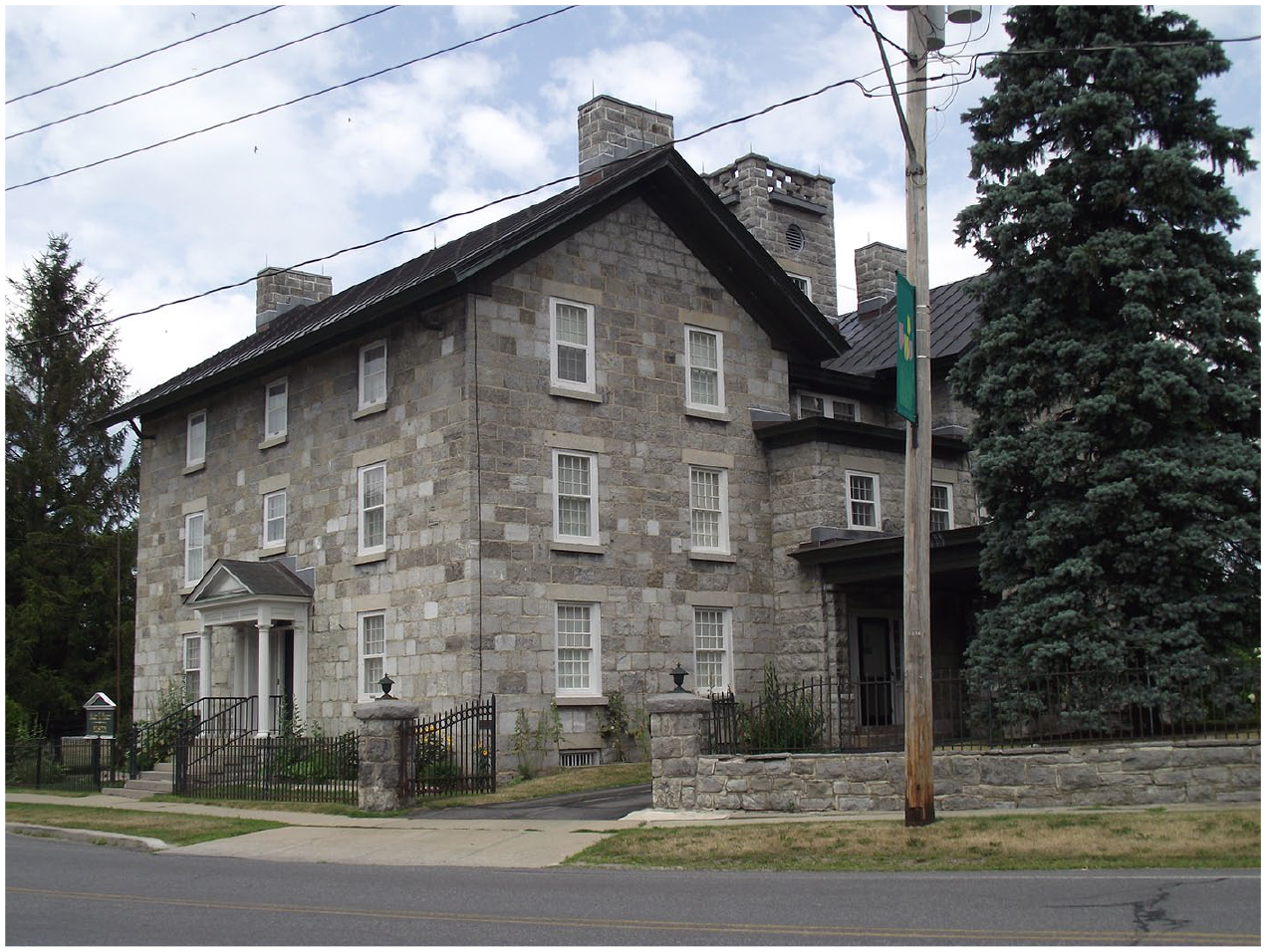
The Alice T. Miner Colonial Collection, courtesy M.F. Wills.
Across the lake, Electra Havemeyer Webb was in a similar position, having “filled a house . . . with collections.” 19 Actually, she had filled more than one house, “The rooms [at Old Westbury] were over-furnished, the same applied to the Brick House at Shelburne. Then the closets and attic were filled. I just couldn’t let good pieces go by—china, porcelains, pottery, pewter, glass, dolls, quilts, cigar store Indians, eagles, folk art. They all seemed to appeal to me.” 20 By 1946, she was actively searching for a site in Shelburne where she could build her museum, the one she had started thinking about at age eighteen, the one she had long thought of a way to offer “great educational value not only to New England, not only to Shelburne and Burlington, but to Canada and the whole world,” a place where “people will receive their education as pleasure instead of as a hardship.” 21 Thirty years after the Miners had their museum building and lot, the Webbs, too, had a site on the eastern side of Route 7 in Shelburne, Vermont (Figure 2).
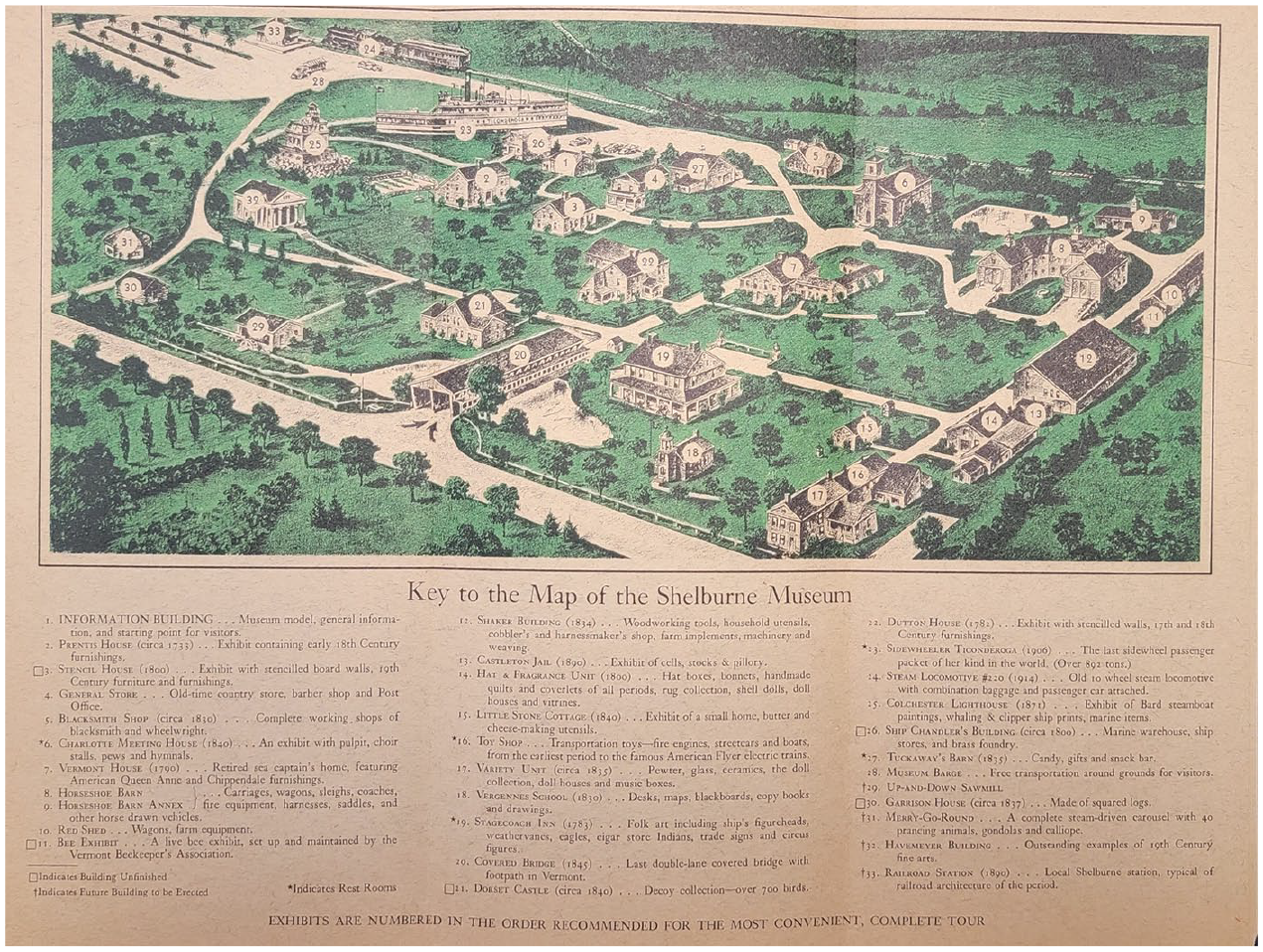
A map of Shelburne Museum, circa 1953, from the Shelburne Museum Archives.
Though distinctly different places, the two museums are remarkably similar in their purpose and in their use of various collections. Neither period room nor historic house museum/village, the museums were designed with the main purpose of sharing the collections these two women had amassed. Alice T. Miner used her collections to furnish the fifteen-room stone structure that bears her name while Electra Havemeyer Webb used her collections to furnish the “collection of old buildings and structures, selected for their beauty and historical interest” 22 that became the Shelburne Museum. Ultimately, the museums themselves are the most important of their collections: repositories of the more than 4,000 objects Miner collected and the more than 100,000 objects Webb assembled. Ranging from sleighs to doll houses, Tobey jugs to needlework, the objects represent early Americana, both at its best and its most ordinary. More importantly, the collections offer us a glimpse of the lives and passions of two women whose imprint can be seen in the objects and their arrangement.
Footnotes
Declaration of Conflicting Interests
The author declared no potential conflicts of interest with respect to the research, authorship, and/or publication of this article.
Funding
The author received no financial support for the research, authorship, and/or publication of this article.

2.
Typescript of notes by Electra Havemeyer on “What Started Me with the Museum,” 1952, EHW I, Box 1, Folder 2, Shelburne Museum Archives.
3.
Lauren B. Hewes and Celia Y. Oliver, To Collect in Earnest: The Life and Work of Electra Havemeyer Webb (Shelburne, VT: Shelburne Museum, 1997), 19.
5.
Frances Weitzenhoffer, “Louisine Havemeyer and Electra Havemeyer Webb,” Antiques, February 1988, 434.
6.
Frances Weitzenhoffer, The Havemeyers: Impressionism Comes to America (New York, NY: Harry N. Abrams Inc, 1986), 138; Weitzenhoffer, “Louisine,”435.
8.
9.
Minutes and Records, Shelburne Museum, Inc., Vol. 1 – Vol. 3, 1947-1959, Shelburne Museum Archives.
10.
Nell Sullivan and Mary Hewson, “Harmony Hall,” February 22, 1963, Miscellaneous Articles Hearts Delight Farm/WHM/Chazy/Alice T. Miner/Museum—History. Box 50, folder 4, Alice T. Miner Museum Archives, 17–20.
11.
Ibid.
12.
Sullivan and Hewson, “Harmony Hall,” 12; “Mrs. Miner’s Diary—1920,” Box 47 Miner Foundation, Etc., Folder 4, Alice T. Miner Museum Archives.
13.
Sullivan and Hewson, “Harmony Hall,” 15.
14.
Joan and Joseph Burke, “William H. Miner: A North Country Legend,” 6–7, available at: https://www.google.com/url?sa=t&rct=j&q=&esrc=s&source=web&cd=&cad=rja&uact=8&ved=2ahUKEwj-tfaj8fqAAxXUD1kFHb3qAZ4QFnoECBsQAQ&url=https%3A%2F%2Fassets.website-files.com%2F5e3379ed2e40db2971c8d8d3%2F5ff4dee90ea5357832c5c682_william-h-miner.pdf&usg=AOvVaw3wxH9SXV6M_I2tePU05RJx&opi=89978449 (accessed July 8, 2023).
15.
Joseph C. Burke, William H. Miner—The Man and the Myth (New York, NY: Langdon Street Press, 2010), 332.
17.
Sullivan and Hewson, “Harmony Hall”; Nell Jane Barnett Sullivan, “Alice T. Miner Colonial Home,” ARC-0491, Alice T. Miner Museum Archives.
18.
Correspondence with Clarence H. Jones 1916, ARC-0494, Alice T. Miner Museum Archives.
19.
Walter Karp, “Electra Webb and Her American Past,” American Heritage, 1982, 19.
20.
Typescript of notes by Electra Havemeyer on “What Started Me with the Museum,” 1952, EHW I, Box 1, Folder 2.
21.
Hewes and Oliver, To Collect in Earnest, 30.
22.
Typescript of notes from “E.H.W. Notes on What Started Me With the Museum,” EHW I, Box 1, Folder 2, Shelburne Museum Archives.