







Abstract
Background: Transumbilical single-incision laparoscopic surgery (SILS) provides an alternative to traditional multiport laparoscopic surgery. The technique may also avoid some of the difficulties surrounding laparoscopic Hartmann reversal. This case represents the first SILS Hartmann reversal via the colostomy site. Methods: SILS Hartmann reversal was performed in a 56-year-old man with a history of resection for perforated diverticulitis. The procedure was performed via a single port placed into the former colostomy site. A combination of flexible and straight instruments was used. Results: The procedure was completed successfully with an operative time of 104 minutes. Recovery was uneventful, and the patient was discharged on postoperative day 5, with no complaints at follow-up. Conclusion: SILS Hartmann procedure reversal via the colostomy site is safe. The approach avoids additional incisions and allows avoidance of dense adhesions to the previous midline incision—a new benefit of SILS, apart from cosmesis.
Keywords
Introduction
Restoration of bowel continuity following a Hartmann procedure remains difficult, with an anastomotic leak rate of 15% and mortality close to 15%.1,2 Studies have shown improved outcomes, such as shorter hospital length of stay and fewer perioperative complications, with a laparoscopic approach. 3 More recently, reports of transumbilical single-incision laparoscopic surgery (SILS) for sigmoid resection have shown this to be a feasible approach.4-6 Combining the techniques used in laparoscopic Hartmann reversal and SILS colectomy could potentially result in improved outcomes. The following is a report of the first SILS Hartmann reversal using the colostomy site as the only port site.
Methods
The case represents a preliminary experience with SILS Hartmann reversal via the colostomy site in a 56-year-old man with a history of a sigmoid resection and end colostomy for perforated diverticulitis. The patient gave informed consent for the surgical approach. He was placed in the lithotomy position and received a single dose of cefoxitin of 2 g. The colostomy was first mobilized down to the fascia, and additional colon was brought out through the colostomy site. An anvil for the CDH29 stapler (Ethicon Endo-Surgery, Cincinnati, OH) was placed in the lumen, a purse-string 3-0 prolene suture was used to secure the anvil, and the colon was returned to the peritoneal cavity. The single-site laparoscopic access system (Ethicon) was then placed in the fascial defect at the colostomy site and pneumoperitoneum was established. Adhesions were taken down and the left colon mobilized using an Harmonic ACE36E scalpel (Ethicon), with use of a Roticulator Endo Grasp (Covidien, Norwalk, CT) for the handling of tissue. Loose adhesions from small bowel loops to the rectal stump were mobilized in the pelvis. Adhesions to the previous midline incision were left in place because they were out of the operative field. The CDH29 stapler was introduced through the rectum, and the anvil was secured to the stapling device. An air leak test was performed prior to removal of the port. The fascia was closed with a 0 polydioxanone suture and skin was loosely approximated with staples (Figure 1).
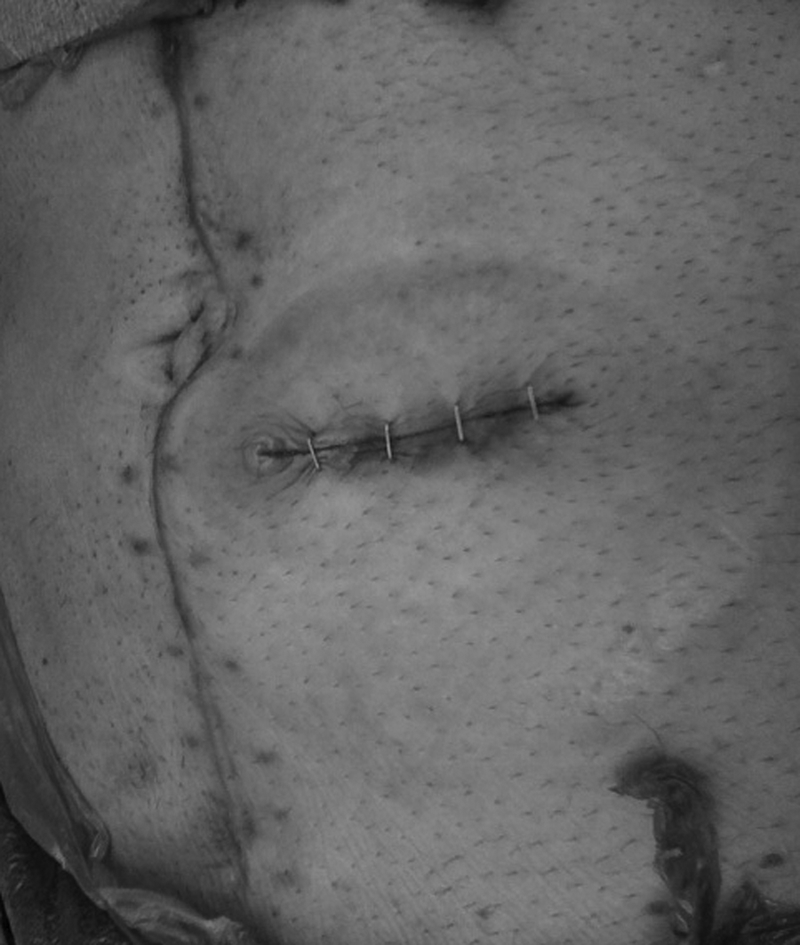
Closed colostomy/port site
Results
Total operative time was 104 minutes. Blood loss was minimal, and there were no complications. A clear liquid diet was started on postoperative day 2, and the patient was discharged on postoperative day 5. The patient reported no problems at follow-up.
Discussion
SILS Hartmann reversal via the colostomy site is feasible using a combination of straight and articulated laparoscopic instruments in conjunction with an advanced port device.
Familiarity with the SILS technique was first obtained with SILS appendectomies and cholecystectomies. SILS hemicolectomy and sigmoidectomy were then completed prior to SILS Hartmann reversal. The procedure reproduced a standard laparoscopic Hartmann reversal but with some advantages. By performing the entire procedure from the left-sided port, no adhesiolysis from the prior midline incision was necessary (as would have been the case if ports were placed in the right lower quadrant). Also, no additional incisions are required in a patient who already has a healed midline incision and will have a colostomy site wound.
Three critical aspects of the laparoscopic procedure have been described. First, trocar placement may be difficult, dense adhesions must be mobilized, and the rectal stump must be identified. 7 With a SILS approach, no additional trocars need to be placed, and dense adhesions to the midline incision may be left in place. The SILS approach offers the same benefits of a laparoscopic approach as well. Studies have shown early return of bowel function and fewer perioperative complications (14% for laparoscopy and 59% for open procedures). 3 Reported complications include fistula, leak, hemorrhage, and wound infection.1,2 Average length of stay is reduced by laparoscopic reversal to approximately 4 days.2,3,7-10 Restoration of continuity is well suited to a laparoscopic approach in general because resection and division of the mesentery is not necessary. 11
No study has yet shown a benefit of SILS colectomy over traditional laparoscopic surgery because few reports are available at this time. Proposed benefits include improved cosmesis and decreased risk of injury during trocar placement, peritoneal trauma, and port site hernia. 5 The major difference seems to be in cosmesis associated with fewer port sites and 1 hidden scar. In SILS reversal, the use of the large single port is facilitated by the stoma site, in fact eliminating the need to close the site entirely or partially to accommodate a small port. The patient by definition will have a wound at the stoma site, so in this case, there is no additional incision made. Previous reports have shown single-port sigmoid surgery to be feasible and safe.4,6 Similarly, laparoscopic Hartmann reversal appears to be feasible and in fact may prove to be an ideal procedure for the single-incision approach.
Footnotes
Acknowledgements
The authors would like to thank Ms Margriet Steuer for her assistance with procedure planning.
The authors declared no potential conflicts of interest with respect to the research, authorship, and/or publication of this article.
The authors received no financial support for the research, authorship, and/or publication of this article.