







Abstract
Need
During deep brain stimulation (DBS) surgery, the base ring of the burr hole is the main structure that anchors the DBS lead. A discrepancy between the burr hole size and ring base renders the ring unstable which in turn compromises lead stability. Burr hole size mismatch is often seen in resource-poor countries where advanced perforators, that make exact size holes are not available.
Technical Solution
We describe a simple, cost-effective technique, the screw-lock method. When there is a mismatch, titanium self-tapping screws are inserted through the holding holes of the base ring into the skull with immediate and stable fixation.
Proof of Concept
This technique not only immediately secures the base ring to the skull but also prevents accidental displacement of the DBS lead.
Next Steps
The titanium screws can be included in the burr hole ring set in commercially available products. A new type of expandable burr hole rings can be designed to fit any size of burr hole.
Conclusion
This is an effective method to stabilize the burr hole base ring and the DBS lead.
Keywords
Need
Deep brain stimulation (DBS) therapy is now accepted as a standard of care for movement disorders. To obtain the optimal and sustained effect of DBS therapy, accurate placement of the lead at the target site and permanent stable anchoring of the lead are critical. Hardware-related complications requiring revision surgery are reported in 4.5% of patients.
1
In these patients, an additional surgery with revision, exchange, or removal of system components is frequently required.2,3 Importantly, postoperative lead migration or displacement has been reported in over 10% of DBS leads in a large cohort, with failure of lead fixation at the burr hole site identified as a key contributing risk factor.
4
The most common reason for failed lead fixation is base ring and burr hole size mismatch.
5
Currently available systems to hold the assembly in place are Stim-Loc (Medtronic, Minneapolis, MN, USA) which comes at an additional cost to the patient and burr hole ring base and cap that comes with the lead and does not add to the cost (Figure 1).
6
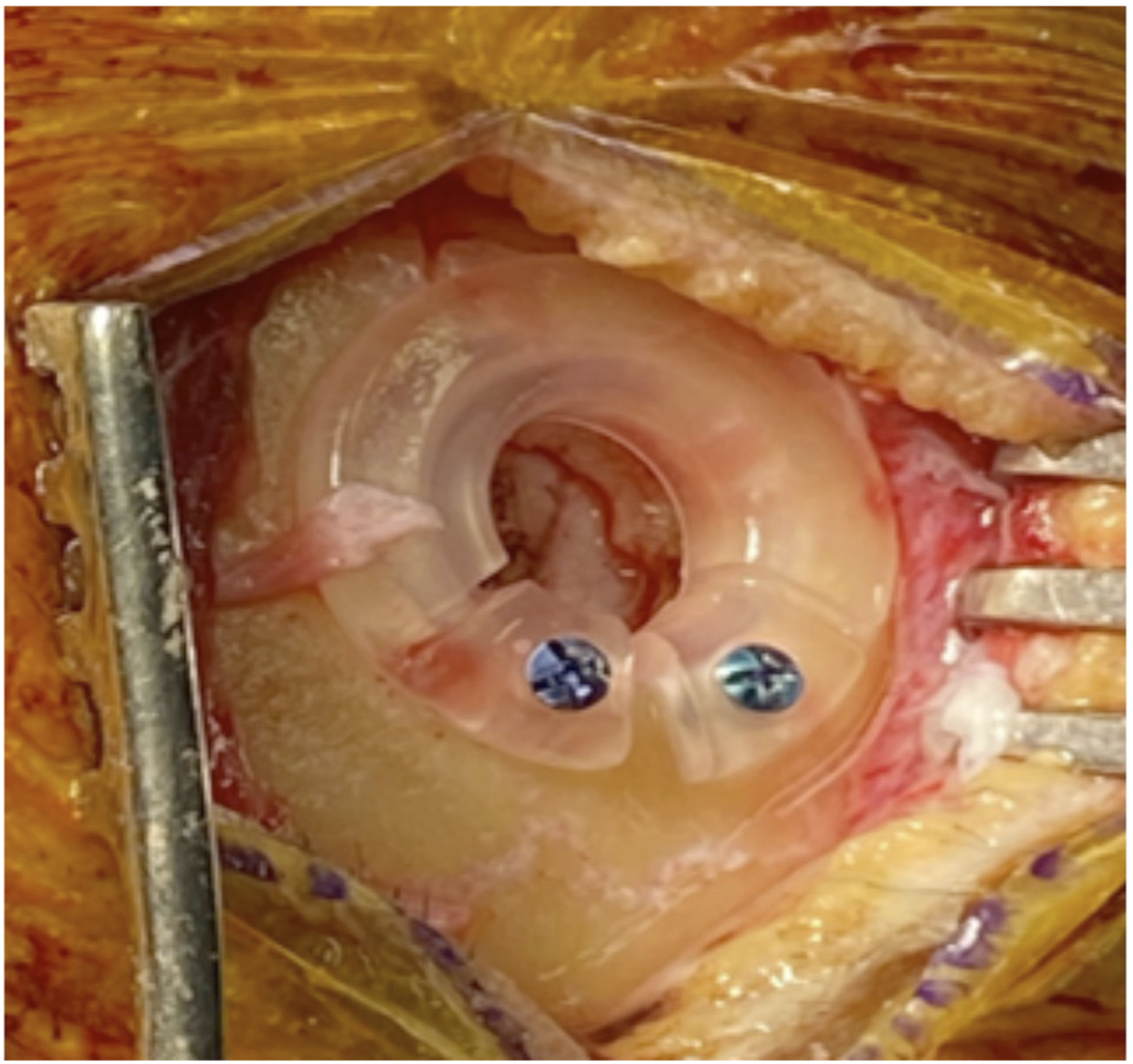
In India, DBS equipment comes with burr hole ring base and cap at no additional cost and hence most often used for lead fixation. In addition, using 14 mm perforators for all the burr holes is not possible due to cost of the perforators and drills. Hand held Hudson brace or match-stick drill is most often used to make a burr hole. This can often result in base ring and burr hole size mismatch. It places a DBS lead at risk of misplacement even after proper micro-electrode (MER) mapping of the target nucleus. No cost-effective alternative currently exists to address this gap; the authors therefore wish to share a novel and cost-effective screw-lock technique to secure the burr hole base ring to the skull (Figures 1 and 2). Burr-hole base ring showing the two holding holes for screw fixation Intraoperative photograph showing fixation of the burr hole base ring to the skull using two titanium self-tapping screws passed through the holding holes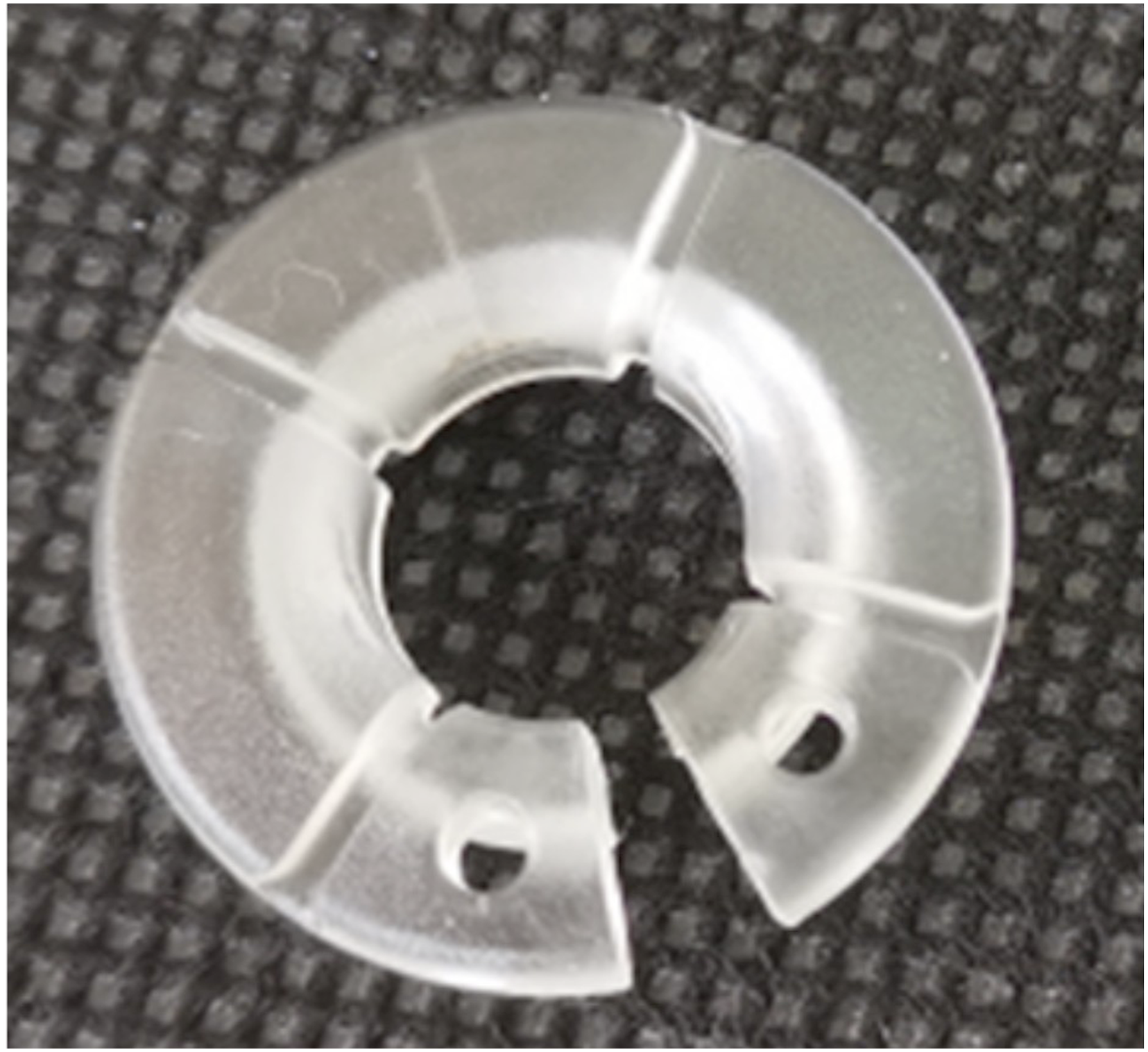
Technical Solution
Once the burr hole is done, before we open the dura widely to accommodate multiple MER tracts, stability of base ring needs to be assessed. Usually, the base ring is held using a small artery forceps using the two holes provided at the open ends of the ring and placed in the burr hole (Figure 1). If the size of the burr hole is larger than the base ring diameter then the ring does not get stably anchored in the burr hole (Figure 3A). This can lead to rotatory movements as well as displacement of the base and the DBS lead (Figure 3A). To address this, we placed the base ring in the oversized burr hole. Then used the two holes provided for holding the base and placed 6 mm self-tapping titanium screws (Figure 2). This made the base ring stable (Figure 3B). Schematic illustration of the screw-lock technique. (A) Without screw-lock: the oversized burr hole results in a loose base ring with rotational instability in both directions, as indicated by the curved red arrows. (B) With screw-lock: two titanium self-tapping screws passed through the base ring’s holding holes provide stable fixation, eliminating rotational movement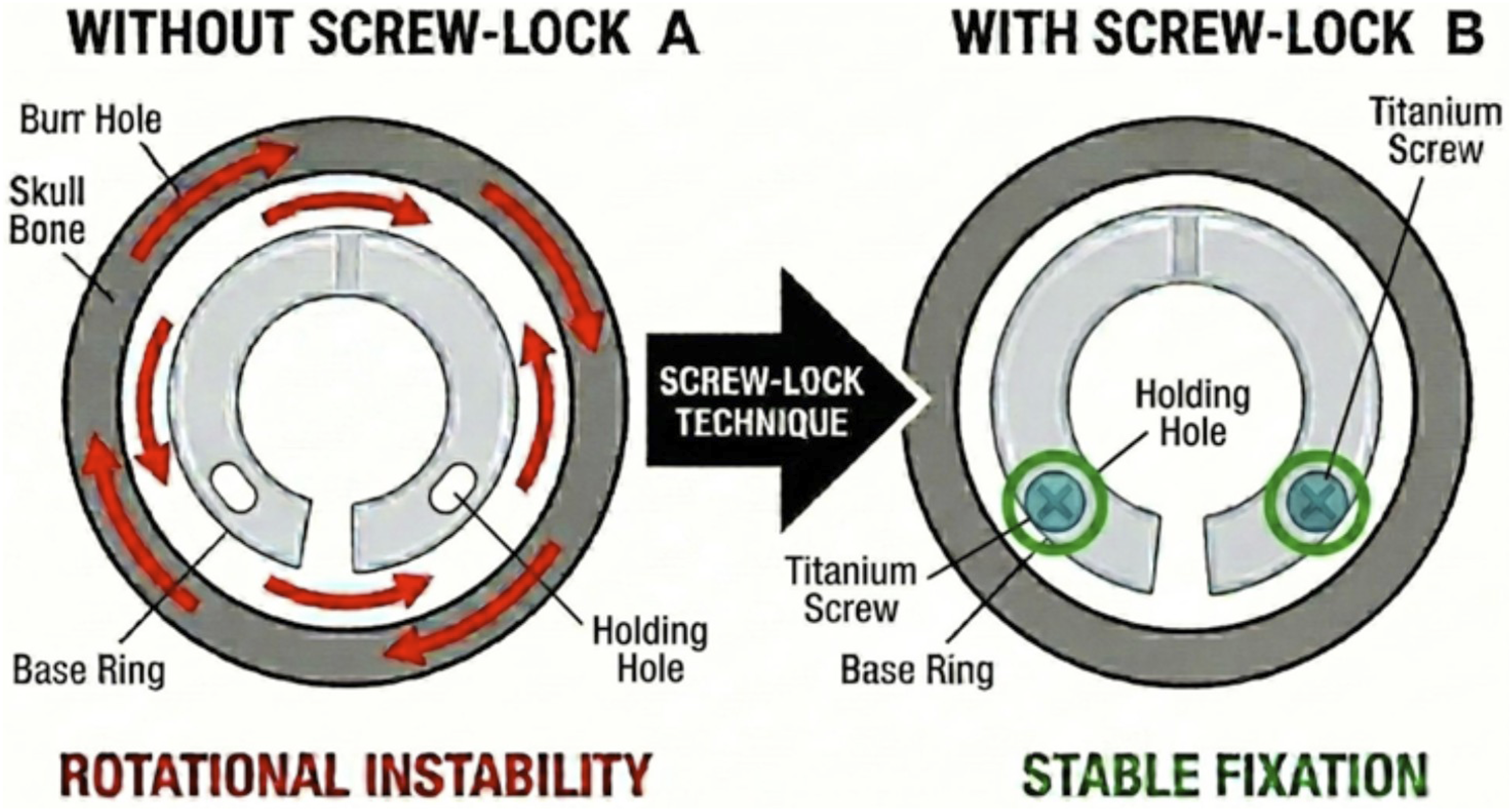
Proof of Concept
We have shown that securing the ring with two screws prevents rotatory instability and dislodgment from the burr hole (Figures 2 and 3B). Even in the expensive, commercially available burr hole fixation systems like Stim-Loc (Medtronic, Minneapolis, MN, USA), there are only two screws providing fixation. So, two-point fixation is adequate for a stable base ring on the burr hole. 7
Next Steps
It is advisable to place these screws in all cases where a dedicated holding assembly is not available. They can be included in commercial kits. Expandable base rings can also be manufactured to fit all burr hole sizes.
Conclusion
This technique is particularly valuable in resource-limited countries where commercially available fixation systems are beyond the financial reach of most patients. The advantages of this technical innovation are 1. It secures the base ring and the DBS lead effectively. 2. It can rescue an unstable base ring in case of burr hole size mismatch. 3. It can be done before we start MER, target mapping and actual lead placement, hence can avoid surgical mishaps before they can happen.
Footnotes
Acknowledgements
The authors wish to acknowledge Pijush Gayen, Kuntal Kanti Das, Anant Mehrotra, Ashutosh Kumar, and Awadhesh Jaiswal for their technical assistance and support during this work.

Ethical Considerations
This study was conducted in accordance with the ethical standards of the institutional committee and with the 1964 Helsinki Declaration and its later amendments.
Consent to Participate
Written informed consent was obtained from the patient for the publication of this technical note and accompanying intraoperative images.
Author Contributions
All authors contributed equally to the concept, surgical technique, data collection, manuscript preparation, and critical revision. All authors have read and approved the final manuscript.
Funding
The authors received no financial support for the research, authorship, and/or publication of this article.
Declaration of conflicting interests
The authors declared no potential conflicts of interest with respect to the research, authorship, and/or publication of this article.