







Abstract
In the contemporary context, demands for rapid school turnaround meet the reality of increased principal turnover. Therefore, it is crucial to help aspiring school leaders hone their problem-solving skills. This case provides readers with an opportunity to diagnose issues of concern at a struggling school, and then prescribe several initial strategies for improvement. To accentuate the personal relevance of the exercise, the authors employ second person narrative voice. The case has been revised and enhanced during its use over the past several years in principal preparation programs, including a federal-grant-funded initiative to train aspiring leaders of high-need, low-performing schools. The teaching notes provide guidance on how educational leadership instructors might use the case within their own courses.
Introductory Note
Since the school accountability era manifested in earnest during the past decade, beginning school leaders have faced an increasingly daunting dilemma. On one hand, policymakers and educational reformers have routinely portrayed principals as individuals uniquely positioned to drive improved academic performance in schools, especially those in need of rapid “turnaround” (Peck & Reitzug, 2014; The Wallace Foundation, 2010). On the other hand, researchers have demonstrated how first-time principals are overwhelmed by their initial exposure to job-role responsibilities, and documented how school leader turnover has become a worrying trend (Fuller, Orr, & Young, 2008; Spillane & Lee, 2014). Given this complex combination of lofty public expectations and difficult role-based challenges, it is crucial to help aspiring school leaders hone their problem-solving skills.
Accordingly, this case provides readers with an opportunity to diagnose issues of concern at a struggling school (Duke, 2008), and then prescribe several initial strategies for improvement. To accentuate the personal relevance of the exercise, the authors employ second person narrative. Accordingly, this case directly immerses you, the reader, into the role of a beginning, novice principal who is considering first steps toward encouraging greater school success.
The case starts with your hiring as principal of Sparrow Middle School. Good luck in your new position.
Case Narrative
It is the evening of July 23, a Tuesday. Moments ago, the school board for the Middleville City School District (MCSD) officially approved your selection as the new principal of Sparrow Middle School. You were endorsed for the position after completing three levels of interviews: an initial interview with the assistant superintendent in charge of secondary schools, a formal, school-based finalist interview with various stakeholders including teachers, parents, and student representatives, and a final interview with the MCSD superintendent. MCSD is a mid-sized district that educates 31,269 students in 51 schools. This is your first principalship after you served 2 years as an assistant principal in a different middle school in the district. Teachers report for duty on August 19, and students report for the first day of school on August 26.
The person who advocated for your hiring and will now serve as your immediate supervisor is Dr. Lisa Johnson, the MCSD assistant superintendent of secondary schools. She is White and has 17 years of experience, including as a teacher and principal in the district. She touched base briefly with you before the Board meeting, and explained that she wants to meet with you tomorrow morning Wednesday, July 24 at 10:00 a.m. to discuss the following items:
What are three main areas of strength and three main issues of concern at Sparrow Middle School?
What are three action steps that you plan to take from now through the first day with students August 26?
What are three goals that you are considering establishing for your first year at the school?
What do you want to know more about? Why? How do you plan to find out that information?
What is one formal, reasonable, and immediate request you would like to make to her?
Dr. Johnson explained that these questions represented discussion starters for her initial meeting with you as the officially appointed principal of Sparrow. Her questions were intended to help her understand what you knew thus far about the school and the community, and your answers would aid her in helping you frame and actualize your goals for the school. As the Board meeting winds down, you begin to consider responses to each of Dr. Johnson’s questions. Fortunately, you assembled a rather dense volume of information regarding Sparrow Middle School as you prepared for the several levels of interviews that preceded your selection for the position. Now back at your home, you review your various notes, documents, and data in preparation for your discussion with Dr. Johnson tomorrow morning.
Facility and Setting
The 1931 Sparrow Middle School facility has an inspiring Art Deco façade, but its interior is in need of repair. Hallways just off the main entrance are subject to leakage. When rains are heavy, custodians place large plastic garbage cans throughout the hallways to catch water dripping from the ceilings. There are no computer labs, and the Media Center has fewer than 1,000 books and only five computers. Thanks to a grant obtained by a social studies teacher, since last year the building provides wireless Internet access and there are two laptop carts that teachers can sign out. Each cart can serve a classroom of students. Three teachers use the laptop carts fairly regularly.
The attendance zone for Sparrow is a 3-mile square radius community that includes stand-alone houses with small yards, apartment complexes, and four mid-sized federally subsidized housing projects. Sparrow Middle School is on the main street (Front Street—which is called simply “F Street” by locals) that runs through the community. There is a corner market across the street from the school. The owner has repeatedly complained about rowdy students to district office staff, but he keeps the store open before, during, and after school hours to sell candy, soft drinks, and other popular items to students. A group of retired men play checkers outside the front of the store each morning. There are 21 churches in the area, and the majority of the school’s parents and students attend Sunday services. One of the largest churches has added three additional Sunday Spanish-language services in the past year, and it is planning on adding a Saturday evening Spanish-language service as well.
Demographics and Performance Data
In the school year that just concluded, Sparrow Middle School served 817 students in Grades 6 to 8 in a facility originally built for 900 students. The school draws from a racially diverse but economically homogeneous community. Most families are in the lower stratus of the income range, and most rely on some form of public assistance to supplement wages or as a main means of subsistence. The school qualifies to receive Title I funding with 84% of its students receiving free lunch. In terms of racial background, 22% of students are White, 38% are African American, 36% are Hispanic, and 4% are categorized as “other.” In the past 5 years, there has been a 140% increase in the number of students who identify as Hispanic at the school. Students identified in need of English language development are scheduled to be provided pullout limited English proficiency (LEP) services once a week by a central office-based LEP teacher who comes to Sparrow 3 afternoons a week. On days she is not at Sparrow, the LEP teacher rotates through two other schools in the district. Fourteen percent of students receive special education services. The school has four full-time Specialized Education Services (SES) teachers.
Most students arrive at Sparrow after having attended one of three elementary schools in the district; two of the schools are Title I and in need of academic improvement, whereas the third is not Title I, has achieved an exemplary academic rating in the state accountability system, and has been honored by a national organization as a glowing example of a “best practices” arts-focused elementary school. Most of Sparrow’s students who develop most successfully into artists attended the latter, arts-focused elementary school. From Sparrow Middle, most students progress to a large, diverse, comprehensive high school in the district that lacks much attention to the arts.
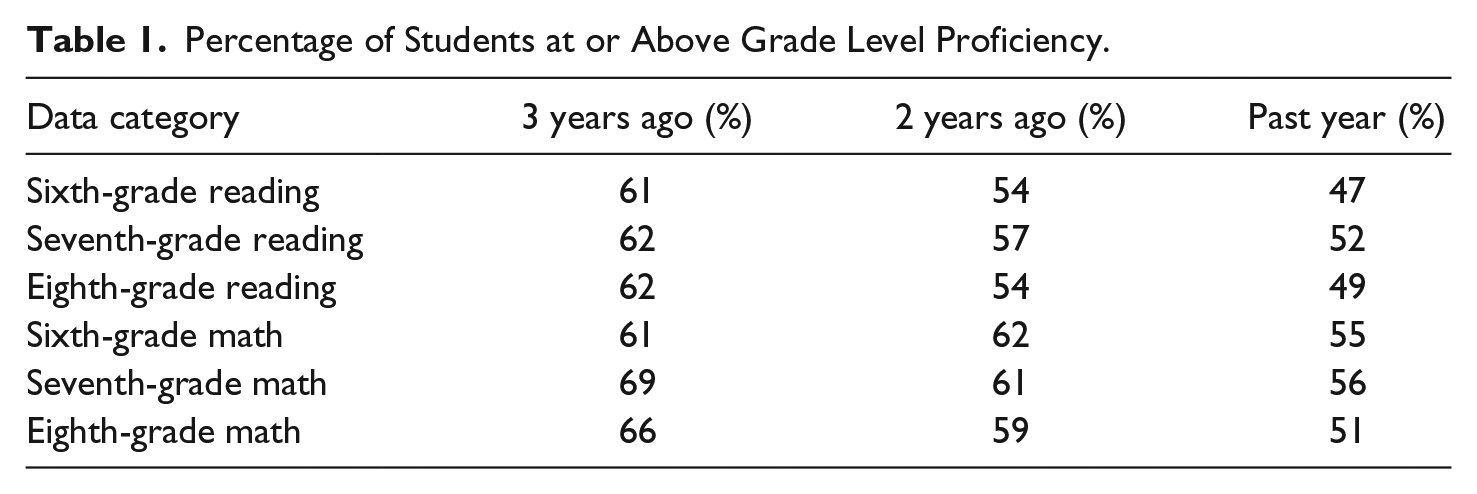
You have access to some of the Sparrow’s key aggregate student performance data regarding yearly end-of-grade testing. First, you can consider the school’s grade level performance over the past 3 years, including the most recent school year that just finished (See Table 1). Also available to you is the percentage of students who passed both math and reading tests in the past year, disaggregated by particular student groups (See Table 2).
Percentage of Students at or Above Grade Level Proficiency.
Percentage of Students Who Passed Both Tests, by Student Group, Past Year.
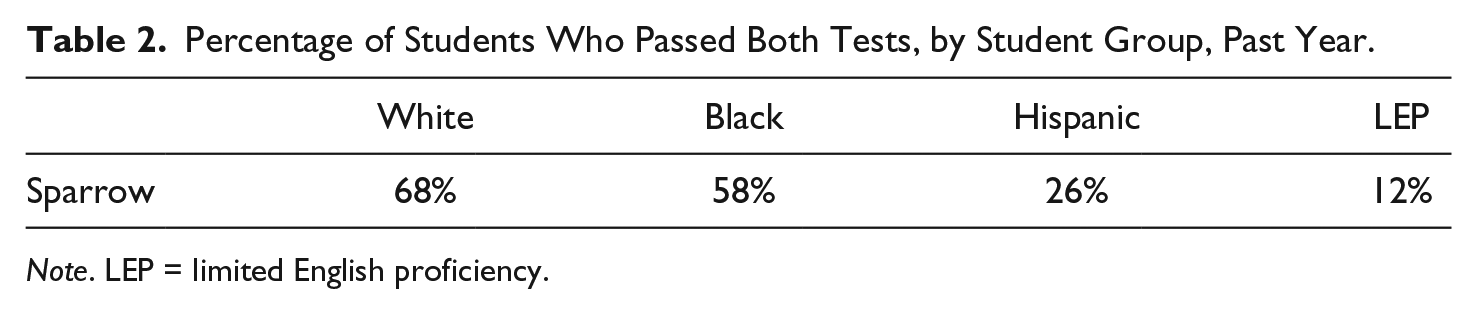
Note. LEP = limited English proficiency.
During your school level interview, several stakeholders expressed concern about attendance problems at the school. They noted specifically that they routinely saw students out on F Street during school hours, hanging out in front of the corner market across the street. You have attendance data for the school from the past 3 years including the most recent (See Table 3).
Average Daily Attendance.

In addition, district officials now view Sparrow Middle School as real cause for concern due to student safety. The number of reported Serious Incidents (violence, robberies, and other police-involved issues) has increased from seven 5 years ago to 26 in the school year that just ended. At the same time, the suspension rate decreased from 341, 5 years ago, to 56 in the year that just ended.
Schedule, Curriculum, and Alumni
As implemented and operational for the past 15 years, the Sparrow Middle School Master Schedule allows the school to offer five classes for 50 minutes every day, along with a 20-minute homeroom, 50-minute period for lunch and recess, and 5 minutes for passing between classes. In terms of classes, students take language arts, math, science, and either art, music, or dance every day. Social studies is offered 2 to 3 times a week, alternating with physical education.
Unique to the school and as a long-standing tradition, a thriving arts program allows students to take classes in art, dance, or music 5 times a week, for 50 minutes a period. The walls of the facility are adorned with student artwork. Student-composed music is played instead of electronic bells to mark the end of periods. Each month, a committee of teachers chooses the school’s monthly poet laureate, who is a student who has shown promise in rhyme, verse, spoken word, rap, or other poetic forms. The student presents his or her work at an assembly held each month, and each year the school publishes a collection of its poet laureates’ works. Importantly, “Sparrow Spring” is a student art and music festival held every May, usually at the same time as state-mandated end-of-grade testing. It is the most heralded event in the community. Sparrow Spring has occurred for 33 years now, and it garners significant media attention for the school, the district, and the community. The most influential figure in the community, a world famous musician, always mentions Sparrow Spring fondly in interviews and calls it “the very best thing about living in this community.”
Several other Sparrow alumni have gone on in their adult lives to garner national and international attention for their music and artwork, though none are connected to the school in any way. Also, several community leaders are parents of students who attend the school. The local City Council member, Mr. Edwards, for instance, is an African American businessman whose son attends seventh grade. He is very concerned about the school and its present situation. This past year, he made weekly visits to the school and dropped in on classes throughout the building, sometimes asking teachers if he could teach the lesson for them to show them a different approach that he claimed would be more effective in reaching the students. You have learned that some parents have complained about Mr. Edwards and his drop-in teaching while a few other parents have requested that they too be allowed to model classes for the teachers.
Budget and Personnel
At tonight’s school board meeting, the district office informed all schools that funding will be cut due to state financial shortfalls. Sparrow specifically will lose US$42,674.45 in a special local discretionary allocation for the coming school year. In the past, this money had been used to hire tutors to help with the after-school tutoring program. Most of the teachers at the school worked in the after-school program and depended on these funds each year to supplement their teaching salary. There is no documentation available as to whether the tutoring program has helped improve student performance on the state tests. One way to address the funding loss and retain the tutoring program, as you understand it, is to forgo replacing one of the teachers who is leaving and increase class sizes.
In terms of school staff, during the most recent school year, 14 teachers had 7 or more years of experience and 26 teachers had 3 or fewer years of experience. Six teachers fall somewhere in between these poles of experience. Roughly, 75% of the teachers are White, and roughly 25% are African American. There are no full-time teachers with a Hispanic/Latino background. Two of the 46 teachers speak some Spanish, and none of the other staff members in the school speak Spanish. In crisis situations, eighth-grade students who speak Spanish as a home language or one of the custodians who is Latino are brought in to help translate for non-English speaking parents.
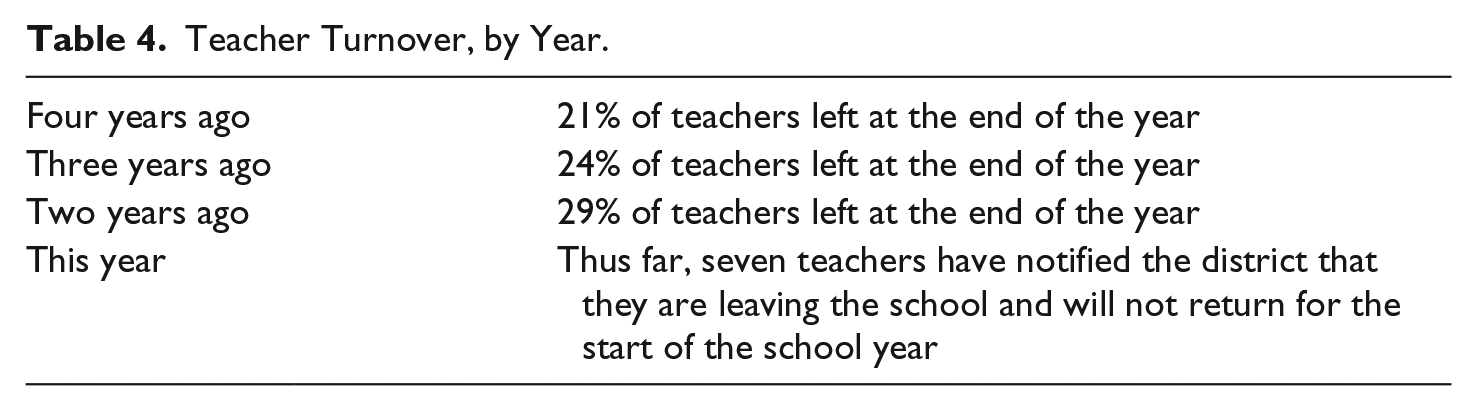
Table 4 represents teacher turnover from year-to-year.
Teacher Turnover, by Year.
Sparrow has had five principals in the past 3 years. The most recent was Mr. Reynolds, a White, first-time, first-year principal who started his tenure a year ago in July. The rumor you heard about Mr. Reynolds was that he left work after school several weeks ago, stressed out by numerous issues, and that he never returned. You asked around before you accepted the position and discovered that, in reality, Mr. Reynolds had accepted a principal’s job in a neighboring district that offered significantly higher pay. Dr. Johnson confirmed this version of events. A picture of the school’s founding principal is the only formal portrait to decorate the main hallway. He stayed for 30 years after the founding, and retired 30 years ago.
Six School Personnel Whom You Already Know Professionally and/or Personally
Ms. Apple is an African American math teacher, and a 5-year veteran at the school and 10 years in education. She is from the community and understands its concerns. She is excited about the prospect of change. You have known and admired Ms. Apple professionally since she entered the teaching profession.
Mr. Billups is a White English teacher, and a 28-year veteran at the school. He does not like change, he does not like administrators, and he does not like all these new students from different backgrounds. He speaks some Spanish.
Mr. Cubby is a White Music teacher, in his second year at the school. He is eager to do anything he can to help to make Sparrow a great place! You remember that you and your principal tried to hire Mr. Cubby at your previous school.
Ms. Duncan is an African American social studies teacher with a technology background. She is in her seventh year at Sparrow. She wants the students to do well—she knows they can. She secured a significant grant for technology that afforded the purchase of two technology carts. A close, trusted friend tells you that Ms. Duncan is a great educator and person.
Mrs. Eloise is the assistant principal. She is African American and has spent 14 years at the school. She appears to be friendly with Mrs. Feakins and Mr. Billups. She has seen principals come and she has seen them go. She is frequently absent on Fridays.
Mrs. Feakins is the school’s longtime front-office administrative assistant, though she prefers to be called “head secretary.” She is White and has spent 21 years at the school. Her favorite phrase (said only to her closest friends but communicated to you by a confidante) is “Sparrow is my school.”
Final Thoughts
As you reviewed the data, you also began jotting down notes in answer to the set of five questions that you will discuss with Assistant Superintendent Johnson tomorrow. Preparing for bed, you feel like you have a fairly firm sense of how to address each query. You will solidify your ideas in the morning in the time before the meeting starts. As you try to drift off to sleep, though, a nagging, thorny question pushes back against the inviting softness of incipient slumber: But where do I start?
Teaching Notes
Developed specifically for use in principal preparation programs, this case places readers directly into the role of a new principal considering a complex array of information regarding the school he or she is tasked with leading to improvement. It is meant, in other words, to simulate what Spillane and Lee (2014) describe as the “ultimate responsibility shock” that new principals feel (p. 442). Based on the data, the school is clearly in need of intervention. However, the closing thought in the case—But where do I start?—is apt. The school’s academic results are clearly unacceptable and disciplinary issues are on the rise. Yet, difficult choices abound, positive options stand alongside negative alternatives, and it appears there are messy personnel matters that will complicate any course of action taken. Moreover, stakeholders inside and outside of the school appear to have exerted some form of political power and influence. If past is indeed prologue, one can imagine that it is likely these stakeholders will wish to maintain and exert such political power and influence in the future. The case represents, in essence, a fair approximation of how modern-day principals must, from the outset of their tenures, confront a fractious, complicated professional terrain far different from the long ago past (Rousmaniere, 2013).
In our experiences utilizing this case in principal preparation classes for the past 5 years, we found that students wrestle with which of the many problems that confront Sparrow Middle School is most important. In addition to issue prioritization, students also must consider how to approach a diverse number of challenges that span key principal leadership domains, including political, instructional, and managerial (Cuban, 1988). Indeed, there are so many managerial problems and political complications to consider that readers may neglect to establish a clear focus on addressing some of the school’s glaring instructional needs (Hallinger & Murphy, 2013). Yet, existing research literature asserts that successful principals perform as instructional leaders who set directions and provide guidance toward academic improvement (Seashore Louis, Dretzke, & Wahlstrom, 2010). At the same time, readers should remember that studies have found that principals who were considered expert organizational managers headed schools that produced the most pronounced academic gains (Grissom & Loeb, 2011). In sum, this case, much like contemporary scholarship, offers no set of “right” answers but rather a rich set of contradictions, much like the principalship itself.
Below we offer three activities to help accentuate the learning value of the case.
Activity 1—Where Do I Start?
Students write a three-page memorandum that addresses each of the questions that Assistant Superintendent Johnson wishes the principal to answer:
What are three main areas of strength and three main issues of concern at Sparrow Middle School?
What are three action steps that you plan to take from now through the first day with students August 26?
What are three goals that you are considering establishing for your first year at the school?
What do you want to know more about? Why? How do you plan to find out that information?
What is one formal, reasonable, and immediate request you would like to make to her?
Students should bring their memorandum to class, or they can share it with classmates electronically. Once in class or in an online collaborative space, students can work in small groups discussing their memoranda together. These small group discussions will help students recognize how their particular diagnoses and strategies may be similar or different from their classmates’, may provide them additional ideas to consider, and can surface vexing issues that none of them feel they can master easily. The small groups’ ideas can be captured on chart paper or via electronic notes, and shared with the full group. A full group discussion can follow the small group activity. Instructors have the option of grading the memoranda as a course assignment, but preferably after the group discussion, so that students can make informed revisions to their manuscripts before submission to the instructor.
A final pedagogical option for instructors to consider is to use the case study twice in a structured principal preparation program, once at the program’s outset and once near its conclusion. This is the approach we used successfully in our yearlong, federal-grant-funded initiative to train aspiring leaders of high-need, low-performing schools. When a new cohort started its monthlong summer regimen of daily classes, we provided the case within the second week as means to expose students to the vast array of issues that would confront them as principals of high-need schools. Later in the following spring, as students concluded their coursework and completed their full-time administrative internship, we distributed the case again to students and asked them to offer responses to Dr. Johnson’s questions. We then provided them with the responses they wrote during the previous summer so they could consider how and why their responses may have changed or stayed the same. Based on the authors’ experiences serving as principals of Title I schools, such early exposure to and, subsequently, more informed consideration of a global representation of a school’s various realities and needs is the closest text-based approximation we could devise to represent the type of “ultimate responsibility shock” principals of low-performing schools feel as they enter the position (Spillane & Lee, 2014).
Whichever pedagogical approaches instructors utilize, they should assert early and often that there are few easy solutions in such a complex situation; students should feel frustrated by the difficult choices they must make. Instructors should also encourage students to understand the activity as a chance to consider how other pre-service school leaders, when presented with similar information, may take dramatically different forms of action. In essence, encourage students to have open minds to considering alternative approaches to common problems. Finally, instructors should ensure that students consider deeply the possible consequences of any actions they plan to take. In the full group discussion especially, the instructor can take a Socratic approach and ask probing questions intended to unsettle and problematize any easy solutions that students might propose. John Kenneth Galbraith suggested, “Politics is the art of choosing between the disastrous and merely unpalatable.” Similarly here, students must ensure that any of their proposed solutions produce manageable attendant problems, rather than exacerbating matters by making things worse.
Instructors can enhance the activity described above by asking students specifically to consider how their race, ethnicity, gender, sexual orientation, and other personal characteristics may have influenced their approaches to the assignment. For instance, Gooden and O’Doherty (2015) provide a useful way for pre-service school leaders to develop a deeper understanding of their own racial identities. If assigned in the same class as the Sparrow study, Gooden and O’Doherty (2015) can help students critically consider how race and racial identity may inform their approaches to the dilemmas central to Sparrow. Other research regarding culturally relevant pedagogy and leadership (e.g., Milner, 2015; Mullen & Robertson, 2014; Terrell & Lindsey, 2009) can be assigned as means to expand student understanding.
Activity 2—How Will I Address Specific Issues? 1
This is a targeted follow-up activity that can help enrich lessons students gleaned from Activity 1. In essence, students shift here from asking themselves, “Where do I start?” to, “How will I address specific issues?” Students must choose from options presented by the assistant superintendent in a scenario that occurs subsequent to the main case described previously. Dr. Johnson compels the principal to make difficult choices between distinct alternatives in a manner that simulates the crucible of administrative decision-making. The scenario proceeds like this:
At your meeting with Assistant Superintendent Johnson, she thanks you for answering her questions in preparation for the meeting. Doing so helped her better understand your beliefs and intended approach. She then provides more insight regarding the school’s needs based on input she has received from faculty, students, and the community. In her opinion, some of the main issues at Sparrow are improving the performance of the increasing English language learner (ELL) population, addressing the rise in student disciplinary incidents, determining the proper role of arts and enrichment in relation to the academic program, and curtailing the high teacher turnover that occurs even as several long serving personnel persist and engage in negative employee behaviors. She explains that she will present you some definitive options regarding these issues. Each choice involves significant dilemmas that you, as principal, will need to consider as you make your decisions.
Dr. Johnson will provide you with sufficient funding to either (a) hire a full-time LEP teacher or (b) provide yearlong, dedicated professional development and on-site coaching in ELL strategies for the school’s full faculty.
In her quest to improve the school, Dr. Johnson has discovered a local grant provider who has agreed to fund two of the following four actions over the next 3 years: (a) hire a bilingual school social worker; (b) provide two classroom carts of Internet-connected tablet computers; (c) hire an additional staff member who is an experienced, respected teacher in the district and will serve as a support coach for beginning teachers; and/or (d) hire an additional staff member who will serve solely in the role of dean of students and oversee school discipline.
Sparrow Spring presents you with a particularly challenging conundrum, a fact that Dr. Johnson readily acknowledges. On one hand, the annual arts festival is a tradition cherished by the community. On the other hand, it occurs in the midst of the state’s annual testing window and may, therefore, inhibit student academic performance as demonstrated through mandated assessments. Dr. Johnson describes two distinct alternatives from which you can choose: (a) leave Sparrow Spring as it is on the calendar and develop alternative support structures and scheduling mechanisms to ensure the timing of the festival does not adversely affect students’ performance on the year-end examinations or (b) move Sparrow Spring to the fall with the involvement, consent, and approval of the vast majority of the school’s community and alumni. She would also like you to examine the school’s daily schedule to determine if there are ways to increase the academic focus while maintaining the school’s unique focus on the arts.
Assistant Superintendent Johnson will agree to facilitate the transfer of one non-teaching staff member. Such employees, under the district’s personnel contracts, do not retain placement rights. Assistant Superintendent Johnson suggests either assistant principal Ms. Eloise or administrative assistant Ms. Feakins as transfer candidates. You would need to replace Ms. Feakins if she departs so that you have help maintaining operations in the main office; therefore, any cost savings to your budget would be minimal. Under the district’s administrators’ personnel contract, you cannot replace the assistant principal for 1 year if she is transferred to another school. Therefore, your budget for next year would include full, flexible use of Ms. Eloise’s salary and benefit funds, which are in slight excess of US$70,000.
As your meeting concludes, Dr. Johnson explains that it is her expectation that you will return in a week to discuss your initial thoughts on each of the options she has provided for you. She emphasizes that she will work with you and support you in making decisions that will help provide the best possible paths toward improvement at Sparrow.
After students share, analyze, and discuss their responses to the Activity 1 prompts, the instructor can use additional time during the class or the next one to have students engage in Activity 2. One approach would be to distribute the Activity 2 scenario to students in class and have them read it and formulate responses to it individually. Students can then assemble in small groups to share their responses before engaging in a full class discussion moderated by the instructor. As an alternative approach, the instructor can assign Activity 2 as a written assignment after students have completed the Activity 1 discussion in class.
Activity 3—From the Practitioner’s View
To extend learning opportunities beyond the immediate classroom, university instructors can encourage students to share the Sparrow case study with a school administrator, preferably a principal who serves as a mentor to the student at his or her school placement site. The principal can read the case and have a follow-up conversation with the student to describe how he or she would approach the various dilemmas. During the conversation, the student can listen, take notes, and ask questions. Ideally, the student will feel comfortable enough with the principal mentor to pose tough, honest questions about why the principal chose to take particular actions. Subsequently, the university instructor can ensure that, in class, students have a chance to share what their individual mentor principals discussed. These discussions will offer an additional opportunity to expand student exposure to alternative approaches to addressing issues at Sparrow.
Activity 4—Engage With Existing Research
Turnaround has expanded as a school reform movement in recent years, represented most prominently through the Obama administration’s US$3.5 billion School Improvement Grant (SIG) “Turnaround” grant program initiated in 2009 (Peck & Reitzug, 2014; U.S. Department of Education [U.S. DOE], 2009). As the focus on improving low-performing schools has increased, various authors have described key characteristics of successful leaders in such challenging contexts (Chenoweth & Theokas, 2011; Duke, 2015; Fullan, 2006; Leithwood, Harris, & Strauss, 2010; Papa & English, 2011). Moreover, research has demonstrated how specific principal behaviors and actions fostered increased aggregate student test score performance (Seashore Louis et al., 2010; U.S. DOE, 2008). Other studies have profiled how individual principals have successfully generated student academic success by involving parents and the local community (Khalifa, 2012); leading instruction (Terosky, 2014); developing school culture (Eilers & Camacho, 2007); and using an internal sense of accountability as a primary motivator (Mintrop, 2012). Principals, of course, cannot immediately solve every problem within a school. Therefore, diagnosing issues of concern and considering remediation approaches is an important first step in a principal’s efforts toward school improvement (Duke, 2008). Principals seeking rapid yet sustainable school improvement must implement potent short-term changes as well as develop and execute effective long-term strategies (Duke, 2015).
The leadership behaviors and approaches identified above coalesce in individuals who have come to personify the term “turnaround principals,” which represents those school leaders who combine effective instructional leadership skills and outreach to community with a fearless, deep-seated sense of urgency to improve schools in dire academic need (Duke, 2015). Importantly, turnaround principals are best considered a rare breed (Duke, 2004). Indeed, leading schools most in need presents principals with significant role-based challenges that can lead to significant stress and potential burnout (Spillane & Lee, 2014). In addition, scholars have cautioned against the idea that principals can serve as “superheroes” who single-handedly lead school improvement (Peck, Reitzug, & West, 2013; Copland, 2001). Principals of low-performing schools in particular must also confront a paradox latent in policies and prescriptive literature attendant to turnaround: They must simultaneously distribute leadership to others in the school yet accept ultimate responsibility for a school’s academic performance (Peck & Reitzug, 2014). Nonetheless, there have been, are, and will be principals who, no matter the challenges, ensure their school is “getting it done” in terms of increasing student achievement (Chenoweth & Theokas, 2013). The phrase “never-give-up principal,” from Duke (2015, p. 3), perhaps best sums up what it takes to lead school turnaround successfully.
Reflective of the established research literature, this case offers students an opportunity to consider possible first steps forward as a newly appointed principal of a low-performing school with various complex issues and problems. Instructors can assign the scholarship discussed here as well as other related texts to students in order that they may consider what leadership practices lead to successful turnaround. Students can discuss the substance of the texts, as well as how particular authors might suggest that the new principal approach issues at Sparrow.
Footnotes
Declaration of Conflicting Interests
The author(s) declared no potential conflicts of interest with respect to the research, authorship, and/or publication of this article.
Funding
The author(s) received no financial support for the research, authorship, and/or publication of this article.