






Abstract
A recent surge of research universities and human subjects research funding in the Arab world raises concerns about applied research ethics and oversight. In-depth interviews conducted with 52 researchers in Lebanon and Qatar about their research conduct and the problems they face while conducting it indicate that although researchers admit to the added value of institutional review board (IRB) functions, the researchers have several complaints, such as rigid and contextually insensitive requirements, delays, and inadequate resources at IRBs, and a lack of outreach and effective communication with researchers. The study discusses these challenges pointing to the need for socioculturally adaptive regulations and forms and strengthening outreach and communication between IRBs and their users to improve ethical practices. Implications for future research are also presented.
Keywords
Despite the well-intended role of reviewing and regulating research conduct to protect participants, institutional review boards (IRBs) and their processes have increasingly become subject to critique and controversy. Much of the studies documenting the shortcomings of IRB functions from the perspectives of researchers (Abbott & Grady, 2011; Burman et al., 2003; Fost & Levine, 2007; Gunsalus et al., 2006; Rubin & Sieber, 2006) have used quantitative survey data collected in the West. Very few studies have used qualitative interviews with academic researchers particularly focusing on Arab countries where research and necessity for ethical practice in research are currently emerging. A review of empirical research exploring researchers’ views on IRBs indicates disenchanting reports from the biomedical research fields (Deslauriers et al., 2010; Guillemin, Gillam, Rosenthal, & Bolitho, 2012; Wisner et al., 2011), as well as the social–behavioral disciplines, especially from researchers using ethnographic or qualitative methods (Ashcraft & Krause, 2007; Hemmings, 2006; Oakes, 2002). Examples of recurring challenges include time delays (Arslanian-Engoren & Moser, 2013; Guillemin et al., 2012; Hemmings, 2006; Wisner et al., 2011), ambiguity in requirements (Gunsalus et al., 2007; Mamotte & Wassenaar, 2009), and a lack of requirements that are applicable to non-Western settings such as Africa, South America, and Eastern Europe (Camp et al., 2009; Chilisa, 2009; Oguz, 2003). Some studies mention suggestions to improve IRB oversight processes (Gunsalus et al., 2007; Hemmings, 2006; Lincoln & Tierney, 2004; Rubin & Sieber, 2006) and the need to adapt what is perceived as rigid regulatory practices (Gunsalus et al., 2007; Hemmings, 2006). There is also a large body of literature on ethical review difficulties mainly in Asia and Africa. These difficulties present themselves as absence of research ethics committees (RECs) in India (Nair & Martin, 2004), for instance; absence of ethics review of research in some countries in Asia, Africa, or Latin America (Hyder et al., 2004); reported bias in REC decisions in Uganda (Ibingira & Ochieng, 2010); and problems with ethics review in South Africa, such as slow or inadequate reviews or researchers’ lack of knowledge about these reviews (Mamotte & Wassenaar, 2009). However, an analysis of the underlying reasons or root causes from an epistemological perspective, which looks at the process of knowledge production, and from a context specific perspective is absent from this literature. Further discussion in this direction allows a clearer understanding of these problems and, consequently, facilitates better solutions.
Although RECs were established in some countries of the Arab world (Abou-Zeid, Afzal, & Silverman, 2009; Sleem, El-Kamary, & Silverman, 2010), the adequacy of the ethical review remains uncertain (Abdul Rab, Afzal, Abou-Zeid, & Silverman, 2008; Kandeel et al., 2011; Sleem et al., 2010). With the rise of academic and research institutes in different parts of the Arab World, including Lebanon and Qatar, the implications for oversight of research conduct for human subjects protection are many. Although the Qatar National Research Fund (QNRF) is the main funding agency for most of the research carried out by universities in Qatar (Carnegie Mellon University in Qatar, 2014), limited funding opportunities are provided by a national body, the Lebanese National Council for Scientific Research in Lebanon (LNCSR; American University of Beirut, 2014).
This study aims to present findings on IRB oversight functions through the viewpoints of academic researchers who conduct biomedical and social–behavioral research with human beings in public and private universities in Qatar and Lebanon. A discussion of these findings, including the underlying reasons for the recurring challenges and implications for practice, will assist universities and funding agencies in the region to enhance capacity building and develop ways to conduct and regulate responsible culturally appropriate research. This, in turn, will contribute to the intellectual discussion on ethical conduct and may also be useful for other countries in the Arab region.
Method
The research study protocol was reviewed and approved by the IRBs of the collaborating research institutes, the American University of Beirut and Qatar University. Flyers summarizing the study as well as general informational meetings were used to recruit participants in universities which conduct Human Subjects Research (HSR) and which invited us to their campuses. These informational meetings were open to all researchers in these universities. We used in-depth interviews which explored the perspectives of 52 academic researchers conducting research in Qatar and Lebanon about the challenges they face while doing their research in general and applying research ethics in specific, 29 in Lebanon and 23 in Qatar (Table 1). In-depth interviews aid in understanding how people make sense of and dwell on their experiences and challenges on a range of topics faced daily (DiCicco-Bloom & Crabtree, 2006; Marvasti, 2010) from an insider’s view within the social context of the participants (Kellehear, 1993). Appropriate consent forms in Arabic and English were signed before commencing with the interviews with our participants. The anonymity of participants was protected through de-identifying the transcribed interviews and thus no identifying details could be traced when verbatim quotes were used. (The source of quotes in the results section are indicated by the discipline of the participant and the country where the interview was conducted.) The interviews were guided by open-ended questions inquiring about common practices, clearance procedures, challenges, capacity for research, and suggestions to improve research conduct. Although the interview guide did not originally include a specific question related to their experience with IRBs, we found that the first few participants referred to IRBs as a source of concern to them. So we probed for this information where needed. We did not go back for the approval of IRB because the question added to the interview guide was a probe and the original interview guide was not changed.
Disciplines and Research Areas of Participants per Country.
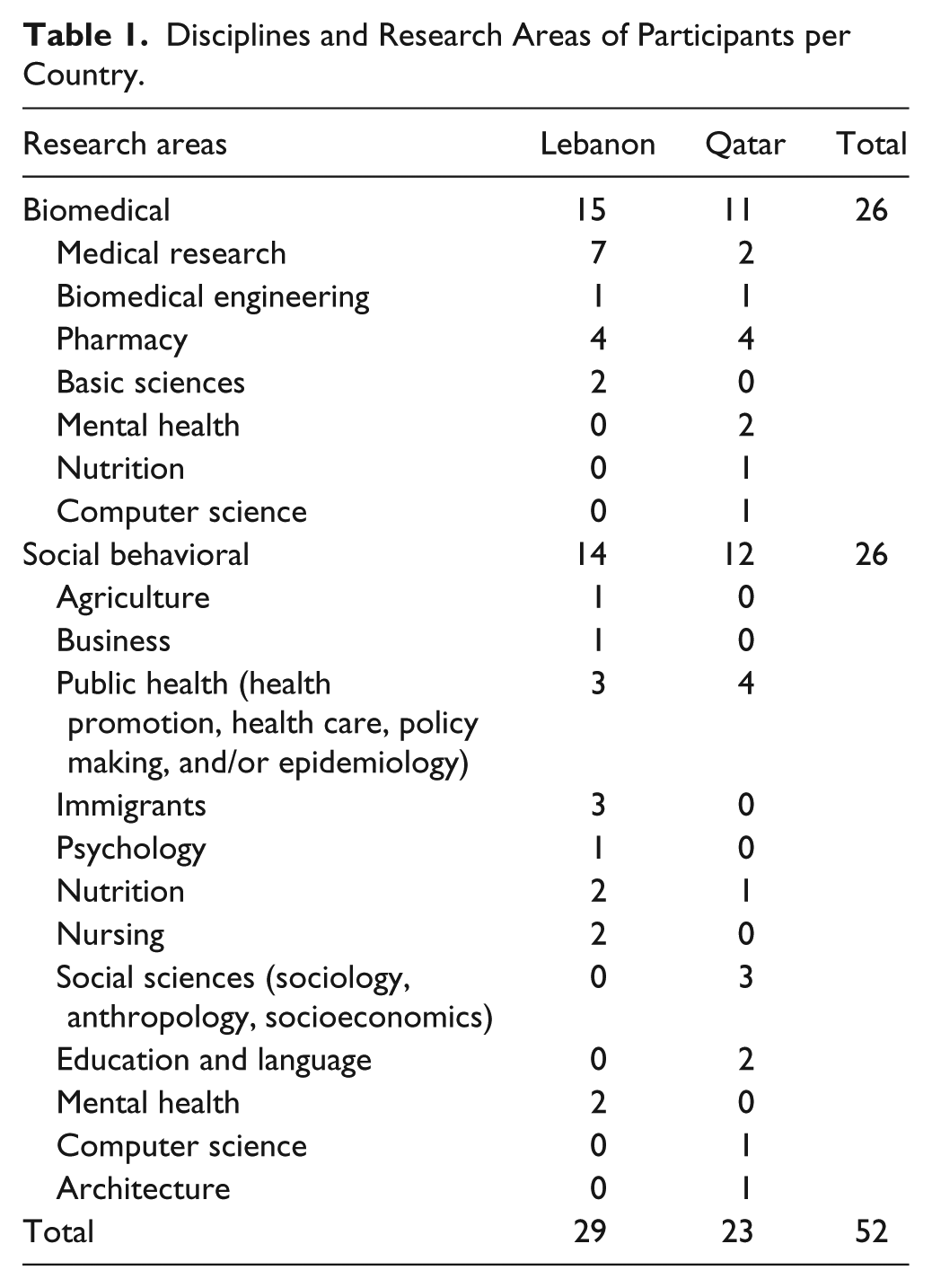
The research teams in Lebanon and Qatar, qualified and trained in qualitative research methods, conducted the in-depth interviews in colloquial Arabic and/or English depending on the preference of the participants. The recorded interviews were transcribed verbatim, and checked against the recordings. The research team coded the transcripts in pairs, then with a third member of the research team reviewed the codes in both countries. Each data set was then transformed onto a separate matrix and regular meetings were set to read through and pick up recurring themes and patterns.
Results
The academic researchers, who voluntarily participated in the study, conduct research with human subjects in social–behavioral and/or biomedical fields. Department of Health and Human Services regulations under Code of Federal Regulations 45CFR46.102 (U.S. Department of Health and Human Services, 2009) define a human subject as a living individual about whom an investigator conducting research obtains data through intervention or interaction with the individual or identifiable private information. (In Qatar, the Supreme Council for Health uses this code in its policies, regulations, and guidelines for research involving human subjects.) For the purpose of this study, academic researchers who involve individuals, groups, and communities in their research were included. We explained HSR in Arabic and English lay terms in the recruitment process. (We found that the vast majority of researchers misunderstood what HSR means, and so, where we used HSR, it was followed by an explanation of what we meant by it.) This allowed us to recruit social–behavioral and biomedical researchers (Table 1). Thirteen out of the 52 participants came from some of the universities in Lebanon that do not have IRBs. Although they do not submit to ethics review boards there, they do so when they are involved in collaborative research involving researchers from other universities.
The findings from the in-depth interviews indicated that the most recurring challenges reported have to do with IRBs, their operations, review processes, requirements, and implications on research. At the time of the study, our investigation showed that out of the 26 universities involved in human subjects research in Lebanon, only 5 had IRBs, whereas in Qatar, the Qatari national and 9 North American and British satellite universities that conduct human subjects research had IRBs. All of the participants in Qatar come from universities that conduct collaborative research with Western universities whether inside or outside Qatar. Seven participants come from Qatar University, a public university in Qatar (has an IRB). All other participant universities are branch campuses of Western universities (all have IRBs, out of which four have local IRBs). In Lebanon, five universities have IRBs, and all five have connections to Western universities. With this background, we will now present what the researchers themselves have to say about the challenges they face (Table 2).
Challenges for Researchers.
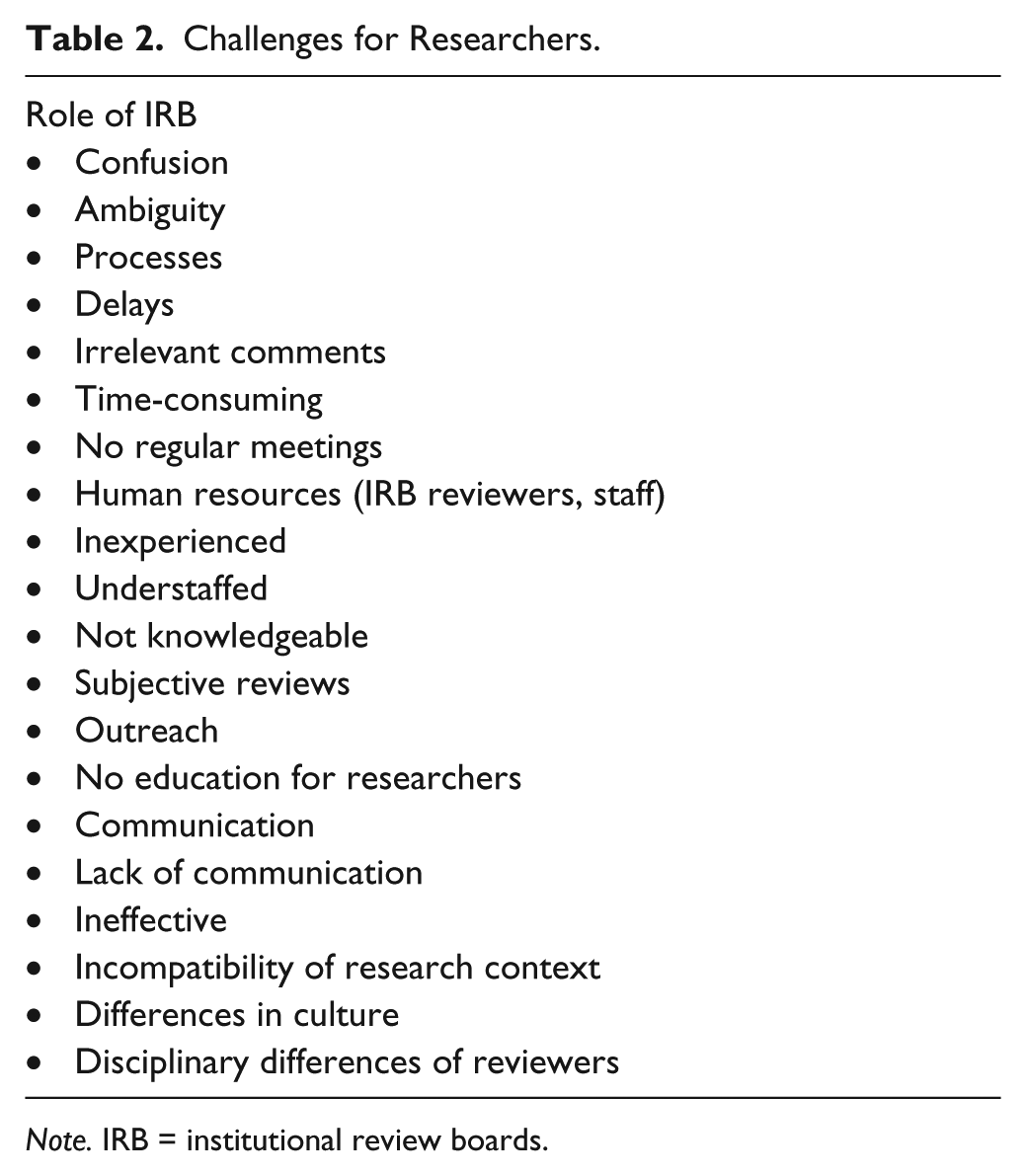
Note. IRB = institutional review boards.
Variations in the Process of Research Approval
The research approval process reported by the researchers in Lebanon varies according to whether IRBs exist at their universities. For researchers (13 participants) at universities where there were no IRBs/RECs at the time of the study, approval follows the hierarchical procedures at each university, whereby the department chairpersons, deans, and/or presidents contribute to the approval process of locally funded research. For researchers at universities with IRBs (16 participants), approval is always sought from IRBs. The IRBs are described by the participants to review the scientific or methodological merit of research protocols while ensuring the protection of human subjects. This review was described by six participants as a “mechanical” process, meaning it is a technical process that looks at all proposals in the same way regardless of their research methodology. In contrast, some participants in Qatar describe their studies as “IRB projects” and the IRB application processes as similar across all universities, something they came to know from their experiences with multi-site collaborative research projects, with some variation related to the level of details required by each institution. Research and ethics regulations are relatively new and are spreading in Qatar, supported by annual training in research ethics carried out by the Supreme Council of Health. Hamad Medical Corporation (HMC), where most clinical research is conducted, has an IRB to oversee ethical practices in its facilities:
. . . you know when you get a notification . . . that your project is awarded you have two months to submit the ethics approval document, so right away you start with your ethics application, you know the first and foremost step before you can do anything! Right? So not only us as researchers who know that but in these institutions, the instructors and students know that as well that you have to have ethics approval before you can do anything! (Public health researcher, Qatar)
Advantages of IRB Reviews
Fifteen participants in Qatar and four in Lebanon reported several advantages to IRB oversight. These advantages include human subjects protection from harm, and the benefits that IRB reviews and approval have for their research, such as improving possibilities of publishing, and enhancing the credibility of a study. The relatively small number of positive views of IRBs were held mostly by participants in Qatar, who came from both Western and national universities and who described IRB as “cooperative,” “fast in responses,” available for “counseling, monitoring, and training,” and “setting best practices and standards.” Examples of respondents’ narratives are as follows:
They fast tracked it and I got the approval very quickly, so I couldn’t have asked for a better reception. (Linguistics researcher, Qatar) IRB [approval] helped us a lot, when you talk to any stakeholder organization or a person you want to, and you say ok this is IRB [approval] . . . you provide much more confidence with this whole work. (Health management researcher, Lebanon) Sometimes, when you want to publish, they ask if you have IRB approval. (Epidemiologist, Lebanon)
Discontent With IRB Processes, Reviewers, and Reviews
Despite these reported advantages, there were more complaints about IRBs. Participants in Lebanon spoke about the implications of IRB reviews on their research. The terms the participants used to describe IRBs include “police,” “punishing,” “radar,” “adds burden,” and “overdoing their job”; their regulations as “inconsistent”; their processes as “mechanical,” “rigid,” “bureaucratic,” and in cases of non-compliance the implications can be “degrading” and “harmful”:
The attitude with which it’s done and the approach is very important and when they are acting like a police that can stop you and can hurt you, it’s not nice. [But] when it’s a collaborative constructive process, it can be very good. (Medical doctor, Lebanon) [On non-compliance] The researcher feels insulted, feels that his integrity or her integrity are at stake, feel that the credibility is at stake. This is not something to be taken lightly. These things have ramifications . . . the person who is overseeing the IRB in our institution is the provost . . . the provost at one time has to basically also look at the academic profile and the promotion file of that individual and in the back of his head you would say “this person has problems with ethics.” What would that do? (Nutrition researcher, Lebanon)
Inefficient Processes and Rigid Requirements
The most recurrent challenge reported by the participants in Qatar is delays (12) in IRB responses, which would sometimes result in project delays. These delays were reported to be experienced only when applying to IRBs of public institutions:
Any one week delay pushes everything out of proportion and it becomes . . . difficult. (Economics researcher, Qatar)
Similarly, 13 of the 29 participants from Lebanon reported that IRBs slow down the research process for them because of time-consuming reviews. Terms used include “hindering,” “delaying,” and “limiting,” in addition to adversely affecting the participants consenting to participate with inappropriate forms and requirements, and research quality especially for projects involving students. Two researchers explained that IRB requirements do not give a chance for university students involved in research to learn proper research skills because of their rigid demands and requirements of the methodology. According to them, the delays of the IRB are mainly due to inexperienced reviewers who are volunteers. Participants in Qatar complained about multiple submissions to the IRBs of collaborating universities and institutions, which require extensive documentation and duplication and complying with the different IRB requirements across countries and institutions. One participant stated,
I think one of the challenges here is that we have to submit, like for . . . especially for me, I have to submit for you know . . . Hamad Medical Corporation, Qatar University, Weill Cornell, umm . . . So as you can see, it is a lot of work . . . you still have to go through all that duplication process to submit to each institution. (Public health researcher, Qatar)
Ambiguity and Confusion
Ambiguity of IRB processes, roles, requirements, or guidelines were brought up by four participants in Lebanon and nine in Qatar. Some of the participants reported that they did not know IRB members or IRB contact information, which they could use to follow up on their applications. Others reported being unclear about the reasons for IRB required changes to their research protocol. Other levels of confusion regarding the IRB review process pertained to certain regulations for new researchers in Qatar:
I don’t even know there is an IRB in the University.
there is, actually.
there is?! (Computer science researcher, Qatar)
There are [requirements] that the IRB office rightfully requests . . . There are others which are weird and others that are acceptable. (Human resources researcher, Lebanon)
They ask these kinds of questions and why do they need to have this many progress reports? . . . I don’t get it frankly. It’s weird. I don’t know. (Infectious diseases researcher, Lebanon)
Inadequate Human Resources at IRB
Problems with human resources at IRB, such as reviewers and/or staff, were among the challenges highlighted by participants in both sites. Common complaints pertained to understaffing and lack of experience and knowledge of their research methods. Two of the participants reported the following:
Maybe the office is understaffed; maybe the people in the [IRB] office do not have enough experience. (Human resources researcher, Lebanon) . . . maybe if another team submits this to another research council they might approve it. (Biomedical engineering researcher, Lebanon)
Lack of Sensitivity to the Context
Certain concepts such as autonomy and consent signature were described to be imported from the West and, therefore, not applicable in their cultures.
I think our comprehension, autonomy, decision-making and research are very different from the West so when we come and bring these principles and apply them here they don’t make sense. I think we need to adapt them to make more sense and to be more contextual. (Medical doctor, Lebanon) So really, it’s unfair to conduct a study using western criteria or using the Common Rule regulations and trying to say I want to study my society using these western criteria and if they don’t fit . . . I say there is a problem. This approach I think is totally wrong. (Sociologist, Lebanon) The people reviewing the IRB proposals were looking at those proposals as if they are biomedical type of research, not what we do, health system policies. So when you look at it from that perspective, the comment that you can give sometimes doesn’t apply to a proposal. (Health Management, Lebanon)
Discontent with the required forms was voiced by social–behavioral as well as non-biomedical researchers in Lebanon. Consent forms were reported by nine participants to be complex, demanding, and inappropriate for the local context, which was recurrently described as “not a research culture,” where people are not interested in research and are afraid of signing forms:
Consenting for research is a new concept, consenting for anything is a new concept. People have the right to participate or not participate [in the research] . . . we don’t want to shove it down their throats, we want to do it in a way that is sensitive to how we do things and the way we communicate in our culture. (Medical doctor, Lebanon)
Concerns of the Social Scientists
The concern about using biomedical research standards to review social–behavioral research was highlighted by five participants in Lebanon. The same complaint of irrelevance of the biomedical model for all IRB oversight processes and forms pertaining to some of the researchers’ disciplines was a recurring challenge in Qatar voiced by six social science researchers. Examples included the irrelevant questions they were required to answer in IRB forms that were described as “funny” or “frustrating” in the IRB review processes, which do not accommodate to the flexible nature of social research, and consent forms that often confuse subjects due to the terms used and information included. The dissatisfaction with the review process following the biomedical model framework means that the review process is often biased to medical terms and ideas. Sometimes this means that the researchers would have to change their protocols for easier review processes:
It is also legalistic, and it happens every time, that I went to the class and students would start looking at me like this (Participant shows a confused expression) and I said I know it sounds very strange, and I hope it doesn’t make you scared, but the model for research is medical! . . . It is an issue not just here, it is an issue in North America too, is having a medical model for ethics in research and applying it to research in say social sciences where it is not the same . . . And there is something called research chill . . . where people are changing the kind of research they do or they’re not doing empirical research because they are afraid it is not gonna get passed by the IRB. (Linguistics researcher, Qatar) It was just a bit awkward at times filling out different sections [of the IRB application] or it was funny actually [laughing]. (Education researcher, Qatar) When you get to these [irrelevant] questions . . . you feel oh! So you’re not taking our work seriously, because obviously this is not relevant. But it’s not that it’s not relevant because of my particular question, it’s not relevant to an entire field of social sciences. So I feel a little bit betrayed that you are supporting a program and an idea, and you know an ideology . . . but . . . but they’re not supporting your discipline. (Anthropologist, Qatar)
The IRBs in the main campuses of the universities in Qatar were described as being unaware of sensitive issues in the culture. According to one participant, this meant the responsibility was then placed on the researcher to work out what is culturally appropriate and what is not:
So they [the IRB in the main campus outside of Qatar] put the burden on me!! To say you’re the one living there and you’re in this foreign country, so what do you think are the potential risks, and then what are you doing to mitigate the risk? (Architecture researcher, Qatar)
Problems in Outreach and Effective Communication
Two recurring themes emerged from the Lebanon site: the absence of much-needed outreach activities for researchers or of ongoing educational programs to build their research capacity to meet IRB requirements, and ineffective communication with IRB. Terms used include “mismatch,” “disconnect,” “aggressive,” and “tension”:
. . . mismatch [between] what the IRB feels they are doing and what the faculty perceive what the IRB is like . . . [Faculty members] should not feel that the IRB is impeding their work because this will just create more and more tension. (Public Health researcher, Lebanon) Honestly, the IRB is not doing anything; they’re not doing workshops, nor approaching the investigators . . . their [the IRB’s] role shouldn’t be like a tower that is disconnected of the masses, and only punishes, it is sad . . . (Food Sciences researcher, Lebanon) I spoke to the IRB people they don’t seem to really see. You have a standard protocol. (Nutrition researcher, Lebanon) . . . I felt that relationship with the faculty was aggressive and not conducive to good research. They played the power card too much, had this we-can-stop-your-research attitude not a collaborative, positive, constructive relationship. (Medical doctor, Lebanon)
In Qatar, researchers also expressed the need for the IRB to have outreach services for researchers and to ensure stronger communication between the researchers and the IRB. A participant suggested,
One thing that I would like to see from the IRB is at least one year seminar to let us know: the researchers, the newcomers to the university, to get acquainted with procedures of getting ethical approval . . . that will be a good idea. (Nutrition researcher, Qatar)
Discussion
Our findings indicate that although IRBs are important for advancing the quality and credibility of research protocols and for ensuring the protections of human subjects, they fall short of meeting the satisfaction of the researchers themselves who report on the adverse effects that IRBs have on their research. They are also dissatisfied with the requirements that their IRBs pose as they are inapplicable to the social context of the research participants. The study has shown that the researchers who deal with IRBs at their universities experience such problems which force them to describe the IRBs as having policing rather than protecting roles because of the perceived distance from, ineffective communication with, and inappropriate requirements of IRBs. The changes they reported implementing to their original research plans and protocols to meet IRB requirements as well as delays in responses to the researchers are understandably frustrating although the changes may in fact serve to enhance human subjects protection.
These views are important to consider as they highlight a number of issues that need to be considered from this group of stakeholders to strengthen the IRB processes and make them more acceptable for the end users. Their views are concurrent with the relevant literature that explicitly cites similar complaints portraying the undesirable expansion of IRB oversight into the study methodology reported by the participants such as sample size, data analysis, and research methods described as IRB mission creep (Gunsalus et al., 2006, 2007). The justification for this expansion by IRBs manifests in the discourse around best practices or “good science” for research to be ethical, yet this could signal mistrust in the capacity of researchers to apply rigorous methodology (Speiglman & Spear, 2009). These findings indicate a setback for academic institutions, where knowledge production is key. In a recent study of RECs in Egypt, Matar and Silverman (2013) concur with a number of our findings, which they report hindering optimal functioning of IRBs, such as inadequate research ethics training for chairs and reviewers, shortage of human resources, and language barriers in informed consent forms. Our findings, questioning the adequacy of the human resources of IRBs, have important implications. IRB reviewers’ capacity for review has implications on the quality of reviews and conditions for approval. This draws attention to the reviewers themselves rather than the researchers. The inadequate staffing challenge has been reported in this study and by Matar and Silverman (2013) and Moodley and Myer (2007). Unavailability of a budget (Sleem et al., 2010), office space, and secretarial support (Milford, Wassenaar, & Slack, 2006) are also reported in the relevant literature. Another challenge for our participants was the irregularity of meetings, which not only hampers development of research, undermines the importance of ethical review, and negatively impacts funding (Kirigia, Wambebe, & Baba-Moussal, 2005), but also indicates an institutional lack of attention to the necessary resources for adequate and efficient IRB functioning.
Although many of the complaints about IRBs are similar in both sites, there are differences in the country and institutional contexts of Lebanon and Qatar, which affect the terminology and concepts used by the participants. The statement about the “lack of research culture” in both sites reflects the challenges of conducting research in a multicultural society and the inadequate preparation of expatriate researchers in Qatar, as well as the lack of national support for and regulation of research in Lebanon. In Qatar, the institutionalization of research support and IRB oversight seem to have produced fluency in research terminology among the researchers there. Meanwhile, decades of adverse country conditions, impoverishment, and fluctuating security, in addition to the lack of strong support for research at a national level in Lebanon, may partly explain the challenges, ambiguities, and inconsistencies reported herein.
Variations in the interpretation and the attention to research ethics, such as consent forms required by IRBs are expected, given the variation of social values and social contexts of Lebanon and Qatar in comparison with countries of the West. Obtaining written informed consent, a requirement for IRB approval, for example, is not in line with the Arab world context and is unacceptable in some places (Matar & Silverman, 2013). It therefore represents one example of rigid requirements for researchers where signing is acceptable only in formal transactions. So requiring written consent is both threatening (Nakkash, Makhoul, & Afifi, 2009) and problematic, given the high rates of illiteracy, and consequently requires researchers to use oral consent. Also, because of societal factors such as impoverishment, common in resource poor societies where there are inequitable health care and social services, people tend not to question their participation in any kind of research because they perceive this research as bringing them the benefits of the services they lack (Lynoe & Ziauddin, 2001; Ramahi & Silverman, 2009). Lay people may not distinguish between research studies and service programs, especially when they are uneducated and are not familiar with research jargon (Nakkash et al., 2009). Also, in Arab collectivist societies, individuals’ choices and decisions are affected by the group they belong to (Joseph, 1993), which means that the concept of individual autonomy is not applicable in places where individual identity is linked to communal and family identity, common in similar contexts of Africa (Chilisa, 2009) and Turkey (Oguz, 2003). This variation of cultural research contexts begs for an adaptation of the oversight processes called for by Speiglman and Spear (2009). One may argue that in principle, local IRBs are more sensitive to their own contexts than others; however, the regulatory guidelines they follow are overwhelmingly biomedical and the reviewers may not all be sensitive to how these may be applied to non-biomedical research. In the case of Qatar, members of private university IRBs are not as sensitive to the context as the public university IRB because their members are expatriate researchers.
Some of the above concerns raised by the researchers may be attributed to ineffective communication between the IRBs and the end users of the system, the researchers who apply for research oversight. Although this is a recurring theme in the findings, one could argue that proper communication, both written and oral, and verbal and non-verbal, could clarify several requirements and work to inform the researchers. An analysis of university websites (Makhoul, Qutteina, El-Alti, Baroud, & Nasrallah, 2014) indicates that there is a dire shortage of relevant and updated information on their IRB sites pertaining to policies, procedures, and forms, which if made available may prevent many procedural and communication problems. Consequences of such poor communication could include unnecessary delays in the review process and possible non-compliance by researchers (Burke, 2005; Fitch, 2005; Hoecht, 2011; Keith-Spiegel, Koocher, & Tabachnick, 2006).
The lack of attention to ethics courses, such as the online Collaborative Institutional Training Initiative (CITI) training modules or other training workshops, may indicate an institutional gap in capacity building for IRB members and researchers. Although the researchers did not report a need for capacity building, they spoke of their interest in seeing IRBs reaching out to them through information sharing and communication to meet their needs, which could include instructions pertaining to the requirements for submission of their protocols to IRBs. This gap has been addressed by the introduction of the Fogarty International Research Ethics Education and Curriculum Development Program, which starting in 2000 has supported grants for the development of training programs in research ethics. Such training programs have been crucial in providing for the growing training needs of low- and middle-income country professionals.
To further explain the general dissatisfaction with IRB oversight, specifically from the perspectives of the social–behavioral and the non-medical sciences, one could attribute this to the dominance of scientific or positivist paradigms, which underlie the work and oversight guidelines of IRBs that are rooted in the biomedical research model as indicated in the literature (Deeds et al., 2008; Oguz, 2003). Historically, biomedical research ethics preceded social science research ethics in the United States, where the Belmont Report set the philosophical basis for federal guidelines for institutional review. Therefore, research ethics was tied to biomedical ethics (Kitchener & Kitchener, 2009). With differing epistemological (how knowledge is produced) and ontological (worldview) assumptions, then the standards and principles used in one may be inappropriate to review the quality of research and the application of research ethics in other fields of study.
Similarly, the dissatisfaction with IRB reviewers, who are academic researchers themselves, is attributed to their unfamiliarity with the research approaches that other disciplines use. A pertinent example is how anthropological studies and researches using qualitative participatory approaches are many times judged by measures relevant to quantitative approaches (Shore, Drew, Brazauskas, & Seifer, 2011; Speiglman & Spear, 2009). Other root causes may be a lack of understanding or appreciation of the IRB system by the researchers due to the concern that the IRB reviewers may take their research ideas for their own uses.
Best Practices
Institutions where human subjects research is conducted should ensure that proper ethical standards for research are applied. First, this requires establishing IRBs where none exist. Those should have a system set up that ensures that standards and procedures are transparent and tailored to the context of practice and culture in which research is conducted. For example, informed consent processes in collectivist versus individualistic societies could require different procedures and approvals.
To achieve transparency, IRBs should first have a standardized communication strategy to inform their “users,” the researchers, about their procedures and requirements in a frequent and timely manner. Second, IRB reviewers who are recruited should be diverse in disciplinary trainings and should be carefully screened to ensure that proposals are matched with reviewers for optimal reviews. Third, IRB practices should be constantly reviewed to evaluate their processes with their users. This could potentially be achieved through informally interviewing the researchers about their satisfaction with services and their experiences with the oversight process.
Another recommendation pertains to outreach and training. Although there are a number of on-line courses catering for both biomedical, social–behavioral, and other disciplines, they may fall short of offering a variety of cases and examples that prepare researchers for contextually sensitive research outside Western contexts. One of the primary goals of the National Institutes of Health’s (NIH) Fogarty International Research Ethics Education and Curriculum Development Program has been to develop socioculturally relevant master’s level international research ethics curricula (Millum, Grady, Keusch, & Sina, 2013).
Research Agenda
A number of follow-up studies could be conducted to obtain a holistic and clearer understanding of the situation of applied research ethics. First, as this study focuses on only two countries of the Arab world, further research is warranted to be able to understand challenges in other countries in the region as well as in other similar countries where research funding, research culture, and practice of research ethics have been more recently introduced. Second, it is important to study perspectives and views of other stakeholders in the process, such as funding bodies, IRB members, IRB executives, as well as research participants as “human subjects.” When this research is conducted in other contexts, results could be used to develop a multicultural set of guidelines for applied ethics research that can be consequently tested and evaluated. Third, the research also revealed the need to develop training on research ethics that is culture and setting specific. Thus, training modules such as the current widely used CITI or NIH on-line courses need to be evaluated vis-à-vis appropriateness and suitability. This would require an assessment of the content to suggest changes and develop a dynamic and linguistically relevant alternative that can benefit both researchers and IRB reviewers, and that can help prepare them for their review in non-Western settings. All newly constructed ethics courses can thus be populated with culture-specific case studies and practices.
Educational Implications
The study findings point to several implications for continuing education and training. First, training of IRB reviewers and the researchers themselves should be a priority on the agenda of academic institutions. As Guillemin et al. (2012) rightfully indicate, this will be determined by the resources allocated to training by these institutions, but also, we believe, by the awareness of the administration of its importance. Second, as our findings imply, there is a need for expanding the horizons of academic knowledge beyond the disciplinary boundaries for researchers to raise their awareness of other disciplines through encouraging academic trans-disciplinary collaboration in more than one area of scholarship, such as professional practice, and teaching. Continuing education workshops for academics in any subject and that aim at fostering these collaborations seem to be one area that universities should invest in to facilitate dialogue and understanding across disciplines. The same academicians may become IRB reviewers at their institutions and will have a better appreciation of other disciplines. Third, ethics committee members need to be trained on the review process and be allowed to critique the guidelines they use to accommodate non-biomedical protocols as well as contextually sensitive reviews. Fourth, an open discussion of paradigms and theories pertinent to the review process is much needed. Intellectual discussion of philosophical theories and epistemological principles fueling the framework of reviews should be openly discussed and subject to critique to allow involvement and ownership.
Footnotes
Acknowledgements
The authors thank the participants for their time and input and the Qatar National Research Fund (QNRF) for its generous funding of this research study (NPRP No. 4-079-3-030). The authors also acknowledge the contribution of Miss Farah Mazloum and Miss Sawsan Awada, the research assistants during the data collection phase.
Authors’ Note
The statements made herein are solely the responsibility of the authors, and not necessarily the views of the funder.
Declaration of Conflicting Interests
The author(s) declared no potential conflicts of interest with respect to the research, authorship, and/or publication of this article.
Funding
The author(s) disclosed receipt of the following financial support for the research, authorship, and/or publication of this article: This research was made possible by NPRP Grant 4-079-3-030 from the Qatar National Research Fund (a member of Qatar Foundation).