







Abstract
Background
Ethical conduct of research is of global significance. Research findings are disseminated via journal publications. Hence, journal editors should serve as gatekeepers by ensuring that authors report ethical review of their work before publication. This study aimed at determining the compliance of Nigerian Medical Journals to ethical clearance certification.
Methods
A cross-sectional design was employed using a mixed-methods approach. Nigerian Medical Journals were evaluated, and journal editors interviewed. Key informant interview (KII) guide was used for the qualitative aspect.
Results
A total of 24 journals and 400 publications were included. Of the 400 original articles, 302(75.5%) reported having obtained ethical approval, while 236(70.9%) of those eligible reported having obtained informed consent. Six themes emerged from the KIIs.
Conclusion
Reporting of ethics approval and informed consent was high. This is commendable and calls for more effort on medical research stakeholders to maintain the current rate and improve on it in upholding standards of ethical conduct in research.
Introduction
Much of the advances in medicine and health sciences that benefits humanity has their origins in human subject research. The protection of human subjects involved in these research activities has therefore assumed global significance. Concerns about the ethics of research with human subjects have had a checkered history of unethical practices in the past. This led to the perceived need for the regulation of human subject research.
While the United States has been in the forefront of providing these regulations, various other regulations exist in different countries with the singular purpose of protecting the research participant. Prominent among the key requirements of these various regulations is the research protocol review by an appropriately constituted Research Ethics Committee (REC), known in different climes as Institutional Review Board (IRB), Institutional Review Committee (IRC) or Ethical Review Committees (ERC).
Research protocol review by a REC is essential to protect the rights and safety of research participants, by promoting socially beneficial research, protecting human subjects from harm, exploitation and indignity, ensuring that research risks are minimal and reasonable in relation to potential benefits, and maintaining trust between researchers and society. All stakeholders involved in research, should therefore strive to uphold this very important requirement by ensuring that researchers subject their study protocols to a REC review before conducting the study.
Among the concerted effort to ensure that researchers subject their research proposals to ethical review is the demand by journal editors for evidence of such review before they accept journals for publication. This has now become an ethical requirement for publication. This is corroborated by Committee for Publication Ethics (COPE) guidelines on good publication practice. According to COPE, good research should be well justified, well planned, appropriately designed and ethically approved (COPE, 2000).
Publication of research findings helps in disseminating new information thereby advancing scientific knowledge and its applications. However, it is imperative to ensure that research is conducted ethically and responsibly before it is published. And this may be ensured by subjecting the research to ethical review before conducting the study, evidenced by an ethical clearance certification.
In the Nigerian context, the National Code of Health Research Ethics explicitly states that for (human) research to be ethical, it must undergo an independent (REC) review. With increasing volume of research being done in the medical field it is imperative that researchers have a good knowledge of ethical principles guiding research. However, a number of studies in Nigeria (Ogunrin, Ogunrin, et al., 2016), (Ogunrin, Daniel, et al., 2016), (Fadare et al., 2012), (Ogundele et al., 2019), (Ubi et al., 2020) which assessed knowledge and practice of ethical considerations in research among researchers in Nigeria reported inadequate knowledge and practice of research ethics.
With this background, it becomes imperative to equally ascertain the compliance of ethical clearance certification among journals. This is important because journal editors and publishing companies can be seen as another set of gatekeepers in the quest for upholding the conduct of ethical research, by making the provision of an ethical clearance certificate by authors a pre-publication requirement.
Although a number of studies have been done in the western countries and some African countries assessing compliance with ethical clearance certifications of research works before publications there remains a dearth of literature in Nigeria on this topic. In a study done in Cameroon, out of 217 reviewed full length articles in the health sciences, 57.5% of these reported having obtained ethical approval (Munung et al., 2011). In another study conducted in India, of the 132 manuscripts reporting biomedical research, only 39 (29.53%) reported having obtained approval from the ethics committee (Bavdekar et al., 2008). Yet another Indian study reported that overall ethical approval was obtained in 163 (24.2%) of the surveyed research articles (Belhekar et al., 2014). A related survey of all clinical research published in the five leading international nursing journals from the SCI Journal Citation Reports between 2015 and 2017, reported that whilst most of clinical studies (93.7%) mentioned ethical approval; 92.5% of those stated the name of ethical committee and interestingly, only 37.1% of those mentioned the ethical approval reference (Wu et al., 2019).
From reports of these previous studies in other climes, reporting of ethical approval is still sub-optimal. This study was designed to determine the compliance of ethical clearance certifications among medical journals in Nigeria.
Methods
Study design: A cross-sectional research design using a mixed methods approach.
Study period: November, 2021 to May, 2022.
Study population and sampling method: A total population sampling method was adopted for the quantitative aspect, which included all Nigerian Medical Journals indexed in African Journals OnLine (AJOL) which met the inclusion criteria. The latest two (2) consecutive issues of each journal as of December, 2021 were reviewed. The qualitative aspect of the study entailed Key Informant Interviews (KII) of five (5) journal editors purposively selected from the surveyed journals.
Sample Size Determination
Sample size for the quantitative aspect was determined with the use of Fisher's formula, prevalence of 57.5%, (Munung et al., 2011) and precision of 0.05. Critical value at 95% confidence level was set at 1.96. This yielded a minimum sample size of 376 articles which was considered representative of the population size.
Inclusion Criteria
Journals: Medical journals owned by Nigerian Associations and published in Nigeria, those owned by Nigerian Associations but not published in Nigeria, possession of a functional website, regular publication in the past two (2) years; (2019–2021), must be peer-reviewed.
Articles: Original research (Full-text articles) involving human participants or human tissue
Exclusion Criteria
Journals: Medical journals not owned by Nigerian Associations, those without a functional website, those which have not published regularly in the past two (2) years, those not peer-reviewed, not open-access.
Articles: Animal studies, reviews, letters, editorials, discussion papers, erratum/corrigendum, commentaries, and news.
Data collection
For the quantitative aspect of the study, a web review of eligible journals and published articles was carried out. For each included journal, the ‘Instruction to authors/Submission requirements’ were reviewed to determine the journal's requirements regarding ethical approval and informed consent. Then the full text of each included article was also reviewed to confirm reporting of ethical approval and informed consent.
For the qualitative aspect of the study, a researcher-designed open-ended Key Informant Interview (KII) guide was used to solicit information from journal editors. KII was done through telephone conversations. Data was obtained through audio recording and note-taking and the transcribed texts were used for data analysis.
Data Analysis
Quantitative data was entered into an Excel Spreadsheet, double-checked for accuracy to minimize bias, and analyzed with the aid of SPSS version 22 using descriptive and inferential statistics. Categorical variables were summarized using frequencies and proportions. Pearson's Chi-Square Test was used as a test of association between categorical variables, and statistical significance was put at P < 0.05. Qualitative data was audio-recorded, transcribed, coded and content-analyzed for results. Transcribed data was organized along thematic lines and findings used to complement and support the quantitative data. Review of results was done independently by 2 authors to minimize bias.
Ethical Considerations
Ethical review and approval was obtained from our institution's Health Research Ethics Committee. Study-specific verbal and written informed consent were obtained from participants involved in the qualitative aspect of the study.
Results
General Characteristics of the Journals and Publications
A total of 24 journals and 400 publications that met the study's inclusion criteria were included in the study. The publications comprised 67 (17.0%) retrospective and 333 (83.0%) cross-sectional and prospective studies.
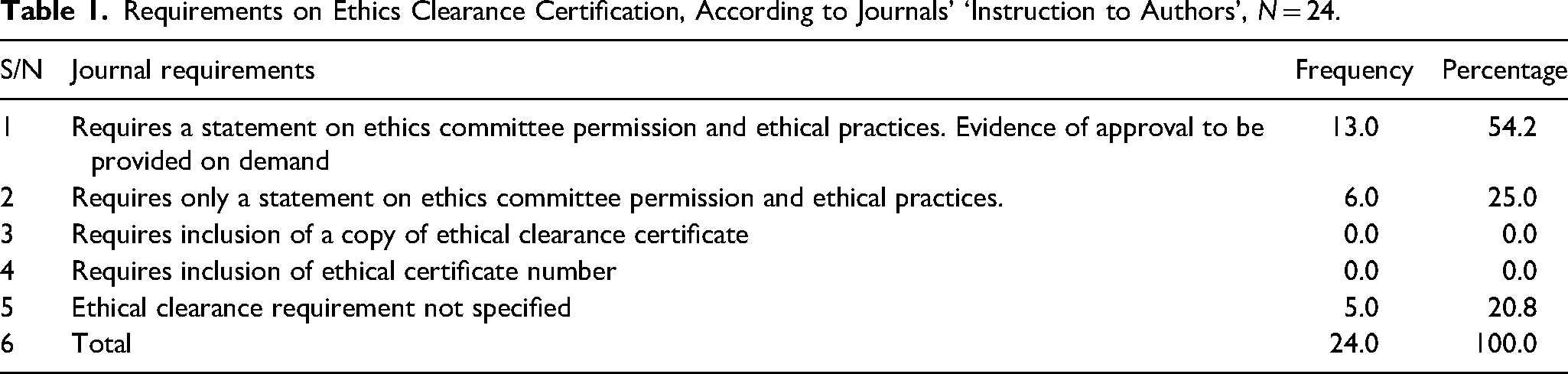
With reference to the journals’ ‘instruction to authors’, majority 13 (54.0%) of the sampled journals require a statement in the published article on ethics committee review and ethical practices which the authors adhered to, and evidence of ethical approval to be provided by the authors on demand, Table 1.
Requirements on Ethics Clearance Certification, According to Journals’ ‘Instruction to Authors’, N = 24.
Publications’ Ethical Clearance Reporting
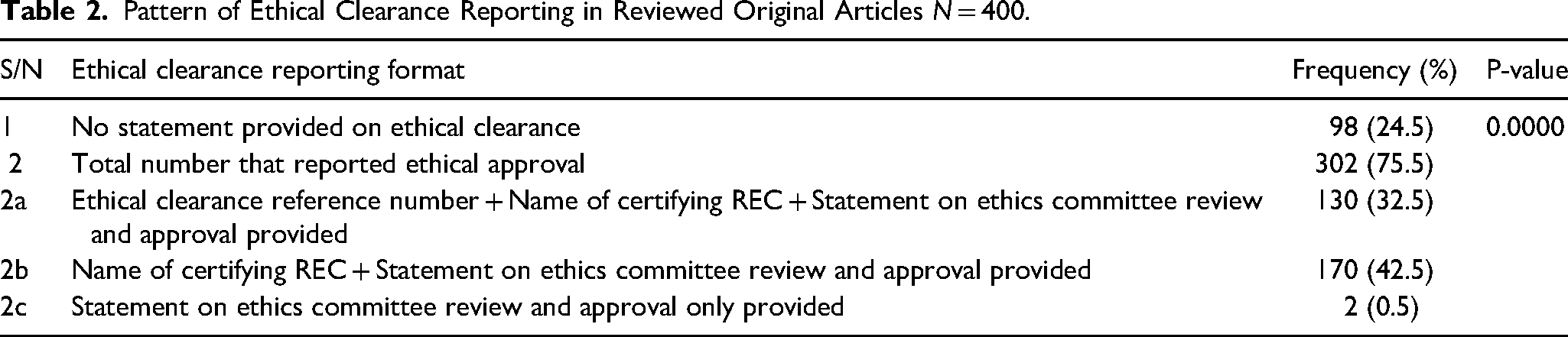
In terms of ethical clearance reporting, 302 (75.5%) of the sampled articles reported having obtained ethical approval with varying details. Table 2 describes the differences in the details provided by the articles that obtained ethical approval.
Pattern of Ethical Clearance Reporting in Reviewed Original Articles N = 400.
Nineteen (19) journals required a statement on ethics committee review and ethical clearance in their ‘instructions to authors’, but 89 (27.2%) of the published articles in these nineteen journals contained no ethical consideration information. The various details in the ethical review and approval provided by articles published in the journals that mandate such reporting are described in Table 3.
Level of Details in Ethical Information Provided by Published Articles in Journals That Mandate Ethical Statement. N = 327.

Informed Consent
Seventy-seven (77) of the sampled published articles were retrospective studies and so were excluded from the analysis on reporting of Informed consent process. Among the 333 sampled publications where informed consent would have been necessary, 236 (70.9%) reported having obtained informed consent. Written informed consent was reported in the majority 107 (45.3%) of the published articles, Figure 1. Only 1 (0.3%) of the reviewed published articles indicated that they obtained broad consent. The rest of the sampled published articles did not specify whether consent obtained was study-specific or broad.
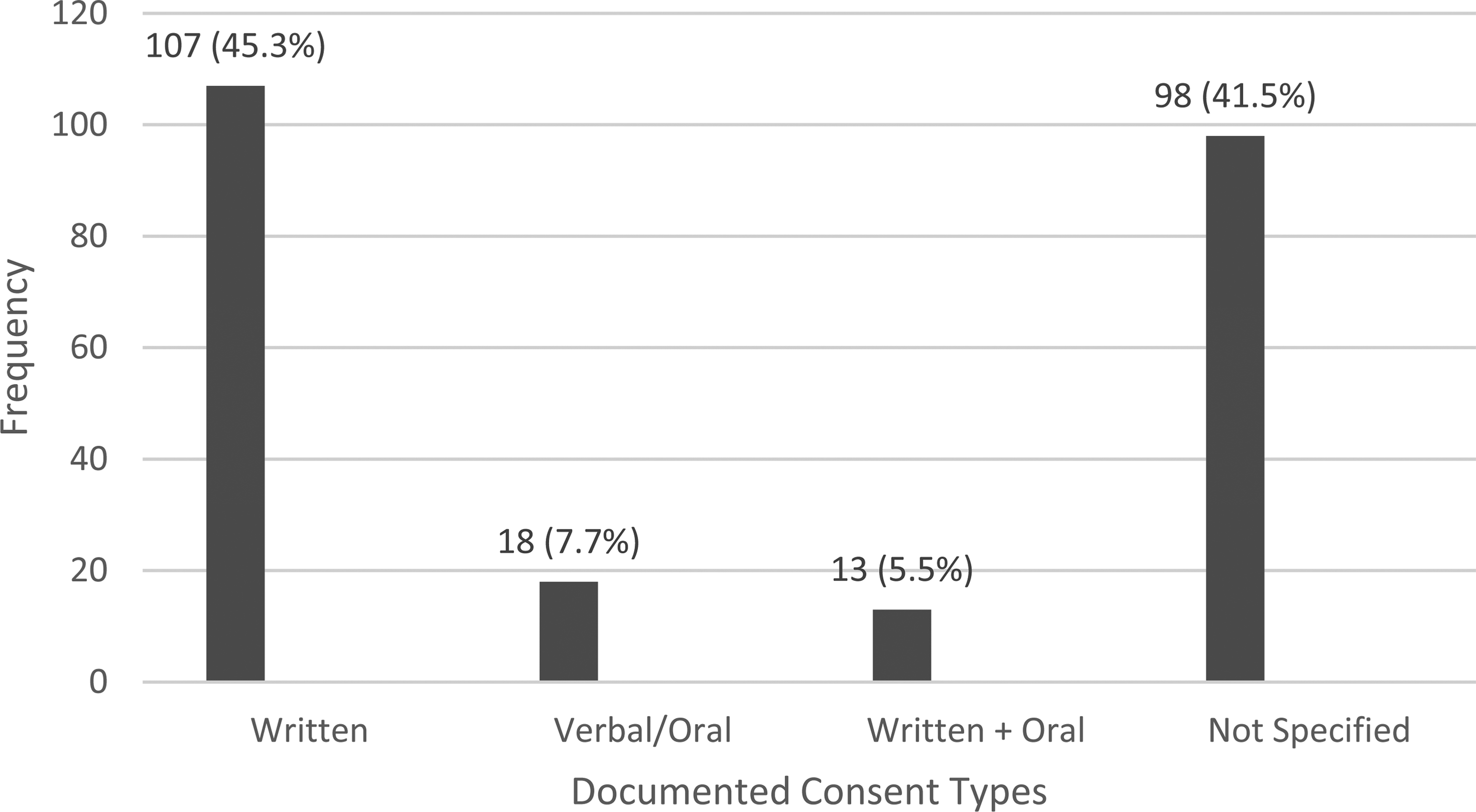
Types of reported informed consent, N = 236.
Key Informant Interviews
A total of five (5) individuals, all males who were either editors or members of the editorial board of the journals were interviewed as key informants. Their years of experience as editors/editorial board members range from 2.5 years to 8 years. Their responsibilities included corresponding with both authors and reviewers for manuscript revisions, and ultimately taking a decision on whether to accept or not to accept manuscripts for publication.
Six (6) themes with three subthemes emerged from the interviews:
Importance of Ethical Clearance Certification
All of the respondents agreed that ethical committee review and approval serves to regulate human research. Furthermore, the certification provides evidence that methods used to conduct a study met ethical requirements. As stated by a respondent, ‘Any investigation involving human beings or involving animals …….. must conform with ethical standards as enunciated in various global conventions and even scientific norms, ….., and so must be a very important consideration for any journal…’ (Male, Editor 4 years).
Ethical Clearance Certification as Part of Journals’ Requirement for Manuscript Submission and Publication
All the respondents stated that ethical clearance certification was part of their respective journal's requirement for manuscript submission and publication.
Inclusion of Ethical Consideration Section as Part of Manuscript Requirement
All respondents indicated that a section on ethical consideration is required of submitted manuscripts. However, details of the requirements in this section varied; while two respondents stated that they do not usually insist on authors providing the reference number and name of the ethics committee which reviewed the proposal, two other respondents stated they require a copy and one respondent said his journal demands the reference number or name of the certifying REC. However, if the editor has any cause to request for a copy, especially for interventional studies, a demand is then made. According to a respondent ‘If you are writing on an investigative, new modality of treatment, not known before, not standard….. then we’ll require a copy of your letter’ (Male, Editor 5 years). Another respondent added that ‘… once it is a study with significant ethical considerations, then it (ethical clearance copy) has to be submitted before the manuscript can be processed’ (Male, Editor 4 years).
Whether Provision of Evidence of Ethical Certification Affects Acceptance or Rejection of a Manuscript
For three respondents, their journal will not publish a manuscript if the authors fail to provide evidence of ethical approval. However, for two, their journal would publish if the editor felt there are no significant ethical issues involved in the manuscript. According to a respondent, ‘Where it is not submitted and the editor thinks the ethical issues involved in that study are not too strong, then he may not bother. The editor may go on with the manuscript processing.’ (Male, Editor 4 years). Another respondent stated, ‘…that is the best practice but I must say that even when this is not there, sometimes we still overlook it. …the red flag comes when I see the kind of study being conducted and the concern that ethical issues can be of serious concern there…’ (Male, Editor 5 years).
Types of Research Requiring Ethical Clearance Certification
Though four respondents agreed that all human studies require ethical clearance, one respondent stated that his journal does not demand it for retrospective studies. According to him, ‘…If one is submitting a retrospective study, we don't really bother so much’ (Male, Editor 5 years).
Documentation of Informed Consent
Three respondents affirmed that their journals require a statement from the authors stating that informed consent was obtained from their study participants. As a respondent put it, ‘Informed consent is mandatory; (our journal requires that authors include) a statement saying that they obtained informed consent from the subjects of the study’ (Male, Editor 5 years). However, for two respondents, it does not form a major consideration in their requirements for manuscript publication. According to one of the respondents, ‘… if we go by the books, that is an important aspect but I must say that… it is not that we return your manuscript because that is not stated.’ (Male, Editor 5 years).
Knowledge of Existence and Functions of NHREC and Registration of Ethics Committees
Only two respondents had some knowledge of the existence of NHREC. However, the fact that NHREC was responsible for registration of Institutional Ethics Committees was only known by one of the respondents. According to a respondent, ‘I have not come across that (NHREC), most of the ethics committees I have come across are from the various teaching hospitals where those studies are carried out…. (Male, Editorial board member/Editor, 2.5 years). Another respondent stated, ‘I know that there is a National Research Ethics Committee under the Federal Ministry of Health…’ (Male, Editor 4 years).
Regarding whether NHREC registration/non-registration of the institutional REC which approved a study protocol affects acceptance of ethical clearance certificates, a respondent stated, ‘ …once it is an institutional ethics committee, …… we don’t normally go into the issue of whether they are registered or not… (Male, Editor, 4 years).
Estimated Compliance Rate of Authors
According to the respondents, the estimated compliance rate of authors showing evidence of having obtained ethical clearance certification varied from 50 to over 90%. One of the respondents stated, ‘Generally, they (authors) comply. So I will say more than 90%.’ Another respondent said, ‘…in reality, are authors even telling the truth? I feel that the compliance can be put at 50% with regard to authors’ compliance with ethical provisions.’ (Male, Editor 5 years).
Respondents’ Opinion on Factors Affecting Authors’ Compliance
The respondents cited several factors which in their opinion can affect authors’ compliance. These factors included; Long turnaround time of RECs, Financial constraints regarding the charges incurred when applying for ethical certification, Promotion pressure, Poor knowledge of the importance of ethical committee review and Poor enforcement on the part of journal editors.
Discussion
The findings of the present study indicated that majority of the surveyed journals required ethical committee review and approval as part of their requirements for manuscript submission, however, about one-fifth of the journals had no ethical committee certification requirements stated in their instructions to authors. This vacuum invariably leaves the onus of obtaining ethical approval entirely to the researchers’ self-regulation.
In this study, a commendable 75.5% of published original studies showed documentation of having obtained ethical approval. Those with no documented evidence were seen even among journals with stated ethical consideration requirements in their ‘instructions to authors’. The documented 75.5% is higher than the 57.53% and 29.53% recorded in the Cameroonian (Munung et al., 2011) and Indian (Bavdekar et al., 2008) studies, but lower than the 93.7% reported in a previous study. (Wu et al., 2019). This high rate of compliance could be as a result of increased awareness among researchers from ethics training of researchers.
The 32.5% proportion of those who included the ethical reference number in the present study comes close to the 37.1% earlier reported (Wu et al., 2019), but differed from that of Schroter et al., 2006 which reported that 69% of publications documented evidence of ethical review while 43% stated the name of the ethical committee. It is worthwhile to note that these studies were carried out among different sets of journals, at different periods and with different sample sizes which may account for the observed differences.
About a quarter (24.5%) of the surveyed publications showed no evidence of ethical approval. This is lower than 81.7% reported in an Iranian study (Astaneh & Khani, 2017) and higher than 6.3% reported in a previous study in China (Wu et al., 2019). Several factors might be responsible for the differences, ranging from a possible reflection of the proportion of journals with no stated ethical committee certification requirements to other factors like those stated by respondents.
Journals’ instructions to authors play an important role in shaping authors’ responsibilities around submitted manuscripts. Where there are no stated ethical certification requirements, or when editors do not comply with their own journal's policy, authors may not be as likely to seek ethical review. The COPE guidelines on good publication practice clearly indicated that good research must have ethical approval. Hence, publication of human research without reporting of ethical certification equates to noncompliance to both COPE and the National Code of Health Research Ethics guidelines, and sometimes with the journal's policies.
It is recommended that journal editors and publishers undergo research ethics training courses so they can recognize their roles as stakeholders in ethical research. All journals ought to have the requirement for ethical approval captured in their ‘instructions to authors’. So journals lacking this need to update their ‘instructions to authors’ to clearly indicate it as a requirement for manuscript submission. The Association of Editors of Scholarly Publications in Nigeria (AESPN) need to be more vibrant in monitoring compliance to these ethical requirements. The association should equally strive to liaise with NHREC in the training and certification of their members, and also establish a minimum requirement in terms of research ethics certification for an individual to serve as a journal editor. In addition, AESPN should establish a uniform minimum standard for ‘instructions to authors’ in their respective journals, and adequacy of ethical considerations in manuscripts submitted for publication in accordance with existing guidelines and policies. It is hoped that these measures will maintain and possibly further increase the compliance rate of authors.
Delayed ethical review by RECs was the commonest factor cited by respondents which may deter authors from seeking ethical approval. This was corroborated by studies within and outside Nigeria. A study in Nigeria documented that the average time from submission to ethical approval was approximately 21 weeks (Eyelade et al., 2011), while a study in England (Ahmed & Nicholson, 1996) reported that one-third of the surveyed committees did not approve a multi-center proposal within three months, while three (3) of the committees took longer than 6 months.
On obtaining informed consent from research participants, 29.1% of eligible published articles did not report whether informed consent was obtained. This is lower than the reported figures of 58.2%, 52.8%, 49.4%, 50.6% and 55.1% over 5 years in Iran, (Astaneh & Khani, 2017), and higher than 9.9%, 13.8% and 13.4% seen in a previous study in China (Wu et al., 2019) over three years.
This failure to report informed consent in published articles may be a reflection of some editors’ attitude (as seen in the results of the present study) of not regarding it as a major consideration in the processing of manuscripts for publication. Informed consent is rooted in respect for an individual's autonomy and self-determination, hence failure to obtain it prior to enrollment of study participants violates the ethical principle of respect for autonomy. Training and retraining of journal editors in research ethics will help them to recognize human research with its ethical requirements. Again, it may be helpful for a minimum of two (2) editors to take a decision on a manuscript which is deemed not to require ethical review and/or informed consent before publication. Of the total number of publications with documented informed consent, 34.7% did not specify the type of informed consent obtained. Written and verbal informed consent are two types of informed consent generally acknowledged. Though this practice might be unintentional, but non-documentation of the type of informed consent obtained leaves a vacuum and a doubt as to whether informed consent was actually obtained. Reporting the type of consent obtained increases transparency of the ethical conduct maintained in a study.
Only one manuscript in the present study reported that they obtained broad consent. The manuscript in question considered the future use of unused biological samples. This finding might imply lack of awareness as regards specificity of informed consent in research.
Knowledge of the regulatory body for Health Research Ethics in Nigeria (NHREC) was poor among interviewed editors. This comes after seventeen (17) years of inauguration of NHREC in Nigeria. The fact that journal editors who are major stakeholders in research have a poor knowledge of the agency mandated to regulate all research processes in Nigeria does not give a good image of research regulatory framework in Nigeria. Editors may be more familiar with other widely known codes of research ethics, but their lack of knowledge of NHREC may reflect a lack of familiarity with the National Code of Health Research Ethics (National Code, 2007) produced by NHREC in 2007, which stipulates the roles and responsibilities of NHREC, Institutional Health Research Ethics Committees; Healthcare Professionals; Universities; Health Researchers and Research Sponsors in the protection of human research participants.
Conclusion
The compliance of medical journals in Nigeria to ethical certification was high. This was seen both in journals’ guidelines to authors on ethical considerations and in the actual reporting of ethical considerations in published manuscripts. Reporting of having obtained informed consent was also high. Ethical review and obtaining of informed consent in human research promotes transparency of the ethical conduct of such a study and should be upheld. The findings of this study calls for more effort on the part of journal editors, authors and all stakeholders in medical research in Nigeria to maintain the current rate and equally improve on it in upholding the standards of ethical conduct in research.
Study Limitation
The study was a cross-sectional study hence authors could not describe trends over time. The study was equally carried out in 2022, and so may not portray the most current representation of data. Despite that, it gives a valuable insight while contributing extensively to the available literature and also seeks to help in bridging the literature gap on this topic in the study area.
Best Practices
- Research ethics training courses to be extended to journal editors and publishing companies so that they can recognize their roles as stakeholders in ethical research.
- The Association of Editors of Scholarly Publications in Nigeria (AESPN) should be more vibrant and strive to liaise with NHREC in the training and certification of their members, and in addition establish a minimum requirement in terms of certification in research ethics for an individual to serve as a journal editor.
- AESPN should establish a uniform minimum standard for adequacy of ethical considerations in manuscripts submitted for publication in accordance with existing guidelines and policies.
- Speeding up ethical reviews: Every effort which can hasten the turnaround time of ethical reviews is greatly recommended. These efforts need to primarily emanate from members of the ethics committee themselves in the context of their area of operation, bearing in mind that most members work on altruistic grounds and have their primary responsibilities.
Research Agenda
In this study, factors affecting compliance of authors to obtaining ethical certification were obtained from the opinions of journal editors. It would be preferable to obtain this directly from authors/researchers, hence this represents a gap for future research. It will equally be helpful to ascertain the level of research ethics training required by AESPN for serving and intending editors.
Educational Implications
Institutions which conduct research need to recognize the importance and relevance of obtaining ethical approval before commencement of research work. Hence, researchers and future researchers need to be periodically educated on this subject. Universities ought to find a way of exposing their undergraduate and postgraduate students to critical aspects of research ethics. There should equally be training and retraining of researchers in this aspect of research regulation.
Footnotes
Declaration of Conflicting Interests
The authors declared no potential conflicts of interest with respect to the research, authorship, and/or publication of this article.
Ethical Considerations
Ethical review and approval was obtained from our institution's Health Research Ethics Committee. Study-specific verbal and written informed consent were obtained from participants involved in the qualitative aspect of the study.
Funding
The authors disclosed receipt of the following financial support for the research, authorship, and/or publication of this article: Research reported in this publication was supported by the Fogarty International Center of the National Institutes of Health under the Eastern Nigeria Research Ethics (ENRICH) program, Award Number R25TW011811. The ENRICH Program is a collaborative research ethics training program implemented jointly by the University of Nigeria, Nsukka (UNN), NIH/FIC-funded Center for Bioethics and Research (CBR) and University of Maryland School of Medicine (UMSOM). The content is solely the responsibility of the authors and does not necessarily represent the official views of the National Institutes of Health.
