






Abstract
Robot-assisted surgery has not yet been able to establish itself for vascular surgery. However, the preconditions for robot-assisted vascular interventions have changed fundamentally over the past years because of technological advances and extensive experience in other surgical disciplines. Hence, we describe a robot-assisted repair of an iliac artery aneurysm using a late-generation robotic platform. A 63-year-old male patient was diagnosed with an asymptomatic 30 mm aneurysm of the right common iliac artery. The operation was performed with the Da Vinci Xi system (Intuitive Surgical, Inc., Sunnyvale, CA, USA) using a direct transperitoneal approach to repair the aneurysm by interposition of a Dacron vascular prothesis. The total operating duration was 304 minutes without perioperative need for blood transfusion. The patient was discharged on the eighth postoperative day after an uneventful postoperative course. The case presented shows that robot-assisted surgery in the iliac axis can be performed safely with reasonable operating times.
Introduction
Compared with other surgical disciplines, robot-assisted surgery has not yet been able to establish itself for vascular procedures. In the past, the feasibility of robot-assisted aortic surgery was documented by smaller case series or case reports. 1 It has evolved from laparoscopic vascular surgery and incorporated endoscopic techniques in terms of positioning, pneumoperitoneum, access techniques, and trocar placement. 2 Because of the breakthrough of endovascular techniques in the aorto-iliac segment, robot-assisted vascular surgery has been mainly abandoned. 3 However, in recent years, case reports of robot-assisted vascular interventions have resurfaced from various research groups due to technical advances in robotic surgery and growing experience in other surgical fields. Especially in the aorto-iliac segment, robot-assisted surgery offers reduced surgical trauma and fast convalescence in comparison with open repair.
Case Report
We present a technique of robot-assisted repair of an aneurysm of the common iliac artery. A 63-year-old male patient (body mass index 24.2 kg/m2) was diagnosed with a 30 mm aneurysm of the right common iliac artery confirmed by magnetic resonance angiography (Fig. 1). Because of prostate carcinoma, the patient had undergone abdominal radiotherapy 5 years previously, with an overall favorable long-term prognosis. Secondary diagnoses included paroxysmal atrial fibrillation, chronic obstructive pulmonary disease, and nicotine abuse of 50 pack-years. Considering the patient’s age, condition, low burden of comorbidities, and favorable aneurysm morphology, an interdisciplinary decision was made for surgical treatment. Moreover, the patient specifically opted for surgery to avoid follow-up examinations after interventional treatment. The patient was considered a suitable candidate for a robot-assisted procedure due to the favorable localization of the aneurysm and the significantly reduced access trauma. Because this was classified as an observational study, the local Ethics Committee of the Christian-Albrechts-University of Kiel confirmed that no ethical approval was required. However, the committee was closely involved during the obtainment of informed consent. Moreover, written informed consent was obtained from the patient for participation in this study and for publication of this report and any accompanying images and the Supplemental Video. The procedure was scheduled and realized in cooperation with the Kurt-Semm-Center for Laparoscopic and Robot-Assisted Surgery. Given the history of former radiotherapy, ureteral splints were implanted preoperatively to prevent intraoperative injury.
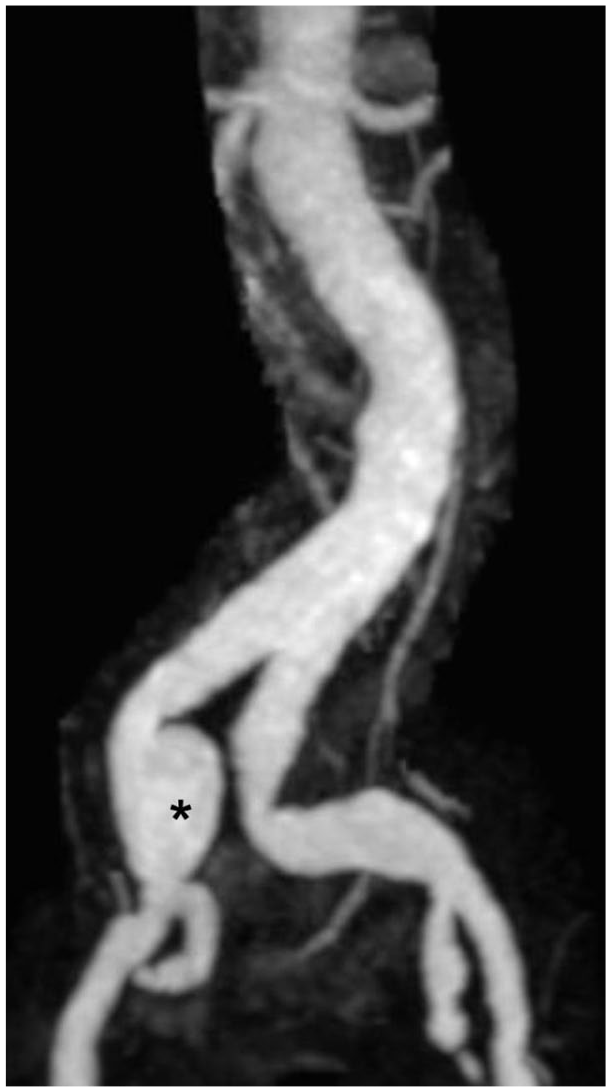
Magnetic resonance tomography showing a 30 mm aneurysm (*) of the right common iliac artery.
The operation was performed under general anesthesia using the Da Vinci Xi system (Intuitive Surgical, Inc., Sunnyvale, CA, USA) with 4 arms. Because the procedure was performed in collaboration with visceral surgery colleagues, a second surgeon console was used for training purposes. The robotic system was placed on the patient’s right side. The patient was placed on his left side at a 45° angle and in a 15° Trendelenburg position. Five trocars for placement of instruments, camera, and vascular clamps were placed. Three of the trocars were used to have 3 robotic instruments in the field, of which 2 were actively used and a third was available for quick changeover. In addition, two 7-French arterial sheaths were inserted in both groins to insert blocking balloons in the case of bleeding (Fig. 2). A pneumoperitoneum was established with an abdominal pressure of 12 mm Hg and perfusion of 6 L of CO2 per minute. A direct transperitoneal approach was used, and the retroperitoneum was opened above the aneurysm of the right common iliac artery. The aneurysm was dissected from the proximal neck to the iliac bifurcation. After systemic heparinization (100 IE per kilogram of body weight), the proximal neck was clamped with a Chitwood clamp (Scanlan International, Inc., St Paul, MN, USA) while the iliac bifurcation was occluded using disposable endoscopic vascular clamps (Scanlan International, Inc; Fig. 3a). A Dacron vascular prosthesis (FlowNit Bioseal, 8 mm; JOTEC GmbH, Hechingen, Germany) with attached Gore-Tex suture 3/0 (Gore, Flagstaff, AZ, USA) was inserted into the abdomen through a trocar. After opening the aneurysm, the vascular prosthesis was implanted as interposition with a running suture (Fig. 3b-d). After iliac reperfusion, protamine substitution, hemostasis, and graft inclusion using the aneurysm sac, the retroperitoneum was closed over with a running suture. Final inspection of the abdominal cavity revealed a Meckel’s diverticulum, which was resected using a stapler device. One suction drain was introduced into the abdominal cavity, the trocars were removed under laparoscopic guidance, and all incisions were closed. The total operating duration was 304 minutes.
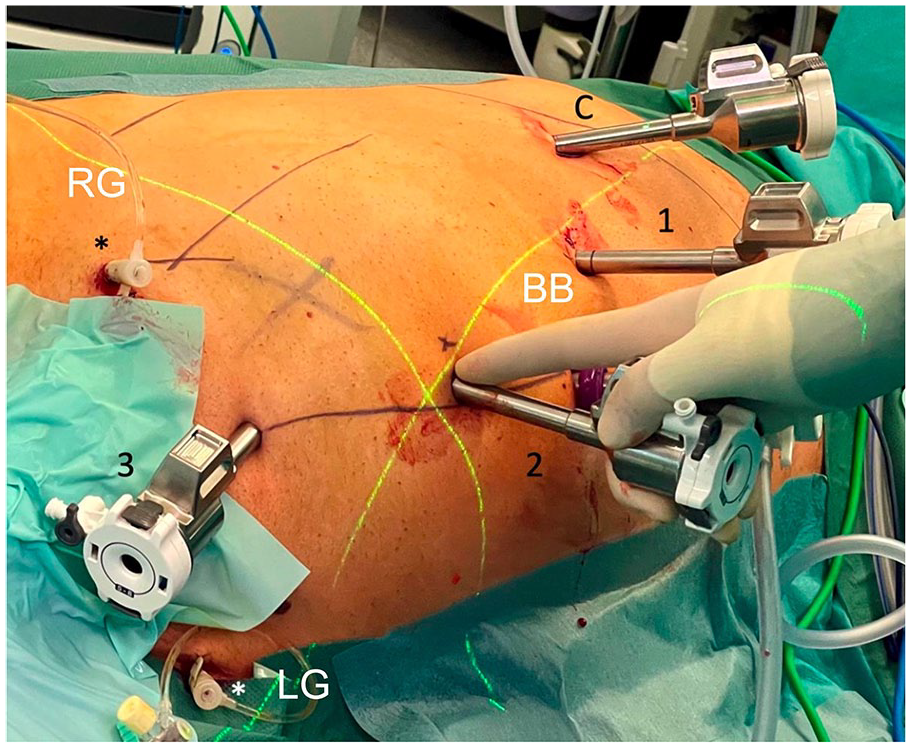
Placement of ports for robotic arms (1 to 3) and camera (C), vascular sheaths (*), and anatomical landmarks: belly button (BB), left groin (LG), and right groin (RG).
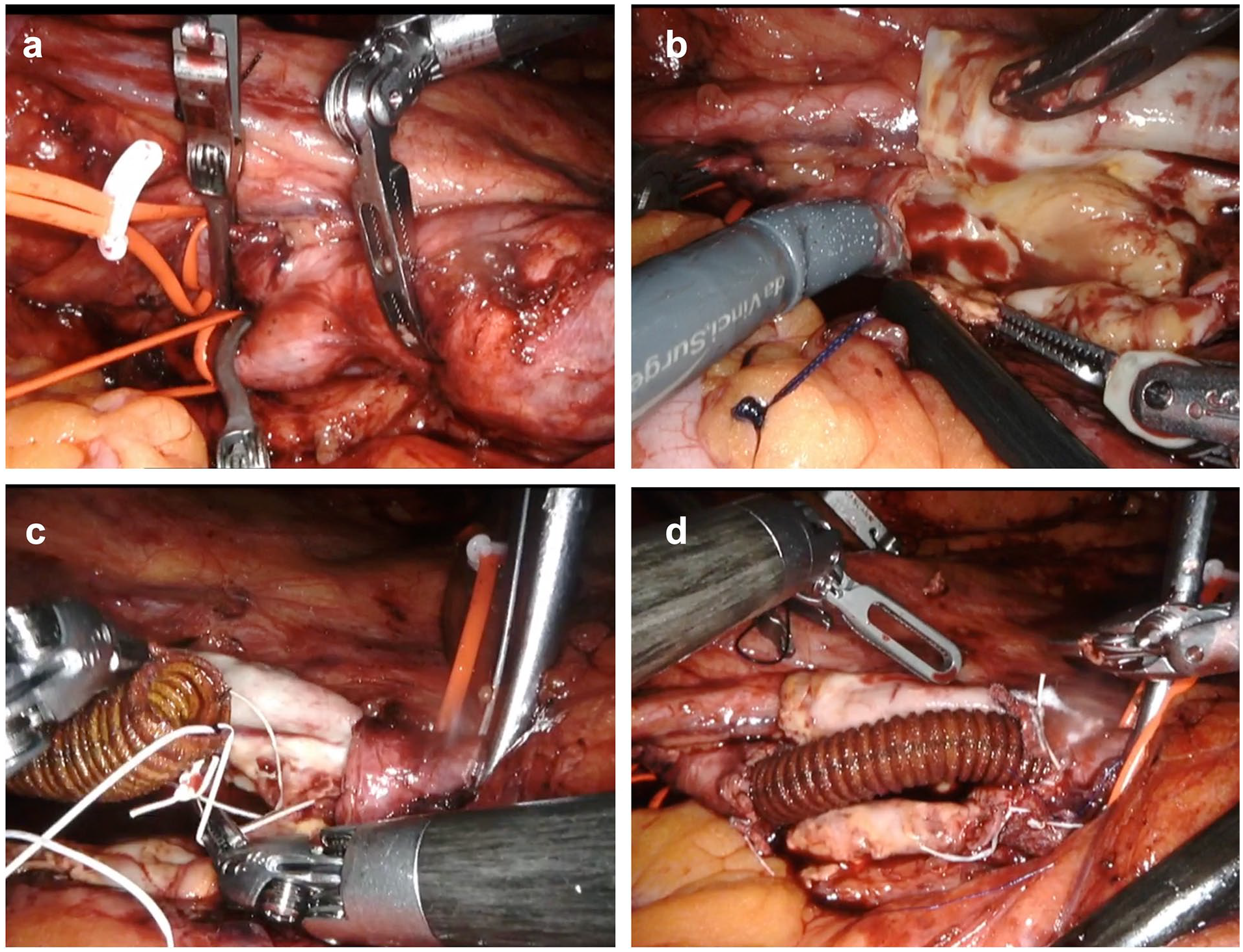
Intraoperative views: (a) aneurysm with clamped iliac bifurcation, (b) opened aneurysm, (c) proximal anastomosis, and (d) final result.
There was no perioperative need for blood transfusion. The patient was extubated in the operation theater and transferred to the normal ward on the day of surgery. After an uneventful postoperative course, the patient was discharged on the eighth postoperative day. Discharge medication included a 100-mg dose of aspirin.
Discussion
In the early 2000s, several research groups explored the possibilities of robot-assisted aortic surgery and showed its feasibility by smaller case series or case reports. 1 With the simultaneous emerging of endovascular techniques in the aorto-iliac segment and the associated good results, the further development of robot-assisted, respectively minimally invasive techniques were abandoned by most research groups, with few exceptions. 3 However, in recent years, case reports of robot-assisted vascular interventions have resurfaced from various research groups. From our point of view, this is due to the improvements in robotic platforms, instrumentation, and the growing experience with robot-assisted surgery in other surgical disciplines during the past 2 decades. The presented case shows that robot-assisted surgery in the iliac axis can be performed safely with reasonable operating and clamping times. Although these times were longer compared with conventional open surgery, it is to be expected that they would level out as part of a learning curve. In summary, conditions for robot-assisted vascular surgery are currently very favorable compared with 20 years ago. While the surgical principles for robot-assisted vascular interventions have already been validated, robotic surgery has been lifted to a new level in general. Valuable experience was gained in the neighboring disciplines regarding optimized surgical techniques in terms of patient positioning, vascular exposure, port placement, and complication management. In parallel, the robotic platforms were further developed technically with improved imaging, additional robotic arms, and new robotic instrumentation. In addition, the growing number of hybrid suites and new stent and prosthesis designs (e.g., self-anchoring) offer optimal conditions for the development of innovative vascular procedures involving robotic platforms. 4 Finally, a shorter postoperative length of stay compared with open surgical procedures can be expected due to rapid wound healing and faster mobilization with reduced access trauma. However, the country-specific minimum lengths of stay specified by the health insurance companies must be taken into account here.
Supplemental Material
Visual abstract – Supplemental material for Robot-Assisted Surgery of an Iliac Artery Aneurysm: A Case Report
Supplemental material, sj-pptx-1-inv-10.1177_15569845221133328 for Robot-Assisted Surgery of an Iliac Artery Aneurysm: A Case Report by Grischa Hoffmann, Melanie Rusch, Rouven Berndt, Jan Beckmann, Thomas Becker, Jochen Cremer and Rene Rusch in Innovations: Technology and Techniques in Cardiothoracic and Vascular Surgery
Footnotes
Declaration of Conflicting Interests
The authors declared the following potential conflicts of interest with respect to the research, authorship, and/or publication of this article: JB is active as a speaker for Johnson & Johnson Medical. JB and TB received grants for training with the da Vinci Xi Surgical System through Intuitive Surgical Sàrl. JB works as proctor for Intuitive Surgical Sàrl. TB received the da Vinci® Xi Surgical System from Intuitive Surgical Sàrl for the purpose of clinical research. The robotic procedures were performed on the da Vinci® Xi Surgical System, provided by Intuitive Surgical Sàrl for the purpose of clinical research to the Department of General, Visceral, Thoracic, Transplantation, and Pediatric Surgery and the Kurt-Semm Center for Laparoscopic and Robotic Assisted Surgery, University Hospital Schleswig-Holstein, Campus Kiel. The funder had no role in study design, data collection and analysis, decision to publish, or preparation of the article. MR, RB, JC, RR, and GH state that there is no conflict of interest.
Funding
The authors received no financial support for the research, authorship, and/or publication of this article.

Supplemental Material
Supplemental material for this article is available online.
References
Supplementary Material
Please find the following supplemental material available below.
For Open Access articles published under a Creative Commons License, all supplemental material carries the same license as the article it is associated with.
For non-Open Access articles published, all supplemental material carries a non-exclusive license, and permission requests for re-use of supplemental material or any part of supplemental material shall be sent directly to the copyright owner as specified in the copyright notice associated with the article.
