







Abstract
This article discusses the potentials of a mixed methods approach to the study of children’s mobility patterns. The methodology presented here combined ethnographic fieldwork with global positioning system technology and an interactive questionnaire that children completed via mobile phone. This innovative methodology allowed the researchers to generate a rich understanding of children’s everyday movements. The study combined documentation of children’s subjective experiences with systematic observations, mapping, and survey data. The article sets out lessons learned for future mixed methods research into children’s everyday mobility. One such lesson was that it required the interdisciplinary research team to cooperate closely through dialogue, support, and coordination of activities and perspectives. The approach also promoted the children’s commitment to the study.
The aim of the case study reported here was to understand the empirical characteristics of suburban and rural children’s everyday mobility patterns in the context of their social, material, and cultural contexts. This included identifying sociomaterial facilitators and constraints on their movement. “Everyday mobility” refers to the whole spectrum of bodily motion that children engage in during their daily activities (World Health Organization, 1998), from the stationary activities made while staying in place to the more vigorous physical activities made within a place or between places (see Casey, 1996). Included therein is the notion of everyday mobility, defined as
all travel from home undertaken on a temporary basis. This includes frequent and
regular trips such as the journey to school or to work; less regular but still
frequent trips to visit friends or relatives, to shop, for sport and for other
leisure activities including children’s play; and trips undertaken only once or
twice a year such as holidays and visits to distant relatives (Pooley, Turnbull, & Adams,
2005, p. 5).
Mobility forms an integral part of everyday life, contributing significantly to how people sustain their routines and to the shaping of individual and family life (Pooley et al., 2005). Although everyday life includes movements that many people do much of the time, in the social sciences people’s everyday mobility has been relatively neglected in favor of attention to large-scale and long-distance movement (Pooley et al., 2005). In addition, most studies of people’s everyday movements have focused on the practices and experiences of the adult population. Much less is known about children’s everyday mobility practices and experiences. What is known, however, is that within the last two generations, European and North American children’s mobility patterns have changed radically (Hillman, Adams, & Whitelegg, 1990; Karsten, 2005; Keim, 2005; O’Brien, Jones, & Sloan, 2000). Compared with the childhoods of their grandparents, contemporary children from the European and North American continents are subject to markedly greater restrictions on their everyday movements (Pooley et al., 2005), not least because of the increasing institutionalization of childhood (James, Jenks, & Prout, 1998; Rasmussen & Smidt, 2003; Smith & Barker, 2000). As noted by these scholars, children’s everyday experience at home and school is characterized by close supervision and regulation of activities by adults. Several studies suggest that the increased regulation of children’s outdoor play and mobility is to a great extent a product of a heightened risk awareness among parents and children themselves (O’Brien et al., 2000; Valentine, 1997), fuelled by the mass media (Furedi, 2002; Pooley et al., 2005). To guard children from the presumed dangers of the street, parents increasingly escort children by car to and from educational and leisure-time activities (Barker, 2003, 2009; Fotel, 2007; Hillman et al., 1990; O’Brien et al., 2000). A study conducted in Denmark 10 years ago showed that the number of children driven by car to school doubled between 1993 and 2000 and that children aged 11- to 15-years-old tripled their car trips on all journeys between 1978 and 2000 (Jensen & Hummer, 2002, as cited in Fotel & Thomsen, 2004, p. 538). Research suggests that today’s urban and rural environments offer an unfriendly milieu for children’s independent and free movement (Christensen & O’Brien, 2003; McKendrick, 2000), owing to the ever-increasing number of cars in the streets (Björklid, 1994; Hillman et al., 1990), disinvestment in community facilities (Katz, 1994), and changes in the rural landscapes and landownership (Davis & Ridge, 1997; Matthews, Taylor, Sherwood, Tucker, & Limb, 2000; Ward, 1990). As a result, the amount of time that children spend outdoors in public space has declined considerably in favor of the private sphere of the home (Zinnecker, 1990). This is a development that may have been reinforced by the speedy growth of technology that enables children to engage in activities and communication with their friends without being physically active—providing they have a mobile phone or access to the Internet from home. Children’s mobility has recently emerged as a question needing social scientific attention and enquiry, with scholars arguing that children, youth, and mobility pose a set of new and challenging questions (Barker, Kraftl, Horton, & Tucker, 2009). These include refinement of social scientific understandings of the discourses about childhood and youth through an appreciation of the co-constituted nature of mobility, age, and life course and exploration of important aspects of the creation of urban living and identities, urbanisms, and change. The inclusion of children/young people’s perspectives and mobilities as urban citizens may also source policy and practice decisions regarding the future planning and design of outdoor environments.
This article presents the methodological insights of a mixed methods study of children’s everyday mobility in a suburban and a rural area. The study combined ethnographic methods with those involving the use of new mobile technologies. The development of this methodology for the study of children’s mobility patterns entailed mixing a researcher-directed approach with participatory inquiry (Christensen & James, 2008). It also included developing a research practice in line with children’s everyday routines and practices. The researchers asked the participating children to reflect on the research process and incorporated their views and observations into the way the study was designed, including later evaluating the use of the technologies.
In this article, we argue that the combination of ethnographic fieldwork and global positioning system (GPS) tracking/mobile phone survey is particularly useful for the study of “everyday mobility.” 1 The design adopted in this study produced systematic mapping of children’s mobility patterns (through the use of GPS and mobile phone technologies) combined with a thick description of the social and material context of children’s physical movements, their experiences and the meanings of these for children (through the use of ethnography).
Why Mixed Methods?
The recognition that one single method cannot grasp the complexity and variety of contemporary social science research questions (Weisner, 1996) is by now widely recognized. Weisner warned against what he called “methodocentrism,” which he defined as “the exclusive use of one method and fear of others” (p. 307). However, more recently mixed methods research has gained its own distinct identity and paradigmatic status (Denscombe, 2008; Johnson, Onwuegbuzie, & Turner, 2007; Mertens, 2010). It would seem therefore that the study of children’s everyday mobility invites the use of multiple methods and combined interdisciplinary efforts. Nevertheless, a methodological division between quantitative and qualitative studies has characterized most research into children’s everyday mobility. Qualitative social science studies (including studies referred to above) have made important contributions to our understanding of the subjective experience of children’s everyday mobility (Brunton et al., 2003; Zeiher, 2003). Although often on a small scale, these studies have produced rich in-depth understanding of children’s everyday mobility through their focus on the experiences of relationships, contexts, and movements from the perspective of children. This research includes studies of children’s sensuous experience of place, the social construction of children’s spaces, and landscapes of risk, power, and hierarchy (Christensen, 2003; Matthews, 1992). However, qualitative methods are limited in their ability to provide a systematic and accurate overview of children’s everyday mobility patterns.
Most quantitative research about children’s movements derives from child public health and policy research into children’s physical activities (Due, Lynch, Holstein, & Modvig, 2003; Hillman et al., 1990; Nader, Bradley, Houts, McRitchie, & O’Brien, 2008; Wedderkop, Froberg, Hansen, & Andersen, 2004; Wold & Hendry, 1998). These primarily survey- and register-based studies focus on producing data about the prevalence, distribution, and intensity of children’s physical activities. The research interest is to document patterns of physical activity of child and youth populations in order to monitor their health and more effectively prevent the health risks associated with low physical activity. Quantitative studies seek to produce data on children’s organized physical activities (e.g., sports) and are often based on parents rather than children as respondents (but see World Health Organization/HBSC Project: http://www.hbsc.org/). Public health studies that have asked children themselves tend to focus on the amount of time spent on particular, especially vigorous, forms of physical activity on a daily or weekly basis and to establish its relationship to measures of well-being and health (Holstein, Henriksen, Krølner, Rasmussen, & Due, 2007). Quantitative research has difficulty in studying children’s physical activities outside sports clubs and organizational settings because of the lack of a precise understanding of what constitutes “healthy” everyday mobility. However, the use of a new technology, the accelerometer, may be about to change this (Page, Cooper, Griew, & Jago, 2010; Pedersen & Saltin, 2005). The accelerometer measures vibration and will in the form of a pedometer provide a set of objective measures of children’s physical activity, although it cannot give information about location or itinerary. Quantitative research treats physical activity as a behavior detached from personal experience and meaning. It therefore abstracts children’s everyday movement from its geographical, social, material, and cultural contexts. The increasing concern with obesity in the population has led some health research to focus on children’s walking and cycling to school (Neuwelt & Kearns, 2006; Orsini & O’Brien, 2006). However, only a few studies have explored children’s everyday travel and outdoor activities beyond their journeys to and from school (but see Mackett, Brown, Gong, Kitazawa, & Paskins, 2007, and for studies on children’s access to and participation in leisure activities, Hjorthol & Aslak, 2009; Sepner, Copperman, Pendyala, & Bhat, 2008). One recent comprehensive study investigated 10- to 11-year-old children’s self-reported physical activity (in outdoor play, structured exercise/sport, and active commuting to school) and its relation to independent mobility, children’s perceptions of the environment, and distance from home to school in a large city in the United Kingdom (Page et al., 2010). The study found that boys aged 10- to 11-years-old play outdoors and take part in structured exercise and sport more often than girls do. There was no gender difference in children walking or cycling to school. This finding highlighted the importance of active commuting as a source of physical activity for both girls and boys and suggested that increasing opportunities for outdoor play and structured sport and exercise for girls may be warranted.
Quantitative studies focused on the physical activity afforded by walking and cycling have argued that these forms of everyday mobility are affected by urban and transportation policy and planning. However, in the field of urban development and transport, research has focused primarily on describing and understanding the mobility patterns of the adult population. In this body of work, children appear as the cause of particular patterns of adult mobility, such as the increase in parental car travel—to and from school and other leisure activities (e.g., McDonald, 2008; Yarlagadda & Srinivasan, 2008)—rather than children’s everyday mobility being of interest in its own right.
Although led by anthropologists trained in ethnography, it was evident from the outset of the present study that neither quantitative nor qualitative approaches were in themselves sufficient when seeking to understand children’s everyday movement, despite the individual strengths of each method. At the same time, it was clear that each methodological approach had much to offer the broader understanding of mobility patterns. The research team and authors of this article were brought together by an almost coincidental recognition: two researchers, from transportation and mobility studies, experienced the need for qualitative social science input to understand the subjective and contextual basis for people’s movements, and two anthropologists needed to understand the broader patterning of children’s everyday mobility. In this study, therefore, the value of a pragmatic approach that accentuates the flexibility of methods and techniques, and interdisciplinary collaboration, led to the development of an integrated research design unifying our efforts in a holistic approach (Onwuegbuzie & Leech, 2005) to understand the everyday mobility patterns of children. This resulted in a combination of approaches that would ideally make it possible, as Greene (2005) argues, to generate “a more complete, contextual, contingent and complex understanding of the phenomena of interest than would have a single-method study” (p. 410).
A Mixed Methods Study of Children’s Everyday Mobility
The study was carried out in Denmark with children living in a suburb close to the capital city of Copenhagen and with children living in a rural area in the northeastern part of Denmark. The empirical part of the study was carried out over 12 months in 2005-2006 with the field researcher (second author, male) spending 3 days a week in the field. Forty 10- to 13-year-old children and 29 families participated in the study. The children were recruited through two local schools and an out-of-school center after approval from the principal and board of governors. Later in the fieldwork, the participating children’s parent(s) were contacted by telephone and asked to participate in an interview. Although we were interested in studying children’s movement in the local area other than the school, out-of-school center, and home, we chose to use the institutional settings as a point of departure for the fieldwork. In Denmark, children’s day care institutions are primary gathering points for children’s everyday social life and physical activities. The local schools where we recruited the children were state schools attended by children living locally. These state schools were the only schools in the areas studied, and this ensured that the sample of children was representative of the socioeconomic and ethnic background of families living in the two areas.
We limited the sampling criteria to include age and gender. These two factors have been identified in previous research as key for understanding children’s mobility patterns (Brown, Mackett, Gong, Kitazawa, & Paskins, 2008; Hillman et al., 1990; O’Brien et al., 2000). Although previous research has shown that ethnicity, obesity, and disability are also important for the development of children’s mobility, we decided to let these factors emerge from the data rather than impose them on the sampling strategy for the study. We focused on recruiting one particular age cohort of children and aimed for an equal distribution of boys and girls. This sampling strategy was guided by an interest in the findings of previous studies suggesting that at the age of 10 to 12 years, children expand their mobility radius significantly as they gain parental consent to explore places at a greater distance from home (e.g., Matthews, 1987; O’Brien et al., 2000). An exact number of participating children was not essential, but it was important to recruit children together with their families, as parents have been found to be key in shaping children’s mobility patterns.
Ethnography
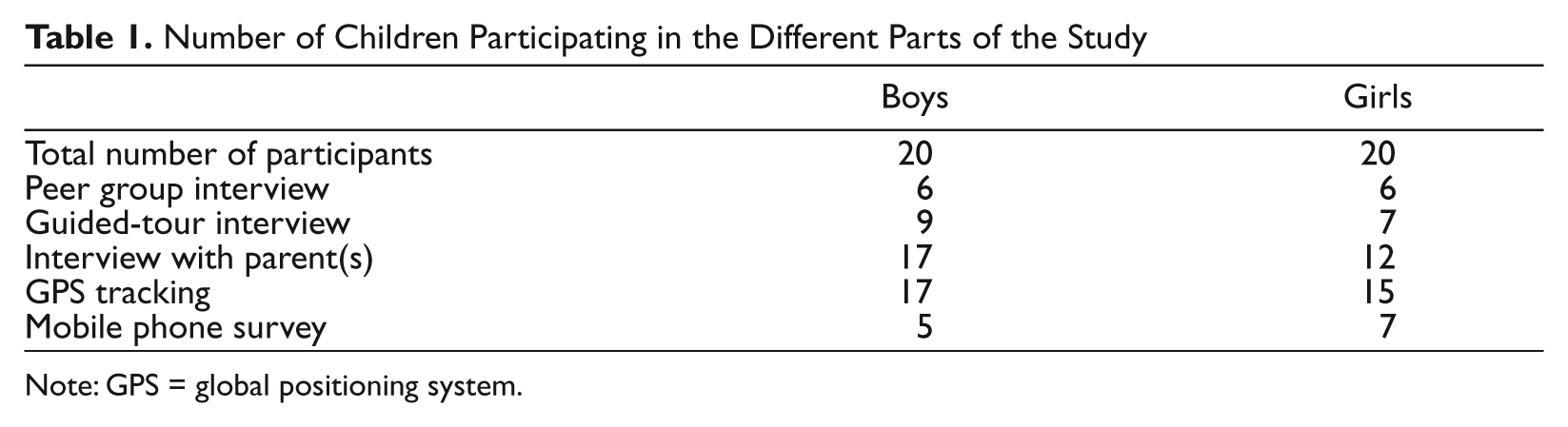
The purpose of the ethnographic study was to produce detailed and in-depth data about children’s experiences, practices, and routines in the context of their everyday life. Knowledge of children’s mobility was generated through observations, interviews, peer group discussions, and informal chats with the children, parents, and teachers. All interviews and discussions were audiotaped and subsequently transcribed (see Table 1). Central to the ethnography was participant observation of the children’s everyday lives, which allowed the researchers insight into the children’s time at school during lessons, at break times when they played outside, and after school when they spent time at home and in their local community. On most days, the field-worker joined the children from the beginning of the school day in the morning until late afternoon when the children returned home. The field observations were structured and systematically distributed across the participating children. Focused observation of 30 to 60 minutes a week over a 6-month period, including interviewing, was carried out with each child across the two field sites. The observations focused on the way the children used their indoor and outdoor spaces, their social relationships, and interactions with friends, families, peers, and others. These observations were systematically recorded in a field note diary. However, observing children’s everyday mobility outside the school and after school center was, as we will go on to show, difficult because the children’s movements were geographically scattered and often difficult to localize.
Number of Children Participating in the Different Parts of the Study
Note: GPS = global positioning system.
Children were also invited to take the field-worker on a guided tour around their local community and talk about the activities and relationships important for their everyday use of the community. Sixteen guided-tour interviews were conducted. The guided-tour interview, which would last 60 to 90 minutes, offered the opportunity for the researcher to obtain firsthand experience of the children’s favorite places and everyday daily routes and routines and to observe the children in their natural milieu (Christensen, 2003). The children took the researcher around their neighborhood: past their house, around the garden, and out onto the fields and roads. The children decided the route and whether the tour should be conducted on their own or together with a friend or family member. The conversations did not have a preplanned format but allowed dialogue between the children and the researcher to emerge and develop as and how the tour itself developed, prompted by people they met or places visited on the way. This method builds on the mental (emotional and cognitive) maps that people make of the places they know and the places where they live: the house, neighborhood, and town. The “method of loci,” as it is called, refers to the way these spatial and relational contexts become interwoven in memory (Yates, 1966). Spaces where experiences and events occur become mentally coded for subsequent retrieval or recall when revisited. The guided-tour interview gave unique insight into the children’s place experience that exceeds the knowledge that can be verbalized in traditional interviews. Examples include the revelation of some children’s active rebellion against adults’ rules by leaving the out-of-school center without permission, the children’s private spaces such as dens built hidden away from the road, children’s delight and affection when meeting a disabled woman and her dogs, and the excitement of jumping down the stairs on bikes in the community square together with a group of friends. The guided-tour method was crucial to achieve an in-depth understanding of the children’s bodily movement and journeys outside their home and school in their local community. Like the school and out-of-school center, the home constitutes an important setting for children’s everyday lives and as starting and end points for their mobility (Christensen & O’Brien, 2003; Rasmussen, 2004). For this reason, as well as for the reason that families constitute an important part of shaping children’s social environment, we found it important to gather contextual data about the children’s home and family life. During a family visit, parents were interviewed about their attitudes to children’s independent mobility and their parenting practices around children’s leisure activities and range of mobility in the local area; 29 such formal interviews were conducted.
Children’s Mobility: A Methodological Conundrum Revisited
Observing children’s everyday outdoor mobility rendered it difficult ethnographically to explore the children’s mobility patterns in their full scale in actual time. Unlike their older peers, the children in this age group did not gather or “hang out” in the streets, parks, or the local shopping centers. Although some of the children who lived in the suburb, especially the girls, tended to spend whole afternoons in the local shopping centre, the children’s everyday mobility took place through their travel between their home, school, out-of-school center, and leisure activities.
In the field, the ethnographer is limited by the physical fact that she or he can only be in one place at a time. Of particular challenge are momentary and occasional events:
How—for instance—do we observe interactions that happen sometimes but not
necessarily when we are around? How do we participate in or observe
practices that are enacted here and there by one or a few people? (Malkki,
1997, as cited in Amit,
2000, p. 15)
To compensate for this methodological limitation and to produce a fuller understanding of the field setting, ethnographers use longitudinal fieldwork based on methods such as participant observation and interviews, in conjunction with other techniques that may help the ethnographer gain insight into social events and interactions that they may otherwise have no or only limited access to. Accordingly, in the present study the researcher spent time with the children. For much of the time, the children were in motion whether they were indoors or outdoors, in their home, or at school. They moved within places, when they travelled between places and when they were playing games or when they just roamed about. Although some of their physical activities were routinely arranged and orchestrated in time and space by the adults at school, out-of-school center, or sport clubs, other activities were initiated spontaneously by the children or their families. This meant that the methodological requirements differed according to location. At school, the children routinely assembled in the same place and time and their physical activities (as well as other activities) were scheduled to take place in predetermined and fixed locations such as the classroom, sports hall, athletics stadium, and swimming bath. Any deviation from these patterns would therefore often be directly observable for the researcher. The field of action was rather clear, inasmuch as a field-worker with some experience of the temporal and spatial patterning of the school knew where and when to be present. However, at the end of the school day, the mobility patterns changed. On most days, the children gradually trickled away from the school after having gathered around the bicycle stands or outside the school gate to chat. Children would disperse in different directions of their local community: to go home, to the out-of-school center, to sports or music lessons, or to meet their parents for shopping. This daily gathering outside school would sometimes allow the field-worker to make arrangements with individual or small groups of children to accompany them on bike or walking from the school. However, on other days the children departed quickly from the school, leaving the classroom, the schoolyard, and the ethnographer behind. This sudden scattering of the children in many different directions complicated the pursuit of participant observation. Not only was the field-worker unable to accompany more than one child or group of children at a time, but he would as an adult and nonrelative also be excluded from activities by the children and their families after school. Outdoors, the children moved around in a number of different places—streets, fields, parks, and shops in the local community. From an outsider’s perspective, their mobility was diffuse and changeable, influenced among other things by the children’s different networks and resources, their means of transport and places of sports, work, and other activities—and the weather. Given these methodological challenges, the possibility of combining the depth of ethnographic data with the breadth of data produced via new mobile technologies seemed beneficial not only for the outcome of the research but also in ensuring its validity.
GPS Tracking and Mobile Phone Survey
We used two types of technology: a GPS 2 receiver and a mobile phone. The GPS records the position of its carrier by satellite—a capacity used in commercial applications such as the navigating device in cars. The purpose of the GPS tracking was to produce a visual overview and a factual set of data of children’s total movement and geographical allocation of time use. By the use of GPS technology, we set out to understand the total picture of children’s everyday mobility in real time and space during 1 week.
Thirty-two children in the urban and rural settings carried the GPS device for 7 days to include both the children’s weekday and weekend mobility. The 7-day period represents a compromise between the desirability of capturing the variability of the mobility pattern, including less frequent activities and behaviors, and the burden put on the participants, as well as the logistical demands of the survey. Research applying a longitudinal perspective to focus on the variability of spatial behavior of individuals should rely on a survey period of a minimum of 2 weeks (see Schlich & Axhausen, 2003); whereas a survey focusing on the habitual and repetitive activities and travel patterns can rely on a shorter time period.
To ensure the quality of the recordings, the children were asked to carry the GPS at all times they were awake and to place it somewhere visible such as on the wrist or on their waist belt in order to secure the best possible conditions for GPS-based positioning. The GPS was not capable of recording indoors, and clothing covering the device may influence its capacity. The GPS was programmed to register every 30 second in order to map the geographical movement of the children in real time. There was a large variation in the recording efficiency of the devices, and in four cases no or very few tracks were recorded and, therefore, could not be deciphered. The highest number of tracks recorded from one child during 1 week was 13,834 and the lowest was 245. The number of loggings depended on the proportion of time being spent outdoors, but variations also originated from technical difficulties. The lower bound of 245 reflects such difficulties and yielded only limited insight into the child’s movements. In principle, GPS data are objectively recorded because the technology producing them ascribes no meaning to the data; however, this does not necessarily mean that the data material will produce an objective representation of the children’s everyday movements. Children’s everyday routines may be affected by the unusual event of carrying a GPS. In the follow-up interview, for example, one boy revealed that the prospect of receiving a map of his movements had encouraged him to move more than usual. However, most of the children appeared not to change their everyday routines. The small size of the portable GPS device—which makes it relatively easy to carry around—made it easy to access children’s movement in time and space and made it possible to generate persistent data on children’s own routes and spatial mobility.
The GPS data were generated through frequent recording of children’s geographical position and were visualized onto aerial photographs. These produced a clear and coherent picture of the children’s mobility in the landscape over one week (see Figure 1).
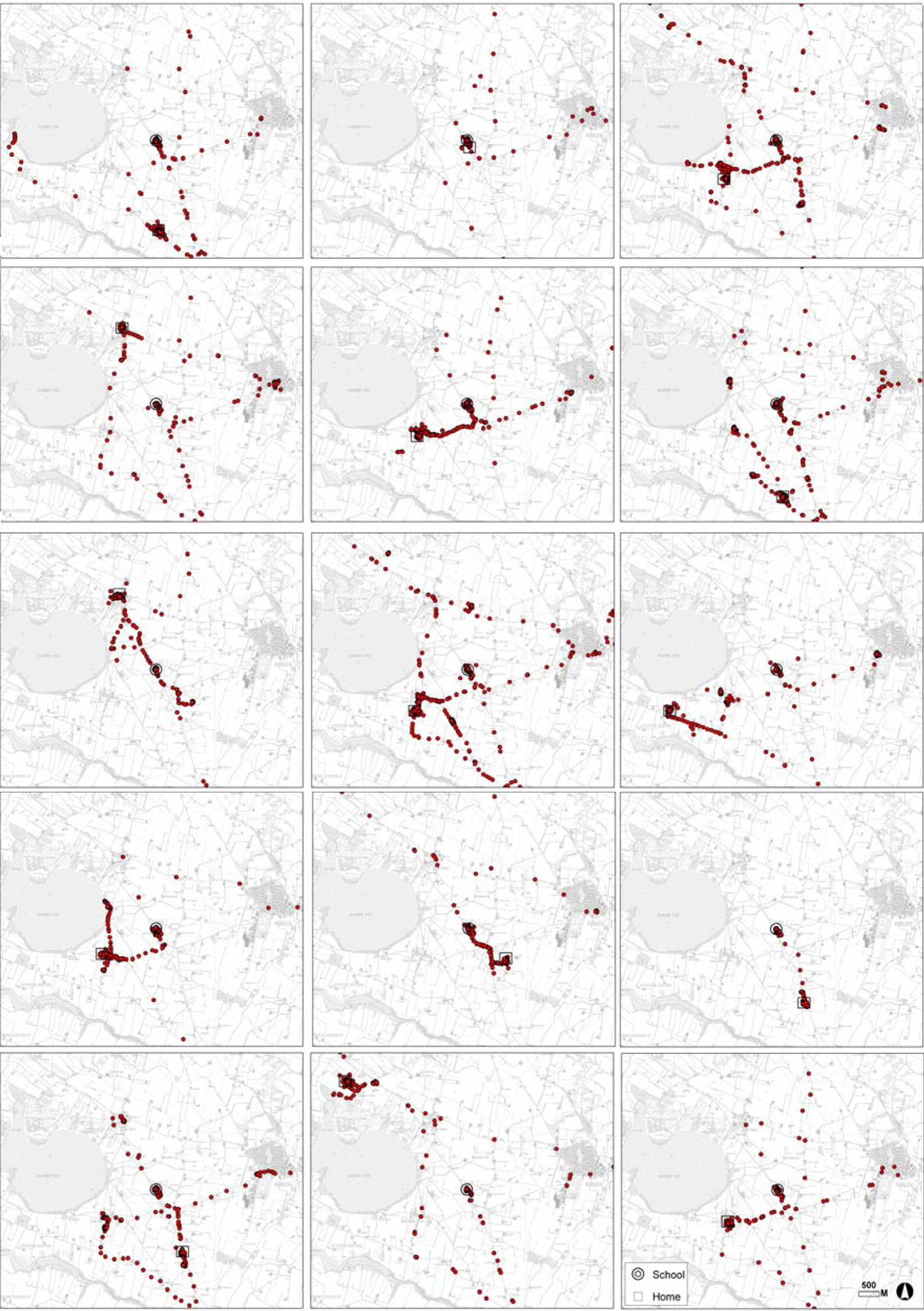
Basic maps resulting from GPS tracking
The GPS data were able to scaffold the ethnographic fieldwork and the interpretive analysis of the children’s interactions with their social and material environments. We produced two types of maps: the itinerary map that shows the continuous movement of the respondents and the sojourn map used to identify the respondent’s whereabouts and to locate the places where he or she spends most/least time.
The mobile phone served as a medium for a “self-controlled rolling” survey. The purpose of the survey was to investigate quantitatively and in real time key questions about children’s physical movements and use of their neighborhoods. Twelve children living in the suburb participated in the rolling survey. They carried the mobile phones during the same week that the GPS recorded their movements. Similar to the “experiential sampling method” known from the “beeper studies” (see, e.g., Csikszentmihalyi, Larson, & Prescott, 1977), the respondents were required to fill out a short questionnaire each time a beeper sounded. In our study, the beep announced an “incoming text message” asking the child to reply to a short questionnaire consisting of five questions. The text message was sent five times a day to the child.
The mobile phone survey functioned as a travel diary of the children’s present activities, prompting the child to report on their real-time mobility—while on the move. The children were asked in chronological order: (a) What are you doing? (b) Where are you? (c) Are you inside or outside? (d) How did you get there? (e) Did you go by yourself or in company with others? In the aforementioned sequence, the five questions generated knowledge about: children’s activities, children’s mobility in relation to place, children’s everyday activities focusing on time spent indoors and outdoors, their forms of transportation, and the social aspect of children’s mobility patterns. The first question was intended as an “everyday greeting” in line with the text children used in their own daily mobile phone communications to initiate contact with each other. All questions but the first one had fixed reply categories for the children to respond to. Over the day, the child received the first questionnaire via mobile phone at 7:55am—on the way to school, which in Denmark usually begins at 8 a.m. The second was sent at 11:40 a.m. when the children had a long lunch break at school. The third was sent at 3 p.m., which marked the end of the school day. The penultimate session was scheduled for 5 p.m.—on the way home from the out-of-school center, in the time before or after an activity and to be received before dinner. The final one arrived at 7 p.m. when the children were expected to be outside playing or back at home. In total, the questionnaire was sent out 420 times, and the children posted 276 replies to the questionnaire. With a response rate of 66%, this is judged as acceptable.
By virtue of their different qualities, the two technologies were designed to complement each other—the GPS passively recorded, whereas the mobile phone survey required the children actively to communicate their mobility patterns. After the weekly trial, we conducted two interviews with the children. The first interview invited the children to evaluate the appropriateness of the mobile phone survey design and the practical use of the GPS technology. The second interview was based on a laminated aerial photo of the local area and their individual weekly movements (as recorded by the GPS). The map was used to elicit a conversation about the children’s everyday mobility and the places they went during the week. This method resembles the photo-elicited interview, which is the method of including a photograph in an interview and making it an object of conversation (Harper, 2002). The idea is to draw out new understandings of the child’s journeys when the map is introduced to the child. The purpose of this interview was to connect the children’s routine and occasional mobility patterns in their local community (and beyond) with the children’s reflections, experiences, and associated meanings. The questions that guided these interviews with the children would also draw on questions deriving from field observations or earlier informal conversations.
Combining Ethnography and New Technology: Working With Children
We are aware that the mix of ethnographic fieldwork and new technology in research with children could be regarded as controversial. 3 For this reason, we have been mindful of critically reflecting on the value of the research and the research process. A key aspect of this process was to draw on our previous ethnographic experience of working with children and the feedback we received from the children who participated in the present study.
In the study, we drew on our extensive experience of ethnographic child research (Christensen, 2004). However, this was not possible with regard to the new technologies. At the time of this study in 2005-2006, the research team did not have any prior experience of using such technologies in research with children. Indeed, at the time only a few researchers had any such experience (but see Brown et al., 2008; Mackett et al., 2007). GPS tracking and survey via mobile phone have been used as research tools only in very few recent studies with children (see, e.g., Duncan & Mummery, 2007; Mackett et al., 2007; Ohmori, Harata, & Nakazato, 2005). Because of this imbalance of methodological experience in the field, we decided to develop the research design and practice by careful attention to how the data were produced. The design and methodology was developed and refined through listening to and observing the experiences of the child participants. Our aim was to enrich our understanding of the applicability of these new technologies to research with children. In ethnographic research with children, an ongoing concern for the researcher is to position oneself in the field so as to work successfully with both children and adults. In the present study, these concerns formed part of establishing contact and carefully negotiating access to the school and family homes, to the children’s friendship groups, and to their movements inside and outside the school and out-of-school center. Our concern was to establish a research practice in line with children’s experiences, interests, values and everyday routines throughout the research process (Christensen, 2004). Consistent with well-established ethical guidelines in research with children, information leaflets were given to all children and parents prior to their participation in the study (Alderson, 1995; Alderson & Morrow, 2004). In the leaflet, children and their families were informed about the study, its methods, and its aims. Both parents and children were asked for their consent to participate in the study. They were also informed that they were free to withdraw at any time they may wish. Prior to the GPS and mobile phone component of the study, the children and parents were asked for particular consent to the children taking part in it. The families were assured that they would not be held economically responsible if the equipment should go missing, be damaged, or be stolen during the trial. In addition, the participating children were given practical and technical instructions in managing the new technology before the equipment was distributed to them. The children, their families, school, and out-of-school center were guaranteed anonymity and confidentiality.
The longitudinal nature of the fieldwork enabled the children’s commitment and sustained efforts. It allowed the research team to judge whether the 7-day period captured typical mobility patterns or whether it contained unusual and exceptional journeys. We had foreseen that the children’s routines may be affected by the unusual event of carrying a GPS. However, in conversation the children reported that it did not affect their everyday routines to wear the GPS. Indeed, at times some children found it difficult to remember to bring the equipment with them.
We considered the questionnaire design essential to the successful outcome of the survey. The questionnaire needed to be easy for the children to understand, allow for instant replies, and log precise data as the children may receive the questionnaire when they were engaged in an activity or on the brink of moving from one place to another. The children’s accounts subsequently supported this presumption but also confirmed that we had only been partially successful in designing the survey. All children approved the quality of the questions, but many disputed the timing and found the frequency of incoming text messages disruptive and far too intrusive. Most children agreed that they should only have to reply to the questionnaire three times a day instead of five times a day. This criticism was also reflected in the response rate, which for some children turned out to be very low. As a device the mobile phone was generally very popular. Apart from responding to the questionnaire, the children used it for photographing, game playing, and chatting on MSN. These became enjoyable benefits of taking part in the study. Prior to the study, the research team was concerned that the children might use up the prepaid time with private conversations and text messaging, but this concern proved unwarranted. In fact, the children showed great responsibility for the equipment and took an interest in ensuring that it worked throughout the week.
Prior to launching the devices, the research team discussed whether to introduce the children to the GPS software or not. On one hand, we wanted the children to be properly informed about the technology, so that they could understand and manage it. On the other hand, we knew that the GPS component was sensitive to interference. “Incorrect” use of the GPS device risked disconnecting it from the satellite. To minimize the risk of disconnection, we therefore decided not to introduce the children to the software but to let the GPS work as a passive device. The children’s attitudes toward the GPS were diverse, and their concerns turned out to be to some extent gender specific. In the girls’ accounts, the GPS was an inconvenient piece of technology that they felt obliged to carry around. Accordingly, the girls tended to treat the device as merely a passive object. However, the feedback from the boys suggested that the practice of merely informing the children about the hardware and general functioning of the technology did not meet their actual interest in and use of the technology. The boys interacted with the device and quickly discovered that the GPS had other facilities than simply picking up signals from satellites. The boys engaged with the capacity of the technology, which they explored and during the week integrated into their activities and social interactions. None of the participating boys complained about the inconvenience of carrying the devices around. Although some children succeeded in making the GPS serve their own purposes, others reported frustration at not being able to understand and control the functioning of the device. The data output suggests that a feeling of control affected the GPS data and that more consistent data were produced by those children who felt in control compared with those children who did not feel in control. 4
The technical functioning/malfunctioning of the equipment was important for the children’s commitment. Several children complained about technical dysfunctions of the equipment, most reports relating to the use of the GPS. These complaints reflected the unfortunate technical fact that the GPS receivers we used in the first trial 5 suffered occasional outages. In the course of the week, a couple of the GPS devices worked poorly or stopped working halfway through the trial. For a second trial, we decided to replace the GPS receiver with another and better model. Although this new model was more stable, it had the disadvantage of being bigger and heavier. It was important that the field-worker was present at school and the out-of-school center during the whole week of the trial. This enabled the children to discuss any issues or concerns they had, and they could receive instant help and support to find on-the-spot solutions.
Combining Ethnography and New Technology: What Are the Benefits?
The combination of the different methods of data production and analysis in this study was enabled through the interdisciplinary research team’s continuous discussion, coordination, and cooperation throughout the research. Our aim was to achieve a productive synergy rather than simply working as parallel teams. We enacted this by close cooperation even in the details of the study. For example, the information leaflet was designed by the researchers so that the leaflet presented the technical knowledge and terminology in a way that the children and their parents would find easy and accessible. We introduced and distributed the technology to the children as a team allocating tasks and building on the strengths of our particular specialisms. As a simple example, when introducing the new technologies, the role of the ethnographer was to introduce to the children the GPS specialist whom they had not met before. The role of the GPS specialist was to introduce the children to the GPS technology and together with the ethnographer explain and reply to the questions the children and their teachers or parents asked. During data collection, the daily presence of the ethnographer among the children carrying the GPS and the mobile phone enabled us to support and help the children when they were having practical problems or questions about the technologies. Continuous communication between the researchers enabled us to keep up a high level of information to the children and to ensure a speedy recovery of dysfunctional equipment. During the data analysis, the specialist’s knowledge about the analytical possibilities of the software could unravel questions and puzzles raised by the ethnographic data about the children’s everyday experiences and movements and vice versa. These discussions would partly ensure the validity and quality of the data and form part of discussing the distinctiveness of the emerging findings and conclusions.
In the following section, we will discuss how we accomplished the set of methodological opportunities that Johnson et al. (2007) argue an effective mixed methods design can offer. They argue that the combination of multiple methods enhances the fundamental principle of validity (i.e., quality) of research findings through what Denzin (1989) has termed methodological triangulation. The rationale behind this strategy is
that the flaws of one method are often the strength of another; and by
combining methods, observers can achieve the best of each while overcoming
their unique deficiencies. (Denzin, 1989, p. 244)
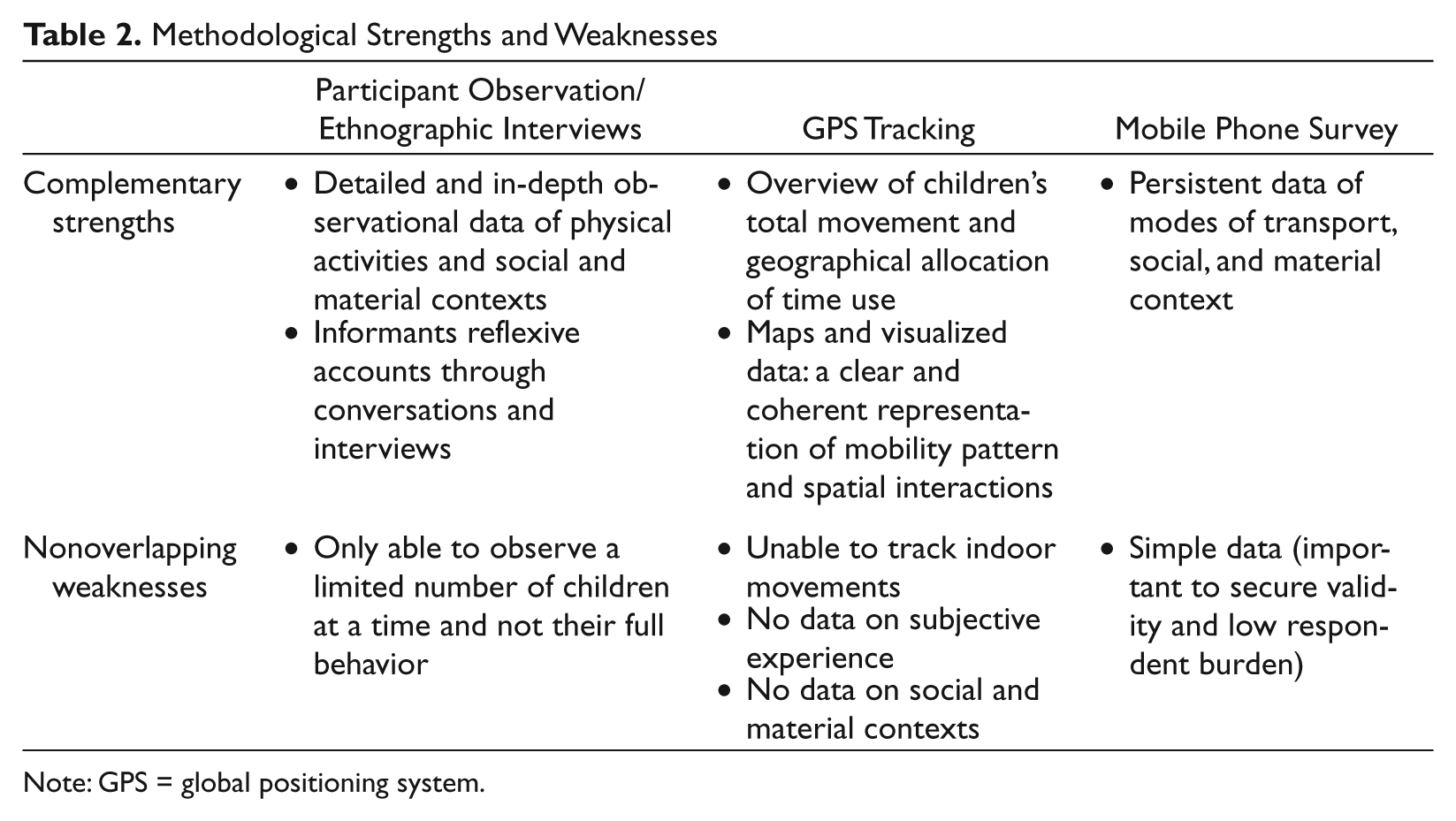
This principle has been further developed to encapsulate the creation of a research design where the combinations of methods and approaches are put together in ways that build on complementary strengths and nonoverlapping weaknesses (Brewer & Hunter, 1989; Johnson & Turner, 2003; Onwuegbuzie & Johnson, 2006).
As illustrated in Table 2, the complementary value of the different methods is high, and the integrated design improved validity by minimizing the weaknesses of data produced through the different methods (Onwuegbuzie & Johnson, 2006).
Methodological Strengths and Weaknesses
Note: GPS = global positioning system.
To maximize the data production and to achieve a productive synergy between the qualitative and quantitative methods (Gibson-Davis & Duncan, 2005), we carried out the study so that its different components were integrated in various ways. After all, the strength of mixed methods presupposes a thoughtfully developed design in which the methods are well integrated (Sosulski & Lawrence, 2008). We accomplished this by having each method designed and implemented based on the insights from preceding findings. The mobile phone survey made use of data from the preceding ethnographic interviews and observations to formulate the questions and “fixed reply” categories in the questionnaire. Ethnographic observation had suggested that children only rarely moved around on their own; most of the time, their mobility took place in the company of others, be they other children or adults. Asking a question about this in the mobile phone survey allowed the study to collect more exact data about the number of journeys carried out with companions of different kinds (Mikkelsen & Christensen, 2009). The scheduling and timing of the questionnaire was designed so that it would work in concordance with the children’s everyday routines. When the questions worked well, they provided a persistent data set. However, in practice the scheduling turned out not to work entirely successfully, and there is a need for further investigation into how the response rate can be enhanced. 6
We also combined methods so that different methods and data sets fed into each other. For example, the aerial map of the children’s routes produced by the GPS technology was combined with the use of the qualitative photo-elicited interview for a conversation with the children about their weekly mobility patterns. Essentially, the mapping of children’s mobility patterns via GPS would be of limited value if researchers only have access to the geographical pattern of the children’s routes on the map. In their unprocessed form, the GPS data appear as a large number of recorded numerical coordinates. A first draft of the analysis is visualized onto aerial maps using ArcGIS. 7 Each map then has to be examined for erroneous GPS registrations (i.e., GPS track points caused by technological deviations). The field researcher’s knowledge of the participating children’s everyday movements and the local area made this possible. Outliers were erased from the geographic information system (GIS) program before the final maps were printed. To ensure the quality of the GPS/GIS maps, the contextual data and interpretation that only the ethnographic data can provide is therefore important. Like ethnographic participant observation, new technology is capable of generating data about practices, activities, and social relationships in real time. However, although the ethnographer is capable of generating detailed in-depth data about practices, experiences, and meaning, the data produced via GPS and mobile phone are simpler, in the sense that these quantitative data are designed to focus on the carrier’s geographical position and the specific contextual data that the survey could produce. This meant, for example, that the GPS could confirm a preliminary ethnographic finding that the children living in villages moved more frequently and in a wider radius than the children living in rural areas outside villages. The GPS and the mobile phone combination thus allows for the study of a large number of children simultaneously. For example, if research wishes to know where children travel to on a Monday afternoon as they leave the school premises or where children gather on a Sunday morning, then the GPS can reveal this. The GPS method on its own, however, could not tell precisely how the children moved around: if they walked, cycled, or went roller-skating or if their movement took place on the backseat of their parents’ car. 8 Neither was it capable of providing the social context of movement and therefore the distribution of children moving on their own or in company with others. It would also be impossible from the map alone to know why the children chose a particular route and not another—or indeed why they would make a particular stop on the road. The mobile phone survey data were able to provide such a fuller picture. Generated through the repeated snapshots of children’s everyday mobility practices, it produced knowledge of these important contextual elements. This was further enriched by the detail and insights gained from the ethnography. Moreover, the ethnography and mobile phone survey were capable of producing data about children’s indoor activities. The GPS was not able to do this. 9 With the GPS and the mobile phone survey we had two instruments, which by their different and complementary capacities worked to produce a quantitative overview of the mobility pattern of the children. Traditional ethnographic methods on their own were not capable of producing such insight for the simple reason that the field-worker (who can be seen as the most important tool in ethnographic research) was unable to observe all children at all times and simultaneously. The ethnography was capable of producing exhaustive data not only about the children’s everyday mobility but also of their experiences and understandings in the context of their social and material environment. Above all, the combination of ethnography with GPS and the mobile phone survey data provided such an overview and a detailed understanding of the meaning of children’s individual and collective mobility patterns.
The study’s overall finding was that children’s mobility is primarily social, and that companionship is a central aspect of it (Mikkelsen & Christensen, 2009). When combined, the data underlined the need to take into account the diversity of children’s movements. 10 The GPS and mobile phone survey data revealed important similarities in and differences between the mobility patterns of children living in the rural villages and the suburb. The GPS data documented the destinations and range of the children’s weekday and weekend movements. The mobile phone data showed that whereas the mobility of the rural children largely involved family, pets, and animals, for the suburban children it mainly involved other children. In both the rural and suburban sites, companionship proved to be important to children during their travels to and from school and when roaming around their neighborhood. The ethnographic data revealed that children preferred the company of others for the sense of companionship and safety that it provided, compared with undertaking journeys on their own. Similarly, parents in both the suburban and rural areas preferred that children travelled together with others on their journeys. The ethnographic observations showed that the everyday mobility of the suburban children and their parents was largely separate. Both parents in the suburban families were working full-time, and in their accounts they were anxious for their children to develop the skills to travel to their school and leisure activities independently. Family life was characterized by parents and children being engaged in separate activities during weekdays and joint family activities were allocated to the weekends. In the suburb, parents and children’s joint mobility included shopping and family visits. Children’s companionship with other children was seen as a way of ensuring the children’s safety and protection when parents were not present to transport them during weekdays. In contrast, parents and children living in the rural area were likely to engage in joint mobility throughout the week, often as part of their leisure activities. This supported and encouraged the value of companionship in family mobility and formed part of a network of family interdependence. In the rural area, the prevalence of only one parent having full-time paid employment outside the home enabled the interconnected character of children’s and parents’ everyday mobility. The data about family contexts, processes of everyday life, and meanings underlying children’s mobility patterns were revealed by the ethnographic methods and demonstrate that geographical differences (e.g., the rural/suburban comparison discussed above), cultures of social cohesion within families, and parental employment patterns are significant in understanding how children’s mobility is shaped.
However, despite the differences between families in the rural and suburban areas, the mobile phone survey and the ethnography showed that companionship with others pervaded children’s mobility. This social characteristic, along with the variations of children’s mobility described above, indicates the need to reconsider the notion of children’s “independent mobility.” The centrality of this concept to debates and studies of children’s mobility has led, we argue, to a disproportionate emphasis on children’s individual and autonomous travel. This emphasis does not reflect how children in our study themselves understood and valued their movement. The ethnographic data showed that for children, moving around on their own is not their priority. To them, everyday physical activities were most appreciated when the journeys, games, and outings involved others with whom they could create and share experiences and with whom they felt comfortable. To the children it was not essential whether the companions were other children, family members, or pets (even though the individual children might have their personal preferences).
Although the above findings contribute to the empirical literature about children’s mobility by combining quantitative and qualitative methods to reveal differences in the patterns and meanings of different children’s mobility, their wider significance is found in the ongoing theoretical debate about the notion of “independent mobility” in studies of children’s movement. This idea has framed most empirical studies of children’s mobility (see, e.g., the American journal Children, Youth and Environments’ special issue on “Increasing Children’s Freedom of Movement” (Karsten & van Vliet, 2006). However, the study reported here has given rise to greater critical discussion: that the concept of independent mobility is not well-defined, that it places too much emphasis on the physical presence/absence of adults while simultaneously underemphasizing parental influence through family rules and mobile communication, and that the concept of “independent mobility” is underpinned by an unexamined value position that places independence at the centre of attention leading to an empirical focus on individual travel and autonomy in movement (Mikkelsen & Christensen, 2009). The importance to this debate of the findings of the present study is threefold. First, it is apparent that for the children who took part in the study, moving around on their own is not their priority. To them everyday physical activities were most appreciated when the journeys, games, and outings involved others with whom they could create and share experiences and with whom they felt comfortable. Second, the children moved around with a number of different companions—other children, family members, and pets. The situation was more complex than the choice between movement with or without an accompanying adult. Third, the patterns of movement shown by the study and the ways in which they were shaped are related to wider patterns of interdependence in family relations rather than independence from parents (or adults more generally). These insights will contribute to the continuing debate about whether independence is the most useful lens through which children’s mobility can be viewed or whether viewing it through the different configurations of interdependence that are in play may afford a more complete account.
Conclusion
Although it has become popular within studies of children to combine different qualitative methods such as interviewing, drawing, photography, and video, few have successfully combined qualitative and quantitative methods (but see Nørgaard, Brunsø, Christensen, & Mikkelsen, 2007; O’Brien et al., 2000). Although such approaches may not be appropriate for every research question, the time, expertise, and resources it requires mean that it has often been rejected (or not even considered). In the study presented here, the mix of ethnography and innovative technological methods constituted a methodological triangulation that enhanced the validity of the data about children’s mobility. In particular, the strengths of one method were used to compensate for the weaknesses of another. The use of new technologies compensated for some of the difficulties connected with the ethnographic study of the children’s mobility patterns. As discussed above, the practical and technical use of mobile technologies in the present study was not unproblematic. However, in combination, the ethnography and the new technologies worked successfully to produce a multilayered data set, which makes it possible to carry out analysis that can broaden and deepen our understanding of children’s everyday mobility (see, e.g., Mikkelsen & Christensen, 2009) by taking a holistic approach to its study.
Footnotes
The author(s) declared no potential conflicts of interest with respect to the research, authorship, and/or publication of this article.
The author(s) disclosed receipt of the following financial support for the research, authorship, and/or publication of this article:
The research reported here was supported by the Danish Research Councils to Professor Pia Christensen (PI) ref. no. 25-03-0546 and ref. no. 22-04-0088.